2 Chronicles 33:3
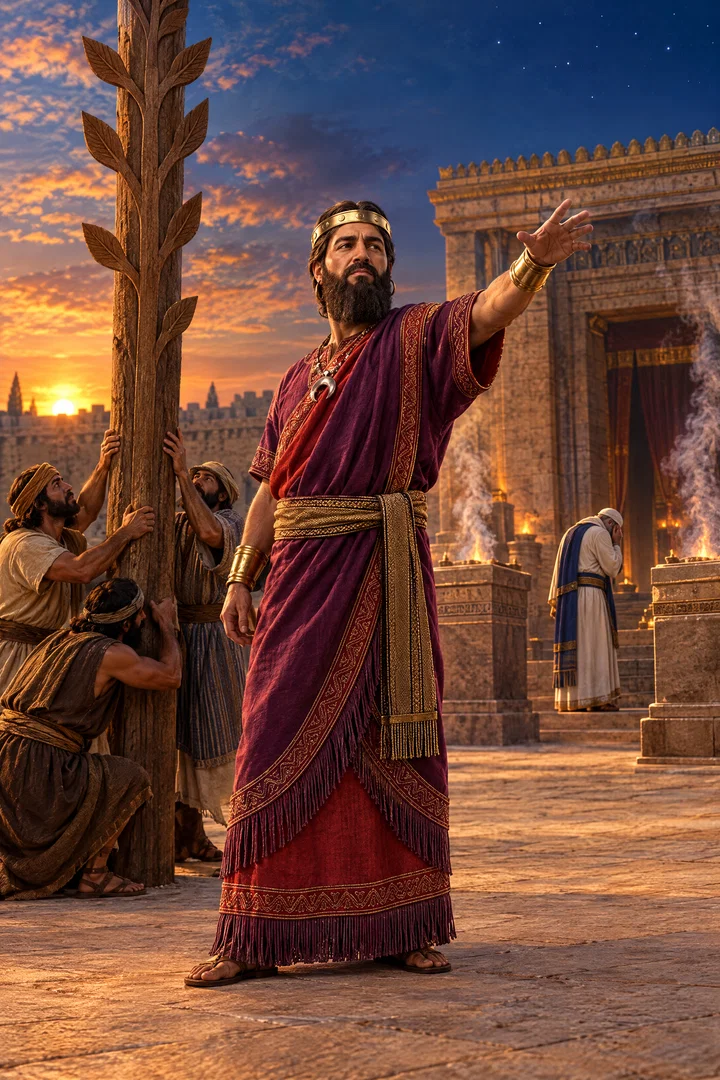
For he built again the high places which Hezekiah his father had broken down, and he reared up altars for Baalim, and made groves, and worshipped all the host of heaven, and served them.
Translations
American King James Version, King James Version, KJV Cambridge Paragraph Bible
For he built again the high places which Hezekiah his father had broken down, and he reared up altars for Baalim, and made groves, and worshipped all the host of heaven, and served them.
For he built again the high places which Hezekiah his father had broken down; and he reared up altars for Baalim, and made groves, and worshiped all the host of heaven, and served them.
Revised Version, American Standard Version
For he built again the high places which Hezekiah his father had broken down; and he reared up altars for the Baalim, and made Asheroth, and worshipped all the host of heaven, and served them.
and he turneth and buildeth the high places that Hezekiah his father hath broken down, and raiseth altars for Baalim, and maketh shrines, and boweth himself to all the host of the heavens, and serveth them.
And he built again the high places that Hezekiah his father had broken down; and he reared up altars to the Baals, and made Asherahs, and worshipped all the host of heaven and served them.
And he again built the high places, which Hezekiah his father had thrown down,—and set up altars to the Baalim, and made Sacred Stems, and bowed in prostration unto all the army of the heavens, and served them;
Berean Standard Bible, Majority Standard Bible
For he rebuilt the high places that his father Hezekiah had torn down, and he raised up altars for the Baals and made Asherah poles. And he worshiped and served all the host of heaven.
For he built again the high places which Hezekiah his father had broken down; and he raised up altars for the Baals, made Asheroth, and worshiped all the army of the sky, and served them.
For he put up again the high places which had been pulled down by his father Hezekiah; and he made altars for the Baals, and pillars of wood, and was a worshipper and servant of all the stars of heaven;
For he went backe and built the hie places, which Hezekiah his father had broken downe: and he set vp altars for Baalim, and made groues, and worshipped all the hoste of the heauen, and serued them.
Douay-Rheims (Challoner revision)
And he turned, and built again the high places which Ezechias his father had destroyed: and he built altars to Baalim, and made groves, and he adored all the host of heaven, and worshipped them.
Pictures
Cross-references
- Deuteronomy 17:3
And hath gone and served other gods, and worshipped them, either the sun, or moon, or any of the host of heaven, which I have not commanded;
Forbids serving other gods or worshiping the host of heaven.
- Deuteronomy 4:19
And lest thou lift up thine eyes unto heaven, and when thou seest the sun, and the moon, and the stars, even all the host of heaven, shouldest be driven to worship them, and serve them, which the LORD thy God hath divided unto all nations under the whole heaven.
Both forbid worshiping the host of heaven.
- Jeremiah 7:17-20
Seest thou not what they do in the cities of Judah and in the streets of Jerusalem?
Condemns Judah’s worship of other gods and warns of its consequences.
- 1 Kings 16:31-33
And it came to pass, as if it had been a light thing for him to walk in the sins of Jeroboam the son of Nebat, that he took to wife Jezebel the daughter of Ethbaal king of the Zidonians, and went and served Baal, and worshipped him.
Both describe the promotion of Baal worship and idolatry.
- Jeremiah 19:13
And the houses of Jerusalem, and the houses of the kings of Judah, shall be defiled as the place of Tophet, because of all the houses upon whose roofs they have burned incense unto all the host of heaven, and have poured out drink offerings unto other gods.
Both describe worship of the host of heaven and offerings to other gods.
- 2 Chronicles 33:11-13
Wherefore the LORD brought upon them the captains of the host of the king of Assyria, which took Manasseh among the thorns, and bound him with fetters, and carried him to Babylon.
Manasseh’s idolatry brings captivity, but he humbles himself and receives mercy.
- 2 Kings 17:16
And they left all the commandments of the LORD their God, and made them molten images, even two calves, and made a grove, and worshipped all the host of heaven, and served Baal.
Both describe worshipping the host of heaven and serving Baal.
- Job 31:26-28
If I beheld the sun when it shined, or the moon walking in brightness;
Both treat worship of the sun and moon as unfaithfulness to God.
- 2 Chronicles 33:12-13
And when he was in affliction, he besought the LORD his God, and humbled himself greatly before the God of his fathers,
Manasseh humbles himself, and the LORD restores him to his kingdom.
- 2 Chronicles 33:22
But he did that which was evil in the sight of the LORD, as did Manasseh his father: for Amon sacrificed unto all the carved images which Manasseh his father had made, and served them;
Amon repeats his father’s idolatry and wicked course.
- 1 Kings 14:23
For they also built them high places, and images, and groves, on every high hill, and under every green tree.
Both describe Judah’s forbidden worship at high places and under green trees.
- Romans 1:25
Who changed the truth of God into a lie, and worshipped and served the creature more than the Creator, who is blessed for ever. Amen.
Both describe people worshipping and serving created things instead of God.
- Exodus 32:1-6
And when the people saw that Moses delayed to come down out of the mount, the people gathered themselves together unto Aaron, and said unto him, Up, make us gods, which shall go before us; for as for this Moses, the man that brought us up out of the land of Egypt, we wot not what is become of him.
Both texts describe Israel turning to idolatrous worship.
Commentary
Each commentary is drawn from primary sources: the writings of Ellen G. White and Adventist pioneers and periodicals. Each commentary is separate. Its own words are not a quotation; follow the references to read the source passages.
Ellen G. White
1 source
Manasseh deliberately dared to set aside the statutes recorded by Moses, especially those contained in the book of the covenant in Deuteronomy.RH Jul 22, 1915 Those same statutes had been observed during the reign of his father Hezekiah and had made that reign prosperous, a prosperity Manasseh reversed by rebuilding the high places that Hezekiah had broken down.RH Jul 22, 1915 Under Manasseh the temple copy of the book of the law was lost through careless neglect, with the result that for many years the people generally were deprived of its instruction.RH Jul 22, 1915
Sources
Pioneers and periodicals
20 sources
Manasseh reversed the reforms of his father Hezekiah by rebuilding the high places he had broken down and rearing altars for Baalim and groves while worshiping and serving the host of heaven.ST Jul 19, 1905ST Sep 13, 1905ST Jul 17, 1879 The high places were idolatrous sanctuaries, Baalim the local forms of the chief Canaanite god Baal, the groves wooden Asherah images of the Phoenician goddess, and the host of heaven the sun, moon, stars and signs of the zodiac, making his worship sun-worship and nature-worship.ST Oct 22, 1894ST Dec 24, 1894ST Dec 5, 1911ST Jul 19, 1905ST Jul 19, 1905 His course was evil in the sight of the Lord, abominations like those of the heathen, joined with observing times, enchantments, witchcraft, sorcery, divination and dealing with familiar spirits and wizards to provoke the Lord to anger.ST Jul 19, 1905ST Jul 17, 1879RH Dec 3, 1857 His wickedness made his people worse than the heathen and brought the hosts of Assyria upon Jerusalem to carry him away, and this idolatry is set forth as the offense for which Judah was carried into Babylon.ST Sep 13, 1905RH Dec 3, 1857ST Nov 4, 1897ST Jan 30, 1896ST After severe chastisement he humbled himself and prayed and was converted and restored to his kingdom as a marvelous instance of God's mercy, while his history stands as a warning that what God called an abomination then remains an abomination and its prohibition remains binding.ST Sep 13, 1905ST May 7, 1912ST Jul 4, 1911ST Aug 27, 1902ST Sep 18, 1901
Manasseh's Idolatrous Reversal
Manasseh deliberately undid the reforms of Hezekiah his father by building again the high places Hezekiah had broken down, rearing up altars for Baalim, making groves, and worshiping and serving all the host of heaven.ST Jul 19, 1905ST Sep 13, 1905ST Jul 17, 1879ST Oct 22, 1894 This rebuilding was a turning from the worship Hezekiah had restored to evil worship and to the abominations of the heathen, including witchcraft in its forms of observing times, using enchantments and witchcraft, sorcery, divination, necromancy, dealing with a familiar spirit and with wizards.ST Jul 17, 1879RH Dec 3, 1857 He wrought much evil to provoke the Lord to anger, and in his reign Israel was taken captive by the Assyrians.RH Dec 3, 1857
The high places were idolatrous sanctuaries first built on hills and later found in other locations, even anywhere.ST Jul 19, 1905ST Jul 19, 1905 Baalim is the plural of Baal, the chief Canaanite god worshiped under different local forms.ST Jul 19, 1905ST Jul 19, 1905 The groves were not trees but groups of wooden images or symbols, Asherah images, associated with the Phoenician goddess of love.ST Jul 19, 1905ST Jul 19, 1905ST Jul 19, 1905
The host of heaven means the heavenly bodies, including the sun, moon, chief or principal stars, and signs of the zodiac, so the verse describes sun-worship and nature-worship contrary to worship of the Lord who created the sun and all the host of heaven.ST Oct 22, 1894ST Dec 24, 1894ST Dec 5, 1911ST Jul 19, 1905ST Jul 19, 1905 This idolatry is identified with Baal worship and with the nature-worship and sun-worship connected with Babylonian religious feasts and revels, in the setting of the nation's apostasy and eventual captivity in Babylon.ST Dec 24, 1894ST Dec 5, 1911ST Dec 24, 1896
Manasseh was the son of Hezekiah born during the fifteen years added to Hezekiah's life after his prayer for an extension of life, and he became one of the wickedest kings Judah ever had.ST May 7, 1912 His reign of 55 years was one of the longest reigns.ST May 7, 1912 He dared to set aside the statutes recorded by Moses, especially those in the book of the covenant in Deuteronomy whose observance had made Hezekiah's reign prosperous.RH Jul 22, 1915 Through careless neglect during his reign the temple copy of the book of the law became lost, so that for many years the people generally were deprived of its instruction.RH Jul 22, 1915
Judgment Mercy and Warning
Manasseh's rebuilding of the high places, raising altars for Baal, making Asherah images, and worshiping and serving the heavenly bodies was evil in the sight of the Lord, abomination like that of the heathen, and a departure from the true God to the false gods of the neighboring nations that rejected his father Hezekiah's reforms.ST Jul 19, 1905ST Jul 17, 1879RH Dec 3, 1857ST Jan 14, 1897 It stands as an example of forbidden pagan worship in Israel.ST Aug 27, 1902 His evil included the abominations of witchcraft in its forms of observing times, using enchantments and witchcraft, sorcery, divination, necromancy, and dealing with a familiar spirit and with wizards, and he wrought much evil in the sight of the Lord to provoke Him to anger.RH Dec 3, 1857
While departing from God, religious worship and sacrifice still continued, and could become more elaborate and pretentious than what God required.ST Jan 14, 1897 That falling into idolatry and sun-worship was contrary to the worship of the Lord who created the sun and all the host of heaven.ST Dec 24, 1894ST Jan 14, 1897 His wickedness made the people worse than the heathen and brought great trouble upon the kingdom.ST Sep 13, 1905ST Sep 13, 1905 For that wicked course the Lord brought the hosts of Assyria upon Jerusalem and carried Manasseh away, and in his reign Israel was taken captive by the Assyrians.RH Dec 3, 1857ST Nov 4, 1897
This idolatry leading Judah into Baal worship and worship of the host of heaven is presented as the offense for which the people of Judah were carried into Babylon.ST Jan 30, 1896 His reign exemplifies the departure from God and false worship, identified with sun-worship, that brought evil consequences upon Judah in apostasy and eventual captivity in Babylon.STST Dec 24, 1896 Yet after severe chastisement and God's long patience Manasseh humbled himself, learned to know God, prayed, and was converted.ST Sep 13, 1905ST May 7, 1912ST Nov 4, 1897 He was restored to his kingdom and accepted by God, then did what he could to undo his former evil deeds, showing that God has power both to bring a heathen nation against His wayward people and to deliver them upon due repentance, and he is a marvelous instance of God's wonderful mercy, with what is said to be his prayer found in the Apocrypha.ST May 7, 1912ST Nov 4, 1897
Amon his son then returned to the same former wicked course of his father, reigned two years, and was assassinated by his servants.ST Nov 4, 1897 The history shows that Judah's kings and people had departed from God's law through false worship.ST Sep 18, 1901 What God called an abomination then remains an abomination, so the prohibition against such pagan worship remains binding.ST Aug 27, 1902 Alliances with heathen peoples had helped draw Israel and Judah into idolatry as early as Solomon's time.ST Jul 19, 1905 Sun-worship faced east, while the arrangement of the tabernacle turned worshipers away from the rising sun.ST Jul 19, 1905 The Judean youths in exile had seen the sad results of that departure and refused to take part in the Babylonian religious feasts and revels connected with that nature-worship and sun-worship.ST Dec 5, 1911ST Sep 18, 1901
Sources