Exodus 32:1
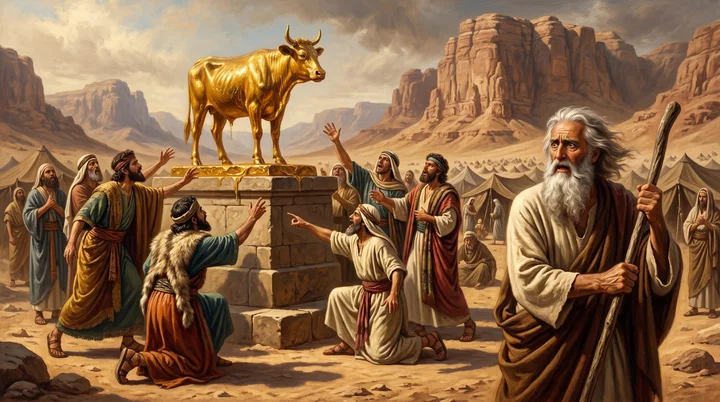
And when the people saw that Moses delayed to come down out of the mount, the people gathered themselves together unto Aaron, and said unto him, Up, make us gods, which shall go before us; for as for this Moses, the man that brought us up out of the land of Egypt, we wot not what is become of him.
Translations
And when the people saw that Moses delayed to come down out of the mount, the people gathered themselves together to Aaron, and said to him, Up, make us gods, which shall go before us; for as for this Moses, the man that brought us up out of the land of Egypt, we know not what is become of him.
King James Version, KJV Cambridge Paragraph Bible
And when the people saw that Moses delayed to come down out of the mount, the people gathered themselves together unto Aaron, and said unto him, Up, make us gods, which shall go before us; for as for this Moses, the man that brought us up out of the land of Egypt, we wot not what is become of him.
And when the people saw that Moses delayed to come down from the mount, the people assembled themselves to Aaron, and said to him, Arise, make us gods which shall go before us: for as for this Moses, the man that brought us out of the land of Egypt, we know not what is become of him.
Revised Version, American Standard Version
And when the people saw that Moses delayed to come down from the mount, the people gathered themselves together unto Aaron, and said unto him, Up, make us gods, which shall go before us; for as for this Moses, the man that brought us up out of the land of Egypt, we know not what is become of him.
And the people see that Moses is delaying to come down from the mount, and the people assemble against Aaron, and say unto him, 'Rise, make for us gods who go before us, for this Moses — the man who brought us up out of the land of Egypt — we have not known what hath happened to him.'
And when the people saw that Moses delayed to come down from the mountain, the people collected together to Aaron, and said to him, Up, make us a god, who will go before us; for this Moses, the man that has brought us up out of the land of Egypt, — we do not know what is become of him!
And, when the people saw that Moses delayed to come down out of the mount, the people gathered themselves together unto Aaron, and said unto him—Up, make for us gods, who shall go before us, for, as for this Moses—the man who brought us up out of the land of Egypt, we know not what hath befallen him.
Berean Standard Bible, Majority Standard Bible
Now when the people saw that Moses was delayed in coming down from the mountain, they gathered around Aaron and said, “ Come, make us gods who will go before us. As for this Moses who brought us up out of the land of Egypt, we do not know what has happened to him!”
When the people saw that Moses delayed coming down from the mountain, the people gathered themselves together to Aaron, and said to him, “ Come, make us gods, which shall go before us; for as for this Moses, the man who brought us up out of the land of Egypt, we don’t know what has become of him.”
And when the people saw that Moses was a long time coming down from the mountain, they all came to Aaron and said to him, Come, make us a god to go before us: as for this Moses, who took us up out of the land of Egypt, we have no idea what has become of him.
Bvt when the people sawe, that Moses taryed long or he came downe from the mountaine, the people gathered themselues together against Aaron, and sayde vnto him, Vp, make vs gods to goe before vs: for of this Moses (the man that brought vs out of the land of Egypt) we knowe not what is become of him.
Douay-Rheims (Challoner revision)
And the people seeing that Moses delayed to come down from the mount, gathering together against Aaron, said: Arise, make us gods, that may go before us: for as to this Moses, the man that brought us out of the land of Egypt, we know not what has befallen him.
Pictures
Cross-references 20 of 63
- Exodus 20:3-4
Thou shalt have no other gods before me.
Israel’s demand for the calf violated the commands against other gods and graven images.
- Exodus 24:18
And Moses went into the midst of the cloud, and gat him up into the mount: and Moses was in the mount forty days and forty nights.
Moses remains on the mountain for forty days while the people await his return.
- Exodus 32:7-8
And the LORD said unto Moses, Go, get thee down; for thy people, which thou broughtest out of the land of Egypt, have corrupted themselves:
God identifies Israel’s calf worship as corruption and turning aside from his commands.
- Exodus 24:7
And he took the book of the covenant, and read in the audience of the people: and they said, All that the LORD hath said will we do, and be obedient.
Israel pledged to obey God’s covenant before breaking it.
- Exodus 19:8
And all the people answered together, and said, All that the LORD hath spoken we will do. And Moses returned the words of the people unto the LORD.
Israel pledged obedience to God at Sinai before breaking faith through idolatry.
- Exodus 32:19-20
And it came to pass, as soon as he came nigh unto the camp, that he saw the calf, and the dancing: and Moses’ anger waxed hot, and he cast the tables out of his hands, and brake them beneath the mount.
Moses sees Israel worshiping the calf, breaks the tablets, and destroys the idol.
- Exodus 32:26
Then Moses stood in the gate of the camp, and said, Who is on the LORD’s side? let him come unto me. And all the sons of Levi gathered themselves together unto him.
The call to be on the Lord’s side follows the golden calf rebellion.
- Exodus 24:3
And Moses came and told the people all the words of the LORD, and all the judgments: and all the people answered with one voice, and said, All the words which the LORD hath said will we do.
Israel pledges obedience at Sinai before turning to idolatry.
- Psalms 106:19-20
They made a calf in Horeb, and worshipped the molten image.
Retells Israel’s making and worshiping the calf at Horeb.
- Exodus 32:23
For they said unto me, Make us gods, which shall go before us: for as for this Moses, the man that brought us up out of the land of Egypt, we wot not what is become of him.
Aaron repeats the people’s demand for gods to excuse making the calf.
- Exodus 19:16-20
And it came to pass on the third day in the morning, that there were thunders and lightnings, and a thick cloud upon the mount, and the voice of the trumpet exceeding loud; so that all the people that was in the camp trembled.
The people’s recent encounter with God at Sinai contrasts with their later doubt.
- Deuteronomy 9:20
And the LORD was very angry with Aaron to have destroyed him: and I prayed for Aaron also the same time.
Moses says the Lord was angry enough to destroy Aaron, but his prayer spared him.
- Exodus 32:31-32
And Moses returned unto the LORD, and said, Oh, this people have sinned a great sin, and have made them gods of gold.
Moses confesses the golden-calf sin and pleads for the people.
- Exodus 32:11-14
And Moses besought the LORD his God, and said, LORD, why doth thy wrath wax hot against thy people, which thou hast brought forth out of the land of Egypt with great power, and with a mighty hand?
Moses intercedes for Israel after the calf, and God relents from judgment.
- Exodus 32:6
And they rose up early on the morrow, and offered burnt offerings, and brought peace offerings; and the people sat down to eat and to drink, and rose up to play.
The calf-worship included offerings, feasting, and revelry.
- Exodus 20:4-5
Thou shalt not make unto thee any graven image, or any likeness of any thing that is in heaven above, or that is in the earth beneath, or that is in the water under the earth:
The calf demand broke the prohibition against making and worshipping images.
- 1 Corinthians 10:7
Neither be ye idolaters, as were some of them; as it is written, The people sat down to eat and drink, and rose up to play.
Israel’s worship of the calf warns against idolatry.
- Acts 7:40
Saying unto Aaron, Make us gods to go before us: for as for this Moses, which brought us out of the land of Egypt, we wot not what is become of him.
Israel rejects Moses and asks Aaron to make gods to lead them.
- Exodus 32:5
And when Aaron saw it, he built an altar before it; and Aaron made proclamation, and said, To morrow is a feast to the LORD.
Aaron proclaims a feast to the Lord after making the calf.
- Exodus 32:28
And the children of Levi did according to the word of Moses: and there fell of the people that day about three thousand men.
About three thousand people die after worshipping the golden calf.
Commentary
Each commentary is drawn from primary sources: the writings of Ellen G. White and Adventist pioneers and periodicals. Each commentary is separate. Its own words are not a quotation; follow the references to read the source passages.
Ellen G. White
67 sources
After only a few weeks while Moses remained on the mount communing with God and receiving the tables of stone without eating or drinking, the impatient people concluded he would not return and gathered about Aaron demanding new leadership.Ms 83, 1907, par. 4–8Ms 166, 1898, par. 9–15RH Feb 4, 1909CT 351.2 Although the cloud of the Presence still rested visibly on the mount and God still guided and fed them after Egypt and the Red Sea, they lost faith under the test of delay, doubted their absent leader, and credited Moses rather than God with their deliverance.Lt 69, 1904, par. 27–28Ms 13, 1906, par. 5–7Ms 117, 1909, par. 11–14PP 315.2–3ST May 13, 1880 Their demand for visible gods to go before them was turning back to Egypt, led by the mixed multitude who remembered ox and calf worship, replacing invisible guidance with an image in forgetfulness of the command against other gods and the promise to lead by His Angel.PP 315.2–31SP 242.3–244.13T 339.3PP 316.1–317.1SG3 274.1–3 Aaron, left in charge as guardian of the people, first reasoned with them but from fear and moral weakness yielded, permitted and made the molten calf, proclaimed its feast, and emboldened unchecked reveling until stern judgment was required.Ms 166, 1898, par. 9–154T 514.1–2SG3 275.1GW92 81.3–4RH Feb 4, 1909 Only weeks after pledging obedience at Sinai they broke the first and second commandments, so about three thousand persistent rebels perished while the repentant were pardoned through Moses' intercession, leaving a perpetual warning against trusting in man, yielding to please others, and making pleasure or any cherished idol take God's place.Ms 83, 1907, par. 4–8SG3 275.13T 340.2Ms 34, 1900, par. 87–88
Delay on the Mount
Moses delayed to come down while he remained on the mount communing with God and receiving special instructions, the tables of stone written with the finger of God, the law and the sacred oracles, for forty days and forty nights without eating or drinking, a short test of a few weeks.Ms 83, 1907, par. 4–8Ms 166, 1898, par. 9–15RH Feb 4, 1909SG3 273.2SG3 275.1 Israel failed in that short forty-day test while left under Aaron's leadership, breaking their promise to do all the Lord had spoken, and the delay tested their faith soon after they had listened to God's law proclaimed from Sinai amid sublime demonstrations of divine power.Ms 83, 1907, par. 4–81SP 242.3–244.1SG3 275.1 The people had seen Moses ascend into the cloud while the top of the mount was in flames and waited every day for his return, but when he did not come down as soon as they expected they became impatient and rebellious.SG3 274.1–3
God's presence had not left the people, for the cloud of the Presence still rested visibly on the smoking mount where His glory, audible voice and living words had been revealed.Lt 69, 1904, par. 27–28Ms 117, 1909, par. 11–14PP 315.2–3 The solemn impression of that presence and their covenant quickly faded even though God's glory was still visible on the mountain, and their old habits of thought and feeling regained power.SPBC 155.3 He continued to guide them by the pillar of cloud and fire and to feed them with manna after mighty miracles in Egypt and at the Red Sea, so Moses' absence did not mean God had left them while Moses pleaded for them on the mount.PP 315.2–33T 340.1
Seeing the delay, the people grew anxious, impatient, discontented and tired of waiting, and lost faith and trust in their absent leader.Lt 69, 1904, par. 27–28Ms 13, 1906, par. 5–7Ms 58, 1900, par. 23–251SP 242.3–244.1 They failed to hold to God's words, persisted in unbelief, and let unbelief, doubt, carelessness and lawlessness regain power, turning in heart to go back into Egypt.Ms 117, 1909, par. 11–14PP 315.2–3Ms 58, 1900, par. 23–25 Their discontent revealed their unbelief in a marked manner, and their earlier vows of allegiance and terror at hearing God's voice did not keep them from rushing into transgression of the law recently given there.Ms 58, 1900, par. 23–253T 340.14T 514.1–2GW92 81.3–4
Some feared Moses had deserted them or been consumed by the fire, been killed, or would never return.Lt 69, 1904, par. 27–28ST May 13, 1880SG3 274.1–3 A large company claimed Moses would never return and that the cloud which had led them now rested on the mount and would no longer direct their route through the wilderness.SG3 274.1–3 They invented explanations for his continued absence even though God had already given them the instruction they needed, and reasoned amid fear that Moses was gone.ST May 13, 1880Ms 170, 1904, par. 13–15
The people gathered themselves together about Aaron and his tent with propositions and clamors, a vast crowd demanding gods to go before them because the fate of Moses was unknown.Ms 166, 1898, par. 9–15PP 316.1–317.1SG3 274.1–3 Aaron had been left in charge as guardian of the church with delegated judicial authority to hold them to allegiance and hold the congregation back from wrongdoing.Ms 166, 1898, par. 9–15CT 351.2PP 316.1–317.1 While Moses was on the mountain receiving the stone tables, Aaron was responsible for the people in this severe crisis of temptation.Ms 73, 1912, par. 13Ms 92, 1900, par. 22–25
They said they did not know what had become of Moses, calling him the man that brought them up out of the land of Egypt.Ms 13, 1906, par. 5–7ST May 13, 1880Ms 2, 1904, par. 20–27ST May 20, 1880 Thus they credited Moses rather than God with their deliverance, despite their experience of God's deliverance from Egypt, the passage through the Red Sea, and the display of God's glory on the mountain.Ms 2, 1904, par. 20–27 They complained he had left them, dismissing him and no longer caring whether he returned, set on mischief and rejecting the leader who had brought them out.4T 514.1–2GW92 81.3–4ST May 20, 1880
Demand for Visible Gods
In Moses' absence the people felt helpless without a leader and demanded that Aaron make gods to go before them and lead them in his place, wanting something they could see to represent God and resemble Him, a visible substitute they could rely on.PP 315.2–31SP 242.3–244.1SG3 275.1ST May 13, 1880Lt 206, 1906, par. 34–37 The cry was for visible gods because Moses was delayed on the mount and they claimed they did not know what had become of him.1SP 242.3–244.1SG3 275.1ST May 13, 1880 The demand was led at the suggestion of the mixed multitude, the believing Egyptians who had come out with Israel and intermarried with the Hebrews, who had practiced Egyptian ox or calf worship and kept those gods in mind.PP 315.2–31SP 242.3–244.1SG3 274.1–3 It was encouraged by Egyptian idolatry and by the thought that an image would win favor if they returned to Egypt.1SP 242.3–244.1SG3 274.1–3
It grew from impatience to be on the way to the promised land, from loss of sight of obedience as its condition, from carelessness and lawlessness, and from failure to meditate on the law they had heard and humble their hearts to be shielded from temptation.Ms 117, 1909, par. 11–14PP 315.2–3 Though God had given His living words beneath the smoking mount with His audible voice and glory revealed, they did not hold to those words but persisted in unbelief.Ms 117, 1909, par. 11–14 It was a turning back in heart to the idolatry of Egypt and a refusal to trust God as the invisible, all-powerful Helper, with a plan to return there and find favor with the Egyptians by bearing the image before them and acknowledging it as their god.PP 315.2–33T 339.3PP 316.1–317.1SG3 274.1–3RH Apr 23, 1901
The demand meant replacing invisible guidance, claiming the cloud that had led them now rested permanently on the mount and would no longer direct their travels through the wilderness, so an image must take its place.PP 316.1–317.1SG3 274.1–3 It forgot God's command against other gods and His promise to lead them by His Angel.3T 339.3 It insulted the Son of God, their chief leader.3T 339.3
The calf represented the glory of the invisible God by the similitude of an ox.PP 315.2–3 It revived Apis and Egyptian sun-worship with the license associated with heathen worship, and although the people professed to worship Jehovah, the sun-god was the real object of their adoration.PP 761.1–3 It substituted their own degraded ideas for God, and God could not accept worship offered to Him through an idol.PP 761.1–3Ms 60, 1890, par. 11 He had given no manner of similitude of Himself and had prohibited any material representation for such a purpose.PP 315.2–3
Satan devised and excited the evil at the foot of Sinai, carrying forward against God's law the same overthrow he had begun in heaven.RH Feb 4, 1909PP 335.1–2 During the forty days Moses was in the mount he stirred doubt, apostasy and rebellion, using the absence of the appointed leader to tempt them to imitate Egyptian idolatry.PP 335.1–2SG3 274.1–3 By leading Israel into this daring insult and blasphemy to Jehovah he planned to cause their ruin, believing God would divorce them from Himself and devote them to destruction because they were degraded and had broken their solemn pledges.PP 335.1–2 He thus sought to secure the extinction of the seed of Abraham, the seed of promise that was to preserve the knowledge of the living God and through whom He was to come, the true Seed that was to conquer Satan, and so to thwart the purposes of God.PP 335.1–2
Aaron's Yielding Failure
Aaron had been left as guardian of the church to hold the people to their allegiance while Moses remained communing with God in the mount receiving the tables of stone, and he was responsible to carry them through this severe crisis of temptation to idolatry.Ms 166, 1898, par. 9–15Ms 92, 1900, par. 22–25Ms 26, 1900, par. 5–8 Though blessed above the people and admitted to close converse with God, he proved an unfaithful general who did not bear the burden of the work as Moses did, heeding their inclinations instead of directing them to the Authority above human wisdom and permitting contempt for God's counsel to rule by uniting with them in carrying out their plans.Ms 26, 1900, par. 5–8SG4 19.2ST May 20, 1880 Had he remained faithful and kept them loyal to God, this terrible record of idolatry need never have been written.Ms 166, 1898, par. 9–15
He first argued against their plan and tried to dissuade them until he thought them determined, but he did not rebuke and check their first rebellious words because he feared offending them.4T 514.1–2SG3 275.1GW92 81.3–4Ms 2, 1904, par. 20–27 From fear for his life at their clamors and threats of death when they gathered about him set on mischief, he lost courage and trust in God who had wrought wonders for them.SG3 275.1Ms 2, 1904, par. 20–27ST May 20, 1880 Instead of standing nobly for the honor of God he cowardly yielded to their wishes in direct opposition to the commands of God.SG3 275.1ST May 20, 1880
He was a man of much ability yet morally weak because he lacked decision, letting others be conscience for him and think for him instead of leaning wholly upon God and waiting to know His will.SG4 19.2Ms 121, 1898, par. 24–2612MR 255.1 He waited to hear what others thought, accepted their opinion as true, and spoke and acted as they acted, changing with every current.Ms 121, 1898, par. 24–2612MR 255.1 When placed where he must think and act for himself he dared not express a settled opinion, yielding to influence brought to bear upon him at the cost of duty.Ms 121, 1898, par. 24–2612MR 255.1
He should have firmly rejected the call to idolatry, cited the people to the perils of Sinai, reminded them of God's law spoken there and their solemn covenant to obey, and refused even at risk to his life.3T 298.3RH Jul 29, 1873RH Feb 4, 1909 Instead he yielded to their wishes in an attempt to please them at the sacrifice of principle and to avoid dissatisfaction and rebellion, using his influence to lead them toward apostasy.CT 351.23T 298.3Ms 73, 1912, par. 13Ms 32, 1900, par. 1–8 His conduct illustrates the danger of seeking peace by yielding to people at the expense of truth, siding with men who opposed the work of God, resisted light and evidence, and did not repent of their course.5MR 452.1Ms 8, 1875, par. 13
His compliance with the desires of the people and the calm assurance with which he proceeded to carry out their plans emboldened them to go to greater lengths in sin than had before entered their minds.RH Feb 4, 1909 At the very first permission he gave to go contrary to God's commands in the least particular he lost his power of command and destroyed his commanding power.CT 351.2Ms 73, 1912, par. 13Ms 32, 1900, par. 1–8 That small beginning of wrong let a spirit of hilarity, reveling and commonness into the camp, so that the people ate and drank as they chose and became intemperate, then rose up to play in what they supposed an innocent frolic.RP 45.1Ms 73, 1912, par. 13Ms 32, 1900, par. 1–8 The spirit of idolatry like the idols of the nations came in and set in motion a current that could not be stayed until stern and decisive measures were taken.CT 351.2RP 45.1Ms 73, 1912, par. 13Ms 32, 1900, par. 1–8
He made the molten idol and built an altar where sacrifice was offered to it, submitted to proclaim these gods brought Israel up from Egypt, and announced a feast to the Lord, thereby engaging in idolatry so recently specified and expressly forbidden and transgressing the first and second commandments.SG3 275.1RH Jul 29, 18733T 340.2 He failed to stand firm for God's honor, did not resist their demand, gave way to their pressure, joined their plans and worship, and later tried to make the people responsible for his weakness.RH Jul 29, 18733T 341.2Ms 112, 1897, par. 42 His yielding was a grievous sin marring an otherwise noble life, stripping the people of their ornaments and putting them to shameful use in the calf, and stripping them of piety and consecration to God.ST May 20, 1880 It divested them of defense against Satan and forfeited His protection, so that God removed His sustaining hand and they were left naked to shame among their enemies and to their contempt and power, with the festival marked by heathen licentious practices.ST May 20, 1880Ms 112, 1897, par. 42
His yielding to that demand to save his own life brought so great a sin upon the people and made him the principal agent in the transgression, with guilt heightened by his exalted privilege and responsible position to lead and control Israel.ST May 20, 1880 His course placed him under God's sentence to be slain, and God declared he would have been slain if Moses had not pleaded and interceded in his behalf.Ms 166, 1898, par. 9–15Ms 92, 1900, par. 22–25Ms 26, 1900, par. 5–8ST May 20, 1880
Judgment and Mercy Shown
Only a few weeks after lifting voice and hands to pledge to do all the Lord had spoken, and soon after hearing Him proclaim the Ten Commandments from Sinai amid sublime demonstrations of divine power with terror, the people broke that covenant by worshiping a graven image of their own hands.SG3 275.13T 296.1–3RH Jul 29, 1873Ms 1, 1865, par. 8Ms 185, 1907, par. 13–16 In demanding gods to go before them because they did not know what had become of Moses during the short forty-day test while he was in the Mount of God receiving the tables of stone, they transgressed the first and second commandments so recently specified and expressly forbidden, rejected the living God who had shown them special favor, and turned in grave apostasy to a golden calf proclaimed as the gods that brought them from Egypt.Ms 83, 1907, par. 4–8SG3 275.1Ms 1, 1865, par. 8ST Jul 29, 1897Ms 185, 1907, par. 13–16 Their act exposed their sinfulness and their inability without Christ to obey God's law by their own strength.PP 371.2–4RH Oct 17, 1907
Moses in zeal for God's glory broke the stone tablets, the pledge of God conditioned on obedience, signifying that God had broken His covenant with them.3T 341.1ST Jul 29, 1897 After breaking the covenant they needed pardon and the Saviour promised in the Abrahamic covenant, and were thus prepared to value the new covenant.PP 371.2–4RH Oct 17, 1907
For wise and holy purposes God permitted the hidden designs of people and leaders to come into view and allowed the evil to develop until it reached its height, preventing still greater evils that might otherwise have followed, though He could have warned Moses that Aaron could not be relied on.Ms 13, 1906, par. 15
Their rebellion called for judgment, yet God allowed freedom of choice and opportunity to repent, and prompt punishment restrained the spread of evil, protected Israel from enemies, and served as a lesson that sin must be punished. Moses took his special position and called all to come to his side and take position on the Lord's side, and those who yielded were preserved in life while about three thousand men who would not come to be loyal and true perished.Ms 32, 1900, par. 1–8Ms 185, 1907, par. 13–16Ms 125, 1909, par. 40–41 The calf-worshippers were stripped of piety and consecration, divested of defense against Satan with God's sustaining hand and protection removed, and left naked to shame among their enemies and to their contempt and power.ST May 20, 1880 The judgment was also an act of mercy toward Israel, the world, and the transgressors themselves.
Satan was defeated, for sinful Israel was not wholly destroyed despite his plan by this daring insult and blasphemy to cause their ruin, divorce them from God, devote them to destruction, and secure extinction of the seed of Abraham through whom the true Seed was to come and conquer him.PP 335.1–2 Those who stubbornly ranged themselves on Satan's side were cut off, while the humbled and repentant people were mercifully pardoned through Moses remaining on the mount and pleading for Israel until God granted his request.PP 335.1–23T 340.2GW92 33.1–34.3 The history of this sin stands as a perpetual testimony to the guilt and punishment of idolatry and to the justice and long-suffering mercy of God, though the punishment and losses should have left a lasting lesson and the people failed to learn and obey from it.PP 335.1–23T 342.1
Warning for Today
The record of what happened when Moses delayed stands as a warning to avoid evil and to learn from failure, and the golden-calf experience beginning with the demand for gods to go before them stands as an example for God's people today.Ms 13, 19064T 12.1–319MR 107 The punishment and losses that followed should have left a lasting lesson leading to faithful obedience, but Israel failed to learn and obey after them.3T 342.1 That apostasy came just after God had revealed Himself to Israel and made known His Sabbath, reviving the Egyptian worship the people had known.PP 761.1–3 Although the people professed to worship Jehovah, the calf represented Apis and Egyptian sun-worship and the sun-god was the real object of adoration, which God could not accept through an idol, and it revived a form of worship whose chief festival, the first day of the week, contended with the Sabbath as the distinctive day of true worship, with the license associated with heathen worship.PP 761.1–3
The verse warns those in positions of responsibility, guardians of youth, and leaders looked to for counsel not to follow Aaron's yielding example but to stand firm for the principles of righteousness.Ms 83, 1907, par. 4–8Ms 26, 1900, par. 5–8Ms 6, 1889, par. 27–28 Aaron proved in this crisis of severe temptation an unfaithful general who failed to carry the people through, heeding their inclinations instead of directing them to the Authority above human wisdom and uniting with them in carrying out their plans, a course that placed him under sentence to be slain and from which he was spared only because Moses interceded.Ms 26, 1900, par. 5–8 Had he declared the truth firmly and spoken plainly against the demand, the calf would not have been made, but from fear of offending and displeasing the people he pacified them, sought peace by yielding at the expense of truth, and falsely presented the calf as representing the one who brought Israel out of Egypt.Lt 10, 1896, par. 4–7Ms 8, 1875, par. 13Ms 6, 1889, par. 27–28 His failure was especially grave because the people looked to him as leader, and his course was opposite to the work of building up the cause in right lines.Ms 17, 1908, par. 4Ms 6, 1889, par. 27–28 Those acting as shepherds watching for souls as they that must give an account must learn from this history to have moral backbone, to walk in fear of offending God, to check the first suggestion of wrong, to act wisely and decisively in an emergency, and not to yield through cowardice or desire to please when counsel is needed.Ms 26, 1900, par. 5–8Ms 8, 1875, par. 13Ms 6, 1889, par. 27–28
It means backsliding by trusting in man and making flesh one's arm instead of God, substituting a golden calf for Jehovah before Moses had been away forty days though Israel had beheld the awful presence of God in the mount.Ms 34, 1900, par. 87–88 It applies to churches and institutions that have done the same, and calls them to return to where they were before the backsliding commenced, to seek God in earnestness and simplicity and serve Him with heart and mind and strength, to return to God in penitence and contrition and trust in Him, not in man.Ms 34, 1900, par. 87–88 It means that amusements and hilarity indulged by God's people, pleasure-seeking especially among youth, and cherished idols great or small such as pride, self-gratification and worldly display that weaken trust in God and foster selfishness are idolatry.Ms 32, 1900, par. 1–8Ms 52, 1898, par. 23–2719MR 107 The people pressed their proposal upon Aaron when Moses was in communion with God and Aaron was left as general, and his first permission in weakness to please them at the sacrifice of principle destroyed his commanding power.Ms 32, 1900, par. 1–8 Then the people ate and drank as they chose and became intemperate, then rose up to play in what they supposed an innocent frolic, and the spirit of idolatry like the idols of the nations came in with a current that could not be stayed until three thousand fell, showing that a decisive stand at the first step would have saved the terrible consequence, and that Christian character requires resisting the first departure and developing by working truth into character.Ms 32, 1900, par. 1–8Ms 52, 1898, par. 23–2719MR 107
Acting Aaron's part now means siding with men who oppose the work of God and resist light and evidence without repentance.5MR 452.1 It means disregarding the counsel of the Holy Spirit and thereby helping another persist in spiritual blindness and wrongdoing, leading others contrary to God's word and helping them resist divine warnings.Lt 242, 1906, par. 43–45Lt 121, 1906, par. 3–5 It means helping on the work of apostasy by seeking to destroy the confidence of God's people in the messages of reproof and warning, making of none effect the word God has sent through the working of His Spirit and doing the work of the enemy, thereby betraying sacred trust and the interests of the cause, spoiling the record, proving untrustworthy, and making God's people the sport of sinners who sneer at and scorn messages of heavenly origin sent to prepare them to stand in the last days.Lt 356, 1907, par. 5–6 The same test will come in the present day through the constant insinuations of devils, for God tests His people by His Word.Ms 185, 1907, par. 13–16 As He dealt with ancient Israel at Sinai when they broke their covenant promise made with lifted voice and hands to do all He had spoken, despising the Word of the Lord and refusing to humble proud hearts, so He will deal with those today who do the same.Ms 83, 1907, par. 4–8Ms 185, 1907, par. 13–16 When Moses came down from forty days and forty nights without eating or drinking listening to the words of God and found them worshiping the calf they called the gods that brought them out of Egypt, he gave them the privilege to come out on the Lord's side, and those who yielded were preserved in life while about three thousand who would not come to be loyal and true lost their lives.Ms 185, 1907, par. 13–16Ms 125, 1909, par. 40–41 Therefore young and old must be braced up as Bible students, led step by step to do righteously and work out truth in character, and must pray and keep hold upon God so that if obedient they will have strength of character under every temptation.Ms 185, 1907, par. 13–16
Sources
Pioneers and periodicals
110 sources
Moses delayed forty days and forty nights on the mount receiving the tables and the law, and when the people saw the delay they gathered together unto Aaron to demand other gods.ST Mar 11, 1889ST Apr 17, 1907 This came within forty days, only a few weeks after the covenant at Sinai and the deliverance from Egypt, while the pillar of cloud and fire and the glory of God were still in sight.ST Jun 16, 1914ST Jun 9, 1914ST Jan 27, 1909 They spoke dismissively of Moses as lost or gone for good, and demanded a visible, tangible substitute to go before them in place of the unseen God and the pillar that had led them.ST May 13, 1880ST Feb 11, 1886ST Sep 17, 1902ST Sep 12, 1895RH Dec 7, 1869 Even before Moses came down they broke the covenant they had just promised to keep, breaking especially the first, second, fourth and seventh commandments, including the command just given against gods of silver and gold.ST Jun 16, 1914RH Nov 13, 1856 Their impatience, unbelief and longing for Egyptian nature worship made them forget God's voice and power, and the demand warns those waiting for the Lord's coming not to grow impatient for something new but to wait by faith, hold fast, and walk by God's word alone rather than by majorities or idols of gold and self.ST May 13, 1880ST Apr 17, 1907RH Aug 7, 1860RH Jul 8, 1858RH May 19, 1863
Time Place and Wording
Moses had been delayed forty days and forty nights on the mount receiving the tables, the law, the Ten Words and instruction about the sanctuary, and when the people saw the delay they gathered together unto Aaron and demanded gods to lead them.ST Mar 11, 1889ST Apr 17, 1907RH Aug 19, 1852 The demand arose while Moses was absent on the mountain and belonged to the account of their sin in worshipping the golden calf during that absence.ST Apr 17, 1907RH Jan 7, 1862 Aaron was told to break off the golden earrings in the ears of wives, sons and daughters and bring them to him, and all the people did so.ST Mar 11, 1889 Their desire to hurry toward the promised land did not make them faithful, but they soon became inattentive and lawless and forgot their covenant commitment to obey God.ST Apr 17, 1907 The incident introduces their idolatry and illustrates disobedience to the moral law, and though God intended to destroy the people He spared them after Moses interceded.RH Aug 19, 1852RH Jan 7, 1862
The demand came before Moses had been forty days in the mount, within forty days, in less than forty days, after only a few weeks or within six weeks after God spoke from Sinai.ST Jun 16, 1914ST Jan 27, 1909ST Aug 6, 1896RH Jan 8, 1857ST Jul 10, 1901 It came within a year after the covenant at Sinai and after being miraculously brought out from more than two hundred years in Egypt, much of it in distressing servitude and slavery, into liberty.ST Jun 16, 1914ST Jun 9, 1914RH Jan 8, 1857 It happened while they were still seeing the pillar of cloud by day and the pillar of fire by night, with the Angel hovering over them day and night and the glory of God still in sight.ST Jun 9, 1914ST Jan 27, 1909 In that act Israel as a body fell and broke the covenant on their part, choosing to make their way back to Egypt and slavery in preference to unrestrained liberty with free provision for temporal sustenance.ST Jun 16, 1914ST Jun 9, 1914 That quick breaking shows fear or compulsion does not make people serve God, but love does, for had the law been received in their hearts as well as written on stone they would not have turned back toward Egypt.ST Jan 27, 1909
The people spoke of Moses as the man that brought them up out of Egypt, saying they did not know what had become of him.ST May 13, 1880ST Feb 11, 1886ST Mar 11, 1889 They spoke dismissively, as if he were missing, dead, gone for good or had abandoned them, reasoning that because he did not return as soon as expected he had been killed or was gone and they no longer cared whether he returned.ST May 13, 1880RH Jul 29, 1873RH Dec 7, 1869RH Apr 3, 1879ST Nov 11, 1908 They forgot that God had delivered them from Egypt through Moses and denied His deliverance, treating Moses as though he had abandoned them despite having witnessed deliverance and care.RH Apr 3, 1879RH Nov 6, 1866 Their failure to hold to the evidence of God's choice made them ready to worship idols as soon as Moses was out of sight, and their murmuring warns against a critical complaining spirit toward weary leaders.RH Dec 7, 1869 Despite having heard deliverance and care proclaimed, they made a molten calf and called it the god that had brought them out, worshiping and dancing around what their own fingers had made.RH Nov 6, 1866
The demand, Up, make us gods which shall go before us, sought a tangible substitute for the pillar of cloud that had gone before them and for the unseen God whom they could not trust when Moses was out of sight.ST Feb 11, 1886ST Sep 17, 1902ST Sep 12, 1895 It sought a visible god they could see, an image of inert metal to replace the Creator as leader who would guide and sustain them on the journey to the promised land and promised refuge.ST Feb 11, 1886ST Mar 31, 1909ST Nov 11, 1908 They had trusted Moses as their god because he was the visible leader above all others to physical sight, and when he was no longer in evidence they lost self-control and demanded a visible god to lead them.ST Nov 11, 1908 When people lose sight of God by faith they make or find other gods, which need not be physical idols but are just as demoralizing and powerless, and this loss of faith in the invisible God led them to idolatry.ST Sep 12, 1895ST Jul 16, 1902 Putting any other being or thing before God includes seeking help in distress from some source outside God's appointment and resorting to known physical force when plans are thwarted or calamity comes.ST Nov 11, 1908
The verse stands within the story told in Exodus 25 to 40 of the inner tabernacle erected by Israel in the wilderness at the command of God, the building generally meant by the word sanctuary.ST Jun 19, 1907 That portable tabernacle was later replaced by Solomon's temple.ST Jun 19, 1907 In both buildings the worship of God on earth centered, with all earthly worship and service revolving around the holy of holies where the law of God rested beneath the mercy-seat.ST Jun 19, 1907
Calf as Egyptian Sun Worship
The god they made was the Egyptian Apis, the sacred bull and ox that eats grass, the image and incarnation of Osiris manifested as a bull, identified with the sun and standing at the head of Egyptian religion with its sun-worship and doctrine of the future state, the oldest, most widespread and most universal rival of the worship of Jehovah.ST Aug 6, 1896ST Jan 29, 1908ST Mar 11, 1889 In making the calf they simply took up the worship most familiar in Egypt, the old Egyptian nature worship of the sun-god loved for its sensuousness and licentiousness, substituting something else for the worship of God and calling it God rather than holding a faithful conception of God as a person.ST Jul 16, 1902ST Aug 6, 1896ST Sep 24, 1896 That demand for gods to go before them, made less than forty days after God spoke at Sinai despite having witnessed His saving power and glory, was in intent a complete return to Egyptian bondage, even to bondage under Pharaoh himself, whose name and rule were identified with the sun-god Ra.ST Aug 6, 1896ST Sep 24, 1896ST Sep 10, 1896ST Jan 29, 1908ST Mar 11, 1889 Their deliverance from physical bondage was meant to bring and represent deliverance from spiritual bondage, but by plunging into Egypt's idolatry they deliberately sank into sin and put themselves in a worse bondage than physical oppression, for those overcome are brought into bondage.ST Mar 11, 1889 The golden calf was the exaltation of low, lustful nature worship, the worship of the carnality of the human heart and the deifying of lust put in the place of Jehovah, leading to gluttonous eating and drinking and to wanton, naked, lewd orgies, yet this sun-god feast was named as a feast to Jehovah, which is awful backsliding and awful blasphemy.ST Jul 16, 1902
Their physical departure from Egypt had not freed their hearts from its idolatry and desires, proving contamination by Egyptian idolatry and showing how quickly people can fall after seeing God's glory.ST Dec 13, 1905ST Jan 30, 1896ST Feb 20, 1896 When Israel left Egypt for Canaan the whole people were permeated with Egyptian idolatrous ideas, and the golden calf displayed the result of Egyptian teaching and example, for calf worship came from Egypt, the most conspicuous source of idolatry in the world, from which even the Greeks and Romans learned idolatry.RH Feb 4, 1909 After long servitude and deep affliction in cruel bondage they had imbibed much of the spirit of their surroundings and retained only imperfect ideas of the sacredness of the divine law, when circumstances would seem to forbid such superstition, and the act was a wide departure from the faith and godliness of their fathers Abraham, Isaac, and Jacob, and of Joseph.ST Sep 27, 1883 Egypt with its teachings and abominations stands as a corrupter of religion of holy origin, against which God continually warned Israel through all its history.RH Feb 4, 1909 Those who held it taught that Moses saw this idolatry in their act, and to stamp out the heresy he was inspired and directed by the Lord to change the Sabbath from the Sunday of the Egyptians to Saturday, which then became the sacred day until the time of Christ, and by that change the idolatry inherited from the Egyptians was stamped out.ST Dec 16, 1908
The calf was fashioned from the golden earrings in the ears of wives, sons and daughters and from gold ornaments brought out of Egypt, which Aaron told them to break off and bring to him, and all the people did so.ST Mar 11, 1889ST Nov 11, 1908RH Dec 12, 1907 They had trusted Moses as their god because he was the visible leader above all others to their physical sight, and when rumor spread that he was gone for good and no longer in evidence they lost self-control and demanded a visible god to lead them to the promised refuge.ST Mar 11, 1889ST Nov 11, 1908 They brought their gold to Aaron and required him to form a golden figure for that purpose, in the same way gold and jewels were later used for crowns on images in Manila.ST Nov 11, 1908RH Dec 12, 1907 Putting any other being or thing before God includes seeking help in distress from some source outside God's appointment and resorting to known physical force when plans are thwarted or calamity comes, an experience still repeated by those who profess to be led by Providence and give God credit in prosperity but forget that help comes alone from Him who rules in heaven.ST Nov 11, 1908
Their request sought a tangible substitute for the pillar of cloud that had gone before them, and led to the golden calf, which the people credited with bringing them up out of the land of Egypt, claiming that senseless idol had wrought their miraculous escape and worshiping it blindly and dancing around what their own fingers had made.ST Feb 11, 1886ST Aug 6, 1896RH Jan 29, 1867ST May 31, 1899RH Jul 8, 1858 Though they intended to worship the true God, they made Him a secondary object by approaching Him through an idolatrous image, violating both the letter and spirit of the law, in direct disobedience to what God had just commanded in the second commandment forbidding making gods of silver and gold.ST Feb 11, 1886ST May 31, 1899 Their failure to hold fast to what they had witnessed and to wait patiently while Moses delayed forty days on the mount receiving the tables led to apostasy, as they dismissed Moses as missing, forgot the solemn revelation of God's majesty and law, and denied His deliverance.RH Jan 29, 1867RH Jul 8, 1858 The demand was the voice of the people and was not the voice of God, and their swift turn illustrates how Satan's deception can make people act irrationally in spiritual matters.RH Jan 29, 1867ST May 31, 1899
The golden calf was a religious invention that replaced obedience to God with humanly devised worship, involving zeal, devotion, and sacrifice, but these did not make the worship faithful, for God regards such substitution as a great sin and cannot accept it, and the calf would not do at all in the place of God.RH Oct 8, 1872RH May 25, 1876 It was a creature of human invention without God's appointment and a god of their own devising rejecting the conception of God given in His Word, and though made of the most prized metal in the form of the most useful animal, it has no merit whatever and is useless and valueless because God did not appoint it, and human reasoning cannot make it right.RH Oct 14, 1909ST Jun 6, 1916 It brings embarrassment, idolatry, disaster, and death, a reversal of what human judgment would expect, because the Lord sees not as man sees.ST Jun 6, 1916 The calf might look dangerously like the brazen serpent, since the serpent was also a made image and an instrument of miraculous blessing, but they were not alike, for the serpent was a divine ordinance commanded by God, while the calf was a heathenish insult to the Most High, and in making it Aaron broke the second commandment.RH Jul 28, 1868
Breaking Covenant and Law
Within a few weeks of solemnly promising to obey God's voice, even before Moses came down from the mount with the tables, Israel broke the covenant made at Horeb by worshiping the work of their own hands.RH Nov 13, 1856RH Jan 8, 1857ST Sep 23, 1913ST Jul 10, 1901 In less than forty days after Sinai they turned to Egypt's sun-god Apis, showing they were still in bondage to sin and unable to keep the commandments by their own strength.ST Jul 10, 1901 That act broke the first precept, and especially the first, second, fourth and seventh commandments, including the second commandment just given forbidding gods of silver and gold.ST Jun 16, 1914RH Nov 13, 1856RH Jun 25, 1872
According to the demands of the old covenant kingdom they forfeited their lives and their claim to the conditional promises, so that the day of transgression was the day of execution.ST Jun 16, 1914RH Jun 25, 1872 God's dealing was ever conditional, to bless when obedient and punish when disobedient, so He thought to disinherit them, but for their fathers' sakes spared all that repented when Moses pleaded.RH Nov 13, 1856 Their idolatry led Moses to break the first stone tablets when he returned, signifying that God had broken His covenant with them.ST Jul 29, 1897RH Feb 1851 Their disobedience forfeited claim to promises made on condition of obedience, though it did not abolish God's law or end His claim to their obedience, and in His anger He at first refused to go with them toward the promised land.RH Jun 25, 1872RH Mar 3, 1853
Their quick breaking proves the law had no power over them because it was not in their hearts but was weak through the flesh; only when the Spirit of Christ is in the heart is the law written there with power to control conduct.ST Sep 17, 1902 Fear or compulsion does not make people serve God; love does, and had God's law been received in their hearts as well as written on stone, they would not have turned back toward Egypt or worshiped the calf.ST Jan 27, 1909 In less than six weeks they turned from their solemn promise made in confidence that they could keep God's law by their own efforts, showing the futility of relying on themselves.ST Jul 16, 1902 The glory of condemnation associated with receiving the law outwardly could not keep them from sin.ST Jan 16, 1907
Though Israel had honestly promised in their own strength to obey God's voice, their hearts were unregenerate and self-deceived, and a deceived heart turned them aside to idolatry.ST Jun 17, 1889 Good intentions and promises without God's assisting grace cannot produce obedience, and their failure exposed the weakness of relying on assumed ability and righteousness rather than depending on God for strength and wisdom to do His will.RH Oct 15, 1908ST Oct 12, 1904 Obedience is possible only by regeneration, being born again with the heart of enmity taken away and a new heart given, and God's commandments can be kept only by His strength put on through faith in Christ.ST Jun 17, 1889 Every covenant made in human strength, like Israel's at Horeb, genders to bondage.ST Jun 17, 1889
Their failure exposed the sinfulness of their hearts and their inability to establish their own righteousness or obey God's law without Christ.RH Jul 3, 1900 Only a few weeks after promising obedience they turned to a graven image, showing they could not secure God's favor by their own ability to keep the covenant.RH Jan 12, 1911 Their sin left them unable to hope for God's favor through the broken covenant and made them feel their need for pardon and a Saviour.RH Jan 12, 1911RH Jul 31, 1900 That Saviour was revealed in the Abrahamic covenant as God's promise of mercy and deliverance from bondage and the curse of sin, shown in the sacrificial offerings, with faith and love then binding them to God as deliverer from sin and preparing them for the blessings of the new covenant.RH Jul 3, 1900RH Oct 17, 1907RH Jul 31, 1900
The beginning of Israel's corporate fall while under the old covenant stands related to the kingdom of glory as Adam stood in Eden, except Adam was perfect under perfect conditions while Israel was imperfect under a covenant unaccompanied by the kingdom of grace and thus adapted only to perfect conditions.ST Jun 16, 1914 Before Moses had been forty days in the mount, Israel as a body fell to worshiping a golden calf, and under the demands of the law of the kingdom of glory reestablished with them, under which they had agreed to live perfectly obedient lives, they forfeited their lives.ST Jun 16, 1914
Aaron Failure and Divine Response
While Moses delayed on the mount, Aaron was left in charge as guardian of the people and as God's representative before them.ST Sep 17, 1902ST Jun 17, 1903 He was afraid to refuse their demand for gods to lead them, yielding to public opinion and to fear for his own safety under threats of death rather than fearlessly presenting God's word.RH Jul 29, 1873ST May 20, 1880ST Sep 17, 1902RH Jun 16, 1903 He should have rejected the demand, cited the perils of Sinai, reminded them of God's law spoken there and of their solemn covenant to obey Him, and stood firm for the right irrespective of consequences even at personal cost.RH Jul 29, 1873RH Feb 4, 1909 Instead his compliance with their desires and the calm assurance with which he proceeded to carry out their plans emboldened them to go to greater lengths in sin than had before entered their minds.RH Jul 29, 1873RH Feb 4, 1909
He molded the golden calf, called it their deliverer from Egypt, and announced a feast, and the people followed his direction into idolatry and revelry.RH Jul 29, 1873RH Jul 29, 1873ST Sep 29, 1881 In this he helped impatient Israel make an image of inert metal to replace the Creator as the leader who would guide and sustain them to the promised land.ST Mar 31, 1909 He thus shared in breaking an important commandment soon after covenanting to obey God and hearing His commands against other gods and images, even though he had been on Sinai with Moses and had seen God.RH Jul 29, 1873ST Mar 31, 1909 It was a grievous sin that marred his otherwise noble life, and his guilt was heightened because he had been blessed above the people, admitted into close converse with God, and placed in responsible position to lead and control Israel.ST May 20, 1880ST Oct 14, 1880 His yielding to save his own life made him the principal agent in the transgression, bringing so great a sin upon the people, stripping them of piety and consecration to God, divesting them of defense against Satan and forfeiting His protection, so that God removed His sustaining hand and they were left naked to shame among their enemies, deserving destruction for Aaron apart from Moses' special intercession.ST May 20, 1880
His turning the people to idolatry proves that Moses' choice of Aaron as his speaker instead of God speaking through him was unwise, for the human help brought scant help and he became a thorn in Moses' side, making a task hard at best vastly harder by choosing a human helper instead of a divine helper, God's second best instead of His best. Their conduct under his giving way also illustrates how the corrupting influence of the mixed multitude could lead even the people of God into rebellion and insult God.RH Nov 25, 1873 Yet Moses' leadership itself did not cause their idolatry, for their demand for gods during the forty days revealed their need for the leader God had appointed.RH Mar 7, 1907
While Moses was in the mount with God the Israelites did great wickedness, and their merriment over the calf ended in lamentation when he came down.ST Mar 18, 1889RH Jul 2, 1861 Sin under the theocracy was met with summary punishment, but God was no less merciful then than now.ST Jan 2, 1901 After great light at Sinai they had turned back toward Egypt, persuaded Aaron to make the calf and worshiped it, and because they had heard God's law and promised allegiance they were more culpable and could not be treated as when emerging from Egypt's spiritual darkness, so that three thousand leaders in the rebellion were destroyed.ST Jan 10, 1906 Their violation of God's law while waiting for Moses brought punishment, illustrating that wrongdoing has consequences.ST Jan 2, 1907 Their rebellion called for judgment, but God allowed freedom of choice and opportunity to repent and only those persisting in rebellion were cut off, with prompt punishment restraining the spread of evil, protecting Israel from enemies, and serving as lesson and mercy toward Israel, the world, and the transgressors themselves. The punishment of sin in that age demonstrates that sin in every age will be punished, while His enduring mercy and desire to save remain unchanged.ST Jan 2, 1901
Moses did not remain silent but stood in the breach, pleaded for them, destroyed the calf, and acted in resistance against rebellion.RH Nov 13, 1856RH Jun 16, 1903RH Feb 12, 1914 Even before he came down with the tables they had broken the first precept by worshiping the works of their own hands, and God's dealing being ever conditional to bless when obedient and punish when disobedient, He thought to disinherit them and cut Israel off entirely.RH Nov 13, 1856ST Nov 4, 1897 For their fathers' sakes and because of His promise to Abraham He repented of the evil He thought to do and saved all that repented.RH Nov 13, 1856ST Nov 4, 1897 God intended to destroy the people but spared them after Moses interceded, and did not destroy Aaron and the people.RH Jun 16, 1903RH Jan 7, 1862 He kept leading Israel by pillar of cloud by day and pillar of fire by night while developing character which will stand through all eternity.RH Jun 25, 1914
The record is an apostasy by Israel, the church in the wilderness, in which the people turned from God and the Lord restored them through Moses. It proves the church of God on earth has never been without sin, with grievous sinners among the people God is leading, and even with this apostasy God was leading His people just the same.RH Jun 25, 1914 Coldness and indifference in the church therefore do not prove the movement is not in God's order.RH Jun 25, 1914
Roots of Sudden Apostasy
The people grew tired of waiting when Moses remained concealed by God's glory on the mount longer than they expected, and losing patience and faith they treated his delay as grounds to demand another god.ST May 13, 1880ST Apr 17, 1907RH Aug 7, 1860RH Apr 3, 1879RH Jul 8, 1858 Having grown accustomed to God's awe-inspiring presence, they forgot the solemn revelation of His majesty and law and failed to hold fast to what they had witnessed.ST Apr 17, 1907RH Jul 8, 1858RH Aug 3, 1869 Passing from idleness into pleasure and from pleasure into unbelief, they soon became inattentive and lawless, gathering around Aaron to demand gods they could see to lead them and showing indifference to what had become of Moses.ST May 13, 1880ST Apr 17, 1907RH Aug 7, 1860RH Aug 3, 1869 Their desire to hurry toward the promised land did not make them faithful, for they reasoned that Moses who had brought them out of Egypt was gone and feared he had been killed or had abandoned them.ST May 13, 1880ST Apr 17, 1907RH Apr 3, 1879
Their impatience and unbelief dulled their awareness of God's power, though they had been brought to Sinai, had made solemn covenant to obey His voice, had heard His own voice from the mount proclaim the commandments of the moral law, and had pledged again to keep them.ST Feb 25, 1886RH Aug 3, 1869 Within a few days, after only forty days' absence, they quickly forgot God's voice, power, love and care, denied His deliverance from Egypt and the Red Sea, and demanded gods to go before them.RH Oct 7, 1862RH Jan 29, 1867ST Feb 25, 1886RH Jan 1, 1867 They made the similitude of an ox that eats grass, a molten calf resembling an Egyptian god, credited it with bringing them out of Egypt, and worshiped and danced around what their own fingers had made like heathen people.RH Oct 7, 1862RH Jan 29, 1867ST Feb 25, 1886RH Nov 6, 1866 Their act shows the blindness and stubbornness of unbelief, whose bewitching power they seemed unable to resist, and how quickly people who have chosen the Lord may forsake Him, disregard His commands and make other gods.RH Aug 7, 1860RH Jan 29, 1867RH Nov 6, 1866RH Jan 1, 1867
Satan devised the evil and made a desperate effort to lead Israel to forget God right after hearing the law proclaimed from Sinai in awful solemnity amid terrible grandeur.RH Feb 4, 1909RH Dec 14, 1911 In sight of the mount on which they had shortly before seen a wonderful display of God's power, while Moses was in the mount receiving the sacred oracles and delayed to come down, the people left in Aaron's charge were led into idolatry.RH Feb 4, 1909 He exploited Moses' absence, their brief experience and moral weakness, and their being quick to follow popular wishes, to lead them away from God.RH Oct 7, 1862 By causing them to erect a golden image of Apis, the sacred ox of Egyptian worship, he showed the hold of Egyptian animal idolatry that had already weakened their faith and made it hard to carry forward the sacrificial offerings ordained as types of the coming Messiah, so that they forgot God, the Lamb of God and the plan of salvation God had called them out of Egypt to restore and acted irrationally in spiritual matters.RH Jan 29, 1867RH Dec 14, 1911
The demand for gods to go before them was a longing for the old Egyptian nature worship of the sun-god Apis, loved for its sensuousness and licentiousness, the exaltation of low, lustful nature worship and the carnality of the human heart deifying lust and putting that false god in place of Jehovah.ST Jun 9, 1914ST Jul 16, 1902ST Mar 11, 1889 Within a year after being miraculously brought out from more than two hundred years in Egypt, much of it in distressing servitude and slavery, into liberty, they chose to make their way back to Egypt and slavery in preference to the unrestrained liberty they were enjoying, even with free provision for temporal sustenance and with the Angel hovering over them day and night to protect them.ST Jun 9, 1914ST Mar 11, 1889 In intent the demand was a complete return to Egyptian bondage, even to bondage under Pharaoh himself, whose name and rule were identified with the sun-god Ra, deliberately sinking into sin and into a worse bondage than physical oppression.ST Oct 15, 1896ST Mar 11, 1889RH Oct 14, 1909 Their pride and love of display, pomp and pleasure helped draw them into this sin at the very place where God's glory had been revealed, and after liberty they relinquished vigilance and stood in danger of losing it, yielding to temptation, turning from God toward the practices of Egypt and rebelling against Him despite the law still sounding in their ears and His glory before their eyes.ST Oct 15, 1896ST Aug 12, 1889RH Oct 14, 1909
The episode illustrates the human tendency toward evil, natural depravity, religious fickleness and stiff-necked disobedience, for when people lose sight of God by faith they make or find other gods to worship.ST Sep 12, 1895ST Jun 17, 1889RH Apr 28, 1863RH Oct 17, 1854 These need not be physical idols but are just as demoralizing and powerless, idols many that call each person to seek divine help in cleansing the heart of the gods of time and sense.ST Sep 12, 1895 Though Israel had honestly promised in their own strength to obey God's voice, their hearts were unregenerate and self-deceived, and a deceived heart turned them aside, proving obedience possible only by regeneration with a new heart given through faith in Christ.ST Jun 17, 1889 Readily departing from Heaven-born truth and the true worship of God to traditions of men and gods of foolish human imagination made by their own fingers, from Cain through ancient Israel to the present day, men are slow to break down such images and monuments of wickedness and folly even when convinced of their madness.RH Apr 7, 1868RH Apr 28, 1863RH Oct 17, 1854
Application to Later Generations
Those waiting for the Lord's coming are warned not to refuse to wait by faith when fulfillment seems delayed, for impatience and loss of confidence preceded apostasy when Moses delayed on the mount and the people said they did not know what had become of him.RH Jul 8, 1858RH May 19, 1863ST Apr 15, 1875RH May 19, 1859RH Jul 28, 1874 Dissatisfaction, uneasiness and desire for something new or strange lead to making untrue theories and gods that are no gods, to murmuring against God's direction and turning from faith in trial.RH May 19, 1863ST Apr 15, 1875RH Jul 28, 1874 Instead they are to be patient, establish their hearts, hold fast what they witnessed, counsel together and remain united, walk out by faith on God's good promises, and be sober and hope to the end.RH May 19, 1863ST Apr 15, 1875
The calf warns against treating money, gold and wealth as worship, valuing persons for possessions or social position rather than character, and abandoning principle or loyalty to God to gain riches or human approval.ST May 27, 1880ST Dec 30, 1880ST Mar 4, 1913 It means making gold the mainspring of human energy, caring only what a thing will fetch in the market, degrading even art into marketable commodity, letting buying and selling crush noble feeling, making the ledger the Bible and the counting-house the church, teaching the young to revere only money-getting, measuring a man by the style he keeps and the attention his money influence commands, making respectability mere social status, and treating it as a crime to be poor.RH Aug 25, 1874 The same idolatrous spirit breaks the first commandment not only by graven images, heathen images or crucifixes but by covetousness and love of money, for there may be idols in the heart when there are none in the sanctuary.RH Jul 2, 1872 In the twentieth century the worship is repeated as the golden calf of intemperance, with millions enslaved by liquor and paying with all they have including body and soul, while the traffic is tolerated for the riches heaped up from depraved appetite though it causes 75 per cent of murders, 60 per cent of poverty, 25 per cent of insanity and 30 per cent of divorces.RH Feb 25, 1915
When people lose sight of God by faith they make or find other gods, and those gods need not be physical idols to be just as demoralizing and powerless.ST Sep 12, 1895 Whatever is loved with inordinate attachment becomes an idol in the heart that steals affection from God and leads to disobedience, whether fashion, wealth, fame, relatives, appetite or self, and the calf truly led away from the true God.ST Sep 12, 1895RH Jun 13, 1865 The same turning is seen in an admired son idolized more than Christ, in a sensational figurehead rushed to by crowds, in wealth and its controllers treated as objects of worship, in reliance on prescriptions while continuing harmful habits, in pursuit of conquest and empire made into a new commandment to suit desire, and in crowned images publicly worshiped, and the wilderness idolatry stands as the early example of idolatry later defended as ancient practice.ST Mar 4, 1913RH Dec 12, 1907RH Jul 2, 1872RH May 5, 1859
Large numbers even with the high priest at their head could not make calf worship right, while Moses and the loyal few who stood for Jehovah were right despite being in the minority.ST Jun 17, 1903ST Aug 3, 1915ST Jun 25, 1912 Popular opinion demanded the calf and opposed God's will even while His commandments were being given, proving the multitude can be wrong and the worshiping majority need not have Heaven's approval.ST Jun 17, 1903ST Jun 28, 1905ST Jul 14, 1887 Religious truth in morals and religion is decided by the word of God alone and not by sentiments of any number of fallible men, and God's work is accomplished by His Spirit, not by human might or numbers.ST Jun 25, 1912ST Jul 14, 1887 The spirit of compromise for popular acclaim is the spirit of the world and of the multitude, and what is popular is no standard of right or wrong, for majorities are seldom right and numbers decide neither rectitude nor truth.
Substituting a human choice for a plain command and becoming careless about God's requirements is apostasy, including substituting another day for the Sabbath which God plainly gave.ST Nov 19, 1894RH Dec 2, 1909 Calf worship is compared with replacing God's commanded Sabbath with a day of human making, for the calf was made by human hands after Egypt's example and drew the people into transgression of the commandments heard at Sinai, while the Sabbath guards against idolatry and promotes worship of the true God.ST Nov 19, 1894ST Sep 22, 1914 The demand was Egyptian calf-worship which was sun-worship, the same worship later attached to Sunday, insulting the Deliverer from Egyptian bondage, breaking especially the first, second, fourth and seventh commandments, and in intent a complete return even to bondage under Pharaoh identified with the sun-god Ra.ST Mar 11, 1889 By plunging into Egypt's idolatry they sank into worse than physical oppression, for those overcome are brought into bondage, yet deliverance from physical bondage was meant to bring and represent deliverance from spiritual bondage.ST Mar 11, 1889 Contamination by Egypt's sun-worship and Sunday-keeping required rescue through Moses and Aaron and restoration to the true Sabbath, since the calf represented the life-giving power of the sun.ST Nov 8, 1899 Those who held the account that Moses stamped out the heresy teach that he was inspired and directed by the Lord to change the Sabbath from the Sunday of the Egyptians to Saturday until the time of Christ.ST Dec 16, 1908
Egypt is a type of the world and ancient Israel a type of modern Israel, so clinging to the calf and to Egypt a thousand years after Abraham's descendants went down to sojourn there proves how powerful the world's attraction has always been.RH Aug 29, 1912 God's people living near the end are therefore warned not to love the world and its things but to come out and be separate.RH Aug 29, 1912
The priest-made god and man-made representation set up to go before the people teaches to bow the knee only to the God of heaven and to reverence His house and its services.RH Aug 20, 1914 Falling down before a calf set up by an apostate priesthood forgets the Lord and Master and slights His divine sacrifice and His priestly ministry now going forward, and the same is taught concerning any man-made representation of Christ and His sacrifice as worshiped in the Catholic mass.RH Aug 20, 1914
Sources