2 Kings 13:15
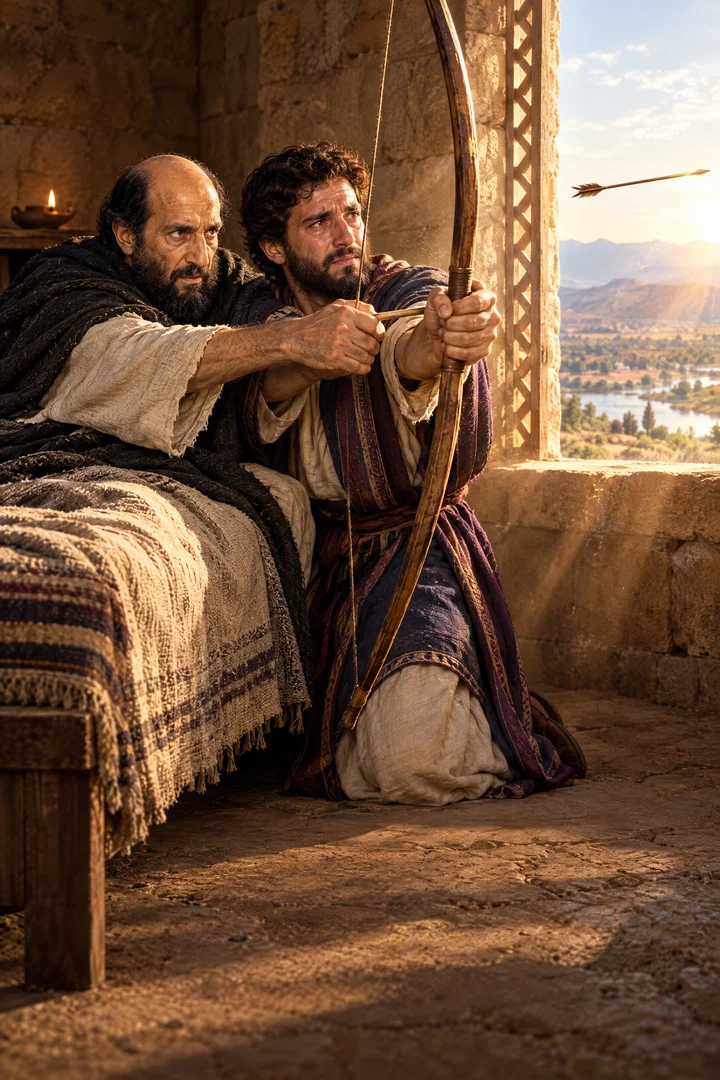
And Elisha said unto him, Take bow and arrows. And he took unto him bow and arrows.
Translations
American King James Version, Webster Bible
And Elisha said to him, Take bow and arrows. And he took to him bow and arrows.
King James Version, KJV Cambridge Paragraph Bible
And Elisha said unto him, Take bow and arrows. And he took unto him bow and arrows.
And Elisha said unto him, Take bow and arrows: and he took unto him bow and arrows.
And Elisha said unto him, Take bow and arrows; and he took unto him bow and arrows.
And Elisha saith to him, 'Take bow and arrows:' and he taketh unto him bow and arrows.
And Elisha said to him, Take bow and arrows. And he took a bow and arrows.
And Elisha said unto him, Take bow and arrows. So he took unto him bow and arrows.
Berean Standard Bible, Majority Standard Bible
Elisha told him, “ Take a bow and some arrows.”So Jehoash took a bow and some arrows.
Elisha said to him, “ Take bow and arrows;” and he took bow and arrows for himself.
Then Elisha said to him, Take bow and arrows: and he took bow and arrows.
Then Elisha sayde vnto him, Take a bowe and arrowes. And he tooke vnto him bowe and arrowes.
Douay-Rheims (Challoner revision)
And Eliseus said to him: Bring a bow and arrows. And when he had brought him a bow, and arrows,
Pictures
Cross-references
- 2 Kings 13:25
And Jehoash the son of Jehoahaz took again out of the hand of Ben-hadad the son of Hazael the cities, which he had taken out of the hand of Jehoahaz his father by war. Three times did Joash beat him, and recovered the cities of Israel.
Joash’s three victories fulfill Elisha’s promise.
- 2 Kings 2:9-14
And it came to pass, when they were gone over, that Elijah said unto Elisha, Ask what I shall do for thee, before I be taken away from thee. And Elisha said, I pray thee, let a double portion of thy spirit be upon me.
Joash seeks a blessing from Elisha, echoing Elisha’s request for a double portion from Elijah.
Commentary
Each commentary is drawn from primary sources: the writings of Ellen G. White and Adventist pioneers and periodicals. Each commentary is separate. Its own words are not a quotation; follow the references to read the source passages.
Ellen G. White
3 sources
This command was given as part of Elisha's final counsel and encouragement to King Joash as his work as a prophet was coming to a close.PK 263.2 Elisha directed Joash to take bow and arrows as the first step in a prophetic act concerning deliverance from Syria, and Joash obeyed the direction.PK 262.1–263.1PK 261.1–3 That taking up of the weapons opened a symbolic test of Joash's faith, giving opportunity to reveal that Israel could be delivered from its enemy, with the extent of Syria's defeat to match Joash's persistence.PK 262.1–263.1PK 261.1–3
Joash struck the ground only three times, and therefore he would defeat Syria only three times.PK 262.1–263.1 The episode shows that when God promises success and opens the way for a task, those entrusted with it must press forward with energy and perseverance.PK 262.1–263.1
Sources
Pioneers and periodicals
11 sources
In his last sickness Elisha commands Joash king of Israel to take bow and arrows, and his obedience begins a prophetic sign of promised victory and deliverance from Syria.RH Mar 25, 1902ST Oct 22, 1885 The bow and arrows are the appointed instruments and pledge of the Lord's deliverance, with the eastward shot declared the Lord's arrow of victory against Syria and the striking of the ground measuring how fully the foe will be defeated.RH Mar 25, 1902ST Oct 22, 1885ST Oct 22, 1885RH Jun 29, 1911 The command tests the strength of Joash's faith and persistence in seeking God against the Syrians, but he strikes the ground only three times from small faith, small vision, and lack of perseverance.ST Sep 17, 1896ST Jun 3, 1913RH Nov 16, 1916ST Oct 29, 1885 His limited action limits Israel to three victories rather than complete destruction of Syria, teaching that God's power and means of deliverance must be met with bold faith and used fully until the work is done.ST Oct 22, 1885ST Sep 17, 1896RH Nov 16, 1916RH Mar 25, 1902
The Sign of Deliverance
During Elisha's last sickness he tells Joash, king of Israel, to take a bow and arrows, and Joash obeys by taking them, beginning a prophetic sign and test concerning victory and promised deliverance from Syria.RH Mar 25, 1902ST Oct 22, 1885ST Oct 22, 1885 The taking of the bow and arrows is the first step in the symbolic action through which victory over Syria is foretold and acted out.RH Mar 25, 1902ST Oct 22, 1885 The bow and arrows are instruments through which God offers deliverance and a token of good from the Lord to the king.RH Mar 25, 1902ST Oct 22, 1885RH Mar 25, 1902 God thus places in Joash's hands the sign of an offered deliverance from Syria.RH Mar 25, 1902ST Oct 22, 1885RH Mar 25, 1902
Elisha lays his hands upon the king's hands as Joash shoots, and the arrow shot eastward is declared the Lord's arrow of deliverance.ST Oct 22, 1885RH Jun 29, 1911 By custom, shooting an arrow toward a country an army intends to invade signified intended warfare and expected victory. The eastward shooting therefore points to Joash's coming victorious war against Syria.ST Oct 22, 1885RH Jun 29, 1911 It is God's vindication of His suffering people against Hazael's oppression.RH Jun 29, 1911
Striking the ground with the arrows represents how fully Joash will defeat Syria and destroy his foes.ST Oct 22, 1885RH Jun 29, 1911 The later command to strike the ground shows that Joash was expected to act fully on the opportunity God gave him.RH Mar 25, 1902 Because he strikes only incompletely, the sign promises that Israel under Joash will defeat Syria only three times rather than destroy it.ST Oct 22, 1885ST Jun 14, 1899ST Oct 29, 1885 That limited deliverance is later completed under Jeroboam II.ST Oct 29, 1885
Faith and Persistence Tested
The taking of the bow and arrows begins a symbolic test acted out before the promised deliverance from Syria.RH Nov 16, 1916ST Sep 29, 1914 It is a test of the strength of faith, meant to teach persistence and faithfulness in seeking counsel and protection against the Syrians.ST Jun 3, 1913ST Sep 29, 1914 That lesson is failed to be learned.ST Jun 3, 1913
What follows exposes the failure, for striking the ground only three times shows small faith and vision.RH Nov 16, 1916 It shows lack of persistence and venturing little, bringing limited results.ST Sep 17, 1896RH Nov 16, 1916ST Oct 29, 1885
Because of that limited action the victories under that leadership are limited by lack of faith in the prophetic promise.ST Sep 17, 1896RH Nov 16, 1916 Deliverance comes only to the extent there is action in faith.RH Nov 16, 1916 Greater persistence could have brought fuller victory, even complete destruction of Syria rather than defeating Syria only three times.ST Oct 22, 1885RH Nov 16, 1916ST Oct 29, 1885 The later completion of the deliverance under Jeroboam II belongs to this same shortfall.ST Oct 29, 1885
The bow and arrows are instruments through which deliverance is offered, and the one who receives them is expected to act fully on the opportunity given.RH Mar 25, 1902 God's power and willingness to help should be met with bold faith rather than treated as sufficient only in small measure.RH Nov 16, 1916 The means of deliverance God provides — prayer, confession, love, faith, giving, and consecrated service — must be used until the work is fully done rather than stopping partway.RH Mar 25, 1902RH Nov 16, 1916RH Mar 25, 1902
Sources