2 Kings 16:10
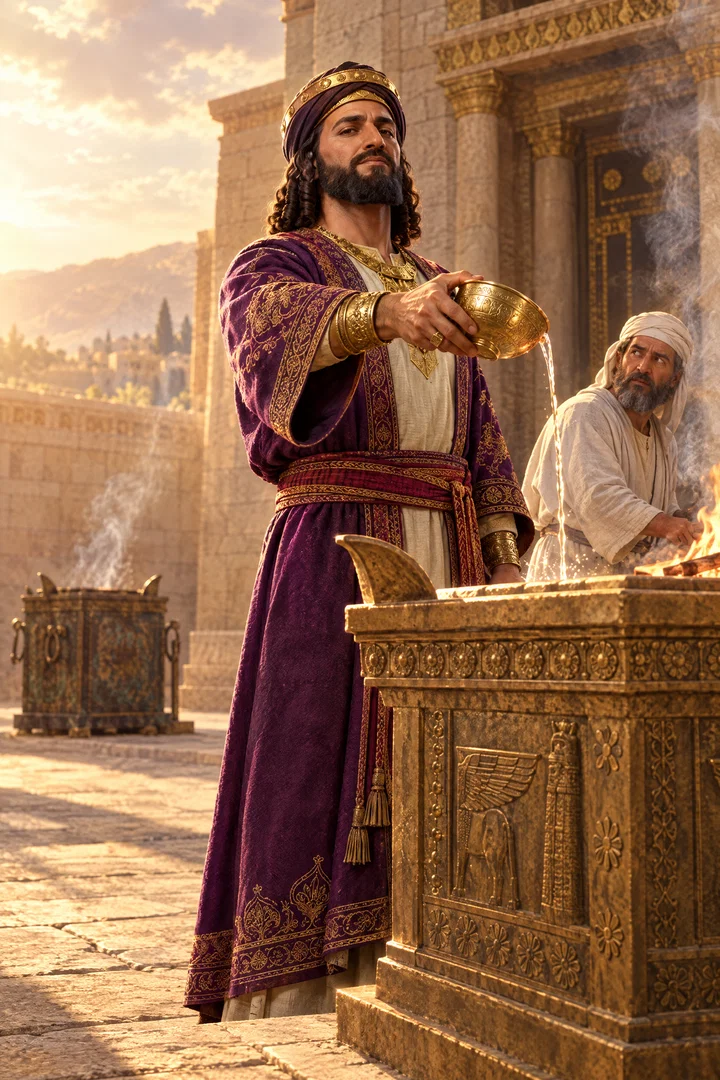
And king Ahaz went to Damascus to meet Tiglath-pileser king of Assyria, and saw an altar that was at Damascus: and king Ahaz sent to Urijah the priest the fashion of the altar, and the pattern of it, according to all the workmanship thereof.
Translations
And king Ahaz went to Damascus to meet Tiglathpileser king of Assyria, and saw an altar that was at Damascus: and king Ahaz sent to Urijah the priest the fashion of the altar, and the pattern of it, according to all the workmanship thereof.
King James Version, KJV Cambridge Paragraph Bible
And king Ahaz went to Damascus to meet Tiglath-pileser king of Assyria, and saw an altar that was at Damascus: and king Ahaz sent to Urijah the priest the fashion of the altar, and the pattern of it, according to all the workmanship thereof.
And king Ahaz went to Damascus to meet Tiglath-pileser king of Assyria, and saw an altar that was at Damascus: and king Ahaz sent to Urijah the priest the fashion of the altar, and the pattern of it, according to all the workmanship of it.
And king Ahaz went to Damascus to meet Tiglath-pileser king of Assyria, and saw the altar that was at Damascus: and king Ahaz sent to Urijah the priest the fashion of the altar, and the pattern of it, according to all the workmanship thereof.
And king Ahaz went to Damascus to meet Tiglath-pileser king of Assyria, and saw the altar that was at Damascus; and king Ahaz sent to Urijah the priest the fashion of the altar, and the pattern of it, according to all the workmanship thereof.
And king Ahaz goeth to meet Tiglath-Pileser king of Asshur [at] Damascus, and seeth the altar that [is] in Damascus, and king Ahaz sendeth unto Urijah the priest the likeness of the altar, and its pattern, according to all its work,
And king Ahaz went to Damascus to meet Tiglath-Pileser king of Assyria; and he saw the altar that was at Damascus, and king Ahaz sent to Urijah the priest the form of the altar, and the pattern of it, according to all its workmanship.
So then King Ahaz went to meet Tiglath-pileser king of Assyria, in Damascus, and saw the altar which was in Damascus,—and King Ahaz, sent unto Urijah the priest, a likeness of the altar, and a model thereof, according to all the workmanship thereof;
Berean Standard Bible, Majority Standard Bible
Then King Ahaz went to Damascus to meet Tiglath-pileser king of Assyria. On seeing the altar in Damascus, King Ahaz sent Uriah the priest a model of the altar and complete plans for its construction.
King Ahaz went to Damascus to meet Tiglath Pileser king of Assyria, and saw the altar that was at Damascus; and King Ahaz sent to Urijah the priest a drawing of the altar and plans to build it.
Then King Ahaz went to Damascus for a meeting with Tiglath-pileser, king of Assyria; and there he saw the altar which was at Damascus; and King Ahaz sent to Urijah the priest a copy of the altar, giving the design of it and all the details of its structure.
And King Ahaz went vnto Damascus to meete Tiglath Pileser King of Asshur: and when King Ahaz sawe the altar that was at Damascus, he sent to Vriiah the Priest the paterne of the altar, and the facion of it, and all the workemanship thereof.
Douay-Rheims (Challoner revision)
And king Achaz went to Damascus to meet Theglathphalasar king of the Assyrians, and when he had seen the altar of Damascus, king Achaz sent to Urias the priest a pattern of it, and its likeness according to all the work thereof.
Pictures
Cross-references
- 2 Chronicles 28:20
And Tilgath-pilneser king of Assyria came unto him, and distressed him, but strengthened him not.
Assyria distressed Ahaz instead of helping; both texts name Tiglath-Pileser.
- 2 Chronicles 28:24-25
And Ahaz gathered together the vessels of the house of God, and cut in pieces the vessels of the house of God, and shut up the doors of the house of the LORD, and he made him altars in every corner of Jerusalem.
Ahaz closed the temple and promoted worship at high places.
- Isaiah 7:1-10
And it came to pass in the days of Ahaz the son of Jotham, the son of Uzziah, king of Judah, that Rezin the king of Syria, and Pekah the son of Remaliah, king of Israel, went up toward Jerusalem to war against it, but could not prevail against it.
Ahaz rejected God's promise of deliverance
- 2 Chronicles 28:23
For he sacrificed unto the gods of Damascus, which smote him: and he said, Because the gods of the kings of Syria help them, therefore will I sacrifice to them, that they may help me. But they were the ruin of him, and of all Israel.
explains altar copy as worship of Syrian gods
- 2 Kings 16:17-18
And king Ahaz cut off the borders of the bases, and removed the laver from off them; and took down the sea from off the brasen oxen that were under it, and put it upon a pavement of stones.
Ahaz further robbed the temple to satisfy Assyria.
- 2 Kings 8:7-15
And Elisha came to Damascus; and Ben-hadad the king of Syria was sick; and it was told him, saying, The man of God is come hither.
Both texts recount events involving Damascus and its rulers.
- Joshua 22:28
Therefore said we, that it shall be, when they should so say to us or to our generations in time to come, that we may say again, Behold the pattern of the altar of the LORD, which our fathers made, not for burnt offerings, nor for sacrifices; but it is a witness between us and you.
The altar’s pattern served as a witness, not for sacrificial worship.
- 2 Kings 17:1
In the twelfth year of Ahaz king of Judah began Hoshea the son of Elah to reign in Samaria over Israel nine years.
Both texts name Tiglath-pileser as Assyrian king during Hoshea’s reign.
Commentary
Each commentary is drawn from primary sources: the writings of Ellen G. White and Adventist pioneers and periodicals. Each commentary is separate. Its own words are not a quotation; follow the references to read the source passages.
Ellen G. White
1 source
The sixteenth chapter of Second Kings belongs to the history of Israel in which the nation's own course of action helped forge the fetters of its later bondage.Ms 129, 1899, par. 7–8 That course is presented as self-chosen conduct that bound the people toward future captivity.Ms 129, 1899, par. 7–8 Its place in the record is therefore as one part of the actions by which Israel prepared its own enslavement.Ms 129, 1899, par. 7–8
Sources
Pioneers and periodicals
9 sources
The verse belongs to the reign of Ahaz of Judah, a weak and wicked king standing between the good Jotham and the good Hezekiah, in the closing history of Kings when Judah was following Israel in idolatry and departure from God toward captivity.ST Jun 3, 1913ST May 10, 1910 The king of Assyria named is Tiglath-Pileser II, who became king in B.C. 745 after Pul, following a thirty-six-year pause in Assyrian conquest from B.C. 781 to 745. He was a mighty conqueror who again asserted the vigor of the old empire after insurrection and revolt under weak, ease-loving kings.
Ahaz went to Damascus after refusing through Isaiah the word of the Lord that Syria and Israel would not stand, and instead hired Assyria with silver and gold taken from the house of the Lord and the king's house to save him from Rezin king of Syria and Pekah king of Israel, thereby acknowledging Tiglath-pileser as sovereign and paying him tribute.ST Nov 12, 1885ST Jul 30, 1885 The meeting at Damascus took place after Tiglath-pileser overthrew the kingdom of Damascus in 740 B.C., and his inscriptions list Ahaz of Judah among those who acknowledged his sovereignty and paid tribute, agreeing exactly with the Bible record in 2 Kings 16:7-18.ST Jul 30, 1885 The word translated fashion is the Hebrew d'mooth, or likeness, the same word used for man made in the likeness of God and for the likeness of living creatures, firmament, throne and other visible forms, marking what Ahaz sent as the physical pattern and workmanship of the altar.RH Jan 5, 1860
At Damascus Ahaz saw the elaborate Syrian altar and sent its fashion, pattern and workmanship to Urijah the priest, who built a duplicate before Ahaz returned.ST Nov 12, 1885RH Jan 19, 1911ST Nov 7, 1906 When Ahaz returned he approved the new altar and offered sacrifices on it, sacrificing to the gods of Damascus because he thought the gods of the kings of Syria had helped them and would help him, but they were the ruin of him and of all Israel.ST Nov 12, 1885 The new altar displaced the established service and introduced foreign worship, for Ahaz moved the established altar to an obscure place and rearranged the temple furnishings.ST Nov 12, 1885RH Jan 19, 1911 He shut up the house of the Lord and made high places in the cities of Judah to burn incense to other gods, and having put himself into Assyria's hands he further robbed the house of the Lord by cutting off the borders of the bases, removing the laver, taking the sea from off the brazen oxen, and turning the Sabbath covert and booth and the king's entry from the house to satisfy the king of Assyria, who distressed him but strengthened him not.ST Nov 12, 1885RH Jan 19, 1911
Ahaz's making of an altar after the pattern he saw was sinful because he made it for worship; making an image or likeness was not wrong in itself, but using it as an object of worship was.ST May 18, 1904 The pattern of the altar represents an outside model adopted by God's people as a human expedient, rather than trusting God to supply what his church needs.ST Jan 20, 1898 The copying of the Damascus altar means God's people mar God's work when they look upon worldly plans and copy them into God's work.ST Nov 7, 1906 That copying is a mistake of judgment and lack of clearness of vision, following previous plans and duplicating extravagant construction and extra expense from older institutions to younger ones, bringing worldly methods and a worldly spirit into God's work, and seeking and doing the world's work invariably leads to that copying and awakens enmity with worldly concerns with whom God's people come in competition.ST Nov 7, 1906
Sources