2 Kings 3:12
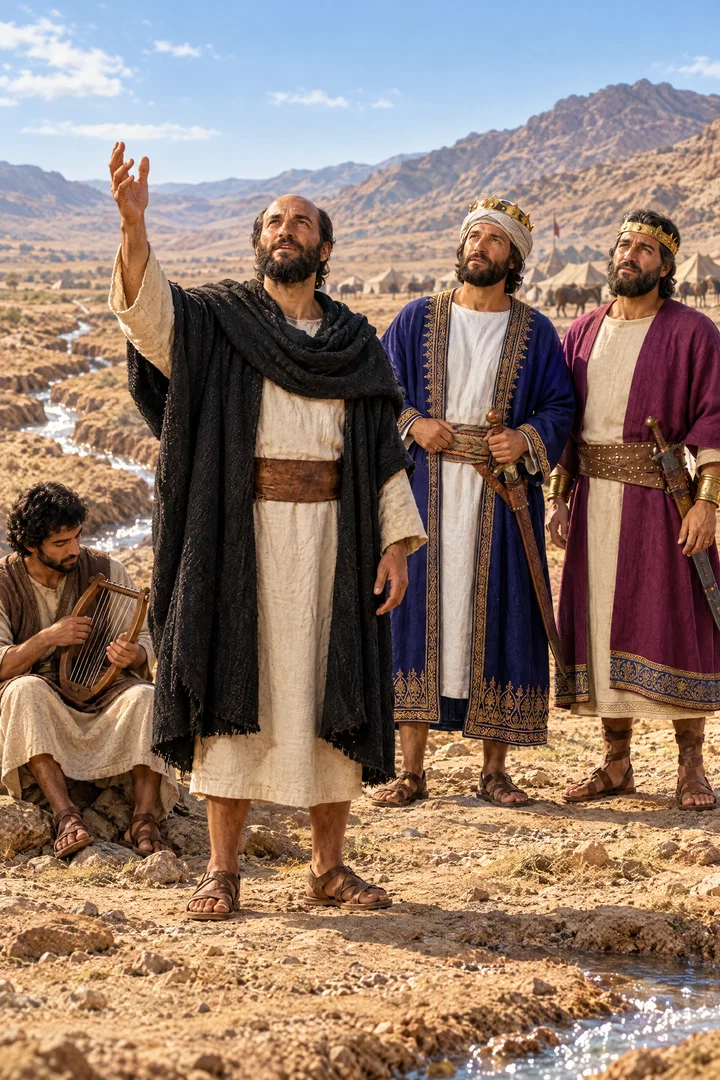
And Jehoshaphat said, The word of the LORD is with him. So the king of Israel and Jehoshaphat and the king of Edom went down to him.
Translations
American King James Version, King James Version, Webster Bible, Revised Version
And Jehoshaphat said, The word of the LORD is with him. So the king of Israel and Jehoshaphat and the king of Edom went down to him.
KJV Cambridge Paragraph Bible, Bible in Basic English
And Jehoshaphat said, The word of the Lord is with him. So the king of Israel and Jehoshaphat and the king of Edom went down to him.
And Jehoshaphat said, The word of Jehovah is with him. So the king of Israel and Jehoshaphat and the king of Edom went down to him.
And Jehoshaphat saith, 'The word of Jehovah is with him;' and go down unto him do the king of Israel, and Jehoshaphat, and the king of Edom.
And Jehoshaphat said, The word of Jehovah is with him. And the king of Israel and Jehoshaphat and the king of Edom went down to him.
Then said Jehoshaphat, The word of Yahweh, is with him. So the king of Israel, and Jehoshaphat, and the king of Edom, went down unto him.
Berean Standard Bible, Majority Standard Bible
Jehoshaphat affirmed, “ The word of the LORD is with him.” So the king of Israel and Jehoshaphat and the king of Edom went down to him.
Jehoshaphat said, “ The LORD’s word is with him.” So the king of Israel and Jehoshaphat and the king of Edom went down to him.
Then Iehoshaphat saide, The worde of the Lord is with him. Therefore the King of Israel, and Iehoshaphat, and the King of Edom went downe to him.
Douay-Rheims (Challoner revision)
And Josaphat said: The word of the Lord is with him. And the king of Israel, and Josaphat king of Juda, and the king of Edom went down to him.
Pictures
Cross-references
- 2 Kings 3:4-5
And Mesha king of Moab was a sheepmaster, and rendered unto the king of Israel an hundred thousand lambs, and an hundred thousand rams, with the wool.
Records Moab’s revolt against Israel after Ahab’s death.
- 2 Kings 2:1-11
And it came to pass, when the LORD would take up Elijah into heaven by a whirlwind, that Elijah went with Elisha from Gilgal.
Elijah is taken to heaven before Elisha’s prophetic ministry.
Commentary
Each commentary is drawn from primary sources: the writings of Ellen G. White and Adventist pioneers and periodicals. Each commentary is separate. Its own words are not a quotation; follow the references to read the source passages.
Ellen G. White
3 sources
Elisha is the one with whom the word of the Lord is, and for that reason the king of Israel with Jehoshaphat and the king of Edom go down to him to seek God's direction.STMW7 19.2Ms 1b, 1874, par. 9–11 The episode is a test of faith in which teachers of truth pass through sifting, searching, trying trials, with faith and patience severely tried by apparent impossibilities blocking the way.STMW7 19.2Ms 1, 1874, par. 37Ms 1b, 1874, par. 9–11 That same test of faith will be met again by those who trust God.Ms 1, 1874, par. 37
The lesson is to trust not in what people can do by themselves but in what God can do for them and through them.STMW7 19.2Ms 1, 1874, par. 37Ms 1b, 1874, par. 9–11 Those who trust in this way will certainly experience and realize God's power in their work.STMW7 19.2Ms 1, 1874, par. 37 The Lord has ways and means and resources for every emergency.Ms 1b, 1874, par. 9–11
He works in the least expected ways, turning the battle against the enemy not by human strength but by His own strength as the mighty General and commander of armies.STMW7 19.2Ms 1, 1874, par. 37Ms 1b, 1874, par. 9–11 He gives the victory and works for the glory of His own name.STMW7 19.2Ms 1, 1874, par. 37 Therefore His workers must go forward with the grace of Christ without questioning the length of the way or its obstacles, walking by faith and not by sight rather than living by what is seen.Ms 1b, 1874, par. 9–11 They must not limit the Holy One, whose power is from of old and whose ways are past finding out and beyond finding out, by marking out in advance how He will work, or they will be disappointed.Ms 1b, 1874, par. 9–11
Sources
Pioneers and periodicals
7 sources
The verse belongs to the 2 Kings 3 record of Moab, the battle, wars, conflict, rebellion and revolt of Mesha king of Moab against Israel.ST Dec 21, 1915RH Aug 4, 1910ST Aug 12, 1913RH Aug 12, 1875 That war was fought against Jehoram and Jehoshaphat in the three kings' campaign against Moab, and belongs to the history of relations between Moab and Israel under Omri, Ahab, Jehoram and Jehoshaphat.ST Dec 21, 1915RH Aug 4, 1910ST Aug 12, 1913RH Aug 12, 1875 Within that setting it is part of the account of Elisha, Elijah's devout pupil.ST Jun 7, 1899 His prophetic experiences in this account are evidence of the development produced by the schools of the prophets.ST Jun 7, 1899 In the three kings' campaign, Elisha's word from the Lord was followed by water appearing in the wilderness without wind or rain.
2 Kings 3 is supplemented by the Moabite Stone, an inscription by Mesha king of Moab commemorating his deliverance from Israel's rule around 850 B.C.RH Sep 28, 1905 The stone was found among the ruins of Dibon and was made at least twenty-seven hundred years ago in the year Elijah was translated to heaven.RH Aug 12, 1875 The achievements of Mesha narrated on the stone include vessels of Jehovah taken from captured Nebo and dedicated to Chemosh his national deity.RH Aug 12, 1875
The Moabite Stone supplements, harmonizes with, vividly depicts and illuminates this biblical record, including Moab's revolt and winning back its independence after Ahab's death.RH Sep 28, 1905RH Aug 4, 1910ST Aug 12, 1913RH Aug 12, 1875RH Nov 16, 1916 It preserves historical information about the reigns of Omri, Ahab and the king of Moab.ST Dec 21, 1915 Awakened after nearly three thousand years, it confirms by emphatic testimony the truth and essential accuracy of this accurate Old Testament history.ST Dec 21, 1915RH Aug 12, 1875 It illustrates the historical, geographical and religious relations of Israel and Moab.RH Aug 12, 1875
Sources