2 Kings 3:11
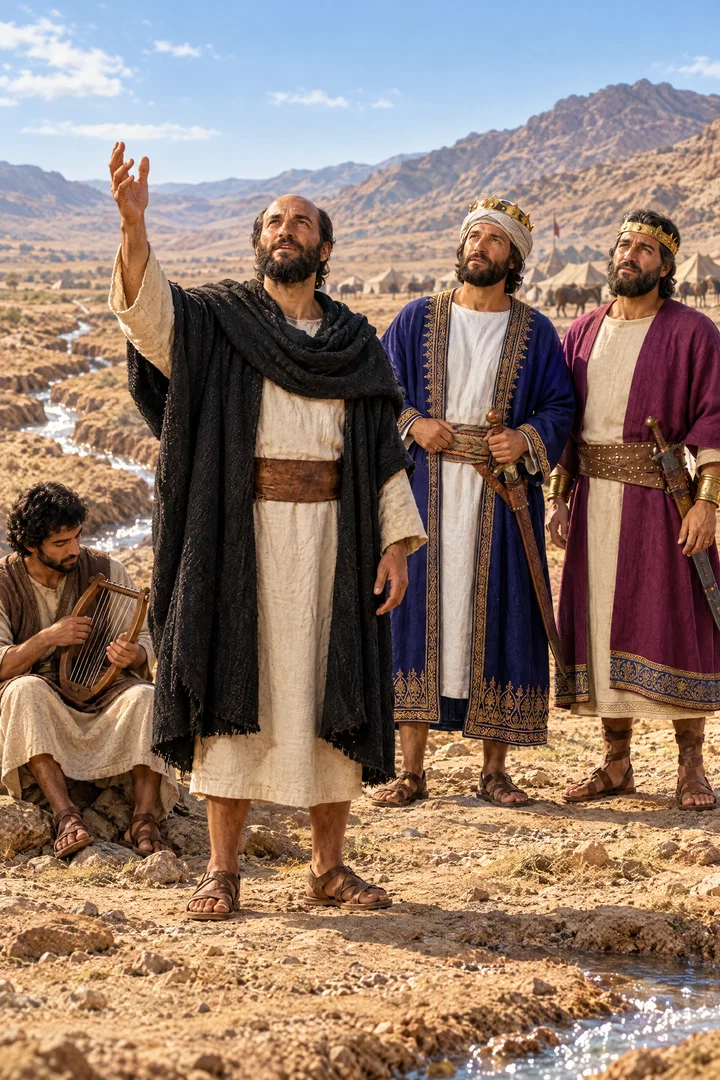
But Jehoshaphat said, Is there not here a prophet of the LORD, that we may enquire of the LORD by him? And one of the king of Israel’s servants answered and said, Here is Elisha the son of Shaphat, which poured water on the hands of Elijah.
Translations
But Jehoshaphat said, Is there not here a prophet of the LORD, that we may inquire of the LORD by him? And one of the king of Israel’s servants answered and said, Here is Elisha the son of Shaphat, which poured water on the hands of Elijah.
But Jehoshaphat said, Is there not here a prophet of the LORD, that we may enquire of the LORD by him? And one of the king of Israel’s servants answered and said, Here is Elisha the son of Shaphat, which poured water on the hands of Elijah.
But Jehoshaphat said, Is there not here a prophet of the Lord, that we may inquire of the Lord by him? And one of the king of Israel’s servants answered and said, Here is Elisha the son of Shaphat, which poured water on the hands of Elijah.
But Jehoshaphat said, Is there not here a prophet of the LORD, that we may inquire of the LORD by him? And one of the king of Israel's servants answered and said, Here is Elisha the son of Shaphat, who poured water on the hands of Elijah.
But Jehoshaphat said, Is there not here a prophet of the LORD, that we may inquire of the LORD by him? And one of the king of Israel’s servants answered and said, Elisha the son of Shaphat is here, which poured water on the hands of Elijah.
But Jehoshaphat said, Is there not here a prophet of Jehovah, that we may inquire of Jehovah by him? And one of the king of Israel’s servants answered and said, Elisha the son of Shaphat is here, who poured water on the hands of Elijah.
And Jehoshaphat saith, 'Is there not here a prophet of Jehovah, and we seek Jehovah by him?' And one of the servants of the king of Israel answereth and saith, 'Here [is] Elisha son of Shaphat, who poured water on the hands of Elijah.'
And Jehoshaphat said, Is there not here a prophet of Jehovah that we may inquire of Jehovah by him? And one of the king of Israel's servants answered and said, Here is Elisha the son of Shaphat, who poured water on the hands of Elijah.
So Jehoshaphat said—Is there not, here, a prophet of Yahweh, that we may enquire of Yahweh, from him? Then answered one of the servants of the king of Israel, and said, Here, is Elisha son of Shaphat, who poured water on the hands of Elijah.
Berean Standard Bible, Majority Standard Bible
But Jehoshaphat asked, “ Is there no prophet of the LORD here? Let us inquire of the LORD through him.”And one of the servants of the king of Israel answered, “Elisha son of Shaphat is here. He used to pour water on the hands of Elijah.”
But Jehoshaphat said, “Isn’t there a prophet of the LORD here, that we may inquire of the LORD by him?”One of the king of Israel’s servants answered, “Elisha the son of Shaphat, who poured water on the hands of Elijah, is here.”
But Jehoshaphat said, Is there no prophet of the Lord here, through whom we may get directions from the Lord? And one of the king of Israel's men said in answer, Elisha, the son of Shaphat, is here, who was servant to Elijah.
But Iehoshaphat saide, Is there not here a Prophet of the Lord, that we may inquire of the Lord by him? And one of the King of Israels seruants answered, and said, Here is Elisha the sonne of Shaphat, which powred water on the handes of Eliiah.
Douay-Rheims (Challoner revision)
And Josaphat said: Is there not here a prophet of the Lord, that we may beseech the Lord by him? And one of the servants of the king of Israel answered: Here is Eliseus the son of Saphat, who poured water on the hands of Elias.
Pictures
Cross-references
- 2 Kings 2:11
And it came to pass, as they still went on, and talked, that, behold, there appeared a chariot of fire, and horses of fire, and parted them both asunder; and Elijah went up by a whirlwind into heaven.
fiery chariot proves readiness after selfless transfer
- 1 Kings 19:19-21
So he departed thence, and found Elisha the son of Shaphat, who was plowing with twelve yoke of oxen before him, and he with the twelfth: and Elijah passed by him, and cast his mantle upon him.
Elisha leaves plowing to follow and minister to Elijah.
- 1 Kings 19:16
And Jehu the son of Nimshi shalt thou anoint to be king over Israel: and Elisha the son of Shaphat of Abel-meholah shalt thou anoint to be prophet in thy room.
Elisha is appointed to succeed Elijah as prophet.
- 2 Kings 2:9
And it came to pass, when they were gone over, that Elijah said unto Elisha, Ask what I shall do for thee, before I be taken away from thee. And Elisha said, I pray thee, let a double portion of thy spirit be upon me.
Elisha asks Elijah for a double portion of his spirit.
- Matthew 17:3
And, behold, there appeared unto them Moses and Elias talking with him.
Elijah appears on the Mount of Transfiguration.
- 2 Kings 3:4-5
And Mesha king of Moab was a sheepmaster, and rendered unto the king of Israel an hundred thousand lambs, and an hundred thousand rams, with the wool.
The verses continue the account of Moab’s rebellion during these reigns.
Commentary
Each commentary is drawn from primary sources: the writings of Ellen G. White and Adventist pioneers and periodicals. Each commentary is separate. Its own words are not a quotation; follow the references to read the source passages.
Ellen G. White
8 sources
The description of Elisha as one who poured water on Elijah's hands means he served as Elijah's personal attendant in a lowly, humble duty.Lt 64, 1897, par. 9–13ED 58.4–5PK 222.2–3Ms 81a, 1901, par. 6–7Lt 12, 1897, par. 22–23 He was called from plowing with twelve yoke of oxen and the plough, and he left all, including a wealthy home where he was beloved, to follow Elijah without complaint into an uncertain life, giving himself entirely to God in obedience.Lt 64, 1897, par. 9–13PK 222.2–3Ms 81a, 1901, par. 6–7Lt 12, 1897, par. 22–23 His first work was willingly taking up little, small, commonplace duties with heartiness and thorough surrender of self, with no great work required at first, and he kept at that humble work until Elijah was to be translated.Lt 64, 1897, par. 9–13PK 222.2–3Ms 81a, 1901, par. 6–7Lt 12, 1897, par. 22–23
That humble service was his training and discipline, in which he learned humility and service, proved faithful in little things, and with daily strengthening purpose prepared for the mission God had appointed him and became acquainted with the work in which he would afterward have a leading part.Lt 64, 1897, par. 9–13ED 58.4–5PK 222.2–3Ms 81a, 1901, par. 6–7 His service under a ruler taught him how to serve under God and proved he had traits of character that would endure test and trial, relying on God in every trying emergency despite the temptation of wealth and comfort and thoughts of the home he had left, and having put his hand to the plow he refused to turn back and proved true to his trust.Lt 64, 1897, par. 9–13PK 222.2–3 Putting away pride and humbling the heart to do humble everyday work and anything the Lord directs qualifies a person to stand as a trusted representative laborer together with Christ fitted for larger things and greater responsibilities, and such humble willing service for the Master is as acceptable as the highest service and lies before everyone who claims to be a child of God.Lt 64, 1897, par. 9–13PK 222.2–3Lt 12, 1897, par. 22–23 God wants men and women to give themselves entirely as Elisha did, even though their work may differ as Elijah's and Elisha's differed while both worked for the Lord.Ms 81a, 1901, par. 6–7
The chapter to which the verse belongs presents tests of faith, teaching that God's people are to trust not in their own ability and strength but in what God can do for and through them, with their work and victory over the enemy depending on God's power.STMW7 19.2Ms 1, 1874, par. 37Ms 1b, 1874, par. 9–11 That test of faith will be repeated, with the certainty that such trust will realize God's power in the work, for the battle against the enemy is turned not by human strength but by the strength of the mighty General of armies working for His own name's glory.Ms 1, 1874, par. 37 God is not to be limited as to how He will work, since He works in ways least expected and may act in unexpected ways.Ms 1, 1874, par. 37Ms 1b, 1874, par. 9–11
Sources
Pioneers and periodicals
10 sources
Jehoshaphat asked for a prophet to consult when the kings of Israel, Judah and Edom marched against Moab and found no water in the wilderness, and a servant named Elisha the son of Shaphat, through whom water was then brought without wind or rain.ST May 13, 1908 To pour water on Elijah's hands means Elisha had been Elijah's personal servant and attendant, following him and bringing water for washing.ST May 13, 1908RH Feb 13, 1900 That willing performance of lowly tasks and close attention to a man of God was itself true ministry and trained him for higher work.RH Dec 30, 1902 Elijah was told to anoint his own menial attendant to take his place, and he passed his last test by turning his work over to his servant and asking for a double portion of his Spirit upon him.RH Feb 13, 1900 The surrounding history of Moab's revolt after Ahab's death is confirmed by Mesha's own thirty-four-line inscription on the Moabite Stone found at Dibon, which agrees with the relations between Moab and Israel though it adds no detail about the inquiry itself.RH Sep 28, 1905ST Dec 21, 1915RH Aug 4, 1910ST Aug 12, 1913RH Aug 12, 1875
History Confirmed by Stone
The verse stands in the account of the kings of Israel, Judah, and Edom marching against Moab, which is the battle between Mesha king of Moab and Israel. On that march they found no water in the wilderness. Elisha's word then brought water by way of Edom to fill the country without wind or rain.
The chapter is supplemented by the Moabite Stone, an inscription by Mesha king of Moab commemorating his deliverance from Israel's rule around 850 B.C.RH Sep 28, 1905 The account in 2 Kings 3:4-27 gives facts relating to the reigns of Omri, Ahab, Jehoram, and Jehoshaphat, covering material also found across 1 and 2 Kings and 2 Chronicles.ST Dec 21, 1915 A stone monument about two feet wide, four feet high, and fourteen and a half inches thick confirms the accuracy of this Old Testament history.ST Dec 21, 1915
The Moabite Stone's account of Moab regaining independence after Ahab's death agrees with and supports the historical setting and the relations between Moab and Israel in the account of Moab's revolt and conflict with Israel.RH Aug 4, 1910ST Aug 12, 1913 It adds no detail about Jehoshaphat's inquiry or Elisha and does not specifically confirm the events in this verse.RH Aug 4, 1910ST Aug 12, 1913 The verse belongs to the true record of the wars between Israel and Moab in which Mesha fought against Jehoram and Jehoshaphat.RH Aug 12, 1875 The thirty-four-line inscription on the Moabite Stone found among the ruins of Dibon narrates the achievements of King Mesha and confirms the facts related in that record, illustrating the historical, geographical, and religious relations of Israel and Moab, including the taking of the vessels of Jehovah from captured Nebo and dedicating them to Chemosh.RH Aug 12, 1875 That inscription was made in the year Elijah was translated to heaven nearly twenty-seven hundred years ago.RH Aug 12, 1875
Servanthood Trains for Ministry
The verse introduces Elisha the son of Shaphat as a prophet through whom the Lord could be consulted.ST May 13, 1908 It identifies him as Elijah's attendant and servant, the one who poured water on Elijah's hands.ST May 13, 1908RH Feb 13, 1900ST Aug 27, 1885 Pouring water on the hands means he was Elijah's personal servant who followed him around and brought water for him to wash his hands.RH Feb 13, 1900 He was Elijah's devout pupil, formed through the prophetic school's education and later known for the experiences recorded in the opening chapters of 2 Kings.ST Jun 7, 1899
His faithful performance of humble tasks and attention to Elijah's words show how close association with a man of God shaped him, and by choosing that company over worldly pleasures and riches he was prepared for a higher position. Though a prophet who performed many wonderful miracles, he spent years as a servant attending to Elijah, and that lowly service done willingly from the heart was his training for the ministry and was itself true ministry, so that he never served the Lord better than when he waited on Elijah.RH Dec 30, 1902
Elijah was told to anoint his own menial attendant to be prophet in his place, with no further earthly work named for himself, as if he were to be laid aside entirely, and he passed this last and supreme test by willingly turning his work over to his servant and asking God to put a double portion of his Spirit on Elisha, to make him twice as great a man as himself.RH Feb 13, 1900 Closing and opening the heavens and bringing fire down by his word did not prove Elijah ready to go to heaven without seeing death, but turning his work over to his servant with nothing before him did, and then a chariot of fire and horses of fire took him to heaven.RH Feb 13, 1900 This self-effacing willingness for a brother to increase while self decreases is the spirit of Elijah, together with the power of Elijah, that must characterize the remnant people who will be translated for the same reasons Enoch and Elijah were.RH Feb 13, 1900 Those same hands that Elisha washed with water belonged to the body that was changed from mortal to immortal when Elijah was taken bodily to heaven, and it was the same body that later stood on the Mount of Transfiguration and stands in God's presence.ST Aug 27, 1885
Sources