2 Kings 4:37
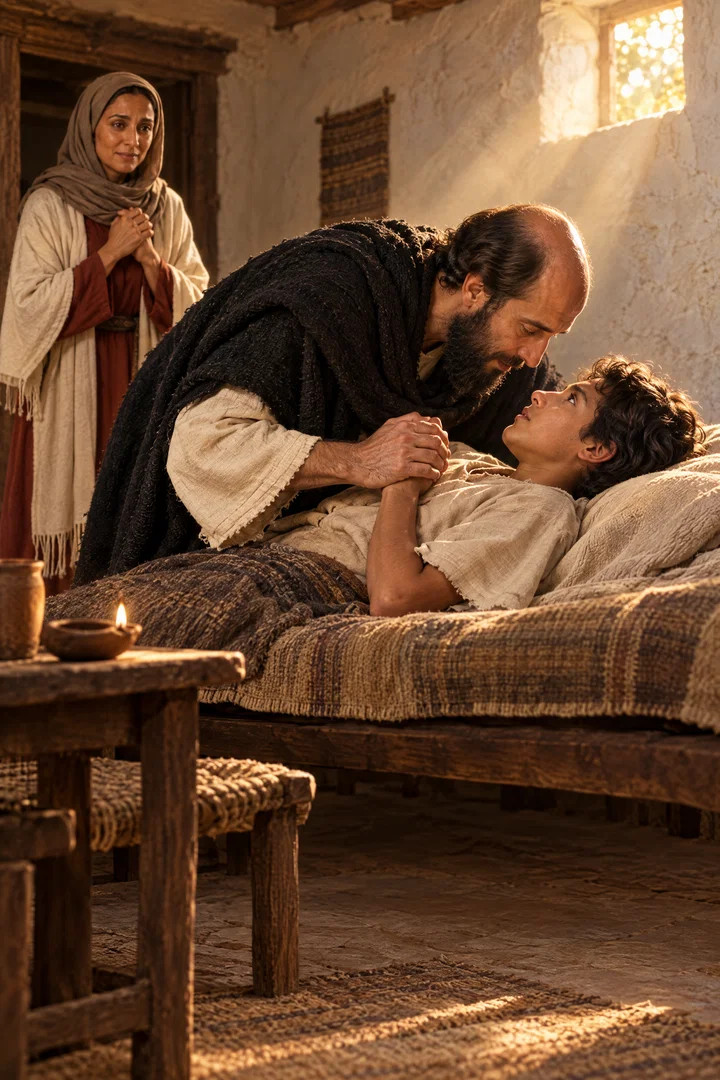
Then she went in, and fell at his feet, and bowed herself to the ground, and took up her son, and went out.
Translations
American King James Version, King James Version, KJV Cambridge Paragraph Bible, Webster Bible
Then she went in, and fell at his feet, and bowed herself to the ground, and took up her son, and went out.
Revised Version, American Standard Version
Then she went in, and fell at his feet, and bowed herself to the ground; and she took up her son, and went out.
And she goeth in, and falleth at his feet, and boweth herself to the earth, and lifteth up her son, and goeth out.
And she came and fell at his feet, and bowed herself to the ground; and she took up her son, and went out.
So she came in, and fell at his feet, and bowed herself to the ground,—and took up her son, and went forth.
Berean Standard Bible, Majority Standard Bible
She came in, fell at his feet, and bowed to the ground. Then she picked up her son and went out.
Then she went in, fell at his feet, and bowed herself to the ground; then she picked up her son, and went out.
And she came in, and went down on her face to the earth at his feet; then she took her son in her arms and went out.
And she came, and fell at his feete, and bowed her selfe to the ground, and tooke vp her sonne, and went out.
Douay-Rheims (Challoner revision)
She came and fell at his feet, and worshipped upon the ground: and took up her son, and went out.
Pictures
Cross-references
- 1 Kings 17:17-24
And it came to pass after these things, that the son of the woman, the mistress of the house, fell sick; and his sickness was so sore, that there was no breath left in him.
Elijah restores a widow’s son to life.
- Luke 7:14-15
And he came and touched the bier: and they that bare him stood still. And he said, Young man, I say unto thee, Arise.
Jesus raises a widow’s only son, recalling Elisha’s raising of the Shunammite’s son.
- John 11:43-44
And when he thus had spoken, he cried with a loud voice, Lazarus, come forth.
Lazarus is another person raised from the dead.
- Luke 8:55
And her spirit came again, and she arose straightway: and he commanded to give her meat.
Jesus raises the ruler’s daughter from the dead.
- 2 Kings 8:1-6
Then spake Elisha unto the woman, whose son he had restored to life, saying, Arise, and go thou and thine household, and sojourn wheresoever thou canst sojourn: for the LORD hath called for a famine; and it shall also come upon the land seven years.
Later restoration follows the woman’s earlier kindness and shows continued remembrance.
- Mark 5:41-42
And he took the damsel by the hand, and said unto her, Talitha cumi; which is, being interpreted, Damsel, I say unto thee, arise.
Both accounts describe a child restored to life.
- Acts 9:40-41
But Peter put them all forth, and kneeled down, and prayed; and turning him to the body said, Tabitha, arise. And she opened her eyes: and when she saw Peter, she sat up.
Peter raises Tabitha from the dead, and she rises and is presented alive.
- Acts 20:9-12
And there sat in a window a certain young man named Eutychus, being fallen into a deep sleep: and as Paul was long preaching, he sunk down with sleep, and fell down from the third loft, and was taken up dead.
Paul restores Eutychus to life, and the young man is brought back alive.
- John 11:11-26
These things said he: and after that he saith unto them, Our friend Lazarus sleepeth; but I go, that I may awake him out of sleep.
another true resurrection before Christ rose
- John 5:29
And shall come forth; they that have done good, unto the resurrection of life; and they that have done evil, unto the resurrection of damnation.
even raisings to mortality are called resurrection
Commentary
Each commentary is drawn from primary sources: the writings of Ellen G. White and Adventist pioneers and periodicals. Each commentary is separate. Its own words are not a quotation; follow the references to read the source passages.
Ellen G. White
2 sources
The verse records the Shunammite woman receiving her son after he was restored to life through Elisha.PK 237.3–239.2PK 239.3–240.1 She falls at Elisha's feet, bows herself to the ground, takes up her son, and goes out with him.PK 237.3–239.2PK 239.3–240.1 Her falling at his feet expresses gratitude and reverence.PK 237.3–239.2
Her faith is rewarded by the return of her child.PK 237.3–239.2PK 239.3–240.1 The return of her child is an instance of God's power to restore life.PK 237.3–239.2 The restoration of her son points to the hope that Christ will restore the faithful dead to their loved ones at His coming.PK 239.3–240.1
Sources
Pioneers and periodicals
29 sources
The verse closes the raising of the Shunammite's only son, when after Elisha prayed and stretched himself upon the dead child till he sneezed seven times and opened his eyes, his mother fell at the prophet's feet in thankful reverence and took up her son alive.ST Jul 28, 1898ST Jul 28, 1898ST Oct 5, 1904ST Jun 2, 1881 It was a real breaking of death's power and a true resurrection from the dead, though not a raising to immortality.ST Aug 12, 1889RH Aug 6, 1872RH May 28, 1861ST Apr 30, 1896 Like every raising before and after his own, it centered in Christ and depended on his power and sacrifice, and it does not set aside his preeminence as firstborn and first-fruits, which means chief rank and not first in order of time.ST Oct 12, 1876ST Apr 30, 1896ST Jan 11, 1905ST Dec 30, 1903 Receiving her son back alive was God's joyful reward for furnishing and providing for His servant, showing that kindness to the Lord's worker is never regretted.CO 73.5ST Jun 16, 1914RH Jul 25, 1907 Her clinging to Elisha in importunate faith won her suit, and a mother thus taking up her son alive again gives comfort to sorrowing parents in the hope of the glad reunion of the resurrection.RH Jan 4, 1906RH Jun 24, 1902ST Nov 24, 1887ST Jul 28, 1898
Story and Setting
This closing moment ends the account of the Shunammite's son in 2 Kings 4:18-37, standing next in Elisha's work after parting the Jordan with Elijah's mantle, healing the bitter waters and barren ground at Jericho, bringing water by the way of Edom with neither wind nor rain for the kings in the wilderness, and multiplying the widow's single pot of oil to pay her debt and live of the rest. It follows Elisha praying for the dead child, lying upon him till his flesh grew warm, stretching himself upon him again till he sneezed seven times and opened his eyes, and then having Gehazi call his mother and tell her to take up her son.ST Jul 28, 1898 The child was the only son of a woman who had shown Elisha hospitality, and his raising is recalled as one of the prophets' triumphs over death.ST Jun 2, 1881
The son fell under the influence of a sunstroke, showing that sunstroke was familiar in the Holy Land in biblical times.RH Aug 29, 1871 Shunem was on the opposite side of the hill where Nain stood, linking this earlier raising to the setting in which Jesus raised a widow's son. The verse belongs to the wonderfully interesting chapters from 1 Kings 22 through 2 Kings 20, specifically in the 2 Kings 3-5 section from which readers gather lessons, and illustrates that the books of Kings are much fuller in the history of Israel than in the history of Judah, while Chronicles are much fuller in the history of Judah than of Israel.ST May 3, 1910
The verse is part of the account of the experiences of Elijah's devoted pupil Elisha and offers a glimpse of the spiritual development produced by the schools of the prophets.ST Jun 7, 1899 The story of the raising in 2 Kings 4:32-37 is intended to interest children and awaken sympathy and understanding.RH Dec 7, 1916 The account records no question about what the boy experienced while dead, supporting the lesson that the dead are unconscious.ST
Resurrection Doctrine Explained
The return of the Shunammite's son to life was a real breaking of death's power, though he was not raised to immortality, and it took place long before Christ's own resurrection.ST Aug 12, 1889RH May 28, 1861 It is counted among the genuine, true resurrections from the dead before Christ rose, and it is not to be excluded from that category merely because it was only a return to mortal life.RH Aug 6, 1872ST Apr 30, 1896 Even the wicked who are raised to mortality are spoken of as resurrected, so mortality after raising does not disqualify it as resurrection.ST Apr 30, 1896
Like all resurrections before and after his own, this raising centers in Christ, who is the resurrection and the life, and depended on his power.ST Apr 30, 1896 It was made possible by the sacrifice of the Son of God, established in God's purpose even before that sacrifice was accomplished.ST Oct 12, 1876ST Apr 30, 1896 Occurring before Christ rose, it does not contradict his preeminence as the firstborn and first-fruits of them that slept, since first-fruits means chief rank and preeminence in redemption, not first in order of time.ST Apr 30, 1896ST Dec 30, 1903 In that sense Christ is foremost and the first-fruits, the one who demonstrated power over death and who called Moses back to life.ST Apr 30, 1896ST Dec 30, 1903 The son stands named among those raised before Christ's resurrection.ST Jan 11, 1905
The raising is an exception to the general resurrection at Christ's coming.ST Jan 28, 1889 It shows that a prophet could be an instrument in restoring life, and such a miracle by itself did not prove that Jesus was the Messiah, since Elijah, Peter, and Paul also raised the dead.ST Jan 30, 1912 The account of raising a man from the dead is accepted as true because the Bible is divinely inspired, not because the event seems reasonable when considered alone.RH Aug 29, 1912
Gratitude Faith Application
Falling at the prophet's feet and bowing to the ground before taking up her son was thankful reverence expressing gratitude when her dead son was restored to life and given back to her.ST Jul 28, 1898ST Oct 5, 1904 She first fell at his feet and bowed to express her thanks, then took up her son and went out.ST Jul 28, 1898ST Oct 5, 1904
Receiving her son back alive from death was God's joyful reward for entertaining His servant, because she and her husband provided a furnished chamber for Elisha with loving service.CO 73.5ST Jun 16, 1914 The same hospitality was later remembered by saving them from a great famine.CO 73.5 It was the second rich reward for genuine hospitality in which she thought and planned and acted to make her guest comfortable specially because he was a man of God. After first being blessed with embracing a son in hope of the coming Messiah, the highest aspiration of every wife among the children of Israel, she had him restored to her even from the dead. The Lord in loving-kindness remembered and blessed acts of kindness shown to His servant, and this teaches others to take thought and care for the work and worship and service of God and to set affection on things above, bringing blessing and grace to men.
Kindness and faithful provision for the Lord's servant with a bedchamber on the wall and food and lodging is never regretted but brings great blessing in return.RH Jul 25, 1907 That same chamber where Elisha had enjoyed blessed seasons of secret prayer and study became the place where the mother laid her dead son and where Elisha continued in supplication until God heard and raised the boy to life again.RH Jul 25, 1907 Sweet cooperation between God's worker and the believing family opens the way for God's mighty power to be manifested.RH Jul 25, 1907 The restoration illustrates personal work, since Elisha healed the son through close personal contact, and God wants people to come into close personal touch with others so that His power through them may awaken them from death to life.RH Jul 20, 1916
Receiving her living son was Heaven's response to the prayer of faith.ST Jul 28, 1898 She had no confidence in Gehazi or in Elisha's staff because she knew the Spirit of God was in the prophet himself, so she clung to Elisha and would not go home without him, pressing a journey of some sixteen miles with importunate pleading until he yielded and accompanied her home.ST Jul 28, 1898 Her clinging was a struggle of faith like Jacob wrestling with the angel, and she won her suit.ST Jul 28, 1898 Gehazi hastened ahead with the staff and did as directed, but there was no virtue in the staff apart from connection with the Spirit of God or with one in whom that Spirit was manifested, so his ostentatious ministration was not honored of God.ST Jul 28, 1898 The same remembrance followed her years afterward when the Lord moved the king to restore her home taken during her seven years' absence.ST Jul 28, 1898
The raising belongs to the account of Elisha raising a child from the dead through solitary pleading with God in prayer, showing the power of prayer when Elisha prayed and the child was restored to life.ST Nov 24, 1887RH Aug 1, 1871 A mother taking up her son alive again from death gives comfort to parents who miss their dead little or infant child sorely, giving them to look forward to the glad reunion of the resurrection.RH Jan 4, 1906RH Jun 24, 1902 Christ can be found in this Old Testament story and taught out of it, so it is not a Christless lesson.ST May 15, 1884 A teacher filled with the Holy Ghost can show Christ from it as effectively as from the New Testament, following the example of Peter, Stephen, Paul and Apollos in finding and proclaiming Christ from the Old Testament Scriptures.ST May 15, 1884
Sources