2 Kings 8:11
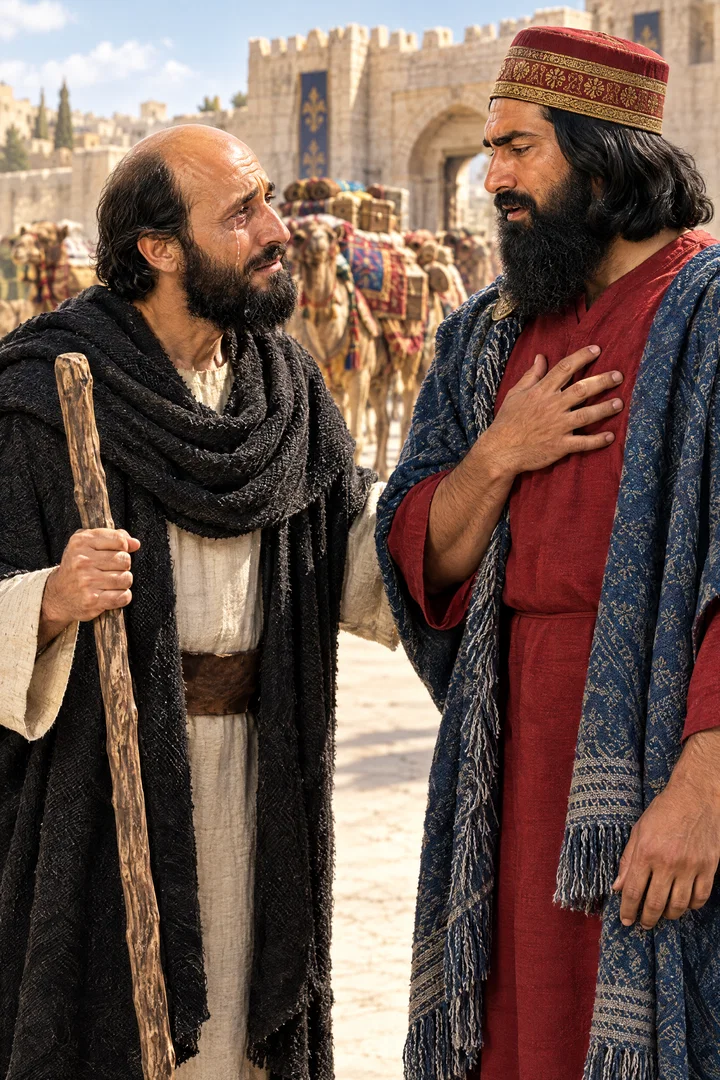
And he settled his countenance stedfastly, until he was ashamed: and the man of God wept.
Translations
American King James Version, Webster Bible
And he settled his countenance steadfastly, until he was ashamed: and the man of God wept.
King James Version, KJV Cambridge Paragraph Bible
And he settled his countenance stedfastly, until he was ashamed: and the man of God wept.
Revised Version, American Standard Version
And he settled his countenance stedfastly upon him, until he was ashamed: and the man of God wept.
And he setteth his face, yea, he setteth [it] till he is ashamed, and the man of God weepeth.
And he settled his countenance stedfastly, until he was ashamed; and the man of God wept.
And he settled his countenance, and fixed it until he turned pale,—and the man of God, wept.
Berean Standard Bible, Majority Standard Bible
Elisha fixed his gaze steadily on him until Hazael became uncomfortable. Then the man of God began to weep.
He settled his gaze steadfastly on him, until he was ashamed. Then the man of God wept.
And he kept his eyes fixed on him till he was shamed, and the man of God was overcome with weeping.
And hee looked vpon him stedfastly, till Hazael was ashamed, and the man of God wept.
Douay-Rheims (Challoner revision)
And he stood with him, and was troubled so far as to blush: and the man of God wept.
Pictures
Cross-references
- 2 Kings 8:15
And it came to pass on the morrow, that he took a thick cloth, and dipped it in water, and spread it on his face, so that he died: and Hazael reigned in his stead.
Hazael kills Ben-hadad, fulfilling the prediction.
Commentary
Each commentary is drawn from primary sources: the writings of Ellen G. White and Adventist pioneers and periodicals. Each commentary is separate. Its own words are not a quotation; follow the references to read the source passages.
Ellen G. White
4 sources
The scene is in Damascus, where messengers sent by Ben-hadad come to Elisha to learn whether the king will recover from his sickness, and Elisha bears faithful witness to them in that meeting.PK 255.1 Elisha fixes his gaze steadily upon Hazael until Hazael is ashamed, and then the man of God weeps.Lt 15, 1898, par. 17–19 He weeps because he foresees the evil that Hazael will do.Lt 15, 1898, par. 13–16
That steadfast gaze marks the moment when Hazael's test comes to him over whether he will become a traitor and a betrayer.Lt 15, 1898, par. 1–5 The test is whether he will barter his own soul for a mess of pottage, committing a crime to ward off financial embarrassment and robbing the cause of God in order to be revenged.Lt 15, 1898, par. 1–5 It is a life-and-death question on the edge of a precipice, deciding eternal destiny, with fearful and fatal effect upon his eternal welfare if he goes forward in separating himself forever from God and from the people of God.Lt 15, 1898, par. 1–5
Hazael thus stands as a memorable example of the depths of evil to which men sink when under the control of satanic agencies, illustrating the solemn truth that the heart is deceitful above all things and desperately wicked, and he is by no means the only such illustration.Lt 15, 1898, par. 13–16Lt 15, 1898, par. 17–19 Satan takes advantage of circumstances to arouse all the evil tendencies of the natural heart and sets every evil propensity on fire, until a man who had every opportunity for obtaining a rich experience in spiritual things but did not appreciate his advantages becomes the dupe of deception and falsehood, little knowing the evil of the unsubdued natural heart.Lt 15, 1898, par. 13–16 A mere spark is enough to turn such an unsanctified temper into a seething cauldron that he cannot control, so that he is no longer master of himself, Satan speaks through him as a channel for the power of darkness, and having long been subjected to Satan's molding control he has no power to escape the snare.Lt 15, 1898, par. 13–16
Sources
Pioneers and periodicals
11 sources
The verse stands in the record of 2 Kings 1 to 12, which covers Elijah still acting and being taken up to heaven in a whirlwind with God's chariots, Elisha receiving Elijah's mantle and working mighty miracles, and the reigns of Ahaziah and Joram over Israel, Jehoram and Ahaziah over Judah, Jehu anointed king and slaying Joram, Ahaziah of Judah, Jezebel and the worshipers of Baal, Athaliah usurping the kingdom of Judah, and Joash hidden until proclaimed king with Athaliah slain, with good kings at times in Judah but kings in Israel invariably weak or bad.ST May 27, 1913 More narrowly, it is part of the historical account of Ben-hadad's reign in Damascus and Hazael's succession to him, belonging to the history of Hazael and Jehu.ST Jul 30, 1885 The account tells of Hazael succeeding Ben-hadad as king of Damascus at the same time Jehu succeeded Ahab as king of Israel, exactly as told, and outside records confirm it.ST Nov 20, 1884 Shalmaneser of Assyria records fighting Ben-hadad of Damascus in his sixth year, when Ahab of Israel sent two thousand chariots and ten thousand infantry to help Ben-hadad, and twelve years later records attacking Hazael of Damascus, showing Hazael had replaced Ben-hadad and Jehu had replaced Ahab in the interval.ST Nov 20, 1884
In that history Assyria later campaigned against Hazael, and Israel under Jehu submitted and paid tribute to Shalmaneser. Hazael obtained the throne of Syria through treachery and murder, with Ben-hadad's death connected not to the illness itself but to harmful treatment, likened to a thick, wet cloth spread over his face that smothered him.ST Nov 19, 1902RH Jun 1, 1916 God appointed Hazael king of Syria, knowing he would treat Israel cruelly, and used him as an agent to punish Ahab and Israel.ST Jul 7, 1898 Elisha recognized Hazael as the man God had revealed would become king of Syria and bring great evil on Israel.PGGC 68.2–69.1
Elisha fixed his gaze steadily on Hazael until Hazael was ashamed, as the full significance of Hazael's case came vividly to him.PGGC 68.2–69.1ST Nov 19, 1902GSAM 379.2–3 The account shows Elisha could reveal through prophetic insight what he had learned in vision about a person he had not met.PGGC 68.2–69.1RH Nov 5, 1914PGGC 73.1 Then the man of God wept because he knew what Hazael would do, and his tears teach that the wickedness of the ungodly is a cause for grief and pity.PGGC 68.2–69.1GSAM 379.2–3RH Oct 29, 1861 The scene serves as a parallel to a prophetic testimony that foretold how a person would respond when reproved, with the predicted response then occurring as described.PGGC 73.1 The smothering of the king applies as a warning to people who die because of poor diets, quack remedies, and irrational treatment.ST Nov 19, 1902
Sources