2 Kings 9:13
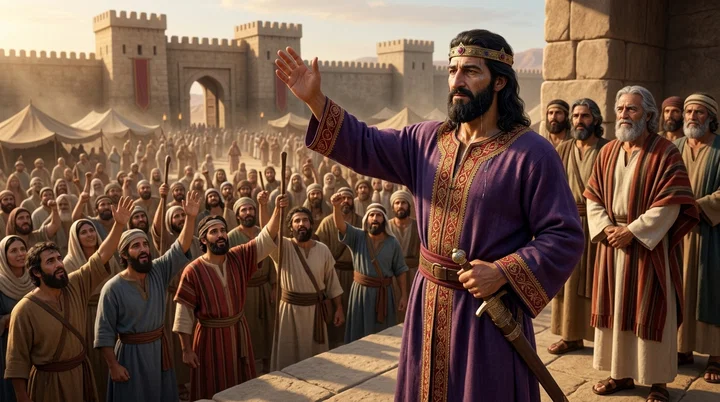
Then they hasted, and took every man his garment, and put it under him on the top of the stairs, and blew with trumpets, saying, Jehu is king.
Translations
Then they hurried, and took every man his garment, and put it under him on the top of the stairs, and blew with trumpets, saying, Jehu is king.
King James Version, KJV Cambridge Paragraph Bible, Webster Bible
Then they hasted, and took every man his garment, and put it under him on the top of the stairs, and blew with trumpets, saying, Jehu is king.
Revised Version, American Standard Version
Then they hasted, and took every man his garment, and put it under him on the top of the stairs, and blew the trumpet, saying, Jehu is king.
And they haste and take each his garment, and put [it] under him at the top of the stairs, and blow with a trumpet, and say, 'Reigned hath Jehu!'
Then they hasted and took every man his garment, and put it under him on the very stairs, and blew with trumpets, and said, Jehu is king!
Then hasted they, and took, every man his garment, and put it under him, upon the very steps,—and blew with a horn, and said, Jehu, is king!
Berean Standard Bible, Majority Standard Bible
Quickly, each man took his garment and put it under Jehu on the bare steps. Then they blew the ram’s horn and proclaimed, “ Jehu is king!”
Then they hurried, and each man took his cloak, and put it under him on the top of the stairs, and blew the trumpet, saying, “ Jehu is king.”
Then straight away everyone took his robe and put it under him on the top of the steps, and, sounding the horn, they said, Jehu is king.
Then they made haste, and tooke euerie man his garment, and put it vnder him on the top of the staires, and blewe the trumpet, saying, Iehu is King.
Douay-Rheims (Challoner revision)
Then they made haste and taking every man his garment laid it under his feet, after the manner of a judgment seat, and they sounded the trumpet, and said: Jehu is king.
Pictures
Cross-references
- Matthew 21:7-8
And brought the ass, and the colt, and put on them their clothes, and they set him thereon.
Garments are spread beneath the king in acts of public acclamation.
- Mark 11:7
And they brought the colt to Jesus, and cast their garments on him; and he sat upon him.
Garments spread before Jesus proclaim him as king.
- 1 Kings 16:29-30
And in the thirty and eighth year of Asa king of Judah began Ahab the son of Omri to reign over Israel: and Ahab the son of Omri reigned over Israel in Samaria twenty and two years.
Identifies Ahab, whom Jehu succeeded.
Commentary
Each commentary is drawn from primary sources: the writings of Ellen G. White and Adventist pioneers and periodicals. Each commentary is separate. Its own words are not a quotation; follow the references to read the source passages.
Pioneers and periodicals
12 sources
Then they hastened to proclaim Jehu king of Israel after he was anointed and took the kingdom following the death of Joram, succeeding Ahab and beginning a new dynasty.ST May 5, 1909ST May 27, 1913ST Nov 20, 1884 The chapter is the account of his rise as king and of the extinction of the house of Ahab.ST May 13, 1908ST Nov 20, 1884 Spreading every man his garment beneath him on the top of the stairs, with trumpet blowing and the shout that Jehu is king, was the customary public form and initial act for proclaiming an anointed man as king.ST Sep 18, 1884ST Sep 27, 1899ST Sep 27, 1899 The verse falls at the chronological transition between the reigns of the kings of Israel, and its date can be related to the reigns of the kings of Israel and Judah.ST Dec 8, 1887
In its setting Jehu was raised up by God to destroy the house of Ahab when its punishment was due.ST May 13, 1908ST Sep 8, 1881RH Aug 1, 1871 The background of that doom includes Jezebel's scheme to obtain Naboth's vineyard, which led to the doom of both Ahab and herself.ST Jul 14, 1898 After destroying Ahab's house Jehu fiercely rooted Baal worship out of Israel.ST May 13, 1908ST Sep 8, 1881RH Aug 1, 1871 Yet he continued Jeroboam's sin of using images to represent the true God, in effect worshiping himself, and so failed to redeem Israel from false worship though he might have done so had he not worshiped himself.ST May 13, 1908ST Sep 8, 1881RH Aug 1, 1871
Jehu as king of Israel in this period is also named in Assyrian records.ST Nov 20, 1884RH Sep 7, 1905 The name Jehu king of Israel appears on the Black Obelisk of Shalmaneser II, which depicts and lists tribute brought from him.ST Nov 20, 1884RH Sep 7, 1905 Those records incorrectly call him the son of Omri, the founder of Ahab's dynasty.ST Nov 20, 1884 This king-making ceremony explains the public honors given to Jesus at His entry into Jerusalem, when the disciples laying their garments on the colt for Him to sit on was the same act proclaiming Him king and making the first move to hail Him, in expectation that the long-expected Messianic reign was about to open, formally proclaiming His kingship in fulfillment of prophecy.ST Sep 18, 1884ST Sep 27, 1899ST Sep 27, 1899
Sources