2 Peter 1:14
Knowing that shortly I must put off this my tabernacle, even as our Lord Jesus Christ hath shewed me.
Translations
Knowing that shortly I must put off this my tabernacle, even as our Lord Jesus Christ has showed me.
Knowing that shortly I must put off this my tabernacle, even as our Lord Jesus Christ hath shewed me.
knowing that shortly I must put off this my tabernacle, even as our Lord Jesus Christ hath shewed me.
Knowing that shortly I must put off this my tabernacle, even as our Lord Jesus Christ hath shown me.
Revised Version, American Standard Version
knowing that the putting off of my tabernacle cometh swiftly, even as our Lord Jesus Christ signified unto me.
having known that soon is the laying aside of my tabernacle, even as also our Lord Jesus Christ did shew to me,
knowing that the putting off of my tabernacle is speedily [ to take place], as also our Lord Jesus Christ has manifested to me;
Knowing that, speedy, is the putting off of my tent—even as, our Lord Jesus Christ also, made clear to me:
Berean Standard Bible, Majority Standard Bible
because I know that this tent will soon be laid aside, as our Lord Jesus Christ has made clear to me.
knowing that the putting off of my tent comes swiftly, even as our Lord Jesus Christ made clear to me.
For I am conscious that in a short time I will have to put off this tent of flesh, as our Lord Jesus Christ has made clear to me.
Seeing I knowe that the time is at hand that I must lay downe this my tabernacle, euen as our Lord Iesus Christ hath shewed me.
Douay-Rheims (Challoner revision)
Being assured that the laying away of this my tabernacle is at hand, according as our Lord Jesus Christ also hath signified to me.
Pictures
Cross-references
- John 21:18-19
Verily, verily, I say unto thee, When thou wast young, thou girdedst thyself, and walkedst whither thou wouldest: but when thou shalt be old, thou shalt stretch forth thy hands, and another shall gird thee, and carry thee whither thou wouldest not.
Jesus foretold Peter’s death and how it would glorify God.
- 2 Corinthians 5:1
For we know that if our earthly house of this tabernacle were dissolved, we have a building of God, an house not made with hands, eternal in the heavens.
Both use a tabernacle for the present body and earthly life.
- Philippians 1:23
For I am in a strait betwixt two, having a desire to depart, and to be with Christ; which is far better:
Both describe departing this life to be with Christ.
- 2 Timothy 4:6
For I am now ready to be offered, and the time of my departure is at hand.
Both describe an approaching death as a departure.
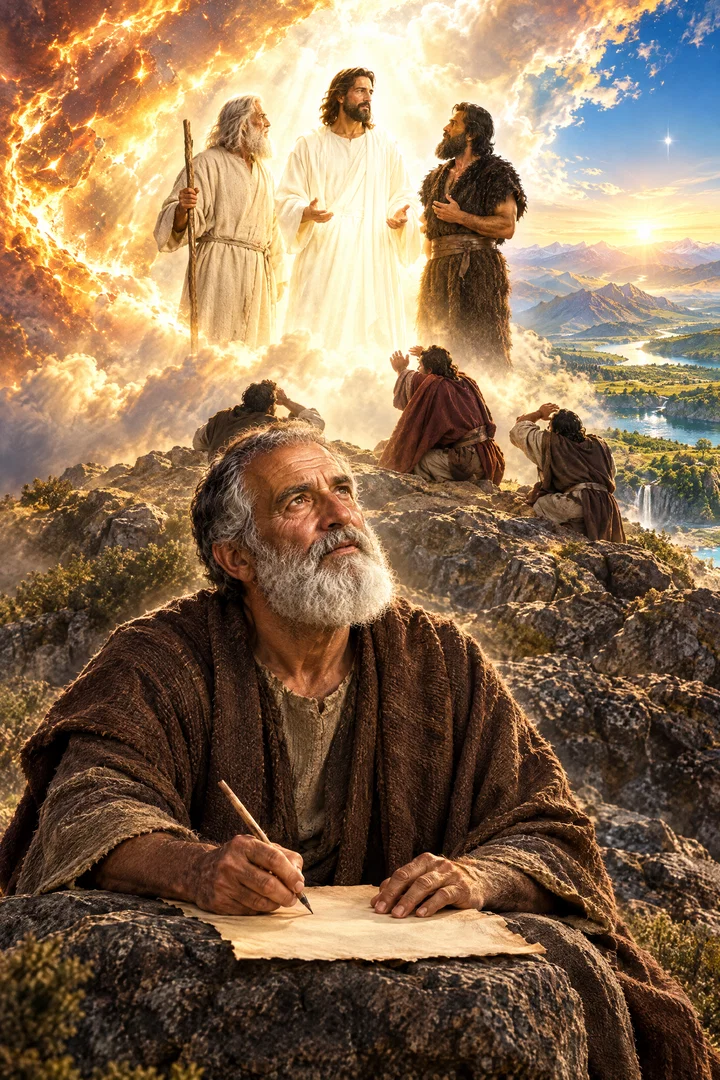
- Matthew 17:1-5
And after six days Jesus taketh Peter, James, and John his brother, and bringeth them up into an high mountain apart,
Recalls Jesus’ glory and the heavenly voice on the holy mount.
- 1 Corinthians 6:19
What? know ye not that your body is the temple of the Holy Ghost which is in you, which ye have of God, and ye are not your own?
Both describe the body as a dwelling place of the Holy Spirit.
- 1 Corinthians 15:51-55
Behold, I shew you a mystery; We shall not all sleep, but we shall all be changed,
The change and putting on of immortality happen at the last trumpet.
- Philippians 3:21
Who shall change our vile body, that it may be fashioned like unto his glorious body, according to the working whereby he is able even to subdue all things unto himself.
Christ will transform believers’ bodies to be like his glorious body.
Commentary
Each commentary is drawn from primary sources: the writings of Ellen G. White and Adventist pioneers and periodicals. Each commentary is separate. Its own words are not a quotation; follow the references to read the source passages.
Ellen G. White
23 sources
Peter knew he would shortly lay aside his present earthly bodily life and dwelling in death, because the Lord Jesus Christ had showed and revealed it to him beforehand.Ms 41, 1908, par. 25–27Ms 79, 1912, par. 6–8Ms 49, 1909, par. 7–8AA 533.2–534.1 He expected to lay down his earthly life as a martyr for his faith.AA 533.2–534.1Ms 183, 1907, par. 30 While still in the body he counted it right to stir up believers by putting them in remembrance of things they already knew, laboring with his remaining time so that after his decease they would always have these truths that support their eternal welfare in remembrance.Ms 41, 1908, par. 25–27Ms 79, 1912, par. 6–8Ms 23, 1910, par. 9–10Ms 78, 1910, par. 5–7 The verse stands in a chapter full of instruction that strikes the keynote of victory, presenting Jesus Christ as the believer's only hope and complete dependence to whom every trial is to be brought in trust.12MR 120.1Ms 80, 1894, par. 5Ms 1, 1895, par. 34–35 It is an urgent call to keep advancing by working on the plan of addition, adding daily grace to grace and virtue to virtue while God works on the plan of multiplication, becoming partakers of the divine nature through the knowledge of Christ, holding fast and cooperating with God without giving up, and acting at once upon the light received.Lt 103, 1902, par. 14–15Ms 78, 1910, par. 13–14Ms 71, 1911, par. 13–16Ms 163, 1898, par. 16–1721MR 296.3
Peter's Approaching Death
The tabernacle is the present earthly bodily life and dwelling in which Peter then lived.Ms 49, 1909, par. 7–8AA 533.2–534.1Ms 23, 1910, par. 9–10Ms 68, 1905, par. 17Ms 164, 1907, par. 29–31 To put it off is to lay that body aside in death, laying down the earthly life.AA 533.2–534.1Ms 23, 1910, par. 9–10Ms 68, 1905, par. 17 Peter knew that he must do this shortly.Ms 41, 1908, par. 25–27Ms 79, 1912, par. 6–8Ms 49, 1909, par. 7–8Ms 23, 1910, par. 9–10Ms 78, 1910, par. 5–7 He knew it because the Lord Jesus Christ had showed and revealed it to him beforehand.Ms 41, 1908, par. 25–27Ms 79, 1912, par. 6–8Ms 49, 1909, par. 7–8AA 533.2–534.1Ms 23, 1910, par. 9–10 He expected to lay down his earthly life as a martyr for his faith.AA 533.2–534.1 Persecution took his life.Ms 183, 1907, par. 30
Urgency of Remembrance
Knowing that he must shortly put off his tabernacle, Peter thought it right while still in this tabernacle to stir believers up by putting them in remembrance.Ms 41, 1908, par. 25–27Ms 79, 1912, par. 6–8Ms 78, 1910, par. 5–7 What he pressed upon them was not unknown, but things they already knew and were established in, present truth to be kept before the mind.Ms 41, 1908, par. 25–27Ms 78, 1910, par. 5–7 He spoke with full confidence that they would carry out the principles he presented, using his remaining time to keep them before their minds and to help their memories.Ms 41, 1908, par. 25–27Ms 79, 1912, par. 6–8Ms 78, 1910, par. 13–14 His labor and endeavor was that after his decease they would have these truths that support their eternal welfare always in remembrance.Ms 41, 1908, par. 25–27Ms 79, 1912, par. 6–8Ms 23, 1910, par. 9–10Ms 78, 1910, par. 5–7
Caution and repeating the evidences of the Word must not offend.Ms 79, 1912, par. 6–8 Believers are fitting for immortality and for the glory to be revealed at the revelation of Jesus Christ, and must be careful at every step not to give offense to Jesus Christ who bought them with the price of His own blood.Ms 79, 1912, par. 6–8 His nearness to death gives weight to his witness that the apostles had not followed cunningly devised fables in making known the power and coming of the Lord Jesus Christ. They were eyewitnesses of His majesty when He received honor and glory from God the Father and they heard the voice from heaven on the holy mount. That witness points to the more sure word of prophecy to be heeded as a light in a dark place until the day dawn and the daystar arise in the heart, with that voice of heaven still coming today to souls striving for victory over sin.
For everyone now the verse means that angels are present.Ms 78, 1910, par. 5–7 It means that the Holy Spirit must impress the human heart, and that the impression must be accepted.Ms 78, 1910, par. 5–7 It means that the heart must understand the principles of eternal life, and that daily work to that point is required.Ms 78, 1910, par. 5–7
Growth and Present Duty
The chapter where the verse stands is full of instruction that strikes the keynote of victory, with truth forced impressively upon the mind by the way it is presented.12MR 120.1 It presents Jesus Christ as the believer's only hope and complete dependence, to whom every little trial and large perplexity is to be brought in trust in Him as Helper, Strength, and sympathizing Friend who is touched with the feeling of infirmities.Ms 80, 1894, par. 5Ms 1, 1895, par. 34–35 That dependence is confessed by erecting the family altar in every home, presenting petitions to God morning and evening and bringing the whole family before God in recognition of dependence on Him and the claims of His service.Ms 1, 1895, par. 34–35 Asking His guidance confesses that Christ is Leader, Captain, and divine Teacher, and brings eternal reality to the view of every member of the family.Ms 1, 1895, par. 34–35
Advancement comes by working on the plan of addition, adding daily to the store of the knowledge of God and of Christ and adding grace to grace and virtue to virtue, while God works on the plan of multiplication.Lt 103, 1902, par. 14–15Ms 78, 1910, par. 13–14Ms 189, 1907, par. 9–11 Its promises are to be appreciated and its Word of the living God laid hold on as one's own, with the immortal promise of heaven and eternal life to those who do this.Ms 78, 1910, par. 13–14 The duty is to obey God's commandments as given in His Word and to carry out Christ's teachings in life, since disobedience leaves people unfit to enter God's kingdom and those who claim the city without a right to it will remain outside its gates.Ms 189, 1907, par. 9–11Ms 3, 1906, par. 10 Believers are to be divine partakers through the knowledge of Jesus Christ who gave His life to buy them with precious blood, which even the simplest person can take hold of.Ms 163, 1898, par. 16–17 God will not leave those who stand in Christ to drift with temptation and does nothing without cooperation and will not force anyone to drink of the water of life, but whoever determines to make of himself all God intended and stands complete in Christ can become as precious in God's sight as Daniel, beloved of God, looked upon as an heir of God and joint heir with Jesus Christ to the immortal inheritance.Ms 163, 1898, par. 16–17
Seeking first the kingdom of God and His righteousness enlists heart, mind, soul, and strength and affects the entire character, and following the principles outlined in the chapter secures life insurance while seeking the righteousness of Christ.Ms 33, 1901, par. 2 It makes seekers one with the Saviour and partakers of the divine nature, molding character after the similitude of Christ and growing it into a holy temple for the Lord, so that through them light shines to the church and to the world.Ms 33, 1901, par. 2 The verse belongs to an urgent call to keep growing in grace and to hold fast to what God has given and cooperate with God and never give up the effort to overcome, because the struggle against evil continues throughout life.Ms 71, 1911, par. 13–16 The promises of God provide light as long as life lasts, even if death comes suddenly.Ms 71, 1911, par. 13–16 Its truths give comfort and encouragement to all who have obtained like precious faith, are to be read in the churches as an uplifting testimony, and when they fill the heart and mind they give strength to resist every temptation to look on the dark side of circumstances and to talk discouragement.Lt 18, 1912, par. 2–3
The first chapter presents the experiences that fit men and women to become efficient workers for God and is to be studied by all who offer themselves for service in giving the last message of mercy to the world.Lt 142, 1909, par. 15–16 Young people pursuing education, especially when surrounded by contaminating influences, need to study its words more abundantly and practice its precepts, making Christ their all in all rather than giving their minds up almost wholly to study, so that knowing their own weakness they go to God for strength and do not lose all that enriches life.12MR 120.1 The verse calls for acting at once upon light and evidence received, giving God the service of the whole mind and heart with every capability called for, and for great and earnest work because the world is fast ripening for the closing up of its history.21MR 296.3Ms 140, 1908, par. 6–9 Those truly serving the Lord Jesus will be a holy, sanctified people, communicating the light of truth to all around them not only in their households but outside them to those not in the faith.Ms 140, 1908, par. 6–9 When pressed with earnest prayer this makes a break upon hearers, bringing many forward for prayers and moving souls long on the point of decision to take their position to keep the Sabbath in decided victory.21MR 296.3
Sources
Pioneers and periodicals
21 sources
Peter's tabernacle is his body and present earthly life, a temporary dwelling soon to be laid aside, and to put it off is to die and end earthly life.RH Oct 30, 1855RH Sep 22, 1859RH Oct 24, 1885RH Nov 18, 1858 The I and my are Peter himself as a whole unified person, not a separate soul leaving the body, while those who held that pronouns point to the conscious responsible person taught they refer to his soul as well.ST Dec 7, 1882RH Oct 30, 1855RH Sep 22, 1859RH Nov 12, 1872 He knew his death was near and would soon come as a martyr for his faith when he was old, even as the Lord Jesus Christ had showed him.RH Sep 26, 1912RH Oct 30, 1855RH Sep 22, 1859 Putting off the tabernacle does not show that an immortal soul leaves the body, for Peter himself and not merely his body was to die.ST Dec 7, 1882RH Oct 30, 1855RH Sep 22, 1859 The hope beyond death is the renewal of the whole person at the resurrection, when the dead are raised incorruptible and the living are changed, for being clothed with immortality and receiving a glorified body is not given individually at death but to the whole church together when Jesus comes.RH Oct 24, 1885RH Nov 18, 1858RH Aug 12, 1862ST Aug 21, 1879
Words and Setting
The tabernacle is the body, the present earthly life itself, a temporary dwelling soon to be laid aside, the body and form received from Adam.RH Oct 24, 1885ST Mar 4, 1897ST Jul 14, 1914 To be in the tabernacle is to remain alive, and to put it off is to die and bring earthly life to an end.RH Nov 18, 1858RH Aug 12, 1862 When Peter meant his own death he spoke of it plainly as putting off this tabernacle.RH Oct 30, 1855RH Sep 22, 1859ST Feb 3, 1881
The I and my are Peter himself as a whole person, not a separate soul leaving the body.RH Oct 30, 1855RH Sep 22, 1859 A person can speak possessively of parts of his single unified being without those parts being separate personalities continuing independently.ST Dec 7, 1882 On the argument that personal pronouns refer to the conscious responsible person, the I and my refer to Peter as a person and to his soul as well, not merely to his body, and the verse is set against the claim that it proves an independently conscious immortal soul.RH Nov 12, 1872
Peter knew his death was near and would soon come, even as the Lord Jesus Christ had showed him.ST Jul 14, 1914 He would die as a martyr for his faith at the hands of his enemies when he was old.RH Sep 26, 1912RH Oct 30, 1855RH Sep 22, 1859 The Bible gives no further information about when, how, or where he died.ST Apr 16, 1896
Death, Resurrection and Return
Putting off the tabernacle is Peter's own approaching death, not the departure of a separate immortal soul from the body, for it is Peter himself who was to die and not merely his body.ST Dec 7, 1882RH Oct 30, 1855RH Sep 22, 1859 The tabernacle is his body and his present earthly life, so that to remain in it is to remain alive and to put it off is to end earthly life.RH Oct 30, 1855RH Sep 22, 1859RH Nov 18, 1858RH Aug 12, 1862 The words I and my do not prove an intelligent soul dwelling in the body and living on independently, since they refer to Peter himself as a whole person, and a single unified person may properly speak possessively of parts of himself without making them separate personalities continuing on their own.ST Dec 7, 1882RH Sep 22, 1859 The verses describe no soul separating from the body, and the hope they point to beyond such death is the renewal of the whole person at the resurrection.RH Nov 18, 1858RH Aug 12, 1862 What Jesus had shown him was that he would die as a martyr at the hands of his enemies when he was old, and that after his death his written teaching would still keep his readers in remembrance.RH Oct 30, 1855RH Sep 22, 1859
Putting off the earthly tabernacle at death is distinct from being clothed upon with immortality.RH Oct 24, 1885ST Aug 21, 1879 The glorified body is not given to the believer individually at death, but is obtained only together by the whole church when Jesus comes.RH Oct 24, 1885ST Aug 21, 1879 Then the dead are raised incorruptible and the living are changed.RH Oct 24, 1885 Dying therefore affects only the individual, when the spirit goes to the Lord Jesus Christ and leaves behind the brethren and sisters in Christ, the church militant.ST Aug 21, 1879 By contrast the return of the Lord has to do with the whole body of Christians, including all saints living on earth at that time, all saints under the present dispensation who have fallen asleep, and all old covenant believers such as Abraham, Isaac and Jacob who trusted in the Messiah for the salvation of their souls.ST Aug 21, 1879
Peter knew he must shortly die before Christ returned, and so he did not expect the second advent in his own day or lifetime.ST Oct 3, 1878ST May 15, 1907ST Mar 8, 1883 When he meant his own death he spoke of it plainly as putting off his tabernacle, and that death was not the end of all things.ST Feb 3, 1881 His words about the end being near therefore do not mean that he expected Christ to come in his own lifetime.ST May 15, 1907
Witness and Application
The opening chapter sets out eight graces to be added — faith, virtue, knowledge, temperance, patience, godliness, brotherly kindness and charity — with the promise that if these abound believers will be neither barren nor unfruitful in the knowledge of Jesus Christ and that by doing them abundant entrance into His everlasting kingdom will be secured.RH Feb 5, 1861 Within that setting, virtue, temperance, patience and godliness belong to righteousness or right doing which is the white raiment, knowledge belongs to the anointing from on high by which believers see and know the things of everlasting peace which is the eye-salve, and faith and charity, more fully expressed as faith, hope and charity, belong to the gold.RH Feb 5, 1861
Because the end of earthly life was near, it was right while still in the tabernacle to stir believers up by putting them in remembrance of present truth and to labor so that they would have these things always in remembrance after decease.RH Sep 22, 1859 That nearness of death gives weight to the witness that the apostles had not followed cunningly devised fables in making known the power and coming of the Lord, but were eyewitnesses of His majesty when He received honor and glory from God the Father and the voice from heaven was heard on the holy mount. What was seen there was a representation of Christ coming in His kingdom in glory and majesty, fulfilling the promise that some standing by would not taste death till they saw the Son of Man coming in His kingdom, with Christ glorified as He will be, Moses present as representative of the righteous dead raised and glorified, and Elijah present as representative of the living saints immortalized without dying.ST Sep 13, 1905 This confirms the more sure word of prophecy to be heeded as a light in a dark place until the day dawn and the daystar arise in the heart, with the voice of heaven still coming today to souls striving for victory over sin.
Life in the body is temporary and a person may know that death is approaching, which makes precious faith especially valuable.ST Nov 21, 1892 Without it, one may grieve its loss and be left without hope for this life or the life to come.ST Nov 21, 1892 Death is the putting off of the body or earthly dwelling, in the hope of meeting the Saviour at His coming.RH Jan 9, 1900
Sources