2 Samuel 1:3
And David said unto him, From whence comest thou? And he said unto him, Out of the camp of Israel am I escaped.
Translations
And David said to him, From where come you? And he said to him, Out of the camp of Israel am I escaped.
King James Version, KJV Cambridge Paragraph Bible, Revised Version, American Standard Version
And David said unto him, From whence comest thou? And he said unto him, Out of the camp of Israel am I escaped.
And David said to him, From whence comest thou? And he said to him, Out of the camp of Israel have I escaped.
And David saith to him, 'Whence comest thou?' and he saith unto him, 'Out of the camp of Israel I have escaped.'
And David said to him, Whence comest thou? And he said to him, Out of the camp of Israel am I escaped.
And David said unto him, From whence comest thou? And he said unto him, Out of the camp of Israel, am I escaped.
Berean Standard Bible, Majority Standard Bible
“ Where have you come from?” David asked.“ I have escaped from the Israelite camp,” he replied.
David said to him, “ Where do you come from?”He said to him, “ I have escaped out of the camp of Israel.”
And David said to him, Where have you come from? And he said, I have come in flight from the tents of Israel.
Then Dauid saide vnto him, Whence commest thou? And he said vnto him, Out of the host of Israel I am escaped.
Douay-Rheims (Challoner revision)
And David said to him: From whence comest thou? And he said to him: I am fled out of the camp of Israel.
Pictures
Cross-references
- 1 Samuel 31:1-6
Now the Philistines fought against Israel: and the men of Israel fled from before the Philistines, and fell down slain in mount Gilboa.
Describes the battle the messenger escaped from and Saul’s death behind his report.
- 2 Samuel 1:14-16
And David said unto him, How wast thou not afraid to stretch forth thine hand to destroy the LORD’s anointed?
David questions and executes the messenger for claiming a part in Saul’s death.
Commentary
Each commentary is drawn from primary sources: the writings of Ellen G. White and Adventist pioneers and periodicals. Each commentary is separate. Its own words are not a quotation; follow the references to read the source passages.
Ellen G. White
1 source
David put a direct question to the newly arrived messenger about where he had come from.PP 694.3–695.2 The man answered that he had escaped from Israel's camp.PP 694.3–695.2 He had come bearing news of the battle in which Saul and Jonathan had died.PP 694.3–695.2
Sources
Pioneers and periodicals
6 sources
2 Samuel 1 stands immediately after the record of King Saul's death in 1 Samuel 31.ST It belongs to the account of David's rising career and the events surrounding Saul's fall, a narrative that shows God's providence shaping national events.ST Apr 11, 1911 The verse records David asking the messenger from where he had come, and the messenger answering that he had escaped out of the camp of Israel.STST Apr 29, 1913ST Apr 7, 1909ST
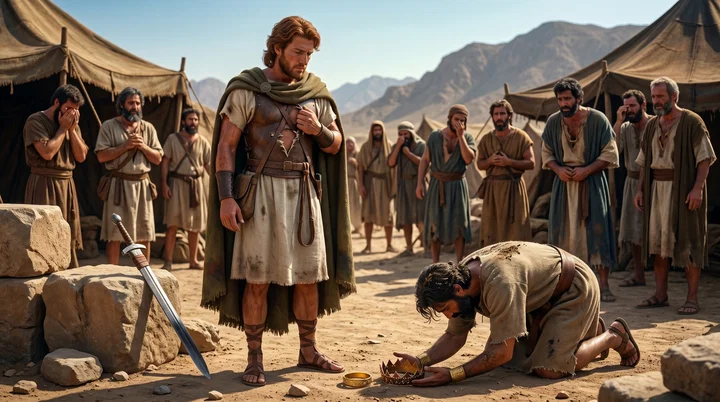
The messenger was an Amalekite who had come from Israel's camp after Saul's defeat.ST Apr 7, 1909 His answer opens the account in which he brings David news of Israel's defeat and Saul's death.STST Apr 29, 1913ST
David receives that news with grief over Saul rather than rejoicing.STST Apr 11, 1911ST The surrounding chapter reveals David's character through his treatment of the messenger, who claimed a part in slaying Saul and was later put to death for it.ST Apr 7, 1909ST
Sources