2 Samuel 1:9
He said unto me again, Stand, I pray thee, upon me, and slay me: for anguish is come upon me, because my life is yet whole in me.
Translations
He said to me again, Stand, I pray you, on me, and slay me: for anguish is come on me, because my life is yet whole in me.
King James Version, KJV Cambridge Paragraph Bible
He said unto me again, Stand, I pray thee, upon me, and slay me: for anguish is come upon me, because my life is yet whole in me.
He said to me again, Stand, I pray thee, upon me, and slay me: for anguish is come upon me, because my life is yet whole in me.
And he said unto me, Stand, I pray thee, beside me, and slay me, for anguish hath taken hold of me; because my life is yet whole in me.
And he said unto me, Stand, I pray thee, beside me, and slay me; for anguish hath taken hold of me, because my life is yet whole in me.
'And he saith unto me, Stand, I pray thee, over me, and put me to death, for seized me hath the arrow, for all my soul [is] still in me.
He said to me again, Stand, I pray thee, over me, and slay me; for anguish has seized me; for my life is yet whole in me.
And he said unto me, I pray thee, take thy stand by me, and put me to death, for the cramp hath seized me,—even for as long as my life shall be in me.
Berean Standard Bible, Majority Standard Bible
Then he begged me, ‘ Stand over me and kill me, for agony has seized me, but my life still lingers.’
He said to me, ‘ Please stand beside me, and kill me, for anguish has taken hold of me because my life lingers in me.’
Then he said to me, Come here to my side, and put me to death, for the pain of death has me in its grip but my life is still strong in me.
Then saide hee vnto me, I pray thee come vpon mee, and slay me: for anguish is come vpon me, because my life is yet whole in me.
Douay-Rheims (Challoner revision)
And he said to me: Stand over me, and kill me: for anguish is come upon me, and as yet my whole life is in me.
Pictures
Cross-references
- 1 Samuel 24:6
And he said unto his men, The LORD forbid that I should do this thing unto my master, the LORD’s anointed, to stretch forth mine hand against him, seeing he is the anointed of the LORD.
David refuses to kill Saul, whom God had anointed.
- 1 Samuel 31:4-6
Then said Saul unto his armourbearer, Draw thy sword, and thrust me through therewith; lest these uncircumcised come and thrust me through, and abuse me. But his armourbearer would not; for he was sore afraid. Therefore Saul took a sword, and fell upon it.
Records Saul’s death in the final battle.
- 1 Samuel 26:9
And David said to Abishai, Destroy him not: for who can stretch forth his hand against the LORD’s anointed, and be guiltless?
David again refused to strike Saul, the Lord’s anointed.
Commentary
Each commentary is drawn from primary sources: the writings of Ellen G. White and Adventist pioneers and periodicals. Each commentary is separate. Its own words are not a quotation; follow the references to read the source passages.
Ellen G. White
1 source
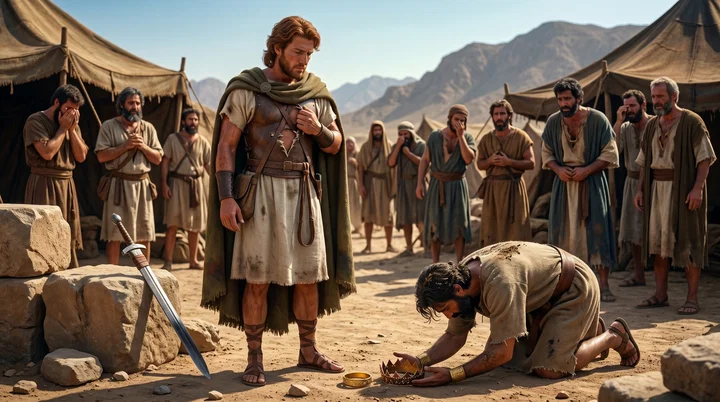
The wounded Saul was in anguish yet still alive when he reportedly asked the Amalekite to stand upon him and slay him.PP 694.3–695.2 The Amalekite claimed that he carried out that request.PP 694.3–695.2 He then brought Saul's crown and bracelets to David, apparently expecting a reward for the deed.PP 694.3–695.2 David instead mourned Saul and Jonathan.PP 694.3–695.2 He then sentenced the Amalekite to death on his own confession, because he had not feared to kill the Lord's anointed, and his own testimony made him liable to death.PP 694.3–695.2
Sources
Pioneers and periodicals
4 sources
The verse records Saul wounded on the battlefield and in anguish yet still alive, asking the Amalekite to stand upon him and slay him.ST Apr 11, 1911 The word rendered life is the Hebrew nephesh, which occurs 745 times in the Old Testament and is rendered soul about 473 times.ST Jun 6, 1878 In this verse nephesh is rendered life, one of 118 places where it is rendered life or lives, and it is the word principally translated soul in the Old Testament, being the source of every soul in the Old Testament with only two exceptions, Job 30:15 where it comes from n'dee-vah and Isaiah 57:16 where it comes from n'shah-mah.ST Jun 6, 1878
The statement is the Amalekite's claim that he killed Saul at Saul's own request.ST Apr 7, 1909ST It belongs to the account of Saul's death in which a messenger brought the news to David expecting him to rejoice.ST The chapter then gives David's response to the man who said he slew Saul, who was slain for his part in Saul's death.ST Apr 7, 1909ST That response shows submission to the established government, for although already anointed king and hated by Saul, David would not take action against the Lord's anointed but left judgment to God.ST
Sources