2 Samuel 12:30
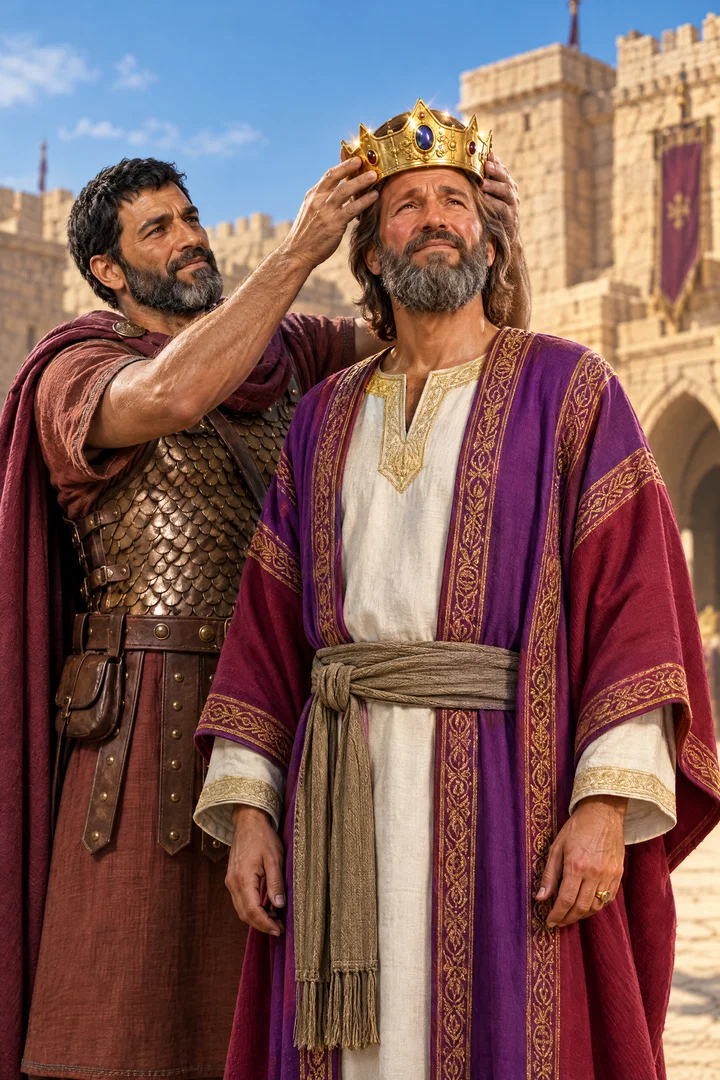
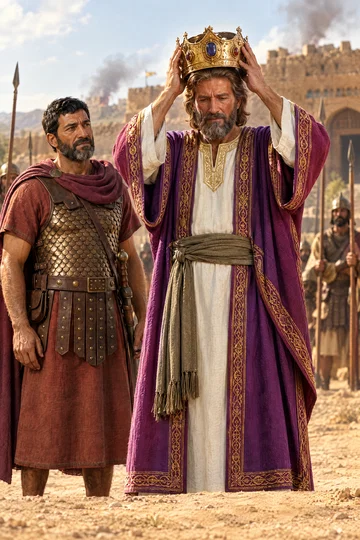
And he took their king’s crown from off his head, the weight whereof was a talent of gold with the precious stones: and it was set on David’s head. And he brought forth the spoil of the city in great abundance.
Translations
American King James Version, King James Version, KJV Cambridge Paragraph Bible
And he took their king’s crown from off his head, the weight whereof was a talent of gold with the precious stones: and it was set on David’s head. And he brought forth the spoil of the city in great abundance.
And he took their king's crown from off his head, the weight of which was a talent of gold with the precious stones: and it was set on David's head. And he brought forth the spoil of the city in great abundance.
Revised Version, American Standard Version
And he took the crown of their king from off his head; and the weight thereof was a talent of gold, and in it were precious stones; and it was set on David’s head. And he brought forth the spoil of the city, exceeding much.
and he taketh the crown of their king from off his head, and its weight [is] a talent of gold, and precious stones, and it is on the head of David; and the spoil of the city he hath brought out, very much;
And he took the crown of their king from off his head, the weight of which was a talent of gold with [ the] precious stones; and it was [ set] on David's head; and he brought forth the spoil of the city in great abundance.
Then took he the crown of Milcom from off his head, the weight thereof, being a talent of gold, with the precious stones, and it remained on the head of David,—the spoil of the city also, brought he forth in great abundance;
Berean Standard Bible, Majority Standard Bible
Then he took the crown from the head of their king. It weighed a talent of gold and was set with precious stones, and it was placed on David’s head. And David took a great amount of plunder from the city.
He took the crown of their king from off his head; and its weight was a talent of gold, and in it were precious stones; and it was set on David’s head. He brought a great quantity of plunder out of the city.
And he took the crown of Milcom from his head; the weight of it was a talent of gold, and in it were stones of great price; and it was put on David's head. And he took a great store of goods from the town.
And he tooke their Kings crowne from his head, (which weighed a talent of golde, with precious stones) and it was set on Dauids head: and he brought away the spoyle of the citie in exceeding great abundance.
Douay-Rheims (Challoner revision)
And he took the crown of their king from his head, the weight of which was a talent of gold, set with most precious stones, and it was put upon David’s head, and the spoils of the city which were very great he carried away.
Pictures
Cross-references
- 2 Samuel 11
And it came to pass, after the year was expired, at the time when kings go forth to battle, that David sent Joab, and his servants with him, and all Israel; and they destroyed the children of Ammon, and besieged Rabbah. But David tarried still at Jerusalem.
The account traces the consequences of David’s sin against Uriah.
- 1 Chronicles 20:3
And he brought out the people that were in it, and cut them with saws, and with harrows of iron, and with axes. Even so dealt David with all the cities of the children of Ammon. And David and all the people returned to Jerusalem.
Both describe David’s treatment of the Ammonites after their defeat.
Commentary
Each commentary is drawn from primary sources: the writings of Ellen G. White and Adventist pioneers and periodicals. Each commentary is separate. Its own words are not a quotation; follow the references to read the source passages.
Ellen G. White
4 sources
2 Samuel 12:30 belongs to the account of David's sin with Bathsheba and his murder of Uriah and its consequences.PP 719.1PP 719.4–720.1PP 719.2–321MR 169.1 In that account the verse follows David's plan to make Uriah the bearer of his own death-warrant, sending by his hand a letter to Joab commanding Joab to set Uriah in the forefront of the hottest battle and retire from him that he might be smitten and die.PP 719.1 Joab, already stained with the guilt of one wanton murder, obeyed without hesitation, and Uriah fell by the sword of the children of Ammon.PP 719.1 The verse comes after Joab sent a carefully worded message that Uriah the Hittite was dead also, and David answered with cold indifference that the sword devours one as well as another and Joab should make the battle stronger against the city and overthrow it.PP 719.4–720.1
Its setting is when David had departed from God and yielded himself to the wicked one, yet still held the position and authority God had given him.PP 719.2–3 It shows David exercising God-given power contrary to divine law and claiming an obedience that would imperil the soul of him who yielded it, as Joab did when he transgressed God's law because the king commanded it.PP 719.2–3 The setting contrasts with David's earlier course of keeping God's Word before him as king and standing firm, but when he turned from its teachings he damaged his good name.21MR 169.1 Royal power and victory do not prevent the harm and consequences that follow turning from God's commands.21MR 169.1
Sources
Pioneers and periodicals
10 sources
The verse records the taking of the Ammonite king's crown from off his head, its weight being a talent of gold with the precious stones, its being set on David's head, and the bringing forth of the spoil of the city in great abundance after victory in the subjection of the Ammonites.ST Dec 12, 1911ST Apr 29, 1908 That taking of crown and spoil came in a civil war against Ammon, a cruel nation and an enemy of Israel.ST Dec 12, 1911ST Oct 29, 1912 The verse belongs to the open, uncovered history told in detail in 2 Samuel 11 and 12, continued through 2 Samuel 11-24 and 1 Kings 1-2, after David's great wickedness in the case of Uriah, which gave great occasion to the enemies of the Lord to blaspheme and is neither covered up nor excused.RH Oct 12, 1869
That background was a year of idleness and luxury leading to temptation, adultery, plotting to take the life of the brave and loyal Uriah the Hittite to hide the sin, and carrying out the plot. Within that history Nathan as God's instrument reproved David, first by a parable and then plainly telling him he was the man, with warning, followed by the death of Bathsheba's child.RH Sep 7, 1869ST Sep 10, 1896 David quickly perceived and believed the prophet's word, bowed down with broken-hearted, humble confession that he had sinned against the Lord, confessing to God and publishing it to the world, and was forgiven in the matter of Uriah and afterward prospered, praising God for forgiveness even while still under punishment, with his confession standing on record for all future time.RH Sep 7, 1869RH Sep 14, 1869RH Oct 12, 1869ST Sep 10, 1896
The surrounding history is presented as the retribution that followed David through the rest of his life, especially in his family, showing how completely Nathan's terrible denunciation was accomplished in judgments upon David and showing sin bringing sorrow in kind.RH Apr 26, 1870ST Mar 31, 1881RH Oct 12, 1869 The account merely reports what David did to the Ammonites without excusing or condemning his conduct, and his treatment may have been cruel by a higher standard though he followed the customs of his time.ST Dec 12, 1911 By a different reckoning, his treatment of the Ammonites is presented as kind rather than cruel.ST Oct 29, 1912
His war was against an enemy of Israel, not a war to punish people for their religion, and wartime conduct gives no church a right to use religious belief as a reason for violence, since religious persecution targets people for conscience' sake and is a judgment God has reserved to himself.ST Dec 12, 1911ST Oct 29, 1912 After being brought to repentance David prayed for mercy according to loving-kindness, blotting out of transgressions, thorough washing and cleansing from iniquity, hiding of God's face from sins, creation of a clean heart, renewal of a right spirit, continuance in God's presence with the Holy Spirit, restoration of the joy of salvation, and upholding with a free Spirit.ST Jul 29, 1889 The forgiveness in the matter of Uriah is the supposed setting of Psalm 32, to be read with profit together with Psalm 51, and Psalm 32 may be studied with profit by every sinner because all have sinned.
The chapter teaches trembling when God speaks and, when reproved, doing more than merely admitting the reproof is true, but heartily repenting by confession and putting away the evil as far as is in human power.RH Sep 7, 1869RH Sep 14, 1869 The same self-abasement and earnest supplication required of David for violating God's holy, just, good and perfect law is required of sinners in Zion in this hour of judgment whose sympathies are always on the wrong side of error and whose lives reproach God's cause, rather than siding with the reprover's enemies, circulating false reports, or trying to conceal wrong.RH Sep 7, 1869RH Sep 14, 1869
Sources