2 Samuel 15:25
And the king said unto Zadok, Carry back the ark of God into the city: if I shall find favour in the eyes of the LORD, he will bring me again, and shew me both it, and his habitation:
Translations
American King James Version, Webster Bible
And the king said to Zadok, Carry back the ark of God into the city: if I shall find favor in the eyes of the LORD, he will bring me again, and show me both it, and his habitation:
King James Version, Revised Version
And the king said unto Zadok, Carry back the ark of God into the city: if I shall find favour in the eyes of the LORD, he will bring me again, and shew me both it, and his habitation:
And the king said unto Zadok, Carry back the ark of God into the city: if I shall find favour in the eyes of the Lord, he will bring me again, and shew me both it, and his habitation:
And the king said unto Zadok, Carry back the ark of God into the city: if I shall find favor in the eyes of Jehovah, he will bring me again, and show me both it, and his habitation:
And the king saith to Zadok, 'Take back the ark of God to the city; if I find grace in the eyes of Jehovah, then He hath brought me back, and shewn me it and His habitation;
And the king said to Zadok, Carry back the ark of God into the city. If I shall find favour in the eyes of Jehovah, he will bring me again, and shew me it, and its habitation.
Then said the king unto Zadok, Take back the ark of God into the city,—if I find favour in the eyes of Yahweh, then will he bring me back, and let me see both him and his habitation,
Berean Standard Bible, Majority Standard Bible
Then the king said to Zadok, “ Return the ark of God to the city. If I find favor in the eyes of the LORD, He will bring me back and let me see both it and His dwelling place again.
The king said to Zadok, “Carry God’s ark back into the city. If I find favor in the LORD’s eyes, he will bring me again, and show me both it and his habitation;
And the king said to Zadok, Take the ark of God back into the town: if I have grace in the eyes of the Lord, he will let me come back and see it and his House again:
Then the King said vnto Zadok, Carie the Arke of God againe into the citie: if I shall finde fauour in the eyes of the Lord, he will bring me againe, and shewe me both it, and the Tabernacle thereof.
Douay-Rheims (Challoner revision)
And the king said to Sadoc: Carry back the ark of God into the city: if I shall find grace in the sight of the Lord, he will bring me again, and he will shew me it, and his tabernacle.
Pictures
Cross-references
- 2 Samuel 15:30
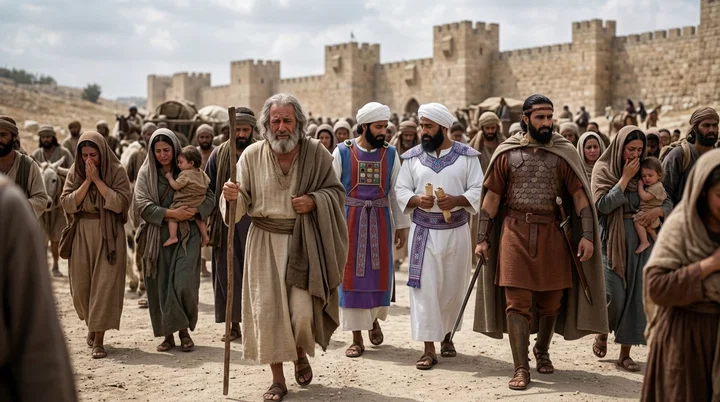
And David went up by the ascent of mount Olivet, and wept as he went up, and had his head covered, and he went barefoot: and all the people that was with him covered every man his head, and they went up, weeping as they went up.
David weeps as he flees Jerusalem over the Mount of Olives.
- 2 Samuel 15:1-14
And it came to pass after this, that Absalom prepared him chariots and horses, and fifty men to run before him.
Absalom’s rebellion drives David to flee and hope to return.
- Psalms 3
LORD, how are they increased that trouble me! many are they that rise up against me.
The psalm expresses David’s feelings during his flight from Absalom.
- 2 Samuel 17
Moreover Ahithophel said unto Absalom, Let me now choose out twelve thousand men, and I will arise and pursue after David this night:
Continues the account of David’s flight amid Absalom’s rebellion.
- 2 Samuel 19
And it was told Joab, Behold, the king weepeth and mourneth for Absalom.
David’s return after the rebellion echoes the hope of being brought back.
- 1 Kings 2:26
And unto Abiathar the priest said the king, Get thee to Anathoth, unto thine own fields; for thou art worthy of death: but I will not at this time put thee to death, because thou barest the ark of the Lord GOD before David my father, and because thou hast been afflicted in all wherein my father was afflicted.
Abiathar is spared because he carried the ark and suffered with David.
- 1 Kings 2:35
And the king put Benaiah the son of Jehoiada in his room over the host: and Zadok the priest did the king put in the room of Abiathar.
Solomon appoints Zadok in Abiathar’s place.
- 2 Samuel 16
And when David was a little past the top of the hill, behold, Ziba the servant of Mephibosheth met him, with a couple of asses saddled, and upon them two hundred loaves of bread, and an hundred bunches of raisins, and an hundred of summer fruits, and a bottle of wine.
Continues the account of the circumstances surrounding the flight.
- Psalms 132:14
This is my rest for ever: here will I dwell; for I have desired it.
Identifies Jerusalem as God’s chosen resting place.
- 2 Samuel 18:9-15
And Absalom met the servants of David. And Absalom rode upon a mule, and the mule went under the thick boughs of a great oak, and his head caught hold of the oak, and he was taken up between the heaven and the earth; and the mule that was under him went away.
Absalom’s rebellion ends in his death.
- John 18:1
When Jesus had spoken these words, he went forth with his disciples over the brook Cedron, where was a garden, into the which he entered, and his disciples.
Jesus crosses the Kidron, as David did.
Commentary
Each commentary is drawn from primary sources: the writings of Ellen G. White and Adventist pioneers and periodicals. Each commentary is separate. Its own words are not a quotation; follow the references to read the source passages.
Ellen G. White
3 sources
David was in flight from Jerusalem after forfeiting God's favor by his own course of action, humbled and mournful with his guilt and Nathan's solemn condemnation still ringing in his ears.Lt 61, 1890, par. 3–8 His expulsion from the throne and his humiliation were not the work of man, human passion, caprice, or merely man's device, but were from the Lord bringing the sure result of his sin.Lt 61, 1890, par. 3–8Lt 6, 1880, par. 14–17 The ark was the symbol of God's presence and of Israel's strength and glory, with its rest in the tabernacle of Zion, the Mount of Holiness, and its dwelling place.Lt 61, 1890, par. 3–8Lt 6, 1880, par. 14–17PP 735.1–3
Worldly wisdom would have kept the ark in flight to use it for advantage as a charm and pledge of victory, to rally Israel, win back the disaffected, and secure his own honor, life, and sinking fortunes.Lt 61, 1890, par. 3–8Lt 6, 1880, par. 14–17PP 735.1–3 But reverence and a high sense of right and sacred things would not allow kings or priests to remove it from Jerusalem without God's authority and divine command or to imperil it by his vicissitudes.Lt 6, 1880, par. 14–17PP 735.1–3 He would make no advancement until the priests returned it to its place, refusing to use it that way and sending it back to the city.Lt 61, 1890, par. 3–8Lt 6, 1880, par. 14–17
He left the outcome wholly with God, trusting that if he should find favor in the eyes of the Lord, the Lord would bring him back to see the ark and His habitation.Lt 61, 1890, par. 3–8Lt 6, 1880, par. 14–17PP 735.1–3 And if the Lord had no delight in him, he submitted to whatever the Lord saw fit to do to him and judged good.Lt 61, 1890, par. 3–8Lt 6, 1880, par. 14–17PP 735.1–3 This expresses humble submission to God's will, providence, and judgment amid uncertainty.Lt 6, 1880, par. 14–17PP 735.1–3 It was an unselfish and noble decision made in overwhelming affliction, refusing strategy and base expediency and refusing to do wrong in order that good might come to him.Lt 6, 1880, par. 14–17
Sources
Pioneers and periodicals
15 sources
David spoke these words while fleeing Jerusalem in grief across the Kidron during Absalom's conspiracy and revolt, surrounded by fear, persecution and treachery.ST Apr 29, 1908RH Aug 17, 1911RH Sep 4, 1855 He ordered Zadok to carry the ark of God back into the city instead of taking it with him or keeping it as a pledge of his return.ST Aug 25, 1914RH Mar 30, 1916RH Jul 27, 1869 His coming back was made dependent on finding favour in the eyes of the LORD, so that only if God willed it would he be brought again to see the ark and its dwelling place.ST May 6, 1913ST Aug 25, 1914RH Mar 30, 1916 In deep penitence he yielded himself to whatever the LORD should decide, accepting further humiliation, pain and loss as the due consequence of his own guilt.RH Jul 27, 1869RH Sep 4, 1855 That suffering belonged to the retribution that followed his wrong toward Uriah through trouble in his own divided house, teaching that transgression of God's law carries its curse within itself, yet such trials disciplined David into humility, nobleness of character and deep piety.ST Mar 31, 1881RH Apr 26, 1870ST Apr 29, 1908ST Oct 4, 1877
Flight and Submission to God
The word was spoken as David fled Jerusalem grief-stricken in the revolt and conspiracy of Absalom.ST Apr 29, 1908RH Sep 4, 1855ST Mar 16, 1915 He was crossing the Kidron in distress, amid fear and flight from persecution and treachery.ST Apr 29, 1908RH Aug 17, 1911ST Mar 16, 1915 The flight belongs to the family troubles told in chapters 13 to 20, revolving around the beautiful Absalom whose ambition was roused by flattery, and including his base conduct, the treachery of Ahithophel, the cursing of Shimei, and David's pathetic journey that touched the hearts of old friends, ending in Absalom's defeat and David's sorrow over his wicked son.ST Apr 29, 1908 Those troubles grew out of multiplying wives to himself, producing a large family of children by different wives in which idleness, luxury, jealousy, rivalry and hostility divided the household.ST Apr 29, 1908
On the way he commanded Zadok to carry the ark of God back into the city to Jerusalem rather than take it with him.ST Aug 25, 1914RH Mar 30, 1916RH Jul 27, 1869RH Oct 12, 1869RH Sep 4, 1855 He refused to carry it as a guarantee of his return, but sent it back and left his return to see it and its dwelling place in the Lord's hands.ST Aug 25, 1914RH Mar 30, 1916RH Oct 12, 1869ST Mar 16, 1915 His return was made conditional on finding favour in the eyes of the LORD: only if the LORD was pleased and favoured him would He bring him again and show him both the ark and His habitation.ST May 6, 1913ST Aug 25, 1914RH Mar 30, 1916ST Mar 31, 1881RH Oct 12, 1869 The outcome was thus left to God's will and decision rather than claimed as certain, trusting that God would restore him if favour was given.ST May 6, 1913ST Aug 25, 1914RH Mar 30, 1916RH Jul 27, 1869ST Mar 31, 1881
In deep penitence he submitted to whatever the LORD should decide if favour was withheld.RH Jul 27, 1869RH Sep 4, 1855 If God rejected him and continued his chastisement, he accepted whatever further pain, humiliation and loss God appointed, recognizing his flight as the consequence of his own guilt.RH Jul 27, 1869RH Sep 4, 1855 Even while abased he thereby honored God's sovereignty.RH Sep 4, 1855 The circumstances of that flight called forth the feelings expressed in Psalm 3.ST Jun 18, 1885 And his grieving crossing of the Kidron provides a typical parallel to Jesus crossing the Kidron before His betrayal.RH Aug 17, 1911
Zadok in the story stands connected with the ark at Jerusalem.ST Sep 18, 1884 He also ministered at the tabernacle in Gibeon, while Abiathar cared for the ark.ST Sep 18, 1884 After Solomon became king he banished Abiathar from Jerusalem and put Zadok in his place.ST Sep 18, 1884
Consequences and Moral Lessons
The verse belongs to the history of suffering and troubles that followed David's wrong conduct toward Uriah.ST Mar 31, 1881RH Apr 26, 1870 That history is presented as retribution and receiving in kind for wrongdoing.RH Apr 26, 1870 The retribution came especially through troubles in his own family, including Absalom's rebellion.ST Mar 31, 1881RH Apr 26, 1870 In that setting the verse shows David entrusting the outcome of his flight to the Lord, that if the Lord favored him he would be brought back to see the ark and its dwelling again.ST Mar 31, 1881
Those family troubles grew out of David multiplying wives to himself, producing a large family of children by different wives.ST Apr 29, 1908 In that household idleness, luxury, jealousy, rivalry and hostility divided the members against one another and developed unenviable characters.ST Apr 29, 1908ST Oct 27, 1898 The surrounding story in chapters 13 to 20 revolves around the beautiful Absalom, whose ambition was roused by flattery.ST Apr 29, 1908 It includes Absalom's base conduct, the treachery of Ahithophel, and the cursing of Shimei.ST Apr 29, 1908 David's pathetic journey in fear and flight from Absalom touched the hearts of old friends, and it ended in Absalom's defeat and in David's grief, humiliation and sorrow over his wicked son's fate.ST Apr 29, 1908ST Oct 27, 1898
His sorrow over his children and his inability to guide a divided family show that he could not be many fathers any more than he could be many husbands.ST Oct 27, 1898 The lesson drawn is that no one can walk contrary to God's laws without suffering.ST Apr 29, 1908 In every transgression of divine law lies the inherent curse, even when God does not openly reprove.ST Apr 29, 1908 David's flight stands among the trials that disciplined him, and his afflictions bore fruit in humility, nobleness of character and deep piety, showing that hardship can subdue and soften the spirit and help prepare a person for life with God.ST Oct 4, 1877
Sources