2 Samuel 15:30
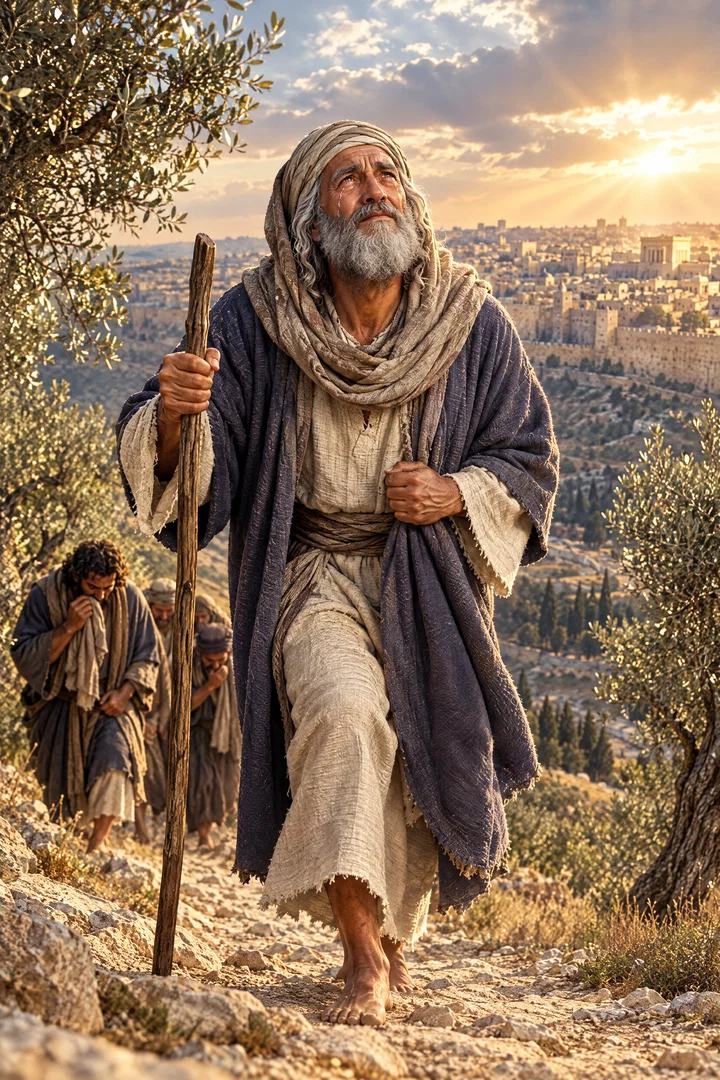
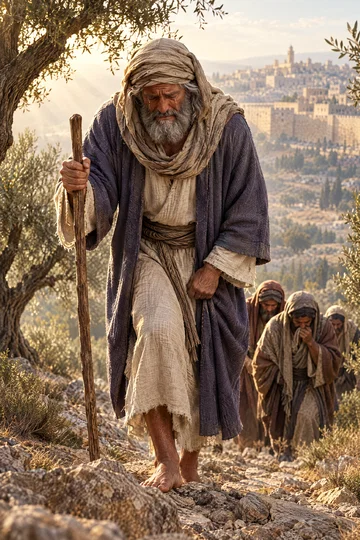
And David went up by the ascent of mount Olivet, and wept as he went up, and had his head covered, and he went barefoot: and all the people that was with him covered every man his head, and they went up, weeping as they went up.
Translations
American King James Version, King James Version, KJV Cambridge Paragraph Bible
And David went up by the ascent of mount Olivet, and wept as he went up, and had his head covered, and he went barefoot: and all the people that was with him covered every man his head, and they went up, weeping as they went up.
And David went up by the ascent of mount Olivet, and wept as he went, and had his head covered, and he went barefoot: and all the people that were with him covered every man his head, and they went up, weeping as they went.
Revised Version, American Standard Version
And David went up by the ascent of the mount of Olives, and wept as he went up; and he had his head covered, and went barefoot: and all the people that were with him covered every man his head, and they went up, weeping as they went up.
And David is going up in the ascent of the olives, going up and weeping, and he hath the head covered, and he is going barefooted, and all the people who [are] with him have covered each his head, and have gone up, going up and weeping;
But David went up by the ascent of the Olives, and wept as he went up, and had his head covered, and he went barefoot; and all the people that was with him covered every man his head, and they went up, weeping as they went up.
Now, David, was going up by the ascent of Olivet, weeping as he went up, with his head covered, himself, passing on barefoot,—and all the people who were with him, covered every man his head, and went up, weeping as they went.
Berean Standard Bible, Majority Standard Bible
But David continued up the Mount of Olives, weeping as he went up. His head was covered, and he was walking barefoot. And all the people with him covered their heads and went up, weeping as they went.
David went up by the ascent of the Mount of Olives, and wept as he went up; and he had his head covered and went barefoot. All the people who were with him each covered his head, and they went up, weeping as they went up.
And David went up the slopes of the Mount of Olives weeping all the way, with his head covered and no shoes on his feet: and all the people who were with him, covering their heads, went up weeping.
And Dauid went vp the mount of oliues and wept as he went vp, and had his head couered, and went barefooted: and al the people that was with him, had euery man his head couered, and as they went vp, they wept.
Douay-Rheims (Challoner revision)
But David went up by the ascent of mount Olivet, going up and weeping, walking barefoot, and with his head covered, and all the people that were with them, went up with their heads covered weeping.
Pictures
Cross-references
- 2 Samuel 16:10-12
And the king said, What have I to do with you, ye sons of Zeruiah? so let him curse, because the LORD hath said unto him, Curse David. Who shall then say, Wherefore hast thou done so?
David accepts Shimei’s cursing as permitted by the Lord and part of his punishment.
- 2 Samuel 15:25-26
And the king said unto Zadok, Carry back the ark of God into the city: if I shall find favour in the eyes of the LORD, he will bring me again, and shew me both it, and his habitation:
David leaves his return and fate to the Lord’s favor and will.
- 2 Samuel 12:11-12
Thus saith the LORD, Behold, I will raise up evil against thee out of thine own house, and I will take thy wives before thine eyes, and give them unto thy neighbour, and he shall lie with thy wives in the sight of this sun.
Nathan foretells the household calamity and public humiliation David later suffers.
- 2 Samuel 15:10-14
But Absalom sent spies throughout all the tribes of Israel, saying, As soon as ye hear the sound of the trumpet, then ye shall say, Absalom reigneth in Hebron.
Absalom’s revolt leads David to flee Jerusalem.
- Psalms 3:1-2
LORD, how are they increased that trouble me! many are they that rise up against me.
David’s distress amid enemies recalls his flight from Absalom.
- 2 Samuel 13:28-29
Now Absalom had commanded his servants, saying, Mark ye now when Amnon’s heart is merry with wine, and when I say unto you, Smite Amnon; then kill him, fear not: have not I commanded you? be courageous, and be valiant.
Absalom avenges Tamar by having Amnon killed.
- 2 Samuel 15:13-14
And there came a messenger to David, saying, The hearts of the men of Israel are after Absalom.
Absalom’s revolt forces David to flee Jerusalem.
- Luke 22:39
And he came out, and went, as he was wont, to the mount of Olives; and his disciples also followed him.
Jesus goes to the Mount of Olives before his agony.
- 2 Samuel 15:23
And all the country wept with a loud voice, and all the people passed over: the king also himself passed over the brook Kidron, and all the people passed over, toward the way of the wilderness.
The people weep as David leaves Jerusalem.
- 2 Samuel 17
Moreover Ahithophel said unto Absalom, Let me now choose out twelve thousand men, and I will arise and pursue after David this night:
The account continues David’s flight from Absalom’s rebellion.
- 2 Samuel 16:11
And David said to Abishai, and to all his servants, Behold, my son, which came forth of my bowels, seeketh my life: how much more now may this Benjamite do it? let him alone, and let him curse; for the LORD hath bidden him.
David accepts Shimei’s cursing as permitted by the Lord.
- 2 Samuel 16:21-22
And Ahithophel said unto Absalom, Go in unto thy father’s concubines, which he hath left to keep the house; and all Israel shall hear that thou art abhorred of thy father: then shall the hands of all that are with thee be strong.
Absalom’s public seizure of David’s concubines fulfills Nathan’s foretold judgment.
- 2 Samuel 13:1-22
And it came to pass after this, that Absalom the son of David had a fair sister, whose name was Tamar; and Amnon the son of David loved her.
Tamar’s humiliation and Amnon’s assault precede violence and grief in David’s household.
- 2 Samuel 18
And David numbered the people that were with him, and set captains of thousands and captains of hundreds over them.
Both texts continue David’s flight and conflict with Absalom.
- Luke 19:41
And when he was come near, he beheld the city, and wept over it,
Jesus weeps over Jerusalem, as David wept while ascending Olivet.
Commentary
Each commentary is drawn from primary sources: the writings of Ellen G. White and Adventist pioneers and periodicals. Each commentary is separate. Its own words are not a quotation; follow the references to read the source passages.
Ellen G. White
6 sources
The verse records David's precipitate flight for his life from his throne in Jerusalem during the rebellion stirred up by his own son Absalom.1SP 381.3–382.3Lt 6, 1880, par. 10–13 As he climbed the ascent of the Mount of Olives, the uncrowned king wept, covered his head, and went barefoot with only a small company.1SP 381.3–382.3Lt 61, 1890, par. 3–8 All the people with him covered every man his head and went up weeping as they went, following his example in a broken-spirited, tearful procession turning its back on the scenes of his glory and his crime.1SP 381.3–382.3SG4 89.2–90.3PP 735.1–3Lt 6, 1880, par. 10–13 Those outward acts were signs of humiliation, contrition, and distress.1SP 381.3–382.3SG4 89.2–90.3Lt 61, 1890, par. 3–8 In marked contrast to his earlier wars, when he went out with confidence and kingly honor, he now went without courage because of his sin.1SP 381.3–382.3
The ascent came just after he sent the ark back to Jerusalem in submission to whether God would bring him back or do to him as seemed good.PP 735.1–3 Sorrow was therefore deepened by being a fugitive king with outcasts who felt forsaken even by the ark, with the future dark with terror and foreboding.PP 735.1–3 On that ascent he was told that Ahithophel had joined Absalom.PP 735.1–3 Ahithophel was the ablest and most wily political leader, and his defection was prompted by revenge for the family disgrace in David's wrong to Bathsheba, who was Ahithophel's granddaughter.PP 735.1–3 David recognized his calamities as the result of his own sin.1SP 381.3–382.3SG4 89.2–90.3PP 735.1–3
David viewed the rebellion as the predicted trouble brought on him by his great crime, and he accepted it as God's correction and verdict.1SP 381.3–382.3SG4 89.2–90.3Lt 6, 1880, par. 41–44Lt 6, 1880, par. 10–13 He did so without complaining, making excuses, repining, or lessening his guilt, knowing that years of earlier service did not excuse his sin or cancel the judgment.Lt 6, 1880, par. 41–44Lt 6, 1880, par. 10–13 His guilt-scourged conscience recoiled terribly upon him and deteriorated his entire character.Lt 6, 1880, par. 10–13 It weakened him physically and morally, costing him self-respect and self-confidence, making him feel he had forfeited the love and loyalty of his subjects and scarcely daring to trust his old and formerly tried advisers.1SP 381.3–382.3Lt 6, 1880, par. 10–13
In that humbled position he submitted patiently to affliction and injury in humble reliance on God.Lt 6, 1880, par. 41–44Lt 6, 1880, par. 10–13 He showed the fruits of repentance in resignation, patience, kindness, and generosity amid his own woes.Lt 6, 1880, par. 41–44 Though a man of keenest temperament cut to the quick by unmerited wrong and heartbreaking reproach, he restrained all irritation, resentment, vehement rage, and revenge and kept fine and deep feeling unblunted while sensing his sin most keenly.Lt 6, 1880, par. 10–13 For that reason he was never more worthy of admiration and never greater than in that hour of adversity while wrestling with storm and tempest as a cedar of God.Lt 6, 1880, par. 10–13 Though afflicted and humbled, he was not forsaken but tenderly regarded with pity and love, with greater standing before God than in prosperity because he faced the storm humbly.Lt 61, 1890, par. 3–8Lt 6, 1880, par. 10–13 His tearful, heartbroken appeals to God on that sorrowful ascent became the occasion of his most eloquent psalm.Lt 6, 1880, par. 41–44
Sources
Pioneers and periodicals
16 sources
David went up the Mount of Olives weeping, barefoot and with covered head, as he fled Jerusalem before Absalom's rebellion, humbled and grieving under treachery, while all who were with him went up weeping with covered heads.ST May 6, 1913ST Apr 29, 1908RH Oct 12, 1869RH Nov 23, 1905ST Apr 14, 1909 The mourning flight was retribution for his wrong against Uriah and the fulfillment of Nathan's denunciation, which David himself recognized as judgment for his own sin.RH Apr 26, 1870ST Mar 31, 1881RH Oct 12, 1869RH Jul 27, 1869 It shows that no one can walk contrary to God's laws without suffering, for every transgression carries its inherent curse, a sorrow deepened by the jealousy and strife of the divided household that grew from his multiplying wives.ST Apr 29, 1908RH Mar 10, 1868ST Oct 27, 1898 His bitter crossing of the Kidron in that flight parallels Jesus' crossing of the same brook before His betrayal.RH Aug 17, 1911 That affliction helped shape his humility, nobility of character and deep piety, and teaches that when God permits suffering His people should humble themselves, accept His will and trust that even chastisement serves a purpose.ST Oct 4, 1877RH Sep 4, 1855
David's Mournful Flight
The verse belongs to the account of David's reign, specifically to the history of Absalom's rebellion when Absalom revolted and sought to take the throne.ST May 6, 1913ST Dec 30, 1913 It shows David fleeing Jerusalem amid the sorrow and trouble connected with Absalom.ST Apr 14, 1909ST Dec 30, 1913 The flight is in fear from Jerusalem, going up by the ascent of Mount Olivet weeping as he went, with his head covered and barefoot.ST Apr 29, 1908RH Oct 12, 1869RH Aug 17, 1911ST Mar 16, 1915 He is deeply humbled, grieving, distressed, and humiliated under persecution and treachery, and his covered head and bare feet express his sorrow, distress, and penitence.RH Oct 12, 1869RH Nov 23, 1905RH Aug 17, 1911RH Jul 27, 1869
All the people that were with him shared his mourning as they went up weeping, each man covering his head.ST Apr 29, 1908RH Oct 12, 1869RH Nov 23, 1905RH Aug 17, 1911ST Mar 16, 1915 Their companions shared that mourning in grief and humiliation as they ascended with him.RH Nov 23, 1905RH Sep 4, 1855 The pathetic weeping journey with covered head and bare feet touched the hearts of his old friends.ST Apr 29, 1908 The flight belongs to the family troubles of 2 Samuel 13-20 that revolve around Absalom and his base conduct and ambition.ST Apr 29, 1908 The flight from Absalom recorded in the chapter provides the setting for Psalm 3 and helps explain the feelings expressed in that psalm.ST Jun 18, 1885
Judgment for David's Sin
The ascent of Olivet in tears belongs to the family calamities that repaid David for his wicked conduct toward Uriah.RH Apr 26, 1870 It stands as retribution for his wrong against Uriah, in which the rebellion and unnatural crimes of Absalom brought sorrow upon David and his family.ST Mar 31, 1881
The chapter stands within the account of the judgments that followed David's great transgression and the fulfillment of Nathan's denunciation.RH Oct 12, 1869 His weeping climb with covered head and bare feet, and the weeping of those with him, expresses mourning and humility under deep distress and penitence.RH Oct 12, 1869RH Jul 27, 1869 In that humiliation he recognizes the rebellion as a judgment for his own sin.RH Jul 27, 1869
Driven from Jerusalem, he suffers the consequences of his sin as he goes up in grief with his people.RH Mar 10, 1868 No one can walk contrary to God's laws without suffering, because every transgression of divine law carries its inherent curse even when God does not openly reprove.ST Apr 29, 1908 That flight grew out of his multiplying wives to himself, which produced a large family by different wives marked by idleness, luxury, jealousy, and unenviable character.ST Apr 29, 1908 Their rivalries and divisions made his children, though sons of one father, strangers at heart, divided by hatred, jealousy, and strife.ST Oct 27, 1898 In his grieving and humiliated flight from his traitorous son he illustrates the pain of a father unable to unite or guide a divided household.ST Apr 29, 1908ST Oct 27, 1898
Parallels and Practical Lessons
David's bitter crossing of the Kidron as he fled finds its parallel in Jesus' crossing of that same brook on the night of His betrayal.RH Aug 17, 1911 The ascent belongs to David's flight in grief, weeping as he went up the Mount of Olives barefoot and with his head covered under persecution and treachery.RH Aug 17, 1911 All the people who were with him shared that mourning, covering every man his head and weeping as they went up.RH Aug 17, 1911
That affliction in fleeing over the Mount of Olives in grief and humility belongs to the trials that formed his humility, nobility of character, and deep piety.ST Oct 4, 1877 He left Jerusalem in grief and humiliation, weeping as he ascended with head covered and feet bare while his companions shared his mourning.RH Sep 4, 1855 The lesson is submission to God, that when sufferers recognize God has permitted their affliction they are to humble themselves and accept His will, trusting that even chastisement answers a purpose.RH Sep 4, 1855
Sources