2 Samuel 17:7
And Hushai said unto Absalom, The counsel that Ahithophel hath given is not good at this time.
Translations
And Hushai said to Absalom, The counsel that Ahithophel has given is not good at this time.
King James Version, KJV Cambridge Paragraph Bible
And Hushai said unto Absalom, The counsel that Ahithophel hath given is not good at this time.
And Hushai said to Absalom, The counsel that Ahithophel hath given, is not good at this time.
Revised Version, American Standard Version
And Hushai said unto Absalom, The counsel that Ahithophel hath given this time is not good.
And Hushai saith unto Absalom, 'Not good [is] the counsel that Ahithophel hath counselled at this time.'
And Hushai said to Absalom, The counsel that Ahithophel has given this time is not good.
Then said Hushai unto Absolom,—Not good, is the counsel that Ahithophel hath given—at this time.
Berean Standard Bible, Majority Standard Bible
Hushai replied, “ This time the advice of Ahithophel is not sound.”
Hushai said to Absalom, “ The counsel that Ahithophel has given this time is not good.”
And Hushai said to Absalom, Ahithophel's idea is not a good one at this time.
Hushai then answered vnto Absalom, The counsel that Ahithophel hath giuen, is not good at this time.
Douay-Rheims (Challoner revision)
And Chusai said to Absalom: The counsel that Achitophel hath given this time is not good.
Pictures
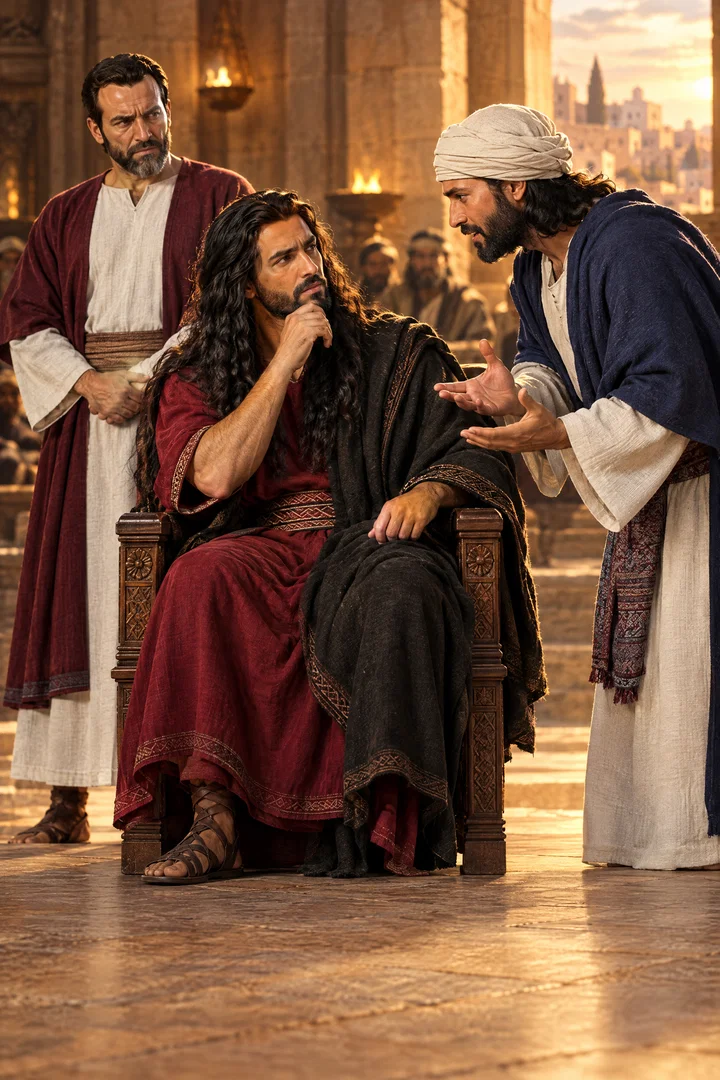
Cross-references
- 2 Samuel 17:14
And Absalom and all the men of Israel said, The counsel of Hushai the Archite is better than the counsel of Ahithophel. For the LORD had appointed to defeat the good counsel of Ahithophel, to the intent that the LORD might bring evil upon Absalom.
God defeats Ahithophel’s counsel as Hushai’s counsel prevails, answering David’s prayer for deliverance.
- 2 Samuel 15:31
And one told David, saying, Ahithophel is among the conspirators with Absalom. And David said, O LORD, I pray thee, turn the counsel of Ahithophel into foolishness.
David prayed that Ahithophel’s counsel would be made foolish.
- 2 Samuel 17:1-3
Moreover Ahithophel said unto Absalom, Let me now choose out twelve thousand men, and I will arise and pursue after David this night:
Hushai declares Ahithophel’s proposed attack counsel not good.
- 2 Samuel 17:11-13
Therefore I counsel that all Israel be generally gathered unto thee, from Dan even to Beer-sheba, as the sand that is by the sea for multitude; and that thou go to battle in thine own person.
Hushai offers Absalom a flattering alternative plan.
- 2 Samuel 15:1-18
And it came to pass after this, that Absalom prepared him chariots and horses, and fifty men to run before him.
Absalom’s rebellion forms part of the retribution in David’s life.
- 2 Samuel 13:1-22
And it came to pass after this, that Absalom the son of David had a fair sister, whose name was Tamar; and Amnon the son of David loved her.
fellow family judgment in same retribution
- 2 Samuel 16
And when David was a little past the top of the hill, behold, Ziba the servant of Mephibosheth met him, with a couple of asses saddled, and upon them two hundred loaves of bread, and an hundred bunches of raisins, and an hundred of summer fruits, and a bottle of wine.
Continues the account of the circumstances behind the psalm.
Commentary
Each commentary is drawn from primary sources: the writings of Ellen G. White and Adventist pioneers and periodicals. Each commentary is separate. Its own words are not a quotation; follow the references to read the source passages.
Ellen G. White
1 source
The declaration that Ahithophel's advice was not good at this time came from Hushai the Archite, who had not been called to the council and would not intrude unasked until Absalom himself laid Ahithophel's plan before him out of high regard for his father's counselor.PP 739.2–740.1 The plan he rejected called for immediate action that very night with twelve thousand men to fall upon the weary David and strike the king alone.PP 739.2–740.1 Had that plan been followed, David would have been lost and would surely have been slain unless the Lord directly interposed.PP 739.2–740.1 Yet a higher wisdom was directing events, for the Lord had appointed to defeat the good counsel of Ahithophel in order to bring evil upon Absalom.PP 739.2–740.1
To turn Absalom aside, Hushai argued that David and his men were mighty and enraged in mind like a bear robbed of her young, a fact all Israel knew, that David was mighty and his men valiant.PP 739.2–740.1 He argued that David as a man of war would not lodge with the people but was hidden in some pit or other place, so the pursuing force would not capture him.PP 739.2–740.1 He warned that any reverse would dishearten Absalom's untrained force and harm his cause.PP 739.2–740.1 To gain delay and to appeal to a vain nature fond of a show of power, he then counseled gathering all Israel from Dan to Beersheba as numerous as sand by the sea with Absalom going to battle in person, to fall on David until none remained and to drag any city sheltering him with ropes into the river until not one small stone remained.PP 739.2–740.1
Sources
Pioneers and periodicals
8 sources
The verse belongs to the flight of David from Absalom, whose circumstances form the setting of Psalm 3.ST Jun 18, 1885 It stands amid the troubles in David's family centered on Absalom's ambition and the treachery of Ahithophel.ST Apr 29, 1908 The surrounding chapters display the consequences of David's transgression and the suffering that follows acting contrary to God's laws.ST Apr 29, 1908
That history is retribution following David's wrongdoing toward Uriah, worked out especially through events in his own family including Absalom's rebellion.ST Apr 29, 1908ST Mar 31, 1881 The retribution was in kind upon David through all the rest of his life and principally in his own family for his wicked conduct toward Uriah.RH Apr 26, 1870 It links Absalom's rebellion and unnatural crimes with Amnon and Tamar and even Adonijah's rebellion and death.RH Apr 26, 1870 In this is proved that with what measure men mete it shall be measured to them again and what a man sows he shall reap, and that wrongdoing brings calamity and sorrow upon the wrongdoer in the very kind of evil he caused.RH Apr 26, 1870
The verse stands within the whole subsequent history in 2 Samuel 11-24 and 1 Kings 1-2 after David's great wickedness in the case of Uriah, by which he gave great occasion to the enemies of the Lord to blaspheme.RH Oct 12, 1869 That transgression is not covered up or excused, and the terrible denunciation spoken by the prophet Nathan is placed on record.RH Oct 12, 1869 David's own humble confession of his great transgression is placed on record for all future time.RH Oct 12, 1869 The history shows how completely that prophetic denunciation was accomplished in the judgments that came upon David.RH Oct 12, 1869
In the verse Hushai rejects Ahithophel's counsel as not good and unsuitable at that time.ST Aug 13, 1896RH Nov 23, 1905 He gives opposing counsel and Absalom follows it.RH Nov 23, 1905 This delays Absalom and gives David time to organize his army.ST Aug 13, 1896 The delay helps bring about the defeat of the rebellion and David's deliverance in answer to David's prayer that Ahithophel's counsel be turned to foolishness and brought to nothing.ST Aug 13, 1896RH Nov 23, 1905
Absalom's greater numbers could not overcome David's trained forces because God was not with Absalom.ST Aug 13, 1896 A large following and promising prospects do not ensure success when God is not in the cause.ST Aug 13, 1896 Hushai's advice overturned the seemingly stronger counsel of Ahithophel, an experienced general.RH Apr 2, 1861 The outcome shows that success does not necessarily belong to the side with the more powerful or capable means.RH Apr 2, 1861
Sources