2 Samuel 6:3
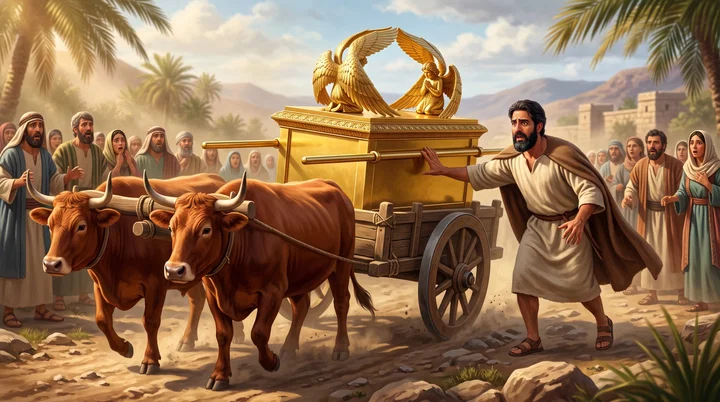
And they set the ark of God upon a new cart, and brought it out of the house of Abinadab that was in Gibeah: and Uzzah and Ahio, the sons of Abinadab, drave the new cart.
Translations
And they set the ark of God on a new cart, and brought it out of the house of Abinadab that was in Gibeah: and Uzzah and Ahio, the sons of Abinadab, drove the new cart.
King James Version, KJV Cambridge Paragraph Bible
And they set the ark of God upon a new cart, and brought it out of the house of Abinadab that was in Gibeah: and Uzzah and Ahio, the sons of Abinadab, drave the new cart.
And they set the ark of God upon a new cart, and brought it out of the house of Abinadab that was in Gibeah: and Uzzah and Ahio the sons of Abinadab drove the new cart.
And they set the ark of God upon a new cart, and brought it out of the house of Abinadab that was in the hill: and Uzzah and Ahio, the sons of Abinadab, drave the new cart.
And they set the ark of God upon a new cart, and brought it out of the house of Abinadab that was in the hill: and Uzzah and Ahio, the sons of Abinadab, drove the new cart.
And they cause the ark of God to ride on a new cart, and lift it up from the house of Abinadab, which [is] in the height, and Uzzah and Ahio sons of Abinadab are leading the new cart;
And they set the ark of God upon a new cart, and brought it out of the house of Abinadab, which was upon the hill; and Uzzah and Ahio, the sons of Abinadab, drove the new cart.
So they carried the ark of God in a new waggon, and brought it out of the house of Abinadab, who was in Gibeah,—and, Uzza and Ahio, sons of Abinadab, were driving the new waggon.
Berean Standard Bible, Majority Standard Bible
They set the ark of God on a new cart and brought it from the house of Abinadab, which was on the hill. Uzzah and Ahio, the sons of Abinadab, were guiding the new cart,
They set God’s ark on a new cart, and brought it out of Abinadab’s house that was on the hill; and Uzzah and Ahio, the sons of Abinadab, drove the new cart.
And they put the ark of God on a new cart and took it out of the house of Abinadab which was on the hill: and Uzzah and Ahio, the sons of Abinadab, were the drivers of the cart.
And they put the Arke of God vpon a newe cart, and brought it out of the house of Abinadab that was in Gibeah. And Vzzah and Ahio the sonnes of Abinadab did driue the newe carte.
Douay-Rheims (Challoner revision)
And they laid the ark of God upon a new cart: and took it out of the house of Abinadab, who was in Gabaa: and Oza, and Ahio, the sons of Abinadab, drove the new cart.
Pictures
Cross-references 20 of 21
- Numbers 4:15
And when Aaron and his sons have made an end of covering the sanctuary, and all the vessels of the sanctuary, as the camp is to set forward; after that, the sons of Kohath shall come to bear it: but they shall not touch any holy thing, lest they die. These things are the burden of the sons of Kohath in the tabernacle of the congregation.
The Kohathites were assigned to carry the holy things without touching them.
- Numbers 7:9
But unto the sons of Kohath he gave none: because the service of the sanctuary belonging unto them was that they should bear upon their shoulders.
The Kohathites were assigned to carry the sanctuary objects on their shoulders, not by cart.
- 1 Chronicles 15:13-15
For because ye did it not at the first, the LORD our God made a breach upon us, for that we sought him not after the due order.
David links the earlier disaster to neglecting God’s prescribed order, then has the ark carried as commanded.
- 1 Samuel 6:7-8
Now therefore make a new cart, and take two milch kine, on which there hath come no yoke, and tie the kine to the cart, and bring their calves home from them:
The Philistines sent the ark on a new cart.
- Exodus 25:12-14
And thou shalt cast four rings of gold for it, and put them in the four corners thereof; and two rings shall be in the one side of it, and two rings in the other side of it.
The ark was to be carried by its staves.
- 1 Samuel 7:1
And the men of Kirjath-jearim came, and fetched up the ark of the LORD, and brought it into the house of Abinadab in the hill, and sanctified Eleazar his son to keep the ark of the LORD.
The ark was kept at Abinadab’s house before it was moved.
- 1 Chronicles 13:7
And they carried the ark of God in a new cart out of the house of Abinadab: and Uzza and Ahio drave the cart.
The ark is carried on a new cart from Abinadab’s house.
- 1 Chronicles 15:2
Then David said, None ought to carry the ark of God but the Levites: for them hath the LORD chosen to carry the ark of God, and to minister unto him for ever.
David later says the Levites must carry the ark as God directed.
- 1 Chronicles 15:15
And the children of the Levites bare the ark of God upon their shoulders with the staves thereon, as Moses commanded according to the word of the LORD.
The Levites carry the ark on their shoulders as commanded.
- 2 Samuel 6:10-11
So David would not remove the ark of the LORD unto him into the city of David: but David carried it aside into the house of Obed-edom the Gittite.
The ark remained with Obed-edom for three months, and the Lord blessed his household.
- 2 Samuel 6:12-14
And it was told king David, saying, The LORD hath blessed the house of Obed-edom, and all that pertaineth unto him, because of the ark of God. So David went and brought up the ark of God from the house of Obed-edom into the city of David with gladness.
The ark is brought to Jerusalem with sacrifice and David’s joyful dancing.
- 1 Chronicles 13:5
So David gathered all Israel together, from Shihor of Egypt even unto the entering of Hemath, to bring the ark of God from Kirjath-jearim.
Describes Israel’s gathering to bring the ark from Kirjath-jearim.
- 1 Samuel 4:11
And the ark of God was taken; and the two sons of Eli, Hophni and Phinehas, were slain.
The ark is captured, separating it from Shiloh.
- 1 Chronicles 16:1
So they brought the ark of God, and set it in the midst of the tent that David had pitched for it: and they offered burnt sacrifices and peace offerings before God.
The ark is placed in David’s tabernacle at Jerusalem.
- 1 Kings 8:4-6
And they brought up the ark of the LORD, and the tabernacle of the congregation, and all the holy vessels that were in the tabernacle, even those did the priests and the Levites bring up.
The ark is brought into the temple’s most holy place.
- 2 Samuel 6:9
And David was afraid of the LORD that day, and said, How shall the ark of the LORD come to me?
David fears to bring the Ark after Uzzah dies.
- Numbers 4:20
But they shall not go in to see when the holy things are covered, lest they die.
Unauthorized approach to sacred things brought death.
- 2 Samuel 6:16
And as the ark of the LORD came into the city of David, Michal Saul’s daughter looked through a window, and saw king David leaping and dancing before the LORD; and she despised him in her heart.
David dances before the LORD as the ark enters Jerusalem.
- 1 Samuel 6:19
And he smote the men of Beth-shemesh, because they had looked into the ark of the LORD, even he smote of the people fifty thousand and threescore and ten men: and the people lamented, because the LORD had smitten many of the people with a great slaughter.
Both texts show that irreverence toward the ark brought judgment.
- 1 Chronicles 13:8
And David and all Israel played before God with all their might, and with singing, and with harps, and with psalteries, and with timbrels, and with cymbals, and with trumpets.
David and Israel rejoice with music during the ark’s procession.
Commentary
Each commentary is drawn from primary sources: the writings of Ellen G. White and Adventist pioneers and periodicals. Each commentary is separate. Its own words are not a quotation; follow the references to read the source passages.
Ellen G. White
3 sources
The ark was the symbol of the divine presence.PP 704.5–705.1 It contained God's holy law.ST Jul 24, 1884 David sought to honor it by bringing it to Jerusalem, his own city, with great rejoicing and display.PP 704.5–705.1ST Jul 24, 1884
They set the ark of God upon a new cart and brought it out of the house of Abinadab, with Uzzah and Ahio, the sons of Abinadab, driving the cart.SG4 111.1–2ST Jul 24, 1884 That setting of the ark on the cart began a triumphant procession toward the holy city, with the men of Israel following with exultant shouts and songs of rejoicing.PP 704.5–705.1 David and all the house of Israel played before the Lord on harps and psalteries and timbrels and cornets and cymbals, a scene of solemn gladness and triumph not witnessed for a long time.PP 704.5–705.1
When the cart came to Nachon's threshingfloor, where the ground was rough, the oxen shook it and Uzzah put forth his hand and took hold of the ark.PP 704.5–705.1ST Jul 24, 1884 Because of the ark's sacredness its handling was subject to God's requirements, so the method of carrying it on a cart was irreverent.SG4 111.1–2 Only a consecrated priest was permitted to touch the ark, so Uzzah's touch was rash and presumptuous.PP 704.5–705.1SG4 111.1–2ST Jul 24, 1884
The anger of the Lord was kindled against Uzzah, and God smote him there by the ark so that he died.PP 704.5–705.1ST Jul 24, 1884 Sudden terror fell on the rejoicing throng and the season of gladness was turned into grief and mourning.PP 704.5–705.1 David was astonished and alarmed and questioned the justice of God in sending fearful judgment while he was seeking to honor the ark, and feeling it unsafe to have the ark near him he left it at the house of Obed-edom the Gittite.PP 704.5–705.1 The judgment taught Israel to treat God's law and its sacred emblem with reverence.ST Jul 24, 1884
Sources
Pioneers and periodicals
26 sources
The verse describes David's first attempt, after the ark had remained twenty years in the house of Abinadab at Kirjath-jearim, to bring it toward Jerusalem with thirty thousand chosen men rejoicing with music, until the oxen stumbled and Uzzah was smitten for steadying it.RH Apr 21, 1851RH Mar 3, 1910RH Sep 5, 1871RH Jan 6, 1853RH Sep 5, 1871 Placing it upon a new cart drawn by oxen and driven by Uzzah and Ahio was contrary to God's express command that it be borne on staves upon the shoulders of the appointed Kohathite Levites and not touched.ST Oct 14, 1889ST Jun 26, 1884ST Sep 10, 1896 Following the Philistines' earlier use of an ox-cart was no excuse, for Israel knew the command and a new or seemingly useful human invention did not make disobedience acceptable.ST Apr 18, 1911ST Oct 17, 1895RH Sep 5, 1871 The cart was the first wrong that put the ark at risk of being shaken on the rough road and set the stage for Uzzah's later touching of it, so the sin did not begin where he reached out.ST Oct 14, 1889ST Apr 18, 1911ST Jul 2, 1896 The ark as the symbol of God's presence and repository of His holy law was holy and not common, and its prescribed handling was meant to teach reverence for holy things, for God, and for His law.ST Jul 24, 1884ST Sep 10, 1896ST Jul 2, 1896 Uzzah's death was presumption bred by familiarity, and no good intention in protecting the ark excused carelessness in obeying, for human wisdom and convenience can never replace obedience to God's revealed will.ST Apr 18, 1911RH Nov 27, 1860ST Apr 22, 1903ST Feb 4, 1897RH Sep 5, 1871
Journey from Abinadab's House
The ark had rested a long time, twenty years, in the house of Abinadab at Kirjath-jearim in Gibeah from the time it was returned by the Philistines, kept under his son Eleazar, until David came to remove it.RH Apr 21, 1851RH Jan 6, 1853RH Sep 5, 1871ST Jun 22, 1915 Uzzah and Ahio, the sons of Abinadab, drove the new cart on which it was set when it left that house for the house of Obed-edom, where it abode three months before David removed it to Jerusalem and placed it in the tabernacle he had pitched there.RH Apr 21, 1851RH Jan 6, 1853ST Jun 22, 1915 Its long abiding in their household weakened the reverence that should have been shown toward it.RH Sep 5, 1871
This removal was David's first attempt to bring the ark to the city of David at Jerusalem, with thirty thousand chosen men of Israel following with rejoicing and music on psalteries, timbrels, cornets and cymbals.ST Jul 24, 1884RH Apr 21, 1851 The oxen stumbled at Nachon's threshing-floor on rough ground, Uzzah steadied the ark and was smitten, David feared, the ark turned aside into the house of Obed-edom for three months, and afterward it was brought joyfully into the city of David with sacrifice and dancing.ST Jul 24, 1884RH Apr 21, 1851ST Jun 22, 1915 That earlier removal stands in contrast to the later, joyful procession in which Levites carried the ark on their shoulders.RH Mar 3, 1910RH Sep 5, 1871
The movement belongs to the incidents connected with the establishment of David's reign and the placing of his throne in Jerusalem, and to the return of the ark to Israel when it was brought to Jerusalem and restored to the nation.STRH Mar 3, 1910ST Apr 19, 1910 It records the stages of the ark's travels from Kirjath-jearim to Obed-edom to the city of David which is Zion, before Solomon later had it conveyed into the Holy of Holies of the temple built on Mount Moriah near Mount Zion.RH Sep 2, 1852 Brought to Zion, God dwelt there then only a short time and in curtains made with hands.RH Sep 2, 1852
The glory or ark never returned to the tabernacle at Shiloh after God forsook His habitation there for the wickedness of priests and people and gave it into the hands of the Philistines.RH Jan 6, 1853 Yet He has chosen Zion to dwell in at rest forever, and He will yet have mercy on Zion and build it up when He appears in glory.RH Sep 2, 1852 Then Jerusalem becomes a quiet habitation, a tabernacle that shall not be taken down, and the people shall dwell in Zion at Jerusalem.RH Sep 2, 1852
Violation of Prescribed Carrying
They set the ark of God upon a new cart and brought it out of Abinadab's house in Gibeah, with Uzzah and Ahio, the sons of Abinadab, driving the cart.ST Oct 14, 1889ST Jun 26, 1884ST Sep 10, 1896ST Jul 2, 1896RH Sep 5, 1871 It was drawn by oxen or cattle instead of being carried by the appointed Levites on their shoulders.ST Oct 14, 1889ST Sep 10, 1896ST Apr 8, 1889RH Sep 5, 1871ST Oct 17, 1895 This was contrary to God's express command that the ark be carried on poles by its staves on the shoulders of the sons of Kohath, with no wagon to be used.ST Oct 14, 1889ST Jun 26, 1884ST Jul 2, 1896RH Sep 5, 1871ST Jun 22, 1882 Those appointed carriers were forbidden to touch or look upon the holy vessels, and only a consecrated priest was permitted to touch them.ST Oct 14, 1889ST Jun 26, 1884 Disregard of that prescribed way set the stage for Uzzah's death and taught reverence for holy things, for God is holy and not common.ST Sep 10, 1896ST Jul 2, 1896ST Apr 8, 1889
The use of the cart followed the Philistines' earlier use of an ox-cart, but that example was not a model for Israel to follow.ST Apr 18, 1911ST Oct 17, 1895RH Sep 5, 1871ST Jun 22, 1882 Israel knew the command to carry the ark by hand with its staves through the rings, so the Philistine precedent did not excuse disobedience.ST Apr 18, 1911ST Jun 22, 1882ST Jul 2, 1896 Their circumstances were different, and Israel was required to handle the ark according to God's instructions.ST Apr 18, 1911RH Sep 5, 1871 A new, more impressive, seemingly useful human invention substituted for God's command did not make disobedience acceptable, for the cart was a human invention and the first step in the transgression.ST Oct 17, 1895ST Jun 22, 1882ST Jul 2, 1896
That first wrong put the ark at risk of being jolted and shaken on the rough road.ST Oct 14, 1889ST Apr 8, 1889RH Sep 5, 1871 Using the cart was a step away from the appointed way and contributed to the shaking that led Uzzah to reach out to steady it.ST Oct 14, 1889ST Apr 8, 1889RH Sep 5, 1871 The sin did not begin where he reached out to touch it, but departing from God's direction led to further disobedience and to his later presumption in touching it.ST Oct 14, 1889RH Sep 5, 1871RH Sep 5, 1871ST Jun 22, 1882ST Jul 2, 1896 Substituting human methods for God's prescribed way thus leads from obedience into darkness and can result in death, while God's word which they made ineffective brought the judgment.ST Apr 18, 1911ST Apr 22, 1903
Holiness Demands Obedient Reverence
The ark was holy and could not be treated as common, for God is holy, not common.ST Jul 2, 1896ST Jul 2, 1896ST Apr 19, 1910 As the symbol of God's presence and the repository of His holy law, it demanded reverence for holy things, for God Himself, and for His law.ST Jul 24, 1884ST Sep 10, 1896ST Jul 2, 1896 The prescribed way of carrying it on poles by the sons of Kohath, the Levites, was given to teach that reverence.ST Sep 10, 1896ST Jul 2, 1896ST Jul 2, 1896 Placing it instead on a new cart and bringing it from Abinadab's house in Gibeah with Uzzah and Ahio, the sons of Abinadab, driving it violated that command and set the stage for judgment.ST Jul 24, 1884ST Sep 10, 1896ST Jul 2, 1896 When the cart reached rough ground and Uzzah touched the ark, he was struck dead, for only a consecrated priest was permitted to touch it, and the solemn lesson taught Israel to treat the law and its sacred emblem with reverence.ST Jul 24, 1884ST Jul 2, 1896ST Apr 19, 1910
Long familiarity had weakened reverence, for the ark had been in that household for twenty years.RH Sep 5, 1871ST Aug 21, 1884 Uzzah's act of putting his hand to the ark to steady it was presumption and rashness, an attempt to act beyond what God permitted.ST Mar 18, 1903ST Aug 21, 1884ST Jan 1, 1885 His brothers' familiarity did not authorize improper handling, and using a cart repeated the Philistines' earlier method, though their circumstances had been different and Israel was required to handle the ark according to God's instructions.RH Sep 5, 1871ST Aug 21, 1884 That departure from the prescribed way was the first wrong in a sequence that led to touching the ark.RH Sep 5, 1871ST Aug 21, 1884 Care in protecting the ark did not excuse carelessness in obeying God's instructions.RH Nov 27, 1860ST Jan 1, 1885
The death that followed cannot be judged unjust or unmerciful merely because he acted with good intentions and careful desire to protect it.RH Nov 27, 1860ST Jan 1, 1885 People lack the full circumstances and knowledge of the heart needed to judge God's action, for God knows the secrets of every heart and is just even when He does not explain His reasons.RH Nov 27, 1860 David forgot himself and was displeased with the Lord, yet the judgment came because they acted against God's instructions and God's word, which they sought to make ineffective, brought the judgment.RH Nov 27, 1860ST Apr 22, 1903 Carrying the sacred ark on a cart drawn by cattle or oxen was human wisdom and human invention substituted for God's command to have it carried by hand on the shoulders of the Levites.ST Apr 18, 1911ST Oct 17, 1895ST Feb 4, 1897ST Jul 2, 1896 A new, more impressive, or seemingly useful method did not make disobedience acceptable, and the Philistines' use of an ox-cart was not a model for Israel to follow.ST Apr 18, 1911ST Oct 17, 1895ST Feb 4, 1897
The cart was the first step in the transgression; the sin did not begin where Uzzah reached out to steady it when the oxen stumbled.ST Oct 17, 1895ST Jul 2, 1896 Choosing a person's preferred way over God's express command can end in death, for substituting human methods and arrangements for His prescribed way leads from obedience into darkness and can result in dishonor and death.ST Apr 18, 1911ST Oct 17, 1895ST Feb 4, 1897 Practical convenience or expediency cannot replace obedience to God's revealed will and instructions for sacred things, and when God has given a command, following it is the right course, for God's ways are right.ST Jul 2, 1896 Treating God's holy ordinance in this way led to death, which warns against disregarding or altering His instructions for sacred things and against making seemingly useful improvements that alter His institutions.ST Jul 2, 1896 Obedience to His instruction would have brought blessing.ST Feb 4, 1897
Sources