Numbers 4:15
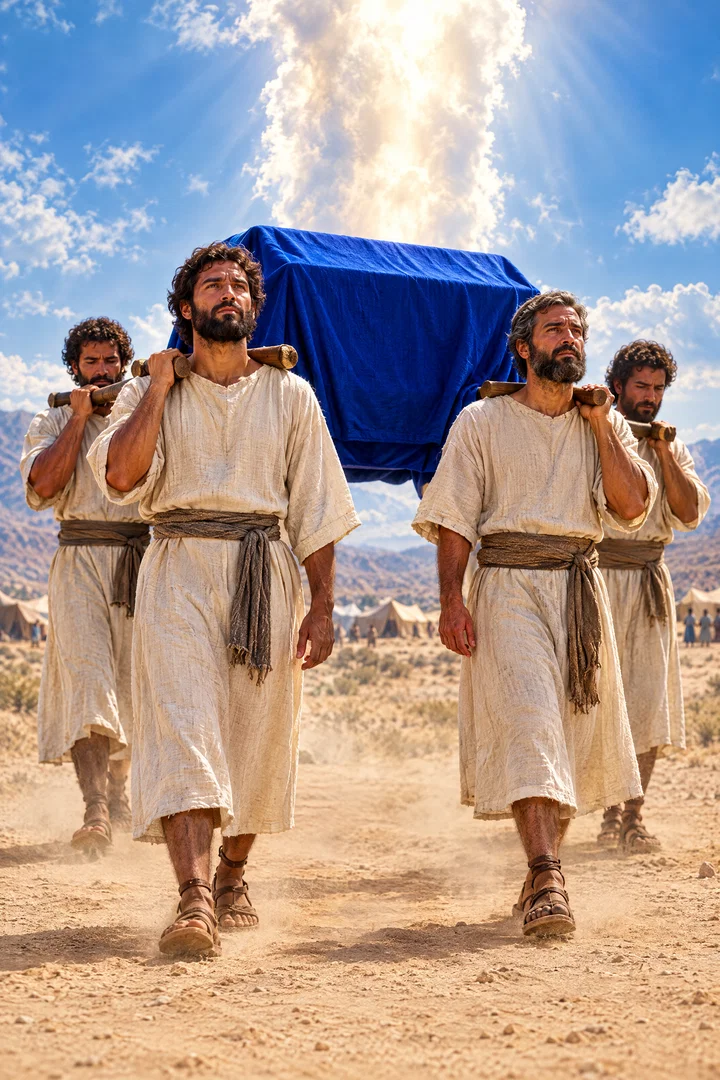
And when Aaron and his sons have made an end of covering the sanctuary, and all the vessels of the sanctuary, as the camp is to set forward; after that, the sons of Kohath shall come to bear it: but they shall not touch any holy thing, lest they die. These things are the burden of the sons of Kohath in the tabernacle of the congregation.
Translations
American King James Version, King James Version, KJV Cambridge Paragraph Bible
And when Aaron and his sons have made an end of covering the sanctuary, and all the vessels of the sanctuary, as the camp is to set forward; after that, the sons of Kohath shall come to bear it: but they shall not touch any holy thing, lest they die. These things are the burden of the sons of Kohath in the tabernacle of the congregation.
And when Aaron and his sons have made an end of covering the sanctuary, and all the vessels of the sanctuary, as the camp is to move forward; after that, the sons of Kohath shall come to bear it: but they shall not touch any holy thing, lest they die. These things are the burden of the sons of Kohath in the tabernacle of the congregation.
And when Aaron and his sons have made an end of covering the sanctuary, and all the furniture of the sanctuary, as the camp is to set forward; after that, the sons of Kohath shall come to bear it: but they shall not touch the sanctuary, lest they die. These things are the burden of the sons of Kohath in the tent of meeting.
And when Aaron and his sons have made an end of covering the sanctuary, and all the furniture of the sanctuary, as the camp is set forward; after that, the sons of Kohath shall come to bear it: but they shall not touch the sanctuary, lest they die. These things are the burden of the sons of Kohath in the tent of meeting.
'And Aaron hath finished — his sons also — covering the sanctuary, and all the vessels of the sanctuary, in the journeying of the camp, and afterwards do the sons of Kohath come in to bear [it], and they do not come unto the holy thing, that they have died; these [things are] the burden of the sons of Kohath in the tent of meeting.
And when Aaron and his sons have ended covering the sanctuary, and all the utensils of the sanctuary, when the camp setteth forward, then afterwards the sons of Kohath shall come to carry it; but they shall not touch the holy things, lest they die. This is what the sons of Kohath have to carry in the tent of meeting.
So shall Aaron and his sons make an end of covering the sanctuary, and all the utensils of the sanctuary, when the camp is to set forward, then after that, shall the sons of Kohath enter to bear it, but they must not put forth a touch unto that which, is holy, else should they die, these, shall be the burden of the sons of Kohath in the tent of meeting.
Berean Standard Bible, Majority Standard Bible
When Aaron and his sons have finished covering the holy objects and all their equipment, as soon as the camp is ready to move, the Kohathites shall come and do the carrying. But they must not touch the holy objects, or they will die. These are the transportation duties of the Kohathites regarding the Tent of Meeting.
“ When Aaron and his sons have finished covering the sanctuary and all the furniture of the sanctuary, as the camp moves forward; after that, the sons of Kohath shall come to carry it; but they shall not touch the sanctuary, lest they die. The sons of Kohath shall carry these things belonging to the Tent of Meeting.
And after the holy place and all its vessels have been covered up by Aaron and his sons, when the tents of the people go forward, the sons of Kohath are to come and take it up; but the holy things may not be touched by them for fear of death.
And when Aaron and his sonnes haue made an ende of couering the Sanctuarie, and al the instruments of the Sanctuarie, at the remouing of the host, afterward the sonnes of Kohath shall come to beare it, but they shall not touch any holy thing, lest they dye. This is the charge of the sonnes of Kohath in the Tabernacle of the Congregation.
Douay-Rheims (Challoner revision)
And when Aaron and his sons have wrapped up the sanctuary and the vessels thereof at the removing of the camp, then shall the sons of Caath enter in to carry the things wrapped up: and they shall not touch the vessels of the sanctuary, lest they die. These are the burdens of the sons of Caath: in the tabernacle of the covenant:
Pictures
Cross-references 20 of 35
- 2 Samuel 6:6-7
And when they came to Nachon’s threshingfloor, Uzzah put forth his hand to the ark of God, and took hold of it; for the oxen shook it.
Uzzah is struck dead after touching the ark, enacting the warning against touching holy things.
- Numbers 7:9
But unto the sons of Kohath he gave none: because the service of the sanctuary belonging unto them was that they should bear upon their shoulders.
Kohath carried the sanctuary’s holy things on their shoulders, receiving no wagons.
- 1 Chronicles 15:13-15
For because ye did it not at the first, the LORD our God made a breach upon us, for that we sought him not after the due order.
The ark is carried by the Levites according to God’s prescribed order.
- Numbers 10:21
And the Kohathites set forward, bearing the sanctuary: and the other did set up the tabernacle against they came.
The Kohathites carried the sanctuary’s holy furnishings as the camp traveled.
- Exodus 25:14
And thou shalt put the staves into the rings by the sides of the ark, that the ark may be borne with them.
The ark is to be carried using its staves.
- Hebrews 8:2
A minister of the sanctuary, and of the true tabernacle, which the Lord pitched, and not man.
Christ ministers in the heavenly sanctuary, of which the tabernacle service was a representation.
- Numbers 3:31
And their charge shall be the ark, and the table, and the candlestick, and the altars, and the vessels of the sanctuary wherewith they minister, and the hanging, and all the service thereof.
Lists the sanctuary furnishings entrusted to the Kohathites to carry.
- 1 Chronicles 13:9-10
And when they came unto the threshingfloor of Chidon, Uzza put forth his hand to hold the ark; for the oxen stumbled.
Uzzah touches the ark contrary to the prescribed instructions and is struck dead.
- Numbers 1:51
And when the tabernacle setteth forward, the Levites shall take it down: and when the tabernacle is to be pitched, the Levites shall set it up: and the stranger that cometh nigh shall be put to death.
The Levites handle the tabernacle, while unauthorized approach brings death.
- 1 Chronicles 15:15
And the children of the Levites bare the ark of God upon their shoulders with the staves thereon, as Moses commanded according to the word of the LORD.
The Levites carry the ark on their shoulders as Moses commanded.
- 1 Chronicles 15:2
Then David said, None ought to carry the ark of God but the Levites: for them hath the LORD chosen to carry the ark of God, and to minister unto him for ever.
David says only the Levites should carry the ark.
- Numbers 4:5-6
And when the camp setteth forward, Aaron shall come, and his sons, and they shall take down the covering vail, and cover the ark of testimony with it:
Priests cover the ark before it is carried.
- Leviticus 10:1-3
And Nadab and Abihu, the sons of Aaron, took either of them his censer, and put fire therein, and put incense thereon, and offered strange fire before the LORD, which he commanded them not.
Both show death as the consequence of deviating from God’s commands in handling holy things.
- Numbers 4:20
But they shall not go in to see when the holy things are covered, lest they die.
Kohathites must not approach the holy objects before they are covered.
- Numbers 3:6-10
Bring the tribe of Levi near, and present them before Aaron the priest, that they may minister unto him.
Distinguishes the priests’ duties from the Levites’ assigned service.
- Hebrews 9:21-22
Moreover he sprinkled with blood both the tabernacle, and all the vessels of the ministry.
The sanctuary and its vessels are cleansed by priestly work with blood.
- 1 Samuel 6:19
And he smote the men of Beth-shemesh, because they had looked into the ark of the LORD, even he smote of the people fifty thousand and threescore and ten men: and the people lamented, because the LORD had smitten many of the people with a great slaughter.
Men die for looking into the ark, which was not to be touched.
- Leviticus 16:33
And he shall make an atonement for the holy sanctuary, and he shall make an atonement for the tabernacle of the congregation, and for the altar, and he shall make an atonement for the priests, and for all the people of the congregation.
Both texts identify the tabernacle as the sanctuary.
- Exodus 36:1-6
Then wrought Bezaleel and Aholiab, and every wise hearted man, in whom the LORD put wisdom and understanding to know how to work all manner of work for the service of the sanctuary, according to all that the LORD had commanded.
Cited with Numbers 4:15 as testimony about the tabernacle sanctuary.
- Numbers 4:4
This shall be the service of the sons of Kohath in the tabernacle of the congregation, about the most holy things:
Describes the Kohathites’ assigned service concerning the most holy things.
Commentary
Each commentary is drawn from primary sources: the writings of Ellen G. White and Adventist pioneers and periodicals. Each commentary is separate. Its own words are not a quotation; follow the references to read the source passages.
Ellen G. White
17 sources
When the camp was to move, the priests were first to finish covering the sanctuary and all its furnishings, and only afterward were the Kohathites to come to carry them, without touching any holy thing on pain of death, for this carrying was their appointed burden.Ms 110, 1899, par. 16–21PP 705.2–3GW92 159.1 This belonged to Israel's wilderness journeys under Moses, when the Levites encamped around the tabernacle and took it down and bore it with the ark and candlestick and other sacred furniture as the hosts journeyed.1SP 296.2–3SG4 28.1–21T 652.2–3 The ark, representing Jehovah's presence among His people, was always kept covered in removal so no curious eye looked upon it, and it was to be borne on its staves by appointed men and not hauled on a cart as if the symbol itself could give victory to the disobedient.PP 705.2–3Lt 28a, 1897, par. 6 Covering belonged to the priests and carrying to the Kohathites, so each was to stay in his appointed place and do only his assigned work with reverence and careful guarding of what God had set apart, rather than taking another's duty into his own hands.GW92 159.1GW92 158.11T 650.2–652.1Ms 29, 1895, par. 4–6Lt 40, 1892, par. 4 To reject that ordered appointment and grasp at greater place or handle holy things unlawfully brings judgment, as seen in Korah's rebellion in seeking the priesthood and rule and in Uzzah's death for violating the carrying command, showing that God values order and requires obedience.Ms 110, 1899, par. 16–21PP 705.2–31SP 296.2–37T 192.3Lt 86a, 1893, par. 2–6
Ordered Transport of Sanctuary
When the camp was ready to move forward, Aaron and his sons were first to finish covering the sanctuary and all its vessels, and only after that were the sons of Kohath to come to bear them, without touching any holy thing lest they die, for these things were the burden of the sons of Kohath in the tabernacle of the congregation.Ms 110, 1899, par. 16–21PP 705.2–3GW92 159.11T 650.2–652.1RH Oct 5, 1905 Covering belonged to the priests and carrying to the appointed Levites, so that no tribe and no volunteer could take the work upon himself, but a particular Levitical family bore what had first been covered for travel.Ms 110, 1899, par. 16–21GW92 159.1GW92 158.11T 650.2–652.1RH Oct 5, 1905 The rule guarded the sacredness of the sanctuary and everything belonging to it, requiring reverence and forbidding unauthorized handling or disregard of the instructions on pain of death.Ms 110, 1899, par. 16–21PP 705.2–3GW92 159.11T 650.2–652.1RH Oct 5, 1905 Their appointed service was therefore a position of trust within an ordered service assigned by God, with place and duties fixed for the journeys rather than left to human choice.Ms 110, 1899, par. 16–21GW92 159.1GW92 158.11T 650.2–652.1RH Oct 5, 1905
The instruction belonged to Israel's wilderness journeys and organization under Moses, when the Levites were to erect the tabernacle and encamp around it while the hosts of Israel pitched at a distance.1SP 296.2–3SG4 28.1–21T 652.2–3 When Israel journeyed they were to take it down and bear it with the ark and the candlestick and the other sacred articles of furniture, dismantling and carrying the tabernacle and its sacred furnishings as their appointed service.1SP 296.2–3SG4 28.1–21T 652.2–3 From that organization comes the lesson that God values order and expects obedience to His arrangements, with Israel's history standing as a warning against disobedience and rebellion.1SP 296.2–3SG4 28.1–21T 652.2–3
The ark, which represented Jehovah among His people, was always kept covered when removed from the sanctuary, so its cherubim were not exposed to view and no curious eye was to look upon it.PP 705.2–3Lt 28a, 1897, par. 6 The sacred ark and its furnishings were thus covered before the camp moved, so the sons of Kohath could carry the sanctuary vessels without touching any holy object.PP 705.2–3Lt 28a, 1897, par. 6 It was to be borne on its staves by appointed holy men in obedience to God's command, not transported on a cart, and violation of that explicit carrying command brought judgment as Uzzah's death illustrates, showing God's requirements are to be treated as sacred and obeyed strictly.PP 705.2–3Lt 28a, 1897, par. 6 The ark was only a symbol of God's presence, not a source of power that could secure victory for a disobedient people.PP 705.2–3
This service of the tabernacle was an honor given to the Levites because they took no part in making and worshiping the golden calf and were faithful in executing God's order upon the idolaters.1SP 296.2–3SG4 28.1–2 Because God thus honored them with the office of erecting, guarding, dismantling, and bearing the sanctuary, they became ambitious for still higher office, seeking greater influence with the congregation by gaining the priesthood and government.1SP 296.2–3SG4 28.1–2
Reverence for Appointed Service
The carrying of the holy objects was not open to any tribe or to anyone who chose to take it up, but was a specific duty within an ordered service assigned by God to a particular Levitical family.GW92 158.11T 650.2–652.1Lt 32, 1892, par. 22–28 Covering belonged to the priests, and carrying to the Kohathites, for Aaron and his sons were first to make an end of covering the sanctuary and all its vessels as the camp set forward, and only after that were the sons of Kohath to come to bear them.GW92 159.1GW92 158.11T 650.2–652.1RH Oct 5, 1905Lt 32, 1892, par. 22–28 They were forbidden to touch any holy thing, lest they die, and bearing these covered things was their burden in the tabernacle of the congregation.GW92 159.11T 650.2–652.1RH Oct 5, 1905 This division made the transport orderly and protected the holiness of the furnishings, guarding their sacredness by entrusting them only to designated carriers.1T 650.2–652.1Lt 32, 1892, par. 22–28Lt 86a, 1893, par. 2–6
Each person was therefore to remain in the appointed place and perform only the assigned task faithfully.Ms 29, 1895, par. 4–6Lt 86a, 1893, par. 2–6 The wilderness service required each one to keep to the work entrusted rather than interfere with another's duties.Lt 86a, 1893, par. 2–6Ms 24, 1887, par. 3–4 People must not take matters into their own hands in sacred work, but act with reverence and caution and wait for God's direction.Ms 29, 1895, par. 4–6Lt 40, 1892, par. 4 Abandoning one's appointed task for another's could bring death, for unauthorized handling of sacred things was a deadly violation of their holiness.Ms 29, 1895, par. 4–6Lt 40, 1892, par. 4Lt 86a, 1893, par. 2–6
The sanctuary and everything belonging to it were sacred and had to be treated with reverence.GW92 159.11T 650.2–652.1STB 181.2 It was a holy trust set apart by God, to be carefully guarded from profanation and unauthorized handling.1T 650.2–652.17T 192.3STB 181.2 What is dedicated to Him is to be protected with the same care as the ark and its holy things.7T 192.3STB 181.2 Touching a holy thing in violation of its holiness brought the penalty of death, so disregard of these instructions invited judgment.GW92 159.1Ms 29, 1895, par. 4–6Lt 40, 1892, par. 4
Rejection of this appointed order brings judgment.Ms 110, 1899, par. 16–21PP 705.2–31T 652.2–3 Korah and his companions had an appointed service as a position of trust in carrying the sanctuary and its vessels, yet wrongly rejected their assigned place and duties when they sought greater authority.Ms 110, 1899, par. 16–211SP 296.2–3 Though thus honored for faithfulness, they became ambitious for still higher office, seeking greater influence with the congregation by gaining the priesthood and government.Ms 110, 1899, par. 16–211SP 296.2–3 Uzzah's death likewise illustrates the judgment for violating the explicit carrying command, since the ark was to be borne on its staves by appointed holy men in obedience to God's command, not transported on a cart.PP 705.2–3 Israel's history under this organization under Moses shows that God values order and expects obedience to His arrangements, warning against disobedience and rebellion.PP 705.2–31T 652.2–3
Sources
Pioneers and periodicals
41 sources
When the camp was to move, Aaron and his sons were first to cover the sanctuary and all its vessels, and then the sons of Kohath were to come and bear those covered holy things on their shoulders by their poles, not haul them on a cart and not touch any holy thing.ST Apr 8, 1889RH Sep 7, 1869RH Jan 6, 1853RH Sep 5, 1871RH Dec 22, 1910 Even the appointed carriers were forbidden on pain of death to touch or uncover what was holy, because God is holy and his presence must be approached with strict reverence and exact obedience in both matter and manner.RH Sep 5, 1871RH Mar 3, 1910ST Feb 4, 1897ST Jul 2, 1896RH Apr 9, 1901 That standing order explains the death of Uzzah long afterward, for placing the ark on an ox-drawn cart instead of having Levites bear it created the occasion for his forbidden steadying touch, and one disregard of the command led to another.ST Apr 8, 1889RH Sep 7, 1869RH Aug 10, 1916ST Jun 22, 1882ST Oct 14, 1889 The divided, assigned burden shows that God works by appointed means and in careful order, not by indiscriminate effort, reflecting the order of heaven and his design for unity and leadership in the church.RH Apr 14, 1903RH Apr 9, 1901RH Apr 7, 1868 The special care for the ark that held his law underscores the sacredness and binding force of his commandments, while its humble outer coverings pictured the Messiah and his salvation kept before the people.ST Jul 2, 1896ST Feb 4, 1886ST Mar 11, 1897ST Mar 31, 1898
Prescribed Manner of Transport
When the camp was to set forward, Aaron and his sons had first to make an end of covering the sanctuary and all its vessels, and only after that were the sons of Kohath to come to bear the covered holy objects.ST Apr 8, 1889RH Jan 6, 1853RH Dec 22, 1910RH Feb 11, 1858RH Sep 2, 1852 They were to bear them on their shoulders by the poles through the rings, not to transport them on a cart, and they were not to touch any holy thing, even after covering, lest they die.ST Apr 8, 1889RH Sep 7, 1869RH Sep 5, 1871ST Mar 21, 1906RH Dec 22, 1910 Putting the ark on a cart drawn by oxen so that it shook and then presumptuously touching it to steady it violated both the prescribed carrying and the express prohibition against touching, with deadly result, while having the Levites themselves carry it after the due order brought clearer views of its holiness with more careful reverence and holier joy.ST Apr 8, 1889RH Sep 7, 1869ST Mar 21, 1906
The work was divided: handling and covering belonged to Aaron and his sons, and carrying the things so prepared was the assigned burden of the Kohathites in the tabernacle of the congregation.RH Sep 5, 1871RH Dec 22, 1910RH Feb 11, 1858RH May 28, 1901ST Nov 1, 1877 That carrying work is distinguished from the priests' preparation of the sanctuary for removal and from their ministry in the earthly sanctuary, with strict limits on who could handle the sacred furnishings.RH Dec 22, 1910RH May 28, 1901ST Nov 1, 1877RH Sep 2, 1852 The ark and other sacred things could be handled only as God appointed, and carrying these sacred items was the Kohathites' assigned duty in the tabernacle service.RH Feb 11, 1858RH May 28, 1901RH Sep 2, 1852
The order was part of what was given at Sinai when the tribe of Levi was set apart to the sacred work of caring for and carrying the tabernacle and its belongings.ST Jul 29, 1880ST Jul 29, 1880 The tribe was divided into three parts according to the descendants of Levi's three sons, and each division was given its own specified portion of the work of bearing the sanctuary.ST Jul 29, 1880 The Kohathites were given the special duty and special charge of caring for the ark and the other furniture belonging to the tabernacle.ST Jul 29, 1880ST Jul 29, 1880 The tabernacle stood in the central position of the encampment, with Moses and Aaron pitched close by in front of it and the Kohathites pitched on the south side of it, distinct from the Merarites on the north side and the Gershonites in the rear who had charge of other parts.ST Jul 29, 1880
In this way the Levites bore the sanctuary and its sacred vessels during Israel's forty years of wilderness travel when the camp moved.RH Aug 21, 1856RH Aug 4, 1863 The wilderness tabernacle so carried is the sanctuary, and after this arrangement the oversight of the sanctuary and everything in it is assigned to Eleazar.RH Jan 6, 1853RH Aug 21, 1856RH Aug 4, 1863
Holiness Requiring Reverence
The prohibition bound even the appointed carriers after the covering was complete: once Aaron and his sons had finished covering the sanctuary and its vessels for the march, the sons of Kohath were to come to bear them on their shoulders and not by cart, yet they were not to touch any holy thing, and not to touch any uncovered holy thing, on pain of death.RH Sep 5, 1871RH Mar 3, 1910ST Jun 26, 1884ST Feb 4, 1897RH May 28, 1901 The handling belonged to Aaron's sons and the carrying so prepared was the assigned burden of the Kohathites, showing that the ark and other sacred things could be handled only as God appointed.RH Sep 5, 1871RH Mar 3, 1910RH May 28, 1901 From curiosity or lack of order no one was to leave his position to touch any part of the sanctuary or its furniture, or even to come near the appointed workmen, under penalty of death.ST Jul 29, 1880 The holy tabernacle was not to be taken down, carried, and set up indiscriminately by any tribe that desired it.ST Jul 29, 1880
The restriction was not arbitrary but taught that God is holy and that His presence and law must be treated with reverence.ST Jul 2, 1896RH Apr 9, 1901RH Nov 17, 1904 Everything pertaining to the most holy was to be regarded with reverence and holy awe, and the death penalty impressed Israel with God's holiness and the need to follow His directions and consecrate themselves before approaching His service.ST Jul 29, 1880RH Nov 17, 1904 Carrying the ark exactly as commanded was an act of simple faith, while replacing that command with a humanly devised cart led to dishonor and death.ST Feb 4, 1897 The carefully ordered, assigned duty taught Israel to respect the sacredness of the sanctuary and obey God's arrangements rather than take up the work at will.RH Apr 9, 1901
Both matter and manner were fixed by positive law for worship, requiring prompt and explicit obedience regardless of motive or apparent harmlessness.ST Jun 22, 1882ST Jan 1, 1885 Touching even with pious and reverent intention to keep the ark from falling is presumption and disobedience to expressly revealed will, and piety is no excuse.ST Jun 22, 1882ST Jan 1, 1885 Ignorance of God's order did not make disobedience harmless.RH Apr 7, 1868 However small men may count these rules, they carry the sanction and direct action of the Almighty, whose word must be regarded first of all and at all times, and the handling therefore had to follow His exact instructions under penalty of death.ST Jun 22, 1882ST Dec 11, 1928 Uzzah's rash touching, though done with great carefulness to save the ark, showed great carelessness to obey the command and was struck dead, displaying God's jealous care to preserve His positive law and to punish even well-meant violation.ST Jan 1, 1885
Only persons chosen to the office who could appreciate the sacredness of the work were to do it, not any tribe indiscriminately.ST Jul 29, 1880RH Apr 9, 1901 Those appointed men were directed to impress upon the people the special sacredness of the ark and all that belonged to it, lest they look upon holy things without realizing their holiness and by making sacred things common be cut off from Israel.ST Jul 29, 1880 None but consecrated hands could touch the ark of God.ST Feb 4, 1886 Since the testimony lay within, the hands that would dare to alter that testimony should be thrice holy, and the erring hand of man should long pause before daring with human reasonings to chip away one God-graven word and deface an article of His law.ST Feb 4, 1886
Those who held a stricter reading taught that only the priests were permitted to touch the ark.RH Sep 16, 1915 In that same line it is taught that the verse commands that the Levites alone were to touch and bear the ark, forbidding others to touch any holy thing lest they die.RH Jun 17, 1873
Uzzah and the Ark
The command given at Sinai remained binding long after Moses, hundreds of years before David, and it explains the death of Uzzah.RH Aug 10, 1916ST Oct 14, 1889 The ark was to be borne on the shoulders of the Levites, the sons of Kohath carrying what Aaron and his sons had first covered, and it was never to be placed on a cart drawn by oxen.ST Apr 8, 1889ST Oct 14, 1889ST Jan 1, 1885 Putting it on a cart violated the prescribed due order for moving it, and steadying it when it shook violated the express prohibition against touching any holy thing on pain of death.ST Apr 8, 1889RH Sep 7, 1869RH Sep 7, 1869ST Oct 14, 1889ST Jan 1, 1885 Uzzah's death before the Lord was therefore direct punishment for direct disobedience to this stated command.RH Aug 10, 1916RH Sep 7, 1869ST Oct 14, 1889
Disobedience to the command about the cart created the occasion for breaking the command not to touch.ST Apr 8, 1889ST Jun 22, 1882ST Oct 14, 1889 Neglecting shoulder-bearing led to the shaking that prompted the touch, showing how one disregard of God's commandment leads to another with deadly result.ST Apr 8, 1889ST Oct 14, 1889 One departure from the appointed path makes the next step easier and leads further from Him.ST Oct 14, 1889
God enforced His stated command in death to preserve the sacred order and to prevent others from disregarding it.RH Sep 7, 1869 Replacing His command with a humanly devised cart and an invented method of handling led to dishonor and swift destruction.ST Apr 8, 1889ST Feb 4, 1897ST Jul 2, 1896 When the Levites afterward carried the ark after the due order, they had clearer views of its holiness and bore it with more careful reverence and holier joy.ST Apr 8, 1889 Carrying as commanded is an act of simple faith.ST Feb 4, 1897
Israel had no excuse in copying the Philistines, for Israel knew God's revealed will while the Philistines did not have His instructions.ST Jun 22, 1915ST Jun 22, 1882 The Philistines' cart was accepted because they lacked that revelation, but David's failure to follow the prescribed plan brought death.ST Jun 22, 1915ST Jun 22, 1882 God's people must follow His revealed directions for worship and service rather than adopt heathen precedent or practice in opposition to His express word.ST Jun 22, 1915ST Jun 22, 1882 Uzzah showed great carefulness to save the ark but great carelessness to obey the command, and his rash though well-meant and pious touch to keep it from falling was presumption punished as direct disobedience.ST Jun 22, 1882ST Jan 1, 1885RH Sep 16, 1915 However small men may count these rules, the matter and manner were fixed by divine positive law requiring prompt explicit obedience regardless of motive or apparent harmlessness, and they carry the sanction and direct action of the Almighty in jealous care to preserve His law.ST Jun 22, 1882ST Jan 1, 1885
Order in Ministry and Church
God works by means, and there is order in his work. The bearing of the covered vessels of the sanctuary only after Aaron and his sons had finished covering them, without touching any holy thing, was a specific assigned burden within an organized, disciplined host, not an unorganized rabble. The assignment of sanctuary work to the Levites, including the duty of the Kohathites to carry the holy objects after Aaron and his sons had prepared them, made their service part of the organized work of the sanctuary.RH Apr 14, 1903 The transport of the sanctuary was thereby made an assigned, carefully ordered duty rather than work any tribe could take up indiscriminately, teaching respect for the sacredness of the sanctuary and obedience to divine arrangements.ST Jul 29, 1880RH Apr 9, 1901 It was not to be carried and set up and taken down indiscriminately by any tribe that desired to do it, but only by persons chosen to the office who could appreciate the sacredness of the work.ST Jul 29, 1880RH Apr 9, 1901
Anyone who from curiosity or lack of order left his position and touched any part of the sanctuary or its furniture, or even came near the appointed workmen, was punished with death, and touching an uncovered holy object brought death.ST Jul 29, 1880RH Apr 9, 1901 These appointed men were to impress upon the people the special sacredness of the ark and all that belonged to it, lest they look upon holy things without realizing their holiness and by making sacred things common be cut off.ST Jul 29, 1880 Everything pertaining to the most holy was to be regarded with reverence and holy awe.ST Jul 29, 1880 That earthly order reflects order in heaven, where the armies of heaven are marshalled under respective leaders by the Lord of hosts, and his design for order in the church on earth through appointed gifts, offices, and chosen leaders.
When God does a great and specific work such as giving the last message to man, the last warning of probation, he chooses certain ones best calculated to lead. All the consecrated and faithful share in the work while honoring that instrumentality, so that the work is harmoniously accomplished in unity. God thus assigns particular work to chosen people and expects his instructions to be respected, and ignorance of his order does not make disobedience harmless.RH Apr 7, 1868
Law Sanctuary and Christ
The sanctuary here is the tabernacle of God with its sacred furnishings and vessels used in the work of atonement, while the other parts of the tabernacle were its appurtenances.RH May 5, 1851 It is the Bible's sanctuary, and the wilderness tabernacle is called the sanctuary in this instruction for covering and carrying when the camp moved.RH Apr 30, 1857RH Dec 5, 1854RH Aug 4, 1863 The Levites bore that sanctuary and its sacred vessels in this covered manner during Israel's wilderness journeys.RH Aug 4, 1863 The instruction stands among those concerning offerings called most holy, but it does not establish that those offerings are holier than the Sabbath.RH Jun 10, 1862
The ark held the sacred law and testimony, and the care required for that law-bearing ark underscores the importance of obeying God's commandments.ST Jul 2, 1896ST Mar 31, 1898 It was not the ark that sanctified the law but the law that sanctified the ark.RH Jun 17, 1873 Because the testimony lay within, only thrice-holy hands should dare alter it, and the erring hand of man should long pause before daring with human reasonings to chip away one God-graven word and deface an article of His law.ST Feb 4, 1886 The ark contained the unchanged law which alone gives the knowledge of sin, so even the least violation is sin, and though there are degrees in sinning yet no sin is small in God's sight and He can hold no compromise with it.ST Oct 14, 1889 Open violation of God's law brings judgment, as touching the ark brought death.ST Oct 14, 1889ST Mar 31, 1898 God is so jealous for the mere vehicle of the ten words spoken by His voice and written by His finger that He is far more jealous for the words themselves, which embody the whole duty of man.RH Jun 17, 1873 He demands exact obedience in small as well as great things, and with that law He tests men's characters though transgression may now go without immediate visible punishment, for He is no respecter of persons.RH Jun 17, 1873
The ark was only a symbol of God's presence, not a source of power that could secure victory for a disobedient people, and it was therefore to be borne by appointed holy men in obedience to God's command. The coverings used in transport, including badgers' skins, pictured the Messiah and His salvation, keeping that work before the people.ST Mar 11, 1897 The plain outer covering represented His humble, unattractive appearance to the world and the spiritual beauty hidden from worldly eyes but seen by God.ST Mar 11, 1897
Sources