Acts 14:11
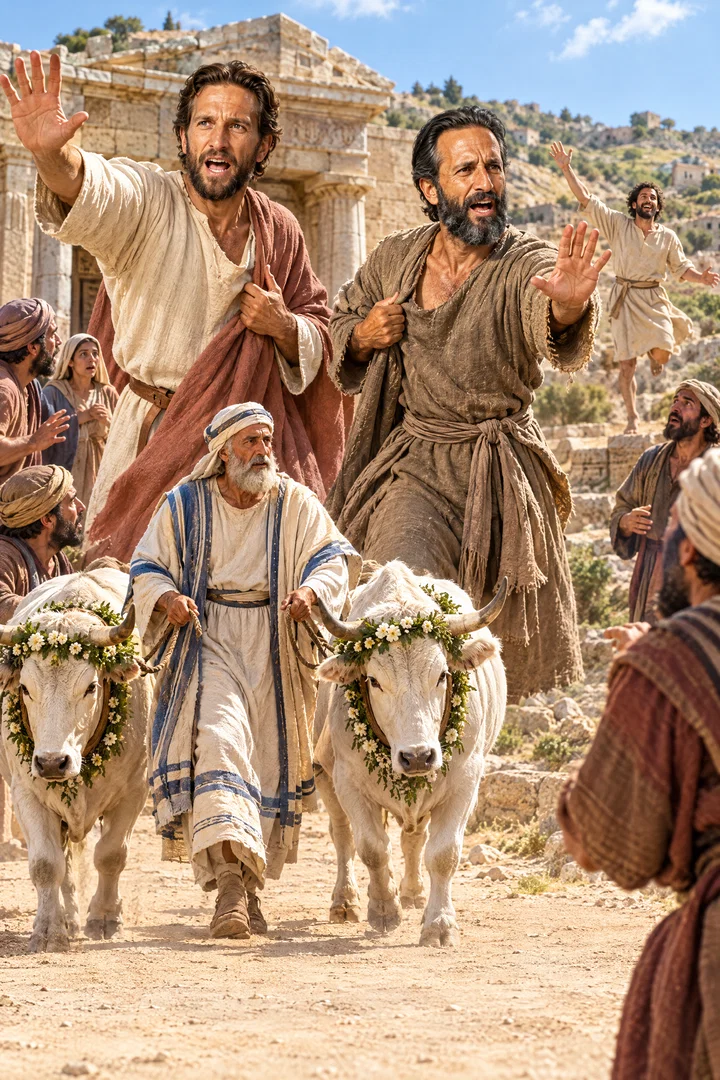
And when the people saw what Paul had done, they lifted up their voices, saying in the speech of Lycaonia, The gods are come down to us in the likeness of men.
Translations
American King James Version, King James Version
And when the people saw what Paul had done, they lifted up their voices, saying in the speech of Lycaonia, The gods are come down to us in the likeness of men.
And when the people saw what Paul had done, they lift up their voices, saying in the speech of Lycaonia, The gods are come down to us in the likeness of men.
And when the people saw what Paul had done, they lifted up their voices, saying in the speech of Lycaonia, The gods have come down to us in the likeness of men.
And when the multitudes saw what Paul had done, they lifted up their voice, saying in the speech of Lycaonia, The gods are come down to us in the likeness of men.
And when the multitude saw what Paul had done, they lifted up their voice, saying in the speech of Lycaonia, The gods are come down to us in the likeness of men.
and the multitudes having seen what Paul did, did lift up their voice, in the speech of Lycaonia, saying, 'The gods, having become like men, did come down unto us;'
But the crowds, who saw what Paul had done, lifted up their voices in Lycaonian, saying, The gods, having made themselves like men, are come down to us.
And, the multitudes, seeing what Paul had done, lifted up their voice, in the speech of Lycaonia—The gods, made like unto men, have come down unto us!
Berean Standard Bible, Majority Standard Bible
When the crowds saw what Paul had done, they lifted up their voices in the Lycaonian language: “ The gods have come down to us in human form!”
When the multitude saw what Paul had done, they lifted up their voice, saying in the language of Lycaonia, “ The gods have come down to us in the likeness of men!”
And when the people saw what Paul had done, they said in a loud voice, in the language of Lycaonia, The gods have come down to us in the form of men.
Then when the people sawe what Paul had done, they lift vp their voyces, saying in ye speach of Lycaonia, Gods are come downe to vs in the likenesse of men.
Douay-Rheims (Challoner revision)
And when the multitudes had seen what Paul had done, they lifted up their voice in the Lycaonian tongue, saying: The gods are come down to us in the likeness of men;
Pictures
Cross-references
- Acts 14:19
And there came thither certain Jews from Antioch and Iconium, who persuaded the people, and, having stoned Paul, drew him out of the city, supposing he had been dead.
The crowd that hailed Paul as a god later stoned him and dragged him outside the city.
- Acts 14:15
And saying, Sirs, why do ye these things? We also are men of like passions with you, and preach unto you that ye should turn from these vanities unto the living God, which made heaven, and earth, and the sea, and all things that are therein:
Paul says the living Creator alone should be worshiped.
- 1 Corinthians 12:2
Ye know that ye were Gentiles, carried away unto these dumb idols, even as ye were led.
shows they formerly served false gods
- Acts 16:1
Then came he to Derbe and Lystra: and, behold, a certain disciple was there, named Timotheus, the son of a certain woman, which was a Jewess, and believed; but his father was a Greek:
Paul returned to Lystra to care for converts
- Psalms 96:4-5
For the LORD is great, and greatly to be praised: he is to be feared above all gods.
The Lord, who made the heavens, is distinguished from the nations’ idols.
- Acts 14:17
Nevertheless he left not himself without witness, in that he did good, and gave us rain from heaven, and fruitful seasons, filling our hearts with food and gladness.
Rain and fruitful seasons witness to God’s goodness against the people’s idol worship.
- Acts 17:24
God that made the world and all things therein, seeing that he is Lord of heaven and earth, dwelleth not in temples made with hands;
Paul points idolaters to God as Maker of the world.
- 1 Corinthians 8:5
For though there be that are called gods, whether in heaven or in earth, ( as there be gods many, and lords many,)
Many beings are called gods, as the Lycaonians mistake Paul and Barnabas for gods.
Commentary
Each commentary is drawn from primary sources: the writings of Ellen G. White and Adventist pioneers and periodicals. Each commentary is separate. Its own words are not a quotation; follow the references to read the source passages.
Ellen G. White
22 sources
When Paul commanded a man crippled from birth at Lystra to stand up, and the well-known sufferer leaped and walked in complete healing, the astonished people shouted in the speech of Lycaonia that the gods had come down to them in the likeness of men.AA 177.1–2Ms 117a, 1901, par. 30–32AA 181.2–182.3SLP 57.18RED 19.3–20.2 They took Barnabas to be Jupiter because of his venerable appearance, dignified bearing and benevolent countenance, and Paul to be Mercury because he was the chief speaker, active, earnest and eloquent.Ms 117a, 1901, par. 30–32AA 181.2–182.3SLP 57.1 Interpreting the miracle through pagan belief that deities sometimes visited earth, they were ready with great enthusiasm to worship the apostles, with the priest of Jupiter bringing oxen and garlands to the gates for sacrifice.Ms 117a, 1901, par. 30–32SLP 57.1SG1 94.1SLP 59.1–2 The apostles refused the honor, rending their clothes and declaring themselves men of like passions, calling the people to turn from vanities and idols to the living God who made heaven and earth and sea and all things therein.Ms 117a, 1901, par. 30–32SG1 94.1EW 168.4 That same fickle reverence soon turned to hate when Jews from Antioch and Iconium persuaded the multitude that they were deceivers, so those who would have worshiped Paul stoned him and dragged him out of the city for dead, yet the Lord preserved his life because his work was not done.Ms 117a, 1901, par. 30–32Lt 218, 1901, par. 13–15SG1 94.1
Miracle and Pagan Interpretation
The cry recorded here followed the healing at Lystra of a man crippled from birth who had listened to the preaching and had faith to be healed, when Paul commanded him to stand upright on his feet and he leaped up and walked.Ms 117a, 1901, par. 30–32AA 181.2–182.3 The cure was complete and undeniable, wrought upon a well-known lifelong condition.8RED 19.3–20.23SP 362.1–3 When the people saw what Paul had done they lifted up their voices in the speech of Lycaonia, declaring that the gods had come down to them in the likeness of men.AA 177.1–2Ms 117a, 1901, par. 30–32 They interpreted what they had witnessed through pagan belief and a local tradition that deities sometimes visited the earth in human form.AA 181.2–182.3SLP 57.13SP 361.1–3 Their words in the Lycaonian language show how they sought to connect the event with their own superstitious beliefs.AA 177.1–2AA 180.1–3
They identified Barnabas as Jupiter, the father of the gods, because of his venerable appearance, dignified bearing, gentle manner, and the mildness and benevolence of his countenance.AA 181.2–182.3SLP 57.18RED 19.3–20.2 They identified Paul as Mercury or Mercurius because he was the chief speaker, active, earnest, quick, and eloquent in warning, exhortation, and preaching.Ms 117a, 1901, par. 30–32AA 181.2–182.3SLP 57.18RED 19.3–20.2 The force of his eloquence and convincing power in preaching the gospel was taken as the mark of the heathen god Mercury come down in the form of a man.8RED 19.3–20.2Ms 128, 1908, par. 7–14
Lystra had no Jewish synagogue, though a few Jews lived there, while the temple of Jupiter stood in a conspicuous place.8RED 18.4–19.2 Its people were ignorant, superstitious, credulous idolaters and heathen worshipers.8RED 18.4–19.28RED 52.2–53.1SLP 89.2–3 In this they were unlike the people at Athens, who were famous for intelligence and education.8RED 52.2–53.1SLP 89.2–3
Mistaking Paul and Barnabas for divine beings come down from heaven, the people with great enthusiasm were ready to worship them with sacrifices and honors.SG1 94.1SLP 59.1–2EW 168.48RED 19.3–20.23SP 363.1–364.2 The priest of Jupiter brought oxen and garlands to the gates to offer sacrifice with the people.Ms 117a, 1901, par. 30–32 Their wonder and admiration took the miracle as proof that gods had come among them in human form.SG1 94.1EW 168.43SP 363.1–364.2 The same mistake occurred at Melita, where the islanders called Paul a god after he survived the viper's bite.SLP 270.2
Refusal, Reversal, and Application
The apostles refused the worship and could scarcely restrain the people, rending their clothes and declaring themselves only men of like passions who must turn from vanities and idols to worship the living God who made heaven and earth and sea and all things therein.Ms 117a, 1901, par. 30–32SG1 94.1EW 168.43SP 363.1–364.2 Paul was grieved by the attempt to sacrifice to them, and he exalted God before them as the first knowledge of faith in the true God, that the worship and honor due Him might form in their minds.SG1 94.1EW 168.43SP 363.1–364.2 Their idolatrous response grew from belief that divine beings visited the earth, and it led them to prepare sacrifices and honors for Paul and Barnabas.3SP 363.1–364.2
To lead them to correct knowledge of the true object of adoration, Paul gathered the people about them and spoke to them in the Greek language.8RED 18.4–19.2 He directed their attention from the visible works of the Almighty — the firmament of the heavens, the sun, moon, and stars, the beautiful order of the recurring seasons, rain and fruitful seasons, the mighty snow-capped mountains, the lofty trees, and the varied wonders of nature showing skill and exactitude almost beyond finite comprehension — to the great Mind of the universe.SG1 94.18RED 18.4–19.2 Then he told them of the Son of God who came from heaven to earth because He loved the children of men, His life and ministry, His rejection by those He came to save, His trial and crucifixion by wicked men, His resurrection from the dead to finish His work on earth, and His ascension to heaven to be man's Advocate in the presence of the Maker of the world, which Paul and Barnabas declared with the Spirit and power of God as the gospel of Christ and the first knowledge of faith in the true God.SG1 94.18RED 18.4–19.2
The people's response was unstable, fickle, and easily led because their faith was not anchored in the true God.Ms 117a, 1901, par. 30–32SLP 59.1–2 Their wonder, reverence, and admiration soon turned to hate, insult, abuse, and a determination to kill.Ms 117a, 1901, par. 30–32SG1 94.13SP 378.1SLP 72.2 Jews from Antioch and Iconium and other cities followed Paul, persuaded them that he and Barnabas were deceivers, and inflamed them with false reports, falsehood, and misrepresentation.Ms 117a, 1901, par. 30–32Lt 218, 1901, par. 13–15SG1 94.13SP 378.18RED 35.2–3 So those who had been ready to worship the disciples stoned Paul and dragged him out of the city, leaving him for dead and supposing him dead.Ms 117a, 1901, par. 30–32Lt 218, 1901, par. 13–15SG1 94.1SLP 72.2
The Lord preserved Paul's life because his work was not done.Ms 117a, 1901, par. 30–32 As the disciples stood about him mourning, he rose up to their joy and went with them into the city.Ms 117a, 1901, par. 30–32SG1 94.1 The whole chapter, including this sudden turn from divine honor to persecution, is to be studied by those preparing to labor together with God in the last days, because they will realize similar experiences while preaching, teaching, and returning to confirm disciples.Lt 218, 1901, par. 13–15
Paul faced this furious mob at Lystra without being ashamed of the cause he served, and his faith strengthened him to remain steadfast.GW 107.3 He was not a mean or contemptible speaker, for the men of Lystra judged him as Mercury come down in the form of a man because of the force of his eloquence and convincing power in preaching the gospel.Ms 128, 1908, par. 7–14 His speech carried the demonstration of the Spirit and of power, so that thousands of Jews and Gentiles believed in many places, a result to be attributed not to the man himself but to the power of God upon him, with angels making the Word effective.Ms 128, 1908, par. 7–14 Paul later returned to Lystra, the scene of this danger, to look after the fruit of his labors, and found the converts not intimidated by the violent persecution but confirmed in faith.8RED 35.2–3
Sources
Pioneers and periodicals
49 sources
When Paul commanded a man crippled from birth to stand upright and the man at once leaped up and walked, the people of idolatrous Lystra together cried out in their own Lycaonian speech that the gods had come down to them in the likeness of men, taking Barnabas for Jupiter and Paul for Mercury.ST Jun 19, 1879ST Dec 9, 1897ST Dec 9, 1897ST Nov 1, 1910ST Jan 15, 1885 They discerned that the healing power was more than human ability, but in ignorance they credited the apostles themselves as its divine source and with heathen excitement brought sacrifices to worship them.ST Apr 29, 1897ST Jun 17, 1897RH Nov 16, 1916ST Apr 29, 1897 Paul and Barnabas with alarm refused the honor and urged them to turn from idols and that very worship to the living God who made heaven and earth and the sea and all things in them.RH Oct 15, 1903RH May 30, 1871ST Apr 6, 1882 That living God has left himself not without witness in gifts of rain and fruitful seasons and food and gladness, which proclaim his power and love and leave all peoples accountable.RH Oct 15, 1903ST Aug 12, 1897ST May 21, 1902 The same excitable multitude soon turned from trying to worship the apostles to stoning Paul and dragging him out as dead, showing popular favor is fickle and no measure of truth or right.RH Feb 15, 1870RH Aug 3, 1876ST Mar 13, 1884RH Apr 10, 1913ST Jul 30, 1894 The human messenger is only the means through whom God gives the gift, so worship and thanks belong to God alone and never to the servant.RH Jul 8, 1909RH Oct 6, 1868ST Aug 26, 1897
Miracle and Cry at Lystra
Paul healed a man at Lystra who had been crippled from birth with deformed feet and had never walked.ST May 21, 1902ST May 21, 1902 While preaching Paul looked steadily at him, discerned by the Spirit that he had faith to be healed on the spot, and loudly commanded him to stand upright on his feet.ST May 21, 1902ST May 21, 1902 The man immediately leaped up and walked about.ST Dec 9, 1897ST Dec 9, 1897ST Nov 21, 1892ST May 21, 1902ST May 21, 1902 The healing followed the man's hearing and believing the gospel of forgiveness through Christ, showing divine power to heal both soul and body.ST Aug 16, 1883
Seeing what Paul had done, the multitude all together cried out vigorously, saying the gods had become like men and had come down to them.ST Apr 29, 1897ST Jun 17, 1897ST May 21, 1902ST Nov 1, 1910ST Nov 21, 1892 They spoke in their native Lycaonian speech, shifting from the common Greek Paul had used into their own excited language.ST Apr 29, 1897ST Jun 17, 1897RH May 20, 1915ST Jan 15, 1885ST Nov 21, 1892 The apostles did not understand what was said until they saw preparations for sacrifice.RH May 20, 1915ST Nov 21, 1892
The cry reflected the pagan belief that gods could take human form and visit the earth, and local traditions about such visits.ST Jun 19, 1879ST May 7, 1885ST Nov 21, 1892 The idolatrous people identified Barnabas with Jupiter, the father of the gods, because of his dignified bearing, and Paul with Mercury.ST Jun 19, 1879ST May 7, 1885ST Jan 15, 1885ST Aug 12, 1897 They were worshipers of Jupiter and Mercury who attributed the power of the miracle to the apostles themselves rather than recognizing the true God as its source.ST May 7, 1885ST Aug 12, 1897
This took place at Lystra on the first visit of Paul and Barnabas, an idolatrous rural town in Lycaonia, which was part of Galatia.ST Feb 13, 1896ST Mar 13, 1884ST Nov 14, 1892 There was no Jewish synagogue and few Jews there, so the two strangers gathered the people as they could to preach the gospel of Christ.ST Mar 13, 1884 Its heathen people had known nothing of God before hearing Paul's gospel, but did service to them which by nature are no gods.ST Nov 14, 1900ST Feb 13, 1896 The event stands among the miracles recorded in the first fourteen chapters of Acts, and after the experience at Lystra and a visit to neighboring towns the itinerary went on to Perga, then to Attalia, where they took ship for Antioch in Syria.ST Jun 2, 1898ST May 28, 1902 Paul preached the same gospel to the uncultivated there as at Athens.ST Mar 13, 1884
Pagan Worship of Messengers
After seeing a man who had never walked healed, the people at Lystra cried out in their local speech that gods had come among them in human form, recognizing in the healing a power more than human ability.ST Apr 29, 1897RH Nov 16, 1916ST Apr 29, 1897 They understood that such power did not belong to human beings by nature, yet in ignorance they wrongly credited Paul and Barnabas themselves with being its divine source.ST Apr 29, 1897ST Apr 29, 1897ST Aug 12, 1897 They could not distinguish the voice that spoke the healing words from the power that accomplished the healing, attributing to the apostles the power that had done the miracle.ST Apr 29, 1897ST Aug 12, 1897 They believed such healing could come only from a god, and therefore mistook the human agents of healing for gods present in the agents.RH Nov 16, 1916RH Jul 8, 1909
From the impressive sign they concluded that the workers themselves were divine beings come among them, and they prepared to worship them.ST Jul 4, 1905RH May 30, 1871 With excitement characteristic of heathenism they moved toward worship with sacrifices, and the idolatrous priests brought preparations for sacrifice to them.ST Jun 17, 1897ST Nov 5, 1894ST Aug 16, 1883 Their response was based on the impressive sign and appearance rather than on principles of righteousness, without regard to righteousness or principle.ST Jul 4, 1905 This readiness to treat Paul and Barnabas as divine beings shows how readily Gentile beliefs turned extraordinary events and human messengers into objects of worship.RH May 30, 1871ST Nov 5, 1894
The impulse to worship the apostles was moved by the adversary of truth in order to turn attention away from God the true Source of power.ST May 21, 1902ST May 21, 1902 When the truth of God's work cannot be denied, the enemy perverts it to serve a sinister purpose, crediting the miracle to the apostles and directing worship toward them.ST May 21, 1902ST May 21, 1902 By that pleasant deception God is robbed of the honor due His name and Satan's purpose is served.ST May 21, 1902ST May 21, 1902
Turning to Living Creator
Paul and Barnabas disclaimed all honor and with alarmed appeal rejected the worship the people offered them.ST Apr 6, 1882ST Mar 13, 1884ST Aug 16, 1883RH Jan 13, 1859 When the multitude moved toward sacrificing to them, the apostles resisted that movement and refused to receive it.ST Apr 6, 1882ST Mar 13, 1884ST Aug 16, 1883RH Jan 13, 1859 The moment gave full opportunity for self-glory and money gain, but they would not take it for themselves.ST Mar 13, 1884 They used the occasion instead to urge the people to turn from idols and from that very kind of worship to the living God.RH May 30, 1871ST Apr 6, 1882ST Mar 13, 1884
That living God is the one who made heaven and earth and the sea and all things in them.RH May 30, 1871ST Aug 2, 1877RH Apr 29, 1875RH Mar 11, 1875 His creative works distinguish him as the true God from them which by nature are no gods.ST Aug 2, 1877RH Apr 29, 1875RH Mar 11, 1875 The error of idolatry is met by directing the mind to the Maker of all as the only right object of worship.RH May 30, 1871ST Apr 6, 1882
They pointed to his goodness witnessed in gifts of rain, fruitful seasons, food, and gladness, with crops and animals included among those blessings.RH Oct 15, 1903ST Aug 12, 1897ST May 21, 1902 Nature proclaims the perpetual presence and manifestation of God's power and love everywhere through these gifts.ST Aug 12, 1897 Those blessings are often regarded as mere natural results, yet they are really witnesses of the goodness of God and leave him not without witness.RH Oct 15, 1903ST Aug 12, 1897ST May 21, 1902 For that reason all peoples in heathen lands as well as enlightened ones are accountable for how they receive or reject the message, and remembering these witnesses keeps men in closer touch with him, while forgetting God causes great loss.ST Aug 12, 1897ST May 21, 1902 Though Paul had opportunity to place Christ alongside Jupiter, he refused to honor idolatrous faiths and exalted Christ alone.ST Nov 13, 1893
Sabbath Creation and Doctrine
At Lystra the appeal was turned from idols to the living God by the fact that the true God made heaven and earth, and that appeal to creation lies at the foundation of the Sabbath institution.RH Apr 29, 1875RH Mar 11, 1875 It proves the Sabbath is the seal or sign of God because it alone in the law shows who the Lawgiver is, giving His title of royalty, the extent of His dominion, and His right to reign, and distinguishes Him from all other gods or lords.RH Apr 29, 1875 In truth only the fourth commandment can distinguish the true God from idol gods.RH Apr 29, 1875 The Sabbath was designed as a memorial of God's creative work to keep the living God in mind, and neglecting and perverting it leads men to follow ways of their own devising instigated by the adversary.ST May 21, 1902 When the truth of God's work in the healing could not be denied, the enemy perverted it by crediting the miracle to the apostles and directing worship toward them so that God was robbed of due honor, and the same principle is seen in perverting the Sabbath commandment by substituting another day for the day the commandment enjoins, making it of no effect while easing deceived consciences.ST May 21, 1902
The cry that the gods had come down in the likeness of men shows that the people of Lycaonia, which was part of Galatia, were heathen who did service to them which by nature are no gods before the gospel came.ST Feb 13, 1896 This proves the Galatians were heathen idolaters, so their observing days and months and times and years in Galatians 4:10-11 was turning again to the weak and beggarly elements and to old heathen feasts and festivals, including Sunday dedicated to sun worship, not keeping the Sabbath of the Lord.ST Feb 13, 1896 The difference of language there, with the crowd crying out in the speech of Lycaonia while Paul had traveled among people not using the same language as himself, illustrates the gift of tongues.ST Jun 7, 1910 That gift is for special occasions when one burns to reveal God's love to another not using the same language.ST Jun 7, 1910
The language about gods coming down in human likeness expresses how extraordinary Jesus of Nazareth, Mary's Son, appeared.ST Jul 26, 1910 A Roman or Greek might have called Him a god when moved by His loving gaze.ST Jul 26, 1910 His loving gaze moved the servant's heart, and the man came to love Him.ST Jul 26, 1910
From Honor to Stoning
The same excitable people at Lystra who tried to honor Paul and Barnabas as gods soon afterward became as anxious to destroy them as they had been to worship them.RH Feb 15, 1870ST Mar 13, 1884RH Nov 6, 1900 Envious Jews came from Iconium and called the apostles impostors, and incited the community that had just been ready to honor them to put them to death.ST Mar 13, 1884ST Nov 14, 1892RH Nov 6, 1900 Paul was then stoned and dragged out of the city and left outside as if dead.RH Feb 15, 1870RH Aug 3, 1876RH Nov 6, 1900 The honoring cry belongs to the first visit to Lystra, an idolatrous rural town with no Jewish synagogue and few Jews where the strangers gathered the people as they could to preach, and it forms the setting for the later opposition there.RH Aug 3, 1876ST Mar 13, 1884ST Nov 14, 1892 The apostles had been given full opportunity for self-glory and money gain yet disclaimed all honor, and the same fickle crowd turned completely when the Jews followed to Lystra.ST Mar 13, 1884RH Nov 6, 1900
The swiftness of the change shows how quickly popular feeling can turn when confronted with extraordinary events.RH Feb 15, 1870RH Apr 10, 1913ST Apr 2, 1885 Superstitious fanaticism unrestrained by cultured sentiment or civil order is hard to deal with, with no telling what the turn of a moment may bring, ready one moment to worship the missionaries and the next to stone Paul and drag him out for dead.RH Apr 10, 1913ST Apr 2, 1885 Public opinion and popular favor are therefore fickle and dangerous and are not a reliable measure of truth or right, and friendship with the world warns by that welcome.RH Feb 15, 1870RH Apr 10, 1913ST Jul 30, 1894
The offered worship was a pleasant deception to turn attention from the true Source of power, which if accepted would have prevented persecution.ST Aug 26, 1897ST May 21, 1902 Refusal of that worship caused the deception to fail, so the devil resorted to his last resort in stoning, proving that religious persecution comes only when all arts and arguments of error have failed.ST May 21, 1902 The sequence from being taken for a god come down in human likeness to being stoned proves that God's prophets have never been welcomed in the age in which they lived, though later ages praise and adore them, liken theological favorites to them, and build monuments to their praise.ST Aug 26, 1897
The disappointment of the people when they learned the apostles were not gods came from idolatry and failure to receive the truth.ST Mar 13, 1884
Lessons for Worship Today
After the cripple was healed at Lystra, the people concluded from the miracle that the workers were gods come among them in human form and prepared to worship them without regard to righteousness or principle.ST Jul 4, 1905 Their judgment rested on what they saw and on the appearance of power rather than on the principles of righteousness.ST Jul 4, 1905 Such tumultuous worship of human messengers was false worship, illustrating how a religion of sense based on feelings and appearances can be swayed by signs and later turn against those it praised.ST Jul 4, 1905
The praise of that crowd was unreliable, for the same people who wanted to worship Paul could soon be persuaded to stone him.ST Aug 16, 1883 Ministers are therefore warned not to measure success by popular applause or to mistake the people's voice for God's, since accepting such worship would ruin their influence for good.ST Aug 16, 1883
The episode shows that people mistook human agents of healing for gods because they believed such healing could come only from a god present in the agent, yet the human servant is only the means through whom God gives a gift, so worship and thanks belong to God and not the servant.RH Jul 8, 1909 The human messenger must not be worshiped, while the God who inspired him alone is to be worshiped and His accredited and approved agent highly esteemed.RH Oct 6, 1868 The same rule applies to inspired reproofs and instructions now, which are to be read daily as from God and not as from an erring mortal, as daily bread where a day's neglect makes work for repentance.RH Oct 6, 1868 God's true prophets and disciples do not call attention to themselves but to God, magnifying the Word of the Lord, and every true message and messenger to the church exalts Jesus Christ, so that everyone who receives the message glorifies God and not the man, while men who preach themselves are to be received with suspicion.ST Aug 26, 1897 That Paul was first taken for a god come down in the likeness of men and offered worship and then stoned by the same people proves God's prophets have never been welcomed in the age in which they lived, though later ages praise, adore, worship them, liken theological favorites to them, and build monuments to their praise.ST Aug 26, 1897
Sources