Acts 16:1
Then came he to Derbe and Lystra: and, behold, a certain disciple was there, named Timotheus, the son of a certain woman, which was a Jewess, and believed; but his father was a Greek:
Translations
American King James Version, King James Version
Then came he to Derbe and Lystra: and, behold, a certain disciple was there, named Timotheus, the son of a certain woman, which was a Jewess, and believed; but his father was a Greek:
Then came he to Derbe and Lystra: and behold, a certain disciple was there, named Timotheus, the son of a certain woman, which was a Jewess, and believed; but his father was a Greek:
Then he came to Derbe and Lystra: and behold, a certain disciple was there, named Timothy, the son of a certain woman who was a Jewess, and believed, but his father was a Greek.
And he came also to Derbe and to Lystra: and behold, a certain disciple was there, named Timothy, the son of a Jewess which believed; but his father was a Greek.
And he came also to Derbe and to Lystra: and behold, a certain disciple was there, named Timothy, the son of a Jewess that believed; but his father was a Greek.
And he came to Derbe and Lystra, and lo, a certain disciple was there, by name Timotheus son of a certain woman, a believing Jewess, but of a father, a Greek,
And he came to Derbe and Lystra: and behold, a certain disciple was there, by name Timotheus, son of a Jewish believing woman, but [ the] father a Greek,
And he came even unto Derbe, and unto Lystra; and lo! a certain disciple, was there, by name Timothy, son of a believing Jewish woman, but whose father was a Greek,—
Berean Standard Bible, Majority Standard Bible
Paul came to Derbe and then to Lystra, where he found a disciple named Timothy, the son of a believing Jewish woman and a Greek father.
He came to Derbe and Lystra; and behold, a certain disciple was there, named Timothy, the son of a Jewess who believed, but his father was a Greek.
And he came to Derbe and Lystra: and there was a certain disciple there named Timothy, whose mother was one of the Jews of the faith, but his father was a Greek;
Then came he to Derbe and to Lystra: and beholde, a certaine disciple was there named Timotheus, a womans sonne, which was a Iewesse and beleeued, but his father was a Grecian,
Douay-Rheims (Challoner revision)
And he came to Derbe and Lystra. And behold, there was a certain disciple there named Timothy, the son of a Jewish woman that believed; but his father was a Gentile.
Pictures
Cross-references
- Acts 14:19-20
And there came thither certain Jews from Antioch and Iconium, who persuaded the people, and, having stoned Paul, drew him out of the city, supposing he had been dead.
Paul was stoned at Lystra and rose afterward, an event Timothy witnessed.
- 2 Timothy 3:15
And that from a child thou hast known the holy scriptures, which are able to make thee wise unto salvation through faith which is in Christ Jesus.
Timothy’s mother taught him the Scriptures from childhood.
- 2 Timothy 1:5
When I call to remembrance the unfeigned faith that is in thee, which dwelt first in thy grandmother Lois, and thy mother Eunice; and I am persuaded that in thee also.
Timothy’s sincere faith also dwelt in his mother and grandmother.
- 2 Timothy 3:11
Persecutions, afflictions, which came unto me at Antioch, at Iconium, at Lystra; what persecutions I endured: but out of them all the Lord delivered me.
Paul recalls persecutions at Lystra that Timothy knew about.
- Acts 19:22
So he sent into Macedonia two of them that ministered unto him, Timotheus and Erastus; but he himself stayed in Asia for a season.
Timothy is named among Paul’s companions at Ephesus.
- Acts 14:6-7
They were ware of it, and fled unto Lystra and Derbe, cities of Lycaonia, and unto the region that lieth round about:
Paul’s first visit to Lystra preceded Timothy’s conversion.
- 1 Timothy 1:3
As I besought thee to abide still at Ephesus, when I went into Macedonia, that thou mightest charge some that they teach no other doctrine,
Timothy was left in charge of the church at Ephesus.
- 1 Timothy 4:14
Neglect not the gift that is in thee, which was given thee by prophecy, with the laying on of the hands of the presbytery.
Timothy received a prophetic gift with the laying on of the presbytery’s hands.
- Acts 15:36-41
And some days after Paul said unto Barnabas, Let us go again and visit our brethren in every city where we have preached the word of the Lord, and see how they do.
Begins the journey whose account includes Acts 16:1.
- 2 Timothy 4:9
Do thy diligence to come shortly unto me:
Paul asks Timothy to come to him without delay.
- 2 Timothy 2:2
And the things that thou hast heard of me among many witnesses, the same commit thou to faithful men, who shall be able to teach others also.
Timothy is entrusted to pass on teaching to faithful workers.
- Galatians 2:3
But neither Titus, who was with me, being a Greek, was compelled to be circumcised:
Titus remained uncircumcised, unlike Timothy.
Commentary
Each commentary is drawn from primary sources: the writings of Ellen G. White and Adventist pioneers and periodicals. Each commentary is separate. Its own words are not a quotation; follow the references to read the source passages.
Ellen G. White
12 sources
Paul came to Derbe and Lystra on a return visit after the earlier violence there, to see how the work he had left behind had borne fruit.8RED 35.2–3 The converts had not been frightened away by persecution, but their trials had strengthened them in faith and in the conviction that suffering belongs to entering the kingdom of Christ.8RED 35.2–3
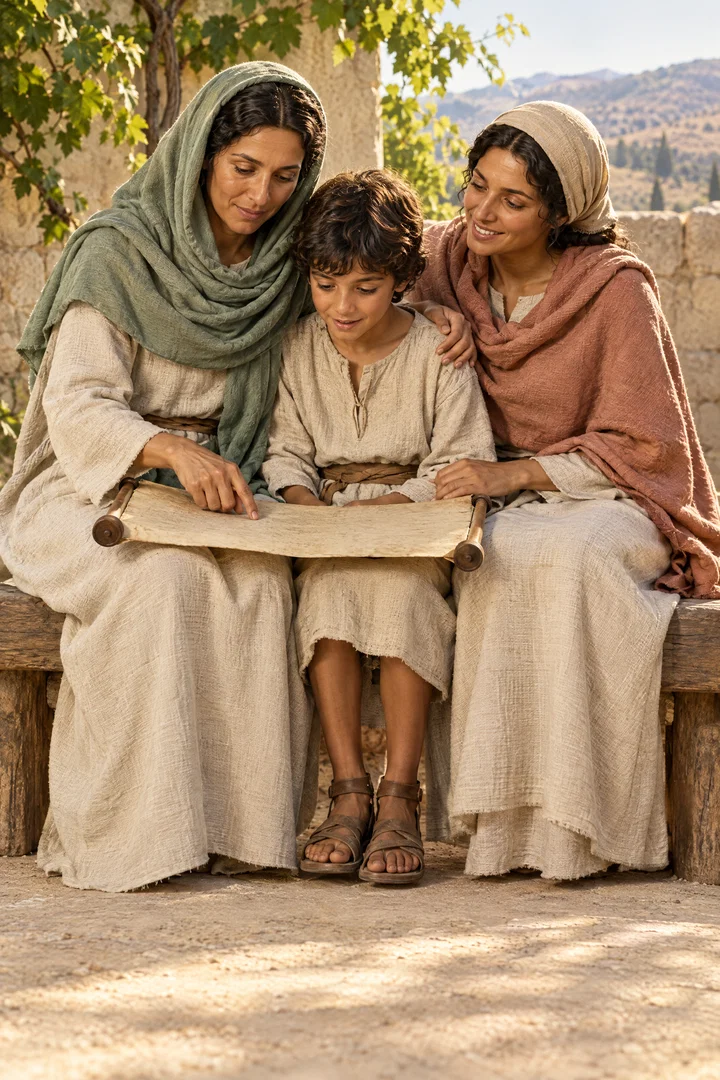
At Lystra there was a certain disciple named Timotheus, the son of a believing Jewish mother and a Greek father.8RED 36.1–3ST Jul 3, 1879AA 203.1–3GW 439.3–440.1GW 440.2 He had been taught the Scriptures from childhood and thoroughly educated in the Jewish religion.8RED 36.1–3ST Jul 3, 1879SLP 62.18RED 25.2 The faith, godly instruction, and example of his mother and grandmother shaped his character, made God's word the rule of his life, kept him pure from corrupting and evil influences, and prepared him for service and ministry.AA 203.1–3GW 439.3–440.1GW 440.2
Timothy had witnessed Paul's suffering during the earlier visit to Lystra, when Paul was stoned and left for dead and then rose bruised and bloodied while praising God and Jesus Christ for being permitted to suffer for His name.8RED 36.1–3AA 184.1–3SLP 62.18RED 25.2 He had stood beside Paul in that hour, and the impression deepened until he was convinced to devote himself to ministry and to share Paul's work.AA 202.2–3AA 184.1–3 Converted there through Paul's missionary work, their bond began then and grew through shared missionary hopes, dangers, and labor.SLP 319.1SLP 62.18RED 25.2 He later became a prominent and faithful worker for Christ and the church, sharing Paul's difficult pioneering work as his companion and helper.AA 184.1–3SLP 62.1
Paul carefully examined Timothy's character before taking him, and saw him as faithful, steadfast, and true.8RED 36.1–3ST Jul 3, 1879AA 203.1–3GW 440.2 He chose him as a fellow worker and companion in ministry and travel, which rewarded the women who had taught him in childhood to see him join Paul in close fellowship.8RED 36.1–3GW 440.2SLP 62.1AA 367.2–368.2 Paul had Timothy circumcised to remove an obstacle to preaching in Jewish synagogues and to ministry among Jews, not because God required circumcision, since the gospel mattered more than circumcision or uncircumcision.8RED 36.1–3ST Jul 3, 1879 Paul's choice of Timothy as a younger worker to take on missionary journeys to gain experience for later responsibility illustrates his practice of training young men for gospel ministry and continuing to care about their work.AA 367.2–368.2
Sources
Pioneers and periodicals
35 sources
Paul with Silas came to Derbe and then to Lystra on his second journey after the Jerusalem council, to strengthen the churches that were established and increasing daily.RH Jan 16, 1900ST Jun 4, 1902ST Jun 4, 1902 There he found Timotheus, already a disciple well reported of by the brethren, the son of a believing Jewish woman and a Greek father who had not embraced the faith.RH Apr 21, 1904ST Dec 5, 1892ST Jun 4, 1902 His mother Eunice and his grandmother Lois had instructed him carefully in the Holy Scriptures from infancy and childhood, even in a divided home far from school or synagogue.ST Jul 3, 1879RH Apr 21, 1904ST Nov 14, 1906ST Mar 20, 1884 Paul examined his character and fitness for ministry and chose him to go forth as his companion, assistant and fellow worker in trials and pioneer labor.ST Jul 3, 1879ST Dec 5, 1892RH May 30, 1907ST Jun 4, 1902 He had Timothy circumcised because of the Jews who knew his father was a Greek, not as necessary for salvation but as a prudent concession to remove prejudice so Jews would hear him.ST Dec 5, 1892ST Jun 4, 1902ST Apr 17, 1907
Journey Setting and Wording
Paul with Silas came to Derbe and then to Lystra, after passing through Syria and Cilicia to strengthen the churches.ST Jun 4, 1902ST Jun 4, 1902 There he found Timothy, a certain young disciple, the son of a believing Jewess and a Greek father, who was well reported of by the brethren at Lystra and Iconium.ST Jun 4, 1902 The coming to Derbe and Lystra stands at the start of a new departure in preaching the gospel, on the route from Jerusalem toward Europe and the call to Macedonia and the crossing to Europe.ST Jun 9, 1898ST Jun 4, 1902
The visit belongs to Paul's second journey, made from Antioch with Silas over the mountains to Derbe and Lystra about A.D. 50-51.RH Jan 16, 1900 It followed the delivering of the decisions made by the apostles and elders at Jerusalem, which had been received with joy, and by these visits the churches were established in the faith and increased in number daily.RH Jan 16, 1900 The journey followed Paul's separation from Barnabas over taking John Mark to visit the churches again, Barnabas taking Mark to Cyprus and Paul choosing Silas.RH Jan 16, 1900ST Jun 4, 1902ST Jun 4, 1902 Their sharp contention did not change the message carried from the apostles and elders, which stood firm, and Timothy went with them through the churches delivering the conclusions of the Jerusalem council to the great blessing of the churches.RH Jan 16, 1900ST Jun 4, 1902
Timothy was born about A.D. 31 or 32 and joined Paul's work about A.D. 51, as a young fellow laborer.ST May 27, 1897 Derbe and Lystra belong to the regions where New Testament missionaries labored, a history echoed by later gospel work there. The verse places Timothy in a community where the gospel had taken root despite earlier persecution.ST Jun 21, 1883
The word rendered Jewess identifies Timothy's believing mother as a Jewish woman, and it occurs in only two places in the Bible.ST Dec 2, 1913 Jew means a descendant of Judah, and in later times Jews were also called Israelites.ST Dec 2, 1913 The verse was written in a particular historical setting, yet it remains applicable to readers in every age.ST Nov 1, 1883 It falls within New Testament events showing God working through human agents to bring people to the way of life.ST Sep 30, 1908
Timothy's Family and Training
Timotheus was a certain disciple found at Derbe and Lystra, the son of a believing Jewish woman and a Greek, that is Gentile, father.RH Apr 21, 1904ST Dec 5, 1892ST May 21, 1885ST The word for his mother identifies her as a Jewess, a Jewish woman who believed, a term occurring in only two places in the Bible, and Jew means a descendant of Judah, in later times also called Israelites.RH Apr 21, 1904ST Dec 2, 1913 His father had not embraced the Christian religion and did not accept the Christian faith.RH Apr 21, 1904ST May 21, 1885 His home was therefore divided in faith, his mother being a believer while his father was apparently not, and his father apparently opposed godly practice.RH Apr 21, 1904ST May 21, 1885
His mother was Eunice, a believing Jewess, and with his grandmother Lois, a woman of unfeigned faith, she gave him careful instruction in the Word of God and the Holy Scriptures from infancy and childhood.ST Jul 3, 1879RH Nov 5, 1914RH Nov 30, 1916 That teaching in the Scriptures from childhood is connected with his Jewish mother, and was given even though he lived far from a school or synagogue.ST Nov 14, 1906RH Nov 30, 1916 His natural abilities and learning were strengthened by the Spirit, and his upbringing and education fitted him for ministry.ST Mar 20, 1884ST Jan 22, 1885 His mother Eunice was converted through Paul's ministry in Lycaonia.ST Jun 19, 1879ST Nov 29, 1910 Timothy himself had been educated in the Jewish religion before his own conversion through Paul's ministry.ST Jun 19, 1879ST Nov 29, 1910
Timothy's conversion took place on Paul's first visit to Lystra.ST Jun 19, 1879RH Nov 30, 1916 This verse records Paul's second visit to Derbe and Lystra, when Timothy was already a disciple.ST Jun 4, 1902RH Nov 30, 1916 At that time he was well reported of and well spoken of by the brethren at Lystra and Iconium, well regarded by the believers, and Paul wanted him to go forth with him.ST Dec 5, 1892ST Jun 4, 1902ST Mar 20, 1884 His Greek father connects the spread of the gospel through Paul's ministry with the Greek people.ST Dec 3, 1896ST Dec 3, 1896 His having a Greek father shows that Paul's fellow laborers included someone with a Greek family background, supporting that the gospel had reached the Gentiles.ST Dec 3, 1896ST Dec 3, 1896
Timothy's Character and Calling
At Derbe and Lystra Paul found Timothy, a young disciple and young fellow laborer whose life and character are worthy of lasting attention.ST Jun 4, 1902ST May 27, 1897 He was a young man, well spoken of by the brethren at Lystra and Iconium, and his circumstances called for courage to live as a Christian in that region.ST Jun 4, 1902ST Mar 20, 1884 His upbringing, education in the Scriptures from childhood, and natural abilities fitted him for ministry, those abilities being strengthened by the Spirit of God.ST Mar 20, 1884ST Jan 22, 1885
He had been taught the Scriptures from childhood and had witnessed Paul's suffering during the earlier visit to Lystra.ST Jul 3, 1879ST Jun 19, 1879 He saw Paul stoned, thought dead by the disciples, then rising bruised and praising God, and later became a prominent worker for Christ sharing Paul's trials and joys in difficult pioneer fields.ST Mar 24, 1914ST Jun 19, 1879 That experience of seeing Paul suffer persecution for Jesus helped prepare him for the important work he later carried out.ST Mar 24, 1914ST Mar 13, 1884
His study of the Scriptures was essential to his becoming Paul's companion, and he would not have become that companion if he had not studied them.ST Jul 3, 1879RH Apr 14, 1903RH Oct 15, 1903 Paul carefully examined his character before taking him as a fellow worker.ST Jul 3, 1879 Paul recognized his careful religious education, his good report among believers, his appreciation for ministry, and his willingness to face suffering and persecution.ST Jul 3, 1879
Paul wanted him to go forth with him and chose him to join his missionary work as companion, assistant, faithful fellow worker and spiritual son on missionary journeys.ST Jul 3, 1879ST Dec 5, 1892RH May 30, 1907ST Jun 4, 1902ST Mar 20, 1884 Already a disciple well reported of by the brethren, Timothy was chosen on this second visit to Derbe and Lystra to become Paul's companion and assistant in missionary labor, sharing the later journey, the stay at Ephesus, and subsequent travels.ST Mar 24, 1914ST Jun 19, 1879RH Nov 30, 1916 Paul selected Timothy to travel with him but did not ordain him on his own.RH May 30, 1907 In taking Timothy through the churches they delivered the conclusions of the Jerusalem council to the great blessing of the churches.ST Jun 4, 1902
Circumcision's Reason and Meaning
Paul had Timothy circumcised because of the Jews in those parts, since all knew his father was a Greek.ST Dec 5, 1892ST Jun 4, 1902ST Apr 17, 1907 The circumcision removed Jewish prejudice and an obstacle to ministry, opening the way for Timothy to enter Jewish synagogues and the temple and to be heard.ST Jul 3, 1879ST Apr 17, 1907 It was done so they could more readily reach the Jews and save some.RH Apr 21, 1851RH Oct 21, 1851 It was a prudent matter of expediency that cost no principle, not something God required.ST Jul 3, 1879
It had no spiritual merit and did not help save him, for it was not necessary for salvation.RH Apr 21, 1851 Circumcision in itself is nothing and uncircumcision is nothing; in itself it is not sin and does not cause a person to fall from grace, which shows Paul did not regard it as sin.ST Dec 5, 1892ST Jun 3, 1886 What mattered was the gospel rather than circumcision or uncircumcision, so whether a person was circumcised was of no vital importance.ST Jul 3, 1879 Paul opposed circumcision when people made it a means of justification and salvation, because to rely on it for righteousness was to reject Christ.ST Jun 3, 1886
Although he taught that circumcision was nothing and that the ceremonial law had been abolished, his act was an effort to avoid prejudice.ST Apr 17, 1907 This apostolic example does not make circumcision a binding precept, since Paul did not have Titus circumcised. In contrast with Titus, Timothy was circumcised after the Jerusalem council as a prudent step.ST Paul had not preached that Jewish believers should abandon circumcision or their customs, so Timothy's circumcision shows he had not taught what his act at Jerusalem was meant to deny and was not acting falsely.RH Aug 19, 1873 This accommodation for mission stands in contrast with keeping God's commandments, which is important.RH Apr 21, 1851
Doctrine and Present Application
The apostles kept God's law with it written in their hearts.ST Dec 12, 1892 That keeping of the law led them to keep the Sabbath.ST Dec 12, 1892 Keeping the law will lead believers now to keep the Sabbath in the same way.ST Dec 12, 1892
Timothy was a disciple from Derbe and Lystra, the son of a believing Jewish mother and a Greek father who had not embraced the Christian religion.RH Apr 21, 1904 His faith and courage testify to the influence of his Christian mother's faith and teaching.RH Apr 21, 1904 This encourages mothers who lack a husband's help in bringing up their children for the Lord.RH Apr 21, 1904 Though his home was therefore divided in faith, he stands as an example that young people can become firmly grounded in truth and steadfast defenders of the faith even when a parent opposes godly practice.
He was a young man whose upbringing, education in the Scriptures from childhood, and natural abilities fitted him for ministry, those abilities being strengthened by the Spirit of God.ST Jan 22, 1885 His example illustrates that people suited to ministry can be recognized through their character, learning in the Scriptures, and gifts.ST Jan 22, 1885 Such persons are then to be counseled and trained for the work.ST Jan 22, 1885
Sources