Acts 14:12
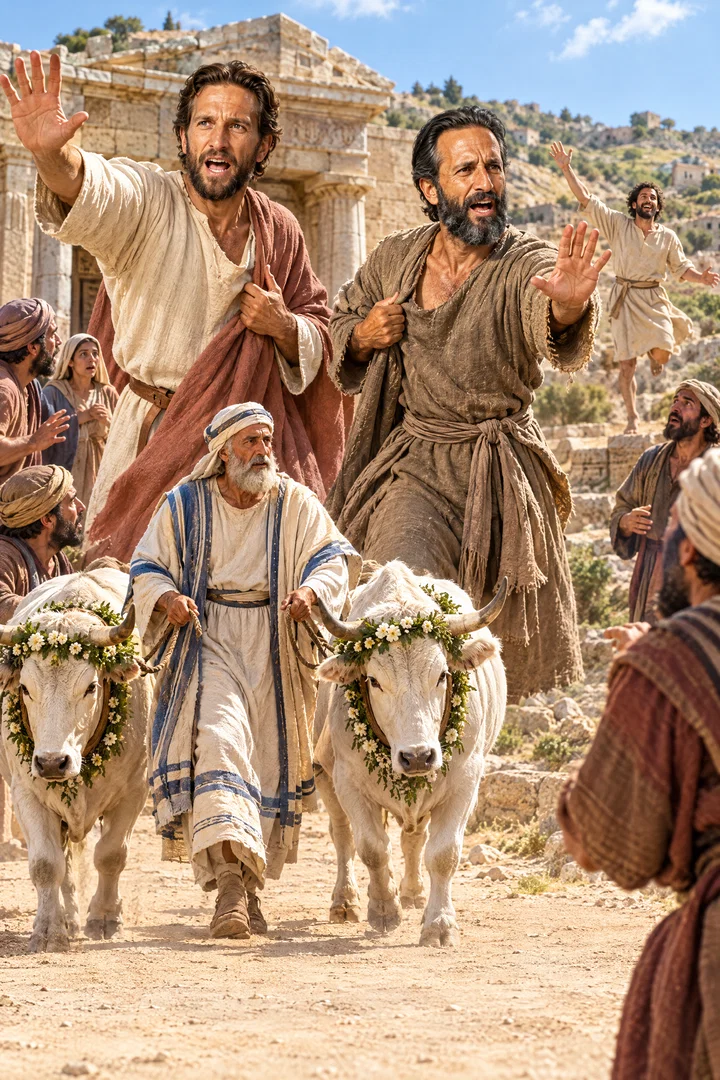
And they called Barnabas, Jupiter; and Paul, Mercurius, because he was the chief speaker.
Translations
American King James Version, King James Version, KJV Cambridge Paragraph Bible
And they called Barnabas, Jupiter; and Paul, Mercurius, because he was the chief speaker.
And they called Barnabas, Jupiter, and Paul, Mercurius, because he was the chief speaker.
Revised Version, American Standard Version
And they called Barnabas, Jupiter; and Paul, Mercury, because he was the chief speaker.
they were calling also Barnabas Zeus, and Paul Hermes, since he was the leader in speaking.
And they called Barnabas Jupiter, and Paul Mercury, because he took the lead in speaking.
And they went on to call Barnabas, Jupiter, and Paul, Mercury, seeing that, he, was the leader of discourse.
Berean Standard Bible, Majority Standard Bible
Barnabas they called Zeus, and Paul they called Hermes, because he was the chief speaker.
They called Barnabas “ Jupiter”, and Paul “Mercury”, because he was the chief speaker.
And they gave the name of Jupiter to Barnabas, and to Paul that of Mercury, because he was the chief talker.
And they called Barnabas, Iupiter: and Paul, Mercurius, because hee was the chiefe speaker.
Douay-Rheims (Challoner revision)
And they called Barnabas, Jupiter: but Paul, Mercury; because he was chief speaker.
Pictures
Cross-references
- Acts 14:19
And there came thither certain Jews from Antioch and Iconium, who persuaded the people, and, having stoned Paul, drew him out of the city, supposing he had been dead.
The crowd that tried to honor Paul and Barnabas later turns against Paul and stones him.
- Acts 14:18
And with these sayings scarce restrained they the people, that they had not done sacrifice unto them.
Paul and Barnabas barely restrain the people from sacrificing to them.
- 2 Corinthians 10:10
For his letters, say they, are weighty and powerful; but his bodily presence is weak, and his speech contemptible.
contrasts false charge his speech was contemptible
- Acts 14:17
Nevertheless he left not himself without witness, in that he did good, and gave us rain from heaven, and fruitful seasons, filling our hearts with food and gladness.
God’s goodness in nature bears witness against deification.
- Acts 16:1
Then came he to Derbe and Lystra: and, behold, a certain disciple was there, named Timotheus, the son of a certain woman, which was a Jewess, and believed; but his father was a Greek:
Paul returned to Lystra to care for converts
- Acts 28:6
Howbeit they looked when he should have swollen, or fallen down dead suddenly: but after they had looked a great while, and saw no harm come to him, they changed their minds, and said that he was a god.
After Paul survives a viper bite, the islanders call him a god.
Commentary
Each commentary is drawn from primary sources: the writings of Ellen G. White and Adventist pioneers and periodicals. Each commentary is separate. Its own words are not a quotation; follow the references to read the source passages.
Ellen G. White
20 sources
At Lystra Paul commanded a man crippled from birth who had faith to be healed to stand upright, and when he leaped and walked the crowd cried in their own tongue that the gods had come down in human form.Ms 117a, 1901, par. 30–32AA 181.2–182.3EW 168.4 They named Barnabas after the father of their gods because of his venerable appearance, dignified bearing, and kindly benevolence, and Paul after the messenger god because he was the active, earnest, eloquent chief speaker.AA 181.2–182.3SLP 57.18RED 19.3–20.2 The priest of Jupiter brought oxen and garlands to the gate to sacrifice to them as visitors from heaven, but the apostles tore their clothes in horror and rushed among the people declaring they were only men of like passions and that worship belongs alone to the living God who made heaven and earth and gives rain and fruitful seasons.Ms 117a, 1901, par. 30–32AA 181.2–182.3EW 168.4 The same idolaters who would have worshiped them soon turned to hate and stoned Paul when hostile Jews misrepresented the apostles as deceivers, showing how quickly a crowd without faith anchored in the true God turns from honoring to condemning.Ms 117a, 1901, par. 30–32EW 168.43SP 378.1
Mistaken for Heathen Gods
The naming came after the complete healing of a well-known man crippled from birth who had never walked.Ms 117a, 1901, par. 30–32AA 181.2–182.3EW 168.48RED 19.3–20.23SP 363.1–364.2 Paul perceived that he had faith to be healed and commanded him with a loud voice to stand upright on his feet, and the man leaped and walked.Ms 117a, 1901, par. 30–32AA 181.2–182.3 When the people saw what Paul had done they cried out in the Lycaonian language that the gods had come down to them in the likeness of men.Ms 117a, 1901, par. 30–32AA 181.2–182.38RED 19.3–20.23SP 363.1–364.2
That cry reflected their tradition that gods sometimes visited the earth from heaven.AA 181.2–182.38RED 19.3–20.23SP 363.1–364.2 It belonged to Lystra, where there was no Jewish synagogue though a few Jews lived there, and where the temple of Jupiter stood in a conspicuous place and the people were worshipers of Jupiter.8RED 18.4–19.2AA 180.1–3 Barnabas was called Jupiter, the father of the gods, because of his venerable appearance, his dignified bearing, and the mildness and benevolence expressed in his face and countenance.AA 181.2–182.3SLP 57.18RED 19.3–20.23SP 362.1–33SP 363.1–364.2 Paul was called Mercurius or Mercury because he was the chief speaker, active, earnest, quick, and eloquent in words of warning and exhortation.AA 181.2–182.3SLP 57.18RED 19.3–20.23SP 362.1–33SP 363.1–364.2
The people of Lystra were ignorant, credulous, and superstitious idolaters.8RED 18.4–19.2SLP 89.2–38RED 52.2–53.1 This was in contrast to the educated people of Athens who were famous for intelligence and education.SLP 89.2–38RED 52.2–53.1 They tried to fit the apostles' teaching about Christ into their idolatrous faith and to connect the new doctrine with their own superstition as far as they were able.3SP 361.1–38RED 18.4–19.2 Paul addressed them in the Greek language to lead them to a correct knowledge of the one to be adored, God the Creator and Jesus the Saviour.8RED 18.4–19.2AA 180.1–3
Refusing Worship, Facing Opposition
Out of gratitude the priest of Jupiter brought oxen and garlands to the gates to offer sacrifice to the apostles as visitants from heaven, and with music and a vast crowd with sacrificial beasts and offerings pressed to the house gate to worship them.Ms 117a, 1901, par. 30–32AA 181.2–182.3EW 168.4SG1 94.13SP 363.1–364.2 Only with much persuasion and explanation were they stopped from sacrificing, leaving them disappointed that their religion was not exalted.Ms 117a, 1901, par. 30–32AA 181.2–182.3EW 168.43SP 363.1–364.2 Paul and Barnabas were filled with indignation, horror, grief, tore their clothes and rushed among the people to stop the worship.Ms 117a, 1901, par. 30–32AA 181.2–182.3EW 168.4SG1 94.13SP 363.1–364.2 They declared they were only men of like passions and that worship belongs alone to the living God who made heaven and earth and the sea and all things in them.Ms 117a, 1901, par. 30–32AA 181.2–182.3EW 168.4SG1 94.13SP 363.1–364.2 In times past He let all nations walk in their own ways, yet He left witness of Himself by doing good and giving rain from heaven and fruitful seasons and filling hearts with food and gladness.Ms 117a, 1901, par. 30–32AA 181.2–182.3 They presented themselves as representatives of the God of heaven and of His Son the great Healer, giving the people their first conception of faith in the true God and of the worship and honor due Him.AA 181.2–182.3EW 168.4
The idolaters who would worship the apostles proved fickle and easily led.Ms 117a, 1901, par. 30–32 When Jews from Antioch and other cities followed after them and persuaded the people with false reports, falsehood and misrepresentation that they were deceivers, the wonder and admiration quickly changed to hate, insult and abuse.Ms 117a, 1901, par. 30–32EW 168.43SP 378.1SLP 59.1–28RED 35.2–3 This shows how quickly a crowd without faith anchored in the true God can turn from honoring to condemning.SLP 59.1–2 Paul was stoned and dragged out of the city as dead shortly after refusing worship.Ms 117a, 1901, par. 30–32Lt 218, 1901, par. 13–15EW 168.4 As the disciples stood mourning about him he rose up and went with them into the city, the Lord preserving his life because his work was not done.Ms 117a, 1901, par. 30–32EW 168.4
Paul's identification as the chief speaker means he was certainly not a mean or contemptible speaker.Ms 128, 1908, par. 7–14 He spoke so convincingly in the demonstration of the Spirit with a force of eloquence that held even the greatest men under convincing power as they listened, so that thousands of Jews and Gentiles believed.Ms 128, 1908, par. 7–14 Yet the success was not to be attributed to the man but to the power of God upon him, with angels making the Word effective.Ms 128, 1908, par. 7–14 The episode belongs to a successful soul-winning tour in which Paul and Barnabas entered every place they could get an entrance, planted churches, revisited them, and returned to Antioch from which they had been recommended by prayer and counsel.Lt 218, 1901, par. 13–15 The whole of Acts 14 is a pattern for laborers together with God in the last days to study and follow.Lt 218, 1901, par. 13–15 Opposition, persecution and a furious mob did not turn Paul from serving Christ, and he later used the influence a remarkable event gave him to lead people toward the gospel.GW 107.3SLP 270.2 When he returned to Lystra, the scene of his former danger, he found the converts not intimidated by violence but confirmed in faith, believing that through trial and suffering the kingdom of Christ would be reached.8RED 35.2–3
Sources
Pioneers and periodicals
51 sources
At Lystra Paul healed a man lame from birth, and the astonished multitudes cried that the gods had come down in human likeness, calling Barnabas Jupiter, that is Zeus the father of the gods, and Paul Mercurius, that is Mercury or Hermes, because he was the chief speaker.ST Apr 29, 1897ST May 21, 1902ST May 21, 1902ST Jan 15, 1885ST May 21, 1902 Barnabas received the name of Jupiter for his older age and dignified, venerable, imposing presence, while Paul was taken for Mercury the spokesman and carrier of messages for Jupiter, the god of eloquence, a choice shaped by a local legend that Jupiter and Mercury had once visited that region.ST Jun 19, 1879ST Apr 29, 1897ST May 21, 1902ST Jan 15, 1885ST Apr 29, 1897 Judging by the miracle's appearance rather than by righteousness and principle, the idol-worshiping people with the priest of Jupiter prepared to offer sacrifice to the apostles as to gods, attributing the divine power to the men themselves.ST Jul 4, 1905ST Jun 17, 1897RH May 30, 1871 Paul and Barnabas disclaimed all honor and only with difficulty restrained the people, directing them away from those vanities to the living God who made heaven, earth, sea and all things, pointing to rain, fruitful seasons, food and gladness as witnesses of His goodness.ST Jun 17, 1897RH May 30, 1871ST Apr 6, 1882 True messengers are only God's servants and instruments to whom no worship belongs, and the same fickle crowd that would honor them soon turned to stone Paul, showing popular praise is no measure of faithfulness and that accepting worship destroys influence for good.RH Feb 15, 1870ST Aug 16, 1883RH Jul 8, 1909RH Oct 6, 1868ST Aug 26, 1897 That appeal to creation states the same fact that lies at the foundation of the Sabbath, by which alone the true God is distinguished from Jupiter and Mercurius and all idol gods.RH Mar 11, 1875RH Apr 29, 1875ST May 21, 1902
Setting at Lystra
Paul and Barnabas came to Lystra in Lycaonia, which was a part of Galatia, on Paul's first missionary tour.ST Jun 8, 1882ST Feb 13, 1896ST Mar 13, 1884 The people there were heathen who before the gospel came served them which by nature are no gods.ST Feb 13, 1896 With no synagogue and few Jews, the apostles as strangers gathered the people and preached the gospel.ST Mar 13, 1884
The occasion was the healing of a man lame and impotent in his feet from birth who had never walked.ST May 21, 1902ST Aug 16, 1883ST Mar 13, 1884ST Jun 21, 1883RH Nov 6, 1900 Paul saw that the man had faith in Christ's forgiveness, and the healing followed that faith, with healing of the soul coming first and healing of the body following as an act of divine power.ST Aug 16, 1883ST Mar 13, 1884ST Aug 12, 1897 The people attributed the miracle-working power to the apostles themselves.ST Aug 12, 1897
At the miracle the astonished multitudes, speaking in Lycaonian, cried that the gods had come down in human likeness and form among them.ST Apr 29, 1897RH Oct 15, 1903ST May 21, 1902ST May 21, 1902ST Nov 5, 1894 Paul had addressed the Lycaonians in the common Greek of the period, the koine, but in the excitement the people switched to their native language which the apostles did not understand.RH May 20, 1915 The gift of tongues was given for such special occasions of language difference to reveal God's love, with no reason for its exercise when speaker and audience understand the same language.ST Jun 7, 1910
Lystra was a rude, uncultivated, semibarbarous field, the counterpart to Athens, proving God cares for barbarians and not only for people of cultivation.RH Mar 5, 1857ST Sep 10, 1896 Paul remained there an uncompromising preacher of the gospel, as among more refined and philosophically minded people.RH Mar 5, 1857 The verse belongs to the record of Paul's places of labor in Acts 14, in connection with the healing of the cripple and the account of Paul being stoned, counted among the miracles wrought through Paul and the persecutions he suffered in Acts 13-20.ST Mar 10, 1898 That account teaches enduring hardness as a good soldier of Jesus Christ, for Paul continued preaching despite persecution and severe suffering.ST Jun 18, 1902RH Aug 3, 1876 After the exciting experience at Lystra, Paul and Barnabas visited neighboring towns and went through Perga and Attalia to take ship for Antioch in Syria.ST May 28, 1902
Why Jupiter and Mercury
Barnabas was called Jupiter, that is Zeus, the chief Greek and Roman deity regarded as the father of the gods, and Paul was called Mercurius, that is Mercury or Hermes.ST May 21, 1902ST Jan 15, 1885ST May 21, 1902ST Nov 21, 1892 With the feeling that the gods had come down in human likeness and form after the healing, it did not take long for the people to decide which of their numerous and multitudinous gods had appeared among them in the persons of the apostles.ST May 21, 1902ST May 21, 1902 Once that supposed identity was settled, they at once began to prepare to offer sacrifices to the apostles as to their gods.ST May 21, 1902
Barnabas was given Jupiter's name because he was older and more imposing in appearance, and his dignified bearing, venerable appearance, mildness, and respect-commanding presence suggested the father of the gods.ST Jun 19, 1879ST May 7, 1885ST Apr 29, 1897ST Jan 15, 1885ST Nov 21, 1892 Paul was associated with the smaller man, active, earnest, quick, and eloquent in manner as the chief speaker.ST Jun 19, 1879ST May 7, 1885ST Nov 21, 1892ST Apr 29, 1897 He was named Mercury because he was the chief speaker and did most of the preaching as the principal speaker.ST Apr 29, 1897RH Oct 15, 1903ST Nov 21, 1892ST Jun 17, 1897ST May 21, 1902 His conduct in that position is an example of upright behavior in response to religious homage.ST Apr 6, 1882
Mercury was associated with eloquence and speaking as the spokesman for the gods and carrier of messages for Jupiter, their great patron of eloquence and trade, even called the god of eloquence.ST Apr 29, 1897ST May 21, 1902ST May 21, 1902RH Oct 10, 1865ST Nov 21, 1892 The people of Lycaonia therefore mistook Paul for that god because he was the principal speaker. A local legend that Jupiter and Mercury had once visited that region testing the people's hospitality shaped the response, so that after seeing the healing the people thought the gods had returned.ST Apr 29, 1897ST Apr 29, 1897
Turning From Idols to Creator
After the healing the idol-worshiping, heathen inhabitants of Lystra treated Barnabas and Paul as divine, concluding that the gods had come down from heaven in human form and preparing with the priest of Jupiter to offer sacrifices and outward honor to them as to their gods.ST Jun 17, 1897RH May 30, 1871ST May 21, 1902ST Mar 13, 1884ST Aug 16, 1883 Once the supposed identity was settled they readily complied with any outward demand for honor or money in that worship.ST Mar 13, 1884 Their excitement belonged to the first visit of Paul and Barnabas, when as strangers with no synagogue and few Jews they gathered the people and preached the gospel.ST Mar 13, 1884
They judged by the miracle's appearance rather than by righteousness, truth, or principle, mistaking the healing of the cripple for proof that its workers were divine.ST Jul 4, 1905 The poor cripple had received new life through exercising faith in Christ, yet the people attributed the miracle-working power to the apostles themselves and called them by the names of their gods.ST Aug 12, 1897 Resting on appearances and signs rather than righteousness and principle left them vulnerable to later delusion and sudden reversal.
The incident reveals the Gentile tendency to worship anything called god, with objects multitudinous and the supposed medium between Creator and man often a deified man or the spirit of a dead person.ST Nov 5, 1894 It shows how closely allied Gentile practices were to heathen worship, so that Christians needed constant carefulness lest poorly informed members appear in league with the reputed gods of the heathen.ST Nov 5, 1894 Instead they were to hold that there is but one God the Father and one Lord Jesus Christ.ST Nov 5, 1894
Paul and Barnabas disclaimed all honor, stopped the people only with difficulty, prevented the sacrifice, and rejected this ignorant adoration.ST Jun 17, 1897ST Nov 5, 1894ST Mar 13, 1884RH Jan 13, 1859 By so doing they proved they were not seeking their own glory or pecuniary gain.ST Mar 13, 1884 Such conduct stands as an example of upright behavior in response to people's religious homage.ST Apr 6, 1882
They directed the people away from these vanities and idols to the living God, the one who made heaven, earth, sea, and all things.RH May 30, 1871ST Aug 2, 1877RH Mar 11, 1875RH Apr 29, 1875 The act of creation distinguishes the true God from false gods.ST Aug 2, 1877RH Mar 11, 1875RH Apr 29, 1875 Paul refused to place Christ alongside Jupiter and exalted Christ alone.ST Nov 13, 1893
Paul pointed to rain from heaven, fruitful seasons, food, and gladness as witnesses of God's goodness and of nature's proclamation of the perpetual presence and manifestation of God's power and love everywhere.ST Aug 12, 1897 By these witnesses man need not be ignorant of the true source of all things.ST Aug 12, 1897 The worshipers listening then were accountable to God for the way they received or rejected that message, just as every people in heathen lands as well as enlightened places is accountable for the witnesses to God's existence and character ever kept before their eyes.ST Aug 12, 1897
People may mistake God's human messengers for divine beings when they witness a healing and may try to worship them and honor the messengers as gods.RH Jul 8, 1909ST Aug 26, 1897 The missionary is only God's servant, an approved agent and instrument through whom God gives healing.RH Jul 8, 1909RH Oct 6, 1868ST Aug 26, 1897 Worship and thanks belong to God who inspired him, not to the human agent, and true messengers direct attention to God rather than themselves.RH Jul 8, 1909RH Oct 6, 1868ST Aug 26, 1897
Sabbath and True God
At Lystra Paul and Barnabas were taken for false gods, Barnabas as Jupiter and Paul as Mercurius because he was the chief speaker, and they answered that idolatry by pointing to the living God who made heaven and earth.RH Mar 11, 1875RH Apr 29, 1875 That appeal distinguishes the true God from false gods by creation, the same fact that lies at the foundation of the Sabbath institution.RH Mar 11, 1875RH Apr 29, 1875 Only the fourth commandment distinguishes the true God from idol gods.RH Apr 29, 1875
The move to worship the apostles was inspired by the adversary of truth to turn attention away from the true Source of power, for when truth cannot be denied the enemy perverts it to serve a sinister purpose.ST May 21, 1902 By accrediting the miracle to the apostles and directing worship toward them God would be robbed of the honor due His name and Satan's purpose would be served.ST May 21, 1902 This works on the same principle as perverting the Sabbath commandment by substituting another day for the day the commandment enjoins, where men who could not be made to deny God's commandment altogether were led to pervert it so it would be of no effect while easing deceived consciences.ST May 21, 1902 Neglect and perversion of the Sabbath as a memorial of God's creative work lets men forget the living God and follow ways of their own devising instigated by God's adversary.ST May 21, 1902
Acts 14 shows Paul and Barnabas preaching in Jewish synagogues during their first missionary tour, yet gives no indication that they taught the first day had been sanctified in place of the seventh day or that they had stopped observing the seventh-day Sabbath.ST Jun 8, 1882 The people of Lycaonia, which was a part of Galatia, were heathen who before the gospel came did service to them which by nature are no gods, seeing the miracles and treating the apostles as gods ready to be worshiped.ST Nov 14, 1900ST Feb 13, 1896 Their former bondage was not to God's precepts, which they did not know, but to the sinful principles of the world.ST Nov 14, 1900 The days and months and times and years to which they turned again were therefore heathen feasts and festivals and sun-worship observances and not God's Sabbath.ST Feb 13, 1896
Fickle Crowd and Faithfulness
The same excitable community that came with offerings to honor the apostles was shortly afterward under other leaders incited to put them to death, exposing the freaks of human nature, the vicissitudes of Christian life and ministry, and the folly of human wisdom.ST Mar 13, 1884 The welcome at Lystra, like the experience at Antioch in Pisidia, quickly turned to opposition, for after readiness to worship the missionaries the fickle crowd, when envious and malignant Jews came from Antioch and Iconium, became as anxious to destroy them, stoning Paul and dragging him out of the city thinking he was dead.RH Feb 15, 1870RH Apr 10, 1913ST Jul 30, 1894RH Nov 6, 1900 Popular opinion is fickle, unreliable, and dangerous, and is not a reliable standard for judging what is right, since popular favor and the friendship of the world can quickly change.RH Feb 15, 1870ST Jul 30, 1894
Their acclaim and later turn shows that popular praise is fickle and is no measure of a minister's faithfulness or success, and accepting worship would destroy a Christian worker's influence for good.ST Aug 16, 1883 Because they did not receive the word of truth, disappointment at learning the apostles were not gods left the idol-worshippers in a frame ready to be stirred to any extreme and to believe a lie when false impressions were spread, a condition belonging especially to the last days.ST Mar 13, 1884 Resting on appearances and signs rather than righteousness and principle makes people vulnerable to later delusion and sudden reversal.
The devil tried pleasantly to lead the people astray by getting them to worship Paul and Barnabas instead of God, and had the apostles accepted that worship they would not have been stoned.ST May 21, 1902 Their stoning proves the deception failed, so the devil dropped deception and resorted to persecution while making it appear necessary for the general welfare, for persecution is always the devil's last resort when deception fails.ST May 21, 1902 Their reaction was like the islanders' reaction to Paul on Melita after the viper did him no harm, when they also regarded him as divine after witnessing a marvel.ST Apr 2, 1885
Sources