Acts 14:19
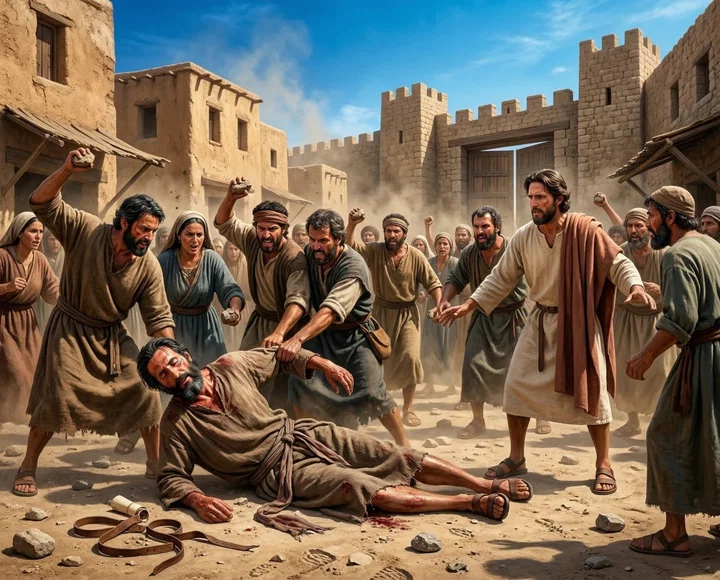
And there came thither certain Jews from Antioch and Iconium, who persuaded the people, and, having stoned Paul, drew him out of the city, supposing he had been dead.
Translations
And there came thither certain Jews from Antioch and Iconium, who persuaded the people, and having stoned Paul, drew him out of the city, supposing he had been dead.
King James Version, KJV Cambridge Paragraph Bible
And there came thither certain Jews from Antioch and Iconium, who persuaded the people, and, having stoned Paul, drew him out of the city, supposing he had been dead.
And there came thither certain Jews from Antioch, and Iconium, who persuaded the people, and having stoned Paul, drew him out of the city, supposing him to be dead.
Revised Version, American Standard Version
But there came Jews thither from Antioch and Iconium: and having persuaded the multitudes, they stoned Paul, and dragged him out of the city, supposing that he was dead.
And there came thither, from Antioch and Iconium, Jews, and they having persuaded the multitudes, and having stoned Paul, drew him outside of the city, having supposed him to be dead;
But there came Jews from Antioch and Iconium, and having persuaded the crowds and stoned Paul, drew him out of the city, supposing him to have died.
But there came thither, from Antioch and Iconium, Jews, and, persuading the multitudes, and stoning Paul, they dragged him outside the city, supposing him to be dead.
Berean Standard Bible, Majority Standard Bible
Then some Jews arrived from Antioch and Iconium and won over the crowds. They stoned Paul and dragged him outside the city, presuming he was dead.
But some Jews from Antioch and Iconium came there, and having persuaded the multitudes, they stoned Paul and dragged him out of the city, supposing that he was dead.
But some Jews came to that place from Antioch and Iconium, and got control over the people; and after stoning Paul, they had him pulled out of the town, taking him for dead.
Then there came certaine Iewes from Antiochia and Iconium, which when they had persuaded the people, stoned Paul, and drewe him out of the citie, supposing he had bene dead.
Douay-Rheims (Challoner revision)
Now there came thither certain Jews from Antioch, and Iconium: and persuading the multitude, and stoning Paul, drew him out of the city, thinking him to be dead.
Pictures
Cross-references 20 of 25
- 2 Corinthians 11:25
Thrice was I beaten with rods, once was I stoned, thrice I suffered shipwreck, a night and a day I have been in the deep;
Paul recalls being stoned once.
- Acts 7:58-60
And cast him out of the city, and stoned him: and the witnesses laid down their clothes at a young man’s feet, whose name was Saul.
Paul’s stoning recalls Stephen’s martyrdom, which he had witnessed.
- 2 Timothy 3:11
Persecutions, afflictions, which came unto me at Antioch, at Iconium, at Lystra; what persecutions I endured: but out of them all the Lord delivered me.
Paul recalls the persecution he endured at Lystra and the Lord’s deliverance.
- Acts 14:11-15
And when the people saw what Paul had done, they lifted up their voices, saying in the speech of Lycaonia, The gods are come down to us in the likeness of men.
The same crowd first offered sacrifice to Paul as a god, then turned to stone him.
- Acts 14:2-5
But the unbelieving Jews stirred up the Gentiles, and made their minds evil affected against the brethren.
Unbelieving Jews turn others against the apostles and plot to stone them.
- Acts 13:50
But the Jews stirred up the devout and honourable women, and the chief men of the city, and raised persecution against Paul and Barnabas, and expelled them out of their coasts.
Jewish opponents expelled Paul from Antioch and later pursued him to Lystra.
- Acts 14:8-10
And there sat a certain man at Lystra, impotent in his feet, being a cripple from his mother’s womb, who never had walked:
The cripple’s healing at Lystra preceded the Jews’ opposition to Paul.
- 2 Timothy 2:3
Thou therefore endure hardness, as a good soldier of Jesus Christ.
Paul’s stoning illustrates enduring hardship as a soldier of Christ.
- Acts 16:1
Then came he to Derbe and Lystra: and, behold, a certain disciple was there, named Timotheus, the son of a certain woman, which was a Jewess, and believed; but his father was a Greek:
Paul returns to Lystra, where he had been stoned, and meets Timothy.
- Acts 7:58
And cast him out of the city, and stoned him: and the witnesses laid down their clothes at a young man’s feet, whose name was Saul.
Paul’s stoning recalls his part in Stephen’s stoning.
- 1 Corinthians 15:9-10
For I am the least of the apostles, that am not meet to be called an apostle, because I persecuted the church of God.
Paul the persecutor saved by grace
- Acts 15:1-2
And certain men which came down from Judæa taught the brethren, and said, Except ye be circumcised after the manner of Moses, ye cannot be saved.
A dispute followed the arrival at Antioch.
- 1 Peter 4:12-13
Beloved, think it not strange concerning the fiery trial which is to try you, as though some strange thing happened unto you:
Enduring tribulation is sharing in Christ’s sufferings and leads to joy.
- Acts 14:5-6
And when there was an assault made both of the Gentiles, and also of the Jews with their rulers, to use them despitefully, and to stone them,
An earlier plot to stone the apostles leads them to flee to Lystra and Derbe.
- Acts 9:16
For I will shew him how great things he must suffer for my name’s sake.
Foretells the great things Paul would suffer.
- Acts 18:23
And after he had spent some time there, he departed, and went over all the country of Galatia and Phrygia in order, strengthening all the disciples.
Paul travels through the region strengthening disciples.
- Acts 13:45
But when the Jews saw the multitudes, they were filled with envy, and spake against those things which were spoken by Paul, contradicting and blaspheming.
Jews oppose Paul’s preaching to the crowds.
- Acts 14:4
But the multitude of the city was divided: and part held with the Jews, and part with the apostles.
The city is divided over the apostles’ preaching.
- Hebrews 11:37
They were stoned, they were sawn asunder, were tempted, were slain with the sword: they wandered about in sheepskins and goat skins; being destitute, afflicted, tormented;
Both describe faithful witnesses being stoned.
- 2 Timothy 3:12
Yea, and all that will live godly in Christ Jesus shall suffer persecution.
Godly living in Christ brings persecution.
Commentary
Each commentary is drawn from primary sources: the writings of Ellen G. White and Adventist pioneers and periodicals. Each commentary is separate. Its own words are not a quotation; follow the references to read the source passages.
Ellen G. White
27 sources
Jews from Antioch and Iconium followed Paul to Lystra and turned the people against him and Barnabas, so that the crowd stoned Paul until he lay bruised and insensible, then dragged him outside the city and left him as dead.Lt 218, 1901, par. 13–15Ms 180, 1901, par. 32–35AA 183.1–3SLP 61.1–2AA 184.1–3 It was a sudden reversal from honoring the apostles as gods to seeking to kill them, made possible because the people's faith was not anchored in God and they were fickle, excitable and easily led.Lt 218, 1901, par. 13–15Ms 180, 1901, par. 32–35AA 183.1–3SLP 60.2–38RED 23.2–25.1 The Jews accomplished it by envy, craft and falsehood, denying God had any part in the healing of the cripple and charging that the miracle was done by demons whom the apostles served.SG1 94.1EW 168.4SLP 59.1–2 Believers gathered lamenting around his apparently lifeless body, but by a miracle of God he rose up bruised and bloodied to praise God and strengthen their faith, went back into the city, left the next day with Barnabas for Derbe, and afterward undauntedly returned through Lystra, Iconium and Antioch to confirm the disciples.Lt 218, 1901, par. 13–15Ms 180, 1901, par. 32–35SLP 61.1–2ST Jun 26, 18793SP 368.1 Those who faithfully carry the truth to all parts of the world in the last days will realize similar Satan-stirred opposition and suffering, which is the best evidence that the work opposed is of the Lord, who preserves His servants while letting them know what they will meet from enemies of the truth.Lt 218, 1901, par. 13–15Ms 180, 1901, par. 32–35Ms 117a, 1901, par. 30–32Lt 223, 1899, par. 1–3
The Attack at Lystra
Certain Jews from Antioch who had driven the apostles from that coast joined with Jews from Iconium and followed on the track of the apostles to Lystra, and there persuaded the people against Paul and Barnabas.Lt 218, 1901, par. 13–15Ms 180, 1901, par. 32–35AA 183.1–3SLP 60.2–38RED 22.2–3 The verse marks a sudden reversal from welcome to violence, for the same people who had just offered to worship the apostles as gods, who had so recently refused to be worshiped as a god, who had admired them and regarded them with wonder, turned to hatred and killing.Lt 218, 1901, par. 13–15Ms 180, 1901, par. 32–35AA 183.1–3SG1 94.1EW 168.4 Their former wonder and admiration were turned into hatred by false reports stirred up by Jews from other cities.SG1 94.1EW 168.4SLP 59.1–2 The crowd that had been ready to honor the apostles as divine beings came to count them worse than murderers and to believe that whoever put them out of the world would do God and mankind good service.SLP 59.1–28RED 22.2–3
The persuasion succeeded because the people's faith was not anchored in the true God, leaving them fickle and excitable, fickle and easily led, superstitious and credulous.SLP 60.2–38RED 23.2–25.18RED 22.2–3Ms 117a, 1901, par. 30–32 They were disappointed at being refused the chance to sacrifice to the apostles, and after the idolaters were refused sacrifice they turned against the apostles with rage.SLP 60.2–38RED 23.2–25.13SP 366.1–2 The Jews exploited that disappointment and credulity, using their superstition to incite the attack and persuading them to attack by force.SLP 60.2–38RED 23.2–25.1 They worked with crafty arguments, with envy, falsehood and misrepresentation, putting a false version on the miracle wrought on the cripple and its effect on the witnesses.3SP 364.3–365.13SP 378.18RED 22.2–3Ms 117a, 1901, par. 30–32 They denied that God had any part in the work and claimed it was accomplished through demons whom Paul and Barnabas served, falsely claiming that their miracle came from demons.SLP 59.1–23SP 364.3–365.18RED 22.2–3 They called them deceivers who would bewitch the people if allowed to speak, charging the Lystrians not to let Paul speak lest he bewitch them, claimed to know thoroughly their history and faith, and so misrepresented their characters and work by falsehoods that they inspired the people of Lystra with their own bitterness of spirit.SLP 60.2–38RED 23.2–25.18RED 22.2–3Ms 117a, 1901, par. 30–32 In this they repeated the same unreasoning wrath once shown to Christ when He was accused of casting out devils through the prince of devils and denounced as a deceiver.8RED 22.2–3
Behind the human agents, Satan stirred up the people against Paul, working through men under him as their general who were full of hatred toward Paul and his work.Lt 223, 1899, par. 1–3 The Lystrians rushed with fury and hurled stones violently, stoning Paul until he was bruised, battered, fainting, insensible and apparently dead.SLP 61.1–2AA 184.1–3SLP 60.2–38RED 23.2–25.1 Then the mob dragged his insensible body through the gates, drew him outside the city, threw it beneath the walls, and left him there because they supposed he was dead.AA 184.1–3SLP 60.2–38RED 23.2–25.13SP 378.13SP 366.1–2 As he was being stoned Paul felt his end had come, with the martyrdom of Stephen and his own cruel part in it vividly in mind.8RED 23.2–25.1
Recovery and Return Mission
Left for dead outside the walls, Paul was not abandoned by those who had believed through the apostles' preaching.Lt 218, 1901, par. 13–15Ms 180, 1901, par. 32–35AA 184.1–3 Newly converted disciples gathered around his apparently lifeless body, lamenting him as dead and remaining loyal at his side despite the danger from the mob that had just stoned him.SLP 61.1–2AA 184.1–3EW 168.48RED 23.2–25.1 Their presence around him became the setting for what followed.Lt 218, 1901, par. 13–15Ms 180, 1901, par. 32–35SLP 61.1–2EW 168.4
While they stood around him he rose up, lifted his head and stood to his feet in what seemed to them like a resurrection from the dead.Lt 218, 1901, par. 13–15Ms 180, 1901, par. 32–35SLP 61.1–2AA 184.1–38RED 23.2–25.1 It was a miracle of God preserving the life of His faithful servant because his work was not done.SLP 61.1–28RED 23.2–25.13SP 367.1–2 Bruised, battered and covered with blood, he praised God, gave thanks, and spoke words of courage to those weeping around him.AA 184.1–38RED 23.2–25.13SP 367.3 Their sorrow turned to joy, and his endurance and restoration renewed, strengthened and confirmed their faith, setting the signet of God upon their belief as a miracle and a sign from God upon their acceptance of the truth.SLP 61.1–2AA 184.1–38RED 23.2–25.13SP 367.1–2
Timothy was among those present, witnessing Paul's suffering, his rising, and his praise to Jesus for being counted worthy to suffer for His name.AA 184.1–33SP 367.3 That sight bound the witness of suffering and deliverance together for the young believers.SLP 61.1–2AA 184.1–38RED 23.2–25.1
The risen apostle went back into the city that same day, and the next day departed with Barnabas for Derbe.Lt 218, 1901, par. 13–15Ms 180, 1901, par. 32–35ST Jun 26, 1879 In this they acted in obedience to Christ's direction to flee from persecution in one city to another.ST Jun 26, 18793SP 368.18RED 25.3SLP 62.2 At Derbe they preached the gospel, taught many, and their labors were blessed in leading many souls to embrace the truth and receive Christ.Ms 180, 1901, par. 32–35ST Jun 26, 18793SP 368.18RED 25.3
Undaunted by danger, Paul and Barnabas afterward returned to the very fields where they had met opposition and persecution — Lystra, Iconium and Antioch.Ms 180, 1901, par. 32–35ST Jun 26, 18793SP 368.18RED 25.3SLP 62.2 They came to visit the churches planted there, to strengthen and encourage believers left exposed to reproach and bitter opposition, to confirm the souls of the disciples, and to securely bind off the work they had done so it would not ravel out.Ms 180, 1901, par. 32–35ST Jun 26, 18793SP 368.18RED 25.3SLP 62.2 They found the converts firm, not intimidated by violent persecution but holding that the kingdom is reached through trial and suffering.ST Jun 26, 18793SP 368.1AA 202.2–3 Paul later counted this stoning at Lystra among his sufferings for the truth and among the dangers he faced both from his own countrymen and from heathen people.SLP 60.2–33SP 366.1–2
Strength for Faithful Workers
Laborers together with God in the last days who carry the truth to all parts of the globe will realize similar experiences of opposition, persecution and suffering.Lt 218, 1901, par. 13–15Ms 180, 1901, par. 32–35 The pattern is seen where one who had just refused to be worshiped as a god was stoned at Lystra by people persuaded by Jews from Antioch and Iconium and dragged out of the city as dead.Lt 218, 1901, par. 13–15Ms 180, 1901, par. 32–35 As the disciples stood around him he rose up and came back into the city, and the next day departed with Barnabas to Derbe, preached the gospel there and taught many, and then returned again to Lystra and to Iconium and Antioch to visit and confirm the churches planted.Lt 218, 1901, par. 13–15Ms 180, 1901, par. 32–35 Faithfully carrying the gospel, especially to the Gentiles and even while laboring among idolaters, can bring fierce persecution and severe suffering, as being stoned and dragged out and left for dead shows.ST Nov 14, 18784T 525.1RH Sep 12, 1912 Jews stirred the Gentiles against him, and his endurance under such attack belongs to the opposition faced by God's faithful witnesses.ST Nov 14, 18784T 525.1RH Sep 12, 1912
Such Satan-stirred hatred and opposition, worked through men under him as their general who were full of hatred toward the apostle and his work, is the best evidence that the work opposed is of the Lord.Ms 117a, 1901, par. 30–32Lt 223, 1899, par. 1–3 Certain Jews coming from Antioch persuaded the people at Lystra with crafty arguments that he and his fellow laborer were deceivers, and the idolaters, fickle and easily led, readily joined in persecuting the disciples, stoning him, drawing him out of the city, and leaving him for dead.Ms 117a, 1901, par. 30–32Lt 223, 1899, par. 1–3 The Lord preserved the life of His servant because his work was not done, preserving His workers under such attacks so that enemies cannot destroy them or do them harm, while letting them know what they will meet from the enemies of the truth.Ms 117a, 1901, par. 30–32Lt 223, 1899, par. 1–3 While the disciples stood round his body supposing him to be dead he rose from the ground, filling the hearts of his brethren with great joy as he spoke words of courage to them and offered thanksgiving to God.Ms 117a, 1901, par. 30–32
Before the furious mob at Lystra that stoned him he was never ashamed of the cause he was advocating there.GW 107.3 His one great purpose was to serve Christ, whose name had once filled him with contempt, and no opposition or persecution could turn him aside from that purpose.GW 107.3 His faith, made strong by effort and pure by sacrifice, upheld and strengthened him.GW 107.3
Sources
Pioneers and periodicals
57 sources
At Lystra hostile Jews from Antioch and Iconium followed Paul, persuaded the people, and had Paul stoned and dragged outside the city as dead.ST Mar 24, 1914ST Aug 16, 1883ST Nov 21, 1892ST May 21, 1902ST Mar 27, 1884 The violence came right after the healing of the lame man, when the crowd had tried to worship Paul and Barnabas as gods and had to be restrained from offering sacrifice.ST Jun 19, 1879ST May 21, 1902ST Mar 13, 1884ST Nov 14, 1892RH Nov 6, 1900 Though his attackers and even the disciples supposed him dead, he rose by divine power as the disciples stood around him, went back into the city, and the next day left with Barnabas for Derbe before returning to strengthen the churches.ST Mar 24, 1914ST Jun 26, 1879RH Apr 15, 1862ST May 21, 1902ST Mar 13, 1884 The sudden turn from worship to stoning exposes a religion of feeling and signs rather than principle, showing that public praise is fickle and no measure of truth or faithful service.ST Nov 1, 1883ST Jul 4, 1905ST Mar 13, 1884ST Aug 16, 1883 His suffering and restoration stand as proof that entry into God's kingdom is through much tribulation, calling believers to endure hardness without retaliation and to keep preaching without discouragement.RH Apr 15, 1862RH Apr 29, 1909ST Jun 18, 1902ST Feb 3, 1881
Context and Sequence
The stoning took place at Lystra, where there was no synagogue and few Jews, when Paul and Barnabas came as strangers preaching the gospel to Gentiles.ST Jun 17, 1897ST May 21, 1902ST Mar 13, 1884 There Paul discerned faith in a man lame from birth who had never walked and commanded him to stand upright on his feet.ST May 21, 1902ST Mar 13, 1884 At that the astonished crowd cried out in their own language that the gods had become like men and had come down to them.ST May 21, 1902ST Mar 13, 1884 Jews from Antioch and Iconium then persuaded the people against Paul, and having stoned him they dragged him outside the city supposing he was dead.ST Jun 17, 1897ST Nov 14, 1892
The stoning belongs to the travels recorded in Acts 13-20, and it has a definite place where it happened and a definite cause for why it happened.ST Mar 10, 1898 Paul and Barnabas had been driven from Antioch to Iconium, where they preached in the synagogue so that multitudes believed.ST May 21, 1902 Unbelieving Jews stirred up division, yet they remained a long time working miracles, until Jews, Gentiles and rulers united in a mob to stone them and they fled to Lystra.ST May 21, 1902
The attack followed the healing and the people's attempt to honor the apostles as gods or beings from the other world.ST Nov 14, 1892RH Nov 6, 1900 They could scarcely be restrained from worshiping them with sacrifice.ST Mar 13, 1884RH Nov 6, 1900 The hostile visitors from Antioch and Iconium denounced them as impostors and falsely claimed they worked by demonic power.ST Jun 19, 1879ST Nov 14, 1892
When the disciples stood around him Paul rose up, went back into the city, and the next day departed with Barnabas to Derbe.ST May 21, 1902RH Nov 6, 1900 There many accepted the truth.ST Jun 26, 1879 They did not return at once but first visited neighboring towns, then returned through Lystra, Iconium and Antioch to strengthen the believers and urge them to remain faithful and to continue through tribulation to reach the kingdom of God.ST Jun 26, 1879RH Apr 15, 1862ST May 21, 1902ST May 28, 1902 They appointed elders in each church and entrusted the believers to the Lord, before going on to Perga and Attalia and taking ship for Antioch in Syria, following Christ's direction to flee persecution to another city when the work there was stopped for a time.ST Jun 26, 1879RH Apr 15, 1862ST May 28, 1902
Instigators and Motives
Jews from Antioch and Iconium had heard of the success among the Lycaonians and followed on the track of the apostles to Lystra to persecute them.ST Mar 24, 1914ST May 21, 1902ST Mar 27, 1884 In some way they won the crowd over and filled the people with their own bitterness, so that yielding to evil influence they acted with satanic fury.ST Mar 24, 1914ST May 21, 1902ST Mar 27, 1884
Their hatred was driven by envy to maintain their own name and authority, and they joined with idolaters and heathen they counted unclean to stir a riot against reformers turning the heathen to the worship of the true God.ST Mar 13, 1884ST Mar 27, 1884 It was Jewish exclusiveness supposing that religious privileges and the blessing of God were reserved for Jews alone, opposing Gentiles receiving the gospel on equality with Jews.RH Aug 27, 1901 Even though the death of Christ had broken down the middle wall of partition to let the Gentiles into the full privilege of the gospel, the veil still remained so that many believing Jews could not clearly discern the end of that which was abolished.RH Aug 27, 1901 They stirred the Gentiles against Paul even while he labored among idolaters, and sought to silence him because he taught and practiced a religion different from Judaism.ST Nov 14, 1878RH May 28, 1908RH Aug 27, 1901 So the stoning at Lystra shows how Jewish opposition could reach beyond Judea and lead to severe persecution.RH Jul 6, 1868
Religious persecution here is the devil's last resort, for Satan prefers to deceive and lead men astray pleasantly, and only when that ruse fails does his true character appear in persecution.ST May 21, 1902 That persecution he then makes appear necessary for the general welfare, and wherever religious persecution is seen it proves that all the arts and arguments of the enemies of truth have failed.ST May 21, 1902 It would not have been allowed if Paul and Barnabas had accepted the worship of the people.ST May 21, 1902 That Paul was stoned in one city while the same apostle preaching the same gospel elsewhere won converts shows the different responses to the same gospel and same messenger did not come from any change in Paul or his message.RH Apr 2, 1861
Worship Turned to Violence
The same people at Lystra who had wanted to offer sacrifices to Paul and Barnabas as gods quickly turned to stoning Paul once they were persuaded against him.ST Aug 16, 1883ST Nov 21, 1892RH Feb 15, 1870ST Nov 21, 1892 Jews from Antioch and Iconium came and won them over, and the change from honor to deadly violence followed that arrival.ST Aug 16, 1883ST Nov 21, 1892ST Nov 21, 1892 They stoned Paul and dragged him out of the city supposing he was dead.ST Nov 21, 1892RH Feb 15, 1870ST Nov 21, 1892 The miracle of healing remained before them, yet they left him as though he were a dead dog.ST Aug 16, 1883
Their shifting response shows a religion driven by appearances, feelings, emotion and signs rather than guided by principle.ST Jul 4, 1905 After hearing false and evil reports they turned against him, disappointed to learn the apostles were not gods.ST Mar 13, 1884 They forgot benefits received and became ready for an extreme act with deadly intent.ST Mar 13, 1884ST Aug 16, 1883 Lasting faith rests on God's truth and obedience, not on displays of power. Public approval, applause and friendly reception are unreliable and fickle, not the voice of God nor a safe measure of lasting support or of what is right.RH Feb 15, 1870ST Aug 16, 1883ST Jul 30, 1894
Paul and Barnabas sought no glory for themselves and no money, but disclaimed all honor, prevented the worship, and labored to turn the people from that worship.ST Mar 13, 1884 Accepting it would have made him an idol to them and destroyed his influence for good.ST Aug 16, 1883 That the same excitable community under other leaders was incited to put to death those it had just sought to worship proves the worthlessness of human wisdom and the unselfish zeal of the apostles.ST Mar 13, 1884 Those who refuse to obey the truth are easily led to believe a lie, a condition belonging to the last days.ST Mar 13, 1884
Envious and malignant Jews turned the fickle current of public opinion so that the people became as anxious to destroy the apostles as they had just been to worship them.RH Nov 6, 1900 They seized Paul and stoned him mercilessly until covered with bruises and faint with pain he fell.ST Jun 19, 1879 The sudden change was fueled by deception, superstition and envy, including false claims that he worked by demonic power.ST Jun 19, 1879 The stoning without trial by a mob driven by passion rather than justice shows the danger of sudden fanatical hostility and is an example of mob violence against even the noblest people.RH Apr 10, 1913ST Nov 11, 1897
Survival and Aftermath
The stoning at Lystra was so severe that those who inflicted it believed Paul was dead and for that reason stopped their assault.ST May 7, 1885RH Dec 3, 1867ST Aug 21, 1879 It appeared fatal, a greater conflict than he faced at Ephesus, and both his attackers and the disciples supposed him dead.ST May 7, 1885RH Dec 3, 1867
His restoration was a miracle of divine power that preserved his life and appeared to the disciples like a resurrection and a raising to life.ST Mar 24, 1914ST May 7, 1885ST Jun 19, 1879 As the disciples and the Lystrian believers who had stayed loyal and true at risk of danger and scorn gathered sorrowfully and mourned around his battered, bloodied body, he suddenly rose praising God for being allowed to suffer for Christ and went back into the city with them.ST Mar 24, 1914ST Jun 19, 1879ST Mar 24, 1914ST May 21, 1902ST Mar 13, 1884 This strengthened their faith and confirmed the new converts by proving that God's power was with Christ's followers who are also called to suffer for Jesus.ST May 7, 1885ST Jun 19, 1879ST Mar 13, 1884 Timothy was among the believers who witnessed it.ST Mar 24, 1914ST Jun 19, 1879ST Mar 13, 1884
God restored his life and he went on as an even mightier witness to the Word.ST Dec 3, 1896ST Apr 4, 1911 His survival and continued preaching spread news of the true God through the region.ST Jun 21, 1883ST Dec 3, 1896 Despite the violence, a company at Lystra feared God and received the gospel.ST Jun 21, 1883ST Dec 3, 1896
Persecution and Tribulation Teaching
The stoning at Lystra is a partial fulfillment of Jesus' prediction that his disciples would be afflicted and killed.RH Apr 15, 1862RH Apr 29, 1909 Jews from Antioch and Iconium persuaded the people against Paul, stoned him, dragged him outside the city supposing he was dead, yet he rose and went on preaching, then returned to strengthen the new believers, urging them to remain faithful and teaching that entering God's kingdom involves much tribulation, appointing elders in each church and entrusting the believers to the Lord.RH Apr 15, 1862RH Nov 6, 1900 That experience is the setting for his later declaration to the disciples that believers must pass through many tribulations to enter God's kingdom.RH Apr 15, 1862 His stoning is thus a direct example that the way into the kingdom of God is through much tribulation and that entering it involves such suffering.RH Apr 15, 1862RH Nov 6, 1900
The reversal followed the healing of a man impotent in his feet from birth, when the people could scarcely be restrained from offering sacrifices to the apostles as beings from the other world.RH Apr 15, 1862RH Nov 6, 1900 Envious and malignant Jews followed them there and turned the fickle current of public opinion so that the people became as anxious to destroy them as they had just been to worship them.RH Nov 6, 1900 He rose up when the disciples stood round about him, came back into the city, and departed with Barnabas to Derbe the next day.RH Apr 15, 1862RH Nov 6, 1900 His suffering illustrates that trials develop character and that God's people may face even violent death.ST Aug 8, 1906ST Dec 9, 1913 He kept the faith even when gravely wounded and abandoned to die, enduring hardness as a good soldier of Jesus Christ when stoned for the gospel at Lystra, dragged outside the city and left wounded and apparently dead as one part of the great suffering he endured in God's service.ST Jun 18, 1902ST Feb 3, 1881RH Aug 10, 1876ST Aug 8, 1906ST Dec 9, 1913
The stoning vividly brought to his mind the part he had acted in the stoning of Stephen.RH Aug 26, 1902 Remembering his own past as chiefest of sinners and persecutor of the church, and his present dependence on the grace of Christ and the help he had obtained from God, gave him sympathy for those who persecuted and reviled him and courage to keep working with love for even the most violent opposers.RH Aug 26, 1902 Though stoned without trial until his attackers thought he was dead and dragged outside the city, and though his Roman citizenship could have enabled him to seek redress, he did not retaliate.ST Nov 21, 1892ST Jun 17, 1903 He endured it with the mind of Christ and regarded such troubles as light and brief afflictions in view of the joy and hope they produced.ST Nov 21, 1892ST Jun 17, 1903 His brief account of being stoned and dragged out supposed dead, then going back into the city, rebukes those who make much of slight reproach suffered in their work, and his later return through the cities he had visited shows that the apostles left because persecution prevented continuing the work there at that time, not from fear.ST Nov 21, 1892ST Jun 17, 1903
God's true prophets are never welcomed in the age in which they live, though later ages praise them, adore them, and build monuments to them.ST Aug 26, 1897 The true prophet calls attention not to himself but to God, and true disciples magnify the Word of the Lord, for every true message and messenger to the church exalts Jesus Christ so that everyone who receives the message glorifies God and not the man, while those who preach themselves are to be received with suspicion.ST Aug 26, 1897 At Lystra the same people who would have worshiped Paul afterward stoned him.ST Aug 26, 1897 The Jews from Antioch and Iconium acted as representatives of the professed church of God, bigoted zealots of the popular church who from envy to maintain their own name and authority joined the heathen they counted unclean and stirred a riot against the reformers who were turning the heathen to the worship of the true God.ST Mar 13, 1884 The same envious spirit pursues the church from age to age and takes possession of every professing individual or body that refuses to keep pace with the light of truth and with every advance step in the great reformation God works by His Spirit among His children, so that when men profess to believe the word of God yet reject its plain fulfillment demonstrated before their eyes, holding the form of godliness while denying its power, they are prepared for almost any inconsistency, even to rejecting the commandments of God and the faith of Jesus.ST Mar 13, 1884
Endurance and Present Application
The stoning stands as a striking example of zeal for the work and forgetfulness of self, for the heralds of the cross did not count their lives dear in order to win souls.ST Mar 10, 1898ST May 21, 1902 It proves consecration of the whole being to the cause without consulting ease, convenience or worldly interest, and makes Paul the noblest human example of the missionary spirit.RH Amid constant perils including whipping, imprisonment, hunger, thirst, cold, nakedness, defamation and bonds with coming imprisonment, he never stood back from the burdens and toils before him, never ceased his labor and never abated his zeal while life continued.RH To be stoned by the very people he wished to help means missionary work involves real hardships with nothing romantic about it, even violent rejection by those helped, but the blessings far outweigh the hardships.RH Jun 20, 1912 His work in Lystra was finished for a time, yet the stoning did not discourage him.ST May 21, 1902
Paul survived the abuse and continued preaching the same unpopular doctrine without turning back, pressing forward despite being dragged outside the city as dead.RH Aug 3, 1876 Stoned and left for dead, he arose with his one purpose to do God's will not shaken in the least, still crying This one thing I do with his face set to the dawn.ST Nov 25, 1903 He was not deterred from preaching Christ, but rose and continued his work without self-pity or blame toward others.RH Jan 22, 1857RH Feb 4, 1915 Though suffering violence meant to stop him from preaching the word entrusted to him, he disliked being stoned yet preached nevertheless, faithfully carrying God's message to the Gentiles despite efforts to stop him.RH Aug 19, 1915 Such singleness of purpose is what God wants in His soldiers now.ST Nov 25, 1903
No Christian blood shed in persecution fails to yield fruit to the glory of God.ST Mar 13, 1884 The young man Timothy learned a lesson at Lystra that prepared him for his important work in later years.ST Mar 13, 1884 A later threat in Ecuador echoed this violence, when a crowd was urged to stone and drag missionaries, but friends brought them to safety.RH Jul 27, 1916
What was written then for reproof and encouragement is as applicable now as when it was written, for those living just before the Lord's coming as much as for those named in it.ST Nov 1, 1883 The sudden turn from nearly offering sacrifices to dragging Paul from the city as though he were a dead dog illustrates the fickleness of popular favor.ST Aug 16, 1883 A crowd's praise and friendly reception are no measure of faithful service or of God's support, and popular opinion is not the voice of God.ST Aug 16, 1883ST Aug 16, 1883 A minister should therefore not measure success by applause nor be discouraged when people turn against him.ST Aug 16, 1883
Sources