Acts 16:20
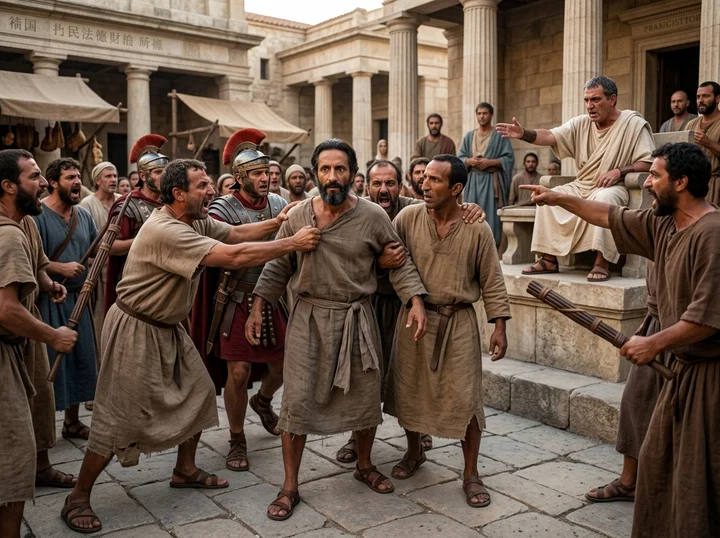
And brought them to the magistrates, saying, These men, being Jews, do exceedingly trouble our city,
Translations
American King James Version, King James Version, Webster Bible
And brought them to the magistrates, saying, These men, being Jews, do exceedingly trouble our city,
and brought them to the magistrates, saying, These men, being Jews, do exceedingly trouble our city,
Revised Version, American Standard Version
and when they had brought them unto the magistrates, they said, These men, being Jews, do exceedingly trouble our city,
and having brought them to the magistrates, they said, 'These men do exceedingly trouble our city, being Jews;
and having brought them up to the praetors, said, These men utterly trouble our city, being Jews,
and, leading them forward unto the magistrates, said—These men, are exceedingly troubling our city, they, being Jews,
Berean Standard Bible, Majority Standard Bible
They brought them to the magistrates and said, “ These men are Jews and are throwing our city into turmoil
When they had brought them to the magistrates, they said, “ These men, being Jews, are agitating our city
And when they had taken them before the authorities, they said, These men, who are Jews, are greatly troubling our town;
And brought them to the gouernours, saying, These men which are Iewes, trouble our citie,
Douay-Rheims (Challoner revision)
And presenting them to the magistrates, they said: These men disturb our city, being Jews;
Pictures
Cross-references
- Acts 16:25-34
And at midnight Paul and Silas prayed, and sang praises unto God: and the prisoners heard them.
The imprisonment following the accusation leads to the jailer’s household believing and being baptized.
- Acts 17:6
And when they found them not, they drew Jason and certain brethren unto the rulers of the city, crying, These that have turned the world upside down are come hither also;
Opponents accused the missionaries of disturbing the city and turning the world upside down.
- Acts 17:7
Whom Jason hath received: and these all do contrary to the decrees of Cæsar, saying that there is another king, one Jesus.
The disturbance charge takes political form in the accusation of disloyalty to Caesar.
- Acts 16:37-39
But Paul said unto them, They have beaten us openly uncondemned, being Romans, and have cast us into prison; and now do they thrust us out privily? nay verily; but let them come themselves and fetch us out.
The magistrates’ charge led to Paul and Silas being beaten, imprisoned, and released.
- Acts 16:9-12
And a vision appeared to Paul in the night; There stood a man of Macedonia, and prayed him, saying, Come over into Macedonia, and help us.
Both texts concern the journey to Philippi.
- Acts 19:37
For ye have brought hither these men, which are neither robbers of churches, nor yet blasphemers of your goddess.
The town clerk says Paul’s companions neither robbed temples nor blasphemed Diana.
Commentary
Each commentary is drawn from primary sources: the writings of Ellen G. White and Adventist pioneers and periodicals. Each commentary is separate. Its own words are not a quotation; follow the references to read the source passages.
Ellen G. White
10 sources
This cry for help at Troas on the borders of the Mediterranean Sea prepared the way for the proclamation of the gospel beyond the confines of Asia Minor into Europe.AA 211.1AA 211.2 After the night vision of the man of Macedonia calling for help, Paul and Silas and Timothy with Luke left Troas at once by way of Samothracia and Neapolis to Philippi, the chief city and colony of that part of Macedonia.AA 211.2 At Philippi, after Paul in the name of Jesus Christ commanded the spirit of divination to come out of a woman and freed her, the owners who had profited from her divination and fortune-telling and from Satanic deceptions brought Paul and Silas before the magistrates, because their income was ended and their hope of gain was gone.RH Jun 29, 1905SG1 95.1–2AA 213.1–3EW 169.1–2ST Jul 3, 1879 Their charge was that these men, being Jews, did exceedingly trouble and disturb the city, portraying them as Jewish outsiders causing civic disorder and turning hostility against them into a civic complaint.3SP 380.2–381.18RED 38.1–2SLP 75.1–2SG1 95.1–2AA 213.1–3 The accusation also presented the apostles as introducing customs that Romans should not accept.AA 213.1–3
The public charge of civic trouble was a pretext that concealed the accusers' financial motive and anger at lost gain and their desire to stop the work.RH Jun 29, 1905SLP 75.1–2SG1 95.1–2AA 213.1–3ST Jul 3, 1879 It stirred an uproar in which the multitude rose against the disciples, and the mob frenzy was accepted and enforced by the authorities, who had Paul and Silas beaten and put in prison with feet in the stocks.RH Jun 29, 1905SLP 75.1–2EW 169.1–2ST Jul 3, 1879 Though it looked like failure, angels were with them as they sang praises to God in prison, and God answered with a great earthquake that shook the prison and loosed the bands, leading to the conversion and baptism of the jailer and all his house.RH Jun 29, 1905 Holding fast to the living principles of truth and rebuking sophistry and evil will bring consequences, yet such faithfulness is not failure.RH Jun 29, 1905
Sources
Pioneers and periodicals
30 sources
At Philippi the masters of a slave girl, after Paul commanded the divining spirit to leave her in the name of Jesus Christ, seized Paul and Silas in anger over lost gain and dragged them to the rulers with the complaint that as Jews they were greatly agitating the city by proclaiming customs unlawful for Romans to receive.ST Jun 26, 1893ST Jun 26, 1893ST Jan 20, 1898ST Jan 28, 1903 The financial grievance was hidden behind an appeal to civic order, Roman religion and popular prejudice.RH Jun 29, 1905ST Jun 26, 1893 The uproar arose not because the truth makes men sinful, but because it exposes sin, pride and self-righteousness instead of flattering with false peace.ST Jun 26, 1893RH Jul 16, 1872ST Jun 26, 1893 Faithful proclaimers of salvation are therefore branded as public troublemakers who disturb the city, and that accusation is used to justify beating and imprisonment for rebuking sin.RH Jun 29, 1905RH Jul 16, 1872ST Jan 19, 1882 On that charge the multitude and magistrates had them beaten publicly and cast into the inner prison in stocks, yet God answered their songs of praise with an earthquake that opened the prison, converted the jailer and his house, and constrained the magistrates in fear to come themselves and release them openly.ST Jan 20, 1898RH Jul 6, 1868ST Jul 3, 1893
The Charge at Philippi
The account belongs to Acts 16:14-34, where the preaching of the gospel makes a new departure as it crosses from Asia into Europe in answer to the Macedonian call, and the two leading features of the chapter are how Paul fell into Roman hands and the wonderful deliverances in his ministry.ST Jun 9, 1898RH Oct 16, 1860ST Jan 20, 1898 At Philippi pious Gentiles were in the habit of assembling on the Sabbath for worship, the Lord opened Lydia the seller of purple to heed what Paul spoke, and she was baptized with her household, laying the foundation of the Philippian church with no hint of a new Sabbath.ST Jan 13, 1898RH Nov 21, 1871 A maid having a spirit of divination followed crying that these men are servants of the Most High God proclaiming the way of salvation, until Paul commanded the spirit in the name of Jesus Christ to come out of her.ST Jan 13, 1898 Little public preaching was done before imprisonment, but the singing of truth in prison, the opening of the prison doors while worshipers sang praise, and the conversion of the jailer and his release became known in that quarter, so Macedonia had opportunity to hear of God.ST Dec 3, 1896 In this way the gospel after crossing from the idolatrous cities of Asia into Greece advanced from Jerusalem through Judea and the surrounding provinces toward the farthest corners to mould nations and individuals.RH Oct 16, 1860
The verse records the first part of the complaint the masters of the possessed girl made before the magistrates after Paul cast the unclean spirit out of her.ST Jun 26, 1893ST Jan 28, 1903ST Jan 13, 1898 When her masters saw their hope of profit was gone they in anger seized Paul and Silas and dragged them into the marketplace before the rulers and to the magistrates.ST Jan 13, 1898ST Jun 21, 1883 There they charged that these men, being Jews, exceedingly troubled the city and caused serious disorder, proclaiming customs it was not lawful for Romans to receive or observe.ST Jun 26, 1893ST Jan 20, 1898ST Jan 28, 1903ST Jan 13, 1898ST Jun 21, 1883 Their charge portrayed the apostles as Jews introducing religious practices Roman citizens could not lawfully accept, though the accusation was a pretext for anger over lost profits.ST Jan 13, 1898ST Jun 21, 1883
The complaint concealed the real cause, which was the loss of unjust profits from the woman's divinations, fortune-telling, and soothsaying when the apostles' work ended the income gained from her.RH Jun 29, 1905ST Jul 3, 1879ST Jun 26, 1893 The masters were angered and humiliated by disappointed gain, and the threat extended to all profiting from satanic delusion.RH Jun 29, 1905ST Dec 2, 1913 They presented their financial grievance as a threat to Roman customs, civic order, and religion, and appealed instead to popular prejudice about religious customs.ST Jun 26, 1893ST Jun 26, 1893
The form of the charge reflects how Jews in heathen cities could be identified with Christians, since both worshiped the same God and opposed idolatry.ST Apr 10, 1884 Roman law tied civic life to Roman religion which Christianity opposed, so the appeal to custom stirred prejudice against a faith feared as setting up a new king, from which the accusers sought to distinguish themselves.ST Apr 10, 1884ST Jun 26, 1893 Unbelieving Jews often led persecution of Christian teachers, and here the outcry is an example of persecution driven by public opinion and public clamor stirring multitude and magistrates.ST Apr 10, 1884ST Jun 17, 1903
On that charge the multitude rose against the disciples, the magistrates had their garments torn off, commanded them to be beaten with rods, laid many stripes on them, and cast them into prison with orders to keep them safely, so the jailer shut them in the inner prison with feet fastened in the stocks.RH Jun 29, 1905ST Jan 20, 1898ST Jan 13, 1898 Though it looked like failure, angels were with them as they sang praises to God, and God answered with a great earthquake that opened the prison, loosed the bands, broke their stocks, and shook the jailer from carnal security.RH Jun 29, 1905RH Jul 16, 1872 That shaking led to the conversion and baptism of the jailer and all his house.RH Jun 29, 1905ST Jul 3, 1893 When it was day the magistrates, having heard of the manifestations of God's power and fearing supernatural wrath, sent by the sergeants to let them go, but Paul asserted citizenship and refused to be cast out privily because they as Romans had been punished publicly uncondemned, so the magistrates feared when they heard they were Romans, came themselves and brought them out with public acquittal, which God overruled so respect would be shown to His servants.ST Jan 20, 1898ST Jul 3, 1893 Punishing them for spreading their principles violated the laws protecting Jews.RH Jul 6, 1868 At the solicitation of the magistrates they were asked to go away from the city, and after leaving the prison Paul and Silas entered the house of Lydia, comforted the brethren, and departed from Philippi through Amphipolis and Apollonia to Thessalonica.ST Jan 20, 1898ST Jul 3, 1893
Teaching and Application
The charge that these Jewish men exceedingly troubled the city illustrates that truth disrupts a world set wrong.ST Jun 26, 1893RH Jul 16, 1872ST Jun 26, 1893 The truth does not make people sinful but exposes sin and reveals their true condition.ST Jun 26, 1893RH Jul 16, 1872ST Jun 26, 1893 It confronts pride and self-righteousness rather than flattering with false peace, and for that reason those opposed to it resist and try to suppress it.ST Jun 26, 1893RH Jul 16, 1872ST Jun 26, 1893 The trouble of the city therefore arose from sin exposed by God's truth.ST Jun 26, 1893ST Jun 26, 1893
Those who accept the truth find peace in the gospel and salvation.ST Jun 26, 1893ST Jun 26, 1893 Those who reject it continue in trouble whose cause is within themselves, and face greater trouble.ST Jun 26, 1893RH Jul 16, 1872ST Jun 26, 1893 Faithful preachers of truth and rebuke for sin are branded as public troublemakers who disturb the city because they proclaim salvation.RH Jun 29, 1905RH Jul 16, 1872ST Jan 19, 1882RH Jun 16, 1874RH Nov 23, 1905 Their enemies use that accusation to justify seizure, beating, and imprisonment.RH Jun 29, 1905RH Jul 16, 1872ST Jan 19, 1882RH Jun 16, 1874 Holding fast to living principles of truth and rebuking sophistry and evil will bring consequences, yet such faithfulness is not failure, for God uses faithful conduct in prison to bring conversion, as the earthquake that broke the stocks and opened the prison shook the jailer from carnal security and led to the conversion and baptism of the jailer and all his house while angels were with the singers of praises.RH Jun 29, 1905RH Jul 16, 1872RH Nov 23, 1905
The accusation at Philippi is an example of Satan trying to attach and hitch his work to the work of God.ST Dec 20, 1899ST Apr 21, 1898 It is an example of charges brought against defenders of God's law for teaching customs called unlawful.RH Mar 31, 1859 It is an example of persecution driven by public opinion and uproar before the magistrates.ST Dec 20, 1899ST Jun 17, 1903 The form of the Gentile charge, that the apostles as Jews troubled the city by teaching customs unlawful for Romans to receive or observe, proves they were keeping the seventh-day Sabbath and were not teaching that the Jewish Sabbath was done away for the first day.RH Nov 21, 1871ST Mar 11, 1897 Romans would not have framed the accusation that way about promoters of Sunday, since the first day was their own chief holiday of the venerable day of the sun.ST Mar 11, 1897 With pious Gentiles assembling on the Sabbath for worship and laying there the foundation of the Philippian church with not one hint of a new Sabbath introduced, and with no recorded charge of Sabbath-breaking against the disciples despite the same eagerness to accuse as had been shown toward Christ, they had not departed from Sabbath observance to keep another day.RH Nov 21, 1871ST Mar 11, 1897
The episode shows the power of the gospel after crossing from the idolatrous cities of Asia into Greece to Philippi, where its spread met the power and malice of enemies in this charge, yet turned idolaters into saints and martyrs by reforming habits and character as part of its advance from Jerusalem through Judea and the surrounding provinces to the farthest corners of the earth to mould nations and individuals.RH Oct 16, 1860 The people of Philippi regarded Paul and Silas as Jews and accused them of troubling the city, and the charge stirred the magistrates to have them beaten and imprisoned, but punishing them for spreading their principles violated the laws protecting Jews.RH Jul 6, 1868RH Oct 16, 1860
Sources