Acts 16:21
And teach customs, which are not lawful for us to receive, neither to observe, being Romans.
Translations
American King James Version, King James Version
And teach customs, which are not lawful for us to receive, neither to observe, being Romans.
and teach customs, which are not lawful for us to receive, neither to observe, being Romans.
And teach customs which are not lawful for us to receive, neither to observe, being Romans.
Revised Version, American Standard Version
and set forth customs which it is not lawful for us to receive, or to observe, being Romans.
and they proclaim customs that are not lawful for us to receive nor to do, being Romans.'
and announce customs which it is not lawful for us to receive nor practise, being Romans.
And are declaring customs, which it is not allowable for us either to accept or to observe, being Romans.
Berean Standard Bible, Majority Standard Bible
by promoting customs that are unlawful for us Romans to adopt or practice.”
and advocate customs which it is not lawful for us to accept or to observe, being Romans.”
Teaching rules of living which it is not right for us to have or to keep, being Romans.
And preache ordinances, which are not lawfull for vs to receiue, neither to obserue, seeing we are Romanes.
Douay-Rheims (Challoner revision)
And preach a fashion which it is not lawful for us to receive nor observe, being Romans.
Pictures
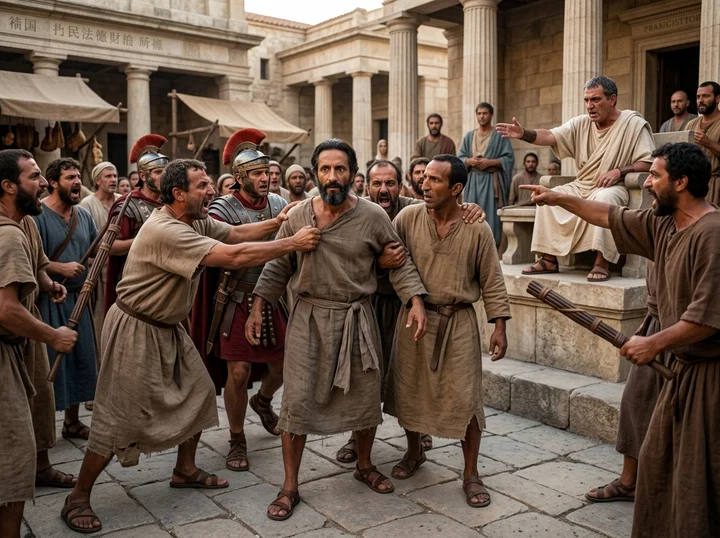
Cross-references
- Acts 16:37-38
But Paul said unto them, They have beaten us openly uncondemned, being Romans, and have cast us into prison; and now do they thrust us out privily? nay verily; but let them come themselves and fetch us out.
Paul invokes Roman citizenship to challenge their unlawful beating and imprisonment.
- Acts 17:7
Whom Jason hath received: and these all do contrary to the decrees of Cæsar, saying that there is another king, one Jesus.
Both texts accuse Christians of violating Roman law and opposing Caesar’s authority.
- Acts 16:12
And from thence to Philippi, which is the chief city of that part of Macedonia, and a colony: and we were in that city abiding certain days.
Philippi’s status as a Roman colony explains the appeal to Roman identity.
- Acts 16:25-34
And at midnight Paul and Silas prayed, and sang praises unto God: and the prisoners heard them.
The prison episode leads to the jailer and his household believing and being baptized.
Commentary
Each commentary is drawn from primary sources: the writings of Ellen G. White and Adventist pioneers and periodicals. Each commentary is separate. Its own words are not a quotation; follow the references to read the source passages.
Ellen G. White
7 sources
The words are the false accusation brought at Philippi that Paul and Silas were troubling the city by teaching customs that Romans could not lawfully receive or observe.3SP 380.2–381.18RED 38.1–2SLP 75.1–2AA 213.1–3ST Jul 3, 1879 The charge singled out that they were Jews and played upon Roman prejudice and civic standing to turn opposition against their preaching.3SP 380.2–381.1SG1 95.1–2AA 213.1–3 The immediate occasion was Paul casting the spirit of divination out of the slave girl in the name of Jesus Christ, after which she became a follower of Christ.RH Jun 29, 1905
Her masters, having lost their hope of gain and income from her divinations and soothsaying, used the charge as a pretext to stir the crowd and the city and to drag the apostles before the rulers and magistrates.8RED 38.1–2RH Jun 29, 1905SLP 75.1–2AA 213.1–3ST Jul 3, 1879 They were joined by others in the city who made money by satanic delusions and feared a power able to stop their work.AA 213.1–3 The accusation stirred an uproar, with the multitude rising against the disciples in a mob spirit sanctioned by the authorities.8RED 38.1–2RH Jun 29, 1905SLP 75.1–2AA 213.1–3
It led directly to the magistrates commanding that the apostles be stripped, beaten and scourged, then cast into the inner prison with their feet in the stocks.RH Jun 29, 1905AA 213.1–3 Paul and Silas were themselves Romans, a fact Paul afterward used to challenge their beating and intended secret release.SG1 95.1–2 Rebuking Satan's sophistry even when it speaks good words brings persecution, and holding fast to the living principles of truth whatever the consequences may look like failure, but God turns it to salvation, as seen in the conversion and baptism of the jailer and all his house.RH Jun 29, 1905
Sources
Pioneers and periodicals
28 sources
At Philippi Paul and Silas were accused as Jews who troubled the city by introducing religious teachings that Romans claimed were unlawful to receive or observe.ST Jun 26, 1893RH Mar 31, 1859 The charge came from the masters of the fortune-telling slave girl after Paul cast the spirit of divination out of her in the name of Jesus Christ, destroying their hope of unjust gain and moving them to stir the multitude and magistrates under pretense of religious prejudice.RH Jun 29, 1905ST Jun 26, 1893 The appeal to Roman custom carried weight because Philippi was a Roman colony where civic life was bound by state religion, so the gospel was presented as a foreign and illegal opposition to Roman worship.ST Jun 26, 1893RH Sep 17, 1861ST Jun 26, 1893 The form of the accusation shows they were still keeping the seventh-day Sabbath as Jews, for they were not charged with setting aside the Sabbath for the first day, which was already the Romans' own chief holiday and could never have been called unlawful for Romans to observe.ST Dec 2, 1886RH Nov 21, 1871ST Mar 11, 1897 Though spoken for that setting, the charge remains the standing attack upon those who openly teach Bible truth and rebuke Satan even when he speaks good words, yet such efforts to suppress truth by rulers and public clamor cannot defeat God's purpose, for He overrules apparent failure to salvation as He did in the earthquake, the prisoners' freedom, and the jailer's conversion.RH Jun 29, 1905ST Nov 1, 1883RH Mar 31, 1859RH Jul 16, 1872
Charge and Setting at Philippi
The charge was that Paul and Silas, singled out as Jews who troubled the city, were introducing and teaching religious customs which Romans claimed were not lawful to receive or to observe.ST Jun 26, 1893ST Apr 10, 1884ST Jan 13, 1898ST Jan 13, 1898 The complaint presented their teaching as foreign and illegal, an unlawful innovation in observance set against Roman law and religion.ST Jun 26, 1893RH Mar 31, 1859ST Apr 10, 1884ST Jan 13, 1898 It was brought before the magistrates at Philippi as the formal accusation against them.ST Apr 10, 1884ST Jan 13, 1898ST Jan 13, 1898 Jews could be associated with Christians in such a charge because both worshiped one God and opposed idolatry.ST Apr 10, 1884
The complaint was made by the masters of the possessed slave girl who practiced fortune-telling and divination.RH Jun 29, 1905ST Jul 3, 1879ST Jun 26, 1893ST Dec 17, 1902 She had followed the apostles through the streets with loud proclamations until Paul commanded the evil spirit out of her in the name of Jesus Christ, after which she became a follower of Christ.RH Jun 29, 1905ST Dec 17, 1902 Seeing their hope of gain from her soothsaying gone, her masters lost their unjust profit from Satanic delusions and were enraged, angered and humiliated.RH Jun 29, 1905ST Jul 3, 1879ST Jun 26, 1893ST Dec 17, 1902 One account describes the lost profits as those of jewelers.RH Jun 29, 1905ST Jul 3, 1879ST Jun 26, 1893ST Dec 17, 1902 The appeal to unlawful customs was a pretext, using religious prejudice and popular clamor to stir the multitude and the rulers.RH Jun 29, 1905ST Jul 3, 1879ST Jun 26, 1893ST Dec 17, 1902ST Jun 26, 1893
Roman life was closely bound to religion by state law, so Christianity was set forth as opposing the Roman religion.ST Jun 26, 1893ST Jun 26, 1893 That appeal carried weight because Philippi was a Roman colony, a standing implied by the accusers' plea of what was unlawful for Romans to receive or observe.ST Jun 26, 1893RH Sep 17, 1861 Its colonial dignity and privileges were granted by Julius Caesar and confirmed and enlarged by Augustus, as later ancient coins record.RH Sep 17, 1861 It was an important town of Macedonia on the great highway from east to west, named by Philip II of Macedonia after himself.ST Nov 28, 1911
The charge belongs to Paul's visit to Philippi, where the Sabbath brought him into contact with worshipers of God including Lydia who listened to his teaching.RH Mar 4, 1862 It stands at the first introduction of the gospel to the people of Philippi and the founding of the Philippian church.ST Nov 18, 1897 The accusation stirred an uproar, the multitude rising against the disciples, and the magistrates commanded them to be beaten and then imprisoned with their feet made fast in the stocks.RH Jun 29, 1905RH Jan 28, 1862ST Dec 17, 1902 God answered with miraculous deliverance by earthquake, and the imprisonment ended with the jailer's question about salvation followed by the baptism of the jailer and all his house.RH Jun 29, 1905ST Jan 28, 1903ST Jul 3, 1893 The devoted Philippian church afterward sent Paul means again and again, and his epistle to the Philippians, written while in prison in Rome, is more like a letter from the heart than any of his other epistles.ST Nov 28, 1911
The words being Romans carry legal force in what followed, for Paul and Silas were Romans who had been beaten publicly uncondemned and cast into prison.ST Jan 20, 1898RH Jan 28, 1862 When the magistrates heard they were Romans they feared, both supernatural wrath after the manifestations of God's power and their own unlawful act.ST Jan 20, 1898RH Jan 28, 1862ST Jul 3, 1893 They came themselves to bring them out, humbled themselves with apology, and granted public acquittal.ST Jan 20, 1898RH Jan 28, 1862ST Jul 3, 1893 They then asked them to go away from the city, and at the magistrates' solicitation Paul and Silas departed and passed through Amphipolis and Apollonia to Thessalonica.ST Jan 20, 1898ST Jul 3, 1893
Sabbath, Gospel, and Persecution
Though written for a particular setting, the charge remains applicable to people in every age.ST Nov 1, 1883 Paul and Silas taught Bible doctrines openly rather than avoiding them to suit popular opinion, unlike ministers who neglect doctrines such as baptism.ST May 15, 1884
The verse connects with Paul's custom of honoring the Sabbath, for his ministry as described in Acts 13, 16, 17, and 18 was consistent with the Sabbath teaching of the prophets and Jesus rather than contradicting it.ST Dec 2, 1886 Pious Gentiles at Philippi were in the habit of assembling on the Sabbath for worship, where he laid the foundation of the Philippian church, and he gave not one hint of introducing a new Sabbath.ST Dec 2, 1886RH Nov 21, 1871
The form of the accusation shows the apostles still held the seventh-day Sabbath, for they were charged by Gentiles as Jews troubling the city by teaching customs unlawful for Romans to receive or observe, marking them as teaching what was foreign to Roman practice.ST Mar 11, 1897 They were not teaching that the Jewish Sabbath was done away and that the first day should be kept, since the first day was the Romans' own chief holiday, the venerable day of the sun, which could not have been charged as unlawful for Romans to receive.ST Mar 11, 1897 This matches the fact that no charge of Sabbath-breaking was ever brought against the disciples.ST Mar 11, 1897
The episode is an example of Satan trying to attach his work to the work of God and hitch his work onto it.ST Dec 20, 1899ST Apr 21, 1898 It stands in the gospel work at Philippi where idolaters were made saints and martyrs, showing the power of the gospel to reform habits and character and to mould the life of diverse peoples into holy and enduring Christians.RH Oct 16, 1860
Rebuking Satan's sophistry even when it speaks good words brings persecution, and the charge about unlawful customs is used against those defending God's law.RH Jun 29, 1905RH Mar 31, 1859 After Paul commanded the spirit of divination out of the slave girl in the name of Jesus Christ and she became a follower of Christ, her masters, having lost their hope of gain from her soothsaying, brought Paul and Silas before the rulers accusing them of troubling the city by teaching customs unlawful for Romans to receive or observe.RH Jun 29, 1905 Their real motive was the loss of their unjust profits, but they appealed to Roman prejudice as a pretext because Christianity opposed the Roman religion, whose practices were tied to state law.ST Jun 26, 1893 The accusation stirred an uproar with the multitude rising against the disciples, and was used to stir the magistrates and rulers to action, leading to the command that they be beaten and then imprisoned with their feet in the stocks, yet their preaching of Christ nevertheless continued.RH Jun 29, 1905ST Jan 19, 1882RH Jun 16, 1874 That effort to suppress truth by stirring rulers, multitude and public opinion could not defeat God's purpose, for human authorities trying to confine God's truth were answered by God's earthquake freeing the prisoners and shaking the jailer from carnal security, and instead helped bring salvation.RH Jul 16, 1872ST Jan 19, 1882 Holding fast to living principles of truth whatever the consequences may look like failure but God overrules it to salvation, as seen in the apostles' faith and conduct in prison and continued preaching leading to the conversion and baptism of the jailer and all his house and household.RH Jun 29, 1905ST Jan 19, 1882 The city's turmoil came from sin, for God's truth did not make people sinful but exposed their condition, bringing peace to those who believed and greater trouble to those who rejected it.ST Jun 26, 1893
Sources