Acts 16:22
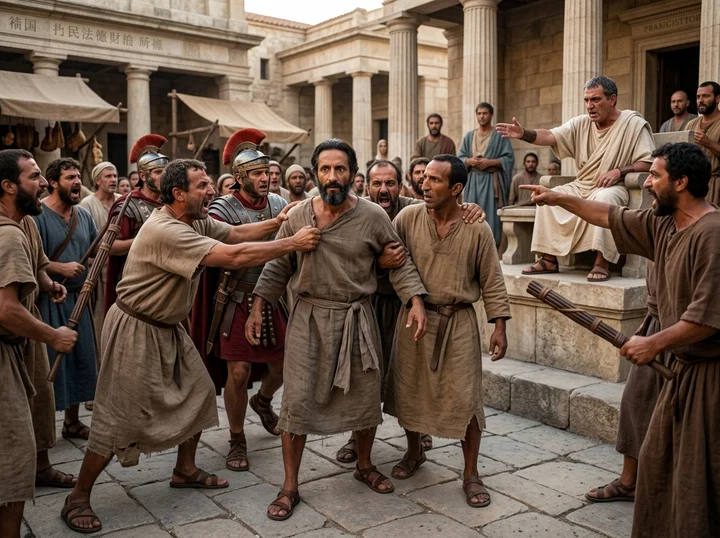
And the multitude rose up together against them: and the magistrates rent off their clothes, and commanded to beat them.
Translations
American King James Version, King James Version, KJV Cambridge Paragraph Bible
And the multitude rose up together against them: and the magistrates rent off their clothes, and commanded to beat them.
And the multitude rose together against them: and the magistrates rent off their clothes, and commanded to beat them.
Revised Version, American Standard Version
And the multitude rose up together against them: and the magistrates rent their garments off them, and commanded to beat them with rods.
And the multitude rose up together against them, and the magistrates having torn their garments from them, were commanding to beat [them] with rods,
And the crowd rose up too against them; and the praetors, having torn off their clothes, commanded to scourge [ them].
And the multitude rose up together against them, and, the magistrates, rending off them their mantles, were giving orders to beat them with rods;
Berean Standard Bible, Majority Standard Bible
The crowd joined in the attack against Paul and Silas, and the magistrates ordered that they be stripped and beaten with rods.
The multitude rose up together against them and the magistrates tore their clothes from them, then commanded them to be beaten with rods.
And the people made an attack on them all together: and the authorities took their clothing off them, and gave orders for them to be whipped.
The people also rose vp together against them, and the gouernours rent their clothes, and commanded them to be beaten with roddes.
Douay-Rheims (Challoner revision)
And the people ran together against them; and the magistrates rending off their clothes, commanded them to be beaten with rods.
Pictures
Cross-references
- Acts 16:37
But Paul said unto them, They have beaten us openly uncondemned, being Romans, and have cast us into prison; and now do they thrust us out privily? nay verily; but let them come themselves and fetch us out.
Paul protests that Roman citizens were beaten publicly without trial.
- Acts 16:30-34
And brought them out, and said, Sirs, what must I do to be saved?
The jailer and his household believe, receive salvation, and are baptized.
- Acts 16:26
And suddenly there was a great earthquake, so that the foundations of the prison were shaken: and immediately all the doors were opened, and every one’s bands were loosed.
An earthquake miraculously shakes the prison and opens its doors.
- 2 Corinthians 11:25
Thrice was I beaten with rods, once was I stoned, thrice I suffered shipwreck, a night and a day I have been in the deep;
Paul recalls being beaten with rods three times.
- Philippians 1:29
For unto you it is given in the behalf of Christ, not only to believe on him, but also to suffer for his sake;
Philippians given same suffering Paul endured
- 1 Thessalonians 2:2
But even after that we had suffered before, and were shamefully entreated, as ye know, at Philippi, we were bold in our God to speak unto you the gospel of God with much contention.
Paul recalls the shameful treatment he and Silas suffered at Philippi.
- Acts 16:13
And on the sabbath we went out of the city by a river side, where prayer was wont to be made; and we sat down, and spake unto the women which resorted thither.
same Philippian Sabbath assembly with no new day
- Acts 16:39-40
And they came and besought them, and brought them out, and desired them to depart out of the city.
The magistrates apologize, release Paul and Silas, and they comfort the believers at Lydia’s house.
- Acts 16:9
And a vision appeared to Paul in the night; There stood a man of Macedonia, and prayed him, saying, Come over into Macedonia, and help us.
call that brought Paul to Philippi where beaten
- Philippians 1:30
Having the same conflict which ye saw in me, and now hear to be in me.
same conflict seen in Paul at Philippi
- Acts 16:16-18
And it came to pass, as we went to prayer, a certain damsel possessed with a spirit of divination met us, which brought her masters much gain by soothsaying:
Paul freed the woman, prompting the unjust beating.
- Acts 17:4-6
And some of them believed, and consorted with Paul and Silas; and of the devout Greeks a great multitude, and of the chief women not a few.
Their later preaching draws converts and renewed accusations of troubling the world.
- Matthew 5:11-12
Blessed are ye, when men shall revile you, and persecute you, and shall say all manner of evil against you falsely, for my sake.
The apostles rejoiced despite suffering for Christ’s name.
Commentary
Each commentary is drawn from primary sources: the writings of Ellen G. White and Adventist pioneers and periodicals. Each commentary is separate. Its own words are not a quotation; follow the references to read the source passages.
Ellen G. White
18 sources
At Philippi the crowd rose as one against Paul and Silas, and the magistrates themselves tore off their outer garments and ordered the apostles stripped and scourged, joining official power to the mob spirit against innocent men.8RED 38.1–2ST Jul 3, 1879EW 169.1–2 The outbreak came because Paul had freed a possessed fortune-telling slave from the evil spirit, restoring her to her right mind to follow Christ, and her masters saw their profit from her divinations cut off if the gospel continued.8RED 38.1–2RH Jun 29, 1905ST Jul 3, 1879AA 213.1–3 Enraged at the loss, they dragged Paul and Silas before the rulers crying that as Jews they troubled the city and taught customs unlawful for Romans, and the magistrates hastily commanded the beating amid the uproar before learning the character and work of the men.8RED 38.1–2RH Jun 29, 1905EW 169.1–2SG1 95.1–2AA 213.1–3 The scourging with many stripes was the rigorous Roman penalty for the worst criminals, followed by imprisonment in the inner prison with feet fast in the stocks.EW 169.1–2AA 213.1–3AA 214.2 Yet thrown into the dungeon in that painful position, Paul and Silas did not complain but sang praises to God at midnight, showing that those devoted to the truth can count it a privilege and even a joy to suffer for it and must keep obeying God rather than man when laws and powers oppose Him.3T 406.3–407.1Ms 6, 1884, par. 7–8RH Dec 15, 1874
Setting and Events
The time had come for the gospel to be proclaimed beyond the confines of Asia Minor, and the way was opening for Paul and his fellow workers to cross over into Europe after the night vision at Troas on the borders of the Mediterranean Sea in which a man of Macedonia pleaded for help.AA 211.1 The attack at Philippi followed Paul freeing a possessed fortune-telling woman from an evil spirit, and she was restored to her right mind and chose to become a follower of Christ.AA 213.1–3 She had been enslaved and a trouble to the city.RH Jun 29, 1905AA 214.2
Her masters saw all hope of money from her divinations was gone and their income cut off if the gospel continued.RH Jun 29, 1905AA 213.1–3 Many others in the city who gained money through satanic delusions feared a power that could stop their work.AA 213.1–3 Driven by anger over the loss, they brought Paul and Silas before the rulers and raised a mighty cry against the servants of God.RH Jun 29, 1905AA 213.1–33SP 380.2–381.1 They charged that being Jews they exceedingly troubled the city and taught customs unlawful for Romans to receive or observe, which stirred the city into frenzy of excitement.8RED 38.1–2AA 213.1–33SP 380.2–381.1
The multitude rose up together against Paul and Silas, and the magistrates themselves tore off their outer garments and commanded that they be stripped and scourged.8RED 38.1–2ST Jul 3, 1879EW 169.1–2SG1 95.1–2AA 213.1–3 In this the mob spirit was sanctioned by the authorities with official power despite the apostles' innocence.8RED 38.1–2ST Jul 3, 1879AA 213.1–3 The command was a hasty, prompt and decisive measure to quell the tumult, inflicted amid uproar before the magistrates knew the men's character and work, after which they returned home congratulating themselves for stopping it.AA 214.28RED 39.2 It meant scourging with many stripes followed by imprisonment, the rigorous Roman penalty reserved for the worst criminals, laid on two innocent men and ending in the inner prison with feet made fast in the stocks.EW 169.1–2AA 213.1–3AA 214.28RED 39.2
The magistrates later learned further particulars and saw the freed woman, once a trouble to the city, now quiet and peaceable with changed countenance and demeanor and in her right mind.3SP 382.1AA 214.2 They recognized they had probably punished two innocent men under the severe penalty, were indignant with themselves, and decided in the morning to have them privately released and escorted safely from the city beyond danger of violence from the mob.3SP 382.1AA 214.28RED 39.2 The beating led to imprisonment that in God's direct providence brought the light of truth within the prison walls so the jailer and his household believed.RH Jun 29, 1905Ms 6, 1884, par. 7–8 The apostles' visible injuries and appearance at Thessalonica still bore witness to the shameful public abuse they had endured at Philippi, which they explained while magnifying God's grace in their deliverance rather than dwelling on their own afflictions.SLP 81.38RED 44.33SP 387.3
Faithful Suffering and Witness
Thrown into the dungeon in a painful position with feet fastened in the stocks in the inner prison, Paul and Silas did not complain but at midnight sang praises to God.3T 406.3–407.1RH Dec 15, 1874 Love for Christ's work cheered them through suffering, and their scourging and imprisonment were borne with joy.3T 406.3–407.1RH Dec 15, 1874 Their joy shows that those devoted to the truth can count it a privilege to suffer for it, that faith can make it joyful to suffer for the truth, and that such suffering need not deter them from their work.3T 406.3–407.1RH Dec 15, 1874
Paul endured this violent opposition and imprisonment in Macedonia without turning from his purpose to serve Christ.GW 107.3 His faith, strengthened through effort and sacrifice, sustained him through persecution.GW 107.3 When he and Silas came to Thessalonica their appearance still bore evidence of the shameful public abuse endured at Philippi, and they explained what they had suffered.SLP 81.33SP 387.3 They magnified God's grace in their deliverance rather than dwelling on their own afflictions and suffering.SLP 81.33SP 387.3
Carrying God's aggressive truth brings reproach, persecution, beating and imprisonment when laws and powers oppose God, yet obedience to God rather than man must continue.Ms 6, 1884, par. 7–8 Their imprisonment was in the direct providence of God so that the light of truth could reach within those prison walls and convert the jailer, proving believers have a message to bear wherever they are and must constantly let their light shine.Ms 6, 1884, par. 7–8 By the same pattern those who stem the current of prevailing iniquity and obey the truth in the face of the world will be brought into strait places, especially when the message goes with a loud cry, because the whole world will not be in harmony with the law.Ms 6, 1884, par. 7–8
Sources
Pioneers and periodicals
58 sources
At Philippi the crowd joined together against Paul and Silas, and the magistrates had their clothes torn off and ordered them beaten publicly with rods until their backs were bleeding and lacerated.ST Jun 26, 1893ST Dec 17, 1902ST Jun 24, 1897ST Jan 9, 1912ST Aug 13, 1894 The attack was driven by the masters of the divining girl who had lost their profit, stirring the multitude with the false charge that as Jews they troubled the city and taught unlawful customs.RH Jun 29, 1905ST Jun 26, 1893ST Jun 24, 1897RH Jul 16, 1872ST Jan 13, 1898 It was unlawful violence, for they were beaten without trial though they were Romans, which afterward frightened the magistrates and forced them to come and release them openly.ST Jul 3, 1879ST Jan 20, 1898RH Jan 28, 1862ST Jul 3, 1893 Wounded and fastened in the stocks in the inner prison, they prayed and sang praises at midnight instead of complaining, and God answered with an earthquake that opened the prison and brought the jailer and his household to conversion and baptism.RH Jun 29, 1905RH Jan 28, 1862ST Jan 17, 1906RH Jul 16, 1872ST Jan 19, 1882 Being filled with the Spirit is therefore known by humbly enduring such suffering without retaliation and rejoicing as counted worthy to suffer for Christ, continuing to preach wherever placed.RH Dec 15, 1874ST Jan 28, 1903RH Nov 23, 1905RH Jan 11, 1912
Setting at Philippi
Paul and his companions stayed certain days in the city, and on the Sabbath went out by the riverside where prayer was customarily made and sat down and spoke to the women resorting there.RH Mar 4, 1862 Among them was Lydia, a seller of purple of the city of Thyatira who worshiped God, whose heart the Lord opened to attend to the things spoken by Paul.RH Mar 4, 1862 Her conversion and baptism followed, and the beating belongs to the account that comes after that and after Paul's command in the name of Jesus Christ for the spirit of divination to come out of the maid.ST Jan 13, 1898
Pious Gentiles at Philippi were in the habit of assembling for worship on the Sabbath, where Paul laid the foundation of the Philippian church.RH Nov 21, 1871 The passage in Acts 16:10-40 gives that founding account.ST Nov 18, 1897 It also introduces the gospel to the Philippian people. It gives not one hint that he introduced a new Sabbath.RH Nov 21, 1871
Philippi was an important town of Macedonia on the great highway from east to west, named after Philip II of Macedonia, and a Roman colony in Paul's time.ST Sep 29, 1909ST Nov 28, 1911 There Paul entered Europe through suffering, being beaten and imprisoned in a Greek dungeon.ST Feb 28, 1884 That apparent obstacle became the setting for the first European converts — a Jewish working woman and a Greek jailer — and for the first European song of Christian praise, sung at night in the dungeon.ST Feb 28, 1884
Before the beating a maid with a spirit of divination, a familiar spirit used for fortune-telling, followed Paul and Silas declaring they proclaimed the way of salvation.ST Jan 13, 1898ST Dec 17, 1902 She followed them through the streets trying to associate herself with their preaching work, with shrill, repeated cries drawing attention to them and their companions.ST Dec 17, 1902ST Dec 2, 1913 Paul in the name of Jesus Christ commanded the spirit to come out and silenced her.ST Jan 13, 1898
Paul and Silas went to Macedonia to preach the gospel.ST Dec 3, 1896 They proclaimed Bible doctrines together rather than avoiding truths that might offend.ST May 15, 1884 The gospel thus crossed into Greece to Philippi despite the power and malice of its enemies, with the multitude rising together against its preachers and the magistrates having them beaten.RH Oct 16, 1860 It prevailed to turn its idolaters into saints.RH Oct 16, 1860
Words and Punishment Described
The multitude at Philippi rose up together against Paul and Silas with hostile sentiment, the crowd joining in opposing them and turning together with the magistrates against the apostles.ST Jun 26, 1893ST Jun 26, 1893ST Dec 17, 1902 The magistrates decided against them and commanded their clothes to be torn off, stripping their garments off and ordering them beaten with rods.ST Jun 24, 1897ST Dec 17, 1902 The magistrates themselves personally tore off their clothes, so they were stripped and beaten on the bare, naked flesh.ST Jul 3, 1879ST Jun 24, 1897ST Jun 24, 1897
The beating commanded was beating with rods with many stripes, done publicly and severely until their backs were bare, bleeding, raw and lacerated.ST Jun 24, 1897ST Jan 9, 1912RH Mar 5, 1872ST Jan 23, 1896 It was one of three such beatings with rods that Paul endured, one of the three times he was beaten in that manner.ST Jun 24, 1897ST Jun 24, 1897 That incident illustrates why he was said to have been whipped repeatedly during his ministry.ST Aug 13, 1894 The punishment was severe and wholly unmerited, and he felt it keenly.ST Jan 23, 1896
The verse records Paul's maltreatment on his first visit to Philippi and belongs to the account of punishment by the magistrates before imprisonment.ST Sep 29, 1909 That suffering is the same conflict set before the Philippian believers.ST Sep 29, 1909 It shows his suffering for Christ's name by whipping and imprisonment at Philippi, one part of violent trials and hardships faced through violent beating before dying a martyr's death.ST Aug 8, 1906ST Dec 9, 1913
Causes Behind the Attack
Paul and Silas brought the message of salvation to Philippi, and after Paul commanded the spirit of divination to leave the slave girl her masters' profit from her fortune-telling was gone.RH Jun 29, 1905ST Jun 24, 1897RH Jul 16, 1872ST Jan 13, 1898ST Dec 17, 1902 Her masters made money from her fortune-telling with a familiar spirit, and enraged at losing it they seized Paul and Silas and dragged them to the marketplace before the rulers.ST Jan 13, 1898ST Dec 17, 1902 Their charge stirred up the city, and the crowd turned against the disciples before the magistrates ordered them beaten and sent to prison.RH Jun 29, 1905ST Jun 24, 1897
The men who had lost their source of profit accused them as Jews who troubled the city and taught customs unlawful for Romans to receive or observe.ST Jun 26, 1893ST Jan 13, 1898 Both the multitude and the magistrates accepted the charge of troubling the city and setting forth unlawful customs, and turned together against the apostles.ST Jun 26, 1893ST Jun 26, 1893 Their punishment followed a false charge of disturbing the colony, with their accusers calling their teaching unlawful.ST Jun 21, 1883RH Jun 16, 1874
The girl's masters were joined by a crowd in attacking them, and the slave owners stirred up the multitude with popular clamor also rising against the apostles.ST Jan 13, 1898ST Dec 17, 1902ST Jun 26, 1893 The crowd joined in opposing them and rose against them, so that public hostility led to persecution.ST Jun 26, 1893ST Jun 17, 1903 That hostility was stirred by the fact that they were Jews.ST Jun 21, 1883
The magistrates were influenced by the mob, and the clamor of the multitude moved them to strip Paul and Silas and beat them with rods.ST Jan 13, 1898ST Jun 26, 1893 They would not have shamefully mistreated them apart from pressure from the people.ST Jun 26, 1893 Outside Judea common people could be provoked to insult Christians and inferior magistrates could join them in mistreating them, illustrating hardship through popular hostility and weak local officials.RH Jul 6, 1868 This was the same pattern as Pilate condemning Christ from fear of the thoughtless mob stirred up by the priests.ST Jun 26, 1893
The episode belongs to Satan trying to hitch his work onto God's work whenever he can, attaching his counter-work to God's work at Philippi.ST Dec 20, 1899ST Apr 21, 1898 The beating and imprisonment were an effort by the powers of darkness to suppress the truth they preached.ST Jan 19, 1882RH Jun 16, 1874 Their imprisonment and restraint in the stocks could not silence God's truth, and the beating and imprisonment did not end their work.RH Jul 16, 1872ST Jan 19, 1882RH Jun 16, 1874
The beating came by order of the Roman magistrates as part of the persecution and imprisonment suffered for refusing to yield to Roman religious laws.ST Jul 28, 1898 If such laws were right it would have been wrong to oppose them and they should have obeyed and thus avoided persecution, imprisonment, and a martyr's death.ST Jul 28, 1898 Their refusal proves that opposing religious laws is right and that making and enforcing them is wrong.ST Jul 28, 1898 The same pattern of rulers yielding to popular clamor appears when the United States Congress commits itself to religious legislation on the Sunday question under pressure from the people.ST Jun 26, 1893
The punishment by the Philippian authorities followed a public dispute after Paul's miracle and teaching, which reduced profits.ST Jun 4, 1885 Unlike them, later Salvation Army officers were arrested for obstructing a sidewalk.ST Jun 4, 1885
Unjust Official Violence
At Philippi the crowd rose together against Paul and Silas, and the magistrates themselves tore off their clothes and ordered them beaten.ST Jul 3, 1879ST Jan 20, 1898RH Jan 28, 1862 The beating was inflicted publicly and severely, without trial, though they were Romans, and afterward they were cast into prison.ST Jan 20, 1898RH Jan 28, 1862ST Jun 17, 1903 In doing this the authorities sanctioned the mob's violence and punished innocent men in response to the uproar stirred by those whose profit from divination had been cut off by the apostles' work.ST Jul 3, 1879ST Jan 20, 1898
The punishment was unlawful because Paul was a Roman citizen who had not been legally condemned.ST Jan 20, 1898ST Jun 17, 1903 When morning came the magistrates sent sergeants to release them privately, but Paul asserted his citizenship and refused to be cast out secretly.ST Jan 20, 1898RH Jan 28, 1862ST Jul 3, 1893 When the rulers heard they were Romans they were afraid, fearing supernatural wrath and the trouble and indemnity he could exact, and were thus compelled to humble themselves and apologize.ST Jan 20, 1898RH Jan 28, 1862ST Jul 3, 1893ST Jun 17, 1903
He required the magistrates to come themselves and bring them out with public acquittal, which was granted.ST Jan 20, 1898ST Jul 3, 1893 They came and besought them, brought them out, and asked them to go away from the city, God overruling the incident so that respect would be shown to His servants.ST Jan 20, 1898ST Jul 3, 1893 Then Paul and Silas went out of the prison to the house of Lydia, comforted the brethren, and departed, passing through Amphipolis and Apollonia to Thessalonica.ST Jan 20, 1898ST Jul 3, 1893
Imprisonment to Release and Fruit
The beating was followed by many stripes, commitment to prison under strict guard, confinement in the inner prison, and fastening of the feet in the stocks.RH Jan 28, 1862ST Jan 13, 1898ST Jun 21, 1883 They were left wounded and bound where escape seemed impossible.RH Jan 28, 1862ST May 16, 1911ST Jan 9, 1912 The crowd had turned against them and the magistrates had ordered them stripped and beaten with rods on a false charge of disturbing the colony, with hostility stirred because they were Jews.ST Jan 13, 1898ST Jun 21, 1883
Though sore, confined in a painful position in the dungeon, and shamefully treated, they did not complain but prayed and praised God in song at midnight.ST Jan 17, 1906ST Jan 9, 1912RH Jan 31, 1871ST Feb 3, 1881 This shows that God's servants can keep faith and praise Him amid trouble and temporal hardship.ST Jan 17, 1906ST Feb 3, 1881 They can meet persecution without hatred and praise God even in suffering.RH Aug 5, 1873
Their suffering did not mean God had abandoned them or that their work had failed.ST Jan 28, 1903 Their affliction came before their work in Philippi and Thessalonica was crowned with success.RH Aug 11, 1863 Their preaching was successful and acceptable to God despite suffering as part of its cost.ST Nov 6, 1893 The gospel thus crossed into Greece to Philippi despite the power and malice of its enemies, prevailing to turn its idolaters into saints and martyrs.RH Oct 16, 1860
While they prayed and sang an earthquake released them and shook the prison with miraculous opening of the doors, shaking the jailer from his carnal security.RH Jul 16, 1872ST May 16, 1911ST Jan 9, 1912 Their singing at midnight was followed by the earthquake.ST May 16, 1911 Bearing the beating with meek, patient suffering instead of complaining brought angelic visitation that shook the prison.RH Jan 31, 1871 Though imprisoned the Lord glorified His name, and before dawn they were encouraged by a company of baptized believers.RH Mar 6, 1913 The region heard how the doors opened while worshipers sang His praise.ST Dec 3, 1896
Their witness and conduct in suffering helped bring the jailer to ask how to be saved and led to the conversion and baptism of the jailer and his household and family.RH Jun 29, 1905ST Jan 28, 1903ST Jan 19, 1882RH Nov 23, 1905RH Aug 5, 1873 Their imprisonment became the occasion for the jailer and his household to hear and believe the message, an effort by darkness to suppress the truth turned to its spread.ST Jan 19, 1882RH Nov 23, 1905 The same conflict was given to the Philippian believers in behalf of Christ not only to believe on Him but also to suffer for His sake.ST Jun 28, 1883 They passed through the same persecution during the ten years after the gospel first came while Paul was again in prison.ST Jun 28, 1883
Paul had come there in answer to the Macedonian man's urgent call for help, so his beating and imprisonment in a Greek dungeon was entering Europe through suffering.ST Feb 28, 1884ST Jan 23, 1896 That apparent obstacle became the setting for the first European converts — a Jewish working woman and a Greek jailer — and for the first European song of Christian praise, sung at night in the dungeon.ST Feb 28, 1884 The church at Philippi was founded in that persecution and imprisonment.ST Jun 28, 1883 Though beaten there, Paul found a devoted church at Philippi who sent him means again and again, and later while in prison in Rome he wrote them the epistle to the Philippians, more like a letter from the heart than any of his other epistles.ST Nov 28, 1911 The punishment was severe and wholly unmerited and he felt it keenly, yet the memory did not quench his love for the brethren, and he desired them to stand fast in one spirit with one mind striving together for the faith against men rabid against the truth, without offense till the day of Christ, with the promise that the peace of God would keep their hearts and minds through Christ and God would supply all their need according to His riches in glory.ST Jan 23, 1896
Lessons for Believers Today
The beating and imprisonment at Philippi show what was endured for Christ without turning from the purpose to do God's will, for though whipped and bleeding and thrown into prison the work did not stop there.ST Jan 28, 1903ST Jan 19, 1882RH Nov 23, 1905ST Nov 25, 1903ST Dec 9, 1913 Being severely beaten and confined in stocks did not prevent laboring, but preaching Christ continued wherever the place was, and that night of singing praises became the conversion of the jailer and his household.ST Jan 19, 1882RH Nov 23, 1905RH Aug 5, 1873 The suffering did not mean God had abandoned the workers or that the work had failed, for while sore and confined they prayed and praised God, and their witness helped bring the jailer to ask how to be saved.ST Jan 28, 1903ST Jan 19, 1882RH Nov 23, 1905 The crowd turning against them and the magistrates ordering them beaten with many stripes after the masters lost their source of profit was an effort to suppress the truth preached, yet the imprisonment became an occasion for the jailer and his household and family to hear and believe.ST Jan 28, 1903ST Jan 19, 1882RH Nov 23, 1905
Being filled with the Holy Spirit led to humble submission to the indignities of beating and imprisonment without display of marvelous power, and then to rejoicing with singing and thanksgiving as counted worthy to suffer for Christ.RH Dec 15, 1874RH Jan 11, 1912 True Spirit filling is known by such practical endurance and joyful suffering, a result still given today, showing that persecution can be met without hatred and God praised even in suffering.RH Jan 11, 1912 Scourged and thrown into the dungeon in a painful position with feet fastened in stocks, there was no complaining, but at midnight singing and praising God, cheered through suffering by love for Christ's work.RH Dec 15, 1874RH Jan 11, 1912 Such faith can make it joyful to suffer for the truth.RH Dec 15, 1874
Obedience to the truth requires enduring such laceration of the back with stripes without murmur or complaint and without becoming more moderate in preaching to avoid it.ST Jul 10, 1893RH Jun 16, 1874RH Jan 31, 1871 With meek, patient suffering instead of complaining, and with singing praises to God at midnight, the prison was shaken by angelic visitation and the jailer and his house were converted.RH Jan 31, 1871 Faithful messengers who press home truth though branded as troublers and charged with teaching what is unlawful show by such endurance and continued preaching a boldness and influence by God's power unlike people generally, even when attacked by the powers of darkness.ST Jul 10, 1893RH Jun 16, 1874RH Jan 31, 1871
Happiness is mainly internal and does not depend on outward circumstances, so with backs raw and bleeding in prison there was happiness and even singing the high praises of God.RH Mar 5, 1872 A contented mind is a continual feast even in suffering, with the peace that passes understanding, while a man surrounded by wealth and luxury can be wretched.RH Mar 5, 1872 That peace is not found by those full of the spirit of speculation and desire to move elsewhere to heap up treasures for the last-day fires to consume.RH Mar 5, 1872
The great affliction under which the churches in Macedonia, especially at Philippi, were brought out, when the multitude rose and the magistrates had them beaten and cast into prison, did not excuse from giving. From the first was learned the sustaining of the gospel with means and efforts even in deep poverty and great trial of affliction, giving to power and beyond. So no new church needs to wait a year or two before systematic benevolence is organized.
Stripped with clothes rudely torn off, beaten until backs were bare and bleeding, bound with feet in the stocks and thrust into prison where escape seemed impossible, faith and hope were not lost nor was it declared that all these things were against them, but prayer and singing praises were offered to God.ST Jan 9, 1912ST Dec 2, 1913 God turned the suffering into victory through the earthquake and miraculous opening of the prison doors, resulting in the conversion of the jailer and his entire household and family, proving that all things work together for good for God's children.ST Jan 9, 1912 The public upheaval that followed the silencing of the slave girl, whose shrill, repeated cries drew attention and whose masters became angry and humiliated at the loss of profit, thus contrasts noisy disorder with the meek and quiet spirit that pleases God.ST Jan 9, 1912ST Dec 2, 1913
Sources