Acts 17:20
For thou bringest certain strange things to our ears: we would know therefore what these things mean.
Translations
For you bring certain strange things to our ears: we would know therefore what these things mean.
King James Version, KJV Cambridge Paragraph Bible, Revised Version, American Standard Version
For thou bringest certain strange things to our ears: we would know therefore what these things mean.
For thou bringest certain strange things to our ears; we would know therefore what these things mean.
for certain strange things thou dost bring to our ears? we wish, then, to know what these things would wish to be;'
For thou bringest certain strange things to our ears. We wish therefore to know what these things may mean.
For, certain foreign things, art thou bringing into our hearing: We are minded to get to know, therefore, what these things please to be!
Berean Standard Bible, Majority Standard Bible
For you are bringing some strange notions to our ears, and we want to know what they mean.”
For you bring certain strange things to our ears. We want to know therefore what these things mean.”
For you seem to us to say strange things, and we have a desire to get the sense of them.
For thou bringest certaine strange thinges vnto our eares: we woulde knowe therefore, what these things meane.
Douay-Rheims (Challoner revision)
For thou bringest in certain new things to our ears. We would know therefore what these things mean.
Pictures
Cross-references
- Acts 17:32-34
And when they heard of the resurrection of the dead, some mocked: and others said, We will hear thee again of this matter.
Hearers respond to Paul’s teaching about the resurrection, with some believing.
- Acts 17:16
Now while Paul waited for them at Athens, his spirit was stirred in him, when he saw the city wholly given to idolatry.
Paul waits in Athens for them.
- Acts 17:27
That they should seek the Lord, if haply they might feel after him, and find him, though he be not far from every one of us:
God is near to all and people should seek him.
- Acts 17:15
And they that conducted Paul brought him unto Athens: and receiving a commandment unto Silas and Timotheus for to come to him with all speed, they departed.
Paul sends for Silas and Timothy to join him.
- Acts 17:30-31
And the times of this ignorance God winked at; but now commandeth all men every where to repent:
Paul calls his hearers to repent and warns of coming judgment.
Commentary
Each commentary is drawn from primary sources: the writings of Ellen G. White and Adventist pioneers and periodicals. Each commentary is separate. Its own words are not a quotation; follow the references to read the source passages.
Ellen G. White
12 sources
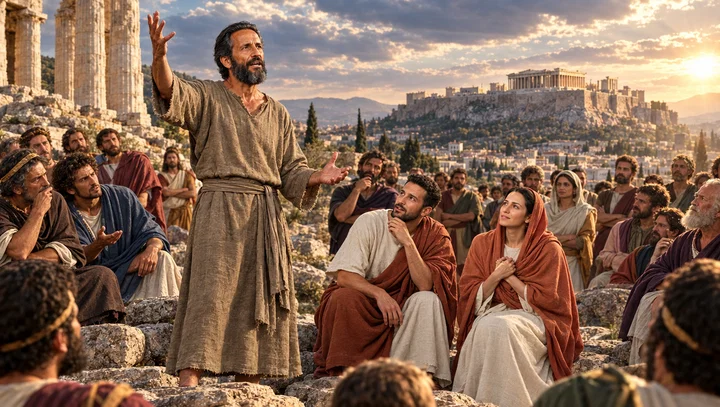
The request in the verse was made after Paul was brought to Mars Hill, also called Areopagus, to be given a fair hearing without interruption.Ms 142, 1897, par. 3–8SLP 92.3–93.1AA 236.2–38RED 56.1–2 Mars Hill was one of the most sacred spots in Athens, regarded with superstitious awe and reverence amounting in some to dread, a place of solemn religious and judicial importance where courts decided criminal cases and difficult religious questions and men acted as final judges on important moral and civil questions.SLP 92.3–93.1AA 236.2–38RED 56.1–2 It stood in the highest place on the Athenian coast, with an open-air platform and rock seats for judges reached by stone steps, near temples, sanctuaries, architecture, sculpture and statuary.AA 236.2–38RED 56.1–2 It was away from crowded streets, public thoroughfares and the tumult of promiscuous discussion where the frivolous and thoughtless class would not follow, so that Paul could be heard there without interruption.AA 236.2–38RED 56.1–2
Those who spoke the words were the Epicurean and Stoic philosophers, the great and learned men of Athens, its scholars and sages, poets and artists, a people devoted to art and idols who spent their time in nothing else but telling or hearing some new thing.Ms 142, 1897, par. 3–8AA 236.2–3AA 235.2–236.1SLP 304.1–2 They had heard Paul in the marketplace preaching Jesus and the resurrection as doctrines new and unfamiliar, sounding like strange gods and a new teaching, and they asked what those things meant and to hear more and have the new doctrine explained.Ms 142, 1897, par. 3–8SLP 92.3–93.1AA 236.2–3ST Sep 22, 19148RED 56.1–2 At first they jeered him as a babbler far beneath them socially and intellectually and as a setter forth of strange gods.AA 235.2–236.1 They warned him of the fate of Socrates, condemned to death for setting forth strange gods, and counseled him not to endanger his life the same way.AA 235.2–236.1
Yet they saw his store of knowledge was even greater than their own, and his intellectual power, earnest logical reasoning and oratory commanded the respect of the learned and held the attention of all.AA 235.2–236.1 Finding him determined at all hazards to accomplish his errand and tell his story and meeting his opposers undaunted on their own ground with logic, philosophy and eloquence, they won respect and admiration for him and decided to give him a fair hearing to know what his strange things meant.AA 235.2–236.1 Paul's standing there to answer showed he was no novice but able to meet every class from men of renown to heathen idolaters.Ms 142, 1897, par. 3–8 He met eloquence with eloquence, logic with logic and oratory with oratory, answering proud philosophy with knowledge, eloquence, natural religion, science, logic and philosophy.Ms 142, 1897, par. 3–8ST Sep 22, 1914RH Dec 21, 1911AA 235.2–236.19MR 69.3
He set before them evidences that Christianity was not of human invention but came from God, with light from heaven that no power on earth could quench, stamped by divinity and of heavenly origin.Ms 142, 1897, par. 3–8 His teaching was accompanied by signs and miracles giving clear evidence of its divine character, and his words astonished and silenced his hearers.ST Sep 22, 1914RH Dec 21, 1911 Despite this, few accepted the gospel, and the effort was judged a failure bearing little fruit.ST Sep 22, 19149MR 69.38RED 60.1–61.1
The experience led Paul afterward at Corinth to present the gospel in plain, simple terms centered on Christ and his mission and on salvation through Christ and him crucified, rather than worldly wisdom, eloquence and display.SLP 120.1–29MR 69.38RED 60.1–61.1 Human wisdom and display have no place, and the short lifetime leaves time for nothing else but Christ crucified.9MR 69.3 The words and circumstances of his preaching at Athens were preserved as a witness to his courage and to Christianity's advance in the heart of paganism.8RED 59.1
Sources
Pioneers and periodicals
39 sources
The philosophers brought Paul to the Areopagus because his preaching of Jesus and the resurrection sounded unfamiliar and strange to their ears, and they wanted to know what it meant, after the manner of Athenians who spent their time in telling or hearing some new thing.ST Jan 27, 1898ST Jan 27, 1898ST Sep 20, 1883 He was then alone in Athens, addressing a curious and Christless crowd in a city wholly given to idolatry and full of representations of false gods, with no follower of Christ present.ST Jul 8, 1897RH Dec 10, 1861ST Apr 19, 1877ST Dec 3, 1896 Their questioning came not from real desire for truth but from mere idle curiosity, though such curiosity at hearing unfamiliar truth should awaken interest and lead to spirited investigation by those tired of their priests and desiring something better.RH Aug 28, 1900ST Jan 27, 1898RH Jun 7, 1864ST Oct 25, 1877 Paul met them carefully from their altar to the unknown God, declaring the true God as He who made the world and all things therein and distinguishing Him from the multitude of false gods by His creative power, which the Sabbath memorializes as the Creator's sign.RH Sep 10, 1872ST Dec 3, 1896ST Sep 20, 1883 His public defense met proud philosophy with knowledge, eloquence, logic and power, with signs giving clear evidence of its divine character, and the Word took possession of hearts so that idols fell, yet few accepted the gospel while others mocked.ST Sep 22, 1914ST Feb 14, 1884RH Dec 21, 1911RH Oct 16, 1860ST Dec 12, 1916 That mockery rejected the biblical promise of resurrection as unreasonable and unphilosophical, in contrast with the Platonic claim of the immortality of the soul, showing that human wisdom could not discover or accept the resurrection apart from gospel light.RH Mar 13, 1879ST Nov 13, 1879RH Dec 16, 1858ST Nov 13, 1893RH Nov 15, 1864
Paul's Setting in Athens
The saying belongs to Paul's first preaching of the gospel in Athens, about A.D. 52, when he was alone there.ST Jul 8, 1897 His attendants had returned to Berea, and he addressed a curious, Christless crowd in a city wholly given to idolatry, with not one follower of Christ present to hear.ST Apr 19, 1877
Epicurean and Stoic philosophers and others brought Paul to the Areopagus to ask about his new doctrine.ST Jan 27, 1898 They asked because his preaching of Jesus and the resurrection sounded as strange things to their ears, after they had first dismissed him as a babbler and a setter forth of strange gods, and they wanted to know what these things mean.ST Jan 27, 1898 Their asking belonged to the Athenian habit that all the Athenians and strangers there spent their time in nothing else but either to tell or to hear some new thing.ST Jan 27, 1898
The saying stands in Acts 17, which records Paul's places of labor, what he did in each place, and where the interest was best.ST Jun 9, 1898 Paul's sermon at Athens is that chapter's most prominent event.ST Jun 9, 1898 There he found the people surrounded by representations of false gods and worshiping many gods in a city full of idols.RH Dec 10, 1861ST Dec 3, 1896 He spoke to the people in the marketplace, and their altar to the Unknown God showed uncertainty about whether they had found the true God.RH Dec 10, 1861ST Dec 3, 1896ST Dec 12, 1916
The account in Acts 17:22-24 is simply a record of facts of Paul's visit and labors there and has no form of a precept whatever.ST Apr 19, 1877 It therefore does not re-affirm the second precept of the decalogue for the Christian church.ST Apr 19, 1877 His speech at Mars' Hill came a full twenty years after the death of Christ, so if the decalogue had been abrogated at the cross and the second precept re-affirmed here, all men were released from the second commandment for twenty years.ST Apr 19, 1877
The saying is also connected with Paul's early labors in Thessalonica, the Macedonian city at the head of the Thermaic Gulf.ST Oct 24, 1911 Thessalonica was a free city governed by seven politarchs, rebuilt by Cassander in 315 B.C. and renamed after his wife the sister of Alexander the Great, from 146 B.C. the seat of Roman government in Macedonia, and after Corinth the second commercial city of the European Greeks.ST Oct 24, 1911 There he preached in the synagogue on three Sabbaths and laid the foundation of the Thessalonian church, with no hint that he taught a new Sabbath day.RH Nov 21, 1871
The Greek verb rendered bringest is eiphero, meaning to carry inward or bring.ST Apr 12, 1905 That sense illustrates the translation of the same word as bring or lead into in the Lord's Prayer. This usage supports rendering the related expression as bring into, not leave in.ST Apr 12, 1905
The Athenians' Curious Request
Acts 17:20 gives the reason the philosophers gave for questioning Paul about his new doctrine, that the teaching he brought to them sounded unfamiliar and strange to their ears and they asked him to explain what it meant.ST May 21, 1885ST May 21, 1885ST Jan 27, 1898ST Sep 20, 1883 After they had dismissed him as a proclaimer of strange gods, he approached them carefully, using their altar to an unknown God as a starting point so he could tell them about the true God and preach Jesus and the resurrection.ST Sep 20, 1883RH Dec 16, 1858 In that setting he adapted his message to his audience, reasoning from the altar inscription and the Creator's attributes toward the need for repentance, the future judgment, Jesus, and the resurrection. His message therefore sounded strange to the Athenian scholars because they had been shaped by human wisdom, and their request provides the setting for preaching Jesus and the resurrection to such hearers.ST May 21, 1885RH Dec 16, 1858
Their asking did not come from a real interest to know the truth but from mere idle curiosity, describing hearers who were idle and curious.ST Jan 27, 1898ST Oct 25, 1877 Their wanting to know what these things mean shows seekers asking to be taught, as the more enlightened among them were tired of their priests and desired something better, having raised an altar to the unknown God. The verse illustrates that people may find God's truth unfamiliar when they have not learned what Scripture teaches, and hearing it should awaken an interest in understanding it.RH Aug 28, 1900 That curiosity in hearing the message can lead to a spirited investigation, as the Epicureans and Stoics who regarded Paul's teaching as strange asked to learn what it meant and the Athenians came to hear out of curiosity.RH Aug 28, 1900RH Jun 7, 1864
Paul's Preaching and Method
After being dismissed as a proclaimer of strange gods, Paul approached his Athenian hearers with care, taking their altar to an unknown God as his starting point from which to tell them about the true God and to preach Jesus and the resurrection.ST Sep 20, 1883 In that setting he adapted his message to his audience, reasoning from the altar inscription and from the Creator's attributes forward to the need for repentance, to the coming judgment, and to Jesus and the resurrection.
At Athens he distinguished the true God from the multitude of false gods by the fact and work of creation, declaring Him as the God that made the world and all things therein.RH Sep 10, 1872ST Dec 3, 1896 He taught them the true God's creative power and the worship acceptable to Him, for power to create and the work of creation are the distinguishing characteristics of the true God.RH Sep 10, 1872ST Dec 3, 1896 That same creative work is memorialized by the Sabbath as the Creator's sign.RH Sep 10, 1872
His public defense of the Christian faith before the Greek sages met proud philosophy with knowledge and eloquence, with logic, science, and philosophy, so as to silence its arguments and proclaim Christ with power.ST Sep 22, 1914ST Feb 14, 1884RH Dec 21, 1911 His teaching was accompanied by signs and miracles giving clear evidence of its divine character.RH Dec 21, 1911 Although his words astonished and silenced his hearers, few accepted the gospel.ST Sep 22, 1914 His preaching of Christ alone, of Jesus and the resurrection, to people shaped by human wisdom met mockery and opposition from the philosophers and rationalizers.RH Dec 16, 1858ST Nov 13, 1893RH Nov 15, 1864 Some mocked the resurrection while others wished to hear him again, showing that human philosophy could not discover or accept the resurrection apart from gospel light.RH Nov 15, 1864
His words exposed their gods as idols, and the Word took possession of hearts so that idols fell without his using force.ST Dec 12, 1916ST Mar 20, 1907 The gospel's power in Athens was thus shown in scoffers becoming penitent believers.RH Oct 16, 1860ST Dec 12, 1916ST Mar 20, 1907 Their inquiry shows that honest questions can be heard and reasons for the gospel given, while Christianity is still presented as the only true religion that must be believed for salvation and whose rejection brings loss.RH Mar 5, 1857 The account shows Paul in the minority while earnestly presenting biblical truth, illustrating that being opposed by the majority does not make a person sectarian.ST Dec 6, 1883
Doctrines the Verse Supports
The verse belongs to the apostles' teaching against idolatry, and that teaching either rests on the continuing authority of God's second commandment or treats idolatry as newly forbidden after that commandment was abolished.RH Aug 5, 1852 The philosophers heard the promise of a resurrection and future life as strange and asked to learn its meaning, rejecting it as unreasonable and unphilosophical.RH Mar 13, 1879ST Nov 13, 1879RH Nov 15, 1864 That rejection sets the Christian hope of future life, on which Christians rested, against the Platonic claim that the soul is immortal and that future life comes through the immortality of the soul.RH Mar 13, 1879ST Nov 13, 1879 Some mocked the idea of resurrection while others wanted to hear more, showing that human philosophy could not discover or accept the resurrection apart from gospel light.RH Mar 13, 1879ST Nov 13, 1879RH Nov 15, 1864
The desire to understand unfamiliar things applies to asking what the evidence about the Sabbath and the weekly cycle means.ST Mar 27, 1893
Application to Gospel Work
The unfamiliar teaching Paul proclaimed at Athens, which prompted the question what it meant, is the message still needed in Martinique, to declare to those who worship ignorantly the true God.ST Aug 13, 1902 That same Athenian setting serves as a reminder of the need for Christ's power when the message is shared where few profess Christianity, as in British West Africa.RH Nov 9, 1905 It also answers the idolatrous setting encountered in China, where Paul found a city full of idols.
The Athenians raised an altar to the unknown God because the more enlightened among them were tired of their priests and desired something better, and their wanting to know what these things mean shows seekers asking to be taught. That same condition exists in Peru, where many are tired of Romish oppression and desire something better, and they cannot find God unless those who know Him go to tell them what kind of being He is. Likewise those who heard truth in earlier years in Uruguay are again inquiring about its meaning.RH Apr 1, 1915
Paul's preaching at Athens alongside his preaching at Lystra shows the gospel was carried to people regardless of culture or degree of cultivation.ST Sep 10, 1896 At Athens the gospel confronted philosophy, and its power is shown in scoffers becoming penitent believers.RH Oct 16, 1860 There his message was met with controversy and sophistry and few received it, reflecting hearers reacting to unfamiliar teaching with a request to learn what it meant.RH Feb 9, 1905
Paul spoke at Athens to people who were idle and curious and saw no apparent result, yet faithful preaching is still worthwhile when hearers show only curiosity with no visible response.ST Oct 25, 1877 The preacher's duty is to sow the word, not to produce or claim the harvest.ST Oct 25, 1877 What Paul saw at Athens stirred his spirit, and such stirring rightly produces earnest, excited speech.RH Jun 9, 1874 A minister who sees men and women perishing should cry out and be ashamed before God and man if he does not, even when called singular or excited by men, because faithfulness in the judgment of God matters more than calmness in the judgment of men while the church sleeps.RH Jun 9, 1874
The charge of bringing unfamiliar teachings to ears is now made almost en masse by professors of religion when truths about the near approach of Christ as taught in the word of God are presented to them.RH Dec 1, 1859 That accusation against preachers of the Second Advent virtually charges the Saviour Himself with giving an unmeaning message when He declared that disciples might know when their redemption draweth nigh.RH Dec 1, 1859
Sources