Acts 17:21
( For all the Athenians and strangers which were there spent their time in nothing else, but either to tell, or to hear some new thing.)
Translations
American King James Version, KJV Cambridge Paragraph Bible
(For all the Athenians and strangers which were there spent their time in nothing else, but either to tell, or to hear some new thing.)
( For all the Athenians and strangers which were there spent their time in nothing else, but either to tell, or to hear some new thing.)
(For all the Athenians and strangers who were there, spent their time in nothing else, but either to tell, or to hear some new thing.)
Revised Version, American Standard Version
( Now all the Athenians and the strangers sojourning there spent their time in nothing else, but either to tell or to hear some new thing.)
and all Athenians, and the strangers sojourning, for nothing else were at leisure but to say something, and to hear some newer thing.
Now all [ the] Athenians and the strangers sojourning there spent their time in nothing else than to tell and to hear the news.
Now, all Athenians and the sojourning foreigners, unto nothing else, were devoting their leisure, than to be telling or hearing, something newer.
Berean Standard Bible, Majority Standard Bible
Now all the Athenians and foreigners who lived there spent their time doing nothing more than hearing and articulating new ideas.
Now all the Athenians and the strangers living there spent their time in nothing else, but either to tell or to hear some new thing.
( Now all the Athenians and the men from other lands who come there were giving all their time to talking or hearing of anything new.)
For all the Athenians, and strangers which dwelt there, gaue them selues to nothing els, but either to tell, or to heare some newes.
Douay-Rheims (Challoner revision)
( Now all the Athenians, and strangers that were there, employed themselves in nothing else, but either in telling or in hearing some new thing.)
Pictures
Cross-references
- Acts 17:15-16
And they that conducted Paul brought him unto Athens: and receiving a commandment unto Silas and Timotheus for to come to him with all speed, they departed.
Paul arrives in Athens and waits there alone.
- 1 Thessalonians 3:1-6
Wherefore when we could no longer forbear, we thought it good to be left at Athens alone;
Paul sent Timothy from Athens and later received news from him.
- Acts 17:34
Howbeit certain men clave unto him, and believed: among the which was Dionysius the Areopagite, and a woman named Damaris, and others with them.
Some Athenian hearers believed and joined Paul.
- Acts 17:16
Now while Paul waited for them at Athens, his spirit was stirred in him, when he saw the city wholly given to idolatry.
Athens described as wholly given to idolatry.
- Acts 18
After these things Paul departed from Athens, and came to Corinth;
Paul’s work in Athens and Corinth shows God at work and the word triumphing.
Commentary
Each commentary is drawn from primary sources: the writings of Ellen G. White and Adventist pioneers and periodicals. Each commentary is separate. Its own words are not a quotation; follow the references to read the source passages.
Ellen G. White
13 sources
The Athenians and the strangers visiting there spent their time in nothing else but telling or hearing some new thing, in a city that was the very heart of paganism, given to idolatry and frivolous art-worship.Ms 142, 1897, par. 3–88RED 59.1AA 235.2–236.1SLP 304.1–21T 332.1 Their hunger for novelty led the great men and Epicurean and Stoic philosophers to seek Paul out in the marketplace and bring him to Areopagus, or Mars' Hill, to ask what his new doctrine of Jesus and the resurrection meant.Ms 142, 1897, par. 3–8AA 235.2–236.1 He met his curious audience with superior knowledge, earnest logical reasoning, philosophy, science and power of oratory, which commanded the respect of the learned, held the attention of all, and astonished and silenced proud philosophy, yet few accepted the gospel.Ms 142, 1897, par. 3–8ST Sep 22, 1914RH Dec 21, 1911AA 235.2–236.1 The labor was not wholly in vain, for several became converts and joined themselves to him, but Paul was disappointed with the result and judged that this display of learning and eloquence had produced little fruit, so at Corinth he set aside worldly wisdom and preached the plain truth of Christ and Him crucified.8RED 59.1SLP 120.1–29MR 69.38RED 60.1–61.1 The same love of novelty and excitement still draws mixed crowds to see and hear what is new, including those who come to camp meetings out of mere curiosity, yet hearing the message of truth can lead them to listen with candid interest.2SP 295.1GC 396.16T 70.3
Paul's Setting in Athens
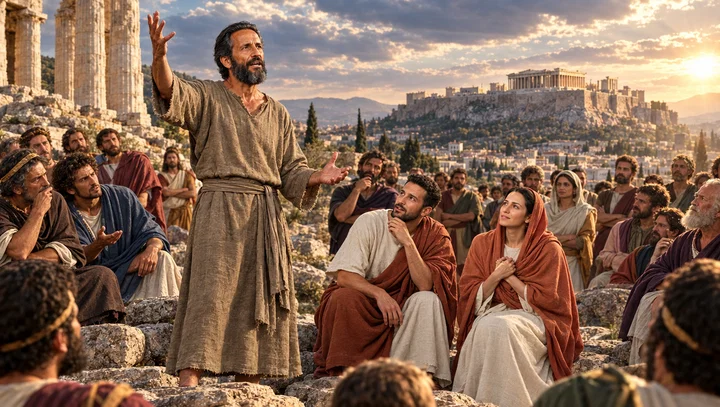
The verse means that the Athenians and the strangers visiting there spent their time in nothing else but telling or hearing some new thing.Ms 142, 1897, par. 3–8AA 235.2–236.11T 332.18RED 60.1–61.1GC 396.1 It describes Athenians and visitors as spending time seeking or sharing something new.6T 70.3 Athens was the very heart of paganism.8RED 59.1 Its people were frivolous art-worshipers.SLP 304.1–2
The new and strange doctrine the novelty-hungry crowd wanted to hear was Paul's preaching of Jesus and the resurrection.Ms 142, 1897, par. 3–8AA 235.2–236.1 Some jeered at it as babbling and others charged it as setting forth strange gods.AA 235.2–236.1 That charge arose because he preached Jesus and the resurrection as a setter forth of strange gods.Ms 142, 1897, par. 3–8
That love of novelty and hunger for novelty brought the great men, the Epicurean and Stoic philosophers, and a crowd of listeners to seek Paul out in the marketplace when they learned a singular teacher was setting forth doctrines new and strange.Ms 142, 1897, par. 3–8AA 235.2–236.1 They took him to Areopagus, or Mars' Hill, to ask what his new doctrine was and what his strange things meant.Ms 142, 1897, par. 3–8AA 235.2–236.1 His undaunted determination to tell his story at all hazards, even when warned of the fate of Socrates for setting forth strange gods, led them to decide to give him a fair hearing.AA 235.2–236.1
Paul's Preaching and Outcome
Paul labored in Athens in loneliness and adversity with unshaken confidence and courage.8RED 59.1 He met that curious audience on Mars' Hill, showing he was no novice but able to meet every class of people from men of renown to heathen idolaters.Ms 142, 1897, par. 3–8 He proclaimed Christ there and set before them evidences of Christianity which were not of human invention but came from God and could not be quenched by any power on earth.Ms 142, 1897, par. 3–8
He met his hearers with a greater store of knowledge, earnest logical reasoning, science, and power of oratory, meeting logic with logic, philosophy with philosophy, and eloquence with eloquence.Ms 142, 1897, par. 3–8ST Sep 22, 1914AA 235.2–236.1 He had adapted his teaching to this audience, engaging in discussions of natural religion, science, logic, and philosophy, and displaying his ability, learning, and smartness.9MR 69.38RED 60.1–61.1 His reasoning commanded the respect of the learned and held the attention of all, and his hearers were astonished and silenced and the arguments of proud philosophy were silenced, yet few accepted the gospel.ST Sep 22, 1914RH Dec 21, 1911AA 235.2–236.1
That labor was not wholly in vain, for several became converts to Christianity and joined themselves to him.8RED 59.1 Paul was nevertheless disappointed with the result and afterward judged that this approach had produced little fruit and no real effect.SLP 120.1–29MR 69.38RED 60.1–61.1 That experience led him to take a different approach at Corinth, presenting the plain truth about Christ and Him crucified without worldly wisdom or adornment, since the shortness of life leaves no time for anything else.SLP 120.1–29MR 69.3 His words at Athens, and the inspired description of his attitude and surroundings, were recorded to be handed down through all coming generations, bearing witness of his confidence, his courage, and the victory gained for Christianity there.8RED 59.1
Curiosity for Novelty Today
The verse describes those who are moved by wonder and curiosity, or by a love of excitement, to see and hear what is new.2SP 295.1 Such curiosity-seekers formed part of the mixed multitude from all grades of society and many nationalities that crowded around Jesus.2SP 295.1 They were distinct from those drawn by an irresistible impulse to hear His words even while only dimly comprehending them.2SP 295.1 In those sincere hearers seeds of life lodged, to spring up afterward and bear fruit.2SP 295.1
That same appetite for novelty marks self-sufficient people who lack faith and experience and are drawn to new teachers.GC 396.1 It also appears in one who is always eager to hear and repeat new things, especially claims about other people's wrongs, which she mistakes for discernment.1T 332.1 Curiosity of this kind draws many to camp meetings to see and hear something new.6T 70.3 Yet hearing the message of truth and meeting those who believe it can lead such visitors to listen with candid interest.6T 70.3
Sources
Pioneers and periodicals
60 sources
Acts 17:21 describes how the Athenians and the strangers staying there spent their time in nothing but telling or hearing some new thing, when the Epicurean and Stoic philosophers heard Paul as a babbler with new teaching and brought him to the Areopagus out of idle curiosity rather than a real desire to know the truth.ST Jan 27, 1898ST Jan 27, 1898RH Apr 7, 1904 Athens was then a center of learning, art and intense intellectual curiosity, yet wholly given to idolatry and ignorant of the true God, so that fearing they had missed a god they raised an altar to the unknown God.RH Dec 10, 1861RH Sep 10, 1872ST Apr 19, 1877ST Sep 20, 1883 Beginning from that inscription Paul declared the true God who made the world and all things therein, preaching creation, repentance, coming judgment, Jesus and the resurrection, which many dismissed as babbling and mocked as unreasonable and unphilosophical.RH Sep 10, 1872ST Nov 13, 1879ST Dec 3, 1896RH Mar 13, 1879 Such eagerness for novelty can draw attention to the message but does not lead to truth, for pride in human achievement and love of what is new rejects God's truth when it comes as something new, and continual appetite for new ideas and fanciful interpretations only increases darkness and leaves people without a firm foundation.ST Mar 27, 1884ST Feb 4, 1889RH Feb 27, 1908 That same Athenian spirit is at work today when professed Christians turn from the Bible to Oriental philosophies, Spiritualism, evolution and other new systems, and the cure is a return to simple Bible faith that holds fast the established truths and detects error instead of chasing something new.ST Aug 14, 1884RH Jul 25, 1912RH Nov 6, 1866RH Dec 16, 1909RH Sep 24, 1901
Athens and Its Curiosity
The verse belongs to the account of Paul's first preaching of the gospel in Athens, understood to have taken place about A.D. 52 when Paul was alone, with Luke at Philippi and Silas and Timothy at Berea and Thessalonica.ST Jul 8, 1897 The seventeenth chapter of Acts records Paul's places of labor and what he did in each place, and its most prominent event is his noted sermon at Athens.ST Jun 9, 1898
All the Athenians and the strangers sojourning there spent their time in nothing else but either to tell or to hear some new thing.ST Jan 27, 1898ST Jan 27, 1898 The Epicurean and Stoic philosophers brought forward new theories and new explanations of things, and hearing Paul as a new man come among them they wanted to hear what he had to say.RH Apr 7, 1904 They called him a babbler and brought him to the Areopagus to learn his new teaching, and their coming out to hear him shows a people stirred by a speaker to hear what he would say.ST Jan 27, 1898RH Jun 7, 1864 That bringing of Paul to the Areopagus to ask about his doctrine was prompted by mere idle curiosity and not by real interest to know the truth.ST Jan 27, 1898ST Jan 27, 1898
Athens was a center of learning and art where Paul encountered philosophers, and an age of intense intellectual curiosity in which Athenians and visitors spent their time telling or hearing new ideas.ST Sep 20, 1883ST Oct 7, 1913 Its people were famed for intelligence and education, yet their culture centered on art, science, and amusements without giving them an intelligent knowledge of God.ST May 21, 1885 They are described as inquisitive and philosophic men, Epicureans and Stoics and the crowd, whom Paul met on Mars Hill and in the marketplace.ST Mar 20, 1907RH Mar 5, 1857 There he preached the same gospel as to other peoples, beginning from an altar inscription and leading his argument from the Creator and human origins to repentance, future judgment, Jesus, and the resurrection.RH Mar 5, 1857
The city was wholly given to idolatry, a curious, Christless crowd with not one follower of Christ present, Paul being alone after his attendants had returned to Berea.ST Apr 19, 1877 Its people were surrounded by representations of false gods and were ignorant of the true God, to whom Paul preached about creative power and the worship acceptable to Him.ST Dec 3, 1896 They worshiped many gods, including the Unknown God worshiped in ignorance, whom Paul distinguished from false gods by His power and work of creation as the God that made the world and all things therein.RH Sep 10, 1872 Fearing they had missed the true one, they set up an altar to the unknown God, thereby acknowledging that the Ruler of the universe was unknown to them, since reason and inward religious feeling did not tell them how to worship rightly.ST May 21, 1885RH Dec 10, 1861
Paul's Message and Reception
Paul took the altar to the unknown god as his starting point and set the true God apart from the false gods around Him by His power and work in making the world and all things in it.RH Sep 10, 1872ST Dec 3, 1896 In that setting before Epicureans, Stoics and the crowd on Mars Hill he proclaimed the Creator, traced human origins from Him, taught the worship acceptable to Him, and pressed his argument forward to repentance, coming judgment, Jesus and the resurrection.ST Dec 3, 1896 He met their reasoning with logic, science and philosophy, and by knowledge and eloquence stood before the sages of Greece and silenced the arguments of proud philosophy, leaving his hearers astonished and silenced.ST Sep 22, 1914ST Feb 14, 1884RH Dec 21, 1911
The gospel advanced there by preaching and not by force, for the word reached hearts and idols fell without his laying hands on them, since he openly declared their gods to be idols.ST Mar 20, 1907ST Dec 12, 1916 He preached the same gospel to them as to other peoples, listening patiently to honest questions and giving reasons for his faith without treating Christianity as one belief among equally valid alternatives.RH Mar 5, 1857 Its power turned some scoffers into penitent believers, yet few accepted the gospel, because controversy and clever argument had displaced the search for truth.ST Sep 22, 1914RH Oct 16, 1860RH Feb 9, 1905
Their love of telling and hearing some new thing helped draw attention to him, but it did not mean they would welcome his message.ST Mar 27, 1884 Faith in the unseen held little appeal to people attached to impressive works of art and outward attractions, and pride in human achievement with ambition to rival the world's intellectual or material appeal obstructs salvation, so that accepting God's wisdom can require becoming a fool in the eyes of others.ST Mar 27, 1884 Though they loved novelty they rejected the gospel because to them it was a new doctrine, counting the resurrection of the dead absurd, which exposes human fickleness that chases what is new while rejecting God's truth when it comes as something new.
His message of truth met a culture absorbed in novelty and was dismissed as childish babbling.RH Mar 10, 1910 The philosophers mocked the Christian hope of the resurrection as unreasonable and unphilosophical because they disregarded Scripture and paid no regard to the Bible's teaching.ST Nov 13, 1879RH Mar 13, 1879 Though the message drew attention as a novelty they mocked it and wanted to hear him again, showing the limits of human philosophy and intellect, which cannot grasp God's purpose of resurrection revealed through the gospel and demonstrated in Christ's resurrection.RH Nov 15, 1864 The duty there was to preach Jesus and the resurrection and declare the glory of the cross without softening God's messages to suit prejudice, and because he exalted Christ alone rather than placing Him alongside the Greek gods, his refusal to accommodate other faiths brought mockery and opposition.RH Dec 16, 1858ST Nov 13, 1893
The Mars Hill speech was given a full twenty years after the death of Christ to a curious, Christless crowd in a city wholly given to idolatry, with not one follower of Christ present, Paul being alone after his attendants had returned to Berea.ST Apr 19, 1877 It was simply a record of facts in his visit and labors in Athens, having no form of a precept whatever.ST Apr 19, 1877 It gives not the least shadow of proof that he there re-affirmed the second precept of the Decalogue for the Christian church.ST Apr 19, 1877
He was therefore in the minority as he addressed people whose attention was drawn to novelty.ST Dec 6, 1883 Those Athenians and visitors are described as idle and curious, spending their time in telling or hearing something new.RH Feb 7, 1871ST Oct 25, 1877 He preached faithfully to them even when there was no apparent result, which illustrates that a minister's duty is to sow the word and not to measure success by immediate harvest.RH Feb 7, 1871ST Oct 25, 1877
Doctrinal Lessons from Athens
The Athenians' uncertainty proves that reason and inward religious feeling cannot teach men how to worship rightly, for they worshiped many gods and, fearing they had missed the true one, raised an altar to the unknown God, which shows the need for revelation from God.RH Dec 10, 1861 Those who raise such an altar cannot find Him unless those who know Him go to tell them what kind of being He is, as with the more enlightened people in Peru who are tired of the Romish priests and desire something better. The same need belonged to the setting of Paul's message to Athens, where the Athenians and visiting foreigners were eager to tell or hear anything new, a message needed also among people engaged in idolatrous worship at Martinique.ST Aug 13, 1902
Their love of novelty belonged to speculation in darkness, for the Epicurean and Stoic philosophers brought forward new theories and new explanations of things and, hearing Paul as a babbler and a new man come among them, wanted to hear what he had to say from that spirit.RH Apr 7, 1904 That spirit agreed in perversion of the relation of God to His created works by shutting out Christ the Son from His place as head of the original creation, and therefore from His place as head of the church.RH Apr 7, 1904 The verse means love of novelty, search after strange and unheard-of theories, where speculation takes the place of sober common sense, philosophy and vain deceit after the rudiments of the world and not after Christ.RH Jul 15, 1875
It describes modern scientists who devise wild and extravagant notions about the final destiny of the physical universe, that the sun will burn out into cold and darkness and chaos, the molten earth will be shattered into whirling death, energy will dissipate into darkness silence and death, cleared forests will bring perpetual drought and universal starvation, and injurious insects will devour man, with many palpable contradictions.RH Jul 15, 1875 Such novelty-seeking forgets that the universe is controlled by an all-wise Creator by whom are all things and who upholds all things by the word of His power, whose plan is infinitely above finite man.RH Jul 15, 1875 It belongs to the impassable gulf by which human philosophy has always opposed the word and promises of God.RH Jul 15, 1875 Their novelty-seeking does not lead them to truth; instead new ideas increase their darkness and draw them farther from true wisdom, and a continual appetite for novelty and fanciful interpretations can leave people confused, unable to give a clear message, and without a firm foundation.ST Feb 4, 1889RH Feb 27, 1908
Modern Spirit of Novelty
The same Athenian spirit of constantly searching out novelty is at work today when professed Christians turn away from the Bible and Bible doctrines to Hindu philosophy and other Oriental philosophies and to American-born systems like Christian Science and Spiritualism.RH Jul 25, 1912 The renewed attention attracted by spiritualism when it presents new or striking phenomena shows the modern age drawn to novelty.ST Aug 14, 1884 This eagerness for new systems reveals sad degeneracy creeping into the so-called Christian church, where human reasoning and idle philosophical speculation are supplanting Christian faith and simplicity.RH Jul 25, 1912
Modern eagerness for supposedly new religious ideas may concern ideas that are old errors dressed in fresh language, new only in appearance.RH Dec 30, 1902 Appetite for new things and sensationalism can displace the enduring truths of salvation.RH Jul 28, 1904 Hunger for something new is one of the principal causes of the many isms and creeds.RH Sep 24, 1901 A spirit full of curiosity and desire for some new thing leaves people open to deception, as by the message that the Seventh-day Adventist Church is Babylon and that all who would be saved must come out of her, which is wrong, off the track, and not given by God, but is one of the satanic delusions designed to create confusion among the churches, with Satan using minds to which he can gain access to originate false theories and go off on a wrong tangent to create a false excitement and divert souls from the true issue for this time.RH Mar 16, 1916
The verse is applied to people absorbed in novelty, including those who repeatedly set dates for Christ's coming and advance vague prophetic theories.ST Oct 13, 1881 It is applied also to professed Christians continually forming new societies.ST Aug 25, 1887 It is applied to people absorbed in discussing the latest claims and theories in science and theology.RH Mar 4, 1909 In a sensational age even remarkable things quickly lose their interest as people turn to the next new thing.RH Jul 6, 1868 It is applied to pleasure-seekers who move from one amusement to another, where seeking a new or higher form of pleasure does not change the self-serving purpose and pleasure pursued as an end remains condemned.ST Oct 1, 1885
Such novelty-seekers seized the scientific hypothesis of evolution and made it a master key to unlock the mysteries of mind and spirit as well as those of matter. The church hastened to follow them and profess agreement to appear up-to-date and not old-fashioned, selling itself for a mess of pottage. Ministers cater to that appetite with intellectual, political, or lifeless preaching while avoiding solemn Bible teachings about death, judgment, and Christ's return, valuing novel ideas over enduring Scripture.RH Nov 6, 1866 This raises the question whether God's people have become more eager for novelty than for the established truths of Scripture.RH Dec 16, 1909
The verse illustrates the human appetite for novelty, an interest that can also turn toward new discoveries about one's own heart.ST Aug 5, 1875 Its phrase has been used to suggest that the Greeks who asked to see Jesus may have been motivated by curiosity or a desire for novelty, though their purpose is not known.ST Oct 17, 1895 That curiosity about novelty is distinct from an earnest desire to know Jesus and the truths He taught.ST Dec 21, 1915 Calling a man who died and was found and buried in a cemetery to rest until the general resurrection translated is such a new thing that would have interested the Athenians.ST Aug 28, 1901
Faithfulness Amid Novelty Seeking
The Athenian habit of always hunting for something new is still at work when professed Christians turn from the Bible and Bible doctrines to other philosophies and new religious systems, and human reasoning and idle speculation displace Christian faith and simplicity.RH Jul 25, 1912 The cure is a return to simple Bible faith and practice.RH Jul 25, 1912 Believers must not let desire for something new move them away from foundational truths, but must present the established message.RH Feb 19, 1901 Instead of chasing new things they must study deeply the principles of the old landmarks until they are so familiar with the Bible and the Testimonies that they instantly detect error even if it were declared by a supposed angel.RH Sep 24, 1901
Truths called familiar are often known only on the surface, yet they contain precious gems that diligent study aided by the Spirit of God discovers.RH Sep 24, 1901 When allowed to mold the life from childhood they never become old but stay ever fresh and welcome.RH Sep 24, 1901 Hunger for something new is one of the principal causes of the many isms and creeds.RH Sep 24, 1901 Seeking novelty rather than following established paths is the lesson of the Athenians and visitors who spent their time telling or hearing about new things.CO 10.1–3RH Feb 19, 1901
The desire to hear and see new things becomes a danger when carried into religion, for it distracts from worshiping God, weakens stability, and diminishes earnest spiritual life.ST Nov 25, 1880 Novelty cannot give life to a dead soul, which needs God's word and the witness of the Holy Spirit.ST Mar 23, 1888 Their interest in novelty helped draw attention to Paul, yet it did not mean they would welcome his message.ST Mar 27, 1884 Faith in what cannot be seen held little appeal to people attached to impressive works of art and outward attractions, and pride in human achievements and ambition to rival the world's intellectual or material appeal obstruct salvation, so that accepting God's wisdom can require becoming a fool in the eyes of others.ST Mar 27, 1884
Paul's preaching at Athens, named alongside his preaching at Lystra, shows that he preached to people of different backgrounds.ST Sep 10, 1896 Their eagerness for novelty was the setting in which he preached in Athens.RH Jun 18, 1872 That love of something new and prevailing desire to hear some new thing can still bring large audiences of candid and intelligent people night after night even when interest might be expected to subside.RH Jun 2, 1874 Those who come at first out of curiosity can have their attention arrested and become deeply interested when every point is proved from the Bible.RH Jun 2, 1874
What Paul saw at Athens stirs a minister's spirit to excited speech, showing that excitement in preaching against evil is right and nothing to be ashamed of before God and man.RH Jun 9, 1874 The sights at Athens that moved him are less stirring than the public houses of Glasgow where men and women perish in whisky-shop pitfalls.RH Jun 9, 1874 When victims overwhelm and church and world sleep hugging each other, a minister weary with holding back must cry out.RH Jun 9, 1874 He must choose faithfulness in God's judgment over being counted acceptable in men's judgment.RH Jun 9, 1874
Sources