Acts 17:19
And they took him, and brought him unto Areopagus, saying, May we know what this new doctrine, whereof thou speakest, is?
Translations
And they took him, and brought him to Areopagus, saying, May we know what this new doctrine, whereof you speak, is?
King James Version, KJV Cambridge Paragraph Bible
And they took him, and brought him unto Areopagus, saying, May we know what this new doctrine, whereof thou speakest, is?
And they took him, and brought him to Areopagus, saying, May we know what this new doctrine is, of which thou speakest?
Revised Version, American Standard Version
And they took hold of him, and brought him unto the Areopagus, saying, May we know what this new teaching is, which is spoken by thee?
having also taken him, unto the Areopagus they brought [him], saying, 'Are we able to know what [is] this new teaching that is spoken by thee,
And having taken hold on him they brought [ him] to Areopagus, saying, Might we know what this new doctrine which is spoken by thee [ is]?
And so, laying hold of him, they brought him up, to the Hill of Mars, saying—Can we get to know what this new teaching is, which, by thee, is being spoken.
Berean Standard Bible, Majority Standard Bible
So they took Paul and brought him to the Areopagus, where they asked him, “ May we know what this new teaching is that you are presenting?
They took hold of him and brought him to the Areopagus, saying, “ May we know what this new teaching is, which you are speaking about?
And they took him to Mars' Hill, saying, Will you make clear to us what is this new teaching of yours?
And they tooke him, and brought him into Mars streete, saying, May we not know, what this newe doctrine, whereof thou speakest, is?
Douay-Rheims (Challoner revision)
And taking him, they brought him to the Areopagus, saying: May we know what this new doctrine is, which thou speakest of?
Pictures
Cross-references
- Acts 17:32
And when they heard of the resurrection of the dead, some mocked: and others said, We will hear thee again of this matter.
Athenians mock Paul’s teaching about the resurrection, while others believe.
- Acts 17:28
For in him we live, and move, and have our being; as certain also of your own poets have said, For we are also his offspring.
same Athens address; quoted phrase
- Acts 17:34
Howbeit certain men clave unto him, and believed: among the which was Dionysius the Areopagite, and a woman named Damaris, and others with them.
several believed and joined Paul
- Acts 17:23
For as I passed by, and beheld your devotions, I found an altar with this inscription, TO THE UNKNOWN GOD. Whom therefore ye ignorantly worship, him declare I unto you.
The altar to the unknown God illustrates Athens’ uncertainty about whom to worship.
- 1 Thessalonians 3:1-7
Wherefore when we could no longer forbear, we thought it good to be left at Athens alone;
Paul's account of sending Timothy from Athens helps explain the sequence of events.
Commentary
Each commentary is drawn from primary sources: the writings of Ellen G. White and Adventist pioneers and periodicals. Each commentary is separate. Its own words are not a quotation; follow the references to read the source passages.
Ellen G. White
13 sources
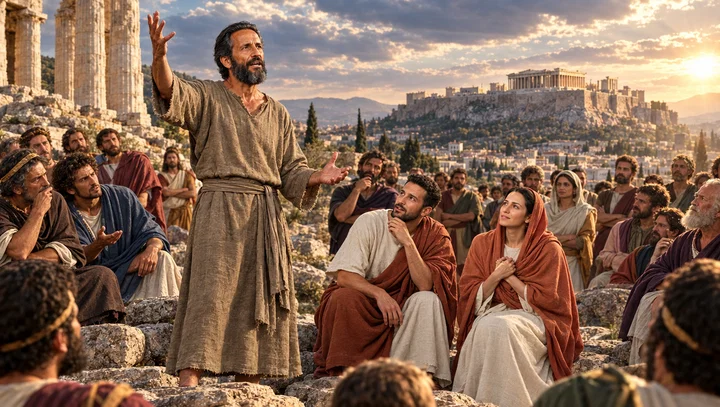
In Athens Paul was seized in the marketplace by Epicurean and Stoic philosophers with city leaders and a curious crowd who mocked him as a babbler and accused him of proclaiming foreign gods because he preached Jesus and the resurrection, and they led him away from its noise to the Areopagus, the sacred open-air court on Mars' Hill revered above all places for judging crimes and religious questions.Ms 142, 1897, par. 3–8SLP 92.3–93.1AA 236.2–3AA 235.2–236.1SLP 304.1–2 They brought him there for a formal uninterrupted hearing because Athenians and strangers spent their time seeking some new thing, and poets, scholars and sages demanded to know the meaning of this strange new teaching.Ms 142, 1897, par. 3–8SLP 92.3–93.1AA 236.2–38RED 56.1–2AA 235.2–236.1 Standing alone under mortal risk like that which condemned Socrates, he met them on their own ground with greater knowledge, meeting logic with logic and philosophy with philosophy, and with unshaken courage proclaimed Christ and salvation as truth from God that no earthly power could quench.Ms 142, 1897, par. 3–8RH Dec 21, 19118RED 59.1AA 235.2–236.19MR 69.3 His witness astonished the wisest so they could not refute him, yet few believed and several joined him, so the harvest was small and disappointing and led him afterward to lay aside learned argument for preaching Jesus Christ and Him crucified in the Spirit's power.ST Sep 22, 19148RED 59.1SLP 120.1–2AA 235.2–236.19MR 69.3 To be told new doctrine lays hearers under judgment according to the light given, so honest minds must receive the word readily and search the Scriptures daily, comparing text with text, with angels beside them to enlighten them, while curiosity alone, prejudice and refusal to investigate leave the mind blinded by error.AA 231.1–232.2
Encounter at Areopagus
Those brought to Mars' Hill were Epicurean and Stoic philosophers together with Athenian leaders and a crowd who had met Paul in the marketplace, where some dismissed him as a babbler and others accused him of setting forth strange gods because he preached Jesus and the resurrection.Ms 142, 1897, par. 3–8AA 235.2–236.1 This took place in Athens, a city given to art and the worship of idols.Ms 142, 1897, par. 3–8SLP 304.1–2 Athenians and visiting strangers spent their time in telling or hearing some new thing, and so poets, artists, philosophers, scholars and sages gathered to ask what this strange new doctrine he spoke meant.Ms 142, 1897, par. 3–8SLP 92.3–93.1AA 236.2–3
Areopagus, or Mars' Hill, was one of the most sacred and revered spots in all Athens, regarded with superstitious reverence that in some amounted to dread, standing in the very heart of paganism.AA 236.2–38RED 56.1–28RED 59.1 There a solemn court acted as final judges on criminal cases and difficult religious questions, and on the more important moral as well as civil questions.SLP 92.3–93.1AA 236.2–38RED 56.1–2 It was the highest spot on the Athenian coast, with an open-air platform with seats for judges hewn from solid rock and reached by stone steps.8RED 56.1–2 The temple of the gods and their sanctuaries lay a little distance below, made magnificent by massive architecture, sculpture and statuary.8RED 56.1–2
He was led there away from the noise and bustle of crowded thoroughfares and the tumult of promiscuous discussion to a formal hearing where he could set forth his teaching.AA 236.2–38RED 56.1–2AA 235.2–236.1 The frivolous thoughtless class would not follow there, so that learned men could hear him explain without interruption.AA 236.2–38RED 56.1–2 The charge of setting forth strange gods carried mortal risk, for Socrates had been condemned to death on that charge.AA 235.2–236.1
Paul's Bold Witness
His stand on Mars' Hill showed he was no novice, but one able to meet every class from men of renown to heathen idolaters.Ms 142, 1897, par. 3–8 He proved to have knowledge greater than their own, commanding the respect of the learned by intellectual power, earnest logical reasoning and oratory.AA 235.2–236.1 As God's ambassador he proclaimed Christ and salvation with persuasive knowledge, eloquence and ability.RH Dec 21, 1911 He met his hearers on their own ground, answering logic with logic, philosophy with philosophy, science with reasoned argument, and eloquence with eloquence.ST Sep 22, 1914AA 235.2–236.19MR 69.3 Signs and miracles gave evidence of the faith's divine character.RH Dec 21, 1911
He was not silenced by science or irony.AA 235.2–236.1 His unaffected wisdom and determination to tell his story at all hazards persuaded them to give him a fair hearing.AA 235.2–236.1 His address met their logic, science and philosophy with reasoned argument, so that the wisest listeners were astonished and could not refute him.ST Sep 22, 1914 He stood in loneliness and adversity with unshaken confidence and courage, publicly challenging proud philosophy with the gospel.RH Dec 21, 19118RED 59.1 His attitude, surroundings, words and the victory gained for Christianity there were to be handed down through all coming generations as a witness.8RED 59.1
The evidences he set before them were not of human invention.Ms 142, 1897, par. 3–8 His religion came from God, and coming from God no power on earth could quench the light from heaven.Ms 142, 1897, par. 3–8 Divinity puts its stamp upon Christianity as of heavenly origin.Ms 142, 1897, par. 3–8 His labor was not wholly in vain, for several became converts and joined themselves to him.8RED 59.1 Yet few accepted the gospel, and the overall effect was barren and disappointing to him.ST Sep 22, 1914SLP 120.1–29MR 69.3
The experience led him to change his approach at Corinth.SLP 120.1–28RED 60.1–61.1 There he no longer brought learning and eloquence to bear in philosophical discussion and elaborate arguments.SLP 120.1–28RED 60.1–61.1 He resolved to know nothing but Jesus Christ and Him crucified, focusing on salvation through Christ.9MR 69.38RED 60.1–61.1 He trusted the Spirit's power rather than human wisdom, since a short lifetime leaves time for nothing else.9MR 69.38RED 60.1–61.1
Searching New Teaching
To be told a new teaching from God places the hearer under solemn responsibility, for judgment will follow the light that has been given and each one must answer for how the spoken words were treated.AA 231.1–232.2 The question put to Paul about his new doctrine therefore marks not idle curiosity but a moment of accountability, where hearing creates obligation.AA 231.1–232.2
Those who honestly desire to do right receive such a word with readiness of mind and then test it by diligent daily searching of the Scriptures, comparing scripture with scripture to learn whether these things are so, with special attention to what is written concerning the promised Messiah.AA 231.1–232.2 Heavenly angels stand beside such sincere investigators to enlighten their minds and impress their hearts as they search.AA 231.1–232.2
That same kind of diligent investigation is required in the closing scenes of earth's history in proving testing truths and unpopular Bible doctrines, and it leads those who persist to loyalty to the precepts of God's law.AA 231.1–232.2 By contrast, narrowed prejudice, studying from mere curiosity, refusal to examine the evidences, the assumption that new light does not matter, and clinging to pleasing fables allow error to blind the mind and separate the soul from heaven.AA 231.1–232.2
Sources
Pioneers and periodicals
38 sources
Paul was taken to the Areopagus, or Mars' Hill, in Athens and asked to explain the new teaching he had been speaking about.ST Jul 8, 1897ST Nov 13, 1879RH Jul 13, 1869 Those who brought him were Epicurean and Stoic philosophers who had heard him preaching Jesus and the resurrection, and they acted more from idle curiosity for some new thing than from real desire to know the truth.ST Jan 27, 1898ST Jan 27, 1898ST Oct 25, 1877 Athens was the famed center of learning and art, yet it was full of idols, and its people worshiped without knowing the true God, as their altar to the Unknown God showed.ST May 21, 1885RH Sep 10, 1872RH Dec 10, 1861ST Dec 3, 1896ST Sep 20, 1883 His bringing there led to his noted sermon in which, beginning from their altar, he declared the Unknown God as the God who made the world and all things therein, argued against idolatry, urged repentance in view of coming judgment, and set forth Jesus and the resurrection.ST Jun 9, 1898RH Sep 10, 1872ST Dec 3, 1896ST Sep 20, 1883 The episode is a pattern for declaring God to those who worship without knowing Him, by tactfully using their own questions as a starting point while exalting Christ alone and refusing to treat the gospel as one opinion among others.ST Aug 13, 1902RH Nov 9, 1905ST Sep 20, 1883RH Mar 5, 1857
Place and Setting
Paul was taken to the Areopagus, or Mars' Hill, in Athens and asked to explain the new doctrine he had been speaking about.ST Jul 8, 1897ST Nov 13, 1879RH Jul 13, 1869ST Feb 3, 1898ST Jul 22, 1908 This was the first preaching of the gospel in Athens, around A.D. 52, when Paul was alone.ST Jul 8, 1897ST Feb 3, 1898ST Jul 22, 1908 The Athenians brought him before the Areopagus to hear the teaching he was proclaiming as something new, in scenes that recall Athens and its history.ST Nov 13, 1879RH Jul 13, 1869ST Feb 3, 1898ST Jul 22, 1908 In that encounter the philosophers mocked the hope of the resurrection as unreasonable and unphilosophical, in keeping with the ancient philosophers' views about immortality and the resurrection.ST Nov 13, 1879RH Jul 13, 1869
He had been left alone after his attendants returned to Berea, and he spoke at Mars' Hill to a curious, idolatrous crowd with no followers of Christ present.ST Jul 8, 1897ST Apr 19, 1877 His visit met a city full of idols, where he spoke about his faith. His speech at the Areopagus belongs among the events of his stay in Athens before he later left for Corinth.ST Sep 27, 1883 Mars' Hill was a sacred place associated with the Athenian court and religious questions, which gave him an attentive audience of the poets, artists and philosophers of Athens away from the bustle and distractions of the marketplace.ST May 21, 1885
The Athens experience is part of the continuous account in Acts 17-20 of Paul at Thessalonica, at Berea, at Athens, at Corinth, at Ephesus, at Troas, and his farewell talk to the elders of Ephesus.ST Jul 7, 1909 In all these places God wrought wonderfully and the word of God triumphed in every case notwithstanding all persecutions.ST Jul 7, 1909 By this work Gentiles came into the church at Athens as also at Antioch, at Corinth, and at Rome.ST Jun 16, 1898 The wider background includes the early labors in Thessalonica, the Macedonian city at the head of the Thermaic Gulf.ST Oct 24, 1911 In Paul's day Thessalonica was a free city governed by seven politarchs, rebuilt by Cassander in 315 B.C. and renamed after his wife the sister of Alexander the Great, from 146 B.C. the seat of the Roman government in Macedonia, and after Corinth the second commercial city of the European Greeks.ST Oct 24, 1911
Athenian Hearers and Motive
The men who laid hold of Paul and brought him to the Areopagus were Epicurean and Stoic philosophers who had heard him preaching Jesus and the resurrection.ST Jan 27, 1898 They dismissed him as a babbler and a setter forth of strange gods, yet asked to be told what this new doctrine he spoke was.ST Jan 27, 1898 Athens was the Greek center of learning, famed for intelligence, education, art and science.ST May 21, 1885ST Dec 3, 1896 The city was full of idols and representations of many false gods, and its people were zealous for their gods and could react dangerously to challenges to their worship.RH Sep 10, 1872ST Dec 3, 1896ST Sep 20, 1883
With devotional feelings and human reason alone they could not direct their worship without revelation.RH Dec 10, 1861 Though surrounded by pagan deities and devoted to art and amusements, they remained ignorant of the true God and his plans and were not connected with him.ST May 21, 1885ST Dec 3, 1896 Their altar inscribed To the Unknown God showed they were still unsure they had found the true God.RH Dec 10, 1861ST Dec 3, 1896 Even their learned people thereby acknowledged that the Ruler of the universe was unknown to them.ST May 21, 1885
They brought him to learn his new doctrine not from real interest to know the truth but from idle curiosity.ST Jan 27, 1898ST Jan 27, 1898 The Athenians and the strangers there spent their time only in telling or hearing some new thing and wanting to know what his strange things mean.ST Jan 27, 1898 He therefore spoke to people described as idle and curious without apparent results, showing that the faithful minister's duty is to sow the word and not to secure or display immediate results, for the outcome belongs to God.ST Oct 25, 1877
Message Paul Proclaimed
The bringing to the Areopagus to hear the new doctrine leads directly to the noted sermon at Athens, which is the most prominent event in the chapter.ST Jun 9, 1898 That sermon teaches that in God men live and move and have their being, declares judgment and the resurrection, and shows the burden of Paul's preaching.ST Jun 9, 1898 In a city zealous for its gods and quick to react dangerously to any challenge to its worship, he introduced his message tactfully by taking their altar to an unknown god as his starting point.ST Sep 20, 1883 To those ignorant worshipers he declared the Unknown God whom they worshiped without knowing Him to be the God that made the world and all things therein.RH Sep 10, 1872ST Sep 20, 1883 He used God's power to create and the work of creation as the distinguishing mark of the true God, thereby teaching His creative power and the worship acceptable to Him.RH Sep 10, 1872ST Dec 3, 1896
Before the Areopagus he adapted his address to Epicureans, Stoics, and other listeners. He began from the altar inscription, argued against idolatry from the Creator's attributes, and spoke of humanity's unity under the common Father. From nature and providence he moved to God's grace, urging repentance in view of future judgment and presenting Jesus and the resurrection.
There he had opportunity to place Christ alongside the Greek gods, but instead he exalted Christ alone.ST Nov 13, 1893 He declared that the city's gods were idols, and his refusal to honor their idolatrous beliefs brought mockery and opposition.ST Mar 20, 1907ST Nov 13, 1893 His words, not force or physical destruction, brought the change, for the gospel worked on hearts so that idols fell without his touching them.ST Mar 20, 1907ST Dec 12, 1916 The setting thus illustrates that faith is voluntary and that the word rather than coercion changes hearts.ST Mar 20, 1907
Doctrine Defended or Denied
Acts 17:16-31 stands with the other apostolic teachings against idolatry as proof that the apostles upheld the second commandment, which continued in force and was not abolished and replaced by a new apostolic rule.RH Aug 5, 1852 Those who held the opposite teaching held that Paul's address at Mars' Hill, delivered when he had been left alone after his attendants returned to Berea to a curious and idolatrous crowd with no followers of Christ present, was not a re-affirmation of the second commandment for the Christian church.ST Apr 19, 1877
At Athens Paul was confronted with the worship of a multitude of false gods, including the Unknown God worshiped in ignorance, and he declared that Unknown God to them as the God that made the world and all things therein.RH Sep 10, 1872 He used God's power to create and the work of creation as the distinguishing mark of the true God, the same truth of which the creation Sabbath is the sign and memorial.RH Sep 10, 1872 The same record belongs to his work in Thessalonica, where he spoke in the Jewish synagogue on three Sabbaths and laid the foundation of the Thessalonian church with no hint that the Sabbath had been changed to a new day.RH Nov 21, 1871
The bringing of Paul before the Areopagus and the asking him to explain the new teaching he was preaching belongs to the philosophers' response to his message about the resurrection.ST Nov 13, 1879RH Jul 13, 1869RH Nov 15, 1864 The philosophers at Athens mocked his teaching about the resurrection of the dead as unreasonable and unphilosophical because they did not accept the Bible as authority.RH Mar 13, 1879ST Nov 13, 1879 Their mockery belongs with the ancient philosophers' views about immortality and the resurrection.RH Mar 13, 1879RH Jul 13, 1869 It shows that human learning could not reveal the resurrection, which the gospel makes known.RH Nov 15, 1864
Pattern for Mission Work
The bringing to the Areopagus to explain the new teaching is a model for declaring God to people who worship without knowing him, as needed among the people of St. Pierre.ST Aug 13, 1902 It parallels preaching in Freetown, where many religions are present and few profess Christianity, illustrating the challenge of bringing a new religious message to a population unfamiliar with it.RH Nov 9, 1905 It also pictures enlightened people in Peru who are tired of oppression by Vatican agents and Romish priests and desire something better, reaching like the Athenians with their altar toward the unknown God.
Those in such fields cannot find Him unless those who know Him go to them and tell them what kind of being He is. Missionary effort in such a field requires Christ's power, His abiding Spirit, and love for people who are perishing.RH Nov 9, 1905 In Athens, where people were zealous for their gods and could react dangerously to challenges to their worship, the message was introduced tactfully, using their altar to an unknown god as a starting point for declaring the God they worshiped without knowing Him.ST Sep 20, 1883 Among the inquisitive, philosophic Athenians there was listening to honest questions and giving reasons for the faith, while refusing to treat the gospel as one opinion among equally valid alternatives, since it is the only true religion that people must believe to be saved and rejecting it means being lost.RH Mar 5, 1857 There was opportunity to place Christ alongside the Greek gods but instead Christ alone was exalted, and refusal to honor idolatrous beliefs brought mockery and opposition.ST Nov 13, 1893
Before the sages of Greece the faith of Christ was proclaimed with knowledge, eloquence and courage, silencing the arguments of proud philosophy.ST Feb 14, 1884RH Dec 21, 1911 The address met their logic, science and philosophy with reasoned argument that the wisest listeners were astonished at and could not refute, yet few accepted the gospel.ST Sep 22, 1914 Public preaching was also accompanied by signs and miracles that gave clear evidence of the faith's divine character.ST Feb 14, 1884RH Dec 21, 1911 Being in the minority while proclaiming truths opposed by many did not make the preacher sectarian, because he was earnestly advocating truth rather than seeking personal honor or followers.ST Dec 6, 1883 Preaching at Athens alongside preaching at Lystra shows that God's concern and gospel work extend to people regardless of their level of cultivation.ST Sep 10, 1896
The setting where people were idle and curious without apparent results illustrates that a faithful minister's duty is to sow the word, not to secure or display immediate results, for the outcome belongs to God.ST Oct 25, 1877 The ingathering of Gentiles at Athens as also at Antioch, Corinth and Rome requires increased effort and skill from the home church to care for a growing church and to give direction in grave and important matters pertaining to the kingdom of God, requiring even apostolic gifts and skill.ST Jun 16, 1898 Experience amid controversy and sophistry where few received the message explains the need for the prayers of fellow believers in seeking souls.RH Feb 9, 1905 The same work belongs now to those entrusted with the ministry of reconciliation: to preach Jesus and the resurrection to men sunk in sensuality and to declare the cross to worshipers of human wisdom, planting the feet firmly on the testimony of the church and every truth of revelation without softening God's warnings to suit prejudice or fear of tumult, but withstanding the people and with pleading, prayer and love winning them back to allegiance to Christ.RH Dec 16, 1858
What was seen in the city stirred the spirit, showing that excitement in a minister when confronting evil is right and is faithfulness in God's judgment rather than shame.RH Jun 9, 1874 The public houses and whisky-shops of Glasgow give more to stir a minister's spirit than all that was seen at Athens, because in them men and women are seen perishing in pitfalls in overwhelming numbers.RH Jun 9, 1874 To cry out for total abstinence while the church and the world sleep is therefore duty even if counted singular in the judgment of men.RH Jun 9, 1874
Sources