Acts 17:22
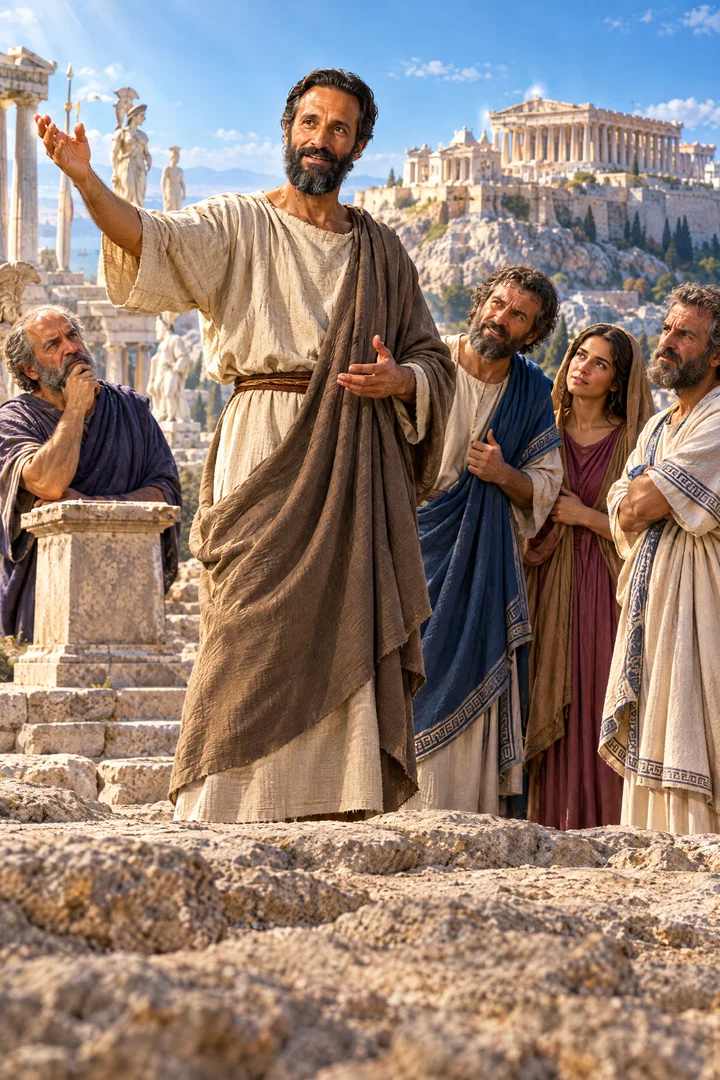
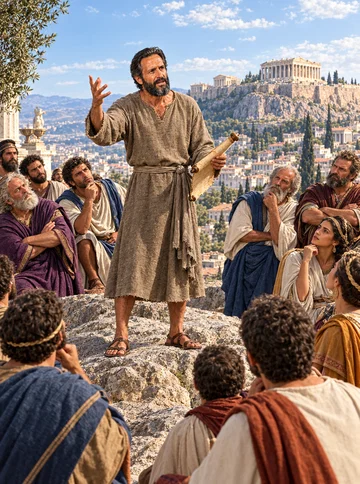
Then Paul stood in the midst of Mars’ hill, and said, Ye men of Athens, I perceive that in all things ye are too superstitious.
Translations
Then Paul stood in the middle of Mars’ hill, and said, You men of Athens, I perceive that in all things you are too superstitious.
King James Version, KJV Cambridge Paragraph Bible
Then Paul stood in the midst of Mars’ hill, and said, Ye men of Athens, I perceive that in all things ye are too superstitious.
Then Paul stood in the midst of Mars-hill, and said, Ye men of Athens, I perceive that in all things ye are too superstitious.
And Paul stood in the midst of the Areopagus, and said, Ye men of Athens, in all things I perceive that ye are somewhat superstitious.
And Paul stood in the midst of the Areopagus, and said,Ye men of Athens, in all things I perceive that ye are very religious.
And Paul, having stood in the midst of the Areopagus, said, 'Men, Athenians, in all things I perceive you as over-religious;
And Paul standing in the midst of Areopagus said, Athenians, in every way I see you given up to demon worship;
And Paul taking his stand in the midst of the Hill of Mars, said—Ye men of Athens! In every way, how unusually reverent of the demons ye are, I perceive.
Berean Standard Bible, Majority Standard Bible
Then Paul stood up in the meeting of the Areopagus and said, “ Men of Athens, I see that in every way you are very religious.
Paul stood in the middle of the Areopagus and said, “ You men of Athens, I perceive that you are very religious in all things.
And Paul got to his feet on Mars' Hill and said, O men of Athens, I see that you are overmuch given to fear of the gods.
Then Paul stoode in the mids of Mars streete, and sayde, Yee men of Athens, I perceiue that in all things yee are too superstitious.
Douay-Rheims (Challoner revision)
But Paul standing in the midst of the Areopagus, said: Ye men of Athens, I perceive that in all things you are too superstitious.
Pictures
Cross-references
- Acts 17:28
For in him we live, and move, and have our being; as certain also of your own poets have said, For we are also his offspring.
Paul says all people are God’s offspring and that in him they live and move.
- Acts 17:18
Then certain philosophers of the Epicureans, and of the Stoicks, encountered him. And some said, What will this babbler say? other some, He seemeth to be a setter forth of strange gods: because he preached unto them Jesus, and the resurrection.
Paul’s preaching of Jesus and the resurrection drew Athenian philosophers’ attention and mockery.
- Acts 17:30-31
And the times of this ignorance God winked at; but now commandeth all men every where to repent:
Paul calls all people to repent and proclaims judgment through the risen Christ.
- Acts 18:4-5
And he reasoned in the synagogue every sabbath, and persuaded the Jews and the Greeks.
Paul’s preaching in Corinth continues his gospel ministry after Athens.
- Acts 17:32
And when they heard of the resurrection of the dead, some mocked: and others said, We will hear thee again of this matter.
Athenians mocked Paul’s teaching about the resurrection.
- Acts 17:16
Now while Paul waited for them at Athens, his spirit was stirred in him, when he saw the city wholly given to idolatry.
Paul’s distress at Athens’s idolatry precedes his speech to the Athenians.
- Acts 17:27
That they should seek the Lord, if haply they might feel after him, and find him, though he be not far from every one of us:
God is near to all people as they seek him.
- Acts 17:29
Forasmuch then as we are the offspring of God, we ought not to think that the Godhead is like unto gold, or silver, or stone, graven by art and man’s device.
God’s divine nature cannot be represented by images made by humans.
- Psalms 96:4-5
For the LORD is great, and greatly to be praised: he is to be feared above all gods.
The Lord who made the heavens is above the nations’ idols.
- Jeremiah 10:11
Thus shall ye say unto them, The gods that have not made the heavens and the earth, even they shall perish from the earth, and from under these heavens.
They contrast the living Creator with false, perishing gods.
- Exodus 20:4-5
Thou shalt not make unto thee any graven image, or any likeness of any thing that is in heaven above, or that is in the earth beneath, or that is in the water under the earth:
Paul points to the command against making and worshipping graven images.
- Acts 17:34
Howbeit certain men clave unto him, and believed: among the which was Dionysius the Areopagite, and a woman named Damaris, and others with them.
Names Athenians converted after Paul’s address.
- Acts 17:14-15
And then immediately the brethren sent away Paul to go as it were to the sea: but Silas and Timotheus abode there still.
shows Paul was left alone
- Acts 7:48-50
Howbeit the most High dwelleth not in temples made with hands; as saith the prophet,
Both texts say God does not dwell in temples made by human hands.
- 1 Thessalonians 3:1-7
Wherefore when we could no longer forbear, we thought it good to be left at Athens alone;
Paul’s account of sending Timothy to Thessalonica aligns with the events in Acts.
Commentary
Each commentary is drawn from primary sources: the writings of Ellen G. White and Adventist pioneers and periodicals. Each commentary is separate. Its own words are not a quotation; follow the references to read the source passages.
Ellen G. White
26 sources
Paul stood on Mars Hill to tell the Athenians that in all things they were deeply devoted to religious worship yet ignorant of the true God.AA 237.1–3SLP 93.2–94.3Ms 71, 1886, par. 7 Despite their intelligence, refinement, art and wisdom, they did not know the Ruler of the universe who created all things, though some longed for greater light.AA 237.1–3SLP 93.2–94.3SLP 91.1 Against that ignorance he declared the God they worshiped without knowing as the living Creator, Lord of heaven and earth, who gives life and breath to all, made all nations of one blood, and commands all to repent because He has appointed a day to judge the world by the Man He raised from the dead.Ms 142, 1897, par. 3–8Ms 40, 1895, par. 2–3RH Mar 17, 1904 He met their idolatry with tact born of divine love, avoiding direct attack and instead drawing their minds from idols to the true God.AA 240.2–241.18RED 59.2ST Jul 20, 1904 His argument silenced the philosophers yet won few converts, showing that the highest education and eloquence cannot convict and convert sinners without power from the Spirit.ST Sep 22, 1914RH Dec 21, 1911Ms 114, 1898, par. 17–19SLP 120.1–29MR 69.3
Setting on Mars Hill
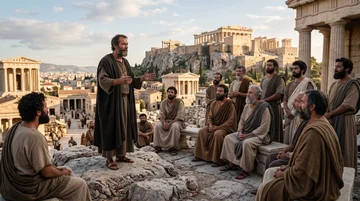
The opening line stands in the midst of Mars Hill, the highest place on the Athenian coast, regarded with superstitious awe and reverence as the place where courts of justice decided criminal cases and difficult religious questions.8RED 56.1–2 It was an open-air platform with seats for judges hewn out of solid rock and reached by stone steps, with the temple of the gods and their sanctuaries a little below amid massive architecture, sculpture and statuary of great magnificence.8RED 56.1–2
Paul was conducted there by Epicurean and Stoic philosophers to declare his doctrine to the learned men of Athens who asked what his new teaching of Jesus and the resurrection meant.Ms 142, 1897, par. 3–88RED 56.1–2 His hearers were philosophers at the Areopagus who spent their time in telling or hearing some new thing.Ms 142, 1897, par. 3–8ST Sep 22, 1914 They brought him away from the public thoroughfares and the tumult of promiscuous discussion so he could be heard without interruption by those who reverenced the place.8RED 56.1–2
He stood there in an hour of solemn responsibility, calm and self-possessed with his heart burdened by an important message.AA 237.1–3 His words convinced his hearers that he was no idle babbler.AA 237.1–3 The address proves he was no novice, but able to meet every class of people from men of renown to heathen idolaters.Ms 142, 1897, par. 3–8
Too Superstitious Explained
Paul's charge that the Athenians were too superstitious meant they were deeply devoted to religious worship yet ignorant of the true God, worshiping without knowing what they worshiped, and the same description still fits formal worship that does not know its object.AA 237.1–3SLP 93.2–94.3Ms 71, 1886, par. 7 With all their intelligence and general knowledge they did not know the God who created the universe, and their many devotions and altar to the Unknown God revealed both ignorance and a longing in some for greater light and a reaching out toward the Infinite.AA 237.1–3SLP 93.2–94.3SLP 91.1 Their wisdom and cultural achievements did not give them knowledge of the Ruler of the universe.AA 237.1–3SLP 91.1
A lifetime of searching for God by reason and logical argument leaves people ignorant, confused, and superstitious, and true knowledge of God is found only in the Bible.Ms 40, 1895, par. 2–3 Fallen man in his own inefficiency, depending on human wisdom, surely fails to read nature correctly because sin has obscured his vision.Ms 86, 1898, par. 9–10RH Mar 17, 1904 Of himself he cannot interpret nature without placing it above God, and cannot discern in nature God or Jesus Christ whom God has sent.Ms 86, 1898, par. 9–10RH Mar 17, 1904 The Athenians were in that position, erecting their altars for the worship of nature for a god they did not know, upon which might well be inscribed To the unknown god.Ms 86, 1898, par. 9–10RH Mar 17, 1904
Paul exposed the fallacies of their religion and its emptiness, for it lacked knowledge of the true God and could not overcome human evil or unite people with God.AA 237.1–3SLP 91.1 With hand outstretched toward the temple crowded with idols, pointing to their statuary and works of art, he showed that God could not be likened to forms of man's devising and that graven images cannot in the faintest sense represent the glory of Jehovah.AA 237.1–3 Images of gold or silver or stone graven by art have no life but are controlled by human power and move only when the hands of men move them, so that those who worship them are in every way superior to that which they worship.Ms 142, 1897, par. 3–8AA 237.1–3
Against that ignorance he declared to them the God they worshiped without knowing, presenting before them the majesty of the living God in contrast with their idolatrous worship.Ms 142, 1897, par. 3–8RH Mar 17, 1904SLP 93.2–94.3 He proclaimed Him as the God who made the world and all things in it, Lord of heaven and earth, who dwells not in temples made with hands.Ms 142, 1897, par. 3–8Ms 40, 1895, par. 2–3 He is independent of man, needing nothing from human hands to add to His power and glory, but giving to all life and breath and all things.Ms 142, 1897, par. 3–8AA 237.1–3 He made of one blood all nations of men, determined their times and bounds of habitation that they should seek the Lord, in whom we live and move and have being.Ms 142, 1897, par. 3–8 He now commands all men everywhere to repent because He has appointed a day to judge the world in righteousness by the ordained man whom He raised from the dead.Ms 142, 1897, par. 3–8
Paul's Method and Results
Paul met paganism with tact born of divine love, refusing a direct attack on Athenian gods and great men that would have irritated proud listeners and exposed him to the fate of Socrates.AA 240.2–241.18RED 59.2ST Jul 20, 1904 He took up their ignorant worship as his starting point and carefully drew their minds away from heathen deities to the true God whom they did not know.AA 240.2–241.18RED 59.2ST Jul 20, 1904 His work on Gentile ground, preaching to Gentiles in their own place before their own temple and in the very presence of their gods just as he preached to Jews in their own place of worship, shows that mission work must come near to people.Lt 17, 1900, par. 3–4Ms 87, 1907, par. 4 It must not erect barriers by constantly thrusting upon people that they are wrong, but must present Christ the Truth and the Light in a way that develops truth rather than destroys, until it is seen that salvation is for all nations, tongues, and peoples.Lt 17, 1900, par. 3–4
He met false philosophy with true philosophy and eloquence with eloquence, meeting science with science, logic with logic, oratory with oratory, and philosophy with philosophy in discussion of natural religion.ST Sep 22, 1914Ms 114, 1898, par. 17–199MR 69.3ST Jul 20, 19048RED 60.1–61.1 By knowledge, persuasive reasoning, and intellectual acquirements in his customary oratorical style he astonished and silenced the sages and philosophers of Greece with arguments that could not be refuted.ST Sep 22, 1914RH Dec 21, 1911Ms 114, 1898, par. 17–19AA 462.1–2MH 213.5–214.2 Signs and miracles gave unmistakable evidence of the divine character of the faith he proclaimed with winning power.AA 462.1–2 Yet winning the argument brought little fruit, for his reasoning from logic, science, and philosophy led few to accept the gospel.ST Sep 22, 1914Ms 114, 1898, par. 17–19MH 213.5–214.28RED 60.1–61.1
The labor in Athens was not wholly in vain, for Dionysius, one of the most prominent citizens, and some others believed the gospel message and united themselves fully with the believers.AA 240.2–241.18RED 59.1 That ingathering was a victory for Christianity gained in the very heart of paganism.AA 240.2–241.18RED 59.1 The disappointment showed that even the highest education and skill in speech cannot reach the highest standard or convict and convert sinners without power from a higher source, the Spirit of God sanctifying every intellectual development.Ms 114, 1898, par. 17–19 Human wisdom and oratory alone accomplish nothing, and with a short lifetime there is time for nothing else but preaching Christ crucified.9MR 69.3
Paul was disappointed with the results at Athens, where his learning, eloquence, ability, theories, and elaborate arguments produced little fruit, so he changed his plan of labor on going to Corinth.SLP 120.1–29MR 69.38RED 67.1–28RED 60.1–61.1 There he preached with plainness in unadorned terms, avoiding worldly wisdom and urging the doctrine of salvation through Christ and Him crucified and His mission.SLP 120.1–29MR 69.38RED 67.1–28RED 60.1–61.1 His Mars Hill address set forth evidences of Christianity not of human invention, showing his religion came from God with divinity putting its stamp upon it as of heavenly origin, and that no power on earth could quench the light from heaven.Ms 142, 1897, par. 3–8 His words together with the description of his attitude and surroundings are handed down to all coming generations as a treasure of knowledge for the church, bearing witness of his unshaken confidence and his courage in loneliness and adversity.Ms 142, 1897, par. 3–8AA 240.2–241.18RED 59.1
He was the same faithful servant before the court of the Areopagus as later in imprisonment expecting sentence from Nero, his character not depending on favorable circumstances.4T 448.1GW92 140.1 A heart steadfast in God holds to what is unseen and eternal and remains true in both hopeful and discouraging circumstances through hardship.4T 448.1GW92 140.1
Sources
Pioneers and periodicals
97 sources
Paul stood in the midst of Mars' Hill about A.D. 52 and opened his first preaching of the gospel in Athens to its learned philosophers, Epicureans and Stoics, in a city wholly given to idolatry.ST Jul 8, 1897ST Jul 8, 1897 His opening words that in all things they were too superstitious mean that they were very religious and greatly devoted to the worship of the gods, a true and courteous recognition that opened the way for what followed.ST Jan 21, 1903ST Jan 21, 1903RH Dec 28, 1916ST Sep 20, 1883RH Jul 6, 1868 He did not attack their institutions by force but took their altar to the Unknown God, whom they worshiped without knowing, as his opening to proclaim the God of heaven who made the world and all things therein and gives life and breath to all.ST Dec 20, 1905ST Mar 27, 1884RH May 5, 1904RH Sep 10, 1872ST Jul 8, 1897 That Creator is distinguished from powerless idols by his power to create, and the seventh-day Sabbath is his standing memorial and sign whereby the true God is known, in contrast to idol gods and to Sunday as a counterfeit rest day without Scripture warrant.RH Sep 10, 1872RH Apr 10, 1916RH Jul 1, 1873 He called them to repent and worship the true God because God has appointed a day in which he will judge the world in righteousness through Jesus Christ, whom he raised from the dead, a resurrection the philosophers mocked as unreasonable.ST Jul 13, 1882ST Nov 23, 1904ST Nov 13, 1879RH Mar 13, 1879ST Mar 31, 1887
Paul's Setting in Athens
The verse opens Paul's first preaching of the gospel in Athens, about A.D. 52, when he stood in the midst of Mars' Hill, the Areopagus, and addressed the men of Athens.ST Jul 8, 1897ST Jul 8, 1897ST Jul 3, 1893ST Jan 27, 1898 He was alone at the time, with Luke remaining at Philippi and Silas and Timothy at Berea and Thessalonica.ST Jul 8, 1897 He spoke to a curious, Christless crowd in a city wholly given to idolatry, with no follower of Christ present.ST Apr 19, 1877
He had been brought and summoned before the Athenian council to explain his teaching and be judged whether he had disturbed the state religion by introducing new gods.ST Jan 27, 1898ST Jan 21, 1903ST Jan 21, 1903 The Areopagus was the open-air summit platform where about one hundred persons could stand, with benches cut from rock in concentric circles.ST Jan 21, 1903 It was death for a private person to disturb the state religion in this way.ST Jan 21, 1903
His hearers were the learned philosophers of Athens, including Epicureans and Stoics who spent their time in telling or hearing some new thing.ST Jul 8, 1897RH Apr 7, 1904RH Oct 16, 1860RH Feb 27, 1908 They are described as idle and curious, in a highly educated and polished city said to worship thirty thousand gods.ST Nov 14, 1878 Nearby temples and altars and the waters of Piraeus were in view, and their many gods had the support of philosophers, statesmen, orators, and government.ST Nov 14, 1878
His opening rests on what he had observed passing through the city, its many objects of worship and an altar dedicated to an unknown god.ST Jan 27, 1898ST Jul 3, 1893ST Jan 27, 1898ST Jul 8, 1897RH Sep 11, 1860 He uses this to begin his argument explaining the true God and how He is acceptably worshiped, and to make known the God they worshiped without knowing.ST Jan 27, 1898ST Jan 27, 1898 The Athenians had honored every known deity and even allowed for a god they did not know, for fear of neglecting any power or missing its blessings.ST Jul 8, 1897 By appealing to that inscription he could explain the true God without appearing to introduce a foreign deity forbidden by law.ST Jul 8, 1897
He spoke calmly and boldly, meeting the sages of Greece with knowledge, eloquence, and fervent power that silenced proud philosophy.ST Feb 14, 1884RH Dec 21, 1911RH Jan 22, 1857 His circumstances were unlike speeches composed to win praise, prizes, fame, or display.RH Feb 17, 1863 His aim was to instruct people, help them become better, and glorify God, proclaiming the faith of Christ with his hand lifted above the Acropolis.ST Feb 14, 1884RH Jun 21, 1864 Scenes in the city still recalled his address.RH Jun 21, 1864
Wording About Religion
The phrase too superstitious in the King James Version is also rendered somewhat superstitious and very religious, and it means very religious or greatly devoted to the worship of the gods.ST Jan 21, 1903ST Jan 21, 1903ST Sep 20, 1883ST Jan 27, 1898 Paul stood in the midst of the Areopagus after being summoned to explain his teaching and be judged whether he had disturbed the state religion by introducing new gods, and he used the observation of their devotion as an opening to teach about the true God.ST Jan 21, 1903ST Jan 21, 1903 He began from their worship of many gods and an altar to an unknown god, using their own religious practice as an opening to speak further about Jesus and the resurrection without bluntly attacking their worship at the outset.ST Sep 20, 1883 The King James wording does not give his meaning to his hearers, for all heathen worship is superstitious yet he was not charging them with superstition here.ST Jan 27, 1898
The rendering very religious better reflects his tact and courtesy, recognizing a quality the Athenians prized and opening with a true statement not calculated to arouse anger or give offense but to naturally open the way for what followed.RH Dec 28, 1916RH Jul 6, 1868ST Jan 27, 1898 His opening recognizes their exceptional piety, for they alone among the Greeks were said to honor an altar of Mercy and to be more pious than other people.RH Dec 28, 1916 With tact born of divine love he took up the ignorant worship of his hearers to point them to Jehovah as the God they did not know, meeting science with science, logic with logic, and philosophy with philosophy.ST Jul 20, 1904
The observation is that in all things they were excessively religious and notably devoted, as shown by their many religious devotions, objects of worship, and many gods including one designated the unknown god.ST May 21, 1885ST Apr 26, 1905ST Jul 3, 1893RH Dec 10, 1861 Their many objects of worship showed that their devotional feelings did not tell them how to direct their worship, and their many devotions revealed that they did not know the true God though their souls craved greater light.ST May 21, 1885RH Dec 10, 1861 Athens was a highly educated and polished city said to worship thirty thousand gods, with extensive devotion supported by philosophers, statesmen, orators, and government, yet that worship and its temples later disappeared.ST Nov 14, 1878 Devotion shaped by ignorance and cherished error fell short of worshiping the true and living God and cannot replace understanding God's will.ST Jun 24, 1875
In another understanding the words are a plain reproof that they were too superstitious and deeply superstitious and did not worship the true God, refusing to give countenance to heathen error but openly reproving it and directing to the true teaching of Moses and the prophets.ST Dec 7, 1882RH Oct 8, 1872 On this understanding he reproved them for not worshiping the true God who made heaven and earth, which should be the foundation of faith and which the Sabbath shows forth, rather than making a new law against image worship.ST Dec 7, 1882 The description is of excessive fear-driven religion directed toward objects believed to possess spiritual power, as in the proverb that worshiping even a sardine's head by faith can give it power.ST May 22, 1901 The same words aptly describe strong idol faith for worldly purposes with monthly candles, incense, firecrackers, and burned paper treated as sufficient duty without prayerful communion with God or desire for holiness, custom of crossing to the other side of a street to avoid angering the gods, and worship directed to devils.RH Feb 3, 1916RH Jul 31, 1913
While all heathen worship is superstitious, Paul is not charging them with superstition here, and their example shows that a strong appearance of piety does not necessarily mean obedience to God's plain requirements.RH Jun 30, 1903ST Jan 27, 1898 Intensely devoted but superstitious worship shaped by ignorance and cherished error cannot replace understanding God's will.ST Jun 24, 1875 Religious profession can conceal neglect of duty.RH Jun 30, 1903
Tactful Missionary Method
Paul did not attack Athenian institutions or their freedom to worship, but left their altars untouched and compelled no one, because faith is voluntary and the gospel advances by preaching that works upon hearts rather than by force.ST Dec 20, 1905ST Mar 20, 1907ST Dec 12, 1916 He looked upon their altars to false gods without destroying them, then spoke quietly so that hearers themselves recognized their gods as idols and let them fall without coercion.ST Mar 20, 1907ST Dec 12, 1916 He took their altar to the Unknown God, whom they worshiped without knowing Him, as his opening to proclaim the God of heaven and the gospel of Christ, reasoning that this God is superior to their other deities.ST Dec 20, 1905ST Mar 27, 1884ST Jul 8, 1897
He made an altar inscription his starting point for declaring the God they did not know as Creator and Judge of all, so that to neglect the salvation provided through His Son is a fearful condition.ST Dec 20, 1905ST Mar 27, 1884 He addressed learned philosophers at the Areopagus, whether the hill itself or a court meeting elsewhere, noting that the Athenians had honored every known deity and even allowed for a god they did not know, fearing to neglect any power or miss its blessings.ST Sep 22, 1914RH Dec 14, 1916ST Jul 8, 1897 He used that inscription to explain the true God without appearing to introduce a foreign deity forbidden by Athenian law.ST Dec 20, 1905ST Jul 8, 1897
He adapted his teaching to learned hearers familiar with Greek religion and culture in order to introduce them to the true and living God and Jesus Christ.ST Jul 20, 1904RH Dec 14, 1916 He met science with science, logic with logic, and philosophy with philosophy, with tact born of divine love taking up their ignorant worship to point them to Jehovah as the God they did not know.ST Sep 22, 1914ST Jul 20, 1904RH Dec 14, 1916 His learning helped gain a hearing while the Holy Spirit carried the truth to some, and his reasoning from logic, science, and philosophy astonished and silenced his hearers though few accepted the gospel.ST Sep 22, 1914ST Jul 20, 1904RH Dec 14, 1916 He argued against idolatry by pointing to the Creator, the common origin of humanity, and the need for repentance in view of future judgment, then presented Jesus and the resurrection.ST Mar 5, 1894RH Dec 16, 1858 He even used words from a poet they greatly respected, not as proof of his teaching but to reinforce a point already established from a sounder source and make his testimony more persuasive to them.ST Jul 20, 1904RH Dec 14, 1916RH Sep 11, 1860
He recognized what was true in their religious system instead of dismissing it as mere superstition, and used that truth to lead people to accept the gospel with its higher teaching and higher provision for spiritual need.RH Mar 5, 1857ST Mar 30, 1904RH Jul 28, 1910 The same work belongs to Christian teachers among heathen who already give chief and constant worship to the Most High God.ST Mar 30, 1904RH Jul 28, 1910 Yet he did not treat Christ as one god among many nor praise their idolatrous faiths, but exalted Christ alone and proclaimed Christianity as the only true religion to be believed, not merely one opinion among many nor a call to become better practitioners of their own faith.RH Mar 5, 1857ST Nov 13, 1893RH Jul 28, 1910 That uncompromising message holds among people of different backgrounds, and is not the kind of religious brotherliness that avoids calling people to the gospel, even when refusal to compromise brings mockery.RH Mar 5, 1857ST Nov 13, 1893RH Jul 28, 1910 He introduced his message with tact but did not soften or withhold its essential truths, proclaiming the whole counsel of God and explaining the resurrection though hearers mocked it.ST Mar 5, 1894RH Dec 16, 1858 He preached Jesus and the resurrection to philosophers who worshiped the creations of human wisdom, declaring the glory of the cross, standing firm on divine testimony, refusing to soften any warning of God to suit prejudice or avoid tumult, and with love withstanding, pleading, and praying to win souls back to allegiance to Christ.ST Mar 5, 1894RH Dec 16, 1858
His address confronts Epicurean and Stoic philosophers who spent their time in telling or hearing some new thing and who, despite their differences, agreed in perverting God's relation to His created works by shutting out Christ the Son from His place as head of the original creation.RH Apr 7, 1904 The Epicureans held that the universe arose by a fortuitous concurrence of atoms, by chance, and the Stoics held that deity animated every part of the universe as a subtle, active, penetrating fire.RH Apr 7, 1904 He answers both errors by proclaiming the true God, the unknown God to whom they had erected an altar and whom they worshiped in ignorance, revealing Him in His true relation to the universe as the God that made the heaven and the earth.RH Apr 7, 1904 That God is revealed through His works, through the gospel, and through the sacrifices and services of the sanctuary, in whom Christ the eternal Son has the preeminence as the One through whom all things came into being.RH Apr 7, 1904
Unknown God Proclaimed
The many religious devotions at Athens, crowned by an altar to an unknown god, showed that the people did not know the true God, though their souls craved greater light and something better.ST May 21, 1885RH May 5, 1904ST Dec 3, 1896ST Feb 3, 1881 They honored every known deity and even allowed for a god they did not know, fearing to neglect any power or to miss its blessings.ST Jul 8, 1897 The city was filled with the worship of false gods, and the observation about their devotion was addressed to learned philosophers at the Areopagus as the introduction to an appeal from that inscription.ST Dec 3, 1896ST Jul 8, 1897 The God they worshiped without knowing became the opening to proclaim who He is, His creative power, and the worship acceptable to Him.RH May 5, 1904ST Dec 3, 1896ST Feb 3, 1881
He is declared as the God who made the world and all things therein, Creator of all things and Lord of heaven and earth.RH May 5, 1904RH Sep 10, 1872ST Apr 19, 1877RH May 30, 1871 He does not dwell in temples made with hands nor depend on human hands, because He gives life and breath and everything to all.RH May 5, 1904ST Apr 19, 1877 The power to create and the work of creation are set forth as the distinguishing characteristic of the true God in contrast to idols worshiped by the nations, the same truth memorialized by the creation Sabbath as the Creator's sign.RH Sep 10, 1872RH May 30, 1871 This proclamation stands as the New Testament counterpart to the command not to make any graven image or likeness, nor to bow down to them nor serve them.ST Apr 19, 1877
Fallen man depending on human wisdom fails to read nature correctly because sin has obscured his vision, so of himself he places nature above God and cannot discern in nature God or Christ whom God sent.RH Mar 17, 1904 The Athenians were in that position, erecting their altars for the worship of nature.RH Mar 17, 1904 Their religion centered largely on worship of art and on amusements and festivals, and despite pride in wisdom, wealth, and skill they lacked an intelligent understanding of God and His plans.ST May 21, 1885 The altar inscribed to the unknown God expressed their acknowledgment that the Ruler of the universe was unknown to them.ST May 21, 1885
The true God is distinguished from powerless idols that could not have made the world by pointing to the Creator, the common origin of humanity, and the need for repentance in view of future judgment, with Jesus and the resurrection then presented.RH Sep 10, 1872ST Dec 9, 1889 Idols are powerless and could not have made the world, so there must be an invisible God, the Creator of all things and maker of heaven and earth.RH May 30, 1871ST Dec 9, 1889
Enlightened people who are tired of their former priests and desire something better are in the same condition as the Athenians who raised an altar to the unknown God because they desired something better. Like those seekers of the unknown God, they cannot find Him unless those who know Him go to them and tell them what kind of being He is.
Creation and Sabbath Truth
Paul on Mars Hill turns idol worshipers to the true and living God by declaring the Unknown One they ignorantly honored as the One who made the world and all things in it, Lord of heaven and earth who does not dwell in temples made with hands nor depend on human service because He gives life and breath and all things to all.RH Jul 1, 1873RH Mar 11, 1875 The appeal to creative work is evidence that the living God exists, with creation revealing His power and Godhead, distinguishing the Creator from all false gods and powerless idols and establishing His right to rule.RH Jul 1, 1873RH Mar 11, 1875 That same distinguishing work of creation is what the Sabbath commandment rests upon and memorializes, for the power to create is the distinguishing characteristic of the true God set against the multitude of false gods at Athens.RH Sep 10, 1872RH Apr 10, 1916ST Aug 2, 1877 The seventh-day Sabbath is His sign and standing memorial and proof of creation, identifying His authority and power as Creator in contrast to idol gods, pointing to Him as Creator in the fourth commandment, and changing it to another day removes that sign.RH Sep 10, 1872RH Apr 10, 1916ST Oct 30, 1884ST Aug 2, 1877
He gave His Sabbath as a memorial of creation so that people might know that He is God, having rested on the seventh day after making the world and having blessed and sanctified it.ST Oct 5, 1882 It remains the true rest day of the Creator, while Sunday is a counterfeit Sabbath, an illegitimate substitute and relic of superstition exalted in its place without any Scripture proof or warrant, since His institutions are given for a reason.ST Oct 5, 1882 The address, given decades after the crucifixion, is an apostolic prohibition of idolatry and the New Testament counterpart to the command not to make any graven image or likeness nor bow down to them nor serve them.RH Aug 5, 1852ST Apr 19, 1877 Its prohibition either rests on the continuing authority of the second commandment or establishes a new rule to replace it, showing the original commandment had not been abolished, and the reproof is for not worshiping the true God who made heaven and earth rather than the making of a new law against image worship, with the Sabbath showing forth that creation truth and thus acknowledging the true God.ST Dec 7, 1882RH Aug 5, 1852ST Apr 19, 1877
He addresses Gentiles who lacked the written law and full knowledge of God by starting from their own worship and literature to demonstrate the existence of the great Creator and the certainty of a future general judgment.ST Sep 16, 1886 In a differing view held by fewer, the verse is simply a record of facts with no form of precept whatever and does not re-affirm the second precept for the Christian church.ST Apr 19, 1877 On that understanding it was spoken alone to a curious, Christless crowd in a city wholly given to idolatry with not one follower of Christ present, a full twenty years after the death of Christ, leaving all men released from the second commandment for twenty years if the decalogue was abrogated at the cross and then re-enacted here.ST Apr 19, 1877
Judgment and Resurrection Call
Paul stood before the Athenians in their highest assembly, having preached in the synagogue and disputed daily in the marketplace, to declare that the true God is the Creator and will judge the world in righteousness through Jesus Christ, whom God raised from the dead.ST Jul 13, 1882ST Mar 31, 1887 His appeal for them to repent was grounded in the certainty that God has appointed a day for this judgment.ST Nov 23, 1904ST Mar 31, 1887 Christ's resurrection assures that appointed judgment.ST Jul 13, 1882ST Mar 31, 1887
His message gave the people of Athens the gospel call in its full expression to remember and worship the true God.ST Aug 21, 1907 They were sunk in hopeless bondage to the worship of thousands of gods which are no gods, and not heroes in liberty and right.ST Aug 5, 1897 To those poor Greeks he carried a liberty higher than they ever knew, liberty from slavery of sin and death to righteousness and life purchased by the precious blood of Jesus Christ.ST Aug 5, 1897
The central testing truth brought to Athens was the resurrection.RH Jan 7, 1862 That teaching struck against their favored doctrine, for their belief in the immortality of the soul effectively denied the resurrection.RH Jan 7, 1862 The philosophers mocked the Christian hope in the resurrection of the dead as unreasonable and unphilosophical because they rejected the Bible's teaching.ST Nov 13, 1879RH Mar 13, 1879 Some mocked and many turned away, and their ridicule shows that human reason cannot discover God's purposes without the light of the gospel.RH Jan 7, 1862RH Nov 15, 1864RH Nov 15, 1864 The encounter marks the contrast between human philosophy and the light about resurrection and the future that comes through the gospel.RH Nov 15, 1864RH Nov 15, 1864
The address on Mars' Hill in the midst of the pagan philosophers shows that very few indeed of the human race have ever believed the immortality of the soul.RH Jul 13, 1869 The same address teaches that God determines the times and boundaries of nations, so that people should not try to overrule God's decrees about nations. Although he proclaimed Christ raised from the dead, Paul did not teach that the first day was to be observed as a memorial of Christ's resurrection.ST Jul 13, 1882
Example for Missions Today
Paul's sermon on Mars' Hill led some hearers to mock, others to put off decision and ask to hear more later, and some to believe, including Dionysius the Areopagite and Damaris.ST Sep 22, 1914RH Feb 26, 1861ST Jul 10, 1893 His reasoning from logic, science, and philosophy astonished and silenced his hearers, yet few accepted the gospel amid controversy and sophistry.ST Sep 22, 1914RH Feb 9, 1905 Even while engaging the wise men of Athens in discussion and drawing on their poets, no remarkable work followed in that great center of learning.RH Oct 3, 1907RH Feb 9, 1905 Apparently no more than one member of the Areopagus was converted, showing that even societies renowned for learning and taste had not been freed from idolatry by intellectual achievement and still needed revelation.RH Feb 26, 1861
Preaching at Athens without apparent result was as faithful and acceptable a duty as preaching at Corinth and gathering a church, for duty is to sow the word rather than to produce or measure the harvest.ST Oct 25, 1877RH Feb 7, 1871 That discourse in Acts 17:22-31 was not a serious blunder but successful preaching that preachers should imitate.ST Nov 2, 1882 Its power lay not only in sublime words but in the life of Christ within, making the living example as convincing as the preaching.ST Jun 8, 1904 By contrast, the brief personal conversation with the awakened jailer at Philippi is judged to have brought more to the Saviour than the sublime public discourse on Mars Hill.ST Jun 8, 1904
The same condition describes modern heathen parallels who worship without truly knowing God.ST Aug 13, 1902RH Aug 11, 1904 At St. Pierre it applies to public religious practice with images, altars, candles, and services, and at Canton to many temples, idols, and altars, including one temple displaying five hundred gods, where people surrounded by objects of worship live in wretchedness yet seem satisfied.ST Aug 13, 1902 In Szechuan it aptly describes strong faith in idol worship for worldly purposes rather than moral or spiritual growth, where monthly offerings of candles, incense, firecrackers, and burned paper are treated as sufficient duty without prayerful communion with God or desire for holiness.RH Feb 3, 1916 The same description fits the Chinese generally, whose religious ceremonies and rites remain widespread though few appear to have real faith, and the people of Ceylon, who are deeply religious while worshiping a God they do not truly know and must be told of the true God.RH Aug 6, 1908RH Aug 11, 1904 At Changsha it applies despite learning and culture to excessive fear-driven religion, as in crossing to the other side of a street to avoid angering the gods, and likewise to devotion in Japan to objects believed to possess spiritual power and to devil-directed worship among the Temnes.
The example recalls the challenge of bringing Christ's message to a population with little Christian belief, where missionary work among perishing people succeeds only through Christ's power, the abiding Spirit, and love.RH Nov 9, 1905 Paul stands as a skilled foreign missionary of scholarship, devotion, wisdom, and highest character, and the ingathering at Athens together with Antioch, Corinth, and Rome requires increased efficiency, skill, and effort by workmen in the home church to care for and direct a growing church.ST Jun 16, 1898 His experience belongs to the connected series from Thessalonica to Ephesus, showing how wonderfully God wrought where notwithstanding all persecutions the word triumphed in every case.ST Jul 7, 1909 The task now is greater because more worship false gods and must hear of the Lord's coming and everlasting life.
Paul on Mars' Hill stood as a minority voice for truth despite majority opposition, showing that being in the minority or earnestly supporting unpopular biblical truth does not itself make one sectarian.ST Dec 6, 1883 In proclaiming the message God gave him he was doing God's work, not a politician's, and was not wrong to proclaim it.ST Dec 11, 1901 God chose this former persecutor as preacher to proclaim Christ's cause before the philosophers of Athens.ST Jul 29, 1886 His ministry at Athens paired with Lystra shows the gospel was addressed to people beyond cultivated audiences.ST Sep 10, 1896 Such great public preaching, like Pentecost, stands in contrast to small humble gleaning of missed individual souls, though many would desire and feel competent for the prominent work.RH Sep 3, 1872
His spirit stirred by all he saw, he spoke out with excited earnestness, and such excitement in the face of soul-destroying evil is right and faithful to God rather than a fault in a minister.RH Jun 9, 1874 The public houses and whisky-shops of Glasgow, with men and women perishing in them, give even more to stir a minister's spirit than all seen at Athens, so crying out against them is faithfulness in God's judgment rather than seeking to avoid being counted singular in men's judgment.RH Jun 9, 1874 He met learned men who spent their time telling or hearing some new thing yet rejected the gospel as a new doctrine, exposing human fickleness and pride in supposed enlightenment that wants novelty while refusing revealed truth. They preferred science falsely so called, supposed spirits of the dead, and human reasoning to the Word of God, counting resurrection absurd, proving human nature always the same in resisting God's message whether it is called too old or too new.RH Feb 26, 1861
Sources