Acts 17:23
For as I passed by, and beheld your devotions, I found an altar with this inscription, TO THE UNKNOWN GOD. Whom therefore ye ignorantly worship, him declare I unto you.
Translations
For as I passed by, and beheld your devotions, I found an altar with this inscription, TO THE UNKNOWN GOD. Whom therefore you ignorantly worship, him declare I to you.
King James Version, KJV Cambridge Paragraph Bible
For as I passed by, and beheld your devotions, I found an altar with this inscription, TO THE UNKNOWN GOD. Whom therefore ye ignorantly worship, him declare I unto you.
For as I passed by, and beheld your devotions, I found an altar with this inscription, TO THE UNKNOWN GOD. Whom therefore ye ignorantly worship, him declare I to you.
For as I passed along, and observed the objects of your worship, I found also an altar with this inscription, TO AN UNKNOWN GOD. What therefore ye worship in ignorance, this set I forth unto you.
For as I passed along, and observed the objects of your worship, I found also an altar with this inscription, TO AN UNKNOWN GOD. What therefore ye worship in ignorance, this I set forth unto you.
for passing through and contemplating your objects of worship, I found also an erection on which had been inscribed: To God — unknown; whom, therefore — not knowing — ye do worship, this One I announce to you.
for, passing through and beholding your shrines, I found also an altar on which was inscribed, To the unknown God. Whom therefore ye reverence, not knowing [ him], him I announce to you.
For, passing through, and carefully observing your objects of devotion, I found an altar also, in which was inscribed—Unto an Unknown God. What, therefore, not knowing, ye reverence, the same, do, I, declare unto you.
For as I walked around and examined your objects of worship, I even found an altar with this inscription:TO AN UNKNOWN GOD.Therefore what you worship as something unknown, I now proclaim to you.
For as I walked around and examined your objects of worship, I even found an altar with this inscription: TO AN UNKNOWN GOD. Therefore Him whom you worship as something unknown, I now proclaim to you.
For as I passed along and observed the objects of your worship, I also found an altar with this inscription: ‘ TO AN UNKNOWN GOD.’ What therefore you worship in ignorance, I announce to you.
For when I came by, I was looking at the things to which you give worship, and I saw an altar with this writing on it, TO THE GOD OF WHOM THERE IS NO KNOWLEDGE. Now, what you, without knowledge, give worship to, I make clear to you.
For as I passed by, and behelde your deuotions, I founde an altar wherein was written, VNTO THE VNKNOWEN GOD. Whom ye then ignorantly worship, him shewe I vnto you.
Douay-Rheims (Challoner revision)
For passing by, and seeing your idols, I found an altar also, on which was written: To the unknown God. What therefore you worship, without knowing it, that I preach to you:
Pictures
Cross-references 20 of 26
- Jeremiah 10:10-12
But the LORD is the true God, he is the living God, and an everlasting king: at his wrath the earth shall tremble, and the nations shall not be able to abide his indignation.
Contrasts the living God with false gods and identifies him as Creator of heaven and earth.
- Revelation 14:7
Saying with a loud voice, Fear God, and give glory to him; for the hour of his judgment is come: and worship him that made heaven, and earth, and the sea, and the fountains of waters.
Calls people to worship the Creator of heaven, earth, and sea.
- Romans 1:20
For the invisible things of him from the creation of the world are clearly seen, being understood by the things that are made, even his eternal power and Godhead; so that they are without excuse:
Creation makes God’s nature, power, and divinity evident.
- Psalms 96:5
For all the gods of the nations are idols: but the LORD made the heavens.
Contrasts the nations’ idols with the Lord, who made the heavens.
- Acts 17:30-31
And the times of this ignorance God winked at; but now commandeth all men every where to repent:
The declaration of the unknown God leads to a call to repent and judgment through the risen Christ.
- Acts 14:15
And saying, Sirs, why do ye these things? We also are men of like passions with you, and preach unto you that ye should turn from these vanities unto the living God, which made heaven, and earth, and the sea, and all things that are therein:
Calls people from false gods to the living Creator.
- Acts 17:28-29
For in him we live, and move, and have our being; as certain also of your own poets have said, For we are also his offspring.
Paul quotes a poet to describe humanity’s life in God and rejects images of him.
- Acts 17:27
That they should seek the Lord, if haply they might feel after him, and find him, though he be not far from every one of us:
God ordered human life so people would seek and find him.
- Acts 17:29
Forasmuch then as we are the offspring of God, we ought not to think that the Godhead is like unto gold, or silver, or stone, graven by art and man’s device.
Paul rejects graven images as representations of the living God.
- Acts 17:16
Now while Paul waited for them at Athens, his spirit was stirred in him, when he saw the city wholly given to idolatry.
Athens was full of idols when Paul saw the altar.
- Acts 17:34
Howbeit certain men clave unto him, and believed: among the which was Dionysius the Areopagite, and a woman named Damaris, and others with them.
Some Athenians believed after Paul declared the unknown God.
- John 4:24
God is a Spirit: and they that worship him must worship him in spirit and in truth.
God must be worshiped in spirit and truth, unlike worship offered in ignorance.
- 1 Corinthians 1:21
For after that in the wisdom of God the world by wisdom knew not God, it pleased God by the foolishness of preaching to save them that believe.
Human wisdom cannot know God.
- Acts 17:18
Then certain philosophers of the Epicureans, and of the Stoicks, encountered him. And some said, What will this babbler say? other some, He seemeth to be a setter forth of strange gods: because he preached unto them Jesus, and the resurrection.
The Greeks respond to Paul’s proclamation of Jesus and the resurrection.
- Acts 17:30
And the times of this ignorance God winked at; but now commandeth all men every where to repent:
Paul’s declaration calls the Athenians to turn from ignorance.
- Psalms 115:4-8
Their idols are silver and gold, the work of men’s hands.
Contrasts the living God with powerless idols.
- John 4:22
Ye worship ye know not what: we know what we worship: for salvation is of the Jews.
Both describe worship without knowledge of God, while salvation comes from the Jews.
- Acts 7:48-50
Howbeit the most High dwelleth not in temples made with hands; as saith the prophet,
Stephen likewise says God does not dwell in handmade temples.
- Acts 17:2-3
And Paul, as his manner was, went in unto them, and three sabbath days reasoned with them out of the scriptures,
Paul reasoned from Scripture about Christ’s suffering and resurrection.
- Acts 17:4
And some of them believed, and consorted with Paul and Silas; and of the devout Greeks a great multitude, and of the chief women not a few.
Cited with the Athens episode as evidence of earlier Gentile labor.
Commentary
Each commentary is drawn from primary sources: the writings of Ellen G. White and Adventist pioneers and periodicals. Each commentary is separate. Its own words are not a quotation; follow the references to read the source passages.
Ellen G. White
38 sources
On Mars Hill at Athens Paul met the philosophers on their own ground and took their altar to an unknown god as his opening to declare the true God without a direct attack.Ms 142, 1897, par. 3–8ED 67.1–28RED 56.1–2SLP 96.3–97.1AA 240.2–241.1 The God so declared is Jehovah, the Maker of the world and all things in it, who needs nothing from human hands, is not confined to temples made with hands, and cannot be likened to gold or silver or stone graven by art.GC88 690.1–691.3AA 237.1–38RED 57.1–2 The Athenians worshiped ignorantly despite intelligence, wealth, and skill in art and science, for sin has obscured vision so that reason and study of nature alone leave men confused and tending to idolatry, and knowledge of God is found alone where He is declared in the Bible and in Christ.Ms 86, 1898, par. 9–10Ms 40, 1895, par. 2–3SLP 93.2–94.3SLP 91.1ST May 12, 1909 Those who worship without fully knowing God are not judged guilty for lacking light but may thirst for truth and respond to it, and God's people are charged to make Him known to such seekers as Paul did.ST Aug 7, 1893Lt 84, 1895, par. 13–15 That true God is distinguished from false gods by creatorship, a distinction kept in the fourth commandment in the Sabbath as the sign of His authority as Creator, yet Paul's philosophical argument at Athens won few, teaching that the highest education and logic bear little fruit without Christ crucified preached in the Spirit's power.GC88 690.1–691.34SP 505.2–3ST Sep 22, 1914Ms 114, 1898, par. 17–19SLP 120.1–2
Paul's Setting and Approach
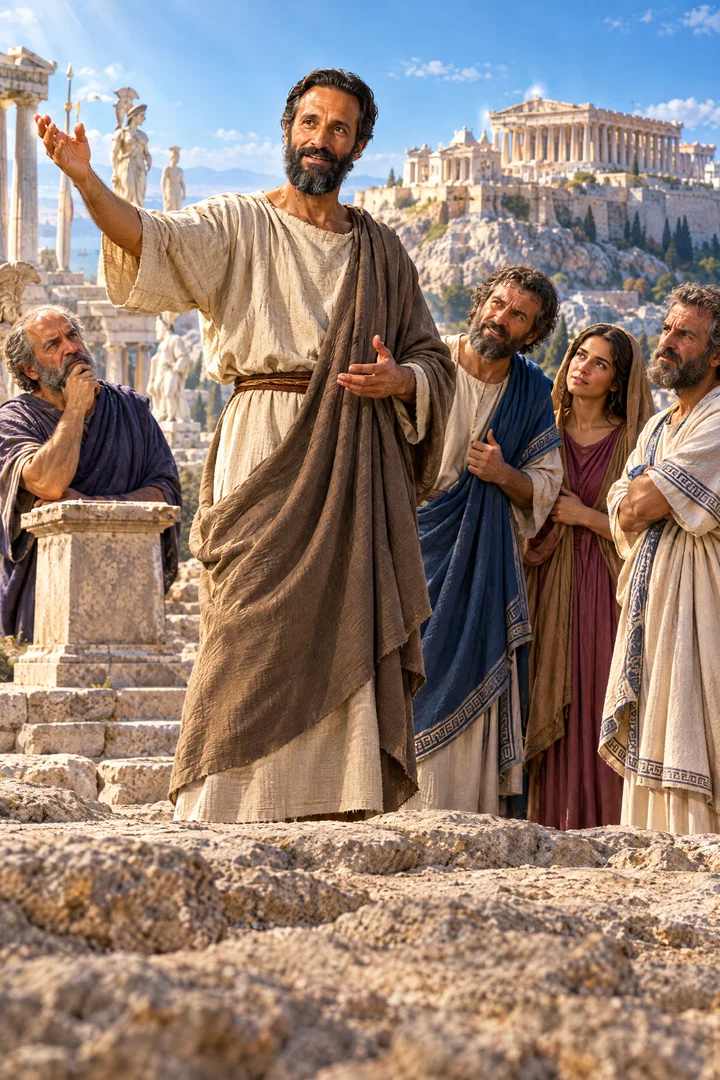
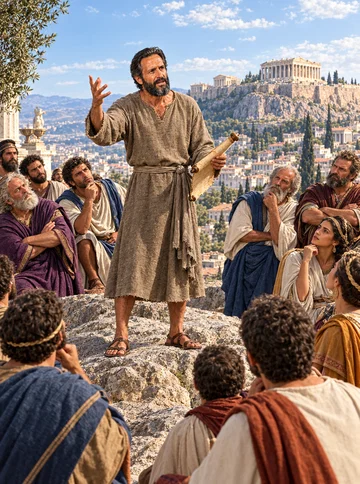
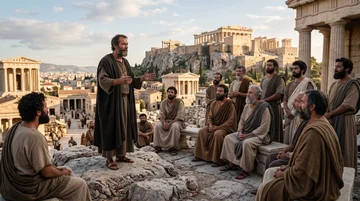
Paul stood on Mars Hill, the highest place at Athens, regarded with awe and reverence, where courts decided criminal cases and difficult religious questions, with open-air seats for judges hewn from solid rock and reached by stone steps, and with temples, sanctuaries, massive architecture, sculpture and statuary a little distance below.8RED 56.1–2 Epicurean and Stoic philosophers, thinking he set forth strange gods because he preached Jesus and the resurrection, brought him there away from public thoroughfares and tumult where frivolous and thoughtless hearers would not follow, so he could be heard without interruption and explain his new doctrine and the strange things he brought to their ears.Ms 142, 1897, par. 3–88RED 56.1–2 There he perceived their devotions and found the altar inscribed to the unknown god, and took that superstition and public admission as his opening to declare to them the true God whom they ignorantly worshiped.Ms 142, 1897, par. 3–88RED 56.1–2
He was no novice but an effectual missionary who met his adversaries and every class from men of renown to heathen idolaters on their own ground, meeting science with science, logic with logic, philosophy with philosophy, eloquence with eloquence, and oratory with oratory.Ms 142, 1897, par. 3–8ST Jul 20, 19049MR 69.3 With tact born of divine love he pointed to Jehovah as that unknown God, and with knowledge and eloquence silenced the arguments of proud philosophy before the council of the Areopagus and the sages of Greece.ST Jul 20, 1904RH Dec 21, 1911AA 462.1–2 His preaching was accompanied by signs and miracles and bore evidences not of human invention but of heavenly origin and divinity's stamp, proving his religion came from God and could not be quenched by any earthly power.Ms 142, 1897, par. 3–8RH Dec 21, 1911
He carefully drew their minds away from heathen deities and idols to the true God whom they acknowledged but did not know, rebuking idolatry and the sins of a proud self-sufficient people who with all knowledge, refinement and art were yet sunken in vice, without a direct attack on their gods and great men.SLP 96.3–97.1AA 240.2–241.18RED 59.28RED 59.1 Such direct attack would have irritated his proud listeners and put him in danger as with Socrates, so his tactful course displayed unshaken confidence and courage in loneliness and adversity and gained a victory for Christianity in the very heart of paganism, preserved as a treasure of knowledge for the church in all coming generations.AA 240.2–241.1 His labor in declaring the unknown God was not wholly in vain, for Dionysius, one of the most prominent citizens, and some others accepted the gospel message and united themselves fully with the believers.AA 240.2–241.1
Yet his logical, scientific and philosophical argument, though it astonished and silenced even his wisest hearers, led few to accept the gospel and bore little fruit.ST Sep 22, 1914MH 213.5–214.2 He had preached in an oratorical style suited to kings and the great and learned men of Athens, bringing his learning, intellectual acquirements, ability and smartness to bear and spending much time discussing natural religion, but was disappointed in the success he hoped for.Ms 114, 1898, par. 17–19SLP 120.1–28RED 60.1–61.1 The experience taught that something above human wisdom is needed, that the highest literary and intellectual education still leaves men in complete darkness without Christ revealed, and that intellectual development must be sanctified by the Spirit of God to convict and convert sinners, with power received from a higher source by eating the flesh and drinking the blood of the Son of God, which is eternal life to the receiver.Ms 114, 1898, par. 17–19 On reviewing the time and labor spent there he therefore set aside elaborate arguments, theories and discussions of natural religion as much as possible, and determined at Corinth to know nothing save Jesus Christ and Him crucified, presenting simply Christ as Saviour of sinners in demonstration of the Spirit and of power, because in a short human lifetime there is no time for anything else.ST Sep 22, 1914MH 213.5–214.29MR 69.38RED 60.1–61.18RED 67.1–2
The Unknown God Made Known
The Athenians with all their intelligence and general knowledge were ignorant of the God who created the universe, the true God and great Ruler of the universe.SLP 93.2–94.3AA 237.1–38RED 54.2 Despite their boasting of wisdom, wealth, and skill in art and science, their religion was destitute of the knowledge of God and of no value.SLP 91.18RED 54.2 It consisted largely of art-worship with a round of dissipating amusement and festivity, a religion of dry intellect and taste that lacked true goodness.SLP 91.18RED 54.2 It had no power to connect men with God, to give victory over self, or to raise them above the evils of their nature.SLP 91.18RED 54.2 The altar to the unknown god was the public expression and admission of this great want, a reaching out toward the Infinite by those longing for greater light.SLP 93.2–94.3AA 237.1–38RED 54.2
Their altars erected for the worship of nature while God remained unknown are the position of all fallen man, whose vision sin has obscured.Ms 86, 1898, par. 9–10RH Mar 17, 1904ST May 12, 1909 Depending on human wisdom alone man is inefficient and surely fails to read nature correctly, and the most difficult and humiliating lesson is the sure failure of his own efforts to read nature alone.Ms 86, 1898, par. 9–10RH Mar 17, 1904ST May 12, 1909 Without the guidance of the divine Teacher he cannot interpret nature without placing nature above God, cannot discern in nature God and Jesus Christ whom He sent, and will assuredly come to wrong conclusions tending to make men idolaters who in blindness exalt nature and the laws of nature above nature's God.Ms 86, 1898, par. 9–10RH Mar 17, 19048T 257.1ST May 12, 1909 The imperfect knowledge gathered from created works does not give exalted conceptions of God, elevate mind and soul, or bring the whole being into conformity with His will.ST May 12, 1909 Men may be religious in all things and yet worship ignorantly, for a lifetime of laborious searching after God by reason and argument and logic leaves a person ignorant and confused.Ms 40, 1895, par. 2–3 Knowledge of God is found alone in the Bible, where the God ignorantly worshiped is declared.Ms 40, 1895, par. 2–3
The God so declared is the Maker of the world and all things in it, the infinite, glorious, living God who created the universe.GC88 690.1–691.3AA 237.1–38RED 57.1–2 He is independent of man and needs nothing from human hands to add to His power and glory.AA 237.1–38RED 57.1–2 Even the heavens are not large enough to contain Him, much less temples made with hands, and He cannot be likened to gold or silver or stone graven by art and man's device, to statuary or idols devised by men.AA 237.1–38RED 57.1–2 Works of art cannot in the faintest sense represent His glory.AA 237.1–38RED 57.1–2 Idols have no breath or life but are controlled by human power and move only when the hands of men move them, so that those who worship them are in every way superior to that which they worship.AA 237.1–38RED 57.1–2 Man himself proves this, for man was created in the image of this infinite God with intellectual power and a perfect and symmetrical body.8RED 57.1–2
This declaration identifies the true God by His creatorship and sets Him apart from false gods.GC88 690.1–691.3 That same distinction is kept in the fourth commandment, which is the only precept of the law that distinguishes the Creator from false gods and therefore gives importance to the Sabbath as the sign and seal and mark of God's authority and power as Creator.GC88 690.1–691.34SP 505.2–3 God was unknown to those who rejected Christ, and the cross revealed the love of that unknown God.Ms 29, 1899, par. 9 Had they known God they would not have thought they did Him service by persecuting and putting the prophets to death, nor would they have forgotten their Creator and grown bold in supposed superiority to put to death Him who alone was able to give them life.Ms 29, 1899, par. 9
Worship of an unknown god continues in the world, and God has a controversy with its inhabitants over it.ST Apr 7, 1898 Many churches and learned preachers do not ensure that people know Bible religion, but like the Athenians they worship an unknown God.HSFM 185.1 People can gather in large congregations and in cathedral worship conducted by dignitaries in white robes embroidered around the bottom with a black velvet surplice worn over them and still not know what they worship.HSFM 185.1Ms 71, 1886, par. 7 The majority bow at idolatrous shrines and worship an unknown god under the direction of Satan disguised as an angel of light.ST Apr 7, 1898 If the fourth commandment had always been obeyed there would be no infidel or atheist, and all would recognize and honor the power of the Creator who by infinite power called the earth into existence, who with a word could depopulate it and return it to its original state and with a word raise up a new race of beings.ST Apr 7, 1898
Reaching Those Who Worship Ignorantly
Those who worship without fully knowing God are not counted guilty for the light they have never had, and their ignorance does not mean they will perish.ST Aug 7, 1893Lt 84, 1895, par. 13–15 They may still respond to the light they have, showing kindness and doing the good within their power.ST Aug 7, 1893 They mourn their human ignorance and find nothing satisfactory, thirsting for knowledge of the only true God and for truth, virtue and holiness.Lt 84, 1895, par. 13–15 They carry an ideal of God in mind, desire to find Him, and are praying for light.Lt 84, 1895, par. 13–15
God has entrusted light and gospel truth to His people to give to such seekers, and has sent forth streams of salvation to refresh all who thirst.Lt 84, 1895, par. 13–15 His message is meant to reach those who have not yet received it, and to them His people are to make God known as Paul did from the altar to the unknown God.ST Aug 7, 1893Lt 84, 1895, par. 13–15
That work at Athens stands as effectual missionary labor meeting every class from men of renown to heathen idolaters and art-worshipers.Ms 142, 1897, par. 3–8SLP 304.1–2 Paul combined home and foreign missions by preaching to the Jews in their own place of worship and to the Gentiles before their own temple in the very presence of their gods.Lt 17, 1900, par. 3–4Ms 87, 1907, par. 4 His course was not to erect barriers nor constantly to thrust upon the people that they were wrong.Lt 17, 1900, par. 3–4 By meeting adversaries on their own ground with evidences not of human invention, he proved a religion of heavenly origin bearing divinity's stamp that no earthly power can quench, showing that Christianity and salvation are for all nations, tongues and peoples and obtaining in that wide carrying of the Word a decided victory.Ms 142, 1897, par. 3–8Lt 17, 1900, par. 3–4
Sources
Pioneers and periodicals
112 sources
As he passed through Athens, wholly given to idolatry, Paul found an altar inscribed to an unknown god and made it the text for declaring the God worshiped without knowing.ST Jul 3, 1893ST Jul 8, 1897ST Jul 8, 1897ST Jan 27, 1898ST Oct 11, 1905 Such altars had been erected to cover any unrevealed power that might exist, lest a neglected deity punish them or remain uninvoked in asking blessing.ST Jan 21, 1903ST Dec 25, 1901ST Jan 15, 1902 With tact he took them on their own ground, turning from their many gods to proclaim the one true living Creator who made heaven and earth and gives life and breath to all.ST Mar 27, 1884ST Dec 20, 1905RH May 5, 1904ST Oct 11, 1905 That God does not dwell in temples made by hands nor need human service, but made all nations of one blood with appointed times and bounds, and now commands all everywhere to repent in view of the appointed day of judgment by the risen Man.RH May 5, 1904ST Oct 11, 1905ST Oct 13, 1909ST Sep 16, 1886 The same ignorant worship remains today, so the everlasting gospel must still go to every nation calling them to fear God, give him glory, and worship him as Creator.ST Jan 15, 1902RH Aug 11, 1904ST Aug 21, 1907
Paul's Visit to Athens
This was Paul's first preaching of the gospel in Athens, about A.D. 52, when he was left alone after his attendants had returned to Berea, with no follower of Christ present to hear him.ST Jul 8, 1897ST Apr 19, 1877 He had come there after leaving Berea, where controversy and clever argument often displaced truth, and he longed for souls though few received his message.RH Nov 18, 1915RH Feb 9, 1905 Alone yet calm and self-possessed, he faltered not but delivered a burning message declaring the Unknown God.ST Jul 8, 1897RH Nov 18, 1915
Athens was wholly given to idolatry and full of idols, a curious Christless crowd in a city with many temples, altars and sacrifices.ST Jan 27, 1898ST Apr 19, 1877 More than thirty thousand false gods were present, thousands of gods which were no gods, and the extent of idolatry was such that 30,000 gods were worshiped in Athens alone.ST Oct 11, 1905ST Oct 13, 1909ST Dec 25, 1901 The many temples and idols deeply moved him, as widespread idolatry like that later seen at Canton with its temples and multitude of gods.ST Jan 27, 1898
He spoke standing in the midst of the Areopagus to the men of Athens, before its council, critics and judges.ST Jul 20, 1904ST Jan 27, 1898 His hearers were the sages and philosophers of Greece, learned men who spent their time in telling or hearing something new, an educated and philosophically minded audience where he stood in the minority.ST Feb 14, 1884RH Dec 21, 1911 There he met science with science, logic with logic, and philosophy with philosophy, publicly proclaiming the faith of Christ with knowledge and eloquence to silence the arguments of proud philosophy.ST Jul 20, 1904ST Feb 14, 1884RH Dec 21, 1911
The visit belongs within his work at Thessalonica, Berea, Athens, Corinth, Ephesus and Troas and farewell talk to the elders of Ephesus, where God worked wonderfully and the word triumphed in every place despite persecution.ST Jul 7, 1909 It shows his work for Gentiles had already begun before Acts 18:6, so that statement did not mark its beginning.RH Dec 19, 1871 Athens stands with Antioch, Corinth and Rome as a Gentile field where Gentiles were coming into the church and growth required increased effort and apostolic skill, and as at Lystra the gospel was preached there regardless of cultivation.ST Sep 10, 1896ST Jun 16, 1898
His logical, scientific and philosophical discourse astonished and silenced his hearers but led few to accept the gospel.ST Sep 22, 1914 Heathen philosophers mocked the Christian hope of resurrection as unreasonable and unphilosophical because they cared nothing for what the Bible said, holding the immortality of the soul and thereby effectively denying the resurrection, and to learned men living to hear something new the resurrection was absurd as a new doctrine.RH Mar 13, 1879ST Nov 13, 1879RH Jan 7, 1862 Many turned away or mocked, others were indifferent, yet scoffers became penitent believers and a few believed including Dionysius and Damaris.ST Sep 22, 1914RH Jan 7, 1862RH Oct 16, 1860 There was no remarkable result, and his faithful sowing without apparent result was as faithful as at Corinth, a successful preaching and not a blunder, sublime like preaching at Pentecost in a prominent public place, while a life in which Christ lives and a brief conversation like that with the Philippian prisoner may also bring people to the Saviour.ST Sep 22, 1914RH Oct 16, 1860
Altar to Unknown God
As he passed along and beheld their devotions and observed the objects of their worship, he found an altar with the inscription to the unknown God, which arrested his attention and confirmed that they were religious in all things.ST Jul 3, 1893ST Jul 8, 1897ST Jan 27, 1898ST Jan 21, 1903ST Jan 27, 1898 Standing in the midst of the Areopagus speaking to the men of Athens, he took what they worshiped in ignorance as his setting and text for his proclamation, declaring to them that the One they worshiped without knowing was the One he now set forth and made known to them.ST Jul 3, 1893ST Jul 8, 1897ST Jul 8, 1897ST Jan 27, 1898ST Jan 21, 1903
The Athenians, and Greeks and Romans generally, had erected altars not only to all named and known gods but also to any other god or power that might exist although as yet unrevealed or overlooked.ST Jan 21, 1903ST Dec 25, 1901ST Jul 8, 1897RH Feb 18, 1915 This was done as a precaution lest some unheard-of deity come and find no statue, altar or temple dedicated to him, punish them and destroy the city in revenge for neglecting his worship, or remain uninvoked when they asked for blessings.ST Jan 21, 1903ST Dec 25, 1901ST Jan 15, 1902 The closed altar in Peking is a magnificent structure devoted to unknown gods on the same principle.ST Mar 20, 1907
The altar reflected their sense that a greater God existed beyond the many gods they worshiped, with a reserved place in their system for a divine power beyond what they recognized.ST Jul 3, 1893ST Jul 3, 1893 Their public inscription admitted uncertainty and ignorance of the true God and the great Ruler of the universe despite many altars to false gods.ST May 21, 1885ST May 21, 1885ST Dec 3, 1896 That ignorance remained despite their celebrated learning and philosophy, wealth, and skill in art and science, whose art worship, festivities and accomplishments had not given them an intelligent understanding of God and his plans or enabled them to escape degrading idolatry.ST May 21, 1885RH Feb 26, 1861
Their ardent devotion was superstitious worship and not consistent worship of the true and living God, for serving God rightly requires knowledge of his will.ST Jan 27, 1898ST Jun 24, 1875 By altars erected for the worship of nature they placed nature and its laws above God, and apart from Christ were incapable of rightly interpreting nature, depending on human wisdom with sure failure to read nature correctly and to discern in it God and Jesus Christ whom he sent.RH Mar 17, 1904ST May 12, 1909 Among many idols their altar to an unknown god thus stood as reflecting rejection of the living God.RH Mar 9, 1905 The revised wording says they worshiped in ignorance and that Paul would explain what they worshiped, highlighting a change in how the sentence is expressed.ST Mar 3, 1881
Paul's Missionary Approach
Paul took the altar and its inscription as his point of contact, starting point, opening and text, declaring to the Athenians the God they worshiped without knowing because they did not understand whom they worshiped.ST Mar 27, 1884ST Jan 21, 1903ST Apr 26, 1905ST Sep 20, 1883 Passing through the city and observing the objects of worship, his attention was arrested by the altar inscribed to an unknown god, which confirmed that the true God was unknown to them and gave him an opening to proclaim the truth of God and introduce Him to them.ST Jan 21, 1903ST Apr 26, 1905ST Jan 21, 1903 He explained who God is, how He is acceptably worshiped, and that God desires all people everywhere to repent, pointing also to the appointed day of judgment when all will be judged by the Man God ordained.ST Mar 27, 1884 He singled out this God as superior to their other gods, the Creator and Judge of all the earth, not a lifeless idol but a living, loving, merciful Father, so that it is a fearful thing not to know Him and to neglect the salvation provided through His Son.ST Mar 27, 1884ST Dec 20, 1905ST Apr 26, 1905 The Athenians had erected such altars not only to all named and known gods but also to any other god or power that might exist although as yet unrevealed, lest any deity punish them for neglected worship or remain uninvoked when they asked blessings, and Paul used this finding to tell them about the God they did not know and the gospel of Christ.ST Dec 20, 1905ST Jan 21, 1903
With tact born of divine love he met science with science, logic with logic, and philosophy with philosophy, publicly proclaiming the faith of Christ before the sages of Greece with knowledge and eloquence that silenced proud philosophy.ST Jul 20, 1904ST Feb 14, 1884 Becoming as without law to gain Gentiles who did not have the written law and full knowledge of God, while himself remaining not without law to God but in law to Christ and bound to keep the whole law with Christ as its end for righteousness, he took them on their own ground from their own heathen worship and literature to demonstrate a great Creator and the certainty of future general judgment.ST Sep 16, 1886ST Sep 20, 1883 He turned attention from other gods to the true God without directly attacking their deities, religious practices or institutions and without claiming they had no right to worship many gods, which opened the way to preach Jesus and the resurrection.ST Dec 20, 1905ST Sep 20, 1883 By declaring the unknown God rather than appearing to introduce a foreign god in violation of the state religion, he proclaimed truth without incurring the death penalty for introducing new gods.ST Jan 21, 1903
He quoted their poets and used a statement by a Greek poet that accorded with truth, not as proof of his teaching but to give his argument greater weight among hearers who respected their poets.RH Sep 11, 1860RH Sep 11, 1860 His addressing of learned listeners in this manner did not produce a remarkable result.RH Oct 3, 1907
He did not place Christ on the same level as the Greek gods or compromise the gospel to please hearers, but exalted Christ alone.ST Nov 13, 1893 He did not treat all religions as equally true, assume religious progress would unite all faiths, or leave people as they were, but told them their worship was ignorant and brought beliefs under God's truth.RH Oct 14, 1909RH Jul 28, 1910 Their worship acknowledged a divine reality they did not know, and recognizing what is true in other religions to lead people to the gospel provides the model for Christian teachers.ST Mar 30, 1904
Encountering altars to false gods, he responded by preaching rather than destroying them, and the preached Word won hearts so that idols fell without force and without damage to the altars.ST Dec 12, 1916ST Mar 20, 1907
His tact did not withhold the whole counsel of God, for his Spirit-guided teaching adapted to hearers and grounded in revelation exposed the folly of idolatry by explaining the Creator's attributes, the unity of humanity under one Father, and the need for repentance in view of future judgment, then presented Jesus and the resurrection even though it drew derision.RH Dec 14, 1916ST Mar 5, 1894 Declaring the unknown God to be the Creator of heaven and earth led people to renounce idolatry and embrace Christianity.ST Nov 12, 1885 Beginning with the foundation of the one true God and leading to the call to prepare to meet Him when He returns in the clouds provides in Acts 17:23-31 the model for preaching to those who do not know the true God.ST Jul 28, 1914
His speech on Mars Hill, delivered as an oration before the critics and judges of Areopagus, was spoken to instruct and benefit hearers for God's glory and the world's good, not to win praise, prizes, fame or display eloquence and rhetorical skill.STRH Feb 17, 1863RH Oct 10, 1865ST Apr 5, 1877 It displays lofty genius and fervent eloquence, elevated and self-denying temper, noble and yearning heart, and vigorous mental grasp that amid digressions ever traces truth to first principles.
True God as Creator
The One worshiped in ignorance is the One declared, the true and only God.ST Oct 11, 1905ST Oct 13, 1909 He is the living Creator who made the world and everything in it, heaven and earth, Lord of heaven and earth.RH May 5, 1904ST Oct 11, 1905RH May 1, 1855ST Feb 20, 1896 He gives life and breath and everything to all, and all living beings depend on Him, which grounds confidence in God.RH May 5, 1904ST Oct 11, 1905ST Feb 14, 1911ST Oct 13, 1909 He is not confined to temples made by human hands and does not dwell in buildings made by hands, nor does He depend on human service or need anything from people.RH May 5, 1904RH May 1, 1855ST Feb 20, 1896RH Mar 18, 1875 All things owe existence to a personal Creator apart from whom nothing was brought into being, the invisible Creator and Cause of Causes unlike powerless idols, not chance or an impersonal force.RH Aug 19, 1909 He created the world through Christ, with Christ the eternal Son pre-eminent in creation as head of the original creation and of the church as the new creation, revealed through His works, the gospel and the sanctuary services.ST Jul 3, 1893
He made all nations from one blood to live on the earth and fixed their appointed times and the boundaries of where they live.ST Oct 11, 1905ST Oct 13, 1909 He governs the course of nations. Power to create and the work of creation are the distinguishing characteristics and proper name and characteristic title of the true God of heaven.RH Sep 10, 1872ST Feb 20, 1896 They distinguish Him from false gods of human imagining, idol gods and the beast power, for gods that did not make heaven and earth are false.RH May 1, 1855RH Sep 10, 1872ST Feb 20, 1896 Creation is the foundation of faith, proof of His Godhead, existence, authority, universal rule and right to worship, honor and obedience.ST Dec 7, 1882RH May 1, 1855RH Mar 18, 1875 The call away from false gods and self-worship to worship the Maker is the same as the first angel's message.ST Feb 20, 1896
The Athenians despite reason and devotional feelings feared they had not found the true God, showing that without revelation people may feel need to worship but cannot direct it.RH Dec 10, 1861 Observing nature can lead to acknowledging a Creator yet leave people worshiping an unknown God, since nature does not reveal God's will, acceptable service or escape from guilt.RH Mar 17, 1904ST May 12, 1909RH Dec 10, 1861 Sin-obscured vision depending on human wisdom fails to read nature correctly, placing nature and its laws above God, unable to discern God and Jesus Christ whom He sent.RH Mar 17, 1904ST May 12, 1909 Despite celebrated learning, philosophy, wealth, art and festivities they lacked intelligent understanding of God and His plans, with religion centered largely on art worship and festivities.ST May 21, 1885RH Feb 26, 1861 Their altars erected for the worship of nature set nature above God and among many idols reflected rejection of the living God, and treating nature, force or law as substitutes is idolatry.RH Mar 17, 1904ST May 12, 1909RH Mar 9, 1905
The God thus declared is not a lifeless idol but a living, loving, merciful Father.ST Apr 26, 1905 He loves the world and gave His Son.RH Jan 21, 1909 Standing in the midst of Mars Hill, Paul set His majesty in contrast to idolatrous worship to meet their longing for greater light.RH Mar 17, 1904ST May 21, 1885 The human longing for God is real and His presence is recognized inwardly.ST Oct 16, 1879
Sabbath Memorial of Creation
The God declared as the one worshiped without knowing is the true God, the Creator of heaven and earth and all things in them, and power to create and the work of creation are his distinguishing characteristics setting him apart from false gods.RH Sep 10, 1872STST Jul 31, 1879ST Oct 30, 1884 The seventh-day Sabbath is his standing memorial, sign and proof of that creation, showing that he made the world in six days and rested on the seventh, and by it people acknowledge the true God.ST Dec 7, 1882RH Sep 10, 1872RH Jul 1, 1873RH Mar 7, 1854ST Oct 30, 1884 It memorializes creation and is therefore a sign of the Creator, identifying Jehovah as Creator and sanctifier and distinguishing him from false gods as the distinctive sign of allegiance to him.ST Oct 5, 1882RH Sep 10, 1872STST Jul 31, 1879 Creation is proof of his Godhead, power and divine nature, and the Sabbath commemorates that creation.STST Jul 31, 1879
The fourth commandment likewise identifies the God to be worshiped as the One who created heaven, earth and sea, naming him as Maker of heaven and earth and establishing his authority to receive worship and his authority as Lawgiver.RH Jul 8, 1852RH Sep 30, 1852RH Apr 24, 1856RH Oct 7, 1851RH Jun 10, 1852 Paul's declaration of the Creator as Lord of heaven and earth taught knowledge of the Creator through that commandment, presenting its reason for Sabbath observance that the Lord made heaven and earth and all things in them.RH Jul 8, 1852RH Sep 30, 1852RH Oct 7, 1851RH Jun 10, 1852 He presented this truth in a city given to idolatry to correct false ideas about God, teaching people to know and worship the living God rather than sun, moon, stars or other created things.RH Jul 8, 1852RH Jun 10, 1852 Abandoning the Sabbath removes the institution that bears this knowledge of creation and of the living God.RH Jun 10, 1852
His way of pointing heathen worshipers to the true and living God is to make use of the Sabbath commandment, or the fact on which it is based, by declaring God through his great creative power as the God who made the world and all things therein.ST Dec 7, 1882RH Jul 1, 1873RH Mar 7, 1854 Creation reveals who God is, and the holy Sabbath serves to remember him, having been set up at the close of creation to commemorate that work forever by having man work six days and rest the seventh.RH Jul 1, 1873RH Mar 7, 1854 That creation truth was missing from Athenian worship yet is meant to be the foundation of faith, and the Sabbath shows it forth so that by it people acknowledge the true God and are reproved for not worshiping him.ST Dec 7, 1882RH Jul 1, 1873 That Creator-memorial stands against the counterfeit Sabbath, an illegitimate substitute for the rest day of the Creator set up without Scripture proof or warrant.ST Oct 5, 1882
If the fourth commandment had always been obeyed there would be no infidel or atheist, and all would recognize and honor the power of the Creator.ST Apr 7, 1898 Resistance to God is vain, for by infinite power he called the earth into existence, and with a word he could depopulate it and return it to its original state, and with a word raise up a new race of beings.ST Apr 7, 1898 The address on Mars Hill is only a record of facts about the visit and labors in a city wholly given to idolatry, having no form of precept, and it does not give the second commandment to the Christian church or give a new command against image worship.ST Apr 19, 1877ST Dec 7, 1882 It was spoken to a curious, Christless crowd with not one follower of Christ present, when Paul was alone after his attendants had returned to Berea, a full twenty years after the death of Christ, so that if the decalogue ended at the cross all men were released from the law against idolatry for twenty years.ST Apr 19, 1877 It also says nothing about making the first day a memorial of the resurrection, though it teaches that the true God is the Creator and will judge the world through Jesus, whom God raised from the dead.ST Jul 13, 1882 Those who held the other view teach by contrast that the declaration restates the second commandment against making graven images and bowing down to serve them, as apostolic teaching against idolatry reaffirming it, resting either on its original authority showing it was not abolished or as a new precept enacted to replace it.RH Aug 5, 1852ST Apr 19, 1877
Repentance Judgment and Resurrection
Paul took the altar to the unknown god as his starting point to declare the true God to Athens, whose worship was ignorant because they did not know whom they worshiped, explaining who God is and how he is acceptably worshiped and that God desires all people everywhere to repent. Becoming as without law to gain Gentiles who lacked the written law and full knowledge of God, he met them on their own ground from their own worship and literature to demonstrate the existence of a great Creator and the certainty of a future general judgment, while himself remaining not without law to God but in law to Christ.ST Sep 16, 1886 His call to repent rested on the fact that God has appointed a day in which he will judge the world by the Man he ordained, whom he raised from the dead, showing that gospel preaching must hold out the certainty of coming judgment to restrain men from evil.ST Sep 16, 1886ST Nov 23, 1904 He exposed the folly of idolatry by setting forth the Creator's attributes, the unity of humanity under one Father, and the need for repentance in view of future judgment, and then presented Jesus and the resurrection. Left alone at Athens he faltered not but stood calm and self-possessed, declaring the One who made the world and all therein and does not dwell in temples made with hands and who will soon come to judge the world, preaching truth in love and lifting high the cross to win people from sin, so that lonely workers today must be brave and strong, look up for renewed strength and never despond, since truth will shine amid glare, some will listen, cities must hear it, and honest souls will stand the test.RH Nov 18, 1915
His message to men who forget God and worship false gods is a full expression of the gospel call to recognize who God is, fear him and give him glory.ST Aug 21, 1907 Because the true God is still the unknown God to the masses, even to millions professing his name who nominally acknowledge the God of the Bible not from knowledge or intelligent belief but lest he prove real and punish unbelief, looking on him as altogether like themselves with superstitious dread and seeking his favor in case they are accountable to him, the everlasting gospel must in the very end of time go to every nation and kindred and tongue and people calling them to fear God and give glory to him, for the hour of his judgment is come.ST Jan 15, 1902 That same call belongs to those still worshiping an unknown God, as in Ceylon, to fear God, give him glory, recognize that his judgment is come, and worship him as Creator.RH Aug 11, 1904
At Mars Hill the resurrection was the testing truth, which the Athenians by teaching the immortality of the soul effectively denied, so that many turned away or mocked when Paul preached it.RH Jan 7, 1862 To learned men who spent their time in telling or hearing something new, the gospel was rejected as a new doctrine and the resurrection of the dead was absurd.
Prophecy Proves True God
Paul stood before the Athenians surrounded by more than thirty thousand false gods to declare to them the Unknown God whom they worshiped without knowing as the true and only God.ST Oct 11, 1905ST Oct 13, 1909 The God he declared is the Creator who made the world and everything in it and gives life and breath and all things to all.ST Oct 11, 1905ST Oct 13, 1909 This same God made all nations of men from one blood to dwell on the earth and fixed their appointed times and the boundaries of where they live.ST Oct 11, 1905ST Oct 13, 1909 Paul made the Creator's foreknowledge of appointed times and events the climax of his argument and the open manifest proof that He is God in contrast to false gods.ST Oct 11, 1905ST Oct 13, 1909 The prophetic part of the Bible that tells the end from the beginning is therefore one of the strongest proofs of its divine authorship.ST Oct 11, 1905ST Oct 13, 1909
Because God governs the course of nations and has determined their appointed times and boundaries, people should not take God's place by seeking to destroy a nation. Christians are called to bring its people the gospel of salvation, not to condemn or destroy them.
Ignorant Worship and Mission Today
The same superstitious ignorance seen at Athens remains today, and the true God is still unknown to the masses of mankind, even to millions who profess His name.ST Jan 15, 1902 They nominally acknowledge the God of the Bible not from knowledge or intelligent belief in Him, but lest denial prove dangerous if He is real and punishes unbelief.ST Jan 15, 1902 Looking upon Him as altogether like themselves, they hold a superstitious dread of Him and seek to claim His favor in case He proves a real Being to whom they are accountable.ST Jan 15, 1902 Because He is still unknown, the everlasting gospel must in the very end of time go to every nation and kindred and tongue and people, calling them to fear God and give Him glory because the hour of His judgment is come.ST Jan 15, 1902
Worship of an unknown god continues in the world, and God has a controversy with its inhabitants over it.ST Apr 7, 1898 The majority of Christians bow at idolatrous shrines and worship an unknown god under the direction of Satan disguised as an angel of light.ST Apr 7, 1898 People can cease direct idol worship and still worship ignorantly, sending petitions to earth, sea and sky into the vaguely known universe in search of the Great Unknown.ST Feb 3, 1904 Such vague seeking is feeling after God and a longing for the great truth to come, which God answers by bringing truth to the seeker so that he finds Him and kneels in reverent thankfulness before Him as Creator of earth, sea and sky.ST Feb 3, 1904RH Nov 11, 1909 Guapung prayed to the unknown God before hearing the gospel and then came to know Him as the God to be worshiped, showing that those who seek without knowing who He is can be taught to know Him.RH Nov 11, 1909
Without revelation even reason and devotional feelings leave people with many gods and fear of missing the true God, for men may feel need to worship yet not know how to direct it.RH Dec 10, 1861 In crisis mercy may be sought from every god except the Unknown God, as when sailors in the storm called on their gods while Jonah was urged to call upon his own.RH Mar 5, 1914 Worshipers hope to appease wrath and gain favor from gods they do not know, yet seeking the unknown through creeds and scenic altar fires cannot satisfy the heart's longing or relieve its fear and pain.ST Jul 29, 1913 The same ignorance appears in those who revere science while knowing little about it, and the unknown power behind X-rays, rightly understood, points to the Author of light and sound whom Athens worshiped without knowing.RH Jul 8, 1915
Like the Athenians, enlightened Peruvians under Romish oppression, tired of false priests and desiring something better, raise an altar to the unknown God in ignorant seeking and cannot find Him unless those who know Him come and tell what kind of being He is. Bolivians, though regarded as Christians, know no more of the true God and Christ the Saviour than the Athenians did, and the Maya of Panama in devotions to an unknown god likewise need to hear the gospel and learn of God.RH Jun 9, 1903RH Jul 31, 1913 Worship observed in Martinique, with images, crucifixes and candlelit altars prominent, needed the same message Paul preached at Athens to those who worshiped without understanding.ST Aug 13, 1902 The Wapares retained belief in one great Creator called the Unknown God after ancestors rejected their former god following famine and unanswered pleas, and their desire for instruction made them ready to learn of the God they did not know. The Japanese who did not know the Creator, the people of Ceylon still worshiping an unknown God, the Chinese couple who left idols for the Great Unknown and then worshiped Him as Creator of earth, sea and sky, the Chinese with only a brief dictionary entry about Christ as an altar to an unknown Saviour to be declared to them, Buddhist schools adopting Christian forms while substituting Buddha for Jesus, and Canton with temples and multitudes of gods like Athens all show peoples acknowledging a Creator without clearly knowing Him to whom He must be declared.RH Jan 21, 1904RH Aug 11, 1904RH Jan 4, 1912
Among the heathen are those who worship God ignorantly, who have never received the message of salvation or the written law and upon whose ears words of life have never fallen by human instrumentality, yet who respond to light, show kindness and do the good within their power.ST Aug 7, 1893RH Jan 3, 1907RH Jul 31, 1913 God speaks to them through nature, the Holy Spirit touches their hearts as evidenced by cherishing the spirit of kindness, befriending missionaries and even ministering to them at peril of life and doing the things the law requires, so they are recognized as children of God and ignorance alone does not mean they will perish.ST Aug 7, 1893RH Jan 3, 1907RH Jul 31, 1913 Paul left alone at Athens yet calm, self-possessed and faltering not, declaring the Unknown God as Maker of the world and all therein who dwells not in temples made with hands and will soon come to judge the world, preaching truth in love and lifting high the cross to win from sin.RH Nov 18, 1915 Lonely workers today must therefore be brave and strong, look up for renewed strength and never despond, for truth will shine amid glare and tinselled dross, some will listen, cities must hear it, and honest souls will stand the test.RH Nov 18, 1915 In fields largely outside Christianity proclaiming the message requires Christ's power and presence to turn nations sunken in hopeless bondage to thousands of gods which are no gods from idols to Jehovah and carry them a higher liberty, a faithful sowing as acceptable at Athens where no result appeared as at Corinth where a church was gathered, since duty is to preach and increase belongs to God.RH Nov 9, 1905RH Nov 16, 1916ST Oct 25, 1877ST Jul 22, 1908ST Aug 5, 1897 The Athenians' worship in ignorance before an altar to a god they did not know stands alongside the Samaritans' worship, which also lacked knowledge of whom they worshiped.RH Oct 12, 1916
Sources