Acts 19:24
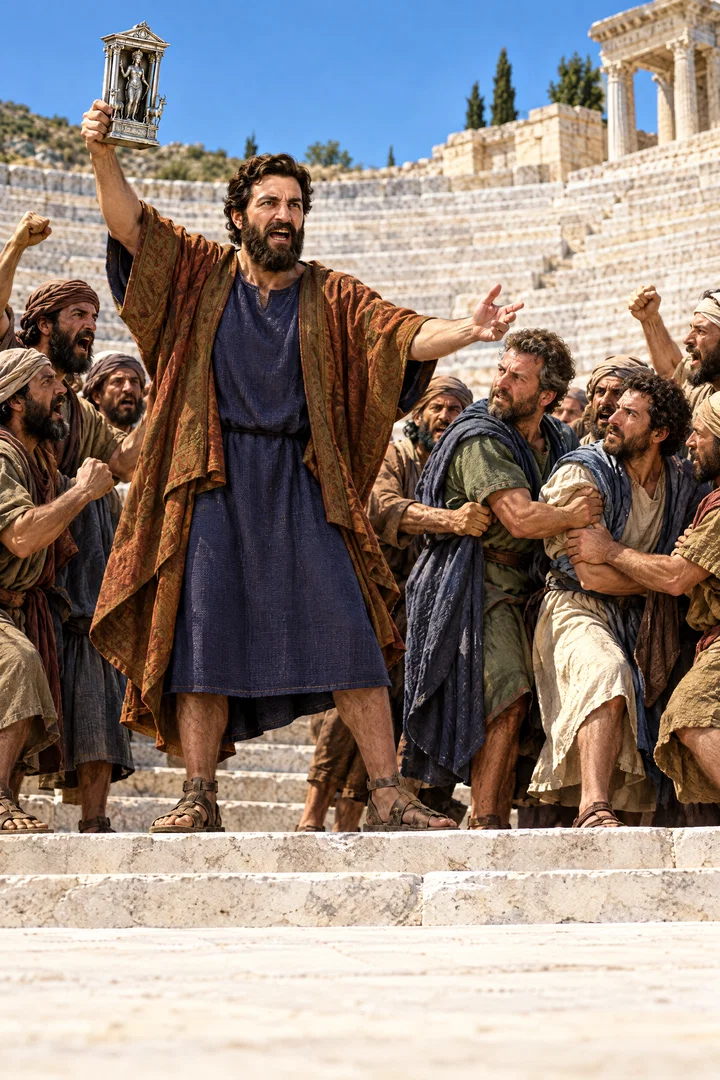
For a certain man named Demetrius, a silversmith, which made silver shrines for Diana, brought no small gain unto the craftsmen;
Translations
For a certain man named Demetrius, a silversmith, which made silver shrines for Diana, brought no small gain to the craftsmen;
King James Version, KJV Cambridge Paragraph Bible
For a certain man named Demetrius, a silversmith, which made silver shrines for Diana, brought no small gain unto the craftsmen;
For a certain man named Demetrius, a silver-smith, who made silver shrines for Diana, brought no small gain to the artificers;
For a certain man named Demetrius, a silversmith, which made silver shrines of Diana, brought no little business unto the craftsmen;
For a certain man named Demetrius, a silversmith, who made silver shrines of Diana, brought no little business unto the craftsmen;
for a certain one, Demetrius by name, a worker in silver, making silver sanctuaries of Artemis, was bringing to the artificers gain not a little,
For a certain [ man] by name Demetrius, a silver-beater, making silver temples of Artemis, brought no small gain to the artisans;
For, one Demetrius by name, a silversmith, making [silver] shrines, of Diana, used to bring unto the craftsmen no little business;
Berean Standard Bible, Majority Standard Bible
It began with a silversmith named Demetrius who made silver shrines of Artemis, bringing much business to the craftsmen.
For a certain man named Demetrius, a silversmith who made silver shrines of Artemis, brought no little business to the craftsmen,
For there was a certain man named Demetrius, a silver-worker, who made silver boxes for the images of Diana, and gave no small profit to the workmen;
For a certaine man named Demetrius a siluersmith, which made siluer temples of Diana, brought great gaines vnto the craftesmen,
Douay-Rheims (Challoner revision)
For a certain man named Demetrius, a silversmith, who made silver temples for Diana, brought no small gain to the craftsmen;
Pictures
Cross-references
- Acts 19:29-34
And the whole city was filled with confusion: and having caught Gaius and Aristarchus, men of Macedonia, Paul’s companions in travel, they rushed with one accord into the theatre.
The craftsmen’s agitation leads to the confused crowd and its cry for Diana.
- Revelation 2:1-7
Unto the angel of the church of Ephesus write; These things saith he that holdeth the seven stars in his right hand, who walketh in the midst of the seven golden candlesticks;
The passage addresses the church in Ephesus.
- Acts 19:35
And when the townclerk had appeased the people, he said, Ye men of Ephesus, what man is there that knoweth not how that the city of the Ephesians is a worshipper of the great goddess Diana, and of the image which fell down from Jupiter?
The city’s claim that the image came from heaven completes the Ephesian allusion.
Commentary
Each commentary is drawn from primary sources: the writings of Ellen G. White and Adventist pioneers and periodicals. Each commentary is separate. Its own words are not a quotation; follow the references to read the source passages.
Ellen G. White
9 sources
The setting is Ephesus, where Diana was widely worshiped and her vast, magnificent temple was a source of civic and national pride.SLP 134.2–4 That temple held a crude image believed to have fallen from the sky, and devotion to Diana existed alongside widespread superstition and magic.SLP 134.2–4 The silver shrines and images made there represented the goddess and her temple, were carried in processions and on journeys and military expeditions, and were treated as objects of worship.SLP 142.1
Demetrius and his fellow craftsmen made and sold silver shrines for Diana, and their manufacture and sale was an extensive business at Ephesus.SLP 142.2AA 292.2–3SLP 142.1 That business brought substantial gain, profit and income by which they lived.SLP 142.2AA 292.2–3RH Sep 14, 1911AA 295.1–2RH Sep 14, 1911 That gain depended on the worship of Diana, especially the yearly national festival when special ceremonies held with utmost pomp and splendor drew great numbers of people from all parts of the province.AA 291.3–292.1RH Sep 14, 1911
The verse belongs to the event that hastened Paul's departure from Ephesus after more than three years of work there that raised up a flourishing church and spread the gospel throughout Asia among Jews and Gentiles.AA 291.1–2 At that time Paul had purposed to pass through Macedonia and Achaia to go to Jerusalem and afterward see Rome, and had sent Timothy and Erastus into Macedonia while deciding himself to remain in Ephesus until after Pentecost.AA 291.1–2 Paul's preaching turned people away from worshiping handmade gods, so that even many who did not openly accept the new teaching became enlightened as to lose all confidence in their heathen gods.AA 291.3–292.1SLP 142.2AA 292.2–3 This weakening of devotion produced a perceptible falling off in attendance at the festival and in the enthusiasm of the worshipers, and the craftsmen's profits began to decline.AA 291.3–292.1AA 292.2–3RH Sep 14, 1911
Because the spread of the gospel threatened their image-making business and income, Demetrius used that danger to stir up bitter opposition against Paul.SLP 142.2RH Sep 14, 1911AA 295.1–2 The silversmiths' opposition was driven by the threat to their trade as well as to Diana's worship.AA 292.2–3 The warning that the craft was in danger reveals the real cause of the tumult at Ephesus was money, not religion, for the teaching and spread of the gospel would endanger the business of image-making with the income of pagan priests and artisans at stake.AA 295.1–2 The same economic threat to idolatrous gain explains much of the persecution that followed the apostles in their work.AA 295.1–2
Sources
Pioneers and periodicals
34 sources
Demetrius was a silversmith at Ephesus who made silver shrines of Diana, and that work brought substantial profit and livelihood to the craftsmen.ST Mar 4, 1903ST Feb 17, 1898 Ephesus was the city of the great temple of Diana, renowned for size and magnificence and enriched as a treasure-house of much of the wealth of Western Asia.ST Jun 4, 1885ST Nov 29, 1910 The opposition to Paul arose chiefly because his teaching threatened that business, for devotion to the goddess was largely a question of profit and concern for her honor was used to rally the people.ST Feb 17, 1898RH May 12, 1868 Preaching that things made with hands are not gods turned people from worshiping images, weakened confidence in heathen gods, and cut demand for shrines, festival attendance, and gain.ST Jan 23, 1907ST Jan 23, 1896 When the trade was put at risk Demetrius rallied the craftsmen, and unable to answer Paul by fair argument they appealed to religious zeal and superstition and stirred a confused uproar.ST Jun 9, 1898ST Jul 24, 1893RH May 12, 1868ST Jul 29, 1897ST Oct 3, 1906
Demetrius and Ephesus Setting
The verse presents a certain man named Demetrius as a silversmith who made silver shrines for Diana, and declares that this work brought no small gain, substantial profit and business and wealth to the craftsmen.ST Mar 4, 1903ST Feb 17, 1898ST Jun 9, 1898ST Aug 12, 1897 The silversmiths were organized into at least two groups, craftsmen and workmen, whose livelihood from this trade was threatened as preaching turned people away from worshiping handmade gods.ST Mar 4, 1903ST Feb 17, 1898 The stir stood about A.D. 57 near the close of Paul's work at Ephesus, about the time Paul stayed in Asia after purposing to go through Macedonia and Achaia to Jerusalem and then to Rome, when there arose no small stir concerning the Way.ST Mar 4, 1903ST Feb 17, 1898
Demetrius was head of the whole guild of image-makers and held authority among the craftsmen and workmen, and so was able to arrest the attention of many.ST Feb 17, 1898ST Mar 4, 1903 As instigator of the trouble he was instrumental in creating the stir concerning the Way.ST Feb 17, 1898ST Mar 4, 1903 Ephesus was the city of the great temple of Diana or Artemis and the place where a strong Christian church arose.ST Jun 4, 1885ST Nov 29, 1910 Her temple was renowned for vast size and magnificence, enriched by kings and princes, and served as a treasure-house for much of the wealth of Western Asia, while the city was famed for worshiping Diana.ST Jun 4, 1885ST Nov 29, 1910
The Diana worshiped at Ephesus was distinct from the Grecian Diana and represented the reproductive powers of nature.ST Mar 4, 1903 She belongs to the same cult and character as Semiramis, wife of Nimrod and one of the early worshiped goddesses, identical with the queen of heaven and Venus.ST Mar 4, 1903ST Mar 4, 1913 A stone found at Ephesus, now in the British Museum at London, bears an inscription concerning a Demetrius of that time, and if he is the Demetrius of 3 John 12 he later profited by the teachings of Paul and his fellow laborers.ST Mar 4, 1903 The verse belongs to the setting of that Ephesian temple of Diana that was later destroyed around A.D. 260 in a Gothic expedition in which the Heruli took a prominent part.ST Sep 16, 1886
Nature of Shrine Trade
The shrines were small reproductions or models of the temple of Diana with the image of the goddess within.ST Mar 4, 1903ST Aug 12, 1897ST Aug 12, 1897 They were made of terra cotta, marble, bronze, and silver, with Demetrius himself working in silver.ST Mar 4, 1903 The silver models included the image and could be taken home for worship or carried as charms believed to ward off illness and danger.ST Aug 12, 1897
The models were sold to townspeople as well as to travelers and merchants.ST Mar 4, 1903 Pilgrims to the temple bought them, just as pilgrims buy rosaries and images and tourists buy models of famous monuments.ST Aug 12, 1897 That trade in shrines brought substantial profit to Demetrius and the other craftsmen.ST Aug 12, 1897
Buyers set them up in homes as objects of household worship after their return.ST Mar 4, 1903ST Aug 12, 1897 They were often made small enough to be set up in homes or carried about on the person.ST Mar 4, 1903ST Aug 12, 1897 Kept on the person they served as charms or amulets believed to have power to avert diseases and other dangers from the bearers.ST Aug 12, 1897ST Aug 12, 1897 Their purchase for household worship reflected the city's devotion to Diana.
These small images made the worship of Diana a profitable trade in Ephesus.ST Mar 4, 1903ST Feb 17, 1898ST Nov 13, 1893 From that worship the silverworkers got their living, and the business prospered through it.RH Sep 14, 1911ST Feb 17, 1898 The making and selling of the silver shrines brought considerable business, wealth, and substantial income to the craftsmen.RH Sep 14, 1911ST Mar 4, 1903ST Nov 13, 1893
Profit Motive Behind Opposition
Demetrius made silver shrines for Diana and brought substantial profit and business wealth to the craftsmen, and the worship of Diana was the source from which the silverworkers got their living.ST Feb 17, 1898RH May 12, 1868 Their devotion to the goddess was wholly a question of profit, and opposition to Paul's teaching came solely because the spread of Christianity interfered with that business.ST Feb 17, 1898 The threat to livelihood was the chief driver of resistance, while concern for Diana's reputation was a secondary appeal used to rally the people.RH May 12, 1868 His livelihood was threatened by the preaching that handmade images are not gods, so he appealed to religious zeal and fear of losing Diana's worship to stir opposition to the truth.RH May 12, 1868ST Nov 13, 1893
The spread of the gospel in Ephesus threatened the income of the craftsmen who made silver shrines, putting their image-making business and the income of pagan priests and artisans at risk.RH Sep 14, 1911ST Jan 23, 1907ST Jan 23, 1896ST Jul 24, 1893 Paul's preaching turned people away from worshiping handmade gods, weakened confidence in heathen gods, and reduced demand for Diana's shrines and temple models.RH May 12, 1868 That loss of confidence also reduced attendance and enthusiasm for the festival and cut profits from the sale of shrines that had brought substantial income to the silversmiths.RH Sep 14, 1911ST Jan 23, 1896ST Jul 24, 1893 Demetrius appears to have held authority among craftsmen and workmen organized into at least two groups, and when the trade was put at risk he rallied the craftsmen against Paul and stirred up opposition in Ephesus.ST Jun 9, 1898ST Jul 24, 1893 This trade was thus connected with the cause of the uproar and riot, for the shrine makers' uproar against Paul arose from the threat to their trade.ST Jun 9, 1898ST Jul 24, 1893ST Oct 3, 1906
Unable to answer Paul's work with fair argument, Demetrius and the craftsmen stirred the people's superstition and fanaticism, helping provoke a confused uproar.RH May 12, 1868ST Jul 29, 1897 They appealed to religious zeal and fear of losing Diana's worship, and that appeal helped cause the riot at Ephesus and prompted bitter opposition to Paul.RH Sep 14, 1911RH May 12, 1868 Those whose livelihood and worldly interests were at stake refused to receive or investigate the gospel, which could have made them wise unto salvation.ST Jan 22, 1885 Attacking idolatry therefore threatened the worldly interests of those who benefited from it and provoked opposition.ST Jan 22, 1885
Paul would not honor Diana alongside Christ, so opposition was tied not only to idolatrous belief but also to the livelihood built around it.ST Nov 13, 1893
Gospel Triumph and Conversion
Acts 19:24 belongs to Paul's experience at Ephesus, where God worked wonderfully through him, and shows that notwithstanding persecution the word of God triumphed.ST Jul 7, 1909 The power of the gospel in Ephesus led people to turn from idolatry and other sinful practices, breaking with their former lives and destroying what had connected them to them. The Ephesians were possessed of idols, with the craftsmen gaining from silver shrines for Diana, and true conversion requires giving up such idols just as the believing Ephesians burned their books of magic and just as a convicted Chinese opium grower destroyed his planted poppy field after yielding to Christ.ST Dec 14, 1904
The insurrection raised by Demetrius and his fellow craftsmen is the disturbance some take Paul's phrase about fighting beasts at Ephesus to refer to, while Paul himself was scarcely in danger during it.RH Dec 3, 1867 That tumult raised by Demetrius and the craftsmen is the setting for Paul's figurative description of fighting beasts, where the beasts are the fierce pagan opponents whose violence resembled the rage of wild animals.RH Dec 3, 1867 Paul's phrase compares his conflict with them to a contest with beasts in the arena, not to an actual fight with animals.RH Dec 3, 1867
Prophecy Doctrine and Scripture
Acts 19:24 belongs with the passages showing that the world will keep opposing Christ and his true church to the end of the age, adding its instance of craftsmen's resistance to the larger picture of conflict between the gospel and the world.ST Aug 7, 1901 The setting is Ephesus amid the worship of Diana, where the silversmith Demetrius made silver shrines that brought substantial profit to the craftsmen, and the followers of Diana there stand contrasted with Christians.RH Jul 30, 1914 As Demetrius stirred opposition because preaching endangered both the trade and the worship connected with Diana, so religious leaders and upholders of established systems will oppose the third angel's message when it threatens their systems and forms of worship, in a Demetrius-like reaction.
The same chapter shows that the disciples at Ephesus had received John's baptism yet had not learned that the promised One had come or that the Holy Spirit had been given.ST Jun 14, 1883 As unbelievers in the risen and glorified Christ they still needed baptism under the terms of Christ's commission.ST Jun 14, 1883 Their earlier baptism and their later baptism were therefore distinct occasions, not parts of one rite requiring three immersions each.ST Jun 14, 1883
Modern Parallels and Warning
Acts 19:24 shows that making silver shrines for Diana brought substantial profit to the craftsmen, and it illustrates how people with a financial stake in popular religious customs may defend them and stir opposition when truth threatens their income.RH May 12, 1868 The lesson applies to religious teachers who promote Sunday as the Christian Sabbath and fear losing their salaries if the seventh-day Sabbath is accepted.RH May 12, 1868 When Paul's preaching reduced demand for shrine work, the threat to income provoked an outcry, and the same principle illustrates how people whose wealth depends on a business may resist reform that threatens its profits.RH Aug 14, 1866 This applies to the drug and patent-medicine trades in relation to health reform.RH Aug 14, 1866
The pattern of profit from silver shrines applies to a Santiago priest who tried to stop teaching against purgatory and other Roman Catholic doctrines for fear it would threaten his traffic in souls.RH May 5, 1903 It likewise applies to Guadeloupe, where the spread of the gospel threatened those who profited from idol worship and where the church party might resist the gospel to defend its religious influence, yet an Ephesian church could follow the uproar.RH Jul 30, 1908 The setting is echoed by the religious goods sold around Loreto's temple, where making shrines was a profitable trade for Demetrius and the other craftsmen.ST Apr 1, 1886 Preaching the gospel there, as Paul did at Ephesus, would provoke vendors whose income depended on religious merchandise.ST Apr 1, 1886
Sources