Acts 19:29
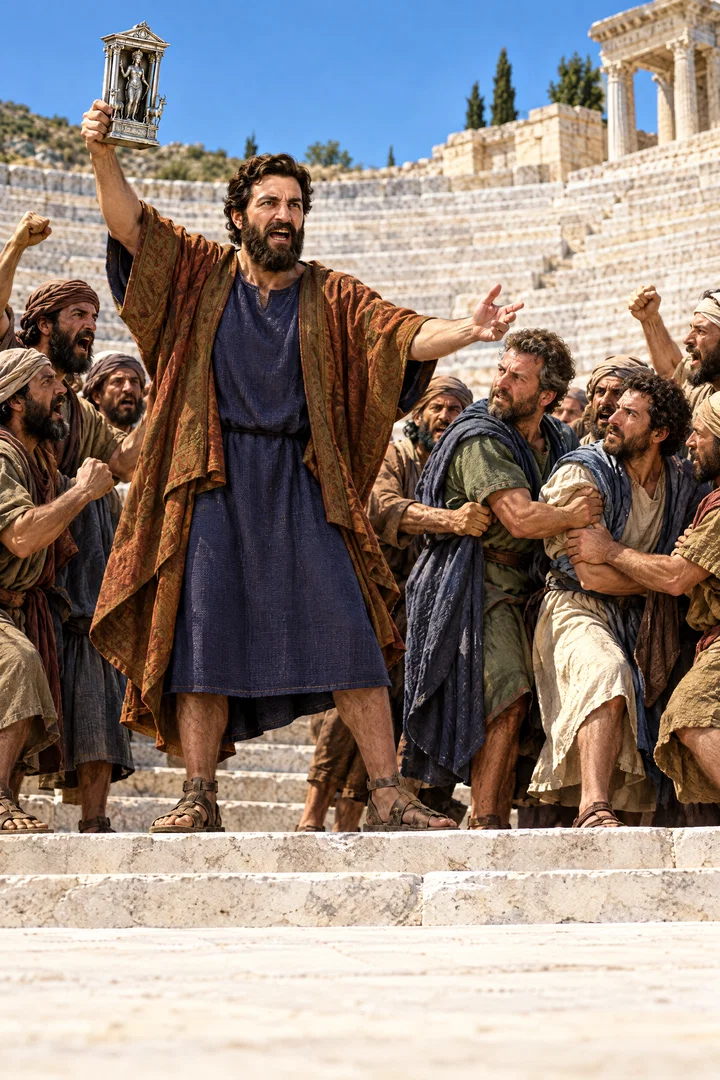
And the whole city was filled with confusion: and having caught Gaius and Aristarchus, men of Macedonia, Paul’s companions in travel, they rushed with one accord into the theatre.
Translations
American King James Version, King James Version, KJV Cambridge Paragraph Bible
And the whole city was filled with confusion: and having caught Gaius and Aristarchus, men of Macedonia, Paul’s companions in travel, they rushed with one accord into the theatre.
And the whole city was filled with confusion: and having caught Gaius and Aristarchus, men of Macedonia, Paul's companions in travel, they rushed with one accord into the theater.
Revised Version, American Standard Version
And the city was filled with the confusion: and they rushed with one accord into the theatre, having seized Gaius and Aristarchus, men of Macedonia, Paul’s companions in travel.
and the whole city was filled with confusion, they rushed also with one accord into the theatre, having caught Gaius and Aristarchus, Macedonians, Paul's fellow-travellers.
And the [whole] city was filled with confusion, and they rushed with one accord to the theatre, having seized and carried off with [them] Gaius and Aristarchus, Macedonians, fellow-travellers of Paul.
And the city was filled with the confusion; they rushed also with one accord into the theatre, carrying off with them Gaius and Aristarchus, Macedonians, fellow-travellers of Paul.
Berean Standard Bible, Majority Standard Bible
Soon the whole city was in disarray. They rushed together into the theatre, dragging with them Gaius and Aristarchus, Paul’s traveling companions from Macedonia.
The whole city was filled with confusion, and they rushed with one accord into the theater, having seized Gaius and Aristarchus, men of Macedonia, Paul’s companions in travel.
And the town was full of noise and trouble, and they all came running into the theatre, having taken by force Gaius and Aristarchus, men of Macedonia who were journeying in company with Paul.
And the whole citie was full of confusion, and they rushed into the common place with one assent, and caught Gaius, and Aristarchus, men of Macedonia, and Pauls companions of his iourney.
Douay-Rheims (Challoner revision)
And the whole city was filled with confusion; and having caught Gaius and Aristarchus, men of Macedonia, Paul’s companions, they rushed with one accord into the theatre.
Pictures
Cross-references
- Acts 19:37
For ye have brought hither these men, which are neither robbers of churches, nor yet blasphemers of your goddess.
The town clerk defends Gaius and Aristarchus against charges of temple robbery and blasphemy.
- Acts 27:2
And entering into a ship of Adramyttium, we launched, meaning to sail by the coasts of Asia; one Aristarchus, a Macedonian of Thessalonica, being with us.
Aristarchus accompanies Paul on his voyage.
- Acts 20:4
And there accompanied him into Asia Sopater of Berea; and of the Thessalonians, Aristarchus and Secundus; and Gaius of Derbe, and Timotheus; and of Asia, Tychicus and Trophimus.
Aristarchus is named among Paul’s traveling companions.
- Colossians 4:10
Aristarchus my fellowprisoner saluteth you, and Marcus, sister’s son to Barnabas, ( touching whom ye received commandments: if he come unto you, receive him;)
Also cited as a reference about Aristarchus.
- Acts 19:34
But when they knew that he was a Jew, all with one voice about the space of two hours cried out, Great is Diana of the Ephesians.
The crowd recognizes Alexander as a Jew and shouts praise to Diana.
- Acts 20:1
And after the uproar was ceased, Paul called unto him the disciples, and embraced them, and departed for to go into Macedonia.
Paul departed for Macedonia after the uproar ceased.
- Acts 19:1-10
And it came to pass, that, while Apollos was at Corinth, Paul having passed through the upper coasts came to Ephesus: and finding certain disciples,
Paul’s preaching in Ephesus led to baptisms and the gospel spreading through Asia.
- Acts 19:22
So he sent into Macedonia two of them that ministered unto him, Timotheus and Erastus; but he himself stayed in Asia for a season.
Timothy and Erastus are named among Paul’s associates at Ephesus.
- Romans 16:23
Gaius mine host, and of the whole church, saluteth you. Erastus the chamberlain of the city saluteth you, and Quartus a brother.
Gaius is commended as a host to believers.
- Acts 19:13-16
Then certain of the vagabond Jews, exorcists, took upon them to call over them which had evil spirits the name of the Lord Jesus, saying, We adjure you by Jesus whom Paul preacheth.
Earlier events in Ephesus preceded the uproar.
- Acts 19:17-20
And this was known to all the Jews and Greeks also dwelling at Ephesus; and fear fell on them all, and the name of the Lord Jesus was magnified.
The gospel’s effects in Ephesus set the context for opposition.
- 1 Corinthians 15:32
If after the manner of men I have fought with beasts at Ephesus, what advantageth it me, if the dead rise not? let us eat and drink; for to morrow we die.
Paul’s fight with beasts at Ephesus is metaphorical.
Commentary
Each commentary is drawn from primary sources: the writings of Ellen G. White and Adventist pioneers and periodicals. Each commentary is separate. Its own words are not a quotation; follow the references to read the source passages.
Ellen G. White
6 sources
The confusion that filled the whole city broke out during the yearly ceremonies in honor of Diana at Ephesus, when great numbers came from all parts of the province and the festivities were conducted with pomp and splendor.AA 291.3–292.1 It took place after more than three years of Paul's work at Ephesus, by which time a flourishing church had been raised and the gospel had spread throughout Asia among both Jews and Gentiles.AA 291.1–2 At that time Paul had purposed to pass through Macedonia and Achaia to go to Jerusalem and afterward to see Rome, had sent Timothy and Erastus on into Macedonia, and had decided to remain at Ephesus until after Pentecost, but the uproar hastened his departure.AA 291.1–2
The uproar grew out of the telling blow Paul's teaching had struck against heathen worship, which caused a perceptible falling off in attendance at the national festival and in the enthusiasm of the worshipers.AA 291.3–292.1 His influence reached far beyond open converts by enlightening many who had not accepted the new doctrines until they lost all confidence in their heathen gods.AA 291.3–292.1 The tumult was stirred up because the spread of the gospel threatened the income of image-makers and pagan priests, and the report of Demetrius's speech threw the city into confusion.AA 293.1–4AA 295.1–2 In that gala season the company of believers meeting in the school of Tyrannus stood as an inharmonious note in the festive chorus and faced ridicule, reproach, and insult.AA 291.3–292.1
When the angry crowd could not find Paul, they seized his traveling companions Gaius and Aristarchus, who were Macedonians, and rushed together with them into the theater.AA 293.1–4SLP 143.2–144.1RH Sep 14, 1911 The mob's violence was directed at Paul, and his companions were caught up in the uproar in his place.AA 293.1–4 Paul was elsewhere because his fellow believers had hurried him to safety, and when he learned his companions were in danger and wanted to go to the theater to address the rioters, they restrained him.SLP 143.2–144.1RH Sep 14, 1911 Influential magistrates also sent word urging him not to enter the perilous situation, since his appearance could provoke the crowd and put his life at risk from a mob that might have killed him, for his time to die as a martyr had not yet come.SLP 143.2–144.1RH Sep 14, 1911 The city recorder's decision showed Paul had committed no unlawful act, checked the mob, and kept Christianity from being discredited by the uproar.AA 295.1–2
Sources
Pioneers and periodicals
36 sources
Acts 19:29 describes the uproar at Ephesus near the close of Paul's work there, when a city famed for its great Temple of Diana and strong pagan worship was stirred against the gospel.ST Mar 4, 1903ST Nov 29, 1910RH Jul 28, 1868 The tumult arose because Paul's preaching against handmade gods threatened the silversmiths' trade in shrines of Diana, so selfish concern for business was the driving motive while zeal for Diana was used to win the people.RH Jul 6, 1868ST Jan 23, 1907 The craftsmen's anger filled the whole city with confusion, and the crowd seized Paul's Macedonian companions in travel, Gaius and Aristarchus, and rushed with one accord into the great theater used for public meetings.ST Mar 4, 1903ST Aug 12, 1897ST Mar 4, 1903ST Jun 18, 1885ST Aug 12, 1897 Paul himself was kept from entering to face the mob by fellow believers and friendly officials, so he escaped martyrdom while his associates were dragged in when the crowd could not find him.RH Sep 14, 1911RH Dec 3, 1867 The episode exposes an exclusive conflict between devotion to Christ and worship of Diana that admits no compromise, yet notwithstanding persecution God's working was seen and His word triumphed.ST Jul 7, 1909RH Nov 21, 1871RH Jul 30, 1914ST Nov 13, 1893ST Jan 23, 1896
The Riot at Ephesus
The uproar belongs to about A.D. 57, near the close of Paul's work at Ephesus and near the close of his third missionary journey.ST Mar 4, 1903 Ephesus was a major city in Asia Minor, famed for its great and costly Temple of Diana, or Artemis.ST Nov 29, 1910RH Jul 28, 1868 That temple was a center of pagan worship where evil supernatural power worked in support of pagan religion, yet a strong church of God was established there.ST Nov 29, 1910RH Jul 28, 1868
The uproar arose from opposition to Paul's preaching against handmade gods and idolatry and for worship of the true God.RH Jul 6, 1868ST Jan 23, 1907 As people turned, the silversmiths' business of making silver shrines and models of Diana's temple was threatened. Selfish concern for trade was the driving motive, while concern for Diana's reputation and appeals to religious zeal, superstition and fanaticism were secondary arguments used to win the people, because Paul's teaching could not be answered with fair argument.RH May 12, 1868ST Jul 29, 1897
The craftsmen's anger stirred the whole city into confusion and disorder, and the whole city was filled with confusion and swept along together.ST Mar 4, 1903ST Aug 12, 1897ST Mar 4, 1903 Most of the crowd did not know why they had gathered.ST Jul 24, 1893ST Jul 29, 1897
The crowd seized Gaius and Aristarchus, men of Macedonia and Paul's companions in travel who worked closely with him in gospel ministry.ST Aug 12, 1897RH Jul 6, 1868ST May 6, 1875 Their association with Paul may have begun during his earlier journey through Macedonia.ST Apr 3, 1884 The mob first went to the house of Aquila where Paul was lodging to seize Paul, and when they did not find him they seized these two associates and dragged them as criminals.ST Aug 12, 1897
Having caught them, the crowd rushed with one accord into the theater at Ephesus.ST Mar 4, 1903ST Jun 18, 1885 That theater held 50,000 people and was used for dramatic representations, gladiatorial contests in which men fought with men or beasts, and for meetings of citizens on extraordinary occasions.ST Aug 12, 1897
Paul himself was elsewhere because fellow believers had hurried him to safety, and though he wished to enter the theater to face the crowd they restrained him.RH Sep 14, 1911ST Jun 18, 1885 Warning from friendly officials helped keep him from a mob that might have killed him, for his time to die as a martyr had not yet come.RH Sep 14, 1911 He was thus in little or no danger because he did not enter, while the riot swept in Gaius and Aristarchus when the crowd could not find him.RH Dec 3, 1867
The episode shows Paul and his companions treated as Jews, whose rejection of idols was shared by Jews generally.RH Jul 6, 1868 Because Jews and Christians both worshiped one God and opposed idolatry, Jews could be identified with Christians and face hostility, and Jewish opponents heightened the people's rage.RH Jul 6, 1868ST Apr 10, 1884 His associates had shared his prudent and inoffensive conduct, as the town clerk later declared that they had neither robbed temples nor blasphemed the goddess.RH Jul 6, 1868 Without the town clerk's prudent intervention the tumult could have led to persecution and massacre of Christians.ST Feb 17, 1898 The disturbance was quieted after about two hours when he addressed them.ST Apr 14, 1881
The tumult raised by Demetrius is the setting for Paul's phrase about fighting with beasts at Ephesus, which describes the violence and fury of his pagan opponents, not an actual fight with wild animals in the theater.RH Dec 3, 1867 Aristarchus appears again with Paul on his journey to Rome.ST Aug 12, 1897
Teaching and Application
The uproar belongs to Paul's experience at Ephesus where God's wonderful working was seen and where the word of God triumphed notwithstanding persecution.ST Jul 7, 1909 It places his work in a setting of conflict with the worship of Diana and other pagan deities, not cooperation with it.RH Jul 30, 1914 The chapter contains no hint that Paul introduced a new Sabbath.RH Nov 21, 1871
The verse exposes the exclusive conflict between devotion to Christ and worship of Diana, for Paul refused to put Christ on the same platform with Diana or to compromise the honor of Christ in any parliament of religions.ST Nov 13, 1893 He exalted Christ alone and would not speak favorably of false and idolatrous faiths, holding to the gospel in its exclusiveness and purity.ST Nov 13, 1893 For this he was mocked and mobbed, called a babbler, a madman, and a pestilent and seditious fellow not fit to live.ST Nov 13, 1893 The choice between Christ and Diana is a test of principle with eternal consequences.ST Jan 23, 1896
The Diana worshiped in Paul's day and defended in the uproar was Semiramis, wife of Nimrod, under another name.ST Mar 4, 1913 The worship behind the uproar belongs to the same cult and character as the queen of heaven, Venus, and other early goddesses, going back to Babylon, whose walls Semiramis began to build.ST Mar 4, 1913 In context the verse stands near the believing Ephesians' burning of their books of magic, showing the right kind of conversion in which a person gives up idolatrous possessions and sinful practices, as when a convert destroys his opium poppy field.ST Dec 14, 1904
Gaius and Aristarchus, Paul's traveling companions, were caught up in the mob's attack and rushed into the theater, and their effort to stand by Paul put them in danger and showed fidelity to him.ST Oct 30, 1884 Seized by the crowd and swept into the theater during the citywide confusion, they are examples of faithful, useful believers who served zealously without being recorded as apostles.RH Aug 19, 1862 The verse is used as a model for how opponents may react when Sabbath preaching challenges Sunday observance, portraying the teaching as a threat to their church and to Sunday worship.RH Mar 31, 1859
The episode illustrates how religious leaders may appeal to popular prejudice and tradition to resist the truth, and how God's servants may need to wait for the tumult to subside before continuing their work of teaching.RH May 12, 1868 The allusion to the uproar, in which the city was thrown into confusion and Gaius and Aristarchus were seized and dragged into the theater, warns that the church party in Guadaloupe might resist the gospel, yet opposition need not prevent a church from being established there, as one was in Ephesus.RH Jul 30, 1908 The disturbance followed Demetrius's appeal to the people's religious zeal to defend his trade in silver shrines, while the crowd's repeated praise of Diana was no argument against Paul's teaching.RH May 12, 1868
Opposition to Paul's work became a citywide uproar when Demetrius and the craftsmen stirred the people by appealing to superstition and fanaticism after they could not answer his teaching with fair argument.ST Jul 29, 1897 The confused crowd seized two of his companions and took them to the theater, though many did not know why they had gathered, showing how public passion can be inflamed without understanding.ST Jul 29, 1897 The verse is invoked as a parallel to artists and dealers protesting when their interests are threatened, since opposition to Paul was stirred by people whose trade depended on the shrine of Diana.ST Oct 3, 1906 Sellers of religious wares rushed together with one accord against Paul because preaching the gospel in its simplicity threatened their commerce in articles of religion such as rosaries, crowns, garlands, and pictures, and the same idolatrous shrine commerce and hostility to simple gospel preaching continues wherever such holy-house worship is carried on.ST Apr 1, 1886
Sources