Acts 19:32
Some therefore cried one thing, and some another: for the assembly was confused; and the more part knew not wherefore they were come together.
Translations
Some therefore cried one thing, and some another: for the assembly was confused: and the more part knew not why they were come together.
King James Version, KJV Cambridge Paragraph Bible
Some therefore cried one thing, and some another: for the assembly was confused; and the more part knew not wherefore they were come together.
Some therefore cried one thing, and some another: for the assembly was confused, and the greater part knew not why they had come together.
Revised Version, American Standard Version
Some therefore cried one thing, and some another: for the assembly was in confusion; and the more part knew not wherefore they were come together.
Some indeed, therefore, were calling out one thing, and some another, for the assembly was confused, and the greater part did not know for what they were come together;
Different persons therefore cried out some different thing; for the assembly was tumultuous, and the most did not know for what cause they had come together.
Others, indeed, were crying out something else; for the assembly had become confused, and, the greater part, knew not for what cause they had come together.
Berean Standard Bible, Majority Standard Bible
Meanwhile the assembly was in turmoil. Some were shouting one thing and some another, and most of them did not even know why they were there.
Some therefore cried one thing, and some another, for the assembly was in confusion. Most of them didn’ t know why they had come together.
And some said one thing, and some another: for there was no order in the meeting; and most of them had no idea why they had come together.
Some therefore cried one thing, and some another: for the assemblie was out of order, and the more part knewe not wherefore they were come together.
Douay-Rheims (Challoner revision)
Now some cried one thing, some another. For the assembly was confused, and the greater part knew not for what cause they were come together.
Pictures
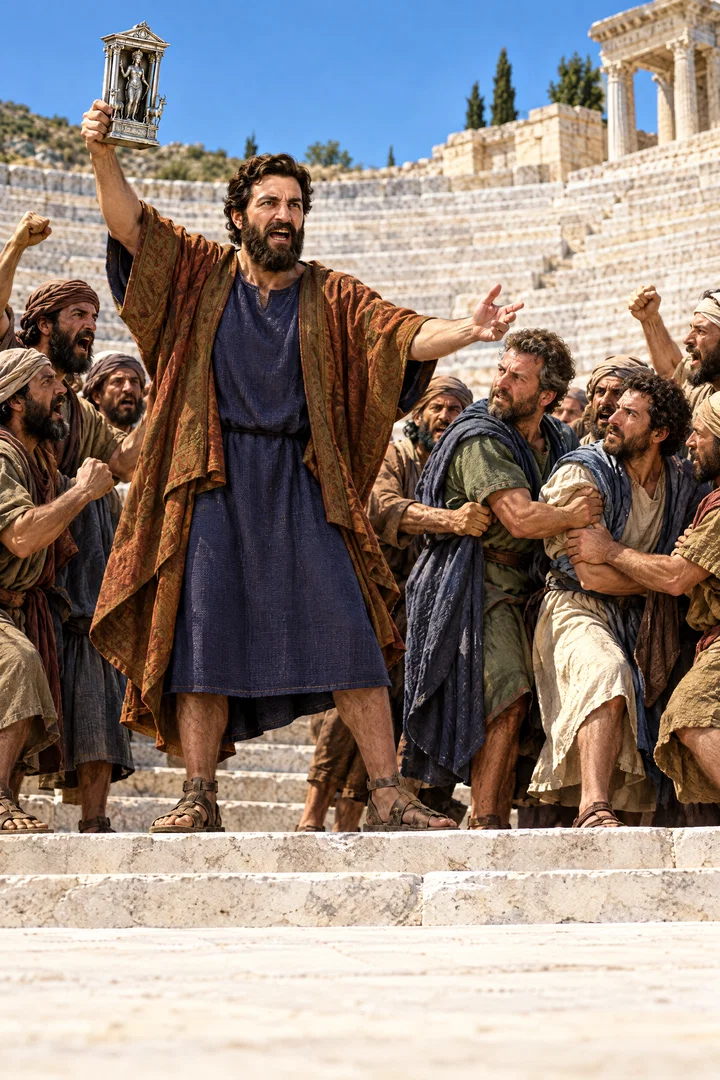
Cross-references
- Acts 19:26-27
Moreover ye see and hear, that not alone at Ephesus, but almost throughout all Asia, this Paul hath persuaded and turned away much people, saying that they be no gods, which are made with hands:
Paul’s preaching threatens Diana’s worship and the shrine trade.
- Acts 19:1-5
And it came to pass, that, while Apollos was at Corinth, Paul having passed through the upper coasts came to Ephesus: and finding certain disciples,
Paul teaches the Ephesian disciples about John’s baptism and baptizes them in Jesus’ name.
- Acts 19:39
But if ye enquire any thing concerning other matters, it shall be determined in a lawful assembly.
Both verses use ekklesia for an assembly.
- Acts 21:34
And some cried one thing, some another, among the multitude: and when he could not know the certainty for the tumult, he commanded him to be carried into the castle.
same confused shouting in Jerusalem mob against Paul
- Acts 19:41
And when he had thus spoken, he dismissed the assembly.
Both verses use the same word, rendered “assembly.”
- 1 Corinthians 16:8
But I will tarry at Ephesus until Pentecost.
states decision to remain at Ephesus until Pentecost
Commentary
Each commentary is drawn from primary sources: the writings of Ellen G. White and Adventist pioneers and periodicals. Each commentary is separate. Its own words are not a quotation; follow the references to read the source passages.
Ellen G. White
5 sources
The scene took place at Ephesus after it had been made the center of work for over three years, where a flourishing church was raised up and the gospel had spread throughout the province of Asia among both Jews and Gentiles.AA 291.1–2 Paul had been planning another missionary journey through Macedonia and Achaia to Jerusalem and afterward to Rome, and had sent Timothy and Erastus into Macedonia while deciding himself to remain at Ephesus until after Pentecost because the cause there still needed him.AA 291.1–2 The assembly gathered during the once-a-year special ceremonies in honor of Diana, which drew great numbers from all parts of the province with utmost pomp and splendor.AA 291.3–292.1
It was a gala season and a trying time for those newly come to the faith, since the company of believers meeting in the school of Tyrannus stood out against the festive mood and faced ridicule, reproach, and insult.AA 291.3–292.1 The confusion followed a telling blow to heathen worship from Paul's labors, seen in a perceptible falling off in attendance at the national festival and in the enthusiasm of the worshipers.AA 291.3–292.1 His teachings reached far beyond actual converts, so that many who had not openly accepted the new doctrines became enlightened enough to lose all confidence in their heathen gods.AA 291.3–292.1
The real cause behind the uproar was the threat of the gospel to image-making, as Demetrius and his fellow craftsmen saw their business endangered and the income of pagan priests and artisans at stake, and for that reason aroused bitter opposition against Paul.AA 295.1–2 The same money interest explains much of the persecution that followed the apostles in their work.AA 295.1–2 The assembly was a confused and tumultuous crowd in the theater, with some crying one thing and some another and most not knowing why they had come together.SLP 144.2AA 294.1–2AA 295.1–2
The uproar kept growing, and the crowd was not willing to distinguish among those involved.SLP 144.2 When Alexander tried to address the crowd, they pushed him aside and shouted in praise of Diana.SLP 144.2 When he tried to direct their anger against Paul and his companions, the crowd rejected him and chanted in praise of Diana.AA 294.1–2
The decision of the city recorder and other honorable officers presented Paul as innocent of any unlawful act, a triumph of Christianity over error and superstition in which God raised up a great magistrate to vindicate His apostle and hold the mob in check.AA 295.1–2 Paul was grateful to God that his life was preserved and that Christianity was not brought into disrepute by the tumult, though the uproar hastened his departure from Ephesus.AA 291.1–2AA 295.1–2
Sources
Pioneers and periodicals
30 sources
The verse describes the crowd gathered in the theater at Ephesus as thrown into confusion, with different groups shouting different things while most did not know why they had come together.ST Aug 12, 1897ST Mar 4, 1903 The uproar had been stirred up by Demetrius and his fellow silversmiths, moved chiefly by selfish fear that Paul's preaching threatened their trade in shrines of Diana, with zeal for Diana added to win the crowd.RH Dec 3, 1867 The word for assembly here means a civic gathering of citizens regularly summoned, showing that ekklesia can describe an assembly other than the church of God's people.ST May 31, 1899ST Jan 1, 1885ST Sep 24, 1896 Such confusion where most do not know the purpose is the characteristic condition of mob action, the mob spirit that is the spirit of Satan let loose to stir a throng quickly to violence.ST Mar 4, 1903ST Mar 4, 1903ST Aug 12, 1897ST Apr 22, 1903 Preaching Christ in simplicity creates such an uproar because it exposes and threatens idolatrous trade, yet the word of God triumphed at Ephesus notwithstanding persecution.ST Jul 7, 1909RH Jul 30, 1914ST Nov 13, 1893ST Oct 3, 1906
The Riot Described
The gathering crowded into the theater at Ephesus was in confusion, with some crying one thing and some another and the more part not knowing why they had come together.ST Aug 12, 1897ST Mar 4, 1903ST Mar 4, 1903ST Feb 17, 1898 This divided shouting by people who did not know why they had assembled is the characteristic condition of mob action and mob violence in the riot.ST Aug 12, 1897ST Mar 4, 1903ST Mar 4, 1903ST Feb 17, 1898ST Aug 12, 1897
The uproar had been stirred up by Demetrius and his fellow craftsmen and silversmiths, whose income depended on making silver shrines of Diana.RH Dec 3, 1867ST Jul 29, 1897ST Feb 17, 1898 Paul's preaching and the spread of Christianity threatened that trade, and selfish concern over the loss of business was chiefly what drove the attack on him.ST Jul 29, 1897ST Feb 17, 1898 The claim that he discredited Diana was added as a secondary appeal to stir the people's superstition and fanaticism and win the crowd's support, rather than answering his teaching with fair argument.ST Jul 29, 1897ST Oct 3, 1906
The city was filled with confusion and the crowd rushed with one accord into the theater, having seized Gaius and Aristarchus, Macedonians and Paul's companions in travel.ST Mar 4, 1903ST Jul 29, 1897 Paul was kept from entering in to the people by the disciples and by his friends the Asiarchs.ST Mar 4, 1903 The disorder of the crowd that filled the theater where his companions had been taken was part of a riot that ended only when the town clerk calmed the people.ST Mar 4, 1903ST Jul 29, 1897
A few leaders started the cry in praise of Diana, and the crowd followed without understanding the cause of the uproar.RH May 12, 1868ST Mar 17, 1887RH May 12, 1868 They had rushed together out of curiosity and were swept along by excitement and alarm until they joined the cry and echoed the alarm raised by others.RH May 12, 1868ST Mar 17, 1887RH May 12, 1868
In the disorder the Jews were likely in danger because feeling ran strongly against them, so they put forward Alexander to defend them.ST Apr 10, 1884 The mob would not listen but instead cried Great is Diana of the Ephesians for about two hours.ST Apr 10, 1884ST Apr 14, 1881 In their mistaken zeal they thought that noisily repeating the cry would establish Diana's greatness.ST Apr 10, 1884ST Apr 14, 1881
That most had not known why they were called together indicates that Demetrius, who summoned the meeting, had authority among the silversmiths and was presumably their organization's head.
The tumult belonged to the worship of Diana of the Ephesians in Paul's days at Ephesus, and the uproar was connected with that worship as the setting in which the gospel confronted pagan worship.RH Jul 30, 1914RH Jul 28, 1868ST Apr 1, 1886 Her magnificent temple was surrounded by street commerce in shrines, rosaries, crowns, garlands, pictures and other articles of religion, whose vendors pressed travelers to buy and assailed them in Italian, in French, or in English, determined to sell their wares.ST Apr 1, 1886 Preaching the gospel in its simplicity there creates an uproar among those sellers because it exposes and threatens their trade, proving the system to be paganism and idolatry.ST Apr 1, 1886
That Diana is of the same cult and character as Semiramis, the wife of Nimrod and one of the early worshiped goddesses, also worshiped as the queen of heaven and as Venus and other goddesses of the same kind.ST Apr 1, 1886ST Mar 4, 1913 The same temple system continues at Loreto on the Adriatic, where the supposed Holy House where Christ was born is adored with continual festival, crowds, masses, censers, kneeling adoration of stones, and a jeweled black image of the virgin and child.ST Apr 1, 1886
The tumult grew so great that order could not be maintained and the gathering broke up.ST Aug 13, 1885
What Assembly Means
The word assembly here names the confused civic gathering at Ephesus, not the church, showing that ekklesia can refer to an assembly other than the assembly of God's people.ST May 31, 1899ST Jan 1, 1885 The gathering shouted different things and most did not know why they had come together, yet it is still called an assembly.ST May 31, 1899ST Jan 1, 1885ST Sep 24, 1896 The reason is that the word belongs to the Greek ekklesia, meaning an assembly of citizens regularly summoned rather than merely a crowd.ST May 31, 1899ST Sep 24, 1896 The verse thus illustrates the distinction between an ekklesia and a mere crowd or concourse.ST May 31, 1899ST Sep 24, 1896
The same use shows that the Greek ekklesia can mean a company called out, a popular meeting, a congregation, or an assembly.ST Mar 5, 1896 The phrase church of God therefore describes a company or assembly belonging to God.ST Mar 5, 1896 It expresses the character of that company rather than serving as a unique denominational name.ST Mar 5, 1896
What Confusion Teaches
The verse shows the characteristic condition of mob action and mob violence.ST Mar 4, 1903ST Mar 4, 1903ST Aug 12, 1897 After the city was filled with confusion and the crowd rushed with one accord into the theater, having seized Gaius and Aristarchus, men of Macedonia and Paul's companions in travel, while Paul was kept from entering to the people by the disciples and by his friends the Asiarchs, the assembly was in confusion with some crying one thing and some another and the more part not knowing why they had come together.ST Mar 4, 1903 This confusion in which most do not know the purpose of the demonstration is universal wherever the mob is found, among heathen, Jews, or those professing Christianity.ST Apr 22, 1903
It is the mob spirit, which is the spirit of Satan let loose in the human being, running quickly through a throng and stirring people to deeds of violence even when they do not know the purpose of the demonstration.ST Apr 22, 1903 The same ignorance marked the Jewish mob against Paul at Jerusalem, where perhaps the majority did not know what Paul had done or even what he was charged with having done.ST Apr 22, 1903 Popular religious traditions and prejudice can stir people against truth without their understanding the issue, as in the uproar over Diana where the people struggled to give a reason for her worship but agreed that she was great.RH May 12, 1868 People echoed the alarm raised by others while most did not know why they had gathered, and when turmoil clouds judgment the truth must be taught patiently after the disturbance subsides.RH May 12, 1868
Paul preached Christ rather than honoring Diana alongside him, and the confused gathering with people shouting different things and many not knowing why they had assembled belongs to the Ephesian mob that opposed him.ST Nov 13, 1893 Preaching the gospel in its simplicity there creates an uproar among the sellers because it exposes and threatens their trade, proving the system to be paganism and idolatry, where a magnificent temple was surrounded by street commerce in rosaries, crowns, garlands, pictures and other articles of religion with vendors assailing travelers in Italian, in French, or in English and determined to sell their wares.ST Apr 1, 1886 The same temple system continues at Loreto on the Adriatic, where the supposed Holy House where Christ was born is adored with continual festival, crowds, masses, censers, kneeling adoration of stones and a jeweled black image of the virgin and child.ST Apr 1, 1886 The incident is a parallel to artists and others defending their interests against criticism of their work, after the shrine makers for Diana stirred opposition.ST Oct 3, 1906
The episode belongs to Paul's experience at Ephesus and shows how wonderfully God worked there, with the word of God triumphing notwithstanding persecution.ST Jul 7, 1909 It belongs to the account of Paul's work amid opposition connected with the worship of Diana, setting the contrast between the gospel and pagan worship: the gospel remains the way of life, and Christian work is not to be joined with pagan religious work.RH Jul 30, 1914 Such an Ephesian uproar over threatened established worship does not prevent an Ephesian church from following, though the crowd gathered against the gospel without knowing why it had assembled.RH Jul 30, 1908 The believing Ephesians show the right kind of religion and conversion, in which those who yield to Christ give up and destroy their idols as the Ephesians burnt their books of magic, like tearing out a planted opium poppy field, and so it will be with any who are possessed of idols.ST Dec 14, 1904
The uprising stirred up by Demetrius and his fellow craftsmen is the danger usually associated with Paul's words about fighting beasts at Ephesus, but it does not adequately explain the expression because Paul did not enter the theater, had little or no danger there, and had no direct contention with the craftsmen, while Gaius and Aristarchus were the ones exposed to danger.RH Dec 3, 1867 The tumult in which the crowd was confused and most people did not know why they had gathered belongs to that uproar, whose violent opposition is compared to the fury of wild beasts.RH Dec 3, 1867 The chapter containing the verse leaves the seventh-day Sabbath unchanged and gives no word about introducing first-day observance, containing no hint of a new Sabbath.RH Nov 21, 1871
Sources