Acts 19:26
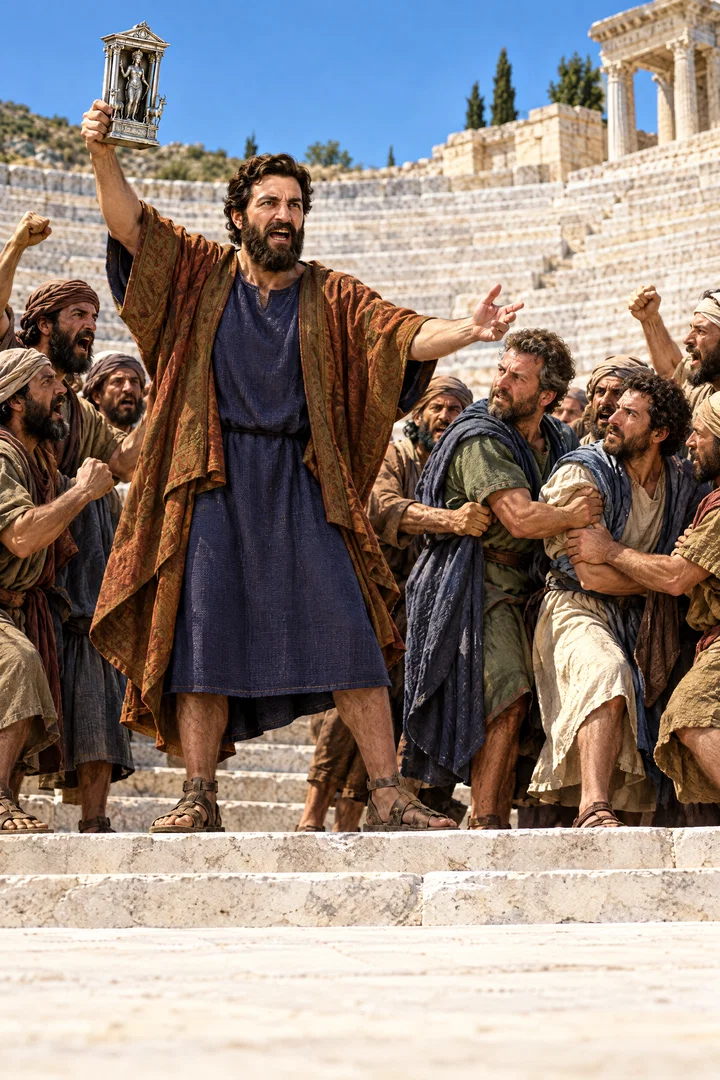
Moreover ye see and hear, that not alone at Ephesus, but almost throughout all Asia, this Paul hath persuaded and turned away much people, saying that they be no gods, which are made with hands:
Translations
Moreover you see and hear, that not alone at Ephesus, but almost throughout all Asia, this Paul has persuaded and turned away much people, saying that they be no gods, which are made with hands:
King James Version, KJV Cambridge Paragraph Bible
Moreover ye see and hear, that not alone at Ephesus, but almost throughout all Asia, this Paul hath persuaded and turned away much people, saying that they be no gods, which are made with hands:
Moreover, ye see and hear, that not alone at Ephesus, but almost throughout all Asia, this Paul hath persuaded and turned away many people, saying, that they are no gods which are made with hands.
And ye see and hear, that not alone at Ephesus, but almost throughout all Asia, this Paul hath persuaded and turned away much people, saying that they be no gods, which are made with hands:
And ye see and hear, that not alone at Ephesus, but almost throughout all Asia, this Paul hath persuaded and turned away much people, saying that they are no gods, that are made with hands:
and ye see and hear, that not only at Ephesus, but almost in all Asia, this Paul, having persuaded, did turn away a great multitude, saying, that they are not gods who are made by hands;
and ye see and hear that this Paul has persuaded and turned away a great crowd, not only of Ephesus, but almost of all Asia, saying that they are no gods which are made with hands.
and ye perceive and hear that, not only in Ephesus, but well-nigh in all Asia, this Paul, hath persuaded and turned away a considerable multitude, saying that they are, no gods, which, with hands, are made.
And you can see and hear that not only in Ephesus, but in nearly the whole province of Asia, Paul has persuaded a great number of people to turn away. He says that man-made gods are no gods at all.
And you can see and hear that not only in Ephesus, but in nearly the whole province of Asia, this Paul has persuaded a great number of people to turn away. He says that man-made gods are no gods at all.
You see and hear that not at Ephesus alone, but almost throughout all Asia, this Paul has persuaded and turned away many people, saying that they are no gods that are made with hands.
And you see, for it has come to your ears, that not only at Ephesus, but almost all through Asia, this Paul has been teaching numbers of people and turning them away, saying that those are not gods who are made by men's hands:
Moreouer ye see and heare, that not alone at Ephesus, but almost throughout all Asia this Paul hath perswaded, and turned away much people, saying, That they be not gods which are made with handes.
Douay-Rheims (Challoner revision)
And you see and hear, that this Paul by persuasion hath drawn away a great multitude, not only of Ephesus, but almost of all Asia, saying: They are not gods which are made by hands.
Pictures
Cross-references
- Acts 19:18-20
And many that believed came, and confessed, and shewed their deeds.
Converts turned from former practices, burned their books, and the word of God prevailed.
- Acts 20:20-21
And how I kept back nothing that was profitable unto you, but have shewed you, and have taught you publickly, and from house to house,
Paul’s public teaching turned people from idols to repentance and faith in Christ.
- Acts 17:16-34
Now while Paul waited for them at Athens, his spirit was stirred in him, when he saw the city wholly given to idolatry.
grouped together as places where God wrought and the word triumphed
- Acts 19:10
And this continued by the space of two years; so that all they which dwelt in Asia heard the word of the Lord Jesus, both Jews and Greeks.
People throughout Asia heard the word during Paul’s work in Ephesus.
- Acts 19:37
For ye have brought hither these men, which are neither robbers of churches, nor yet blasphemers of your goddess.
The town clerk says Paul’s companions neither robbed temples nor blasphemed Diana.
- Acts 19:9
But when divers were hardened, and believed not, but spake evil of that way before the multitude, he departed from them, and separated the disciples, disputing daily in the school of one Tyrannus.
Ephesian unbelief preceded Paul’s persuasion of people to turn from handmade gods.
- John 14:6
Jesus saith unto him, I am the way, the truth, and the life: no man cometh unto the Father, but by me.
Identifies the Way Paul preached as displacing idols.
- Exodus 20:4-6
Thou shalt not make unto thee any graven image, or any likeness of any thing that is in heaven above, or that is in the earth beneath, or that is in the water under the earth:
The commandment forbids making and worshiping images.
- 1 Corinthians 15:32
If after the manner of men I have fought with beasts at Ephesus, what advantageth it me, if the dead rise not? let us eat and drink; for to morrow we die.
Paul describes his conflict at Ephesus as fighting beasts.
- Acts 14:15
And saying, Sirs, why do ye these things? We also are men of like passions with you, and preach unto you that ye should turn from these vanities unto the living God, which made heaven, and earth, and the sea, and all things that are therein:
Paul urges the people to turn from false gods to the living God.
- Acts 19:1-5
And it came to pass, that, while Apollos was at Corinth, Paul having passed through the upper coasts came to Ephesus: and finding certain disciples,
The Ephesian disciples’ earlier baptism and their baptism in Jesus’ name are discussed.
- Acts 17:6
And when they found them not, they drew Jason and certain brethren unto the rulers of the city, crying, These that have turned the world upside down are come hither also;
Paul and his companions were accused of turning the world upside down.
- Acts 20:1
And after the uproar was ceased, Paul called unto him the disciples, and embraced them, and departed for to go into Macedonia.
Paul's hastened departure from Ephesus
- 1 Corinthians 16:9
For a great door and effectual is opened unto me, and there are many adversaries.
An effective ministry opportunity at Ephesus met with many adversaries.
- 2 Corinthians 1:8-10
For we would not, brethren, have you ignorant of our trouble which came to us in Asia, that we were pressed out of measure, above strength, insomuch that we despaired even of life:
Paul’s severe trouble in Asia reflects the danger he faced at Ephesus.
- Acts 19:13
Then certain of the vagabond Jews, exorcists, took upon them to call over them which had evil spirits the name of the Lord Jesus, saying, We adjure you by Jesus whom Paul preacheth.
False exorcists invoke Jesus’ name, while the surrounding miracles confirm unbelief.
Commentary
Each commentary is drawn from primary sources: the writings of Ellen G. White and Adventist pioneers and periodicals. Each commentary is separate. Its own words are not a quotation; follow the references to read the source passages.
Ellen G. White
11 sources
Ephesus was the center of the worship of Diana, honored in a magnificent temple, whose image was believed to have fallen from the sky, and its people also trusted in mystic symbols and books of magic as powerful charms against danger, disease, and death.SLP 134.2–4 The statement that Paul had persuaded and turned away much people describes the result of more than three years of labor with Ephesus as the center, where a flourishing church was raised up and from which the gospel spread throughout the province of Asia among both Jews and Gentiles.AA 291.1–2 It was spoken when Paul had purposed to pass through Macedonia and Achaia on his way to Jerusalem and then to see Rome, had sent Timothy and Erastus, who ministered to him, into Macedonia, and had decided to remain in Ephesus until after Pentecost because the cause there still demanded his presence, until an event hastened his departure.AA 291.1–2
Paul taught that gods made with hands are no gods, and persuaded and turned away much people not only at Ephesus but almost throughout all Asia from belief in and worship of gods made by human hands.AA 291.1–2AA 291.3–292.1SLP 142.2AA 292.2–3RH Sep 14, 1911 That preaching gave the worship of Diana a telling blow, so that the worship declined and confidence in it was lost, challenging a worship represented by portable images and shrines.AA 291.3–292.1AA 292.2–3SLP 142.1 The effect appeared at the yearly national festival for Diana, which drew crowds from all parts of Asia with pomp and splendor, where attendance and enthusiasm for the worshipers' gods perceptibly fell off.AA 291.3–292.1SLP 141.2
The influence reached far beyond actual converts and those who openly became believers, for many who did not openly accept the new faith were enlightened enough to lose all confidence in their heathen gods.AA 291.3–292.1SLP 141.2 At that time the small company of believers meeting in the school of Tyrannus stood out in marked contrast to the festive chorus and faced ridicule, reproach, and insult.AA 291.3–292.1 The loss of confidence and decline of worship threatened the trade and income built on making and selling silver shrines and images of Diana, affecting image-makers and pagan priests.SLP 142.2AA 292.2–3AA 295.1–2RH Sep 14, 1911SLP 142.1
Fear for their business stirred bitter opposition against Paul, bringing curses against him, and Demetrius used the claim that handmade gods are no gods to stir the craftsmen to opposition.SLP 142.2AA 295.1–2RH Sep 14, 1911SLP 141.2SLP 142.1 The chapter containing this statement records the same apostolic experience as Acts 2 and Acts 10, corroborating present reception of the promised blessing where power comes upon believers and they speak in other tongues as the Spirit gives utterance, with accompanying persecution matching that of the early apostles.Ms 115, 1908
Sources
Pioneers and periodicals
41 sources
Demetrius the silversmith told the assembled shrine-makers and workmen that Paul had persuaded and turned away much people, not alone at Ephesus but almost throughout all Asia, by teaching that they are no gods which are made with hands.ST Mar 4, 1903ST Feb 17, 1898ST Aug 12, 1897RH Dec 3, 1867 Ephesus was a great center of the worship of Diana, whose temple brought civic pride and wealth, and the threatened craft was the making of small silver shrines containing her image for pilgrims to honor in homes or carry as charms.ST Jun 4, 1885ST Mar 4, 1903ST Aug 12, 1897ST Jul 29, 1897ST Nov 29, 1910 Paul's preaching of Christ as the Way of Life and the only Saviour dethroned idols in the hearts of the people and turned them from Diana to Jesus alone, not permitting the two worships to be combined.RH Sep 13, 1906ST Nov 13, 1893ST Feb 3, 1881ST Aug 12, 1897 The uproar arose because that success cut into the income of the craftsmen and priests who profited from idol worship, and the alarm for Diana and her temple was raised to draw the people into what was chiefly a struggle for trade.ST Mar 4, 1903ST Mar 4, 1903ST Feb 17, 1898 Things made by human hands are not gods and have no divine authority or claim on conscience, and by the same rule a man-appointed Sabbath of human tradition has no claim on conscience.RH Jul 6, 1868RH Apr 18, 1907RH May 12, 1868ST Nov 5, 1885
Wording and Historical Setting
The words are those of Demetrius, the instigator of the trouble, spoken to the assembled shrine-makers and workmen of like occupation about the influence of Paul's preaching.ST Mar 4, 1903ST Feb 17, 1898RH Dec 3, 1867RH Dec 3, 1867 What he reported was a seen and heard fact: that this Paul had persuaded and turned away much people, not alone at Ephesus but almost throughout all Asia, by saying that they be no gods which are made with hands.ST Mar 4, 1903ST Feb 17, 1898ST Aug 12, 1897ST Aug 12, 1897 The complaint was aimed directly at the product of the silversmiths' craft and at the work that had caused their meeting.ST Mar 4, 1903ST Aug 12, 1897
The time was about A.D. 57, near the close of Paul's work at Ephesus and near the close of his third missionary journey.ST Mar 4, 1903 Paul had preached in Ephesus for two years, so that people throughout Asia heard the word of the Lord, and the verse shows the wide reach of his teaching.ST Mar 4, 1903ST Oct 4, 1883 By all Asia is meant the Roman province of Asia Minor known by that name.ST Mar 4, 1903ST Jul 29, 1897ST Jul 29, 1897
Ephesus was a major center of Diana worship, where the great Temple of Diana stood and a strong church was established.ST Jul 29, 1897ST Nov 29, 1910 Her immense temple was a source of civic pride and wealth, so the claim that handmade gods were not gods challenged a deeply established religious and economic order.ST Jun 4, 1885ST Jul 29, 1897 The silversmiths' craft struck by that teaching was the making of small silver shrines of Diana.ST Mar 4, 1903ST Aug 12, 1897RH Dec 3, 1867 These were small models of the temple containing an image of the goddess, bought by pilgrims and set up in homes for worship or carried on the person as charms to avert disease and danger.ST Aug 12, 1897
The Diana of the Ephesians in Paul's day belongs to the same cult and character as Semiramis, wife of Nimrod, worshiped as the queen of heaven, with Venus and other goddesses of the same kind.ST Mar 4, 1913
Gospel's Spread and Fruit
Paul's preaching persuaded many people, not alone at Ephesus but almost throughout all Asia, to turn away from worshiping handmade gods and images as gods, declaring that things made with hands are no gods.RH Mar 31, 1859ST Mar 4, 1903ST Aug 12, 1897ST Jun 9, 1898 His teaching was the proclamation of Christ as the Way of Life, and that truth dethroned idols in the hearts of the people.ST Aug 12, 1897 The stir this caused came because so many were turned from idols to a new allegiance.ST Jan 23, 1907ST Aug 12, 1897
Christianity did not allow the worship of Diana to be combined with the worship of Christ, because Jesus is the only Saviour; Paul turned the Ephesians from Diana to Jesus Christ and exalted Christ alone rather than placing Him alongside pagan gods.RH Sep 13, 1906ST Nov 13, 1893ST Feb 3, 1881 Its influence reached even people who had not openly accepted the Christian faith, weakening their confidence in heathen gods. His influence emptied the temples and exemplified the power of the church.RH Sep 5, 1871
The verse belongs to Paul's experience at Ephesus in which God wrought wonderfully, as in Thessalonica, Berea, Athens, Corinth, and Troas and in his farewell to the elders of Ephesus, where notwithstanding persecution the word of God triumphed in every case.ST Jul 7, 1909 His work there brought a deeper and more lasting peace.ST Jan 23, 1907 Genuine conversion led people to abandon practices tied to idolatry, as the believing Ephesians burned their books of magic.ST Dec 14, 1904 Even after such an uproar, a Christian church could arise in Ephesus, showing that opposition to the gospel did not prevent its work from taking root.RH Jul 30, 1908
Opposition Over Threatened Trade
Paul's success in turning people from handmade gods cut into demand for idols and shrines and put at risk the livelihood and income of the craftsmen, image-makers and pagan priests who lived by that worship.ST Mar 4, 1903ST Mar 4, 1903ST Jan 23, 1896ST Jul 1, 1880 What Demetrius reported as seen and heard was that Paul had persuaded and turned away much people, not alone at Ephesus but almost throughout all Asia, by teaching that gods made with hands are no gods.ST Mar 4, 1903ST Mar 4, 1903ST Jan 23, 1896ST Jul 1, 1880ST Jul 24, 1893 That was about A.D. 57, near the close of Paul's work at Ephesus and near the close of his third missionary journey, and by all Asia is meant the Roman province of Asia Minor known by that name.ST Mar 4, 1903 The trade at stake was in small shrines of Diana, and the spread of the gospel that challenged idol worship threatened the trade built around making them, so the silversmiths opposed his work for that reason.ST Mar 4, 1903ST Mar 4, 1903ST Jan 23, 1896ST Jul 1, 1880ST Jul 24, 1893
Demetrius treated this teaching as a danger both to his trade in silver shrines and to the worship and standing of Diana and her temple, and he used that double threat to stir the people against Paul's message.RH May 12, 1868 The preaching had persuaded and turned many away from handmade gods not only in Ephesus but across much of Asia, identifying those images as no gods.RH May 12, 1868 The alarm about bringing the goddess Diana into disrepute was secondary, raised to draw the people into the silversmiths' opposition. The opposition arose because the change threatened the craftsmen's income from idol worship, rather than from sincere devotion to Diana.ST Feb 17, 1898
The tumult raised by Demetrius grew out of Paul's teaching that handmade objects are not gods, which turned many away from idol worship and provoked fierce opposition from pagan zealots.RH Dec 3, 1867 The conflict with these adversaries is described as fighting wild beasts metaphorically, not as a literal arena combat.RH Dec 3, 1867
Doctrine Proved by Chapter
The saying reported in the verse teaches that images and other things fashioned by human hands are not gods.RH Jul 6, 1868RH Apr 18, 1907 That denial was the common conviction of Jews generally, and its presence in the charge helps show that Paul and his companions were taken for Jews.RH Jul 6, 1868 To make such images and bow down to them is idolatry of an especially grave sort, the same in kind as enthroning another god in the heart yet heavier in degree because the open example draws others after it.RH Apr 18, 1907 What is only of human making therefore carries no divine authority and lays no claim upon conscience.ST Nov 5, 1885
The wider chapter does not establish that everyone baptized with John's baptism must be baptized over again.ST Jun 3, 1880 The twelve found at Ephesus were an exceptional case, for they had not been immersed by John himself but by some of his followers, had not received the instruction John gave his candidates, and did not even know whether there was a Holy Spirit, so Paul treated them as beginners starting afresh.ST Jun 3, 1880 The chapter thus stands as the record of the apostle's practice of rebaptism.ST Jun 3, 1880RH Apr 2, 1857 It warrants a second baptism when the former rite departed from the mode or purpose Scripture prescribes, since an unauthorized ceremony does not dispense with the true ordinance, and rebaptism is right when the first baptism failed the requirements of the gospel rite.ST Jun 3, 1880RH Apr 2, 1857
Later Parallels and Applications
The preaching that turned people from gods made with hands is the pattern for persuading people to reject a man-appointed Sabbath, with Sunday worship standing in the place of the goddess as the threatened object of worship.RH Mar 31, 1859 By that analogy Sunday-keeping is a human institution and human tradition traced to the Pope of Rome, not a divinely appointed Sabbath, and therefore it has no claim on conscience.RH May 12, 1868ST Nov 5, 1885 The first day does not become the Sabbath merely because men call it the Christian Sabbath.RH May 12, 1868
Opposition to that teaching against Sunday is driven by prejudice and popular tradition and by concern for income and for Sunday worship itself.RH May 12, 1868 In the same way the verse supplies the pattern for opposition to the third angel's message, in which religious leaders and system-worshipers resist testimony that threatens their forms of worship. The same kind of preaching carried to Loreto would provoke an uproar among those selling religious goods, and a broad health reform that lessened the use of drugs and patent medicines would likewise provoke loud protest from those whose income depended on selling them.ST Apr 1, 1886RH Aug 14, 1866
The priest who tried to stop the teaching about purgatory is a modern Demetrius, fearing that exposure of the doctrine would harm the traffic in souls, just as ministers troubled about their own craft echo the verse's concern about a threatened craft.RH May 5, 1903RH Jul 28, 1859 Paul's work at Ephesus in opposition to the worship of Diana and other pagan deities is the setting in which Christians would refuse to cooperate with such worshipers in religious instruction that could direct people toward pagan worship.RH Jul 30, 1914 The missionary work at Ephesus would help the gospel stir Asia Minor again, and although Diana worship would disappear, lifeless formalism would be just as bad.ST Jul 29, 1897 The verse belongs to the account of opposition to Paul at Ephesus over the worship of Diana, the conflict invoked by the choice of Christ or Diana.ST Jan 23, 1896
Sources