Acts 19:31
And certain of the chief of Asia, which were his friends, sent unto him, desiring him that he would not adventure himself into the theatre.
Translations
And certain of the chief of Asia, which were his friends, sent to him, desiring him that he would not adventure himself into the theatre.
King James Version, KJV Cambridge Paragraph Bible
And certain of the chief of Asia, which were his friends, sent unto him, desiring him that he would not adventure himself into the theatre.
And certain of the chief of Asia, who were his friends, sent to him, desiring him that he would not adventure himself into the theater.
And certain also of the chief officers of Asia, being his friends, sent unto him, and besought him not to adventure himself into the theatre.
And certain also of the Asiarchs, being his friends, sent unto him and besought him not to adventure himself into the theatre.
and certain also of the chief men of Asia, being his friends, having sent unto him, were entreating him not to venture himself into the theatre.
and some of the Asiarchs also, who were his friends, sent to him and urged him not to throw himself into the theatre.
Moreover, certain of the Asiarchs also, being his friends, sending unto him, were beseeching him not to adventure himself into the theatre.
Berean Standard Bible, Majority Standard Bible
Even some of Paul’s friends who were officials of the province of Asia sent word to him, begging him not to venture into the theatre.
Certain also of the Asiarchs, being his friends, sent to him and begged him not to venture into the theater.
And some of the rulers of Asia, being his friends, sent to him, requesting him seriously not to put himself in danger by going into the theatre.
Certaine also of the chiefe of Asia which were his friendes, sent vnto him, desiring him that hee woulde not present him selfe in the Common place.
Douay-Rheims (Challoner revision)
And some also of the rulers of Asia, who were his friends, sent unto him, desiring that he would not venture himself into the theatre.
Pictures
Cross-references
- Acts 19:35-41
And when the townclerk had appeased the people, he said, Ye men of Ephesus, what man is there that knoweth not how that the city of the Ephesians is a worshipper of the great goddess Diana, and of the image which fell down from Jupiter?
The town clerk calms the uproar and dismisses the assembly.
- 1 Corinthians 15:32
If after the manner of men I have fought with beasts at Ephesus, what advantageth it me, if the dead rise not? let us eat and drink; for to morrow we die.
Paul’s phrase about fighting beasts at Ephesus relates to the theater tumult.
- Acts 20:1
And after the uproar was ceased, Paul called unto him the disciples, and embraced them, and departed for to go into Macedonia.
hastened departure from Ephesus
- Acts 19:8-10
And he went into the synagogue, and spake boldly for the space of three months, disputing and persuading the things concerning the kingdom of God.
Paul’s preaching in Ephesus led to a church that persisted despite opposition.
Commentary
Each commentary is drawn from primary sources: the writings of Ellen G. White and Adventist pioneers and periodicals. Each commentary is separate. Its own words are not a quotation; follow the references to read the source passages.
Ellen G. White
6 sources
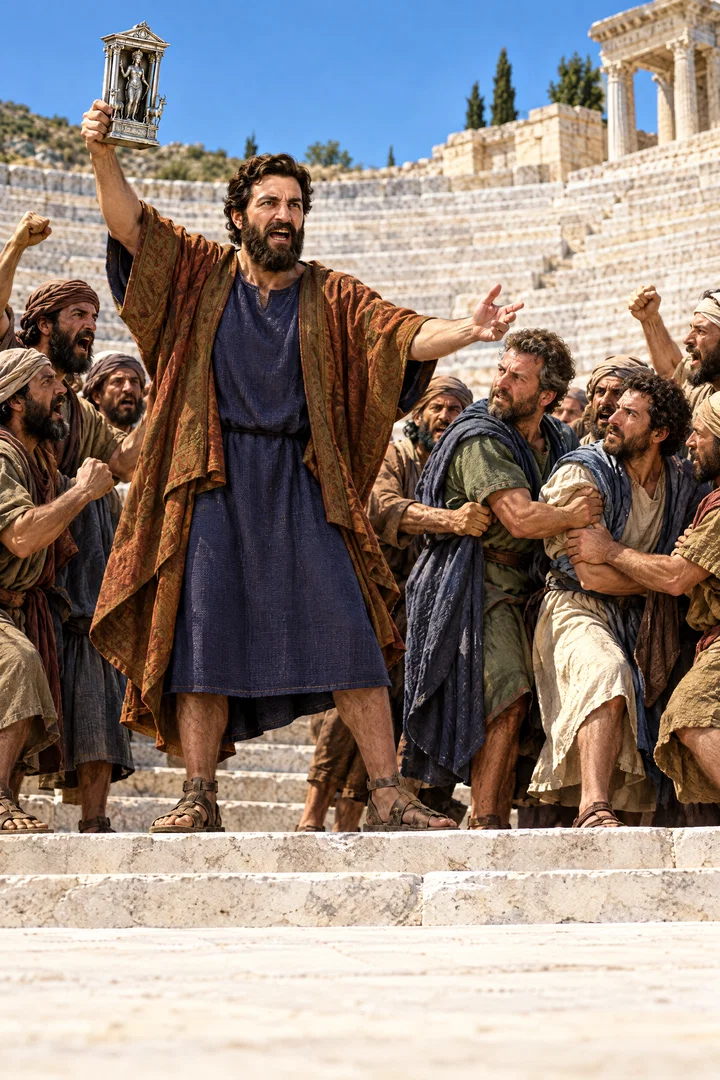
The verse belongs to the close of more than three years of work centered at Ephesus, from which the gospel had spread throughout Asia among both Jews and Gentiles.AA 291.1–2 At that time Paul had purposed to go through Macedonia and Achaia to Jerusalem and afterward to Rome, had sent Timothy and Erastus ahead into Macedonia, and had chosen to remain at Ephesus until after Pentecost because the cause there still needed him.AA 291.1–2 It occurs during the once-a-year special ceremonies in honor of Diana, which drew great crowds from all parts of Asia for splendid festivities.AA 291.3–292.1 It was a trying time for the new believers meeting in the school of Tyrannus, who stood out against the celebration and faced ridicule, reproach, and insult.AA 291.3–292.1 Paul's labors had dealt heathen worship a telling blow, producing a perceptible decline in attendance at the national festival and in the worshipers' enthusiasm.AA 291.3–292.1 His influence extended far beyond actual converts, enlightening many who had not openly accepted the new teaching to lose all confidence in their heathen gods.AA 291.3–292.1
During the resulting riot over Diana, after the mob seized Gaius and Aristarchus, Paul was hidden not far away.AA 293.1–4 When he learned of his brethren's peril he wanted to enter the theater at once to address the rioters and defend the truth, forgetful of his own safety.AA 293.1–4 The disciples would not allow him to go, since Gaius and Aristarchus were not the ones the people sought and no serious harm to them was expected.AA 293.1–4 The sight of Paul's pale, care-worn face would arouse the mob's worst passions with no human possibility of saving his life.AA 293.1–4 Angels were guarding him because his time to die a martyr's death had not yet come.AA 293.1–4
Certain chiefs of Asia who were his friends, influential men and officials, sent him a message from inside the theater asking him not to venture into it.AA 293.1–4SLP 143.2–144.1RH Sep 14, 1911AA 295.1–2 Their warning, following his companions' urging, deterred him and kept him from exposing himself to mortal danger from the enraged mob gathered there.AA 293.1–4SLP 143.2–144.1RH Sep 14, 1911AA 295.1–2 His life was thus preserved amid the uproar.AA 295.1–2 The city recorder's restraint of the crowd helped keep Christianity from being discredited by the disturbance.AA 295.1–2 This protection is credited to God.AA 295.1–2
Sources
Pioneers and periodicals
28 sources
During the stir over the Way at Ephesus the city was filled with confusion and the crowd rushed together into the theater with Gaius and Aristarchus, and when Paul purposed to go in to the people the disciples would not allow him while certain of the Asiarchs as his friends sent to him begging him not to venture himself into the theater.ST Feb 17, 1898ST Mar 4, 1903 The theater held an enraged and excited mob, so to enter was mortal danger and risk of life, and his staying away kept him from the peril that his companions faced while he was preaching God's truth.RH Jul 6, 1868RH Dec 3, 1867 The Asiarchs were the chief officers of Asia, wealthy high priests who oversaw the province's religious observances, feasts and games in the theater, yet as his friends they held him in high regard for his character and integrity and urged him with earnest concern for his safety.ST Feb 17, 1898ST Feb 17, 1898ST Apr 10, 1884ST Aug 12, 1897 The uproar was driven chiefly by the silversmiths' selfish fear that preaching against idolatry would destroy their trade in shrines and idols, with concern for Diana's honor used to stir the crowd.ST Apr 1, 1886 Though opposed and kept back on every side, Paul's work at Ephesus triumphed wonderfully, and the tumult over Diana did not prevent an Ephesian church from taking root and continuing in the truth.ST Jul 7, 1909RH May 12, 1868RH Jul 30, 1908
Ephesian Riot Setting
During the stir concerning the Way at Ephesus the city was filled with confusion and the crowd rushed with one accord into the theater, having seized Gaius and Aristarchus, Paul's companions in travel.ST Feb 17, 1898ST Mar 4, 1903ST Aug 12, 1897ST Feb 17, 1898 When Paul was minded to enter in unto the people the disciples suffered him not, and certain also of the Asiarchs, being his friends, sent unto him and besought him not to adventure himself into the theater.ST Feb 17, 1898ST Mar 4, 1903ST Mar 4, 1903ST Feb 17, 1898 This happened about A.D. 57, near the close of Paul's work at Ephesus and near the close of his third missionary journey.ST Mar 4, 1903
The chief of Asia were the Asiarchs, the high priests of Asia who headed the imperial political-religious organization of the province.ST Aug 12, 1897 They were wealthy men who had charge of preparing feasts and gladiatorial contests in the theater and of overseeing religious observances and public games, including honors to the emperor.ST Apr 10, 1884ST Aug 12, 1897 When carrying out their official duties they were arrayed in purple and crowned with garlands.ST Aug 12, 1897
The attack was driven chiefly by the silversmiths' selfish fear that Paul's preaching against idolatry would reduce demand for idols and silver shrines and threaten their trade. Concern for Diana's reputation was secondary and used to rally the crowd. The same plain gospel preaching against a great idol shrine surrounded by commerce in articles of religion such as rosaries, crowns, garlands, and pictures would stir vendors determined to sell their wares to the same uproar.ST Apr 1, 1886
Most of the crowd did not know why they had rushed together, and their shouting lasted about two hours before it was quieted.ST Jul 24, 1893ST Apr 14, 1881 The town clerk prudently quieted the people, directed Demetrius to take his complaint to the courts by legal proceedings, and dismissed the assembly in good order.ST Jul 24, 1893RH May 12, 1868 The theater held an enraged mob and an excited crowd, so entering was mortal danger and a risk to life.RH Sep 14, 1911RH Jul 6, 1868RH Jan 1, 1914 Paul's staying away meant he was not exposed to the danger there that Gaius and Aristarchus faced.RH Dec 3, 1867 The friends' warning concerned the risk to his life while he was preaching God's truth, not attendance at a play.
The setting is prominent pagan worship of Diana in contrast to the Christian gospel.RH Jul 30, 1914 The city had a costly and magnificent temple to her, opponents stirred trouble over her worship, and Satan used wonders in support of such pagan deities as he does for advocates of Spiritualism.ST Oct 3, 1906RH Jul 28, 1868 Diana of the Ephesians, whose worship stirred the uproar, was the same cult and character as Semiramis, the queen of heaven worshiped in Jeremiah's day, Venus, and other such goddesses.ST Mar 4, 1913
Paul Esteemed Protected
The verse shows the esteem in which Paul was held by the better people at Ephesus when he was minded to enter in unto the people in the theater during the stir concerning the Way.ST Feb 17, 1898ST Feb 17, 1898ST Feb 17, 1898 Certain of the chief officers of Asia were his friends, influential officials who held him in esteem and regard for his character and integrity.ST Feb 17, 1898ST Feb 17, 1898ST Feb 17, 1898 They sent unto him and begged him with urgent concern for his safety not to venture himself and not to risk entering the theater.ST Feb 17, 1898ST Feb 17, 1898ST Feb 17, 1898
Some of these leading officials were not Christians, yet their friendship shows that Paul's conduct and work had earned the respect of the authorities.ST Apr 10, 1884 He did not needlessly provoke opposition, but presented the truth in a courteous, Christian manner without compromising with error.ST Apr 10, 1884 These officials oversaw religious observances and public games, including honors to the emperor.ST Apr 10, 1884
Paul was kept from carrying out his purpose to enter in unto the people, for the disciples and his companions would not allow him to go in and had already urged him not to go.RH Sep 14, 1911ST Aug 12, 1897 The Asiarchs also interfered in his behalf by sending the warning, which kept him from exposing himself to mortal danger where an enraged mob had gathered.RH Sep 14, 1911ST Aug 12, 1897 The episode reflects the hostility he faced for refusing to honor idolatrous worship alongside Christ.ST Nov 13, 1893 It belongs to his experience at Ephesus, where God wrought wonderfully and where, notwithstanding persecution, the word of God triumphed.ST Jul 7, 1909
Doctrine Lessons Connections
The chapter containing the warning not to venture into the theater gives no hint of a new Sabbath, showing that no new day for the Sabbath was introduced there.RH Nov 21, 1871 The fact that Paul stayed away is part of the evidence in deciding whether his later phrase about fighting beasts at Ephesus referred to this riot or to a separate danger.RH Dec 3, 1867 Certain prominent officials of Asia who were his friends sent him a warning not to enter the theater during the Ephesian tumult, and by staying away he was not exposed to the danger there that Gaius and Aristarchus faced.RH Dec 3, 1867
During the tumult raised by Demetrius Paul stayed away from the theater after influential men in Asia who were his friends sent word urging him not to enter.RH Dec 3, 1867 His phrase about fighting beasts at Ephesus is therefore explained as a metaphor for the violent, fierce adversaries he faced rather than a literal fight with wild animals.RH Dec 3, 1867 The verse belongs to the account of the believing Ephesians whose right kind of conversion through the Gospel made them burn their books of magic.ST Dec 14, 1904 The right kind of conversion gives up and destroys sinful business and possessions, as when a convert from opium tears out his planted poppy field after giving himself to God, and so it will be with anyone possessed of idols.ST Dec 14, 1904
The Ephesian uproar over Diana, whose worshippers opposed the gospel, did not prevent an Ephesian church from following.RH Jul 30, 1908 Opposition to a new gospel work need not stop it from taking root.RH Jul 30, 1908 Amid the tumult, someone who calms the people can help God's servants continue their work of teaching the truth.RH May 12, 1868
Sources