Acts 20:1
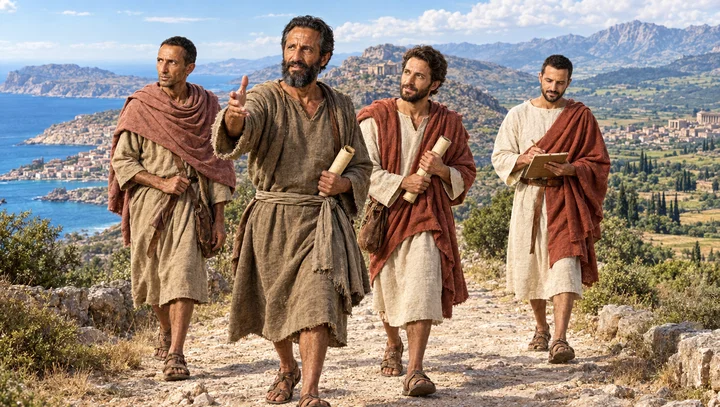
And after the uproar was ceased, Paul called unto him the disciples, and embraced them, and departed for to go into Macedonia.
Translations
And after the uproar was ceased, Paul called to him the disciples, and embraced them, and departed for to go into Macedonia.
King James Version, KJV Cambridge Paragraph Bible
And after the uproar was ceased, Paul called unto him the disciples, and embraced them, and departed for to go into Macedonia.
And after the uproar had ceased, Paul called to him the disciples, and embraced them, and departed to go into Macedonia.
And after the uproar was ceased, Paul having sent for the disciples and exhorted them, took leave of them, and departed for to go into Macedonia.
And after the uproar ceased, Paul having sent for the disciples and exhorted them, took leave of them, and departed to go into Macedonia.
And after the ceasing of the tumult, Paul having called near the disciples, and having embraced [them], went forth to go on to Macedonia;
But after the tumult had ceased, Paul having called the disciples to [ him] and embraced [ them], went away to go to Macedonia.
But, after the tumult had ceased, Paul, sending for the disciples and exhorting them, took leave, and went forth to be journeying unto Macedonia.
When the uproar had ended, Paul sent for the disciples. And after encouraging them, he said goodbye to them and left for Macedonia.
When the uproar had ended, Paul sent for the disciples. And he said goodbye to them and left for Macedonia.
After the uproar had ceased, Paul sent for the disciples, took leave of them, and departed to go into Macedonia.
And after the noise had come to an end, Paul, having sent for the disciples and given them comfort, went away from them to Macedonia.
Nowe after the tumult was appeased, Paul called the disciples vnto him, and embraced them, and departed to goe into Macedonia.
Douay-Rheims (Challoner revision)
And after the tumult was ceased, Paul calling to him the disciples, and exhorting them, took his leave, and set forward to go into Macedonia.
Pictures
Cross-references
- Acts 19:21-41
After these things were ended, Paul purposed in the spirit, when he had passed through Macedonia and Achaia, to go to Jerusalem, saying, After I have been there, I must also see Rome.
The Ephesian uproar preceded Paul’s departure for Macedonia.
- Acts 19:23-41
And the same time there arose no small stir about that way.
The Ephesian uproar immediately preceded Paul’s departure.
- 2 Corinthians 2:12-13
Furthermore, when I came to Troas to preach Christ’s gospel, and a door was opened unto me of the Lord,
Paul left Troas for Macedonia after waiting for Titus.
- Acts 19:21
After these things were ended, Paul purposed in the spirit, when he had passed through Macedonia and Achaia, to go to Jerusalem, saying, After I have been there, I must also see Rome.
Gives Paul’s planned route through Macedonia and Achaia to Jerusalem and Rome.
- 2 Corinthians 1:16
And to pass by you into Macedonia, and to come again out of Macedonia unto you, and of you to be brought on my way toward Judaea.
Paul describes his intended route through Macedonia and back.
- Acts 19:13-16
Then certain of the vagabond Jews, exorcists, took upon them to call over them which had evil spirits the name of the Lord Jesus, saying, We adjure you by Jesus whom Paul preacheth.
Describes the failed attempt to oppose Paul’s work.
- Romans 15:22-25
For which cause also I have been much hindered from coming to you.
Paul later describes his plans to travel through Macedonia and onward to Jerusalem.
- Acts 19:17-20
And this was known to all the Jews and Greeks also dwelling at Ephesus; and fear fell on them all, and the name of the Lord Jesus was magnified.
Records the gospel’s effects in Ephesus before Paul’s journey.
- Acts 19:12
So that from his body were brought unto the sick handkerchiefs or aprons, and the diseases departed from them, and the evil spirits went out of them.
Marks the earlier events at Ephesus before Paul’s departure.
- Acts 20:17-38
And from Miletus he sent to Ephesus, and called the elders of the church.
Paul met the Ephesian elders and said farewell before departing.
Commentary
Each commentary is drawn from primary sources: the writings of Ellen G. White and Adventist pioneers and periodicals. Each commentary is separate. Its own words are not a quotation; follow the references to read the source passages.
Ellen G. White
5 sources
The background was a festival in honor of Diana, at which Paul's teaching had already undermined confidence in the heathen gods and cooled enthusiasm for their worship, helping to stir the opposition that broke out.AA 291.3–292.1 Before the uproar he had purposed to journey through Macedonia and Achaia to Jerusalem and afterward to go to Rome, and to that end he had sent Timothy and Erastus on ahead into Macedonia while he himself intended to stay in Ephesus until after Pentecost.AA 291.1–2 The decision of the recorder and the other honorable officers set Paul before the people as innocent of any unlawful act, a triumph of Christianity over error and superstition in which God raised up a great magistrate to vindicate His apostle and hold the mob in check.SLP 146.2–3 The uproar hastened his departure and closed his labors in Ephesus, ending his work there after sustained teaching, opposition, and trials, because the excitement and tumult in the city was unfavorable to the preaching of the gospel.AA 291.1–2RH Sep 14, 1911SLP 146.2–3 His going was filled with gratitude to God that his life had been preserved and that Christianity had not been brought into disrepute by the tumult.SLP 146.2–3
When the uproar was over, Paul called the disciples together, embraced them, and departed to go into Macedonia.AA 291.3–292.1AA 295.3RH Sep 14, 1911SLP 146.2–3 That gathering and embracing was an affectionate farewell to his children in the faith.SLP 146.2–3 He set out for Macedonia by way of Troas, accompanied by Tychicus and Trophimus, faithful Ephesian brethren who remained his faithful companions and fellow laborers to the close of his life.AA 295.3RH Sep 14, 1911SLP 146.2–3
Sources
Pioneers and periodicals
12 sources
After the uproar at Ephesus ended, in about A.D. 58 or 59, Paul gathered the disciples, embraced them in an affectionate farewell, and departed for Macedonia, ending his work in Ephesus after sustained teaching, opposition, and trials.ST Apr 10, 1884RH Jan 23, 1866 The chapter furnishes the only record of Paul preaching in a religious assembly on the first day of the week, a farewell meeting at Troas after a seven-day stay as he was about to leave, beginning Saturday night, continuing through the night till midnight and ending Sunday morning.AUST Jun 21, 1920ST Jan 20, 1909 That meeting was an accommodation because Paul was departing the next day and they would see him no more, not a regular first-day meeting, and the verse and its context contain nothing regarding Sabbath-keeping.RH Jan 23, 1866AUST Jun 21, 1920ST Jan 20, 1909 The first day itself was an ordinary working and traveling day, not a Sabbath rest day, for after the night meeting Paul continued his journey on foot to meet the other disciples at Assos while the members returned to their usual work, showing the day was not treated as holy time, whereas Christ in His earthly life observed the seventh-day Sabbath and the apostles always preached on the Sabbath.AUST Jun 21, 1920RH Jun 17, 1873
Departure After Ephesian Uproar
After the uproar at Ephesus ended, in about A.D. 58 or 59, Paul gathered the disciples, embraced them in an affectionate farewell, and departed for Macedonia.RH Sep 14, 1911ST Apr 10, 1884RH Jan 23, 1866ST Jul 24, 1893 That departure ended his work in Ephesus after sustained teaching, opposition, and trials.RH Sep 14, 1911ST Apr 10, 1884 He did not return to Ephesus but later on his route toward Jerusalem sailed past it to meet its elders at Miletus.ST Apr 10, 1884 Tychicus and Trophimus accompanied him.RH Sep 14, 1911 The latter part of the chapter records his instruction to the elders of the Ephesian church and his farewell to them, knowing he would not see them again.ST Nov 1, 1910RH Nov 4, 1873
The journey continued through Macedonia and Greece to Troas, where he stayed seven days.ST Sep 28, 1915ST Jul 24, 1893ST Jan 20, 1909 After he had prepared to sail toward Syria, a Jewish plot against him hindered the planned voyage and led him to return through Macedonia on his way toward Jerusalem.RH Jul 6, 1868ST Jul 24, 1893 The passage Acts 20:1-16 covers his experiences at Thessalonica, at Berea, at Athens, at Corinth, at Ephesus, at Troas, and his farewell talk to the elders of Ephesus.ST Jul 7, 1909 It was assigned as evening reading for Friday, July 16, paired with Psalms 16 and 17.ST Jul 7, 1909
His journey and ministry show patient continuance in well-doing though plans are hindered by circumstances and providence.ST Apr 10, 1884 They show how wonderfully God wrought in all these places and how the word triumphed in every case notwithstanding all persecutions.ST Jul 7, 1909 His farewell example was one of hard work and contentment, for though poor and in need he coveted no one's silver, gold, or clothing but worked with his own hands to provide for himself and his companions.RH Nov 4, 1873
First Day and Sabbath
Acts 20 furnishes the only record of Paul preaching in a religious assembly on the first day of the week, a farewell meeting at Troas held after a seven-day stay as he was about to leave.AUST Jun 21, 1920ST Jan 20, 1909 The meeting began on Saturday night at the close of the Sabbath, when the disciples came together to break bread, and Paul preached to the believers till midnight because he intended to depart on Sunday morning.AUST Jun 21, 1920 It continued through the night and ended Sunday morning.AUST Jun 21, 1920
The meeting was an accommodation because Paul was departing the next day and they would see him no more, not a regular first-day meeting.RH Jan 23, 1866AUST Jun 21, 1920 The verse and its context, beginning with Paul gathering and embracing the disciples before leaving for Macedonia, contain absolutely nothing regarding Sabbath-keeping.RH Jan 23, 1866ST Jan 20, 1909
The first day itself was an ordinary working and traveling day, not a Sabbath rest day.AUST Jun 21, 1920RH Jun 17, 1873 After the night meeting Paul continued his journey on foot to meet the other disciples at Assos, while the members evidently returned to their usual work.AUST Jun 21, 1920 This travel on the first day after the resurrection was ordinary secular activity, showing the day was not treated as holy time.AUST Jun 21, 1920RH Jun 17, 1873 By contrast, Christ through His earthly life observed the seventh-day Sabbath and the apostles always preached on the Sabbath.AUST Jun 21, 1920
Sources