Acts 26:27
King Agrippa, believest thou the prophets? I know that thou believest.
Translations
King Agrippa, believe you the prophets? I know that you believe.
King James Version, KJV Cambridge Paragraph Bible, Webster Bible, Revised Version, American Standard Version, Darby Translation
King Agrippa, believest thou the prophets? I know that thou believest.
thou dost believe, king Agrippa, the prophets? I have known that thou dost believe!'
Believest thou, King Agrippa, in the prophets? I know that thou believest!
Berean Standard Bible, Majority Standard Bible
King Agrippa, do you believe the prophets? I know you do.”
King Agrippa, do you believe the prophets? I know that you believe.”
King Agrippa, have you faith in the prophets? I am certain that you have.
O King Agrippa, beleeuest thou the Prophets? I know that thou beleeuest.
Douay-Rheims (Challoner revision)
Believest thou the prophets, O king Agrippa? I know that thou believest.
Pictures
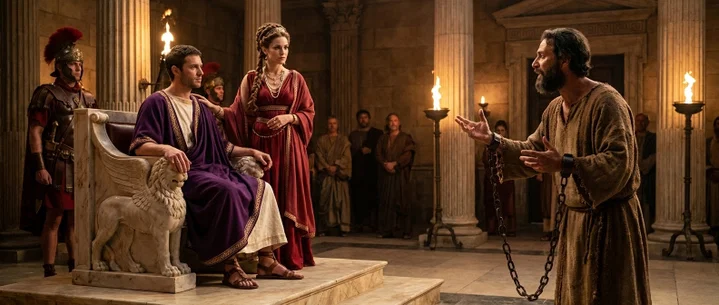
Cross-references
- Acts 26:22-23
Having therefore obtained help of God, I continue unto this day, witnessing both to small and great, saying none other things than those which the prophets and Moses did say should come:
Paul says Moses and the prophets foretold Christ’s suffering and resurrection.
- Acts 25:19
But had certain questions against him of their own superstition, and of one Jesus, which was dead, whom Paul affirmed to be alive.
Festus describes Paul’s claim that Jesus, though dead, was alive.
- Acts 26:1-3
Then Agrippa said unto Paul, Thou art permitted to speak for thyself. Then Paul stretched forth the hand, and answered for himself:
Paul respectfully begins his defense before King Agrippa.
- Acts 9:1-19
And Saul, yet breathing out threatenings and slaughter against the disciples of the Lord, went unto the high priest,
Paul recounts his conversion while testifying before rulers.
- Acts 25:23
And on the morrow, when Agrippa was come, and Bernice, with great pomp, and was entered into the place of hearing, with the chief captains, and principal men of the city, at Festus’ commandment Paul was brought forth.
Agrippa’s appearance begins the setting for Paul’s address.
- Acts 3:18
But those things, which God before had shewed by the mouth of all his prophets, that Christ should suffer, he hath so fulfilled.
Both appeal to fulfilled prophecy as proof of Messiahship.
- Acts 3:24
Yea, and all the prophets from Samuel and those that follow after, as many as have spoken, have likewise foretold of these days.
The prophets foretold the days of fulfillment.
- Acts 26:8
Why should it be thought a thing incredible with you, that God should raise the dead?
Paul asks why it should be incredible that God raises the dead.
Commentary
Each commentary is drawn from primary sources: the writings of Ellen G. White and Adventist pioneers and periodicals. Each commentary is separate. Its own words are not a quotation; follow the references to read the source passages.
Ellen G. White
13 sources
Paul in his defense before Agrippa presses him directly on whether he trusts the prophets, declaring with certainty that he does.ST May 29, 1884RH Nov 16, 1911SLP 258.2–259.1 The appeal carries weight because Agrippa has been taught the law and the prophets and knows the widely reported facts about Jesus, while the central point at issue is that Jesus who died is alive.ST May 29, 1884SLP 258.2–259.1AA 433.2AA 437.2–3 By that shared belief Paul shows that the suffering and rising of Jesus to bring light to Jews and Gentiles fulfills what was foretold, a Spirit-sustained witness that fastens conviction upon Agrippa until he admits he is almost won over.ST May 29, 1884RH Nov 16, 1911Ms 90, 1903, par. 21 That testimony, given even in bonds before princes and nobles, carries convicting power to rulers, though some who feel it delay and lose their opportunity.EW 172.3GC88 207.3Ms 90, 1903, par. 214SP 167.1 In making it Paul speaks with dignified respect and heartfelt kindness, setting the pattern for courteous yet earnest appeal to those in authority.MYP 421.2GW92 431.2MH 489.5
Context and Direct Appeal
The question belongs to Paul's defense before King Agrippa at a hearing arranged by Festus at Agrippa's request, where the central issue was Paul's claim that Jesus, who had died, is alive.AA 433.2 In it Paul directly challenges Agrippa whether he believes the prophets and confidently affirms that he knows Agrippa does believe.ST May 29, 1884RH Nov 16, 1911SLP 258.2–259.1AA 437.2–3EW 172.3 The force of that direct appeal rests on Agrippa's instruction in the law and the prophets and on his knowledge of the events Paul described from credible reports, since those things had not happened in secret.ST May 29, 1884SLP 258.2–259.1AA 437.2–3 Because of that background Paul's testimony about Jesus was clear and convincing to him.ST May 29, 1884SLP 258.2–259.1 The challenge struck home and drew Agrippa's answer that he was almost persuaded to become a Christian.ST May 29, 1884
Prophetic Fulfillment and Conviction
Paul pressed Agrippa on the ground of Agrippa's own belief in the prophets, arguing that the suffering of Jesus, His resurrection, and His mission to bring light to both Jews and Gentiles were the fulfillment of what the prophets had foretold.RH Nov 16, 1911 That direct question was meant to make Agrippa feel the force of prophetic testimony converging on Christ.RH Nov 16, 1911
He spoke with a confidence born of faith in Christ, setting forth truths that fastened upon Agrippa the conviction that Christ is the Son of God.Ms 90, 1903, par. 21 In bearing that witness against the tide of persecution he was upheld by the power of the Holy Spirit.Ms 90, 1903, par. 21
His testimony about Jesus and about his own conversion carried conviction to the hearts of kings and governors who heard it.EW 172.3 Yet some who were thus convicted put off response and let the opportunity pass beyond recovery.EW 172.3
The appeal belongs to that proclamation of the gospel for which Paul was imprisoned, a gospel that was in this way brought before princes and nobles.GC88 207.34SP 167.1 It shows that the message of Christ reached even royal hearers, just as the royal truth of God was afterward proclaimed before the emperor and the princes of the empire.GC88 207.34SP 167.1
Model of Christian Courtesy
Paul's direct question to the king stands as a model of dignified, respectful speech before rulers.GW92 431.2MH 489.5GW 123.2 His bearing in that address shows courtesy joined to persuasive eloquence.MYP 421.2GW92 431.2GW 123.2 That manner was respectful even while pressing the truth upon a king.MYP 421.2GW92 431.2MH 489.5GW 123.2
Such courtesy is true Christian courtesy, the kindness of heart that comes from genuine Christianity.MYP 421.2MH 489.5GW 123.2 It is shown even when speaking to rulers, and is not merely formal politeness.MYP 421.2MH 489.5GW 123.2 In this appeal it is joined with sincere earnestness, not empty form.MYP 421.2GW92 431.2MH 489.5GW 123.2
Sources
Pioneers and periodicals
34 sources
Paul as a Roman prisoner bore witness before King Agrippa II with Festus and other rulers present at Caesarea before being sent to Rome, making the most of imprisonment to preach the gospel to those in authority.ST May 12, 1898ST Dec 20, 1905ST Jan 8, 1885 He made a direct personal appeal asking whether Agrippa believed the prophets and declaring with confidence that he knew he did, pressing him toward decision.ST Oct 7, 1897ST May 12, 1898ST Jul 21, 1909 Agrippa was expert in Jewish customs and questions and instructed in the law and the prophets, knowing the facts about Christ because they were not done in secret.ST May 29, 1884ST May 13, 1903ST May 12, 1898 Paul appealed to that belief because his testimony agreed with what Moses and the prophets taught, that the Christ must suffer and rise from the dead to proclaim light to Jews and Gentiles.ST Aug 14, 1893ST Aug 14, 1893ST May 13, 1903 He showed those predictions accurately fulfilled in the person, life, death and resurrection of Jesus of Nazareth, which is the strongest evidence of His Messiahship and divinity, and his clear Spirit-driven testimony almost persuaded Agrippa to become a Christian.ST May 29, 1884ST Jan 30, 1912ST Jun 12, 1884ST Jun 12, 1884ST Aug 18, 1881
Context and Direct Appeal
The words belong to Paul's defense as a Roman prisoner at Caesarea before King Agrippa, with Festus and other rulers present, before he was sent on to Rome.ST May 12, 1898ST Jan 8, 1885RH Oct 22, 1872 It was his opportunity in imprisonment to preach the gospel before the king, to bear witness to God and to bring the message to people in authority.ST Dec 20, 1905RH Oct 22, 1872ST Dec 29, 1887 He spent at least five years as a prisoner without complaint against the government, while showing his accusers had no ground for their complaints, and he made the most of his imprisonment to preach the gospel at every opportunity.ST Dec 20, 1905 His defense there stands as an example of effective spoken rather than merely read speech.ST Jun 5, 1884
The verse is a direct personal appeal in which he asks Agrippa whether he believes the prophets and then confidently declares that he knows he believes.ST Oct 7, 1897ST May 12, 1898ST May 12, 1898 The question was spoken freely because Agrippa knew these things and they were not done in a corner, after Paul answered Festus's charge of madness by affirming that he speaks words of truth and soberness.ST May 12, 1898 By it Paul drew the king toward a direct decision, connecting Agrippa's belief in the prophets with his own defense of faith in Christ.ST Aug 6, 1896
Agrippa addressed is Herod Agrippa II, son of Herod Agrippa I.ST Jul 26, 1883 He was expert in Jewish customs and questions, instructed in the law and the prophets, and therefore to be addressed on that basis rather than as an ignorant heathen.ST May 29, 1884ST Aug 18, 1881 He had read the prophets, knew the facts about Christ because none of them was hidden and they were not done in secret, and had heard credible reports about the events Paul described.ST May 29, 1884ST May 13, 1903ST May 12, 1898 Because he knew the events, Paul could confidently challenge him to acknowledge their message.
Paul spoke before the splendor and authority of the court with dignified confidence and conscious innocence, which gave him composure while Agrippa trembled under the challenge.RH Oct 15, 1857 His address before kings and governors was marked by courage and powerful reasoning about righteousness, self-control and coming judgment, fearlessly pressing the claims of prophecy and the terrors of judgment.ST Feb 14, 1884RH Oct 15, 1857 He did not soften his message with honeyed phrases but spoke plainly to Agrippa and Festus.ST Mar 5, 1894 Yet his address was masterly, tactful, polite and courteous, with every word marked by the truest and broadest Christian courtesy, and while the king trembled at the powerful reasoning his heart was melted by the gentle and kindly manner, since mere logic or deep and forceful reasoning alone would have been of no avail.
Prophetic Proof of Christ
Paul's question appeals to Agrippa's belief in the prophets because his own testimony agrees with what Moses and the prophets taught and is no rejection of them, binding that belief to the prophetic testimony he has just given.ST Aug 14, 1893ST May 13, 1903 That testimony is that the Christ must suffer and rise from the dead and by resurrection proclaim light both to God's people and to the Gentiles.RH Nov 16, 1911ST Aug 14, 1893ST May 13, 1903ST May 13, 1903 He had shown those predictions accurately fulfilled in the person, work, life, death and resurrection of Jesus of Nazareth, identifying Jesus as the Messiah.ST Jun 12, 1884ST Jun 12, 1884ST Aug 18, 1881ST Jan 24, 1906
That fulfillment is the strongest evidence of His divinity and Messiahship, showing the close relation of prophecy to the gospel.ST Jan 24, 1906 The appeal thus connects the prophetic writings to the defense of faith in Christ and the truth of the resurrection, inviting acceptance of the Christian conclusion drawn from them rather than treating existing religious identity as enough.ST Oct 7, 1897ST Oct 7, 1897RH Jul 28, 1910 Believing the prophets means believing the gospel promises they contain, including the promise that God will raise the dead, for the resurrection is necessary to fulfill those promises.RH Feb 25, 1858 It includes the record in Genesis of humanity's need for a Saviour and the first promise of one, and prophecies of the days of the Lord's coming, Christ's second coming, its signs and manner, and the world's condition at that time, which should strengthen faith that the advent is near and spur worldwide proclamation of the warning.ST Jun 12, 1884RH Nov 4, 1902
Conviction and Gospel Application
Paul's testimony about Jesus was clear and convincing to the king because he knew the prophets and the events described, and the direct question whether he believed the prophets pressed him toward becoming a Christian until he answered that he was almost persuaded to be one.ST May 29, 1884ST Aug 18, 1881 The force of fulfilled prophecy pointing to Jesus as the Christ was driven home by the Holy Spirit through that appeal.ST Jan 30, 1912 Spoken with dignified confidence and conscious innocence despite the splendor and authority of the court, the preaching fearlessly pressed the claims of prophecy and the terrors of judgment, so that the king trembled under the challenge.RH Oct 15, 1857
His being almost persuaded followed naturally from accepting the prophets' testimony after their predictions had been shown accurately fulfilled in Christ's person and work, which made the case for Christ and Christianity compelling.ST Jun 5, 1884ST Jun 5, 1884ST Aug 18, 1881 Only a wicked heart kept him from fully believing and accepting it.ST Jun 5, 1884ST Jun 5, 1884
That defense is an example of effective spoken rather than read speech, showing how to use the prophets' testimony to argue that Jesus is the promised Messiah and that the resurrection is true, pressing belief in them toward Christian faith rather than treating existing religious identity as enough.RH Jul 28, 1910ST Jun 5, 1884 Fulfillment of the prophecies concerning the Messiah in the life and work of Jesus is the strongest evidence of His divinity and Messiahship, showing the close relation of prophecy to the gospel, and the example with Peter and Stephen shows prophecy is one of the pillars of the Christian church and a most potent factor in successful gospel work.ST Jan 24, 1906 Made as a prisoner of the Roman government before a king, after at least five years as a prisoner without complaint against the government and while showing his accusers had no ground, it shows making the most of imprisonment and every opportunity to preach the gospel.ST Dec 20, 1905
Standing before that tribunal was a great public decisive trial where yes or no for right decides career, character and soul, like standing in Nero's judgment-hall, before a Popish inquisitor, or in sight of Smithfield's martyrdom fire.RH Sep 25, 1860 The same decisive conflict now meets ministers not in such public courts but in private, in the quiet study when counseled to keep treacherous silence in the pulpit on some vital question of right, and their yes or no brings either Christ's blessing, Well done, good and faithful servant, or His rejection for being ashamed of Him and His truth before the Father and His holy angels.RH Sep 25, 1860 The mighty defense was given with the same sincerity as when he persecuted the church, showing that a person can sincerely think he is doing God service while only satisfying self, with a curtain over the eyes so he does not see sin in its true light or himself as God sees him.RH Oct 24, 1912
Sources