Acts 26:1
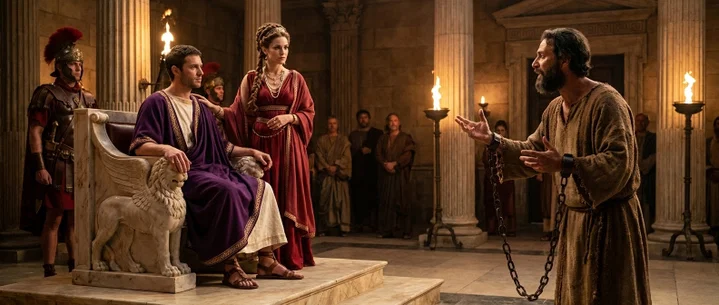
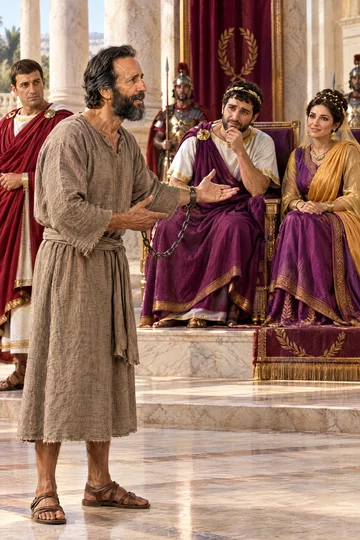
Then Agrippa said unto Paul, Thou art permitted to speak for thyself. Then Paul stretched forth the hand, and answered for himself:
Translations
Then Agrippa said to Paul, You are permitted to speak for yourself. Then Paul stretched forth the hand, and answered for himself:
King James Version, KJV Cambridge Paragraph Bible
Then Agrippa said unto Paul, Thou art permitted to speak for thyself. Then Paul stretched forth the hand, and answered for himself:
Then Agrippa said to Paul, Thou art permitted to speak for thyself. Then Paul stretched forth the hand, and answered for himself:
Revised Version, American Standard Version
And Agrippa said unto Paul, Thou art permitted to speak for thyself. Then Paul stretched forth his hand, and made his defence:
And Agrippa said unto Paul, 'It is permitted to thee to speak for thyself;' then Paul having stretched forth the hand, was making a defence:
And Agrippa said to Paul, It is permitted thee to speak for thyself. Then Paul stretching out his hand answered in his defence:
And, Agrippa, to Paul, said—It is permitted thee, on thine own behalf, to be speaking. Then Paul, stretching forth his hand, went on to make his defence.
Berean Standard Bible, Majority Standard Bible
Agrippa said to Paul, “ You have permission to speak for yourself.”Then Paul stretched out his hand and began his defense:
Agrippa said to Paul, “ You may speak for yourself.”Then Paul stretched out his hand, and made his defense.
And Agrippa said to Paul, You may put your cause before us. Then Paul, stretching out his hand, made his answer, saying:
Then Agrippa sayd vnto Paul, Thou art permitted to speake for thy selfe. So Paul stretched forth the hand, and answered for himselfe.
Douay-Rheims (Challoner revision)
Then Agrippa said to Paul: Thou art permitted to speak for thyself. Then Paul stretching forth his hand, began to make his answer.
Pictures
Cross-references
- Acts 25:23
And on the morrow, when Agrippa was come, and Bernice, with great pomp, and was entered into the place of hearing, with the chief captains, and principal men of the city, at Festus’ commandment Paul was brought forth.
Agrippa hears Paul’s case before Paul gives his defense.
- Acts 25:11-12
For if I be an offender, or have committed any thing worthy of death, I refuse not to die: but if there be none of these things whereof these accuse me, no man may deliver me unto them. I appeal unto Cæsar.
Paul appeals to Caesar before his hearing before Agrippa.
- Acts 24:10
Then Paul, after that the governor had beckoned unto him to speak, answered, Forasmuch as I know that thou hast been of many years a judge unto this nation, I do the more cheerfully answer for myself:
Felix allows Paul to answer for himself in his defense.
- Acts 22:1-22
Men, brethren, and fathers, hear ye my defence which I make now unto you.
Paul gives his defense by recounting his conversion and calling.
- Acts 9:1-22
And Saul, yet breathing out threatenings and slaughter against the disciples of the Lord, went unto the high priest,
Paul recounts his conversion as part of his testimony before rulers.
- Acts 26:22-23
Having therefore obtained help of God, I continue unto this day, witnessing both to small and great, saying none other things than those which the prophets and Moses did say should come:
Paul’s testimony declares Christ’s suffering and resurrection.
- Acts 26:27
King Agrippa, believest thou the prophets? I know that thou believest.
Paul asks Agrippa whether he believes the prophets.
- Acts 26:28
Then Agrippa said unto Paul, Almost thou persuadest me to be a Christian.
Agrippa says Paul’s testimony almost persuades him to become a Christian.
- Acts 26:6-8
And now I stand and am judged for the hope of the promise made of God unto our fathers:
Paul identifies his hope in God’s promise and asks why resurrection should be thought impossible.
- Acts 26:18
To open their eyes, and to turn them from darkness to light, and from the power of Satan unto God, that they may receive forgiveness of sins, and inheritance among them which are sanctified by faith that is in me.
Paul recounts his commission to turn people from darkness and offer forgiveness through faith.
- Acts 21:22-40
What is it therefore? the multitude must needs come together: for they will hear that thou art come.
Listed as another address for comparison.
Commentary
Each commentary is drawn from primary sources: the writings of Ellen G. White and Adventist pioneers and periodicals. Each commentary is separate. Its own words are not a quotation; follow the references to read the source passages.
Ellen G. White
13 sources
Agrippa gives Paul leave to speak in his own defense before the king and the assembled leaders at Caesarea.ST May 29, 1884AA 433.1EW 172.3 On receiving it Paul lifts his chained hand and answers with calm courage and complete self-control.ST May 29, 1884AA 435.2–3SLP 255.1 He is glad for the hearing because Agrippa knows Jewish customs and questions, and he asks for a patient listening.AA 435.2–3SLP 255.1RH Nov 16, 1911 He then uses the permission to set out the grounds of his faith by telling of his conversion and witnessing to Jesus, so that an imprisoned apostle carries the gospel to princes and nobles.AA 433.1EW 172.3RH Nov 16, 1911GC88 207.34SP 167.1 His answer is marked by dignity, persuasive power, and a courtesy that springs from true kindness of heart, making it a pattern for others.MYP 421.2GW92 431.2GW 123.2MH 489.5
Permission and Setting
Agrippa grants Paul permission to speak for himself in his own defense before the king and the assembled officials and leading men of Caesarea.ST May 29, 1884AA 433.1AA 435.2–3SLP 255.1RH Nov 16, 1911 This hearing before Agrippa is made possible by the delay in finding a ship to take Paul to Rome.AA 433.1 On being given leave, Paul stretches out his manacled hand and answers for himself.ST May 29, 1884SLP 255.1
Though surrounded by wealth, rank, and military display, and standing under accusation, he answers with composure, courage, self-control, and serene undauntedness.ST May 29, 1884AA 435.2–3SLP 255.1RH Nov 16, 1911AA 494.1–2 Neither the display of rank and power before him nor the charges against him shake that calm.ST May 29, 1884AA 435.2–3AA 494.1–2 When he is given the opportunity, the assembled crowd listens with eager interest.AA 494.1–2
He is glad to answer the accusations before Agrippa because the king is familiar with Jewish customs and questions.AA 435.2–3SLP 255.1 Knowing this, he asks Agrippa to listen to him patiently.AA 435.2–3SLP 255.1RH Nov 16, 1911
Testimony to Rulers
The permission to speak for himself opens Paul's opportunity before King Agrippa and the other leading men of Caesarea to present the reasons for his faith by recounting his conversion and testifying about Jesus.AA 433.1EW 172.3RH Nov 16, 1911 His trials before kings and governors are thus turned into Spirit-empowered opportunities to testify.EW 172.3 Through that preaching some hearers are convinced that Jesus is the Son of God, while others delay deciding and lose the opportunity.EW 172.3
The verse belongs to the account of the gospel presented through an imprisoned apostle before rulers, showing how the message of Christ could reach princes and nobles.GC88 207.34SP 167.1 It provides a precedent for rulers hearing God's truth with wonder even when preaching it publicly has been forbidden.4SP 167.1 In this it parallels the Reformation, when the gospel was likewise proclaimed in a palace before the rulers of the empire.GC88 207.3
Model of Courtesy
When permission was given to speak for himself, Paul answered with dignity and courtesy.GW92 431.2 His address to Agrippa, extending through the whole account of his defense, illustrates true courtesy joined with persuasive eloquence.MYP 421.2GW92 431.2GW 123.2MH 489.5 It is an example of Christian courtesy in contact with others, showing what true refinement looks like before rulers.MYP 421.2MH 489.5
That speech stands as a model of courteous, persuasive speech for others to follow.GW92 431.2 The courtesy it displays springs from genuine kindness of heart, not from empty formality or mere formal politeness.GW92 431.2GW 123.2MH 489.5
Sources
Pioneers and periodicals
31 sources
Agrippa grants Paul permission to speak in his own defense, and Paul gestures with his hand and begins to answer.ST Oct 22, 1912 His defense is that he is accused for his hope in God's promise to the fathers, the hope of the resurrection of the dead, which drew continued Jewish opposition for preaching.ST Sep 8, 1914ST Aug 21, 1884 He makes that defense by preaching Christ, recounting his conversion, the revelation of the risen Jesus to him, and his commission to turn Jews and Gentiles from darkness to God.ST Aug 14, 1893ST Oct 17, 1895ST Feb 26, 1885ST Oct 29, 1885 He answers with composure before rank and display, even with his hand in chains, with dignified courtesy and undaunted boldness that presses prophecy and judgment upon rulers.ST May 29, 1884RH Nov 16, 1911ST Feb 14, 1884RH Oct 15, 1857 His two years' imprisonment at Caesarea thus becomes an opportunity to bear witness of God to kings, nobles, and the Roman world.RH Oct 22, 1872ST Dec 29, 1887ST Oct 12, 1904
Setting and Action
The speaker is Herod Agrippa II, son of Herod Agrippa I, who with Bernice had come to Caesarea to pay respects to the new procurator, as they did to each procurator in turn.ST Feb 26, 1885ST Jul 26, 1883 His royal authority depended on the emperor's will rather than popular support, and he is the king who later tried unsuccessfully to restore peace during the revolt.ST Feb 26, 1885ST Mar 30, 1915
The verse marks the beginning of Paul's defense before Agrippa as part of the account of his arrest and trial.RH Nov 23, 1916 It belongs to the defense after Paul had been imprisoned at Caesarea for two years, and it marks the occasion for his defense following the events in Acts 25 that led to the hearing.RH Nov 23, 1916ST Oct 7, 1897 It introduces his defense at Agrippa's hearing, when he is given permission to speak for himself before the king.ST Oct 7, 1897
Agrippa grants Paul permission to speak in his own defense, after which Paul gestures with his hand and begins to answer.ST Oct 22, 1912ST Feb 26, 1885RH Nov 1, 1853 The gathering was not a judicial assembly and had no accusers present, but Paul was allowed to speak about himself.ST Feb 26, 1885 He had also been given that liberty before the Roman governor Felix.RH Nov 1, 1853 He answered calmly and confidently, undaunted by the Roman officials and soldiers around him, because he knew his service was not subject to their authority.ST Feb 26, 1885
The verse belongs to the book of Acts, which records the work of people who trusted God.ST Oct 29, 1912 That book concludes with Paul's arrival in Rome, his reception there, and his effort to reach his own people, without recounting his final imprisonment or death.ST Oct 29, 1912 Paul's address in Acts 26:1-32 was probably heard by Julius, which may explain his favorable treatment of Paul during the voyage to Rome.ST Jun 12, 1884
Message and Teaching
The permission to speak opens a defense in which the accused explains that he stands charged because of his hope in God's promise to the fathers, namely the hope of the resurrection of the dead.ST Sep 8, 1914ST Aug 21, 1884 That preaching continued the same Jewish opposition that had met Jesus' own teaching that the dead would live again.ST Sep 8, 1914 In answering, the defense itself takes the form of preaching Christ, keeping the mission to preach Jesus steadily in view before the king at Caesarea.ST Aug 14, 1893ST Oct 29, 1885
The belief defended is that Jesus is the promised Messiah, set forth by recounting the conversion, the revelation of the risen Jesus, and the commission to turn both Jews and Gentiles from darkness to God.ST Feb 26, 1885 That personal encounter with the risen Jesus is what grounds apostolic ministry and testimony.ST Oct 17, 1895 The relating of that experience and conversion beginning here illustrates Romans 7:9-13, for the covenant of ten commandments came, convinced of sin, slew, and brought death to sin through repentance toward God and faith in Jesus Christ, followed by being made alive unto God through Jesus Christ.RH Oct 27, 1868 The account proves the law of ten commandments was not changed, altered, or made unholy at conversion, but remains holy, just, and good, slaying all its violators under the gospel and then making them alive unto God.RH Oct 27, 1868
The discourse thus opened appeals to the fulfillment of the prophecies concerning the Messiah in the life and work of Jesus as the strongest evidence of His divinity and of the truth that He is the Messiah.ST Jan 24, 1906 In this it demonstrates that prophecy is one of the pillars of the Christian church and a most potent factor in successful gospel work.ST Jan 24, 1906 In defending himself before Agrippa the speaker relates personal experience with Christ, using testimony of what Christ had done for him to draw hearers to hear and receive Christ, by the same method the Samaritan woman used to draw the people of her city to Jesus.ST Aug 6, 1896
Manner and Witness
Agrippa grants Paul permission to speak in his own defense before the king and the assembled officials and audience, and Paul answers with composure despite the rank, power, and display before him, stretching out his manacled hand and gesturing as he begins.ST May 29, 1884RH Nov 16, 1911ST Feb 14, 1884 That answer introduces his patient appeal to Agrippa and his account of his conversion and testimony about Jesus.RH Nov 16, 1911 The gathering is not a judicial assembly and has no accusers present, but Paul is allowed to speak about himself.ST Feb 26, 1885
He answers calmly, confidently, and with dignified composure grounded in conscious innocence, undaunted by the Roman officials and soldiers around him because he knows his service is not subject to their authority.RH Oct 15, 1857ST Feb 26, 1885 The splendor of the Roman court cannot intimidate him, as he boldly presses the claims of prophecy and the terrors of the judgment day, even asking Agrippa whether he believes the prophets.RH Oct 15, 1857 His address before Agrippa is one of his opportunities to proclaim Christ before kings and governors, spoken with courage and persuasive power, supporting the faith with signs and miracles and reasoning about righteousness, self-control, and coming judgment, so that rulers tremble before him and the king trembles before him.ST Feb 14, 1884RH Oct 15, 1857
His masterly address before the haughty king shows him to be undoubtedly a very polite man, with tactful courtesy and the truest and broadest Christian courtesy and kindness marking his every word. Mere logic and deep and forceful reasoning would be of no avail without it, for while the king trembles at the powerful reasoning, his heart is melted by the gentle and kindly manner. He addresses Agrippa and defends himself openly and directly, with preaching to Agrippa and Festus not softened with honeyed phrases.ST Mar 5, 1894 That defense comes through spoken discourse rather than reading from a written sermon, as seen across Acts 26:1-32, and his sincerity in defending himself is as real as his earlier sincerity when he persecuted the church.ST Jun 5, 1884RH Oct 24, 1912
His two years of imprisonment at Caesarea give him an opportunity to preach the gospel before kings and nobles.RH Oct 22, 1872 His testimony before rulers is one way God bears witness of himself to the Roman world and brings God's truth to people in authority, making the permission to speak for himself before Agrippa an example of Paul being granted a hearing before a ruler.ST Dec 29, 1887ST Oct 12, 1904ST Jul 25, 1878 Yet Agrippa's tribunal is named as a place where a minister's decisive test of right and truth does not occur.RH Sep 25, 1860
Sources