Acts 28:20
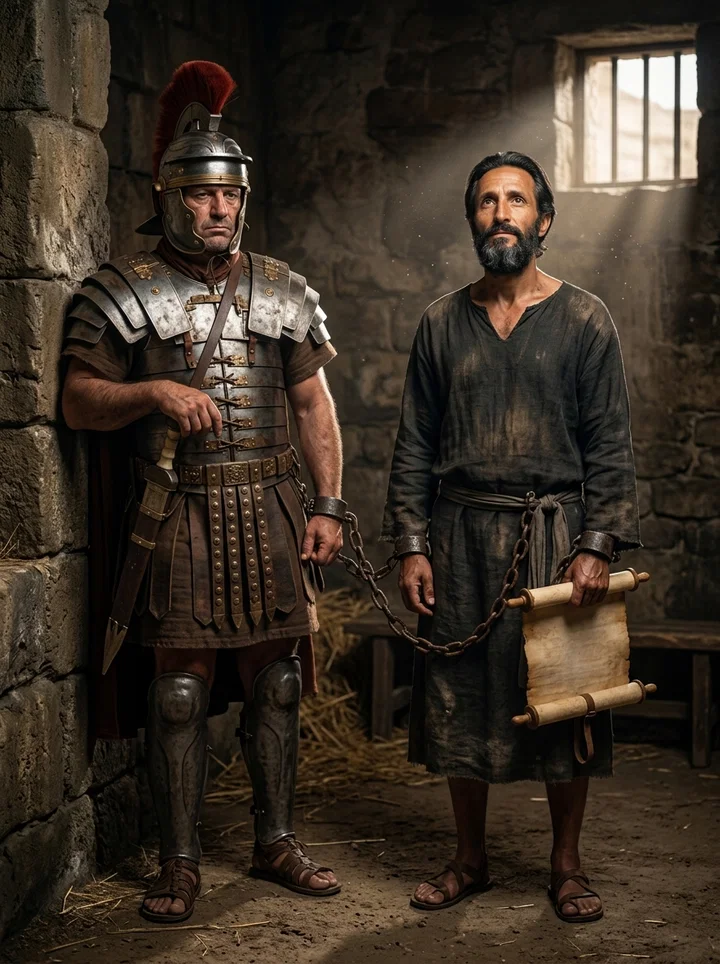
For this cause therefore have I called for you, to see you, and to speak with you: because that for the hope of Israel I am bound with this chain.
Translations
American King James Version, King James Version, KJV Cambridge Paragraph Bible, Webster Bible
For this cause therefore have I called for you, to see you, and to speak with you: because that for the hope of Israel I am bound with this chain.
Revised Version, American Standard Version
For this cause therefore did I entreat you to see and to speak with me: for because of the hope of Israel I am bound with this chain.
for this cause, therefore, I called for you to see and to speak with [you], for because of the hope of Israel with this chain I am bound.'
For this cause therefore I have called you to [ me] to see and to speak to you; for on account of the hope of Israel I have this chain about me.
For this cause, therefore, have I called for you, to see and to speak with you; for, on account of the hope of Israel, this chain, have I about me!
Berean Standard Bible, Majority Standard Bible
So for this reason I have called to see you and speak with you. It is because of the hope of Israel that I am bound with this chain.”
For this cause therefore I asked to see you and to speak with you. For because of the hope of Israel I am bound with this chain.”
But for this reason I sent for you, to see and have talk with you: for because of the hope of Israel I am in these chains.
For this cause therefore haue I called for you, to see you, and to speake with you: for that hope of Israels sake, I am bound with this chaine.
Douay-Rheims (Challoner revision)
For this cause therefore I desired to see you, and to speak to you. Because that for the hope of Israel, I am bound with this chain.
Pictures
Cross-references
- Acts 26:6-8
And now I stand and am judged for the hope of the promise made of God unto our fathers:
Paul identifies Israel’s promised hope with resurrection from the dead.
- Acts 23:6
But when Paul perceived that the one part were Sadducees, and the other Pharisees, he cried out in the council, Men and brethren, I am a Pharisee, the son of a Pharisee: of the hope and resurrection of the dead I am called in question.
Paul identifies Israel’s hope with the resurrection of the dead.
- Acts 24:15
And have hope toward God, which they themselves also allow, that there shall be a resurrection of the dead, both of the just and unjust.
Paul’s hope toward God is hope in the resurrection of the dead.
- Ephesians 2:11-12
Wherefore remember, that ye being in time past Gentiles in the flesh, who are called Uncircumcision by that which is called the Circumcision in the flesh made by hands;
Gentiles were once without hope and alienated from Israel’s commonwealth.
- Titus 2:13
Looking for that blessed hope, and the glorious appearing of the great God and our Saviour Jesus Christ;
Both texts speak of hope, and Titus calls it the blessed hope.
- Acts 26:1
Then Agrippa said unto Paul, Thou art permitted to speak for thyself. Then Paul stretched forth the hand, and answered for himself:
Paul speaks before Agrippa as he did before Judean governors.
- 1 Corinthians 15:18
Then they also which are fallen asleep in Christ are perished.
Without hope, the dead in Christ perish.
- Acts 24:21
Except it be for this one voice, that I cried standing among them, Touching the resurrection of the dead I am called in question by you this day.
Paul says his trial concerns the resurrection of the dead.
- Acts 28:30-31
And Paul dwelt two whole years in his own hired house, and received all that came in unto him,
Both describe Paul’s ministry at Rome.
- Philippians 4:22
All the saints salute you, chiefly they that are of Caesar’s household.
Paul’s time in Rome brings the gospel to people connected with Caesar’s household.
- Acts 27
And when it was determined that we should sail into Italy, they delivered Paul and certain other prisoners unto one named Julius, a centurion of Augustus’ band.
Paul’s difficult voyage to Rome exemplifies sacrifice in his ministry.
- Luke 2:25
And, behold, there was a man in Jerusalem, whose name was Simeon; and the same man was just and devout, waiting for the consolation of Israel: and the Holy Ghost was upon him.
Describes waiting for Israel’s consolation.
- Acts 25:19
But had certain questions against him of their own superstition, and of one Jesus, which was dead, whom Paul affirmed to be alive.
The dispute concerned Jesus, whom Paul preached as risen.
- Acts 26:8
Why should it be thought a thing incredible with you, that God should raise the dead?
Paul explains the promised hope as God raising the dead.
- Colossians 1:22-23
In the body of his flesh through death, to present you holy and unblameable and unreproveable in his sight:
Paul calls believers to remain grounded in the gospel’s hope.
- Isaiah 6:9-10
And he said, Go, and tell this people, Hear ye indeed, but understand not; and see ye indeed, but perceive not.
Israel’s failure to understand and believe accompanies Paul’s message to the Jews.
- Acts 24:27
But after two years Porcius Festus came into Felix’ room: and Felix, willing to shew the Jews a pleasure, left Paul bound.
Paul remained bound for preaching the hope of Israel.
- Romans 11:17
And if some of the branches be broken off, and thou, being a wild olive tree, wert graffed in among them, and with them partakest of the root and fatness of the olive tree;
Converted Gentiles are grafted into Israel’s olive tree.
Commentary
Each commentary is drawn from primary sources: the writings of Ellen G. White and Adventist pioneers and periodicals. Each commentary is separate. Its own words are not a quotation; follow the references to read the source passages.
Ellen G. White
8 sources
The verse belongs to Paul's long-expected journey to Rome, which he reached as a prisoner landing at Puteoli on the coast of Italy.AA 447.2 With the centurion's permission he stayed seven days with the few Christians there, while the Roman Christians one hundred and forty miles away heard of his approach and some started out to meet and welcome him.AA 447.2 They had already received his epistle to the Romans and eagerly looked forward to his visit, though not expecting him as a prisoner, and his sufferings endeared him to them the more.AA 447.2 It was spoken at Rome three days after arrival to the leading men of the Jews, whom he called together so they would first hear the facts about himself and his work before his enemies could embitter them against him.AA 450.1–3
He had called them to see him and to speak with them because he was bound with a chain for the hope of Israel.AA 450.1–3SLP 275.1–3RH Dec 7, 1911RH Nov 11, 1915AA 516.4 He had done nothing against the people or the customs of the fathers, and his chains were not for a crime against his people or their customs.AA 450.1–3SLP 275.1–3RH Dec 7, 1911 He had been delivered as a prisoner from Jerusalem into Roman hands, and the Romans would have released him because there was no cause of death in him.AA 450.1–3 Opposition from the Jews constrained him to appeal to Caesar after they opposed his release, and the appeal was not to accuse his nation.AA 450.1–3SLP 275.1–3 He said nothing of the abuse he had suffered from the Jews or their repeated plots to assassinate him.AA 450.1–3
His words were marked with caution and kindness in a simple, direct manner, seeking not personal attention or sympathy but to defend the truth and maintain the honor of the gospel.AA 450.1–3SLP 275.1–3 The hope of Israel for which he was bound is faith in the promised Messiah fulfilled in Christ, that is Jesus of Nazareth proclaimed as Israel's Hope and the Saviour of mankind.RH Dec 7, 1911AA 516.4 That hope rests on Jesus' crucifixion, resurrection, and ascension establishing him as the world's Saviour and the only hope for humanity, truths entrusted to the apostles as an enduring anchor, calling followers to look to Jesus, follow the way opened by his self-sacrifice, and keep God's law.EW 163.2 His imprisonment shows that chains did not keep him from trusting God's word, and his endurance under Roman power illustrates faith standing firm against worldly authority even when it leads to death.RH Nov 11, 1915 The verse belongs to the period before his release from Roman imprisonment, and he left Rome soon after his release.SLP 304.1–2
Sources
Pioneers and periodicals
50 sources
Paul three days after reaching Rome called together the chief and leading men of the Jews to see him and speak with him to explain his imprisonment.ST Oct 28, 1897ST Oct 4, 1905ST Aug 28, 1898 He told them he had done nothing against the people or the customs of the fathers, but had been delivered prisoner from Jerusalem into Roman hands, examined by the Romans who wanted to set him free because there was no cause of death in him, and constrained to appeal to Caesar when the Jews spoke against it.ST Oct 28, 1897ST Oct 4, 1905 He declared he was bound with a chain for the hope of Israel, not for any crime against his people or their customs.RH Dec 7, 1911ST May 26, 1898ST May 26, 1898 That hope is the resurrection of the dead promised to the fathers to Abraham, Isaac and Jacob, to be fulfilled when the just are raised at Christ's second advent, resting on Christ and grounded in the resurrection of Jesus.GSAM 24.2ST Feb 27, 1879RH May 29, 1855RH Mar 17, 1853 It belongs to the true Israel counted through faith and promise, including converted Gentiles grafted into Israel who become fellow citizens with the saints.ST Jun 9, 1898RH Mar 24, 1863RH Jul 2, 1872RH May 29, 1855
Meeting Jews in Rome
Three days after reaching Rome Paul called together the chief and leading men of the Jews to see him and to speak with him in order to explain his imprisonment.ST Oct 28, 1897ST Oct 4, 1905ST Aug 28, 1898ST Jun 9, 1898 He sought them out to state plainly why he had come as a prisoner before his enemies could turn them against him, telling them he was bound with a chain for the hope of Israel.ST Oct 28, 1897ST Dec 9, 1897 That hope was the burden of his preaching, which he went on to explain by testifying of God's kingdom and persuading concerning Jesus from the law of Moses and the prophets.ST Aug 28, 1898ST Jun 9, 1898ST Dec 9, 1897
In that meeting he declared he had done nothing against the people or the customs of the fathers, though Jewish leaders had brought charges against him.ST Oct 28, 1897ST Oct 4, 1905ST May 26, 1898 He had been delivered prisoner from Jerusalem into the hands of the Romans, had been examined by the Romans who desired to set him at liberty because there was no cause of death in him, and had been constrained to appeal unto Caesar when the Jews spoke against it, not because he had anything whereof to accuse his nation.ST Oct 28, 1897ST May 26, 1898 He said nothing of the abuse he had suffered from the Jews or of their repeated plots to kill him, showing by caution and kindness that he sought not personal attention or sympathy but to defend the truth and maintain the honor of the gospel.
He accomplished the dream of his life by entering Rome in March A.D. 61, in the seventh year of Nero under the consulship of Caesennius Paetus and Petronius Turpilianus, as a chained prisoner under soldier escort. He walked the costly regular road past tombs, statues, inns and streams of carriages, accompanied by brethren, enduring looks of contemptuous curiosity from onlookers. Yet he was sustained by fellowship so as not to feel utterly lonely amid the vast crowded wilderness of human habitations first seen from the slope of the Alban hills. He had come there after wintering in Malta and sailing by Syracuse, Rhegium and Puteoli, being met on the way by brethren from Rome at the sight of whom he thanked God and took courage.ST May 26, 1898 In Rome he was allowed to live by himself with a soldier guarding him.ST May 26, 1898
His chain was, in the setting of his appeal to Caesar, the ordinary arrest chain of a person under arrest and bound as a prisoner.RH Jun 27, 1878 The verse belongs to the account of his arrival in Rome and his effort to reach his own people, which ends with that effort's twofold result and does not recount his final imprisonment or death.ST Oct 29, 1912
Reason for His Bonds
Acts 28:20 is Paul's own statement of the cause of his present bondage, that he was bound with a chain for the hope of Israel.RH Dec 7, 1911ST May 26, 1898ST May 26, 1898 Three days after arriving in Rome he called the chief Jews together to see him and speak with him in order to make this plain.ST May 26, 1898 He declared that he had done nothing against the Jewish people or the customs of the fathers, but had been delivered as a prisoner from Jerusalem into Roman hands.RH Dec 7, 1911ST May 26, 1898 The Romans examined him and desired to set him free because there was no cause of death in him, and Jewish opposition constrained him to appeal to Caesar, not because he had anything with which to accuse his nation.ST May 26, 1898 His faith was in the promised Messiah and in the hope fulfilled in Christ, and that hope, rather than any crime against his people or their customs, was the reason he was in chains.RH Dec 7, 1911
He was imprisoned not because he opposed Israel's hope but because he preached that it had been fulfilled.ST Oct 28, 1897 Israel had long hoped for the Messiah and his reign of peace, and Paul held that this long-hoped-for Messiah had already come in his own day and wanted to share it with the Jews, even while bound.ST Oct 28, 1897 He was in chains because he preached the gospel of Christ, which he called the hope of Israel.ST Oct 4, 1905 He was a prisoner in Rome because of his hope in Israel's promised deliverance, which he proclaimed through that gospel, and he called the Jewish leaders to meet and speak with him about this hope.ST Dec 9, 1897
That hope was the resurrection of the dead.ST Apr 19, 1905ST Oct 4, 1905 He was in chains because he preached the resurrection of the dead through the Lord Jesus Christ, which he identified as the hope of Israel and had also presented as Israel's hope before the Jewish council.ST Apr 19, 1905ST Apr 7, 1914 His preaching of it brought persecution, for it was unpopular then, yet it was essential to the message of salvation.ST Apr 7, 1914 His being bound with a chain for the hope of Israel illustrates that a person may suffer restraint and censure while acting for the good of others, since sincere intentions and fidelity to what is right can be misunderstood even by those who share the hope being served.ST Oct 29, 1885
Hope of Israel Defined
The hope of Israel is the resurrection of the dead, including the resurrection of both the just and the unjust and the salvation of the righteous, or a change equivalent to that resurrection.ST Feb 27, 1879ST Oct 4, 1905 Paul was bound with a chain for preaching this doctrine, and his imprisonment came because he preached the gospel of Christ which he called by that name.ST Feb 27, 1879ST Oct 4, 1905 That resurrection hope is the promise made by God to the fathers, to Abraham, Isaac and Jacob.GSAM 24.2RH May 29, 1855ST Oct 4, 1883 It was to be fulfilled when the just are raised at Christ's second advent, and it belonged to the people counted as Israel through faith and promise and not merely to natural descendants.RH May 29, 1855ST Oct 4, 1883 The hope promised to the fathers was that God would raise the dead and fulfill His promise to them.GSAM 24.2RH Mar 17, 1853
This hope rests on Christ and is grounded in the resurrection of Jesus, who abolished death and brought life and immortality to light through the gospel.RH Mar 17, 1853RH Dec 19, 1907 It is the hope of the gospel and of eternal life, which depends on sharing in the first resurrection or being translated to immortality when Christ comes in glory.ST Oct 4, 1905 Faith and choice determine which resurrection a person will face.ST Oct 4, 1905 It is the hope of eternal life that has sustained God's people in all ages.RH Nov 30, 1916 Because those who attain the resurrection cannot die anymore, there will be ample time for the realization of every worthy object.RH Nov 30, 1916
It will restore Israel to the promised land when the dead are made alive by the Spirit.RH Jan 19, 1864 It is the promise of an inheritance restored through the resurrection of the dead, not temporal dominion or an earthly empire.RH Feb 23, 1911RH Jan 19, 1864 It is the Christian hope and the hope Israel should have cherished.RH Feb 23, 1911 The hope is the Saviour Himself, the promised Messiah and Redeemer in whom patriarchs and prophets trusted.ST Mar 3, 1914ST May 13, 1897ST Jun 9, 1898 It was shared by Paul and other Jewish believers who before Christ came looked forward through prophecy to His coming, though the patriarchs died before receiving what was promised.ST Mar 3, 1914ST May 13, 1897
That hope stands or falls with His resurrection: if Christ is not raised faith is vain, every living soul remains bound in chains of sin with no door of mercy, and those who sleep in Jesus never wake but remain locked in death through endless ages.ST Jun 9, 1898 Because Christ is risen and become the firstfruits of them that slept, the Hope of Israel is a living Saviour who breaks the chains of sin and opens the prison-house of death.ST Jun 9, 1898 The hope for which Paul is bound is tied to Jesus' return from heaven and the expectation that His glory will be seen.RH Nov 8, 1864 It is Christ's second coming, the hope of the church, when the resurrection of His people takes place, when mortal puts on immortality, when death is conquered and life triumphs, and when Christ who is our life appears and His people appear with Him in glory.ST Oct 31, 1895
It is the hope of the promise of God, the blessed hope, promised by God and prophesied and foretold from Enoch who walked with God three hundred years.ST Oct 31, 1895 It was seen by Job looking to the latter day when his eyes should behold his Redeemer, by the psalmist, by Isaiah, Jeremiah, Ezekiel and all the lesser prophets foretelling the glad day of deliverance when children come from the enemy's land, captives of death are delivered, the Israel of God lives in reality, death is no more and the grave destroyed, God's people are all righteous and the Lord alone is king, and by the Lord Himself cheering with promises of His coming, down to the watcher on Patmos and the longing prayer of all ages meaningly cried Thy kingdom come, Come Lord Jesus.ST Oct 31, 1895 It is the Messianic hope given its fullest pre-Messiah utterance and culmination in Malachi to re-affirm God's purpose to form a spiritual kingdom in the world, submissive to His government, obedient to His law, with members and citizens gathered out of all countries and peoples.RH Jun 5, 1900 That hope centers in a personal head supreme in character and power, revealed ever more distinctly as the seed of the woman, the seed of Abraham, the star out of Jacob, coming out of Judah, the son of David, with the time of His appearing fixed in Daniel, the place of His revelation in Isaiah, and His character and office in Micah, till Malachi predicts the coming of the great Refiner to His temple, the gathering of God's jewels from the rubbish of the world, the coming great day of the Lord that shall burn as an oven, and the rising of the Sun of righteousness with healing in His wings to usher in the eternal day, a hope answered in the New Testament and still echoing with increasing fervor as the time is almost up with the cry Come, Lord Jesus, come quickly.RH Jun 5, 1900
The Jews continued to await that Messiah's coming and associated it with the final consummation.RH Feb 28, 1871 The verse states the burden of his preaching, which he went on to explain by testifying about God's kingdom and persuading concerning Jesus from the law of Moses and the prophets.ST Aug 28, 1898ST Jun 9, 1898 Paul called the Jews in Rome to meet and speak with him because his imprisonment was bound up with that hope.ST Aug 28, 1898 The meaning of the hope of Israel needs to be identified, and whether there is any difference between the hope of Israel and the Christian's hope needs to be settled.ST May 26, 1898
Israel Who Shares Hope
Paul called for his hearers to see him and to speak with him, telling them he was bound with a chain for the hope of Israel, which was the burden of his preaching, and in that connection the verse teaches the important truth concerning the true Israel.ST Jun 9, 1898 That hope is the resurrection hope contained in God's promise to the fathers, and it is the hope Paul himself professed.RH May 29, 1855 It belongs to the people counted as Israel through faith and promise, not merely to natural descendants.RH May 29, 1855
Paul was in chains because of the hope of Israel, imprisoned for proclaiming the promise made to Israel's fathers and the hope of its fulfillment.RH Mar 24, 1863RH Jul 2, 1872 Israel includes all who are God's children by faith, including converted Gentiles grafted into Israel.RH Jul 2, 1872 Those who were once Gentiles have through conversion become fellow citizens with the saints and members of God's household, and now share that true hope.RH Mar 24, 1863 The saved are the Israel of God, and the twelve tribes remain the people of that hope.RH Jul 2, 1872
The phrase hope of Israel also names the hope proclaimed in the funeral discourse, as a message pointing hearers to that hope for which Paul was bound in chains.RH Aug 22, 1865
Sabbath Faithfulness Shown
The record of the arrival in Rome and the conference with the Jews there contains no accusation that the seventh day was taught to be replaced by the first day, and it contains no mention by either side of sanctifying the first day.ST Jul 13, 1882 When meeting the Jews in Rome the declaration was made of having done nothing against the customs of the fathers, and the answer returned was that no charge had been heard, which proves that the moral law had nowhere been transgressed even as the Jews themselves regarded it.ST Aug 6, 1912 That freedom from transgression therefore means the Sabbath had not been rejected and no change of it had been taught.ST Aug 6, 1912
The friendly reception by the Jews stands as evidence of not being a violator of the Sabbath.ST Jan 22, 1885 The challenge to bring anything against personal example concerning God's law was also put to those Jewish brethren who were called to hear the one imprisoned for Israel's hope.ST Jul 22, 1908 That example is evidence that the early Jewish Christian churches kept the seventh-day Sabbath.ST Jul 22, 1908 The account belongs to the time in Rome where Sabbaths were spent with the primitive church.RH Mar 14, 1907
Witness in Chains Applied
Paul's imprisonment in Rome did not prevent him from receiving visitors and speaking about the gospel, for even in confinement he spoke openly about the hope for which he was chained.ST Mar 30, 1904ST Jul 21, 1909RH Mar 27, 1856 His chains were bound up with Israel's hope itself, the reason he gave to the Jewish leaders for his condition.ST Mar 30, 1904RH Mar 27, 1856 Those chains did not keep him from trusting God's word.RH Nov 11, 1915 Being bound gave him opportunity to teach the gospel.ST Jul 21, 1909 His bonds became a powerful testimony that helped many face persecution, bonds and death bravely, making his witness stronger than it would have been had he entered Rome as he had planned.ST Jan 19, 1915
His endurance under Roman power shows faith standing firm against worldly authority even when it leads to death.RH Nov 11, 1915 His being bound with a chain at Rome was part of God's missionary plan to set the truth before those of great influence.ST Oct 12, 1904 The Lord will have His name and His truth brought to the attention of kings and others in authority, even if His children have to be forced through oppression or chastisement to bear the message.ST Oct 12, 1904 If influential hearers accept the truth, their endorsement goes far toward a favorable impression upon others, and through them the power of the God of Israel is manifested to whole nations.ST Oct 12, 1904
His journey to Rome stands as an example of labor and sacrifice, not a vacation.ST Mar 18, 1889 In Rome he spoke plainly rather than using honeyed phrases or withholding difficult truths, and his preaching was not limited to an agreeable or gradual introduction to the message.ST Mar 5, 1894
Sources