Acts 8:38
And he commanded the chariot to stand still: and they went down both into the water, both Philip and the eunuch; and he baptized him.
Translations
American King James Version, King James Version, KJV Cambridge Paragraph Bible
And he commanded the chariot to stand still: and they went down both into the water, both Philip and the eunuch; and he baptized him.
Webster Bible, Revised Version, American Standard Version
And he commanded the chariot to stand still: and they both went down into the water, both Philip and the eunuch; and he baptized him.
and he commanded the chariot to stand still, and they both went down to the water, both Philip and the eunuch, and he baptized him;
And he commanded the chariot to stop. And they went down both to the water, both Philip and the eunuch, and he baptised him.
And he commanded the chariot to stand still; and they went down, both, into the water, both Philip and the eunuch,—and he immersed him.
And he gave orders to stop the chariot. Then both Philip and the eunuch went down into the water, and Philip baptized him.
And Philip gave orders to stop the chariot. Then both Philip and the eunuch went down into the water, and Philip baptized him.
He commanded the chariot to stand still, and they both went down into the water, both Philip and the eunuch, and he baptized him.
And he gave orders for the carriage to be stopped, and the two of them went down into the water, and Philip gave him baptism.
Then he commanded the charet to stand stil: and they went downe both into the water, both Philip and the Eunuche, and he baptized him.
Douay-Rheims (Challoner revision)
And he commanded the chariot to stand still; and they went down into the water, both Philip and the eunuch: and he baptized him.
Pictures
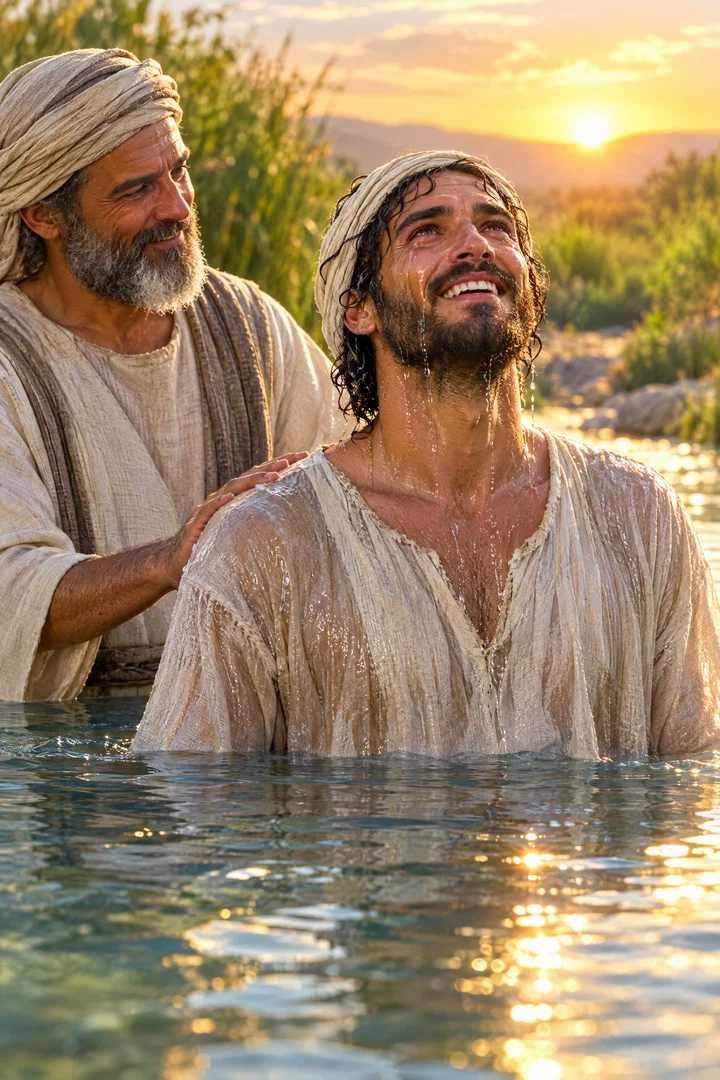
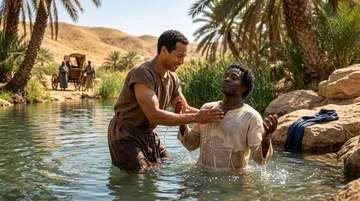
Cross-references 20 of 45
- Romans 6:4
Therefore we are buried with him by baptism into death: that like as Christ was raised up from the dead by the glory of the Father, even so we also should walk in newness of life.
Baptism is described as burial with Christ and rising to new life.
- Matthew 3:16
And Jesus, when he was baptized, went up straightway out of the water: and, lo, the heavens were opened unto him, and he saw the Spirit of God descending like a dove, and lighting upon him:
Both describe baptism involving going into and coming up out of the water.
- Acts 2:38
Then Peter said unto them, Repent, and be baptized every one of you in the name of Jesus Christ for the remission of sins, and ye shall receive the gift of the Holy Ghost.
Peter calls for repentance and baptism in response to the gospel.
- Matthew 28:19
Go ye therefore, and teach all nations, baptizing them in the name of the Father, and of the Son, and of the Holy Ghost:
Jesus commands baptism as part of making disciples of all nations.
- Colossians 2:12
Buried with him in baptism, where in also ye are risen with him through the faith of the operation of God, who hath raised him from the dead.
Baptism is portrayed as burial with Christ and rising with him.
- Isaiah 53:7-8
He was oppressed, and he was afflicted, yet he opened not his mouth: he is brought as a lamb to the slaughter, and as a sheep before her shearers is dumb, so he openeth not his mouth.
Philip explains the suffering servant prophecy as referring to Jesus before baptizing the eunuch.
- Acts 8:30-31
And Philip ran thither to him, and heard him read the prophet Esaias, and said, Understandest thou what thou readest?
Philip's explaining Scriptures prepares eunuch for baptism
- Galatians 3:27
For as many of you as have been baptized into Christ have put on Christ.
Baptism into Christ is described as putting on Christ.
- John 3:23
And John also was baptizing in Ænon near to Salim, because there was much water there: and they came, and were baptized.
Both describe baptism in circumstances requiring much water.
- Acts 10:47-48
Can any man forbid water, that these should not be baptized, which have received the Holy Ghost as well as we?
Peter calls for water baptism after Gentile believers receive the Holy Spirit.
- Mark 16:16
He that believeth and is baptized shall be saved; but he that believeth not shall be damned.
Belief and baptism are joined with salvation.
- Mark 1:9-10
And it came to pass in those days, that Jesus came from Nazareth of Galilee, and was baptized of John in Jordan.
Both describe going down into and coming up out of the water for baptism.
- Acts 8:26-27
And the angel of the Lord spake unto Philip, saying, Arise, and go toward the south unto the way that goeth down from Jerusalem unto Gaza, which is desert.
angel sent Philip to meet the seeking Ethiopian
- Acts 2:41
Then they that gladly received his word were baptized: and the same day there were added unto them about three thousand souls.
Those who received the word were baptized and added to the believers.
- Acts 8:5
Then Philip went down to the city of Samaria, and preached Christ unto them.
Philip preached Christ to the Samaritans before baptizing the eunuch.
- Matthew 3:6
And were baptized of him in Jordan, confessing their sins.
Both describe people being baptized in water.
- Ephesians 4:5
One Lord, one faith, one baptism,
It states that there is one baptism.
- Acts 6:5
And the saying pleased the whole multitude: and they chose Stephen, a man full of faith and of the Holy Ghost, and Philip, and Prochorus, and Nicanor, and Timon, and Parmenas, and Nicolas a proselyte of Antioch:
Names Philip among the seven chosen to serve.
- Acts 16:33
And he took them the same hour of the night, and washed their stripes; and was baptized, he and all his, straightway.
Both show baptism taught and done without delay.
- Acts 21:8
And the next day we that were of Paul’s company departed, and came unto Cæsarea: and we entered into the house of Philip the evangelist, which was one of the seven; and abode with him.
Philip is later identified as the evangelist who baptized the Ethiopian eunuch.
Commentary
Each commentary is drawn from primary sources: the writings of Ellen G. White and Adventist pioneers and periodicals. Each commentary is separate. Its own words are not a quotation; follow the references to read the source passages.
Ellen G. White
31 sources
At his own command the chariot stopped on the desert road from Jerusalem to Gaza, and the Ethiopian treasurer under Candace went down with Philip into actual water to be immersed and come up again after he had heard Jesus preached from Isaiah and believed with all his heart that He is the Son of God.8T 57.5–58.4Lt 94a, 1909, par. 6–8Ms 15, 1909, par. 23–26Ms 17, 1908, par. 14–17Ms 75, 1909, par. 17 The going down together into the water and coming up out of it shows the mode is immersion in the likeness of Christ's death, sealing true conversion only after the gospel has been preached, understood, believed and openly confessed.Ms 46, 1900, par. 10–13Lt 94a, 1909, par. 6–8Ms 17, 1908, par. 14–17Ms 11, 1900, par. 9–12ST Dec 5, 1878 It is to be given at once without waiting to test the believer, because delay leaves the newly awakened mind exposed to Satan's obstacles and confusion.Ms 15, 1909, par. 23–26Ms 13, 1909, par. 2–4Ms 75, 1896, par. 4–5 Heaven and earth are closely joined in such a baptism, for angels mark the honest seeker, the Spirit opens his eyes to see Christ and directs the Spirit-guided worker to his side to explain the Word.Lt 94a, 1909, par. 6–8Ms 17, 1908, par. 14–17Ms 8, 1900, par. 4–8Ms 11, 1900, par. 9–12 Labor for even one soul in an out-of-the-way place is precious and productive of mighty results, for the rejoicing eunuch carried the gospel to Ethiopia and helped convince the church that God grants Gentiles repentance unto life.Ms 15, 1909, par. 23–26ST Dec 5, 18783SP 305.1MH 472.4–473.1Lt 80, 1889, par. 7
Baptism Event and Setting
The man was an Ethiopian nobleman of great authority under Candace queen of the Ethiopians, in charge of all her treasure, who had been to Jerusalem to worship and was journeying homeward studying the Scriptures on the desert road from Jerusalem to Gaza.Ms 15, 1909, par. 23–26Lt 100, 1909, par. 6–13Ms 11, 1900, par. 9–12Lt 5, 1895, par. 9–11 He was a man of influence doing a great work who was interested in the Scriptures, and God recognized him as a seeker after truth.Lt 100, 1909, par. 6–13Ms 17, 1909, par. 7–11 As a reader of Isaiah without understanding he represents a large class who read the Scriptures and cannot understand their meaning.Lt 5, 1895, par. 9–11
As he read, Philip by divine direction joined his chariot, sat beside him, opened the Scriptures to his understanding, and preached Jesus from the prophecy of His suffering and death.Ms 15, 1909, par. 23–26Lt 100, 1909, par. 6–13Lt 5, 1895, par. 9–11 The eunuch's mind had been led by the Spirit to study, and God sent Philip to enlighten him because he could not understand alone.Lt 94a, 1909, par. 6–8 With enlightened heart and mind he came to believe with all his heart that Jesus Christ is the Son of God, confessed that faith as Philip required, and when they came to a stream of water asked what hindered his baptism.Ms 46, 1900, par. 10–13Lt 94a, 1909, par. 6–8Ms 15, 1909, par. 23–26Ms 75, 1909, par. 17Ms 17, 1909, par. 7–11 He did not resist the drawing to the Saviour and did not let high rank keep him from the crucified One, but asked for baptism as soon as water was found.Ms 11, 1900, par. 9–12
At his command the chariot was ordered to stand still, and both Philip and the eunuch went down together into actual water.8T 57.5–58.4Ms 75, 1909, par. 17Lt 100, 1909, par. 6–13Ms 11, 1900, par. 9–12 There in the water Philip baptized him by immersion, not by sprinkling, in keeping with going down both into the water and coming up again.Ms 17, 1908, par. 14–17Ms 8, 1900, par. 4–8Ms 11, 1900, par. 9–12 Afterward they came up out of the water together.Ms 17, 1908, par. 14–17Ms 75, 1909, par. 17Lt 100, 1909, par. 6–13Ms 8, 1900, par. 4–8
Immediately afterward the Spirit of the Lord caught Philip away, and he was seen no more by the eunuch.Lt 94a, 1909, par. 6–8Ms 75, 1909, par. 17Lt 100, 1909, par. 6–13 Philip was taken to Azotus and went on preaching till Caesarea, departing at once to another place when the work was done.Ms 15, 1909, par. 23–26Ms 17, 1908, par. 14–17Lt 100, 1909, par. 6–13 The eunuch went on his way rejoicing as a believer in the truths of God's Word instead of dwelling on trials, with great rejoicing following conviction, confession, and baptism.Ms 15, 1909, par. 23–26Ms 17, 1908, par. 14–17Ms 75, 1909, par. 17Lt 100, 1909, par. 6–13Ms 126, 1902, par. 3–6
Through this one conversion the gospel was carried to Ethiopia, where many accepted Christ and left heathenism for Christianity.ST Dec 5, 18783SP 305.1 The event also helped convince the apostles and Jerusalem leaders that God grants Gentiles repentance unto life, preparing the way for Paul's mission.SLP 39.2
Baptism Meaning and Requirements
The act described is immersion in actual water, not sprinkling, with both men going down together into the water and afterward coming up out of it.Ms 17, 1908, par. 14–17Ms 11, 1900, par. 9–12CET 20.3 The going down and coming up is in the likeness of Christ's death.ST Dec 5, 1878 It is the authorized Scriptural mode, performed promptly when the seeker stops the chariot in response to faith in Jesus Christ.ST Dec 5, 1878CET 20.3
Water baptism seals true conversion and is one of the steps requisite in conversion.Ms 46, 1900, par. 10–13Ms 126, 1902, par. 3–6Lt 189, 1909, par. 19–20 It is given only after the gospel of the Word has been preached, heard, and explained from the Scriptures, and after the hearer has believed with all the heart that Jesus Christ is the Son of God and has openly confessed that faith.Ms 46, 1900, par. 10–13Lt 94a, 1909, par. 6–8Ms 8, 1900, par. 4–8Ms 126, 1902, par. 3–63SP 304.3 The mind is led by the Spirit to study, enlightened by the appointed teacher, and then the believer asks what hinders baptism, orders a halt, and goes down into the water to be baptized.Ms 46, 1900, par. 10–13Lt 94a, 1909, par. 6–8Ms 8, 1900, par. 4–8
Baptism is to be given at once without delay and without waiting to see how the believer will hold to the faith.Ms 15, 1909, par. 23–26Ms 13, 1909, par. 2–4Ms 11, 1900, par. 13 Nothing is to be counted a hindrance when the confession of wholehearted faith has been made and water is found.Ms 15, 1909, par. 23–26Ms 75, 1896, par. 4–5 Immediate action is needed because Satan interposes obstacles to confuse an inquiring mind that would understand the Word, and evil angels wait for opportunity to press in falsehoods and divert a newly awakened mind drawn to the Saviour so that he might never accept Him.Ms 11, 1900, par. 13
Baptism is an ordinance administered by a minister, and receiving it is a first work of duty when its obligation becomes clear.SCEV 17.1–2 Administering it requires courage.SLP 204.1 Though Philip had never received the ceremony of ordination, men who go out with the burden of bringing souls into the truth are ordained of God, and when the Lord works with them to win a soul they should baptize that soul at once and not question about the matter, because the opportunity may not come again.Ms 75, 1896, par. 4–5 If an ordained minister is within reach he should be sought to do the baptizing, but when there is nobody else the worker himself should baptize.Ms 75, 1896, par. 4–5 Being baptized by a minister who is not truly called gives no sound basis for confidence in that minister, and those later troubled by this discovery may seek baptism again and begin anew.SCEV 17.1–2
Divine Leading and Mission
Heaven is closely joined to earth in the search for a single soul, for angels mark honest seekers after light and bring them to appointed human teachers.Ms 17, 1908, par. 14–17Ms 8, 1900, par. 4–8Ms 11, 1900, par. 9–12 The Spirit leads such a mind to study the Scriptures and opens spiritual eyesight to see Christ as the Saviour of the world who pardons the transgression of all who believe on Him.Ms 17, 1908, par. 14–17Ms 11, 1900, par. 9–12Ms 13, 1909, par. 2–4 God sends His angel and His Spirit to direct the worker to the seeking soul, so that teaching of Jesus from Scripture brings conviction, wholehearted belief that Jesus Christ is the Son of God, confession, baptism by immersion in actual water, and then great rejoicing when the work is done.Ms 17, 1908, par. 14–17Ms 8, 1900, par. 4–8Ms 13, 1909, par. 2–4 Every soul is precious in the sight of God, and though God sends light through angels He gives the work of preaching the gospel to people guided by the Holy Spirit to carry that light to the world.Ms 8, 1900, par. 4–8RH Mar 2, 1911HMW 22.3–4 Even high rank does not hold back the one truly drawn to the Saviour, as the treasurer under Candace did not resist the drawing or let position keep him from the crucified One but asked for baptism as soon as water was found.Ms 11, 1900, par. 9–12RH Mar 2, 1911RH Apr 20, 1905
Seekers who read Scripture without understanding are reached through human missionaries who hear God's voice, go where He sends them, and explain His Word and preach Jesus to them.Lt 5, 1895, par. 9–11AA 109.1–28T 58.5 Because the eunuch could not understand, the Spirit led Philip to enlighten him, and after belief and confession both men went down into the water for baptism before Philip was caught away and seen no more.Lt 94a, 1909, par. 6–8Ms 8, 1900, par. 4–8AA 109.1–2 God and His angels as ministering spirits do a special work on earth to instruct seekers, and no one should step between them and one whom God is teaching but should stand aside and let God work on the heart and lay the burden of opening the Scriptures upon human instruments.Lt 94a, 1909, par. 6–8Ms 8, 1900, par. 4–8RH Mar 2, 1911
The baptism shows precious home-missionary labor in personal work for one susceptible soul in a neglected, out-of-the-way place.Ms 15, 1909, par. 23–26MH 472.4–473.1Lt 80, 1889, par. 7 Philip was directed to meet the nobleman journeying homeward from Jerusalem, to sit beside him in the chariot and open the Scriptures to his understanding until with enlightened heart and mind he believed that Jesus Christ is the Son of God.Ms 15, 1909, par. 23–26MH 472.4–473.1 Upon confession of wholehearted faith Philip at once went down with him into the water and baptized him, then departed to another place while the nobleman went on his way rejoicing as a believer.Ms 15, 1909, par. 23–26MH 472.4–473.1 Labor for even one soul in such places is precious and brings mighty results through the Holy Spirit, and the work nearest at hand is to be accepted as God's choice.Ms 15, 1909, par. 23–26MH 472.4–473.1Lt 80, 1889, par. 7
The command to stop the chariot is the model of prompt acceptance and confession of Christ, obedience to Him, and readiness to answer the call of duty.ST Dec 5, 1878ST Dec 5, 18783SP 305.1 Upon believing that Jesus Christ is the Son of God the eunuch acted at once, stopped the chariot, and went down into the water where Philip baptized him.3SP 304.3ST Dec 5, 18783SP 305.1 His response illustrates the steps of conversion including baptism in the likeness of Christ's death.3SP 304.3ST Dec 5, 1878 Through his conversion the gospel was carried to Ethiopia, where many accepted Christ and left heathenism for Christianity.ST Dec 5, 18783SP 305.1
Through one converted man of great authority the light of truth shines to the higher classes and to others.Ms 46, 1900, par. 10–13RH Mar 2, 1911RH Apr 20, 1905 God's guidance brought Philip to a receptive, influential hearer whose conversion and baptism could help spread the truth to others and enable him to share the gospel.Ms 46, 1900, par. 10–13RH Mar 2, 1911RH Apr 20, 1905 Workers are thus to be on watch and ready to help every case that comes to their notice, for such openings enter new fields and allow work with people advanced in temperance principles without entangling the work.Ms 46, 1900, par. 10–13RH Apr 20, 1905
The baptism belongs to the missionary pattern in Acts 8 that must be carefully studied and copied and that belongs to the highest education to be received.Lt 100, 1909, par. 6–13Lt 189, 1909, par. 19–20Ms 11, 1900, par. 13 God's agencies must be wholly consecrated, quick to understand their work, and take advantage of every circumstance to teach the grace of God and draw men to Christ, while heavenly angels cooperate with human workers to win souls.Ms 46, 1900, par. 10–13HMW 22.3–4Ms 11, 1900, par. 13 Immediate action is needed and decision must not be left hanging in the balance, because Satan interposes obstacles to confuse an inquiring mind and evil angels press in falsehoods to divert a newly awakened mind from the Saviour.Lt 189, 1909, par. 19–20Ms 11, 1900, par. 13 The chapter teaches spreading out instead of centering in a few places, dividing and subdividing experienced forces, merging efforts in one city then dividing to enter the next, and entering unworked cities with unpretentious buildings and small schools for preparing workers while working, so the truth becomes a power and thousands are converted to work for other souls.Lt 100, 1909, par. 6–13Lt 189, 1909, par. 19–20
Sources
Pioneers and periodicals
120 sources
Both ordered the chariot stopped and went down into the water together, where Philip baptized the eunuch and from which they afterward came up out.ST Sep 23, 1897ST Mar 5, 1902ST Jun 14, 1905 That going down into and coming up out of the water was burial under water and rising again, which excludes sprinkling or pouring for which entering the water would have been unnecessary.ST Jan 17, 1878ST Dec 27, 1905RH Dec 23, 1915RH Feb 10, 1910 Those who held the Greek to mean only toward and from the water teach they went merely to its edge, while the weight of the teaching holds eis and ek even used once mean into and out of, giving the clearest expression for plunging under water.ST May 17, 1883ST May 17, 1883ST May 17, 1883ST May 17, 1883 Baptism followed preaching of Jesus, instruction and wholehearted belief that Jesus Christ is the Son of God with repentance and confession, and it was done at once by the wayside without waiting for a later gathering.ST Feb 14, 1884ST Feb 17, 1898RH Mar 13, 1913ST Jun 14, 1905RH Nov 28, 1912 It is a water burial picturing death to sin and rising to new life with Christ, an outward act of obedient faith and sign of the inward work rather than a work earning salvation, and in this place it carried the gospel beyond the Jewish people to a foreign seeker under the Spirit's direction through personal human guidance.ST Sep 7, 1915RH Jul 30, 1872ST Apr 9, 1912RH Apr 2, 1908RH Feb 18, 1902
Words Setting and Sequence
The chariot was ordered to stand still, and both Philip and the eunuch went down into the water, where Philip baptized him after confession of faith in Jesus Christ as the Son of God, and afterward they came up out of it.RH Apr 20, 1905ST Sep 23, 1897ST Mar 5, 1902ST Jun 14, 1905RH Jul 20, 1876 The stopping of the chariot and the going down of both men into the water present baptism as a rite performed by entering the water under the special direction of the Spirit, following instruction, examination and preparation in the preaching of Jesus.ST Jun 14, 1905RH Jul 20, 1876ST Sep 23, 1897 The eunuch was converted through that teaching and then went on his way rejoicing.RH Apr 20, 1905RH Feb 18, 1909
The Greek describes actual going down both into the water and then coming up out of it, with eis even when used once meaning into and ek even when used once meaning out of, not merely going to or toward the water and coming back from it.ST May 17, 1883ST May 17, 1883ST May 17, 1883RH Oct 15, 1857 This is the clearest expression for baptism in water by going under and being plunged, corroborating that baptism means dipping or plunging and requires complete submersion as the symbol of Christ's burial.ST May 17, 1883ST May 17, 1883RH Oct 15, 1857 Those who held the opposite reading taught that eis signifies motion toward and never indicates actual going into a place unless repeated once in composition with the verb and once governing the noun, and ek signifies motion from unless likewise repeated, so they went down to the water and came up or back from it.ST May 17, 1883 On still another reading, into does not at all times mean inside, as going up into the mountain means upon it, so they went only close by or near to the water and baptism was then done in the ordinary way by sprinkling or pouring.RH Jan 10, 1871
Going down into the water is distinct from the baptism itself and is its prerequisite step before it, not itself the baptism.ST Mar 6, 1884ST May 13, 1880ST Mar 6, 1884ST Mar 6, 1884 Both men entered the water, but Philip alone then baptized the eunuch, so the verse does not say that both were immersed; immersion applies to the eunuch alone as the person baptized.ST Mar 6, 1884ST Mar 6, 1884ST Mar 6, 1884 In immersion both the one administering baptism and the one receiving it enter the water, and their going down and coming up again describes that burial.ST May 13, 1880ST Mar 6, 1884
Desert on the Jerusalem to Gaza road means a wilderness, an uninhabited solitary place, not a barren waterless waste.ST May 20, 1880ST Jun 7, 1883ST Dec 22, 1887ST May 13, 1880 The route included cultivated hills and valleys, springs, pools and grass, with standing water sufficient for immersion, as proved by the desert place where the multitude sat down on the grass.ST May 20, 1880ST Jun 7, 1883ST May 13, 1880 Early accounts identify the place as a fountain near Bethsur, and as the river Wady Surar, also called Marubah, deep enough in places even in June for immersion rather than sprinkling.ST Dec 22, 1887ST May 13, 1880 The baptism took place in the uncultivated region of Judea southwest of Jerusalem in the early summer of A.D. 37, in one of the incidents resulting from the dispersion of the Christians, illustrating how God led workers and what He will do for honest humble seekers.
The Philip who baptized is Philip the evangelist, one of the seven deacons of the Jerusalem church before the dispersion, not Philip the apostle who remained in Jerusalem.ST Feb 14, 1884ST Jun 7, 1883 After powerful preaching in Samaria he was sent by the Spirit southward into the desert toward Gaza to meet the eunuch, revealing him as an active and efficient worker led by the Spirit, after which he went to Azotus and on to Caesarea where he made his home.ST Feb 14, 1884ST Jun 7, 1883 The eunuch was an Ethiopian official of great authority under Candace queen of the Ethiopians with charge of all her treasure, a proselyte to the Jewish religion who had been to Jerusalem to worship, having heard of the true God and His temple.RH Dec 17, 1901ST Jun 7, 1883 He was returning reading Isaiah without understanding yet willing to learn, diligently searching prophecy on his journey and desiring light, and after hearing Christ and accepting Jesus as Saviour with all his heart he was baptized and continued rejoicing, whence the gospel began in Abyssinia and has remained firm with Old Testament rites kept together with New Testament rites.RH Feb 18, 1909RH Dec 17, 1901RH Sep 27, 1870ST Jun 7, 1883
Baptism by Immersion
Both going down into the water and coming up out of it proves the baptism was performed by immersion, by being buried under water and raised again, and excludes sprinkling or pouring.ST Jan 17, 1878ST Dec 27, 1905RH Dec 23, 1915RH Jul 30, 1872ST Mar 25, 1880 Philip and the eunuch went down into the water before Philip baptized him, and they came up out of the water afterward, illustrating a burial and rising that portrays Christ's burial and resurrection and the believer's new life.ST Jan 17, 1878RH Dec 23, 1915RH Jul 30, 1872ST Mar 25, 1880 The baptism followed without delay for a later ceremony or public gathering, immediately expressing faith in Christ's burial and resurrection through the outward act.ST Jan 17, 1878 The record that both went down into the water proves immersion, which never is and never was done when only sprinkling was practiced.RH Feb 10, 1910ST Jun 29, 1882
The word translated baptized means to dip, immerse, submerge, plunge, whelm, or cover wholly with a fluid.RH Jan 23, 1855ST Jun 29, 1882ST Jul 19, 1883 When adopted into the gospel to define the Christian rite, baptizo kept that one only signification of immerse, with no change in meaning in the least particular, wisely chosen as expressive of its design.ST Jun 29, 1882ST Jul 19, 1883 Scholarship cannot render it otherwise than immerse, not from theological bias, so sprinkling of adults is to be rejected and all converts are to be immersed.ST Jun 29, 1882ST Jul 19, 1883 Entering the water would have been unnecessary if only sprinkling or pouring had been intended.RH Feb 10, 1910ST Jun 7, 1883 Commanding the chariot to stand still and both going down would not have been needed for sprinkling, since two travelers would have had with them enough drinking water for a few drops, and the account gives no support for finding only a small roadside rill and sprinkling him.RH Feb 10, 1910ST Jun 7, 1883
The water is literal water, not a figurative name, and is the element used in baptism.RH Jul 12, 1906ST Jun 1, 1882RH Dec 15, 1859 Philip baptized the eunuch in water after preaching Jesus to him, presenting water baptism as a commanded duty distinct from the promised baptism of the Holy Spirit.RH Jul 12, 1906ST May 27, 1880ST Jun 1, 1882 Water baptism performed by man under the Spirit's direction continued when the church enjoyed the fullness of the Spirit, is not abolished as a carnal ordinance, is not superseded or made unnecessary by Holy Spirit baptism, and remains required under Christ's commission to the end of the world as the outward ceremony of the union formed by the Spirit of God, since only God baptizes with the Holy Spirit.ST May 28, 1896ST Jun 1, 1882RH Dec 15, 1859 It was the uniform apostolic and primitive practice, administered by immersion during the apostles' time and for a long time afterward, almost universal for thirteen centuries until sprinkling or pouring for sickness and cold climates became general in the fourteenth century.ST Mar 23, 1915ST Jun 29, 1882 Philip baptized in one place and one pool of water and does not support three separate immersions.ST Mar 19, 1885
Belief Before Baptism
Baptism followed preaching of Jesus from the Scripture the eunuch was reading, for Philip opened Isaiah to him, explained it on the journey, taught him about baptism from the commission to make disciples and baptize them, and the eunuch, instructed, examined and prepared, accepted the teaching, became a disciple and then desired baptism.ST Feb 14, 1884RH Mar 13, 1913RH Nov 28, 1912ST Nov 14, 1906ST Apr 9, 1912 His request came after receiving that teaching, and his readiness rested on believing with all his heart, which is trusting the righteousness of Christ and turning from sin.ST Apr 9, 1912ST Oct 1, 1896 That timely study bringing light that may lead to eternal life illustrates how instruction leads to conversion and to the stopping at a suitable place, going down into the water, and baptizing.RH Mar 13, 1913RH Nov 28, 1912ST Nov 14, 1906 The examination before baptism was brief yet sufficient, because the candidate understood what belief in Christ means and wholehearted faith made him willing to obey the requirements of Christ.ST Feb 17, 1898ST Mar 5, 1902
Wholehearted belief that Jesus Christ is the Son of God, with confession of faith, repentance, obedience to the gospel and turning from sin, preceded and qualified him for baptism.ST Feb 17, 1898ST Apr 15, 1880ST Jun 30, 1914RH Apr 2, 1857ST Mar 5, 1902 Philip accepted that confession as recognition of readiness, baptizing the officer after he confessed faith, when the chariot stopped and both went down into the water, which presents baptism as a rite performed by entering the water under the special direction of the Spirit.ST Feb 17, 1898ST Jun 14, 1905ST Mar 5, 1902 Baptism is the first work following repentance and faith, administered when the person has received instruction, received the message, professed faith and is prepared to receive remission of sins, as the step of entering the covenant and being added to the church.ST Apr 15, 1880ST Jun 30, 1914RH Apr 2, 1857RH Dec 20, 1853 It signifies dying to sin, rejecting sin and forsaking old ways and habits, so that return to those ways after baptism means the foundation departed from must be laid again, and genuine faith is confirmed by obedience.ST Jun 30, 1914ST Mar 5, 1902
He was baptized immediately, with no delay for a later ceremony, public gathering or prolonged waiting to prove faithfulness, even as the first interview was ending along the highway.ST Jan 17, 1878RH Dec 20, 1853RH Aug 22, 1907 Philip taught baptism in his first and only sermon to him and baptized him as soon as he gladly received the word and decided to follow the Lord, going down with him into the water, which shows baptism by immersion as the outward act expressing faith in the burial and resurrection of Christ.ST Jan 17, 1878RH Aug 22, 1907ST Oct 11, 1883 When souls are converted they are to be baptized, and where possible the service should be in an open stream, conducted with solemnity and importance because angels are present. Baptism in its proper place and significance was invariably preached, invariably required and held in high esteem, as one of the conditions of salvation and the unvarying badge of acceptance of and loyalty to Christ and His gospel, without teaching baptismal regeneration, and the eunuch's rejoicing came after baptism, not before it.ST Jan 17, 1878ST Oct 11, 1883
In this chapter many who accepted the gospel were baptized by Philip before the Holy Spirit was given when Peter and John laid hands on them. The detailed account of the eunuch's conversion and baptism mentions no laying on of hands.ST Jan 1, 1885 Laying on of hands was a special ceremony, not a requirement for baptism, for receiving the Spirit, or for salvation.
Meaning of Baptism
Baptism is a burial in water from which the believer comes up to new life.ST Sep 7, 1915RH Jul 30, 1872RH Apr 2, 1908 Going down into the water and coming up out of it shows the convert plunged beneath the water and raised again.RH Jul 30, 1872RH Apr 2, 1908ST Feb 27, 1896ST Jun 16, 1909 This burial and raising pictures being buried with Christ and rising to walk in newness of life.RH Jul 30, 1872RH Apr 2, 1908ST Sep 14, 1882 It commemorates Christ's death, burial and resurrection, and represents death to the life of sin and resurrection to a life of righteousness.RH Apr 2, 1908ST Feb 27, 1896ST Jun 16, 1909ST Sep 14, 1882 All such detailed descriptions are of immersion, and nothing but immersion meets the demand because no other form even as a figure meets the conditions of death, burial and resurrection.ST Feb 27, 1896ST Jun 16, 1909
Baptism follows acceptance of Jesus as the promised Messiah and is an act of faith and willing obedience, not a human work that earns or helps earn salvation.ST Apr 3, 1893RH Jun 29, 1911 It is the outward part of the ordinance showing the inward work of the Holy Spirit, an outward sign to others of a good conscience toward God through faith in Jesus.RH Jun 29, 1911 It publicly declares that the believer has accepted Christ, yielded to Him and entered union with Him, being baptized into Christ and joined to the risen Christ like a marriage ceremony.ST Apr 9, 1912ST Apr 3, 1893 It is the birth of water that prepares for the future spiritual birth at the resurrection, and the beginning of life united with Christ in which the baptized person keeps learning His ways and growing into a life shaped by Him.ST Apr 9, 1912RH Feb 12, 1857 It does not absolve from sin or prevent sin, and it is not a claim to perfection but receives heaven's approval as obedience that declares acceptance of His death and life in order to walk in newness of life and bring forth fruit to God.ST Apr 9, 1912RH Jun 29, 1911
Readiness for baptism rests on believing with all the heart, which means trusting Christ's righteousness and turning from sin.ST Apr 9, 1912 In its proper place and significance baptism was invariably preached and invariably required and held in high esteem in the gospel system, without teaching baptismal regeneration.ST Oct 11, 1883 It is one of the conditions of salvation and the unvarying badge of acceptance of and loyalty to Christ and His gospel, publicly acknowledging Christ and serving as public testimony of faith.RH Aug 18, 1868ST Oct 11, 1883ST Mar 5, 1902 It follows repentance and obedience when prepared to receive remission of sins, follows conversion, and followed wholehearted belief in Christ as Saviour and Son of God without first mastering creeds or ceremonies.ST Oct 11, 1883ST Mar 5, 1902 Those who do not feel able to live out all of God's truths should not offer themselves as candidates, while one who believes and longs to be baptized may hope God will provide someone to baptize even where a minister cannot be reached.RH Aug 18, 1868RH Jun 14, 1867
Philip taught baptism to the eunuch in his first and only sermon to him after preaching Jesus, and baptized him without long delay after he gladly received the word.ST Feb 14, 1884ST Oct 11, 1883 The eunuch's immediate obedience shows the duty of baptism as part of the commission to make disciples and baptize them.ST Feb 14, 1884 Water baptism is the way a believer follows Christ, who is Saviour, Pattern and Guide, and Christians should follow that example and be buried with Jesus Christ in baptism.RH Jul 1, 1873RH Jul 20, 1876 The point is not that much water is better than little water, but obedience to the way Christ appointed.RH Jul 20, 1876 Convenience does not change the ordinance, so neither soiling delicate clothes to be avoided by wetting the tip of the finger to moisten the forehead, nor the difficulty of immersion where water freezes over around the North Pole, gives reason to abandon immersion.RH Feb 21, 1865
His rejoicing came after baptism, not before it, for he was baptized immediately with no delay for a later ceremony or public gathering and then went on his way rejoicing.ST Jan 17, 1878 He went on his way rejoicing in new light, forgiveness and salvation, and in the truth he had accepted.ST Sep 7, 1915ST Aug 28, 1901RH Nov 17, 1904 This shows God wants all who believe on Him to be happy, with joy as the fruit of the Spirit drawn with joy out of the wells of salvation.ST Aug 28, 1901 He rejoices because God defends His people, dwells in them as the hope of glory, hears and answers prayer, and forgives sins and saves His people from their sins.ST Aug 28, 1901
Gospel Beyond Jerusalem
Acts 8 belongs to the time after Stephen's execution and the scattering by persecution, when the gospel first went beyond the Jewish people to Samaria and to the eunuch on the road to Gaza, moving from Jerusalem toward all nations and the uttermost parts of the earth.RH Feb 18, 1902ST Jun 26, 1907RH Sep 28, 1905STRH May 23, 1912 This marks about A.D. 34, the completion of the 490 years and the end of the seventy weeks cut off upon the Jews and the holy city, closing the seven years from A.D. 27, when Israel's national probation ended and the gospel was thereafter to go to the Gentiles after the Jewish leaders rejected it.RH Feb 18, 1902ST Jun 26, 1907RH Sep 28, 1905STST Nov 28, 1895 The apostles' ministry to the Jews continued during the final half of the seventieth week, and the Jewish nation being cut off as God's special people does not end salvation for Jews, which remains for them as for all nations.RH Feb 18, 1902STST Nov 28, 1895
The eunuch, though a foreigner and a eunuch excluded from Israel's assembly under the old dispensation, was admitted to gospel blessings in fulfillment of Isaiah's promise to eunuchs and Gentiles that they would share in these blessings.RH Dec 17, 1901RH Oct 15, 1872ST Sep 13, 1905 He was a man of great authority under Candace queen of the Ethiopians with charge of all her treasure, who had heard of the true God and His temple and had come to Jerusalem to worship, and after hearing Jesus preached he accepted with all his heart and confessed that Jesus Christ is the Son of God before going down into the water for baptism.RH Dec 17, 1901RH Oct 15, 1872ST Sep 13, 1905 This proves that strangers in far countries, even colored people in Ethiopia, hear of God, worship, accept the gospel, and are accepted by the Lord, whom God cared for as much as any other person and sent Philip to lead to faith.ST Mar 9, 1915RH Dec 17, 1901ST Sep 13, 1905 He belonged to the earnest seekers outside Israel who longed and prayed for light from heaven, and when Christ was revealed to him he received Him with gladness.ST Mar 9, 1915RH Dec 17, 1901
His conversion carried the good news of salvation through Christ into regions beyond, including what is now Abyssinia.RH Feb 18, 1909ST Mar 11, 1897RH May 13, 1862 Returning rejoicing in the new light, forgiveness and salvation he had received, he preached the word to those he met and likely carried it to the queen's court and toward the south of Egypt, though the results of his witness are not recorded.ST Dec 5, 1878RH Feb 18, 1909ST Jun 7, 1883 That baptism of the treasurer of Queen Candace, who had already accepted the Hebrew Scriptures and then received the Christian faith upon hearing the prophecies about Christ and accepting Jesus as Saviour, began the faith held in Abyssinia and marks the beginning of the Christian people of Ethiopia.RH Feb 18, 1909RH May 13, 1862 The churches of Abyssinia and Ethiopia in Central Africa have existed from the first part of the Christian era, perhaps dating from that conversion, and their faith has remained firm ever since, expressed in continued observance of Old Testament rites together with New Testament rites, with many leaving heathenism for Christianity.ST Dec 5, 1878RH May 13, 1862
That Ethiopian church shared in the apostasy that affected the whole church, with Sunday creeping in as a festival day, a sister day to the Sabbath.ST Oct 1, 1896RH Jun 10, 1873 Yet it continued to observe the seventh-day Sabbath, keeping both Saturday and Sunday still, and that keeping stands as the living testimony of a whole people to the perpetuity of the Sabbath in the Christian church for eighteen centuries.RH Apr 18, 1871ST Oct 1, 1896RH Jun 10, 1873 Those Abyssinian churches in Central Africa, in the region where the eunuch lived, kept the seventh-day Sabbath until the early part of the seventeenth century when they were brought under the rule of the pope.ST Oct 1, 1896RH Jun 10, 1873 The eunuch himself, converted to Christianity after coming to Jerusalem to worship and being baptized by Philip, returned to Ethiopia keeping the seventh-day Sabbath, and his example helps explain why the early churches in Ethiopia kept the ancient Sabbath.RH Apr 18, 1871ST Oct 1, 1896RH Jun 10, 1873
The apostolic preaching of the gospel in Samaria and to the eunuch ending in baptism gives no hint of a new Sabbath or first-day Sabbath, though both the Samaritans and the eunuch would have needed it if it had yet been made, proving that no change of the Sabbath had taken place up to that time.RH Nov 9, 1911RH Nov 21, 1871ST Oct 1, 1896 The absence of a recorded command to keep the Sabbath in Acts 8:1-40 does not prove that not a single convert was commanded to keep it, and does not prove that the apostles failed to instruct their converts under the Holy Spirit.RH Nov 9, 1911RH Nov 21, 1871 Silence proves nothing about Sabbath instruction, any more than it proves a command or example for keeping Sunday as a day of rest, while Philip's examining and preparing of the eunuch as a candidate for baptism raises the question why that preparation includes no instruction about the duty of Sabbath observance.RH Nov 9, 1911RH Nov 21, 1871ST Oct 1, 1896
Personal Work and Guidance
The meeting on the road to Gaza was arranged by heaven itself, with angel, Spirit, and Jesus working through the Holy Spirit to bring teacher and seeker together at exactly the right moment.ST Jun 23, 1909RH Apr 24, 1900 Philip was called away from a thriving work in Samaria to go to a desert place for the sake of a single inquiring soul, joined the chariot as commanded, baptized the convert, and was then supernaturally caught away to Azotus.ST Jul 31, 1893ST Jan 22, 1902RH Jan 7, 1909 That continuing direction after Pentecost shows the care of Christ for one soul and that daily labor for another's salvation is guided by Jesus through his delegated representative.RH Apr 24, 1900
God had prepared the heart before he sent the sower, and then brought the prepared heart and the guided teacher into direct contact so the seeker could be enlightened by the truth.ST Oct 23, 1901RH Mar 2, 1911RH Dec 1, 1904 Light is communicated through personal contact by human agents with like passions and similar experience and environment as those who desire help, rather than by the Spirit alone or by angels as laborers.RH May 4, 1911ST Aug 25, 1898 The work of instructing, serving, and baptizing those who need the gospel is entrusted to human servants, even when an angel could have done it, and Philip was given wisdom, courage, self-denial, and fidelity from superhuman power and sent even where he had not chosen to go.ST Dec 8, 1914ST Aug 25, 1898
Though full of the Holy Ghost and wisdom and able to preach to a city congregation, Philip was sent without hesitation to preach to one man alone in the wilderness without knowing he would find even one man.ST Jun 7, 1883 The best New Testament work was done for individuals rather than for masses, and soul-winning is most effective when personal, like hand-picked fruit carefully gathered rather than fruit shaken from the tree in mass.ST Mar 30, 1882RH Jun 20, 1912 That small and seemingly unpromising field proved better than a larger field chosen by human judgment, for the one convert went on his way rejoicing and preaching to those he met and helped carry the gospel to a new continent and to people across nations.ST Jun 7, 1883ST Jan 22, 1902RH Oct 19, 1905 Ministers are therefore to reach people by direct personal contact both at meetings and in house-to-house visitation, and by example to encourage every believer quickened by the Spirit to make a loving personal assault to win unconverted friends.ST Mar 30, 1882RH May 4, 1911RH Jun 20, 1912
Philip was one of the seven deacons, whose duties are largely temporal work as assistant to elders and servant of the church, yet his preaching and baptizing prove those duties do not exclude preaching and baptizing when the Lord leads and opens the way.CO 34.2RH Jan 7, 1862 Whether he did so by virtue of his office as deacon or as one ordained an evangelist before or after he was chosen deacon, his action in leading the eunuch down into the water and baptizing him was no mistake but faithful work in preaching Christ.ST May 15, 1884RH Jan 7, 1862 Following the Spirit's call even outside any assigned territory shows human territorial boundaries must not restrict the freedom to carry out God's work.ST Sep 11, 1907 God could carry on his work without human agents and moves his laborers supernaturally from place to place, yet he graciously gives believers who cannot go themselves the privilege of furnishing supplies so they may share the joy over saved souls with the workers.RH Jan 7, 1909
The eunuch was diligently searching the Scriptures while traveling, taking the Bible as a companion on his journey and reading by the way even what conveyed no meaning to his mind, as a proselyte learner seeking understanding of prophecy and praying for light from heaven.ST Jun 7, 1883RH Dec 17, 1903RH Apr 8, 1909 His willingness to do God's will brought fulfillment of the promise that obedience brings knowledge of doctrine, so that if he had not been reading Philip would not have been sent, and God provided Philip to explain the Scriptures to him on the journey.ST Jun 7, 1883RH Dec 17, 1903 Attentive study with confidence that the Holy Spirit is ever ready to enlighten, even without a human evangelist, is the lesson, while a timely Bible study explaining the Scriptures may bring spiritual light leading to eternal life and glad reception of Christ when revealed.RH Mar 13, 1913ST Jun 7, 1883
His response was immediate, stopping the chariot and acting promptly on faith in Jesus Christ as the Son of God, teaching prompt acceptance and confession, obedience, and readiness to answer the call of duty.ST Dec 5, 1878ST Dec 5, 1878 That winning of another person to Christ with baptism as its result shows what winning others is and how it is done, through a winsome life that mirrors Christ.ST Apr 2, 1896 Philip's help to one being led toward the truth calls believers to give such people needed assistance as the Holy Spirit leads them toward fuller understanding.RH Dec 18, 1913 Each member quickened by the Spirit is to make loving personal effort for friends, and the convert's witness carried the gospel onward so that many left heathenism for Christianity.ST Dec 5, 1878ST Mar 30, 1882
The baptism gives the pattern for the ordinance, where both went down into the water and the baptism followed, read with Matthew 3 when candidates are baptized, including adults already baptized who are baptized again to come closer to the Lord.RH Jul 16, 1901 As an individual case it encourages when only one or a few are baptized at a time.RH Jan 7, 1915 The conversion was genuine though it came without dramatic outward sign, for the Spirit moved through the written Word and Philip's explanation, showing the Spirit's work may be quiet and its process unseen through the power of God's Holy Spirit.RH Dec 30, 1915 That baptism and the joy that followed portray renouncing what stands between a man and wholehearted worship, as when a man renounced his pipe.ST Oct 16, 1879
Power is not given for selfish ends, as Simon desired, but to glorify God, so humility is needed lest the recipient seek personal interest or reputation or take credit for what God does.RH Apr 7, 1868 Philip's trip to the desert brought the truth to the Ethiopians apart from any mission to Ethiopia to gratify personal pride.ST Jun 7, 1883
Sources