Isaiah 53:7
He was oppressed, and he was afflicted, yet he opened not his mouth: he is brought as a lamb to the slaughter, and as a sheep before her shearers is dumb, so he openeth not his mouth.
Translations
He was oppressed, and he was afflicted, yet he opened not his mouth: he is brought as a lamb to the slaughter, and as a sheep before her shearers is dumb, so he opens not his mouth.
He was oppressed, and he was afflicted, yet he opened not his mouth: he is brought as a lamb to the slaughter, and as a sheep before her shearers is dumb, so he openeth not his mouth.
He was oppressed, and he was afflicted,
Yet he opened not his mouth:
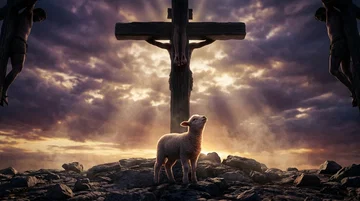
He is brought as a lamb to the slaughter,
And as a sheep before her shearers is dumb,
So he openeth not his mouth.He was oppressed, and he was afflicted, yet he opened not his mouth; he is brought as a lamb to the slaughter, and as a sheep before her shearers is dumb, so he opened not his mouth.
He was oppressed, yet he humbled himself and opened not his mouth; as a lamb that is led to the slaughter, and as a sheep that before her shearers is dumb; yea, he opened not his mouth.
He was oppressed, yet when he was afflicted he opened not his mouth; as a lamb that is led to the slaughter, and as a sheep that before its shearers is dumb, so he opened not his mouth.
It hath been exacted, and he hath answered, And he openeth not his mouth, As a lamb to the slaughter he is brought, And as a sheep before its shearers is dumb, And he openeth not his mouth.
He was oppressed, and he was afflicted, but he opened not his mouth; he was led as a lamb to the slaughter, and was as a sheep dumb before her shearers, and he opened not his mouth.
Hard pressed—yet, he, humbled himself Nor opened his mouth—As, a lamb, to the slaughter, is led, And, as a sheep, before her shearers, is dumb—Nor opened his mouth.
Berean Standard Bible, Majority Standard Bible
He was oppressed and afflicted,
yet He did not open His mouth.
He was led like a lamb to the slaughter,
and as a sheep before her shearers is silent,
so He did not open His mouth.He was oppressed,
yet when he was afflicted he didn’t open his mouth.
As a lamb that is led to the slaughter,
and as a sheep that before its shearers is silent,
so he didn’t open his mouth.Men were cruel to him, but he was gentle and quiet; as a lamb taken to its death, and as a sheep before those who take her wool makes no sound, so he said not a word.
Hee was oppressed and he was afflicted, yet did he not open his mouth: hee is brought as a sheepe to the slaughter, and as a sheepe before her shearer is dumme, so he openeth not his mouth.
Douay-Rheims (Challoner revision)
He was offered because it was his own will, and he opened not his mouth: he shall be led as a sheep to the slaughter, and shall be dumb as a lamb before his shearer, and he shall not open his mouth.
Pictures




Cross-references 20 of 144
- 1 Peter 2:23
Who, when he was reviled, reviled not again; when he suffered, he threatened not; but committed himself to him that judgeth righteously:
Christ endures reviling and suffering without retaliation, entrusting himself to the righteous judge.
- John 1:29
The next day John seeth Jesus coming unto him, and saith, Behold the Lamb of God, which taketh away the sin of the world.
Identifies Jesus as the Lamb who takes away the world’s sin.
- Acts 8:32-35
The place of the scripture which he read was this, He was led as a sheep to the slaughter; and like a lamb dumb before his shearer, so opened he not his mouth:
Philip explains Isaiah’s silent lamb as Jesus and preaches him from the prophecy.
- Matthew 27:12-14
And when he was accused of the chief priests and elders, he answered nothing.
Jesus remains silent under accusation before Pilate.
- 2 Corinthians 5:21
For he hath made him to be sin for us, who knew no sin; that we might be made the righteousness of God in him.
The sinless Christ bears sin for others as an offering.
- Matthew 26:63
But Jesus held his peace. And the high priest answered and said unto him, I adjure thee by the living God, that thou tell us whether thou be the Christ, the Son of God.
Jesus remains silent before his accusers.
- Luke 23:34
Then said Jesus, Father, forgive them; for they know not what they do. And they parted his raiment, and cast lots.
Jesus prayed for forgiveness for those who crucified him.
- Isaiah 53:3
He is despised and rejected of men; a man of sorrows, and acquainted with grief: and we hid as it were our faces from him; he was despised, and we esteemed him not.
Christ is described as despised, rejected, and acquainted with grief.
- Luke 23:9
Then he questioned with him in many words; but he answered him nothing.
Jesus gives Herod no answer during his trial.
- Psalms 22:16
For dogs have compassed me: the assembly of the wicked have inclosed me: they pierced my hands and my feet.
Both foretell the Messiah’s suffering and crucifixion.
- 1 Peter 1:19
But with the precious blood of Christ, as of a lamb without blemish and without spot:
Both describe Christ as the spotless Lamb led to slaughter.
- Isaiah 53:12
Therefore will I divide him a portion with the great, and he shall divide the spoil with the strong; because he hath poured out his soul unto death: and he was numbered with the transgressors; and he bare the sin of many, and made intercession for the transgressors.
The servant bears the sin of many and intercedes for transgressors.
- Matthew 27:39-44
And they that passed by reviled him, wagging their heads,
Jesus endures scoffing and insults at the cross.
- 1 Peter 2:24
Who his own self bare our sins in his own body on the tree, that we, being dead to sins, should live unto righteousness: by whose stripes ye were healed.
Christ, like the suffering servant, bore our sins in his body.
- Acts 8:32
The place of the scripture which he read was this, He was led as a sheep to the slaughter; and like a lamb dumb before his shearer, so opened he not his mouth:
It is cited alongside Isaiah 53:7 as a parallel description of Christ.
- Revelation 13:8
And all that dwell upon the earth shall worship him, whose names are not written in the book of life of the Lamb slain from the foundation of the world.
Both identify Christ as the Lamb slain.
- Matthew 26:53
Thinkest thou that I can not now pray to my Father, and he shall presently give me more than twelve legions of angels?
Jesus could summon angels but accepts arrest so Scripture will be fulfilled.
- 1 Corinthians 5:7
Purge out therefore the old leaven, that ye may be a new lump, as ye are unleavened. For even Christ our passover is sacrificed for us:
Christ is identified as the Passover sacrifice, echoing Isaiah’s lamb imagery.
- Hebrews 12:3
For consider him that endured such contradiction of sinners against himself, lest ye be wearied and faint in your minds.
Jesus endured hostility from sinners with patient suffering.
- Psalms 22:7-8
All they that see me laugh me to scorn: they shoot out the lip, they shake the head, saying,
Foretells the scorn and taunts Christ faced in distress.
Commentary part 1 of 2
Each commentary is drawn from primary sources: the writings of Ellen G. White and Adventist pioneers and periodicals. Each commentary is separate. Its own words are not a quotation; follow the references to read the source passages.
Ellen G. White
103 sources
It means enduring oppression, affliction and false accusation in calm silence without defense, protest or retaliation, led innocently and unresistingly to death as a sacrificial victim and remaining mute before those who harm Him like a defenseless sheep before its shearers.AA 225.2–226.2AA 227.3Ms 29, 1900, par. 2–4Ms 112, 1897, par. 20–21DA 112.5–113.1
It plainly foretells the sufferings and death of Christ at His first coming in humiliation, poverty and lowliness as the suffering Messiah and Lamb of God.AA 225.2–226.23SP 304.2DA 458.2–4
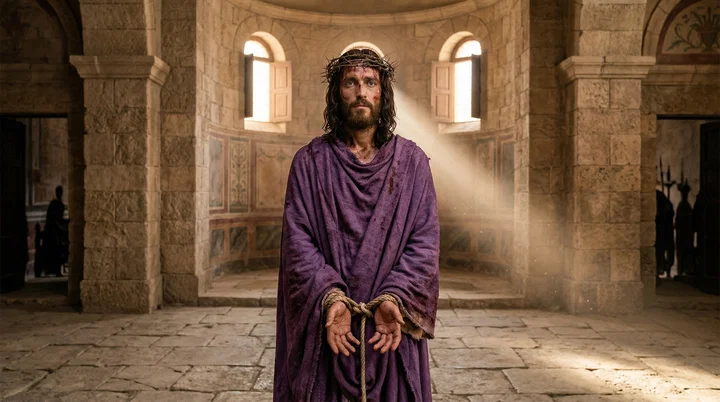
It was fulfilled when He stood calm and silent before Caiaphas, Herod and Pilate, answering nothing to false charges and abuse, and when He was bound, led away, mocked and nailed to the cross without resistance, murmur or complaint.3SP 119.1–2Ms 41, 1887, par. 11–14Lt 61, 1891, par. 10–12Ms 45, 1892, par. 28–31ST Nov 2, 1882
He voluntarily gave His life as an offering for sin, standing as humanity's representative, substitute and surety to bear griefs, iniquities and the curse, bringing pardon, healing and restoration to all who believe and receive Him.AA 225.2–226.2AA 227.3Ms 29, 1900, par. 2–4Ms 112, 1897, par. 20–21Ms 205, 1899, par. 1–2
It speaks not of Isaiah himself but of another man, Jesus Christ the Son of God, and beginning at that same scripture His mission to save sinners is to be preached to call for repentance and faith, leading believers gladly to baptism and rejoicing.Ms 46, 1900, par. 10–13ST Dec 5, 1878AA 107.2–108.1RH Apr 20, 1905
His patient humiliation and silent self-sacrifice require believers to deny self, walk in His footsteps and bear reproach, learning forbearance, forgiveness and eloquent restraint in speech instead of contending for rights.Ms 29, 1900, par. 2–4Lt 416, 1907, par. 21–23Lt 2, 1870, par. 14–15EW 92.2–93.1
Language and Imagery
He was oppressed and he was afflicted yet he opened not his mouth means enduring oppression, affliction, false accusation and suffering in calm silence without answering in defense, protest, retaliation, complaint, murmuring, resentment or impatience.AA 225.2–226.2Ms 29, 1900, par. 2–4Ms 112, 1897, par. 20–21PK 689.2 That silence was not helplessness but willing submission, belonging to bearing human griefs and sorrows, being wounded for transgressions and bruised for iniquities, bearing the chastisement that brings peace and bringing healing by stripes, with the iniquity of all laid upon him.AA 225.2–226.2Ms 29, 1900, par. 2–4Ms 112, 1897, par. 20–21 His endurance expressed forgiving love toward persecutors throughout his life and at the cross, and belonged to his saving work for humanity whose full significance his followers did not understand.Ms 126, 1909, par. 6–8
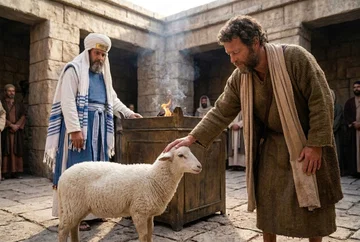
He is brought as a lamb to the slaughter means led innocently and unresistingly to death as a sacrificial victim.AA 225.2–226.2AA 227.3DA 112.5–113.1GC 357.2–358.1GC 17.2–18.1 The sacrificial service was closely linked with prophecy about the One to be so brought, for the Messiah would give his life as an offering for sin, and looking down through the centuries to the scenes of the atonement the prophecy testified of the Lamb of God in his death for sinners.AA 225.2–226.2AA 227.3 Its lamb imagery continues the lesson of the ram provided in Isaac's place, that God provides the sacrifice and Christ bears the sins of humanity, and it was fulfilled in Jesus of Nazareth.DA 112.5–113.1GC 357.2–358.1 The sheep gate through which sacrificial victims had long been led foreshadowed the path he would take to Calvary, seen beforehand from Olivet with Gethsemane and great darkness ahead, yet met without weeping for himself.GC 17.2–18.1GC88 18.1
As a sheep before her shearers is dumb means remaining silent before those who harm, shear, mock and kill him, like a defenseless sheep before its shearers.AA 225.2–226.2Ms 29, 1900, par. 2–4Ms 112, 1897, par. 20–21PK 689.2 He suffered oppression and affliction without speaking in his defense or in protest, without answering or resisting, and without answering in retaliation.Ms 112, 1897, par. 20–21PK 689.2Ms 126, 1909, par. 6–8 That patient, silent submission marks his willing suffering as the sacrificial offering for others, enduring humiliation and death to save people from ruin and bear their sins.Ms 29, 1900, par. 2–4Ms 112, 1897, par. 20–21Ms 126, 1909, par. 6–8
Prophecy of Messiah's Suffering
The verse plainly foretells the sufferings and death of Christ and His first advent in humiliation, poverty and lowliness as the suffering Messiah and Lamb of God come to save sinners.AA 225.2–226.23SP 304.2PK 686.17MR 200.1–202.18RED 45.1–46.1 It describes Him as innocent yet suffering without protest, oppressed and afflicted yet silent, led to death like a lamb to the slaughter and dumb like a sheep before its shearers, and this was fulfilled in Jesus of Nazareth and His work among men.AA 225.2–226.2DA 458.2–4GC 357.2–358.1PK 686.13SP 389.1–2 It belongs to the chapter that sets forth His rejection and sufferings in the world, and its picture accords with the rejection and suffering seen in His humble life and ministry.AA 225.2–226.2DA 458.2–4GC 357.2–358.1PK 686.17MR 200.1–202.1
It foretells that He would come in humility and poverty to be despised, rejected, unappreciated, condemned and slain, not as a temporal ruler to defeat Rome and exalt the nation as a conquering Messiah.7MR 200.1–202.1Lt 65, 1894, par. 4–68RED 45.1–46.1SLP 83.1–23SP 389.1–2 The Passover, the brazen serpent lifted in the wilderness, and all religious services and ceremonies pointed to Him and are valueless if He is rejected, and Moses and the prophets testified of Him in words unlocked and made clear by Christ Himself.8RED 45.1–46.1SLP 103.2–104.1 Religious teachers distorted the prophecy to make it appear that the Messiah could not come in such a lowly form, so those who accepted their claims instead of God's words expected a different kind of Messiah, were misled, and would not listen to the direction to Jesus as the Lamb who takes away the world's sin.DA 458.2–47MR 200.1–202.1
His refusal and rejection, humiliation, suffering and death were ordained in the councils between the Father and the Son and foretold by prophets and men inspired by the Holy Spirit, portrayed in prophetic vision of His whole experience and lowly self-denying life.8RED 45.1–46.1Ms 64, 1895, par. 8SLP 103.2–104.1Ms 138, 1897, par. 15–16Ms 41a, 1896, par. 33 He did not come to establish a temporal kingdom on David's throne but a spiritual kingdom, and therefore passed through oppression and affliction and death as specified, as the Messiah and antitype of the sacrificial offerings whose death belonged to His work as the world's Redeemer.8RED 45.1–46.1SLP 103.2–104.1Ms 138, 1897, par. 15–16 Every specification concerning Him has been fulfilled exactly as written in His own person and verified in history, in His life, teachings, suffering, death, resurrection and ascension, proving His identity, and the vivid Old Testament representations of His sufferings by which salvation was secured are to be sacredly cherished.8RED 45.1–46.1Ms 64, 1895, par. 8SLP 103.2–104.1Ms 138, 1897, par. 15–16Ms 41a, 1896, par. 33
The verse belongs with the wider prophecy that He would grow up as a tender plant despised and rejected, bear human griefs, sorrows, weakness and iniquities, be wounded for transgressions and bruised for iniquities, bear the chastisement that brings peace, bring healing by stripes, and have laid upon Him by the Lord the iniquity of all who like straying sheep have gone each to his own way.AA 225.2–226.2Ms 29, 1900, par. 2–4ST Jan 5, 1915 With the words that follow it about His humiliation, His judgment taken away, and His life taken from the earth, being taken from prison and from judgment and cut off out of the land of the living for the transgression of God's people, it sets forth the great truth of redemption in Jesus as substitute bearing sin's penalty and making atonement to redeem and cleanse the guilty.AA 225.2–226.2AA 107.2–108.1RH Mar 2, 1911ST Jan 5, 1915Ms 126, 1902, par. 3–6 It speaks not of Isaiah himself but of another man, Jesus Christ the Son of God, whose life was taken from the earth, and beginning at this same scripture Jesus can be preached as Saviour, bringing light that leads to faith and baptism when its meaning, not clear without guidance, is explained.AA 107.2–108.1RH Mar 2, 1911Ms 126, 1902, par. 3–6
Fulfilled in Trial and Death
Before Caiaphas and the Sanhedrin the prophecy was fulfilled when Jesus, knowing His sentence was already determined, remained calm and silent under oppression and false accusation like a lamb led to slaughter and a sheep dumb before its shearers.3SP 119.1–2ST Jun 27, 18785RED 39.1–2COS 128.1–4COS 124 The witnesses proved nothing worthy of death and disagreed so their evidence could not be used against Him, and He answered no charge until put under oath.3SP 119.1–2ST Jun 27, 1878COS 128.1–4 His refusal to open His mouth even when urged to answer left the priests and rulers disappointed and perplexed with no ground to condemn Him, so their only hope was to make Him speak something that would condemn Him before the people.ST Jun 27, 18785RED 39.1–2COS 128.1–4
Before Herod it was fulfilled when Jesus stood in calm, profound silence though repeatedly urged to speak, to give evidence of divine power by working a miracle before the crowd, to heal maimed, crippled and deformed persons brought for that purpose, and to use that power to procure His own release.ST Nov 2, 18823SP 137.2ST Jul 11, 1878 He made no answer by word or look, standing as one who neither saw nor heard, and did not answer even when accused of being an impostor and of working miracles by the power of Beelzebub and of sorcery.ST Nov 2, 18823SP 137.2ST Jul 11, 1878 Though Herod pressed his claim to have power to release or to condemn and boasted of the punishment he had inflicted on John for reproof, Jesus remained silent with utter indifference to the royal personage, in dignity, kingly bearing, calm majesty, innocence and noble purity.ST Nov 2, 18823SP 139.25RED 59.2Ms 129, 1897, par. 1–3 His profound silence irritated Herod more than open rebuke would have, and perplexed, unsettled and frightened him and made him hesitate to condemn, while it carried conviction and made some who mocked ashamed.ST Nov 2, 18823SP 139.25RED 59.2ST Jul 11, 1878 He was silent because, having taken the nature of man, He had no such work to do to gratify the curiosity of wicked men nor to save Himself one part of the pain and humiliation man would suffer under similar circumstances, though He could have made the king tremble with terror, and His utter silence was the severest rebuke to the wicked king who had slain God's holy prophet.ST Nov 2, 1882ST Jul 11, 1878Ms 129, 1897, par. 1–3
Before Pilate it was fulfilled when Christ, consciously innocent and free from fear or retaliation, remained unmoved even as the priests' fury rose around Him and answered never a word to uproar, abuse, false charges and cruel death sentence from unreasonable wicked men.Lt 61, 1891, par. 10–12ST Jan 24, 1900Lt 97, 1895, par. 56–61Ms 51, 1897, par. 184MR 162.2–163.1 Like a defenseless sheep before its shearers He did not answer His abusers or retaliate but endured cruel treatment, jeers and insults with dignified composure, serenity, meekness, wisdom and innocence, speaking no more than necessary and saying nothing more to prevent condemnation.ST Jan 24, 1900Ms 51, 1897, par. 18COS 141.2–3 He spoke freely alone with Pilate to enlighten him and spoke freely when poor sinners asked the way of life, but then kept silent while suffering humiliation, agony and the most shameful cruel death because He had freely chosen as man's representative, substitute and surety, pure and holy yet numbered with transgressors and bearing the curse, to bear the sins of the guilty and give His life for them so repentant sinners might be clothed with His righteousness and justified.Lt 61, 1891, par. 10–12Lt 97, 1895, par. 56–614MR 162.2–163.1 He kept silent though He had power to deliver Himself, as shown when His words in Gethsemane knocked the arresting mob to the ground.4MR 162.2–163.1
On the way to Calvary and on the cross it was fulfilled when, bound and led away toward Calvary and delivered to the people to be crucified, He bore insult, mockery, shameful abuse, smiting and derision without resistance, murmur, reproach, retaliation or complaint.Ms 41, 1887, par. 11–14Ms 45, 1892, par. 28–31ST Aug 21, 18792T 207.2–208.1SG1 58.1 A vast multitude enclosed Him with mocking and jeering mingled with coarse oaths of blasphemy, commenting on His lowly birth and humble life, while the chief priests and elders ridiculed His claim to be the Son of God with vulgar jest and insulting sneer passed from lip to lip, and His opposers dared Him to come down.Ms 41, 1887, par. 11–14Ms 140, 1908, par. 45–47 Laid upon the cross and stretched out to be fastened with cruel nails through the bone and muscle of His tender hands and feet, with nails through His hands and feet, He murmured not against His murderers but only groaned in agony, with pale face and large drops of sweat standing upon His brow, suffering for sinners and dying in human agony.Ms 140, 1908, par. 45–47SG1 58.1
It was fulfilled in His public presentation as the antitypical Lamb who voluntarily gave Himself as an offering for the sins of the world, whose death was the crowning sacrifice of His mission.ST Jun 8, 1882DA 571.2–42SP 385.2–386.2 At Passover He publicly presented Himself as the antitypical Lamb, and His entry into Jerusalem and the events surrounding His death and leading to it were meant to direct public attention to that approaching sacrifice and to confirm that He was the Messiah, even for rejecters.ST Jun 8, 1882DA 571.2–42SP 385.2–386.2 The sheep gate through which sacrificial victims had long been led for centuries foreshadowed the path Jesus would take to Calvary and would open for Him.GC 17.2–18.1GC88 18.1 From Olivet He could see Gethsemane where His agony lay ahead and Calvary where He would suffer in great darkness, and though He well knew where His feet were tending and the superhuman anguish before Him, His unselfish spirit was not clouded by foreboding of His own suffering and He did not weep for Himself but wept for the doomed thousands of Jerusalem because of their blindness and impenitence.GC88 18.1 His separation from His parents for three days also foreshadowed their later grief when He was slain and separated from them, followed by His revealing Himself to them as Redeemer and advocate.ST Dec 9, 1880
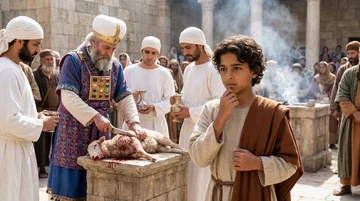
Jesus knew He was its fulfillment from age twelve on His first visit to the temple at Jerusalem at Passover, when the veil was lifted on His mission and work by what He saw there and by communication from His Father, showing Him to be the great Sacrifice for sin.Ms 183, 1903, par. 1–2 Against their view of wonderful elevation for the Jewish nation, He set before the rabbis and teachers the prophecy of the appearing of Messiah that brings to view the humiliation, suffering and death of the Son of God, asking its meaning and interpreting it to their darkened minds. While taking the attitude of a learner He imparted light in every word and by sharp, clear questions brought a flood of light to darkened understanding, revealing Himself as the Lamb of God that takes away the sins of the world and making known the plan of salvation.
From His appearance as a babe in Bethlehem through the desert to Calvary Satan put forth extraordinary efforts with oppression to oppress and overwhelm Him and to prevent His perfect childhood, faultless manhood, holy ministry and final sacrifice.SG1 39.13SP 183.2 As the time drew on for Jesus to accomplish the object for which He came into the world, Satan and his angels decided to inspire His own nation to cry eagerly for His blood and to heap invented cruelty, scorn, abuse and suffering upon Him, hoping Jesus would resent such treatment and fail to maintain His humility and meekness.SG1 39.1SG1 49.13SP 183.2 His persecutors' insults were meant to provoke a murmur or make Him use divine power to escape, but He did not respond in either way and never murmured but yielded up His life as an infinite sacrifice for the sins of men.SG1 49.13SP 183.2 The more mercilessly the storm of Satan's wrath beat upon Him, the more firmly He clung to His Father's hand and pressed on in the blood-stained path before Him, so that every effort to crush Him only brought out His spotless character in purer light and the plan of salvation did not fail and was not broken up.SG1 39.1SG1 49.13SP 183.2
Sacrifice for Human Sin
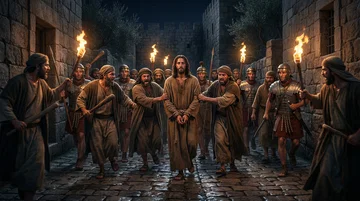
The verse means the Messiah would voluntarily give His life as an offering for sin, as the Lamb of God and the antitypical Passover Lamb whose death crowns His mission to save sinners from guilt and doom.AA 227.3Ms 112, 1897, par. 20–21Ms 205, 1899, par. 1–2Ms 183, 1903, par. 1–2ST Jun 8, 1882 His silence under oppression and affliction belongs to that willing suffering, enduring humiliation and death without speaking in His own defense to bear the sins of others and save them from ruin.Ms 112, 1897, par. 20–21Lt 61, 1891, par. 10–12 After the betrayal in the garden of Gethsemane He was led from mockery to mockery and from insult to renewed insult without failing, bearing Himself with dignity through the disgraceful farce of a trial and remaining silent except for words that glorified God, then led away amid an immense crowd of bitter enemies and unfeeling spectators to crucifixion.Ms 205, 1899, par. 1–2 He knew He was its fulfillment from age twelve on His first visit to the temple at Jerusalem, when what He saw there with communication from His Father lifted the veil on His mission and work.Ms 183, 1903, par. 1–2 His silence before unjust accusers at Pilate's trial was not guilt but free choice to bear the sins of the guilty and give His life for them.Lt 61, 1891, par. 10–12
In that sacrifice He bore human griefs, sorrows, weakness and iniquities, suffered betrayal, trial and insult as a criminal, and died in human agony.AA 225.2–226.2Ms 29, 1900, par. 2–4Ms 140, 1908, par. 45–47ST Jan 5, 1915ST Dec 3, 1885 He was wounded for transgressions and bruised for iniquities, bore the chastisement that brings peace, brought healing by His stripes, and had laid upon Him the iniquity of all who like straying sheep have gone each to his own way.AA 225.2–226.2Ms 29, 1900, par. 2–4 Hanging on the cross with nails through hands and feet, oppressed and afflicted and mocked by opposers daring Him to come down, He bore it to make it possible for humanity to obtain life measuring with the life of God.Ms 140, 1908, par. 45–47 That atonement as substitute bearing sin's penalty redeems and cleanses the guilty, bringing pardon, healing, restoration to God, everlasting life and restoration to God's image to all who believe in Him as Christ, receive Him and follow in His footsteps, seeking and saving the lost.Ms 140, 1908, par. 45–47ST Jan 5, 1915ST Dec 3, 1885ST Sep 28, 1915
He stood as humanity's representative, substitute and surety, pure and holy yet numbered with transgressors, bearing sin's curse and penalty.Lt 61, 1891, par. 10–12ST Jan 5, 1915Lt 97, 1895, par. 56–61Lt 75, 1903, par. 54MR 162.2–163.1 Willingly suffering humiliation, agony and death before Pilate under false accusation and sentence of death like a lamb led to slaughter, He accepted sin's penalty and was treated as a transgressor though condemned for sin He had no share in.Lt 61, 1891, par. 10–12Lt 97, 1895, par. 56–614MR 162.2–163.1 He lived in perfect obedience for sinners and shed His blood on the cross, clothing repentant sinners with His righteousness so they may receive another chance, be justified by a righteousness they had no part in, and be saved as all who come to Him.Lt 61, 1891, par. 10–12Lt 75, 1903, par. 54MR 162.2–163.1 He answered not a word to false accusations and the cruel death sentence from unreasonable wicked men, though He spoke freely when poor sinners asked the way of life, and kept silent while suffering the most shameful cruel death because He had given His life for the life of the world even though He had power to deliver Himself, as shown when His words in Gethsemane knocked the arresting mob to the ground.4MR 162.2–163.1
The sacrifices and services under the law prefigured Him and illustrated His atonement, including the Passover and its lamb's blood and the brazen serpent lifted up in the wilderness, with all religious services and ceremonies pointing to Him and valueless if He is rejected.LC1 60.1SG4 118.11RED 59.2–60.18RED 45.1–46.1 He is the Messiah and antitype of the sacrificial offerings, and His death was part of His work as the world's Redeemer, fulfilling prophecy of His life, teachings, suffering, death, resurrection and ascension and proving His identity.8RED 45.1–46.1SLP 103.2–104.1 When the One those sacrifices pointed to came in humility and poverty to be rejected, despised and slain, contrary to expectation of a conquering Messiah, the blinded and deceived nation would not receive Him and refused Him.LC1 60.1SG4 118.11RED 59.2–60.18RED 45.1–46.1
Though He had taken human nature, God sustained Him with divine fortitude and Godlike strength and power, and He did not depart in any way from His Father's will.5RED 67.23SP 147.2SG1 57.1 He endured insult, cruelty and abuse without complaint, murmur or retaliation, and did not use His divine power to free Himself, escape, strike down tormentors, gratify curiosity or save Himself pain, even when Satan sought to provoke Him to do so, exercising it only for others' salvation.EW 138.13SP 139.15RED 59.1SG1 57.1 His meekness, patience and submission under test were part of His perfect humanity and the test He had to bear, keeping Him a perfect offering as the Lamb of God, for any failure under it would have made Him an imperfect offering and redemption would have failed.3SP 139.15RED 59.1
From Olivet He could see Gethsemane where His agony lay ahead, the sheep gate through which sacrificial victims had been led for centuries and which would open for Him, and Calvary where He would suffer in great darkness and give His life as an offering for sin.GC88 18.1 Though He well knew where His feet were tending and the superhuman anguish before Him, He did not weep for Himself and His unselfish spirit was not clouded by foreboding of His own suffering.GC88 18.1 He wept for the doomed thousands of Jerusalem because of their blindness and impenitence.GC88 18.1
He endured suffering and shame without complaint or resistance in infinite tenderness, patience and long-suffering, with joy for bringing people eternal life and seeing the redeemed restored to God's image and receiving pardon and everlasting life.ST Sep 28, 1915RH Jun 18, 1901Lt 131, 1900, par. 17–19RH May 6, 1902 He gave Himself up as the sacrificial victim and went willingly to death, led like a lamb to slaughter, to save sinners from the doom due to their guilt by taking away their guilt.RH Jun 18, 190121MR 349.6–350.3Lt 131, 1900, par. 17–19 Those who reject Him and refuse to let Him take away their guilt face judgment for their sins and the doom now falling upon them, meeting Him in the great day of His wrath as the wrath of the Lamb.RH Jun 18, 1901Lt 131, 1900, par. 17–19
Preaching Jesus from Prophecy
The prophecy does not speak of Isaiah himself but of another man, Jesus Christ the Son of God.Ms 46, 1900, par. 10–13AA 107.2–108.1RH Mar 2, 1911 It reveals Him and His mission to earth to save sinners, setting forth the great truth of redemption in Jesus as the Saviour who comes as a suffering sacrifice, like a lamb led to slaughter.ST Dec 5, 1878AA 107.2–108.13SP 304.2DA 136.3–137.1 It calls for repentance toward God because of transgression of the Father's law and for faith in Christ as the Saviour of men.ST Dec 5, 1878
The Ethiopian official of great authority under Candace, returning from worship at Jerusalem, was reading this prophecy while diligently studying the prophecies of the Messiah without understanding or comprehending whom they meant.ST Dec 5, 1878Ms 8, 1900, par. 4–8Lt 100, 1909, par. 6–13 He asked whether the prophet spoke of himself or of another man, a question a seeker after light can ask when reading of the silent, suffering servant whose life was taken from the earth.Ms 46, 1900, par. 10–13Ms 8, 1900, par. 4–8Ms 126, 1902, par. 3–6Ms 17, 1908, par. 14–17 His reading joined oppression and affliction, silence under suffering, humiliation, judgment taken away, and life taken from the earth.Ms 46, 1900, par. 10–13RH Mar 2, 1911Ms 17, 1908, par. 14–17
What is read there is not clear and not understood without guidance from one who can explain it, so someone must guide him to understand.AA 107.2–108.1RH Mar 2, 1911Ms 17, 1908, par. 14–17 Philip was to join him and, beginning at that same Scripture, preach Jesus as the Son of God and Saviour.Ms 46, 1900, par. 10–13AA 107.2–108.1RH Apr 20, 1905Ms 8, 1900, par. 4–8Ms 126, 1902, par. 3–6 That explanation shows the words concern Christ and brings light that leads to faith.AA 107.2–108.1Ms 8, 1900, par. 4–8Ms 126, 1902, par. 3–6
Believing with all the heart from this Scripture that Jesus Christ is the Son of God leads gladly to baptism in water in the likeness of His death and to going on the way rejoicing.Ms 46, 1900, par. 10–13ST Dec 5, 1878AA 107.2–108.1Ms 17, 1908, par. 14–17 Through such converts the light of truth shines even to the higher classes.Ms 46, 1900, par. 10–13 The verse thus gives workers a place to begin with seekers who read without understanding, to join them, guide them, and preach the gospel to every case that comes to notice.Ms 46, 1900, par. 10–13
Pattern for Believers Endurance
His patient humiliation and silent self-sacrifice require those who follow Him to deny self and die to self, to make covenant with Him and walk in His footsteps, and to crave the suffering part rather than shun the cross.Ms 29, 1900, par. 2–4EW 92.2–93.1SCEV 32.2–33.1 They are to keep Him in mind as their example and willingly and cheerfully endure hardship for His sake, willing to run risk and bear reproach rather than through timidity or fear of reproach take the side of transgressors of God's law and imperil their souls.Ms 29, 1900, par. 2–4EW 92.2–93.1SCEV 32.2–33.1 His silent self-sacrifice rebukes love of supremacy and self-exaltation, calling servants to press close to His side, learn from Him, become as little children, and take up God-given responsibilities in His Spirit in publishing houses, sanitariums, and churches.Lt 416, 1907, par. 21–23 Those who share His self-sacrifice now will share His glory when the Deliverer comes, and this example should remove crooked ways among men of responsibility.Lt 416, 1907, par. 21–23 His path of humiliation led to the cross where He gave Himself to seek and save the lost and bring humanity back to God, bearing human weakness, sin, grief and sorrow without complaint though He could have called legions of angels to His aid, and that self-giving both saves and patterns the follower.ST Dec 3, 1885RH Jul 25, 1854
His forgiving, unretaliating love under oppression teaches forbearance, forgiveness, pity, self-control and submission to God instead of a combative, independent, self-assertive spirit.Lt 2, 1870, par. 14–15ED 257.4–5RH Nov 7, 1912 He did not contend for His rights, answer in retaliation, reviling or threat, or show resentment or impatience, but committed Himself to God who judges righteously, meeting insult and mockery with uncomplaining silence, pity and love.Lt 2, 1870, par. 14–15RH Nov 7, 1912 He bore rough treatment patiently and without complaint, remaining undiscouraged because He knew God was pleased with Him, and remained unmoved with conscious innocence and freedom from fear or retaliation even as fury rose around Him, testifying by His bearing to wisdom and innocence.COS 41.3ST Jan 24, 1900
His silence is a model of eloquent restraint in speech for those who face injustice, indignation, irritation, criticism and faultfinding.Lt 102b, 1899, par. 17Ms 103, 1903, par. 8Lt 102a, 1899, par. 3 Returning no answer, murmuring or reproach can be the strongest rebuke, can speak eloquently, and can build confidence in genuine experience.Lt 102b, 1899, par. 17Lt 102a, 1899, par. 3 Those who represent unpopular truth are to remain silent rather than complain and conduct themselves with honesty, and burdened and wronged believers learn power to endure wrong, wisdom to keep silent instead of dwelling on trials and reporting them to others, and rest of soul.Lt 2, 1870, par. 14–15GW 372.3 Ministers, physicians and all medical missionary workers, when they meet together for counsel and are tempted by trials and difficulties to express intense feelings in words of bitterness, reproach and complaint, or to look at the faults of others, are to look to Him who never spoke a word of complaint and not show by complaining words that Satan controls their hearts.Ms 103, 1903, par. 8 So also those angered by injustice, including the injustice shown to Black people and workers among oppressed people whose indignation might provoke harmful speech, are to learn restraint from Him.CNA 138.1Lt 102a, 1899, par. 3
Burdened and wronged believers, representatives of unpopular truth, and ministers, physicians and missionary workers tempted to bitterness are to endure without complaint, remain honest, undiscouraged and subdued by grace, and take up God-given duties as little children without love of supremacy.Lt 416, 1907, par. 21–23Lt 2, 1870, par. 14–15COS 41.3GW 372.3 He pledged Himself to a life of self-denial, poverty and suffering, and though unappreciated, unacknowledged, despised and rejected, often weary and hungry and filled with sorrow in consciousness of unrequited love from a nation that departed from God and constantly misunderstood and misinterpreted Him, He made no complaint but bore it in silent meekness as the pattern of submission to God.ST Jul 22, 1897
His steadfast silence is the pattern Christians imitate when they face persecutors and murderers, enduring suffering with patience and firmness so that constancy bears witness to truth.EW 190.1 So Luther at Augsburg and Worms stood like a meek lamb among hostile men, firm yet calm and unyielding amid threats and danger for Christ and the truth, though the comparison does not mean he stayed silent.GW92 57.2–61.1
His silence with God-like bearing, dignity, composure, innocence and noble purity amazed throngs, gained sympathizers, convinced Pilate, unsettled Herod, and helped convict one thief that He was sinless and the Son of God bearing the world's sin.SG1 53.1 He answered nothing to many questions and met insults and mockery without frown or troubled expression, with patience unlike man, perfect and noble form, mild clear undaunted eye, and features marked with benevolence and noble principle bearing no marks of a criminal, so spectators said He looked more like a king to be entrusted with a kingdom than any rulers judging Him.SG1 53.1 He spoke no more than was necessary and maintained serenity, which convinced Pilate while stirring satanic attributes in the Jews, and before Herod His profound silence without word or look, though He could have made the king tremble with terror, expressed dignity and kingly bearing that unsettled and perplexed Herod, made some who mocked ashamed, left Herod afraid and hesitating to condemn, and stood as severest rebuke to the wicked king who had slain God's holy prophet, with only innocence and noble purity in His face.3SP 139.25RED 59.2Ms 95, 1897, par. 13Ms 129, 1897, par. 1–3
Sustained in human nature by divine fortitude and Godlike strength, He never departed in any way from His Father's will, bearing insult with benevolence, wisdom and kinship to God.5RED 67.23SP 147.2SG1 57.1 After betrayal in the garden of Gethsemane He was led from mockery to mockery and from insult to renewed insult without failing, and through the disgraceful farce of a trial bore Himself with dignity, remaining silent except for words that glorified God, then thronged by immense crowds of bitter enemies and unfeeling spectators was led away to crucifixion.Ms 205, 1899, par. 1–2
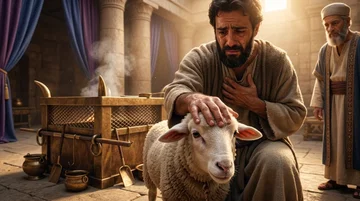
The torn, bruised, mangled and bleeding lamb tied in the temple, given up to suffering on behalf of others, represents Him suffering for sin.CET 25.2–3SG2 16.2–17.1LSEGW 33.1–34.2 It calls everyone who would be saved when time closes and receive pardon to come before the Lamb, confess sins, and then take place among the happy company of the redeemed.CET 25.2–3SG2 16.2–17.1ST Apr 18, 1878LSEGW 33.1–34.2
Sources