Acts 9:37
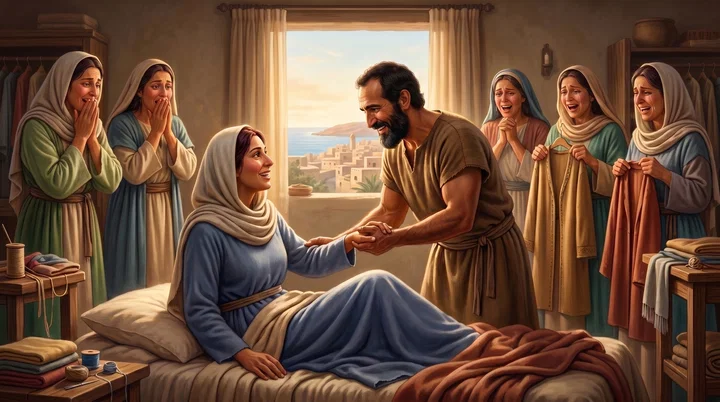
And it came to pass in those days, that she was sick, and died: whom when they had washed, they laid her in an upper chamber.
Translations
American King James Version, King James Version, KJV Cambridge Paragraph Bible
And it came to pass in those days, that she was sick, and died: whom when they had washed, they laid her in an upper chamber.
And it came to pass in those days, that she was sick, and died: whom, when they had washed, they laid in an upper chamber.
Revised Version, American Standard Version
And it came to pass in those days, that she fell sick, and died: and when they had washed her, they laid her in an upper chamber.
and it came to pass in those days she, having ailed, died, and having bathed her, they laid her in an upper chamber,
And it came to pass in those days that she grew sick and died; and, having washed her, they put her in [ the] upper room.
And it came to pass in those days, that she, sickening, died; and, bathing her, they laid her in an upper room.
Berean Standard Bible, Majority Standard Bible
At that time, however, she became sick and died, and her body was washed and placed in an upper room.
In those days, she became sick and died. When they had washed her, they laid her in an upper room.
And it came about, in those days, that she got ill and came to her death: and when she had been washed, they put her in a room which was high up.
And it came to passe in those dayes, that she was sicke and dyed: and when they had washed her, they layd her in an vpper chamber.
Douay-Rheims (Challoner revision)
And it came to pass in those days that she was sick, and died. Whom when they had washed, they laid her in an upper chamber.
Pictures
Cross-references
- Acts 9:41
And he gave her his hand, and lifted her up, and when he had called the saints and widows, presented her alive.
Peter raises her and presents her alive to the saints and widows.
- Acts 9:42
And it was known throughout all Joppa; and many believed in the Lord.
The raising leads many in Joppa to believe in the Lord.
- 2 Kings 4:32-35
And when Elisha was come into the house, behold, the child was dead, and laid upon his bed.
Elisha was an instrument in raising the dead.
- Acts 20:9-12
And there sat in a window a certain young man named Eutychus, being fallen into a deep sleep: and as Paul was long preaching, he sunk down with sleep, and fell down from the third loft, and was taken up dead.
Paul restores Eutychus after he falls to his death.
- Acts 10:9-23
On the morrow, as they went on their journey, and drew nigh unto the city, Peter went up upon the housetop to pray about the sixth hour:
Peter’s vision at Joppa led him to Cornelius.
- 1 Kings 17:17-24
And it came to pass after these things, that the son of the woman, the mistress of the house, fell sick; and his sickness was so sore, that there was no breath left in him.
Elijah was an instrument in raising the dead.
- Acts 10:5-6
And now send men to Joppa, and call for one Simon, whose surname is Peter:
The angel directs Cornelius to Peter, who will tell him what to do.
- Mark 5:41-42
And he took the damsel by the hand, and said unto her, Talitha cumi; which is, being interpreted, Damsel, I say unto thee, arise.
Both accounts describe a girl raised from the dead.
Commentary
Each commentary is drawn from primary sources: the writings of Ellen G. White and Adventist pioneers and periodicals. Each commentary is separate. Its own words are not a quotation; follow the references to read the source passages.
Ellen G. White
10 sources
The verse concerns Tabitha, also called Dorcas by interpretation, lying dead at Joppa near Lydda.7RED 55.3–56.1AA 131.2AC1 55.33SP 323.3–324.1 In those days she became sick, or ill, and died, and after her body was washed it was laid in an upper room, or upper chamber.7RED 55.3–56.1AA 131.3–132.1AC1 55.3 She was a worthy and devoted disciple of Jesus Christ whose life was filled with acts of kindness and deeds of charity and kindness to the poor and sorrowful and with zeal for the cause of truth, greatly beloved and greatly benefiting the infant early church.7RED 55.3–56.1AA 131.2AC1 55.33SP 323.3–324.1RH Apr 6, 1911 She freely ministered to the wants of the poor and the sorrowful, knowing who needed comfortable clothing and who needed sympathy, with skilful fingers more active than her tongue as a seamstress working with her hands more than with her words.AA 131.25T 303.4–304.3ED 217.1–2
Her death was a great loss that the infant church could hardly spare and could not well spare, bringing deep grief and mourning and lamentation with warm tear-drops falling upon the inanimate clay, so that the believers realizing their loss sent for Peter.7RED 55.3–56.1AA 131.3–132.13SP 323.3–324.15T 303.4–304.3RH Apr 6, 1911 Peter prayed and by the power of God she was brought back from the land of the enemy and restored to life and health, that her skill and energy might still be a blessing to others and continue serving others, strengthening the work of Christ, and this miracle led many in Joppa to believe in Jesus.7RED 55.3–56.1AA 131.3–132.15T 303.4–304.3ED 217.1–2 She is the pattern for the Dorcas line of practical charitable work which continues as long as time shall last with work still to be done without end, calling for the spending of strength and money even when there is very little to show for it.Lt 89, 1895, par. 2–3 Her faithfulness is an example of patient, prayerful and persevering fidelity needed in the church and the Sabbath school and society.TSSW 109.4–5
Sources
Pioneers and periodicals
54 sources
The verse records that at Joppa the disciple Dorcas became sick and died, and that after her body was washed it was laid in an upper chamber to await burial.ST Oct 7, 1897RH Aug 3, 1905RH Aug 7, 1913 Her death was a real cessation of life, a state of total unconsciousness with no conscious experience to report afterward.ST Apr 15, 1875ST May 2, 1878ST Apr 10, 1879RH Aug 24, 1905 Before burial she was restored to life in answer to prayer, when Peter as Christ's representative prayed and raised her by the power of the Spirit of God.RH Nov 21, 1912ST Jan 22, 1902ST Oct 7, 1897ST Feb 21, 1906 She had been full of good works and almsdeeds, visiting the sick and making coats and garments for the poor, needy and widows, and her life remains the pattern for practical missionary service and Dorcas work for the poor.RH Apr 6, 1911ST Nov 18, 1903ST Apr 2, 1902RH Oct 3, 1907ST Mar 3, 1881 Her restoration witnessed to the truth, directed the gospel work, and led many to believe on the Lord.ST Nov 18, 1903ST Jun 26, 1901
Wording and Setting
At Joppa Dorcas became sick and died, and after her body was washed it was laid in an upper chamber or upstairs room, setting the scene for Peter's coming and her restoration to life.ST Oct 7, 1897RH Aug 3, 1905RH Aug 7, 1913ST Oct 10, 1906RH Apr 2, 1914 She became ill and died, and after washing she was placed in an upper room before Peter came, with the account of her being brought to life demonstrating the power of salvation to restore life.ST Oct 10, 1906ST Jan 30, 1912ST Jul 8, 1913 The washing of the body and placing it upstairs showed tender care by her friends, prepared her body for burial, and illustrates New Testament customs surrounding death and mourning in that chamber.ST Apr 2, 1902ST Apr 2, 1902ST Mar 27, 1907 She was an earnest disciple who became ill and died, and her friends washed her body and placed it in a room upstairs, while the mourning scene in that chamber is recalled as an example of customs surrounding death.ST Apr 2, 1902ST Mar 27, 1907
The word died is used in its plain sense of losing life and ceasing to live, meaning a complete loss and utter cessation of life rather than a continued conscious existence.ST Apr 15, 1875ST May 2, 1878ST Apr 10, 1879 When Dorcas died she had lost her life, for death means an utter cessation of life and not a continued conscious existence.ST Apr 15, 1875ST May 2, 1878ST Apr 10, 1879 The phrase in those days uses hemera for whole twenty-four-hour periods covering night and day, proving that the days of the week, including the first day, are twenty-four hours long beginning and ending at sunset.RH Dec 12, 1871 The word day means a whole period covering night and day, as in other places where periods of days or a succession of days are named.RH Dec 12, 1871
The death occurred while Peter was traveling preaching the gospel and strengthening the churches, around A.D. 40, staying at nearby Lydda and at Joppa where a house was shown as the place he supposedly stayed with Simon the tanner.ST Jun 17, 1897ST Nov 18, 1903RH Aug 6, 1908ST Nov 24, 1898 Tabitha, a disciple at Joppa called Dorcas meaning Gazelle, fell sick and died in those days, and because Lydda was near Joppa and Peter was there, her death prompted the disciples to send two men entreating him to come without delay.ST Nov 18, 1903ST Apr 2, 1902 She was a good sister living at Joppa not far from Lydda, and after they prepared her body for burial and laid her in an upper chamber, the brethren heard Peter was at Lydda and sent for him asking him to hasten his coming to them.ST Apr 2, 1902 In Acts chapter 9 the chief subject is the conversion of Paul, and this verse belongs to one of two other important subjects in the same chapter and to one of the miracles recorded in Acts 1-14; these details set the scene for the events that follow.ST Jun 2, 1898ST Jul 8, 1913
Dorcas's Life and Death
Tabitha at Joppa, called Dorcas meaning Gazelle, was an earnest disciple and good sister full of good works and almsdeeds.ST Nov 18, 1903ST Apr 2, 1902 She gave much of her time to visiting the sick and to making garments and coats for the poor, the needy, the widows, and the sorrowful.RH Apr 6, 1911ST Nov 18, 1903ST Apr 2, 1902RH Dec 14, 1911 Her death was deeply mourned because she had devoted herself to such kind deeds and care for the poor and sorrowful.RH Apr 6, 1911
She was one of the principal missionaries there, a humble missionary worker for Christ and a temporal benefactor to the widows.ST Apr 2, 1902ST Nov 18, 1903 With only her hope, her needle, and her trust in God, her life was of boundless blessing to the world.RH Apr 7, 1903 Though not an apostle she was useful in her own way, standing among many quiet, zealous, faith-strong Christians, showing that every member of the apostolic church was active in serving the Lord.RH Mar 21, 1871RH Aug 19, 1862
Her sickness, death, and laying of the body to rest caused great grief and deep mourning among the disciples.RH Apr 6, 1911ST Apr 2, 1902 The poor came in crowds mourning and testifying of how she had worked for them.ST Jul 21, 1898 Her lasting memorial is the good she did for others, especially for widows and the needy, rather than an elaborate monument.ST Mar 20, 1893
Because Lydda was near Joppa and Peter was there, her death prompted the disciples and brethren to send two men entreating him to come without delay and to hasten to them.ST Nov 18, 1903ST Apr 2, 1902 Her laying down her life tendered the hearts of those who had valued only her temporal help.ST Nov 18, 1903 In that softened state a more striking manifestation of the goodness of God would show them the real Source of all blessings.ST Nov 18, 1903
Her sickness, death, and laying of the body to rest show the dead laid to rest till the Life-giver shall come.RH Apr 22, 1902 Her death is not the end.ST Jul 21, 1898 When the dead arise, faithful givers like this poor woman who gives out of her poverty will be crowned as genuine Dorcases, pillowed on the Saviour's breast.ST Jul 21, 1898
Raising to Life
Dorcas became sick and died, and after her body was washed it was laid in an upper room, all before Peter arrived.RH Nov 21, 1912ST Oct 7, 1897RH Aug 7, 1913 Her death came before her restoration to life, which followed in answer to prayer when Peter prayed and raised her from death.RH Nov 21, 1912ST Oct 7, 1897ST Jul 23, 1896RH Aug 7, 1913 Her death was followed by her restoration to life through God's power.
Peter in this work stood as the Lord's representative carrying out the power Christ gave to copy His life and work, including raising the dead.ST Jan 22, 1902 When he spoke by the direction of the Holy Spirit his word carried the power of God's command.ST Jan 22, 1902 The raising was wrought by the Spirit of God through an apostle and chosen servant of Jesus Christ, the same Spirit that worked through Jesus of Nazareth.ST Feb 21, 1906 It stands on the same level as the raising of Jairus's daughter by Jesus and must not be ranked below Christ's own miracles.ST Feb 21, 1906 It shows Spirit-filled disciples doing the greater works Christ promised because He went to His Father.ST Feb 21, 1906
Her restoration shows that the Spirit gives life even to the dead. The same gospel word that raised her from the dead proves that word potent to heal all.ST Jul 29, 1913 The account of her being brought to life demonstrates the power of salvation to restore life.ST Oct 10, 1906 She was not told to perform more good works in order to live, but Christ gave her life so she could continue doing good works.ST Jul 23, 1896 She died and was called back to life so that she could continue making garments for the poor, showing that life must come before action and that Christ gives the life that produces righteousness, and that practical work and faithful service in everyday duties are worthy and beneficial.ST Jan 18, 1916ST Jul 23, 1896
Her being raised from the dead is a sign witnessing to the truth and showing that the Lord directed the gospel work.ST Jun 26, 1901 Peter, called through humble lay brethren, came twelve miles on foot to the house where she lay.ST Nov 18, 1903 He was met by the testimonials of her work, then went alone with the dead to present the case to the Master he trusted by faith and experience.ST Nov 18, 1903 Her laying down her life tendered the hearts of those who had valued only her temporal help, so that a more striking manifestation of God's goodness would show them the real Source of all blessings.ST Nov 18, 1903 The victory of her restoration to life led many to believe on the Lord.ST Nov 18, 1903
Prophecy and Gospel Advance
The verse belongs to the events following Stephen's martyrdom, when persecution scattered the disciples, and to the history of Acts 7, 8, and 9 that closes the seventy weeks in A.D. 34.STST Sep 2, 1913 That history shows the second rejection of Christ in Stephen's martyrdom, the scattering by persecution, and the raising up of Paul as apostle to the Gentiles, after the apostles continued their ministry to the Jews for the last half-week following the crucifixion in the midst of the week.ST Sep 2, 1913 It stands in the time in A.D. 34 when the 490 years close with the cutting off of the Jewish nation as God's special people and the giving of the gospel to the Gentiles.ST Nov 28, 1895 It is included among the events of Acts 9 to 16.ST Sep 30, 1908
Peter's work at Joppa where this death occurred was entirely different from his work at Lydda.ST Apr 9, 1902 God led him into each experience because it was best for accomplishing His purpose and meeting the needs of that place, and while he tarried at Joppa God was preparing another experience for him that would meet the needs of the people he would go to next and enlarge his view of the scope of the gospel.ST Apr 9, 1902 The events of Acts 9 to 16 show God's use of human agencies, where heaven always cooperates with God's children below so that souls are brought home through many agencies and no one man or angel alone gets the credit.ST Sep 30, 1908
Doctrine from the Verse
Tabitha had died and was afterward restored to life, yet like all others so restored she had no conscious experience to report from death, for death is a state of total unconsciousness.RH Aug 24, 1905 Her resurrection was as literal as the resurrections of Lazarus and of Christ, yet it depended on Christ's promised death and resurrection.ST Nov 29, 1883 Christ is called the first-fruits not because He was the first ever raised, but because He is supreme and His resurrection makes the resurrection of all possible, and God's promise of it made the earlier raisings possible as well.ST Nov 29, 1883
Tabitha died and was raised to life again by the power of Christ as one of the exceptions both before and since the first advent to the general rule that the dead in Christ rise at His coming.ST Jan 28, 1889 She stands grouped with the widow's son raised by Elijah, the Shunammite's son by Elisha, Moses, the man raised by the bones of Elisha, the son of the widow of Nain, Jairus's daughter, Lazarus, Eutychus, and those raised at Christ's resurrection who afterward ascended with Him as the antitype of the wave-sheaf.ST Jan 28, 1889 This proves that apart from being made immortal at Christ's coming all others live only by a resurrection from the dead through the power of Christ.ST Jan 28, 1889 Her death and subsequent restoration to life by Peter show that Jesus was not the only person associated with a resurrection, so the fact of resurrection alone does not prove that Jesus was the Messiah.ST Jan 30, 1912 His Messiahship is proved by His death, burial, and resurrection in fulfilment of Scripture.ST Jan 30, 1912
The Christian help work for the poor shown in the surrounding account is an important and worthy work.CO 35.1 It belongs to the gift of helps given by the Spirit as He wills, carried out by workers who are necessary helps and servants of the church in Christ's cause but are not officers of the church in the Biblical sense.CO 35.1 The record of Dorcas's service is an example of God using women in the church. Her good works included making coats for the poor and needy.RH Dec 14, 1911
Example for Service
Dorcas died and was mourned, yet her life is remembered through the garments she made for widows, showing the lasting value of practical service to people in need.ST Dec 7, 1915 She was called back to life so that she could continue making garments for the poor, and her story shows that practical work and faithful service in everyday duties are worthy and beneficial.ST Jan 18, 1916
Her life was full of good deeds, and God saw fit to raise her from the dead.RH Dec 30, 1915 The same Spirit who empowered Samson for mighty acts moved Dorcas to serve quietly by making coats and garments for the poor.RH Dec 30, 1915 Her making of garments for widows and orphans is an example of missionary work through serving others by practical acts of care.RH Oct 3, 1907 Her work of making clothing for the poor and caring for the sick gives the pattern for the Dorcas Society, with the minister's wife serving as secretary and doing that same work of making clothing for the poor and food for the sick.ST Mar 3, 1881
The verse gives the pattern for the Dorcas work assigned to deaconesses, which is caring for the poor with clothing.RH Jul 22, 1909 That work means securing the help of young people and children to collect partly worn and left-off clothing from wealthier classes, putting deaconesses in charge of using it for the poor in their care, and getting the sisters of the church to help repair and remake the clothing in their homes or in a regular meeting at a convenient home.RH Jul 22, 1909 Her example provides a ministry of preparing bedding and clothing for the needy, applied in making and sending clothes, towels, quilts, and books to needy schools and preparing garments for foreign missions, sustained by gifts from brethren and discounts on materials.RH Mar 10, 1903 Her name connects with work helping people through practical acts of care, for she became ill and died and her body was washed and laid in an upper room.RH Nov 18, 1902
As a worker with needle and thread her practical lay service is needed to carry the gospel to Africa, China, India, Cuba, Porto Rico, and every mission field.RH Jan 16, 1900 Filling the earth with God's glory requires not only preachers but messengers of this kind answering the cry to come over and help, standing alongside men of eloquence, writers with pen and ink, givers with wealth, men with knowledge of law, and medical workers.RH Jan 16, 1900 Her example is held up as one for daughters to follow rather than the example of Herodias's daughter.ST Apr 14, 1881 She became sick and died and her body was washed and placed in an upper room, and she stands as an example of faithful service that asks whether believers will receive a reward like hers when they die.RH Apr 2, 1914
Sources