Acts 9:38
And forasmuch as Lydda was nigh to Joppa, and the disciples had heard that Peter was there, they sent unto him two men, desiring him that he would not delay to come to them.
Translations
And for as much as Lydda was near to Joppa, and the disciples had heard that Peter was there, they sent to him two men, desiring him that he would not delay to come to them.
King James Version, KJV Cambridge Paragraph Bible
And forasmuch as Lydda was nigh to Joppa, and the disciples had heard that Peter was there, they sent unto him two men, desiring him that he would not delay to come to them.
And as Lydda was nigh to Joppa, and the disciples had heard that Peter was there, they sent to him two men, desiring him that he would not delay to come to them.
Revised Version, American Standard Version
And as Lydda was nigh unto Joppa, the disciples, hearing that Peter was there, sent two men unto him, entreating him, Delay not to come on unto us.
and Lydda being nigh to Joppa, the disciples having heard that Peter is in that [place], sent two men unto him, calling on him not to delay to come through unto them.
But Lydda being near to Joppa, the disciples having heard that Peter was there, sent two men to him, beseeching him, Thou must not delay coming to us.
Now, Lydda being nigh unto Joppa, the disciples, hearing that Peter was therein, sent off two men unto him, beseeching him—Do not delay to come through unto us!
Since Lydda was near Joppa, the disciples heard that Peter was there and sent two men to urge him, “ Come to us without delay.”
Since Lydda was near Joppa, the disciples, hearing that Peter was there, sent to urge him, “ Come to them without delay.”
As Lydda was near Joppa, the disciples, hearing that Peter was there, sent two men to him, imploring him not to delay in coming to them.
And because Lydda was near Joppa, the disciples, having knowledge that Peter was there, sent two men to him, requesting him to come to them straight away.
Now forasmuch as Lydda was neere to Ioppa, and the disciples had heard that Peter was there, they sent vnto him two men, desiring that he would not delay to come vnto them.
Douay-Rheims (Challoner revision)
And forasmuch as Lydda was nigh to Joppe, the disciples hearing that Peter was there, sent unto him two men, desiring him that he would not be slack to come unto them.
Pictures
Cross-references
- Acts 10:9
On the morrow, as they went on their journey, and drew nigh unto the city, Peter went up upon the housetop to pray about the sixth hour:
Peter received his vision at Joppa before going to Cornelius in Caesarea.
- Acts 9:33
And there he found a certain man named Æneas, which had kept his bed eight years, and was sick of the palsy.
Peter was at Lydda before messengers came seeking him.
- Acts 10:5-8
And now send men to Joppa, and call for one Simon, whose surname is Peter:
Cornelius sends men to Joppa to bring Peter for instruction.
- Acts 9:42
And it was known throughout all Joppa; and many believed in the Lord.
Many in Joppa believed after the miracle.
- Jonah 1:3
But Jonah rose up to flee unto Tarshish from the presence of the LORD, and went down to Joppa; and he found a ship going to Tarshish: so he paid the fare thereof, and went down into it, to go with them unto Tarshish from the presence of the LORD.
Jonah boarded a ship at Joppa while fleeing from God.
- Acts 9:43
And it came to pass, that he tarried many days in Joppa with one Simon a tanner.
Peter stayed many days in Joppa with Simon the tanner.
- Joshua 19:46
And Me-jarkon, and Rakkon, with the border before Japho.
same town at conquest
- Acts 9:34
And Peter said unto him, Æneas, Jesus Christ maketh thee whole: arise, and make thy bed. And he arose immediately.
Both describe Peter’s ministry and healing at Lydda.
- 2 Chronicles 2:16
And we will cut wood out of Lebanon, as much as thou shalt need: and we will bring it to thee in floats by sea to Joppa; and thou shalt carry it up to Jerusalem.
Joppa was the port where Hiram sent Lebanon’s timber for the temple.
- 1 Kings 5:9
My servants shall bring them down from Lebanon unto the sea: and I will convey them by sea in floats unto the place that thou shalt appoint me, and will cause them to be discharged there, and thou shalt receive them: and thou shalt accomplish my desire, in giving food for my household.
Hiram’s ships brought timber for Solomon’s temple through Joppa.
Commentary
Each commentary is drawn from primary sources: the writings of Ellen G. White and Adventist pioneers and periodicals. Each commentary is separate. Its own words are not a quotation; follow the references to read the source passages.
Ellen G. White
10 sources
Lydda was near Joppa.AA 131.3–132.1AA 131.2AC1 55.33SP 323.3–324.1RH Apr 6, 1911 When the disciples and believers in Joppa heard that Peter was in Lydda, they sent two men, that is messengers, asking him to come to them without delay because they urgently wanted his help.AA 131.3–132.1AC1 55.35T 303.4–304.33SP 323.3–324.1RH Apr 6, 1911 They wanted him to come because they had heard of the remarkable, marvelous cures he had performed in Lydda.AC1 55.33SP 323.3–324.1 They sent urgently after Dorcas died.RH Apr 6, 1911ST May 15, 1879
Tabitha, called Dorcas by interpretation, was a worthy and greatly beloved disciple of Jesus who lived in Joppa, whose life was filled with acts of kindness, charity, and zeal for the truth.AA 131.23SP 323.3–324.1TSSW 109.4–5 She knew who needed comfortable clothing and who needed sympathy and freely ministered to the poor and the sorrowful, working quietly with skillful fingers and hands more active than her tongue or words, with patient, prayerful, persevering fidelity.AA 131.25T 303.4–304.3TSSW 109.4–5 When she lay dead in Joppa the young, infant church felt her loss deeply and grieved the loss of her charitable service, mourning and lamenting with tears over her lifeless body as a great loss it could not well spare.AA 131.3–132.1AC1 55.35T 303.4–304.33SP 323.3–324.1RH Apr 6, 1911
She was of such great value that by the power of God she was called back from death so that her skill and energy might still be a blessing to others by continuing to make garments for the poor.5T 303.4–304.3ED 217.1–2 Her patient, prayerful, and persevering fidelity is held up as an example of steadfast, God-fearing faithfulness that is rare yet needed for the church to prosper and needed in the church, the Sabbath school, and society.5T 303.4–304.3TSSW 109.4–5
The call connects with the Dorcas work for needy believers, a line of labor among little churches that have heard the truth that lasts as long as time lasts, with work still to be done without end and very little to show for it even when strength and money are spent.Lt 89, 1895, par. 2–3 It is not duty to keep carrying the financial and religious loads for such people much longer when testimony is needed elsewhere, but to plead with the Lord to indicate where to go to bear testimony so souls are benefited and to stay in touch with workers and people who do not know the truth.Lt 89, 1895, par. 2–3
Sources
Pioneers and periodicals
49 sources
Lydda lay close to Joppa, and when the disciples at Joppa heard Peter was at Lydda they sent two men to him urging him to come to them without delay.ST Oct 7, 1897ST Mar 18, 1897ST Apr 2, 1902ST Apr 2, 1902ST Nov 18, 1903
Tabitha called Dorcas, a disciple full of good works and almsdeeds who made garments for the poor, had fallen sick and died and been washed and laid in an upper chamber.ST Mar 18, 1897ST Apr 2, 1902ST Nov 18, 1903ST Nov 18, 1903ST Apr 2, 1902
Peter arose and went with them, and in answer to prayer she was restored to life through God's word and Spirit through him, opened her eyes and sat up, and many believed on the Lord.ST Mar 18, 1897RH Nov 21, 1912ST Nov 18, 1903ST Jul 29, 1913
Her life of quiet, faithful help for the needy remains the pattern for charitable service, especially in making and providing clothing for the poor and suffering alongside visiting the sick.ST Jul 21, 1898RH Apr 2, 1914RH Mar 10, 1903RH Jul 15, 1862RH Nov 18, 1902
The raising was wrought by the Spirit of God through Peter as Christ's chosen servant with the same divine source, authority and value as Christ's own miracles, while like others raised from the dead she gives no account of conscious experience during death, which is a state of total unconsciousness.RH Nov 21, 1912ST Jan 22, 1902ST Jul 29, 1913RH Aug 24, 1905ST Feb 21, 1906
Geography and Setting
Lydda was nigh to Joppa, and the disciples at Joppa heard that Peter was there at Lydda.ST Oct 7, 1897ST Apr 2, 1902ST Apr 2, 1902ST Mar 18, 1897ST Oct 7, 1897 After Tabitha Dorcas fell sick and died at Joppa and was washed and laid in an upper chamber, they sent unto him two men entreating him to delay not to come unto them.ST Oct 7, 1897ST Apr 2, 1902ST Apr 2, 1902ST Mar 18, 1897ST Oct 7, 1897 They urgently asked him to come without delay hoping for help after Dorcas died, and Peter arose and went with them to her death-bed.ST Oct 7, 1897ST Apr 2, 1902RH Nov 21, 1912ST Mar 18, 1897ST Oct 7, 1897 The episode is an example of Tabitha being raised from death in answer to prayer.RH Nov 21, 1912
The distance was about nine or ten miles, roughly two hours' journey, and her friends feared decay would set in before he arrived.ST Mar 18, 1897 Lydda was ten miles from Joppa, two miles beyond Ramleh on the way from Jerusalem to Joppa.ST Nov 24, 1898 It then stood on the principal caravan route between Syria and Egypt and is now only a small village.ST Nov 24, 1898 The distance was twelve miles with no railroad train or stage-coach.ST Nov 18, 1903
This took place about A.D. 40 while Peter was preaching the gospel from place to place and confirming the churches raised up by those scattered by persecution.ST Jun 17, 1897 He was still at Lydda where he had healed Aeneas after eight years with the palsy when he received the messengers from Joppa, who conducted him to the death-bed of Dorcas where he performed the mighty miracle of restoring her to life.ST Jun 17, 1897 He had finished his work around Lydda when believers at nearby Joppa sent for him to come quickly after the death of Dorcas.ST Apr 2, 1902 The event took place at Joppa where he raised Dorcas to life after being called from nearby Lydda, and the account continues with Peter awakening her.ST Apr 2, 1902RH Aug 6, 1908ST Nov 24, 1898
Urgent Appeal Narrative
Tabitha died at Joppa and was washed and laid in an upper chamber, and because Lydda was nigh to Joppa and Peter was there, her friends took hope.ST Mar 18, 1897ST Apr 2, 1902ST Nov 18, 1903 The disciples at Joppa had heard Peter was at Lydda, so they sent two men to him entreating him to delay not to come to them.ST Mar 18, 1897ST Apr 2, 1902ST Nov 18, 1903 Peter arose and went with them to her death-bed, having finished his work around Lydda when believers at nearby Joppa sent for him to come quickly after the death of Dorcas.ST Apr 2, 1902ST Nov 18, 1903ST Apr 2, 1902 She had been one of the principal missionaries at Joppa, giving much time to visiting the sick and making garments for the poor, so her sickness and death caused great grief after her body was prepared for burial, and the brethren's asking him to hasten opened the way for God to carry His power to others through him.ST Apr 2, 1902
Peter was a humble man of faith accustomed to itinerant work on foot, and he went when the humble lay brethren came for him, because the call was of the Spirit of God.ST Nov 18, 1903 The distance was twelve miles with no railroad train or stage-coach, yet he went after being sent for from Lydda to Joppa following the death of Dorcas, a humble sister and missionary worker for the Master.ST Nov 18, 1903 God was leading Peter step by step into exactly the experience needed to carry out His purpose, meeting at Lydda one kind of need and at Joppa an entirely different kind, each fitted to its locality.ST Apr 9, 1902 His tarrying at Joppa after being urgently called there was part of that leading, while God prepared a further work for him among another people that would meet their needs and widen his own view of how far the gospel reaches.ST Apr 9, 1902
The call served to tender the hearts of the widows who valued Dorcas only as a temporal benefactor, and to show them by a more striking manifestation of the goodness of God that He is the real Source of all blessings.ST Nov 18, 1903 Alone with the dead, Peter presented the case to the Master whom he trusted by faith and experience, and the victory was that he presented her alive to the saints and widows, and many believed on the Lord.ST Nov 18, 1903 The scene includes mourning customs such as music and women's wailing, and the family's grief in the room where Dorcas lay when disciples sent two men to Peter in nearby Lydda urging him to come without delay.ST Mar 27, 1907
Dorcas Life and Death
Tabitha by interpretation is called Dorcas, meaning Gazelle, a disciple at Joppa full of good works and almsdeeds which she did, who fell sick and died and was washed and laid in an upper chamber.ST Nov 18, 1903 She had been one of the principal missionaries at Joppa, a humble sister and missionary worker for the Master, giving much time to visiting the sick and making garments for the poor.ST Nov 18, 1903ST Apr 2, 1902 Her sickness and death therefore caused great grief after her body was prepared for burial.ST Apr 2, 1902
She was a poor faithful woman who out of her own poverty gave garments and gifts to the poor, comforted sorrow, and worked without making a fuss or seeking attention or praise.ST Jul 21, 1898 She was mourned and crowded around by the poor she had helped when she sank into death and rested on the Saviour, and will arise out of the dust with many like her in the resurrection to be crowned by angels as genuine holy ones.ST Jul 21, 1898 She was a quiet, zealous, useful believer, though not an apostle, whose charitable life and care for widows made her memory a precious memorial of service.ST Mar 20, 1893RH Aug 19, 1862
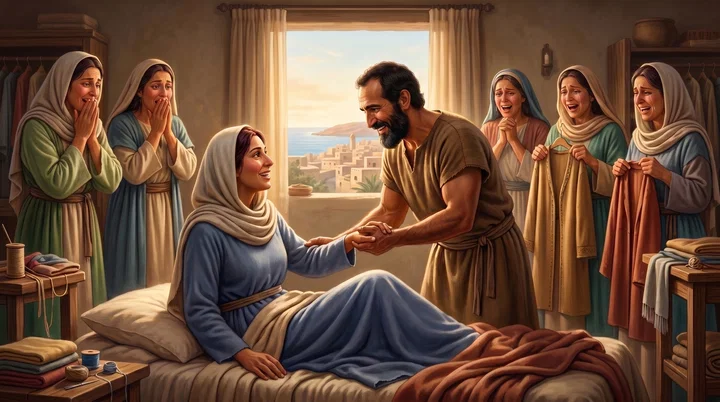
When Peter came he saw the widows weeping and showing the garments she had made for them.ST Dec 7, 1915 Those good works included making garments for the poor and needy in her home.RH Dec 14, 1911 She was called back from death so she might continue to make garments for the poor.ST Jan 18, 1916
Prophetic Time Placement
The verse belongs among the events that followed the martyrdom of Stephen, when persecution scattered the disciples, and it helps mark the transition toward Paul's ministry to the Gentiles and the end of the seventy weeks in A.D. 34.ST It stands with the events of Acts 8 and 9 that mark the close of the 490 years in A.D. 34, when the Jewish nation was cut off as God's special people and the gospel was given to the Gentiles.STST Nov 28, 1895 It falls in the last half-week of the 490 years of Daniel 9 ending in A.D. 34, during which the apostles continued their ministration to the Jews.ST Sep 2, 1913
That closing period was followed by the second rejection of Christ in the martyrdom of Stephen, the scattering of the disciples in the persecution that followed, and the raising up of Paul as apostle to the Gentiles.STST Sep 2, 1913 Thus the account at Lydda and Joppa belongs to the final Jewish phase before the gospel went fully to the Gentiles at the close of the 490 years.STST Nov 28, 1895ST Sep 2, 1913
Miracle and Doctrine
Acts 9 belongs with the account of Saul and Ananias as proof that God kept speaking to the Christian church by visions after Christ's ascension.RH Jun 26, 1855 The promise of power to witness for Christ was at work there, with disciples copying His life and work to show the contrast between the kingdom of heaven and the kingdoms of earth not only in speech but in deeds relieving suffering caused by sin.ST Jan 22, 1902 The apostle stood as the Lord's representative, and when he spoke by direction of the Holy Spirit his word was God's word through him carrying the power of God's command.ST Jan 22, 1902
The sending of two men from Joppa to Lydda to bring Peter without delay led to Tabitha being raised from death in answer to prayer.RH Nov 21, 1912 It was God's word that raised Dorcas from the dead.ST Jul 29, 1913 After Peter came, Dorcas opened her eyes, sat up, and was restored to her friends, and this return to life was an operation of God's Spirit. Peter is thus a restorer of Tabitha to life, showing the work God's word and power accomplished through him.RH Aug 7, 1913 The sending of the two men to ask Peter nearby in Lydda to come without delay illustrates God's use of human agents in carrying out His work.ST Sep 30, 1908
The miracle was wrought by the Spirit of God through Peter as Christ's chosen servant, the same Spirit that worked through Jesus of Nazareth, matching the raising of Jairus's daughter.ST Feb 21, 1906 It has the same divine source, authority and value as Christ's own miracles, with no distinction between what Christ did directly and what His Spirit-filled disciples did, fulfilling His promise that they would do greater works because He went to the Father.ST Feb 21, 1906 Peter's raising of Dorcas stands within the account of earlier resurrections that depended on Christ's promised death and resurrection.ST Nov 29, 1883 Her life was restored in Jesus' name so she could continue her good works, for works do not bring life but life comes first and enables righteous action.ST Jul 23, 1896
Like others raised from the dead, she gives no account of conscious experience during death, which is a state of total unconsciousness.RH Aug 24, 1905 Her raising was a special return to life that is an exception to the general order of resurrection.ST Jan 28, 1889 The general rule is the resurrection of the righteous dead in Christ at Christ's coming and the resurrection of the wicked at the end of the one thousand years, with all others living again only by resurrection from the dead through the power of Christ.ST Jan 28, 1889 Tabitha's raising stands with the widow's son raised by Elijah, the Shunammite's son by Elisha, Moses, the man raised by the bones of Elisha, the son of the widow of Nain, Jairus' daughter, Lazarus, Eutychus, and those raised at the resurrection of Christ, as cases both before and since the first advent that do not replace that general resurrection.ST Jan 28, 1889
Peter's part in raising Tabitha shows that a resurrection performed through a human instrument does not by itself prove that the performer is the Messiah.ST Jan 30, 1912 The summoning of Peter from nearby Lydda to Joppa where he raised Tabitha is evidence that the Lord directed the apostles' work through signs and wonders.ST Jun 26, 1901 The account of Tabitha's death belongs to comfort at the burial of a believer laid to rest till the Life-giver shall come, showing its setting of death and hope of resurrection.RH Apr 22, 1902
Service and Application
The verse belongs to the example of Christian help work for the poor, which is an important and worthy work.CO 35.1 It illustrates the gift of helps given by the Spirit as He wills to servants of the church about whose ordination nothing is read.CO 35.1 Such workers are necessary helps in the great cause of Christ, but they are not, Biblically speaking, officers of the church, though they are chosen to do a specific part of the work.CO 35.1
Dorcas is the pattern for holy charitable women and an example of a faithful life of service whose charitable deeds are remembered and bring a lasting reward.ST Jul 21, 1898RH Apr 2, 1914RH Jul 15, 1862 She was a poor faithful woman who out of her own poverty gave garments and gifts to the poor, comforted sorrow, and worked without making a fuss or seeking attention or praise.ST Jul 21, 1898 She was mourned and crowded around by the poor she had helped when she sank into death and rested on the Saviour, and will arise out of the dust with many like her in the resurrection to be crowned by angels as genuine holy ones.ST Jul 21, 1898
Her work is a pattern for Christian service, in that making and providing bedding and clothing for the needy, including towels, quilts, and books for the poor, for schools, and for distant missions, is a proper branch of the Lord's work, carried on alongside visiting the sick and suffering who are unable to attend church services.RH Mar 10, 1903 The charitable work of making and distributing clothing reflects the account surrounding the verse, where Dorcas was known for good works and the garments she had made.RH Mar 10, 1903RH Nov 18, 1902 She is remembered as a disciple whose work with her needle helped make every apostolic-era believer a bearer of good works.RH Dec 14, 1911RH Mar 21, 1871 That work included making garments for the poor and needy in her home.RH Dec 14, 1911
The account shows God honors the work of the everyday toiler, and children and youth are to learn from it faithfulness in common duties.ST Jan 18, 1916 Faithful service in ordinary work is valued by God, and her quiet sewing of garments for the poor was work moved by the same Spirit who empowered Samson.RH Dec 30, 1915 She was called back from death so she might continue to make garments for the poor.ST Jan 18, 1916RH Dec 30, 1915 The name Dorcas Society connects the women's society with the biblical Dorcas.RH Jun 17, 1915ST May 28, 1912 That connection includes the importance of practical service in the home, described as a home Dorcas society.ST May 28, 1912
God needs not only preachers like Peter but Dorcases to answer the cry for messengers from Africa, China, India, Cuba and Porto Rico and from north and south, east and west, so the whole earth can be filled with His glory.RH Jan 16, 1900 Dorcas as a worker with needle and thread shows the practical lay service needed to carry the gospel to lost and needy places.RH Jan 16, 1900
Sources