Daniel 1:4
Children in whom was no blemish, but well favoured, and skilful in all wisdom, and cunning in knowledge, and understanding science, and such as had ability in them to stand in the king’s palace, and whom they might teach the learning and the tongue of the Chaldeans.
Translations
Children in whom was no blemish, but well favored, and skillful in all wisdom, and cunning in knowledge, and understanding science, and such as had ability in them to stand in the king’s palace, and whom they might teach the learning and the tongue of the Chaldeans.
Children in whom was no blemish, but well favoured, and skilful in all wisdom, and cunning in knowledge, and understanding science, and such as had ability in them to stand in the king’s palace, and whom they might teach the learning and the tongue of the Chaldeans.
children in whom was no blemish, but well favoured, and skilful in all wisdom, and cunning in knowledge, and understanding science, and such as had ability in them to stand in the king’s palace, and whom they might teach the learning and the tongue of the Chaldeans.
Children in whom was no blemish, but of good appearance, and skillful in all wisdom, and intelligent in knowledge, and understanding science, and such as had ability in them to stand in the king's palace, and whom they might teach the learning and the language of the Chaldeans.
youths in whom was no blemish, but well favoured, and skilful in all wisdom, and cunning in knowledge, and understanding science, and such as had ability to stand in the king’s palace; and that he should teach them the learning and the tongue of the Chaldeans.
youths in whom was no blemish, but well-favored, and skilful in all wisdom, and endued with knowledge, and understanding science, and such as had ability to stand in the king’s palace; and that he should teach them the learning and the tongue of the Chaldeans.
lads in whom there is no blemish, and of good appearance, and skilful in all wisdom, and possessing knowledge, and teaching thought, and who have ability to stand in the palace of the king, and to teach them the literature and language of the Chaldeans.
youths in whom was no blemish, and of goodly countenance, and skilful in all wisdom, and acquainted with knowledge, and understanding science, and such as had ability in them to stand in the king's palace, and whom they might teach the learning and the language of the Chaldeans.
youths in whom was no blemish, but comely of countenance, and skilful in all wisdom, and possessed of knowledge, and able to impart instruction, and who had vigour in them, to stand in the palace of the king,—and that they should be taught the learning and the tongue of the Chaldeans.
Berean Standard Bible, Majority Standard Bible
young men without blemish, handsome, gifted in all wisdom, knowledgeable, quick to understand, and qualified to serve in the king’s palace— and to teach them the language and literature of the Chaldeans.
youths in whom was no defect, but well-favored, skillful in all wisdom, endowed with knowledge, understanding science, and who had the ability to stand in the king’s palace; and that he should teach them the learning and the language of the Chaldeans.
Young men who were strong and healthy, good-looking, and trained in all wisdom, having a good education and much knowledge, and able to take positions in the king's house; and to have them trained in the writing and language of the Chaldaeans.
Children in whome was no blemish, but well fauoured, and instruct in all wisedome, and well seene in knowledge, and able to vtter knowledge, and such as were able to stande in the kings palace, and whome they might teach the learning, and the tongue of the Caldeans.
Douay-Rheims (Challoner revision)
Children in whom there was no blemish, well favoured, and skillful in all wisdom, acute in knowledge, and instructed in science, and such as might stand in the king’s palace, that he might teach them the learning, and the tongue of the Chaldeans.
Pictures

Cross-references
- Daniel 1:17-20
As for these four children, God gave them knowledge and skill in all learning and wisdom: and Daniel had understanding in all visions and dreams.
God gave the young men wisdom and knowledge, and they excelled before the king.
- Daniel 1:8
But Daniel purposed in his heart that he would not defile himself with the portion of the king’s meat, nor with the wine which he drank: therefore he requested of the prince of the eunuchs that he might not defile himself.
Daniel resolves not to defile himself with the king’s food and wine.
- Daniel 1:17
As for these four children, God gave them knowledge and skill in all learning and wisdom: and Daniel had understanding in all visions and dreams.
God gave the young men knowledge, skill, and wisdom.
- Isaiah 39:7
And of thy sons that shall issue from thee, which thou shalt beget, shall they take away; and they shall be eunuchs in the palace of the king of Babylon.
Hezekiah’s descendants were taken to Babylon and served in the king’s palace.
- Daniel 1:12-15
Prove thy servants, I beseech thee, ten days; and let them give us pulse to eat, and water to drink.
A ten-day pulse-and-water test demonstrates the captives’ temperate diet.
- 2 Kings 20:18
And of thy sons that shall issue from thee, which thou shalt beget, shall they take away; and they shall be eunuchs in the palace of the king of Babylon.
Hezekiah’s descendants are taken to Babylon, as Daniel’s captivity fulfills the prediction.
- Daniel 1:19
And the king communed with them; and among them all was found none like Daniel, Hananiah, Mishael, and Azariah: therefore stood they before the king.
After training, they were examined and found superior for royal service.
- Jeremiah 25:9
Behold, I will send and take all the families of the north, saith the LORD, and Nebuchadrezzar the king of Babylon, my servant, and will bring them against this land, and against the inhabitants thereof, and against all these nations round about, and will utterly destroy them, and make them an astonishment, and an hissing, and perpetual desolations.
Nebuchadnezzar is appointed to bring Judah into Babylonian captivity.
- Ezekiel 14:20
Though Noah, Daniel, and Job, were in it, as I live, saith the Lord GOD, they shall deliver neither son nor daughter; they shall but deliver their own souls by their righteousness.
Daniel is named among exemplary righteous men.
- Daniel 1:15
And at the end of ten days their countenances appeared fairer and fatter in flesh than all the children which did eat the portion of the king’s meat.
Their appearance improved after the trial of abstinence.
- Daniel 2:48
Then the king made Daniel a great man, and gave him many great gifts, and made him ruler over the whole province of Babylon, and chief of the governors over all the wise men of Babylon.
Daniel is elevated to high office under Babylon’s king.
- 2 Kings 24:1-16
In his days Nebuchadnezzar king of Babylon came up, and Jehoiakim became his servant three years: then he turned and rebelled against him.
Describes the deportation of Judeans to Babylon.
- Daniel 1:18
Now at the end of the days that the king had said he should bring them in, then the prince of the eunuchs brought them in before Nebuchadnezzar.
brought in to stand before the king
- Daniel 6:3
Then this Daniel was preferred above the presidents and princes, because an excellent spirit was in him; and the king thought to set him over the whole realm.
Daniel’s excellent spirit leads to distinction and promotion under Medo-Persia.
Commentary
Each commentary is drawn from primary sources: the writings of Ellen G. White and Adventist pioneers and periodicals. Each commentary is separate. Its own words are not a quotation; follow the references to read the source passages.
Ellen G. White
48 sources
Daniel 1:4 describes youths chosen for service in the Babylonian king's palace as physically sound without blemish and handsome in appearance, and as skilled in all wisdom, discerning in knowledge and understanding science, with ability to stand and serve in the palace.RH Feb 10, 1910HSFM 209.6–210.2Ms 33, 1909, par. 1–8 They were Daniel with Hananiah, Mishael and Azariah, Hebrew captives of royal and princely birth from Judea, about fifteen or sixteen years old when carried away at the beginning of the captivity.PK 476B.1CTBH 26.3–27.2PK 480.1–2 They were to be taught the learning and tongue of the Chaldeans through a demanding three-year course of physical and intellectual discipline, with daily provision from the king's meat and wine.RH Feb 10, 1910HSFM 209.6–210.2CTBH 25.5–26.2FE 77.2–3PK 480.1–2 Placed there by God's providence amid strong temptation in a luxurious corrupt court, they purposed not to defile themselves but requested simple fare, and after a ten days' trial on pulse and water were found healthier in appearance than those who ate the king's dainties.Ms 33, 1909, par. 1–8CTBH 26.3–27.2PK 484.26T 219.1–2 God honored their temperance and faithful diligence with strength and comeliness and intellectual power, so that at examination none equaled them and they were found ten times better than all the magicians and astrologers, and youth so trained in the home, the Scriptures and right effort will likewise stand in kings' palaces to bear witness for God.Ms 110, 1904, par. 37–39CTBH 26.3–27.2Ms 2b, 1895, par. 19–20Ms 110, 1904, par. 11Ms 13, 1900, par. 7–10
Chosen Youth and Setting
The youths sought for service in the Babylonian king's palace were to be physically sound, without blemish, and well favoured or handsome in appearance.RH Feb 10, 1910HSFM 209.6–210.2Ms 33, 1909, par. 1–8Ms 175, 1898, par. 3–4RH May 22, 1900 They were also to be skilful in all wisdom, cunning in knowledge, understanding science and learning, discerning, and having ability in them to stand and serve in the palace.RH Feb 10, 1910HSFM 209.6–210.2Ms 33, 1909, par. 1–8Ms 175, 1898, par. 3–4FE 77.2–3 Daniel was among these youths and showed early promise of the remarkable ability he later developed.HSFM 209.6–210.2FE 77.2–3
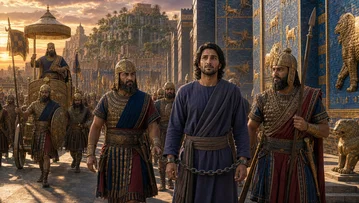
They were four Hebrew captives — Daniel with Hananiah, Mishael and Azariah — of royal and princely birth from Israel taken from their Judean home.PK 476B.1CTBH 26.3–27.2PK 480.1–2BS 16.3–17.1BS 16.2 They were youths about fifteen or sixteen years old, selected for intelligence, knowledge, learning, and good appearance.PK 480.1–2BS 16.3–17.1Ms 122, 1897, par. 25–26BS 16.2 They were carried away when Nebuchadnezzar first besieged and captured Jerusalem early in the reign of Jehoiakim, at the beginning of the seventy-year captivity.PK 479.1PK 428.1
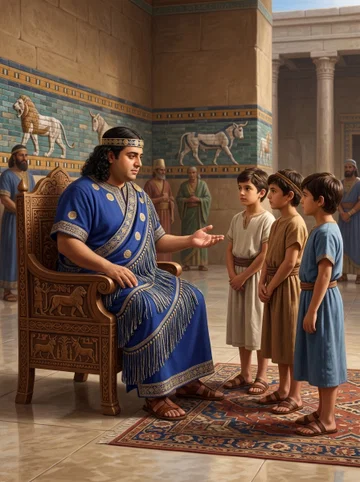
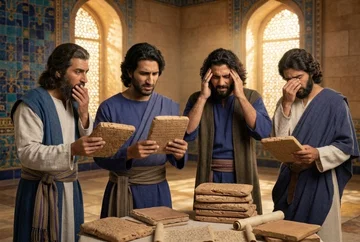
In Babylon they appear in an ornate palace chamber, earnestly appealing to a palace attendant beside a table with vessels and food.PK 476B.1
Training in Babylon
The verse means they were to be taught the learning and tongue of the Chaldeans in order that they might stand and serve in the king's palace at Babylon.RH Feb 10, 1910HSFM 209.6–210.2CTBH 25.5–26.2Ms 33, 1909, par. 1–8Ms 175, 1898, par. 3–4 Those chosen were physically sound and without blemish, well favoured and attractive in appearance, skilful in all wisdom, cunning in knowledge, understanding science and learning, discerning, and having ability in them for that palace service.RH Feb 10, 1910HSFM 209.6–210.2Ms 33, 1909, par. 1–8Ms 175, 1898, par. 3–4RH May 22, 1900
Because of those talents Nebuchadnezzar arranged for them instruction in the Chaldean language and a demanding, rigorous course of physical and intellectual discipline and education suited to service in his kingdom and to important positions at court.FE 77.2–3PK 480.1–2BS 16.3–17.1BS 16.2ST Sep 28, 1882 That training lasted three years in a foreign court, studied as captives, after which they were examined.CTBH 26.3–27.2PK 480.1–2PK 484.2BS 16.2 Daniel was educated under tutors in that learning and tongue, and after his period of study he did not enter upon another line of book study but entered upon the work for which he had studied and put into practical use the theories he had gained.CTBH 26.3–27.2PK 484.2FE 350.1–351.1
Their training included a daily provision appointed by the king of his meat and of his wine.Ms 33, 1909, par. 1–8 That food from the king's table included swine's flesh and other meats pronounced unclean by the law of Moses which Jews were forbidden to eat. The king himself judged their ability and qualifications and took kindly to them, seeing in them independence joined with true courtesy.Ms 2b, 1895, par. 19–20 He expected that change of country and associations and the influence of court life in that magnificent city would efface the impressions of their early religious education.Ms 2b, 1895, par. 19–20
Loyalty Under Trial
They were taken in warfare as captives into a strange land and placed in the court by God in His providence, not by pride or ambition or their own choice, Daniel with Hananiah, Mishael and Azariah seeking not self-glory but the honor of their downtrodden people and of God.CTBH 26.3–27.2PK 484.26T 219.1–2Ms 132, 1901, par. 1–2Ms 35, 1890, par. 7 Their intelligence and comeliness brought them special favor, but their position in a luxurious, corrupt court set them amid strong temptation and exposed them to choices and severe tests of loyalty to God.HSFM 209.6–210.2Ms 132, 1901, par. 3–44T 569.1–570.1ED 54.2–3 They resolved not to damage or defile the mind but to cherish its powers for the Lord's work, to remain faithful to God's commandments and avoid every form of idolatry, and they prayed for understanding about how to act without taking part in idolatry.Ms 186, 1907, par. 38–41Ms 35, 1890, par. 1Ms 122, 1897, par. 25–26Ms 35, 1890, par. 7
Their schooling in Babylon did not erase the education received at home, for truths learned in childhood strengthened them in need and held them faithful to Jehovah under every circumstance.Ms 140, 1906, par. 19–20Ms 56, 1895, par. 8Ms 2b, 1895, par. 19–20 The king himself judged their ability and expected that change of country and associations and court life would efface their early religious education, but their early principles molded after the divine likeness held firm when severely tested.Ms 2b, 1895, par. 19–20 They remained loyal without compromising their faith, never compromising with idolaters, honoring God in both prosperity and adversity, and God honored them, for He never leaves His children who love and serve Him to be the sport of temptation.PK 479.1PK 484.26T 219.1–2Ms 2b, 1895, par. 19–20
Their captivity became the setting in which their loyalty could show Babylon His supremacy, the holiness of His requirements, and the results of obedience, as representatives sharing the blessings of knowing Jehovah and making His glory known to king and nobles as the only true God.PK 479.1PK 479.2Ms 35, 1890, par. 16T 219.1–2Ms 13, 1900, par. 7–10 They endured when tested and stood firm to principle as tried and proved representative persons and a pattern of integrity.Ms 71, 1910, par. 5–6SCE 23.1 Afterward Daniel received through an angel the king's forgotten dream and its interpretation to give to the people.Ms 71, 1910, par. 5–6
Temperance and Its Blessings
The history of the youths chosen to learn the tongue and learning of the Chaldeans that they might stand in the king's palace is the most comprehensive and forcible illustration in the Bible of true temperance and its attendant blessings.CTBH 25.5–26.2 It is set forth to teach Christian temperance, integrity, firmness, and courageous principle.RH May 22, 1900Lt 42, 1900, par. 20 Daniel stands in that history as a holy man who controlled appetite and as a bold representative of pure hygiene.CTBH 189.2
Fitness for a place in the palace depended on what was eaten and drunk.Ms 71, 1910, par. 1 Those selected were physically sound and well favored, skilled in wisdom and knowledge, able to understand learning, and their physical and mental capacities made them useful for service.Ms 175, 1898, par. 3–4 They had been educated beforehand to strict temperance in all things for their present and future good.Ms 71, 1910, par. 1
Daniel purposed in his heart not to defile himself with the portion of the king's meat nor with his wine. With his companions he declined the wine and the rich foods and luxuries of the king's table and requested simple fare.Ms 122, 1897, par. 25–26 They laid out this course as students in order to stand high in clear intellect and in clear presentation of matters that bring a knowledge of God and the truth before the king and their associates.Ms 71, 1910, par. 1 Their training included the king's food and wine, and they refused what would defile them.Ms 33, 1909, par. 1–8
After a ten days' trial on pulse and water they were found far more healthy in appearance than those who partook of the king's dainties.Ms 33, 1909, par. 1–8 Pulse and water thereafter continued as their food. In that test they also appeared healthier and showed better knowledge than the others being proved with them.Ms 33, 1909, par. 1–8
Strict temperance in eating and drinking preserved and increased their physical and mental capacities.HSFM 209.6–210.2Ms 175, 1898, par. 3–4 It allowed God to develop their physical, mental, and spiritual understanding.Ms 175, 1898, par. 3–4 Self-denial in eating and drinking brings gain, and their temperance and self-discipline kept their powers unimpaired amid strong temptation so that their tested ability surpassed that of the other youths.HSFM 209.6–210.2Ms 93, 1910, par. 3–4
God honored their right course with strength and comeliness and intellectual power.CTBH 26.3–27.2 This was seen in erect form, firm elastic step, fair countenance, undimmed senses, untainted breath, keen apprehension, choice exact language, and extensive varied knowledge with unimpaired mental vigor.CTBH 26.3–27.2 At the examination after three years of training none among the most promising youth gathered from conquered lands equaled Daniel, Hananiah, Mishael, and Azariah.CTBH 26.3–27.2 For God gave Daniel and his companions knowledge and skill in all learning and wisdom and caused them to be found ten times better than all the magicians and astrologers in wisdom and understanding.Ms 13, 1900, par. 7–10
Students should practice this lesson.Ms 93, 1910, par. 3–4 They should care for diet and the blood-making organs and seek knowledge and excellence in mental ability in a way that honors God.Ms 93, 1910, par. 3–4
Education and Present Application
Their fitness to stand in the palace began long before Babylon, in the father's home and family before captivity separated them, where parents taught children about God and His works in Scripture and in nature and so prepared them in mind and character.FE 95.5–96.1GW 85.2RH Oct 30, 1900 Brought up from childhood in Jerusalem in the knowledge of the true God with all its religious privileges, they had made the Bible the study of their lives.Ms 2b, 1895, par. 19–20Ms 110, 1904, par. 11 The lessons of childhood molded their characters after the divine likeness, with principles of righteousness vividly impressed upon their minds by the Holy Spirit through parents who feared God and taught them to prize His precepts.Ms 2b, 1895, par. 19–20Ms 110, 1904, par. 11
Right training produces youth like them, for training begun in the home school and in the church and perfected by hearty cooperation between parents and church-school teachers under an elevated standard makes children without blemish, well favored, skillful in wisdom and knowledge and science, and able to stand in kings' palaces.Ms 110, 1904, par. 37–39Ms 110, 1904, par. 11 That ability is gained by putting on righteousness, overcoming every defect, and receiving power from the Lord for victory after victory.Ms 110, 1904, par. 37–39 Where parents fail in this duty and neglect their children, the defective character of sons and daughters brings guilt upon the parents as guardians of their little ones as well as upon the transgressors themselves.Ms 110, 1904, par. 11
Their abilities and education did not make God's blessing a substitute for effort, for they studied diligently with strenuous use of their powers.SPBC 178.1MYP 147.1Lt 55, 1895, par. 16–17 Believing that through grace their destiny depended also on their own will and action, they brought all their ability to the work and by close, severe taxation of their powers made the most of their opportunities for study and labor, because fidelity is expected of servants.SPBC 178.1MYP 147.1Lt 55, 1895, par. 16–17 Daniel thus developed learning and abilities surpassing the wisdom of the highest schools, while heavenly wisdom came from God.STE 221.1 His course shows students to make God's word their guide, to let practical obedience open the understanding, and not to let amusements take precedence.STE 221.1
He gained secular and religious knowledge without being corrupted by Babylonian teaching or compromising loyalty to God, through faithfully using his God-given powers to serve God and make Him known.4MR 51.1–53.1Lt 57, 1896, par. 10–11 With Paul he is an example of entering institutions of learning while remaining faithful and making truth known.4MR 51.1–53.1 After his period of study under tutors in the learning and tongue of the Chaldeans he did not enter again upon another line of book study but entered upon the work for which he had been studying and put into practical use the theories he had gained.FE 350.1–351.1 True education requires the wisdom that comes alone from God with God represented in every phase, seeking heavenly direction and putting learning into practice rather than devoting years to one line of book-knowledge after another, and education matters insofar as the instruction received is practiced.FE 350.1–351.1Ms 35, 1890, par. 7
Every institution established by believers is to be to the world what Daniel and his fellows were in Babylon, as representatives who never compromise, bearing their faith as worshipers of the living God as a special honor in prosperity and adversity.4T 569.1–570.16T 219.1–2 Young people who study God's word and works and learn faithful service may later bear witness for God in positions of influence, using their gifts and opportunities while making God their strength.4T 569.1–570.1GW 85.2 It will be literally fulfilled that youth so trained will indeed stand in kings' palaces and be brought before kings and nobles to give an answer for their faith when God's people are scattered into all parts of the world.Ms 110, 1904, par. 37–39 Every student who honors and glorifies God will receive wisdom from God to do his best, and those who make the most of their opportunities and place themselves in right relation with God will be rewarded even as Daniel was, to whom God gave knowledge and skill in all learning and wisdom.Ms 110, 1904, par. 37–39Ms 13, 1900, par. 7–10
God permitted them to be taken captive to Babylon, then the greatest kingdom in the world, so that they might carry to its king and nobles the knowledge of Him as the only true God, the Creator of the heavens and the earth.Ms 13, 1900, par. 7–10 Their selection gave them opportunities to exalt the true God before the nations through conscientious observance of Holy Scripture.PK 428.1 When their faith was tried to the utmost in a strange land, trust in the promises proved all-sufficient, and the Scriptures proved a guide and a stay, because the instruction received in the homes of their parents had made them strong in faith and constant in service.PK 428.1
Sources
Pioneers and periodicals
93 sources
The verse sets out the strict standards for Israelite youths of royal and noble birth to be trained for service in the Babylonian palace, requiring flawless physical form, attractive appearance, and proven ability in wisdom, knowledge and learning, with capacity to master the language and literature of the Chaldeans during a three-year course. RH Feb 10, 1910ST Mar 2, 1882ST Nov 18, 1897ST Nov 28, 1911 It belongs to the carrying of Daniel, Hananiah, Mishael and Azariah to Babylon about 605 to 603 B.C. at the beginning of the seventy years of captivity, in fulfillment of the word spoken to Hezekiah that his sons would serve in the palace of Babylon. RH Jun 4, 1908ST Jan 13, 1888RH Jan 12, 1869 That schooling was the world's education at its best, meant to assimilate them to the priestly wise men and make them forget their national religion, yet God made the chapter an object-lesson setting that one-sided cramming system against His whole-person education of body, mind and spirit. STSTSTRH Jun 4, 1908ST Sep 25, 1901 Their refusal of the king's food and wine and their life on pulse and water is a comprehensive illustration of true temperance, proving that obedience to God's laws of diet and health gives superior clearness and vigor of body and mind. RH Aug 7, 1866ST Aug 12, 1880ST Mar 1, 1899 God overruled the national disaster to prepare faithful messengers in heathen darkness, so their integrity, courage and loyalty under profit, power and ease remain the pattern for youth and workers called to stand for truth in modern Babylon. RH May 22, 1900ST Nov 24, 1898STST Nov 21, 1911ST Sep 4, 1901
Verse Wording Explained
Daniel 1:4 sets out the qualifications demanded of youths taken for service in the Babylonian king's palace: bodily soundness without blemish, attractive appearance, skill in wisdom, cleverness in knowledge, ability to understand learning, and fitness to stand in the palace, together with instruction in the learning and language of the Chaldeans.RH Feb 10, 1910ST Mar 2, 1882ST Nov 18, 1897ST Dec 5, 1911 The same requirements are stated as physical freedom from defect and good looks joined to wisdom, knowledge, scientific learning, and capacity for court service and for teaching in Babylonian literature and tongue.ST Mar 2, 1882ST Nov 18, 1897ST Dec 5, 1911RH Jan 12, 1869 The word for children means youths rather than small children only, already educated with physical and mental powers developed enough for fitness for palace service to be judged.RH Feb 20, 1900RH Jan 12, 1869 They were lads probably in their teens, just at the age when surroundings exert the most powerful influence on conduct, when those without an inward living principle are swayed by outward pressure.RH Feb 20, 1900
They were about fourteen years old, the age at which the education of youths began.RH Jun 4, 1908 They have also been estimated to have been about eighteen or twenty years old.RH Jan 12, 1869 The demands for absence of blemish, handsome appearance, and skill in all wisdom, knowledge, and science were rigid tests requiring above-average physique and mind, because the proud king would suffer no bodily imperfection in his presence and would not spend effort and expense to educate foreigners unable to render intelligent service.RH Jun 4, 1908ST Mar 1, 1899 They were regarded as superior in mental and physical qualities to Chaldean youths, including ingenuity, quickness of perception, and excellence, though intelligence and talent had not kept their fathers from bringing God's displeasure and captivity upon which the children suffered.RH Jan 12, 1869ST Dec 5, 1911 The careful choice sought the brightest and smartest young men, physically sound and well favored with skill in wisdom, knowledge, understanding of science, and ability to stand in the palace and learn Chaldean learning and tongue, placed in the same classes and studies as Babylon's bright young men without partiality.ST Mar 1, 1899ST Dec 5, 1911
Science here denotes knowledge they had already studied as a foundation for further learning, fitting them as promising, trained candidates for advisers and special servants to receive the best education Babylonia offered.ST Dec 5, 1911 The order was given to Ashpenaz the master of the eunuchs to bring certain children of Israel of the king's seed and of the princes, of royal and noble birth, handsome in form and feature, of royal bearing, with ability already well developed.ST Nov 28, 1911ST Jan 21, 1886 Daniel himself was of royal descent, educated and skilled in wisdom, knowledge, and science with ability to serve in the palace, yet faithful to God.ST May 28, 1885 The number chosen to be thus taught is not known, and only four of the company are known by name, who would never have been known without courage to stand on principle and firm conviction of truth and duty.ST Jan 21, 1886
They were to receive a three-year course of special training in the universities of Babylon to become servants, officers, ministers, counselors, and assistants in government, so as to stand in the palace and before the king at its end, during which they were not yet counted among the wise men nor engaged in public affairs.ST Nov 28, 1911ST Sep 11, 1901ST May 20, 1913ST Dec 2, 1897 The king wisely recognized responsibility in extending his jurisdiction and sought to educate men to assist him, and God endorsed the plan to demonstrate superior power to teach even those subjects and qualify His children for official positions to His honor.ST Nov 25, 1897 Though captives, they received royal treatment, including the king's own food and wine for three years, showing generosity, humane care, and provision for capable advisers, with every supposed advantage and special education for service in the kingdom.RH Jan 12, 1869 The tongue of the Chaldeans was old Chaldee, perhaps the most ancient speech at the seat of the confusion of tongues, the speech of Asshur, the sacred language and peculiar dialect of religion and science with hieratic writing known only to the wise men called Chaldees from proficiency in that venerated lore, whose scope appears from bricks and cylinders bearing lexicon and grammar.RH Jun 4, 1908 Its study involved a vast system of language and writing, including grammar, styles of writing, great libraries, lexicons, a dictionary of synonyms, verb paradigms, cuneiform sign lists, and much else on inscribed bricks and stones, confirming Babylon's greatness and influence above even Egypt.RH Jun 4, 1908ST Sep 25, 1901
Captivity and Historical Background
Daniel 1:4 belongs to the account of Jerusalem's capture, the plundering of its treasures, and the carrying of royal youths including Daniel, Hananiah, Mishael and Azariah to Babylon about 605 to 603 B.C. at the beginning of the seventy years of captivity.ST Jan 13, 1888ST The people had already begun to suffer the consequences of disobedience after Jerusalem was pillaged, before the city and temple were finally destroyed.ST Dec 3, 1894 Daniel lived in Babylon with the Jewish captives during the whole of their seventy-year sojourn there, in constant communion with God and jealousy for His law. His captivity put him where he could teach Babylon what Judah had failed to share in prosperity, fulfilling Isaiah's word to Hezekiah that his sons would be taken as eunuchs to serve in the palace of the king of Babylon.ST Jan 13, 1888ST
The command to select and train certain royal and noble captives for palace service was further evidence of complete subjugation, according to the pride of the Babylonian king and the customs of the East.RH Jun 4, 1908 Israel means the descendants of Jacob whose name was changed to Israel, and Daniel with Hananiah, Mishael and Azariah were of the tribe of Judah of the captivity of Judah.RH Jun 4, 1908 The verse introduces Babylon and her king at a time when Babylon had risen again to supremacy after Assyrian dominance.ST Nov 28, 1911 Nabopolassar was appointed king in B.C. 626, Assyria yielded to the united power of Media, Egypt and Babylonia, Nineveh fell, and Nebuchadnezzar was associated with his father as joint ruler in B.C. 607.ST Nov 28, 1911
Babylon was then no longer Hamitic but decidedly Shemitic, strengthened with Media by marriage of Nebuchadnezzar to Amyitis daughter of Cyaxares king of the Medes.ST Nov 28, 1911 Having brought Egypt, Tyre, Edom, Moab and Philistia under his rule, he was repairing ancient public buildings and heathen temples and projecting new ones on a larger scale.ST Nov 28, 1911 The city had long continued as the center of power, wealth and culture since the days of Hammurabi, with a supremacy none questioned.ST Nov 28, 1911 Babylon was one of the first great cities of antiquity, founded by Nimrod the lawless warrior of the family of Ham.ST Nov 28, 1911
Men called it Bab-il or Bab-ilu, the Gate of God or Gate of Heaven, by attempting to improve God's plan, put man's work in place of God's free grace and Spirit, and exalt the creature to the throne of the Creator.ST Nov 28, 1911 Their sin was rebelling against God, rejecting His law for peopling the earth, seeking their own glory and name, escaping future deluges and judgment, concentrating their efforts, and making themselves arbiters of men's destiny.ST Nov 28, 1911 God called it Babel or Babylon, meaning confusion, because erecting false universal standards always leads to confusion.ST Nov 28, 1911 From that false principle sprang every false system of religion and every perversion of true religion that cursed nations, put millions of God's children to death, and made all the earth drunken.ST Nov 28, 1911
Babylon became the center and starting point of the civilization afterward spread through Western Asia, and the cradle of the earliest religious, scientific and artistic traditions whose learning and tongue are named in the verse.ST Nov 28, 1911 The Babylonian record stands confirmed by records of old Babylon, Assyria and Egypt now brought out, including a cylinder of Cyrus inscribed with the capture of Babylon.RH May 13, 1909 The opening seven verses introduce the principles involved in the experiences of the captivity, with a personal lesson to learn.RH Jul 15, 1902 Together with the first nine chapters as a whole, this opening presents the temple or sanctuary and its significance in worship as the real theme in both the historic and the prophetic portions, proclaiming the provision God has made to cleanse the conscience from dead works to serve the living God through Christ come as High Priest through the greater and more perfect tabernacle, entering once for all with His own blood to obtain eternal redemption.RH Jul 15, 1902
Babylonian Learning and Training
The choosing and schooling of youths in the learning and language of Babylon embodies the Babylonian system of education, the education of the world at its best, backed by the learning, opulence and resources of a mighty empire at the height of its prosperity.STST Many of the brightest and best young men from Babylon and the surrounding countries were selected as without blemish and skillful in wisdom and knowledge, to be fed at the king's table, cared for by the king's most trusted servants, and taught the learning and tongue of the Chaldeans.ST The facts were lived out then and were recorded for the learning and hope of those living in the time of the end, not as mere history to satisfy curiosity nor only as a temperance lesson, but to display the contrast between the results of that Babylonian education under the best conditions and God's plan of education under the lowest and most discouraging conditions.ST That contrast is seen in four youths from war-ravaged, famine-stricken and defeated Judah, living in a strange land on simple vegetarian fare of pulse and water, who surpassed all the other students in knowledge and learning and excelled all the king's counselors in wisdom and understanding.ST
Babylon was a great educational center of the world, with great universities at Borsippa, a suburb of Babylon, and at Ur, and with great libraries whose stone slabs, gems, clay tablets, glass and metals held historical, mythological, religious, official, commercial, astronomical and mathematical matter, including translations with original and translation in parallel columns.ST Dec 5, 1911 The call of the royal Judean youth was therefore to no mean education, comparable favorably with much of the education of today, in the best schools the world knew.ST Dec 5, 1911 The learning of the Chaldeans embraced art, sculpture, painting and coloring with knowledge of metallurgy and chemistry, boring, shaping and engraving hard stones such as carnelian, agate, quartz, jasper, syenite, lodestone and green feldspar with emery and rapidly revolving drills and disks, use of a lens and of glass cut into shapes, use of gold, silver, bronze, copper, lead and iron, casting of massive bronze gates, excellent pottery, and celebrated textile fabrics of wool, cotton and linen.ST Dec 5, 1911 In mechanical art they excelled the Egyptians and fell little short of the Greeks and Romans, while in astronomy they distinguished fixed stars from planets, mapped the heavens into constellations as they exist today, computed eclipses, and learned the relative distances of moon and planets.ST Dec 5, 1911RH Jun 18, 1872 This wisdom was applied in repairing ancient sun temples, erecting gold-covered temples and royal palaces, constructing colossal hanging gardens of rocks and forest trees, and fortifying the sixty-mile, 350-foot-high, 87-foot-thick walled city with river walls, the great Babylon over which Nebuchadnezzar boasted, to which the exiled children mourning desecrated Jerusalem were carried to witness to the truth of God even in humiliation.ST Dec 5, 1911 Babylon was famous for its schools where astronomy and all the sciences were taught, and Daniel was thoroughly educated there with the best opportunities Nebuchadnezzar the Great could furnish, proving that God does not prefer ignorance to learning when choosing agents to do His work but chooses educated men fitted for usefulness.RH Jun 18, 1872
The king's set purpose in this education and association was to transform these noble youth from Jerusalem into wise men of Babylon, causing them to forget as far as possible their national religion and to become assimilated to the priestly class.RH Jun 4, 1908 That was a very distinct order and a considerable power in the state, with direct communication with the monarch, feared and respected by the people, made wealthy by offerings, influential as interpreters of the divine will, believed to possess not merely human learning but supernatural power of predicting future events, and often given important civil offices.RH Jun 4, 1908 The tongue they were to learn was old Chaldee, perhaps the most ancient speech at the very seat of the confusion of tongues, the very speech of Asshur, the sacred language and peculiar dialect of religion and science spoken by the Chaldeans, the reputed wise men of the world, with a hieratic writing in a distinct dialect if not distinct character sacred to religious subjects and known only to the wise men designated as Chaldees from proficiency in that venerated science, whose full scope will not be apprehended until the writing and language are fully deciphered from the bricks and cylinders with lexicon and grammar.RH Jun 4, 1908
That system, which present-day systems resemble, contains four great defects, and the remedy for those defective results is a properly balanced religious education that possesses the whole man and serves as motive power in every act of life.ST Its principle is the same as the worldly educational system today, and it is one-sided in that it aims largely to develop the mental powers at the expense of the physical and spiritual by cramming.STST Sep 25, 1901 It wrecks nervous systems and shatters health, so that children lose sleep and appetite, grow haggard and old in appearance, lose energy and ambition, become feverish and excited and mutter over lessons in sleep, and break down and have to be taken from school during the formative period of life when they should be storing up energy and have proper food, sleep, and time for play.ST Sep 25, 1901 Babylon's rulers sought guidance and occult wisdom from magicians, astrologers, and sorcerers, and the selected young men brought into Babylon to be taught the learning and language of the Chaldeans lived among Babylon's most talented people and encountered its cultured but idolatrous society.ST May 13, 1913
The selection of physically unblemished, well favored, wise, knowledgeable, science-skilled youths able to serve at court was a wise provision for finding capable advisers to administer the kingdom, and the suggestion to choose them was inspired by the Lord.ST Jul 27, 1904 Nebuchadnezzar wanted chosen captives trained in Chaldean literature and language so they could stand in responsible places in the kingdom, realizing that great responsibility rested on him in extending his jurisdiction and wisely seeking to educate men expressly to assist him in his great work.ST Jul 27, 1904ST Nov 25, 1897 God endorsed the plan and demonstrated His superior power to teach even the very subjects the king desired them to know, helping His own children in that heathen school so they were qualified to fill official positions to His honor and glory, for God wanted His servants to lead and not follow in wisdom.ST Nov 25, 1897
Contrast of Divine Education
Daniel 1 is God's object-lesson in education, setting the world's education at its best against His education at its worst and showing the comparative results.STSTST Jul 16, 1912 The selection and training of youth in Babylonian learning and language represents the Babylonian system, which present-day systems resemble and which contains four great defects, and the remedy for those defective results is a properly balanced religious education that possesses the whole man and serves as motive power in every act of life.STST Oct 21, 1908ST Aug 9, 1910 God is thereby shown as Teacher in contrast with the great schools of the world, able to teach and instruct above them all.ST Jul 16, 1912ST Aug 9, 1910 His method educates the whole person physically, mentally, morally and spiritually and puts God first, and its excellence stands in contrast with the three-year course in the Babylonian schools which has remained prevalent through the ages.STST Oct 21, 1908
The facts were lived in Daniel's days and were recorded for the learning and hope of those who live in the time of the end, not as mere history to satisfy curiosity nor only as a temperance lesson.ST The contrast is between that Babylonian education under the best conditions, in the height of Babylon's prosperity with the learning, opulence and resources of a mighty empire behind it, selecting many of the brightest and best young men from Babylon and surrounding countries, without blemish and skilful in wisdom and knowledge, to be fed at the king's table, cared for by the king's most trusted servants, and taught the learning and tongue of the Chaldeans, and God's plan of education manifested under the lowest and most discouraging conditions.ST That lowest condition was four youths from war-ravaged, famine-stricken and defeated Judah, living in a strange land in captivity on simple vegetarian fare of pulse and water.ST
Despite hardship and difficult circumstances, those four Hebrew youths surpassed all the other students in knowledge and learning and excelled all the king's counselors in wisdom and understanding.STST Dec 12, 1911ST Sep 25, 1901 The young men chosen for the king's palace were physically sound and well-favored, skilled in wisdom, knowledgeable, able to understand learning, and capable of serving in the palace and being taught Babylonian learning and language.ST Dec 12, 1911ST Sep 25, 1901ST Sep 25, 1901 God's education, grounded in His living truth, can thus prepare people to excel in every branch of true science and useful work, surpassing education that is merely secular and beyond what secular instruction alone could produce.ST Dec 12, 1911ST Sep 25, 1901ST Dec 1, 1909
Their physical and intellectual inheritance came from their home-school education, for Judah had advanced education including the schools of the prophets founded by Samuel, and Israelite family teaching in which parents taught children about God and His works and prepared them in mind and character.RH Oct 30, 1900ST Nov 28, 1911 Daniel was prepared before the captivity by training in his home, belonging with Moses, Samuel, David, Christ and Timothy, whose early years included instruction in God's truth. That childhood training in health and physical preservation also helped prepare them to resist the king's prescribed food and wine. The verse itself does not describe their spiritual qualities, though their later faithfulness under persecution shows their high character.
Their early education and obedience to God's natural and moral laws, joined with self-denial, diligence, and steadfast purpose, gave them physical strength, comeliness, and intellectual power, with healthy appearance reflecting good habits and unimpaired minds showing the benefit of those habits.ST Mar 2, 1882ST Feb 11, 1886ST Mar 2, 1882 Their disciplined habits preserved their health and strengthened their minds, so that they surpassed the other trainees in ability and understanding.ST Feb 11, 1886 When tested after three years of training, they surpassed the other youths in understanding, language, and knowledge, and their later distinction in appearance and intellectual ability is connected with their faithful obedience, self-denial, and temperate habits.ST Mar 2, 1882ST Mar 2, 1882
The king wisely realized the great responsibility resting on him in extending his jurisdiction and sought to educate men expressly to assist him, wanting chosen captives trained in Chaldean literature and language so they could stand in responsible places in the kingdom.ST Nov 25, 1897 God endorsed the plan and demonstrated His superior power to teach even the very subjects the king desired them to know, helping His own children in that heathen school so they were qualified to fill official positions to His honor and glory, for God wanted His servants to lead and not follow in wisdom.ST Nov 25, 1897 Their practical attainments were recognized by Babylonian officials, but their wisdom and understanding went beyond that training as gifts from God in response to their loyalty to Him, and their success continuing in the administration of the realm where they surpassed Babylon's professional wise men showed that Babylon's apparent victory over Jerusalem did not mean that Jerusalem's God had failed.RH Jun 18, 1908
Daniel's experience in Babylon's schools tested his loyalty to his early teachings and to God, yet he remained steadfast and emerged wiser than his teachers. Daniel, Hananiah, Mishael, and Azariah were enrolled in a three-year university course to learn the language and learning of the Chaldeans, studying the arts, the sciences, the knowledge, all of worth taught by the renowned teachers of Babylon, and also, unwillingly, much not of worth.ST They met every condition of the course so far as slaves could because they were in Babylon to witness for God and expected God to work manifestly and vindicate their faith.ST Their education involved diligent study, and God gave them knowledge and skill in learning and wisdom, for receiving wisdom by faith did not mean they could avoid hard work.RH Jun 17, 1902
Their experience illustrates how the true God's presence guides and rules a life, and their story also serves as a type of the church living in Babylon.RH Sep 30, 1902 Through the captives God displayed His power and sustained true worship without a visible priest or altar.RH Jun 18, 1908 Their training prepared them to stand before the king and, in his own language, share knowledge of the true God and His work among people.ST Jul 30, 1902
Prophecy Fulfillment and Mission
The taking of youths of the royal seed to serve in the palace of the king of Babylon fulfilled the word declared to Hezekiah by Isaiah that his sons issuing from him would be taken away to be eunuchs in the palace of the king of Babylon.RH Jun 4, 1908ST Jan 13, 1888RH Jan 12, 1869STST Nov 21, 1911 Daniel with Hananiah, Mishael and Azariah were among those taken when Jerusalem was first captured and its treasures carried to Babylon about 605 B.C.ST Jan 13, 1888STST Nov 21, 1911 Daniel and his companions may have been made eunuchs, which would explain why no descendants of theirs are recorded.RH Jun 4, 1908RH Jan 12, 1869
Because Israel had utterly apostatized so that nothing else could be done for them or through them, God set up His light and center of illumination on earth in these faithful ones in heathen Babylon.STST Nov 21, 1911ST Sep 4, 1901 He purposed to use that great empire through them for the promulgation of His truth in the earth, which the book of Daniel records.STST Nov 21, 1911ST Sep 4, 1901
God overruled Israel's national disaster to prepare messengers of salvation to a people sitting in darkness, using the custom of victorious monarchs in educating royal captives for court service as the natural means to supply the education these young missionaries from Jerusalem needed.RH Jun 4, 1908RH Feb 13, 1900 Just as modern missionaries to strange peoples must first learn the language of those they serve, so their being taught the learning and tongue of the Chaldeans supplied needed language training, and Israel's scattering among the nations compelled them to share with those nations the truth God had entrusted to Israel.RH Jun 4, 1908RH Feb 13, 1900 The tongue of the Chaldeans was old Chaldee, perhaps the most ancient speech at the very seat of the confusion of tongues, the very speech of Asshur, the sacred language and peculiar dialect of religion and science spoken by the reputed wise men of the world, with a hieratic writing in a distinct dialect if not distinct character sacred to religious subjects and known only to the wise men designated as Chaldees from proficiency in that venerated science, whose full scope will not be apprehended until the writing and language are fully deciphered from the bricks and cylinders with lexicon and grammar.RH Jun 4, 1908 The king's set purpose in this education and association was to transform these noble youth from Jerusalem into wise men of Babylon, causing them to forget as far as possible their national religion and to become assimilated to the priestly class, a very distinct order and considerable power in the state with direct communication with the monarch, feared and respected by the people, made wealthy by offerings, influential as interpreters of the divine will, believed to possess not merely human learning but supernatural power of predicting future events, and often given important civil offices.RH Jun 4, 1908
Though they suffered in the national calamity, they were loyal to God and were honored as messengers of the true God in Babylon.RH Jun 11, 1908RH Jan 28, 1902 They were young men from leading families in Jerusalem carried captive and cut off from temple worship, surrounded by open idolatry, and put under training to serve a false religion.RH Jun 4, 1908RH Jun 11, 1908RH Jan 28, 1902 Their training held out profit and power and a life of ease and luxury if they yielded to Babylonian influence, testing whether they would give in or remain true to the religion of their fathers.RH Jun 4, 1908 Standing firm under such combined pressure required great strength of character, and God used these faithful men whom He could trust with His work to enlighten Nebuchadnezzar so the king could make the knowledge of the true God known throughout the world.RH Jun 4, 1908RH Jan 28, 1902
Their three years of schooling in Babylon preceded Nebuchadnezzar's dream and qualified them to be counted among Babylon's wise men by the time of its interpretation.ST Dec 2, 1897RH Apr 18, 1871 Although Daniel 2:1 calls it the second year of his reign, that date follows the Chaldean count of his sole reign, while by Jewish reckoning it was the fourth year, including two years of joint rule with his father, by which time the three years of schooling were completed.ST Dec 2, 1897RH Apr 18, 1871
Daniel, the greatest of the prophets, lived in Babylon with the Jewish captives during the whole of their seventy-year sojourn there. He had constant communion with God and was very jealous for the law of his God, so he would have corrected his people had they been in danger of losing or forgetting the Sabbath. The account of Daniel and his companions in Babylon, chosen as physically sound and attractive, wise, knowledgeable, able to understand learning, and capable of being taught the language and literature of the Chaldeans, belongs to stories connected with prophecy.ST Oct 11, 1905
Health Temperance and Character
The account is a comprehensive and forcible illustration of true temperance and its attendant blessings, for God blessed Daniel and his companions as they abstained from wine and other harmful things.ST Aug 12, 1880 The food appointed from the king's table included swine's flesh and other meats pronounced unclean by the law of Moses which Jews were forbidden to eat, together with the luxuries of the table, and Daniel purposed in his heart not to defile himself with the portion of the king's meat nor with his wine.RH Aug 7, 1866 The young men declined the king's wine and chose a vegetable diet instead, a choice connected with a clear conscience and with a healthier appearance than that of the youths who ate the king's food.RH Aug 7, 1866
They knew and believed the truth about the food God created to be received with thanksgiving, namely the original plant diet of every herb bearing seed and every tree fruit given to man in Eden, and because they understood it they refused the king's meat and desired pulse instead.RH Nov 17, 1874 At eating time the Hebrews kept to grains and vegetables and water while the others ate the king's meat and drank his wine, though they had been placed in the same classes and given the same studies as the brightest and smartest young men of Babylon with no partiality shown.ST Mar 1, 1899 After a ten days' trial on pulse and water they were found far more healthy in appearance than those who partook of the king's dainties, so pulse and water thereafter continued as their food. The ten-day and final results proved that the vegetarian course kept body and mind superior.ST Mar 1, 1899
Pulse was not scanty fare but a variety of leguminous vegetables and grains such as peas, beans, wheat, barley, lentils, and millet, likely a customary provision to which the Jewish youths had previously been accustomed.ST Nov 25, 1897 Like the Chaldean students from the royal family and upper class who had probably been reared on food similar to the king's table, the Jewish young men made no material change from food to which they had been accustomed.ST Nov 25, 1897 Since Daniel and his companions were already healthy young men when taken into the king's school, ten days of dieting would not naturally produce a marked improvement in their appearance even with a change of diet.ST Nov 25, 1897
Their experience shows that health of body and vigor of intellect result from living according to God's plan, with diet and righteousness by faith as the physical and spiritual sides of receiving God's life in the right way for His glory. Temperate eating, at regular times and of simple food, belongs to the care needed for physical health.ST Feb 13, 1896 Their fitness for service is connected to recognizing God as their King and preserving the body in good condition for His service, for food and drink matter not merely for avoiding illness but because wasting God-given powers on appetite or passion withholds from God the service those powers could give.RH Sep 30, 1902 Keeping the body fit opens the way for God's glory to be revealed through work that surpassed that of the king's other advisers.RH Sep 30, 1902 Yet the description of their fitness and abilities does not promise that every person who adopts a particular diet will receive better health or greater power to present the gospel, nor that God will override the laws of nature when a chosen food does not suit that person.RH Jul 21, 1904
Daniel was a true scientist among Hebrew children described as skillful in wisdom, knowledge, and science, to whom God gave knowledge and skill in all learning and wisdom.ST May 2, 1916 His knowledge of science led him to stand firmly and squarely for and in harmony with the law of his God, whose transgression is sin with death as its penalty, in contrast to science falsely so called.ST May 2, 1916
Example for Believers Today
The youths chosen for the palace became a pattern of integrity and firmness, of loyalty to principle and obedience under every circumstance, held up as an example of Christian temperance, courage and character.RH May 22, 1900ST Nov 24, 1898ST May 28, 1885 The truth and integrity seen in them had been instilled early, and their refusal to violate religious scruple showed commitment to those early principles.ST Nov 24, 1898ST May 28, 1885 Their education, position and ability to serve in the king's court did not keep them from faithfulness to God, for loyalty and obedience were the foundation of character and success through God's blessing.ST May 28, 1885RH May 18, 1905 Brought very young into a heathen court amid corrupting pressures, their steadfast resistance to temptation is the more admirable, proving that Christian principles could be lived even while serving earthly monarchs.ST Nov 4, 1886RH May 18, 1905
They were already fairly well educated in wisdom, knowledge and learning when chosen, physically without blemish and well favored and fit to learn the Chaldean language and literature.ST Nov 18, 1897 Their selection placed them where they could influence others for God's cause, so that their preparation and opportunity served God's providence as well as the king's policy.ST Nov 18, 1897 Cut off from temple worship, surrounded by open idolatry and put under training for a false religion, they were offered profit and power and a life of ease and luxury if they yielded to Babylonian influence.RH Jun 4, 1908 Standing firm under such combined pressure required great strength of character, and their steadfastness is an inspiring example for resisting the strong current of worldly influence today, to make known the gospel that restores the image of God marred by sin.RH Jun 4, 1908ST Nov 20, 1901 Their ability and fidelity in assigned trusts went together with loyalty to God's law, in refusing the king's food and wine rather than defile themselves, even under danger.ST Nov 20, 1901
Daniel met temptation like that of boys from thirteen to twenty in the critical period when all powers of mind and body awake with unrest, strange and conflicting emotions, doubt, uncertainty and questioning of childhood faith. He fought that temptation and won, and his victory stored in the mind encourages youth in the hour of temptation to hold to careful religious training and not make shipwreck for time and eternity. To be a Daniel in wicked Babylon, seeing and hearing evil all around yet not wicked himself, requires the grace of God in the heart, the same grace that kept Lot righteous in Sodom.RH May 29, 1855 Devoted Sabbath-keeping children of God could thus serve in the employ of an ancient pagan power that was liberal toward them.ST Dec 3, 1902
Daniel and his three associates were noble God-fearing men united in seeking the God of heaven, with implicit faith that God would impart wisdom from above when asked.ST Jun 3, 1913 They fasted and earnestly prayed before asking Him to reveal Nebuchadnezzar's dream and its interpretation, and the answer gave increased confidence in God and great joy.ST Jun 3, 1913 Having been in the audience-chamber with God they could never consent to bow to the golden image, for that would break the first and second commandments, deny what happened in Daniel 1-2, and do wrong to the Spirit of God.ST Jun 3, 1913 Daniel is an example of God calling youth to a great work, prepared before the captivity by home training in God's truth like Moses, Samuel, David, Christ and Timothy.RH Jun 13, 1912 As a royal student he stands with others from different walks of life whom God chose and used mightily, whose position and background did not prevent service to God.ST Mar 15, 1910
His fitness for the palace in soundness, capability, wisdom, knowledge and understanding of science was joined to seeking knowledge of God, making the most of opportunities, and living out what he learned, which equipped him to stand when tested.ST Nov 15, 1905 Placed in a strange city he dealt tactfully with those over him, and his first test was whether to eat the king's food, which he refused because he knew it was wrong.ST Nov 15, 1905ST Apr 14, 1909 Before God exalted him to the intended sphere his earthly hopes and joys were crushed, and he served under Melzar, deputy of the chief of the eunuchs. Yet though captives in a strange land, during days of trouble and distress upon Jerusalem they were nourished and instructed in the palace and were much more favorably situated than they would have been in their native land.ST Jan 18, 1877
As captives they remained light bearers where others could learn the truth, and the emphasis on language and learning is a lesson for mission schools teaching language and preparing advanced students to teach.RH Mar 30, 1905RH Dec 17, 1914 As Daniel was sent to ancient Babylon, so young missionaries sent to New York City as a modern Babylon pray for the same wisdom and excellent spirit given to Daniel and his companions.RH Jun 22, 1911 Daniel in Babylon is an example of what God wants His workers to be in the closing work, with each worker individually holding the light higher to reach those perishing spiritually and physically who cannot be reached by an institution.RH Dec 20, 1906 The first seven verses introduce his purpose not to defile himself and the blessing that followed in Daniel 1:8-21, and his schooling with God as teacher is a lesson in Christian education for later generations.ST Jul 24, 1901ST Jun 21, 1899RH Jul 14, 1903 The account belongs to Daniel 1-2 on the captivity of Judah and the experiences of Daniel and his companions, not to an unrelated Hebrew named Daniel in a reported Egyptian papyrus.RH Aug 5, 1902ST Apr 22, 1897
Sources