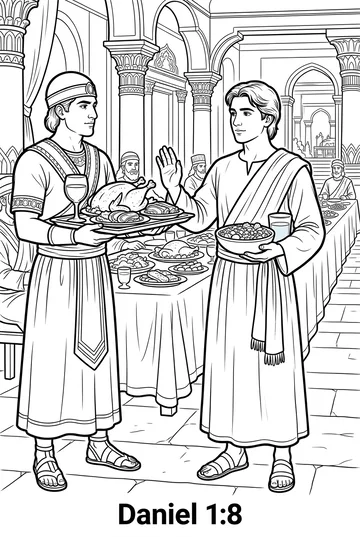
Daniel 1:8
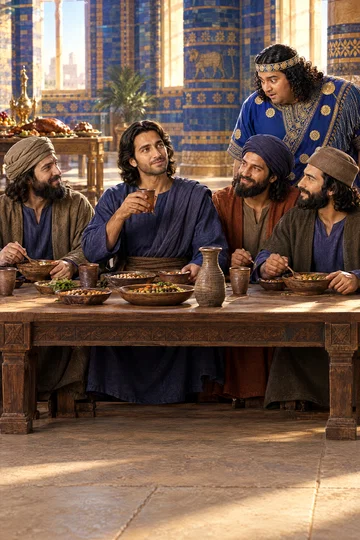
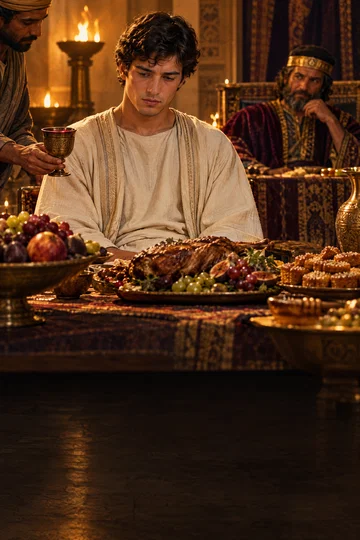
But Daniel purposed in his heart that he would not defile himself with the portion of the king’s meat, nor with the wine which he drank: therefore he requested of the prince of the eunuchs that he might not defile himself.
Translations
American King James Version, King James Version, KJV Cambridge Paragraph Bible
But Daniel purposed in his heart that he would not defile himself with the portion of the king’s meat, nor with the wine which he drank: therefore he requested of the prince of the eunuchs that he might not defile himself.
But Daniel purposed in his heart that he would not defile himself with the portion of the king's food, nor with the wine which he drank: therefore he requested of the prince of the eunuchs that he might not defile himself.
But Daniel purposed in his heart that he would not defile himself with the king’s meat, nor with the wine which he drank: therefore he requested of the prince of the eunuchs that he might not defile himself.
But Daniel purposed in his heart that he would not defile himself with the king’s dainties, nor with the wine which he drank: therefore he requested of the prince of the eunuchs that he might not defile himself.
And Daniel purposeth in his heart that he will not pollute himself with the king's portion of food, and with the wine of his drinking, and he seeketh of the chief of the eunuchs that he may not pollute himself.
And Daniel purposed in his heart that he would not pollute himself with the king's delicate food, nor with the wine which he drank; and he requested of the prince of the eunuchs that he might not have to pollute himself.
But Daniel laid it upon his heart, that he would not defile himself with the delicacies of the king, nor with the wine which he drank,—therefore sought he of the ruler of the eunuchs, that he might not defile himself.
Berean Standard Bible, Majority Standard Bible
But Daniel made up his mind that he would not defile himself with the king’s food or wine. So he asked the chief official for permission not to defile himself.
But Daniel purposed in his heart that he would not defile himself with the king’s delicacies, nor with the wine which he drank. Therefore he requested of the prince of the eunuchs that he might not defile himself.
And Daniel had come to the decision that he would not make himself unclean with the king's food or wine; so he made a request to the captain of the unsexed servants that he might not make himself unclean.
But Daniel had determined in his heart, that hee woulde not defile him selfe with the portion of the Kings meate, nor with the wine which he dranke: therefore he required the chiefe of the Eunuches that he might not defile himselfe.
Douay-Rheims (Challoner revision)
But Daniel purposed in his heart that he would not be defiled with the king’s table, nor with the wine which he drank: and he requested the master of the eunuchs that he might not be defiled.
Pictures

Cross-references 20 of 39
- Daniel 1:17
As for these four children, God gave them knowledge and skill in all learning and wisdom: and Daniel had understanding in all visions and dreams.
God gives Daniel and his companions knowledge and wisdom after their faithful choice.
- Daniel 1:12-15
Prove thy servants, I beseech thee, ten days; and let them give us pulse to eat, and water to drink.
Daniel proposes a ten-day test of the simpler diet, which proves healthier.
- Daniel 1:20
And in all matters of wisdom and understanding, that the king enquired of them, he found them ten times better than all the magicians and astrologers that were in all his realm.
Their faithful refusal of the king’s food was followed by exceptional wisdom and understanding.
- Daniel 1:15
And at the end of ten days their countenances appeared fairer and fatter in flesh than all the children which did eat the portion of the king’s meat.
The ten-day test vindicates Daniel’s chosen diet with healthier appearance.
- Leviticus 11:1-8
And the LORD spake unto Moses and to Aaron, saying unto them,
Mosaic food laws forbade meats that could have defiled Daniel.
- Proverbs 23:31-32
Look not thou upon the wine when it is red, when it giveth his colour in the cup, when it moveth itself aright.
Warns that wine deceives and brings harmful consequences.
- Proverbs 23:20-21
Be not among winebibbers; among riotous eaters of flesh:
Warns against drunkenness and riotous eating.
- Proverbs 20:1
Wine is a mocker, strong drink is raging: and whosoever is deceived thereby is not wise.
Wine is a mocker that can mislead.
- Ezekiel 14:14
Though these three men, Noah, Daniel, and Job, were in it, they should deliver but their own souls by their righteousness, saith the Lord GOD.
Daniel is named as an exemplar of righteousness.
- Acts 5:29
Then Peter and the other apostles answered and said, We ought to obey God rather than men.
Both put obedience to God above human commands.
- Numbers 6:3
He shall separate himself from wine and strong drink, and shall drink no vinegar of wine, or vinegar of strong drink, neither shall he drink any liquor of grapes, nor eat moist grapes, or dried.
Both describe abstaining from wine and other prohibited foods.
- Proverbs 23:3
Be not desirous of his dainties: for they are deceitful meat.
Warns against the ruler’s tempting food, which Daniel refuses.
- Daniel 6:1-3
It pleased Darius to set over the kingdom an hundred and twenty princes, which should be over the whole kingdom;
Daniel’s later service shows the lasting integrity of his resolve.
- Daniel 3:16-18
Shadrach, Meshach, and Abed-nego, answered and said to the king, O Nebuchadnezzar, we are not careful to answer thee in this matter.
The three Hebrews refuse to disobey God despite pressure, as Daniel did.
- Luke 1:15
For he shall be great in the sight of the Lord, and shall drink neither wine nor strong drink; and he shall be filled with the Holy Ghost, even from his mother’s womb.
John abstains from wine for his mission.
- 1 Corinthians 10:31
Whether therefore ye eat, or drink, or whatsoever ye do, do all to the glory of God.
Applies honoring God to eating, drinking, and all conduct.
- Daniel 1:14
So he consented to them in this matter, and proved them ten days.
marked result in ten days
- Daniel 1:4
Children in whom was no blemish, but well favoured, and skilful in all wisdom, and cunning in knowledge, and understanding science, and such as had ability in them to stand in the king’s palace, and whom they might teach the learning and the tongue of the Chaldeans.
Daniel’s earlier training prepared him for the test.
- Leviticus 11:47
To make a difference between the unclean and the clean, and between the beast that may be eaten and the beast that may not be eaten.
explains defilement in king's meat
- Deuteronomy 14:8
And the swine, because it divideth the hoof, yet cheweth not the cud, it is unclean unto you: ye shall not eat of their flesh, nor touch their dead carcase.
It likewise prohibits eating swine’s flesh.
Commentary part 1 of 2
Each commentary is drawn from primary sources: the writings of Ellen G. White and Adventist pioneers and periodicals. Each commentary is separate. Its own words are not a quotation; follow the references to read the source passages.
Ellen G. White
113 sources
Daniel as a young captive chosen for three years of training to stand in the palace at Babylon resolved not to make himself unclean by the daily allowance of rich food from the king's table and wine from his cellar, and with courteous request gained from the officer in charge a ten days' trial of pulse and water judged by appearance, after which he and his companions looked healthier and were allowed to keep the simple diet.ST Mar 2, 1882CTBH 25.5–26.2Ms 85, 1910, par. 5–104MR 123.2–3 To be defiled in this way was to eat swine's flesh and other meats forbidden as unclean by the law of Moses, to partake of food and wine dedicated to idols and thus join in homage to Babylon's gods, and to use intoxicating wine and stimulating luxuries that becloud the brain and blur sacred and common.ST Mar 2, 1882ED 54.2–3PK 481.24MR 125.3–126.3 His purpose was a firm, deliberate and intelligent choice made after prayer, study of Scripture and counting of consequences with his three companions, made known without defiance but with respectful courage at risk of royal displeasure and loss of position and life.Lt 159, 1901, par. 16–1812MR 121.3–123.1Ms 51, 1898, par. 4–8Ms 132, 1901, par. 3–4PK 482.3–483.1 The verse teaches true temperance as mastery of appetite by reason, and loyalty to God above human authority in even small matters, where faithfulness at the outset guards the whole course and unfaithfulness weakens clear thought and spiritual strength.HSFM 209.6–210.2Ms 33, 1909, par. 1–8RH May 22, 1900Ms 9, 1893, par. 4–84T 570.2 God honored the obedience with erect form and fair countenance, with minds clear and ten times wiser at the final test, and with favor, high station and prophetic insight, leaving a pattern that what they did under unfavorable surroundings youth and workers in every age may do.Lt 159, 1901, par. 16–18Ms 71, 1910, par. 5–6CTBH 26.3–27.2STMW9 60.1–24MR 123.2–3
Court Setting in Babylon
Daniel purposed not to defile himself as a young Hebrew captive at the beginning of the seventy years' captivity, when he and his companions were selected to be educated in the learning and tongue of the Chaldeans that they might stand in the king's palace in Babylon when it was the greatest kingdom in the world.PK 479.1ST Feb 11, 1886 They were placed there by Infinite Wisdom and not brought there by their own pride or ambition, to take to the king and nobles the knowledge of the only true God, the Creator of heaven and earth, and to give to heathen nations the blessings that come through a knowledge of Jehovah as His representatives who honor Him in prosperity and adversity.Ms 13, 1900, par. 7–10PK 479.1CTBH 26.3–27.2 Their captivity, with the vessels of God's house placed in the temple of the Babylonish gods, was boastfully cited as evidence that Babylonian religion and customs were superior, a humiliation invited by Israel's departure from God, yet God made their loyalty His testimony to His supremacy, the holiness of His requirements, and the sure results of obedience.PK 479.2PK 479.1 They stood amid idolatry, dissipation, selfish indulgence, gluttony and corrupting luxury as men as true as steel to principle who would not be corrupted by selfishness but would honor God at the loss of all things, bearing their faith and their name as worshipers of the living God as a high honor and refusing ever to compromise with idolaters.PK 479.1CTBH 26.3–27.2
The king appointed them a daily provision of rich meat and wine from the royal table and cellar during three years of training.4MR 123.2–3Ms 110, 1904, par. 7 Though holding absolute authority over a kingdom of surpassing grandeur, he did not use display of power or compulsion to make these young men of perfect form and fine mental qualities renounce their faith for idolatry, but worked gradually by seating them for three years at a table with idolaters to familiarize them with idolatrous customs.Ms 110, 1904, par. 7 The daily observation of the display connected with the charming, seductive rites of heathen worship was an insidious plan to destroy faith without force, hoping to induce full apostasy and make them one with the Babylonians in religion.Ms 110, 1904, par. 7
Daniel requested of the prince of the eunuchs, the officer in charge also called Melzar, that he might not defile himself.ST Mar 2, 1882CTBH 25.5–26.2Ms 85, 1910, par. 5–10STMW9 60.1–2BS 19.2–3 The request was received respectfully and with courtesy, though the official hesitated and feared the king's anger and disfavor would fall on him if such rigid abstinence made them look bad in comparison with those who ate the king's fare.ST Mar 2, 1882CTBH 25.5–26.2PK 483.3–484.1BS 19.2–3 Daniel therefore secured a ten days' trial of pulse, vegetables and water against the king's dainties and wine, to be examined and judged by physical appearance.ST Mar 2, 1882CTBH 25.5–26.2Ms 85, 1910, par. 5–10STMW9 60.1–2BS 19.2–3 At the end they appeared healthier, fairer and fatter in flesh than those who ate the king's provisions, with erect form, firm elastic step, fair countenance, undimmed senses and untainted breath, and they were permitted to continue the simple diet throughout their training.CTBH 26.3–27.2ST Feb 11, 1886PK 483.3–484.14MR 123.2–3
Meaning of Defilement
To defile himself meant to eat swine's flesh and other meats pronounced unclean and unfit for food by the law of Moses and forbidden to Jews, and many articles in the royal provision were of that character.ST Mar 2, 1882CTBH 25.5–26.2ST Feb 11, 1886ST Sep 28, 1882 Refusing them was obedience to divine law, both natural and moral, and faithfulness to the religion of his fathers even at risk of displeasing the king and losing position and worldly advantage.ST Mar 2, 1882CTBH 25.5–26.2ST Feb 11, 1886ST Sep 28, 1882BS 17.2–3
It also meant partaking of food and wine that had been offered or dedicated to idols, for the king dedicated portions to his idols with a libation poured out before each meal.PK 481.24MR 125.3–126.3Ms 132, 1901, par. 8Ms 122, 1897, par. 27–294MR 125.1–2 Eating and drinking them was regarded as joining in homage to Babylon's gods and heathen worship, implicating the eater and dishonoring God, the God of heaven, and the principles of his national religion and of God's law.ED 54.2–3PK 481.24MR 125.3–126.3Ms 132, 1901, par. 8Ms 122, 1897, par. 27–29 Even sitting at the king's table or pretending to partake would deny his faith and violate loyalty to Jehovah, so loyalty required refusal as a firm commitment to truth and righteousness and not from desire to be different.ED 54.2–3PK 481.2Ms 122, 1897, par. 27–294MR 125.1–2
It meant drinking intoxicating wine and the luxuries of the king's table, including highly flavored meat, stimulating drinks, flesh foods of any kind, and great variety.Ms 51, 1898, par. 4–8STMW9 60.1–24MR 125.3–126.3Lt 141, 1896, par. 22Lt 73, 1896, par. 50–53 Wine was judged a snare that becomes pleasant and preferred over water, and that class of food was taught not to keep mind and physical structure in the best health to do God's service.STMW9 60.1–24MR 125.3–126.3Lt 141, 1896, par. 22Ms 122, 1897, par. 25–26Lt 73, 1896, par. 50–53 From Nadab and Abihu it was known that wine confuses the senses, blurs sacred and common, and leads to disobedience in holy service, while rich food and stimulus clog the mind, stimulate and becloud the brain, and impair powers for God's service.Ms 51, 1898, par. 4–8STMW9 60.1–2Lt 141, 1896, par. 22Ms 122, 1897, par. 25–26
Purposed Heart and Request
To purpose in the heart was to make a firm, pointed, deliberate, intelligent and resolute choice, not a defiant or impulsive act of passion, self-will, pride or unworthy ambition.12MR 121.3–123.1Ms 51, 1898, par. 4–8CTBH 26.3–27.2CH 50.1 The choice was made after considering the position with its dangers and difficulties, praying and studying Scripture with the companions, consulting together, taking counsel of God as the mighty Counselor, and carefully counting the consequences even though the cost could not yet be known.12MR 121.3–123.1Ms 51, 1898, par. 4–8Ms 132, 1901, par. 3–4CTBH 26.3–27.2Ms 110, 1904, par. 8 It was a loyalty decision made in the fear of God to be true to the religion of the fathers and to obey the divine law, physical and moral, from love for truth and righteousness.Ms 51, 1898, par. 4–8Ms 132, 1901, par. 3–4CTBH 26.3–27.2 It joined habits of self-denial with earnestness of purpose, diligence and steadfastness, to acquit themselves creditably for the honor of their downtrodden people and for the glory of God whose servants they were.CTBH 26.3–27.2
The purpose was made known not by demanding or storming but by a courteous, respectful, earnest and direct request to be excused and to be permitted to abstain, presented with true courage and perfect courtesy toward elders, youth and the officer in charge.Lt 159, 1901, par. 16–18Ms 110, 1904, par. 19–21BS 19.2–3Ms 191, 1903, par. 21–23Ms 14, 1896, par. 12–13 By that conduct he behaved himself, sweetened the surrounding atmosphere, and gained confidence, favor and tender love with the prince of the eunuchs, also called Melzar, remaining steady without becoming narrow or conceited.Lt 159, 1901, par. 16–18Ms 110, 1904, par. 19–21Ms 191, 1903, par. 21–23Ms 14, 1896, par. 12–13 Valuing God's approval above royal favor and even life itself, and knowing from youth the injurious effects of wine and luxurious living upon physical and mental health, he proposed that the matter be decided by a ten days' trial of simple food against the king's dainties.BS 19.2–3FE 79.2–80.1Ms 191, 1903, par. 21–23 At the end the temperate youth showed marked superiority, appearing fairer and fatter in flesh, and they were permitted to continue the simple diet during the whole course of training for the duties of the kingdom.FE 79.2–80.1Ms 191, 1903, par. 21–23
The resolve was united and exerted influence, for the three companions consulted together, supported it and stood with him, and all the attractions set before them were of no avail to turn them from their purpose.PK 482.3–483.1Ms 110, 1904, par. 84MR 129.1 Had he yielded to self-pleasing they too might have failed, while his faithfulness in this small matter prepared him and them for greater responsibilities.Ms 113, 1901, par. 19–234MR 129.1 Their disciplined habits were joined with earnestness, diligence and steadfastness in obedience to God's natural and moral law.HSFM 209.6–210.2
It was made at risk of the king's displeasure and disfavor, of offending the most powerful earthly potentate and of losing position, life, worldly opportunity and advantage, while young and living in unfavorable surroundings.PK 482.3–483.1FE 77.4–78.2CH 64.2MYP 241.1–2 He firmly resolved to remain true to God whatever the result, valuing God's approval above royal favor, worldly opportunity and life itself, with no plausible excuse to depart.PK 482.3–483.1FE 79.2–80.1 God's commands were thus shown to be binding even in matters men call unimportant or small, to be obeyed without trading for favor or adjusting for convenience.FE 77.4–78.2
It honored right childhood instruction and home training in Judea in strict temperance, God's education making right impressions, and pure, sound and honest principles engraved on mind and heart.Ms 110, 1904, par. 19–21Ms 55, 1911, par. 15–17CTBH 23.2–3Ms 56, 1895, par. 8 That early training had taught accountability to God for every capability as His gift, that eating and drinking directly affect the physical, mental and moral nature, and that appetite must be kept under control so the mind would be clear to understand God's instruction.Lt 159, 1901, par. 16–18CTBH 23.2–34MR 130.1 Stored knowledge of God and the truths of Scripture preserved them when separated from home and sacred associations and left uncontaminated amid the ordeal of courtly grandeur, hypocrisy, paganism and corrupt luxurious influence.CTBH 26.3–27.2PK 482.2CTBH 23.2–3Ms 56, 1895, par. 8 Their self-control preserved the clear mind needed to receive God's instruction and to become successful Christian statesmen.4MR 130.1
Temperance and Health Laws
Daniel purposed not to defile himself with the king's meat and wine as an act of true temperance, self-denial, self-control, and strict temperance in all things.HSFM 209.6–210.2Ms 33, 1909, par. 1–8RH May 22, 1900CTBH 189.2Lt 42, 1900, par. 20 To be temperate is to be master of appetite rather than its slave, practicing total abstinence from every injurious or debasing indulgence and strict temperance in the use of God's bounties.HSFM 209.6–210.2Ms 33, 1909, par. 1–8CTBH 189.2Lt 42, 1900, par. 20Ms 29, 1887, par. 26–29 That mastery comes from a transformed heart in thorough cooperation with Christ, by which animal passions are ruled and circumstances are controlled rather than controlling.HSFM 209.6–210.2Ms 73, 1909, par. 1–6Lt 141, 1896, par. 22 His firm resolve, made known by respectful request and proved by abstinence from the wine and luxuries of the royal table, is Christian temperance and pure hygiene illustrated in obedience to God's natural and moral law.HSFM 209.6–210.2Ms 33, 1909, par. 1–8RH May 22, 1900CTBH 189.2Lt 42, 1900, par. 20
What is eaten and drunk influences physical, mental, and moral powers, so that eating merely to gratify taste impairs the digestive organs, disturbs the organism, stirs the passions, clogs the mind, confuses the brain, and leaves neither body nor mind able to act as fully as intended.Ms 73, 1909, par. 1–6Ms 93, 1910, par. 3–4Ms 175, 1898, par. 3–4Ms 71, 1910, par. 1Ms 85, 1910, par. 15–17 Indulgence dulls the ability to understand inspired truth and to discern right from wrong and sacred from common, weakens hatred of wrong, and violates God's law, since violation of nature's laws is violation of God's law and defiles His property bought by creation and redemption.Ms 73, 1909, par. 1–6Ms 175, 1898, par. 3–4Ms 71, 1910, par. 1Ms 85, 1910, par. 15–17Ms 132, 1901, par. 11 Daniel and his companions knew intelligence depends on what is eaten and drunk, and therefore determined to banish from their diet everything that would defile, refusing the portion of the king's meat and the wine in order to keep clear intellect for gaining a knowledge of God and truth and presenting it clearly.Ms 73, 1909, par. 1–6Ms 93, 1910, par. 3–4Ms 71, 1910, par. 1Ms 85, 1910, par. 15–17Ms 132, 1901, par. 11 They laid out this course as students for their present and future good, believing rich food and wine would harm the health and clear thinking needed to serve God, and a power from above worked in harmony with their efforts.Ms 73, 1909, par. 1–6Ms 71, 1910, par. 1Ms 85, 1910, par. 15–17Ms 132, 1901, par. 11 Their sanctified adherence to temperance preserved physical powers and mental strength and was accompanied by growth in physical, mental, and spiritual understanding, bringing honor to God and proving that health reform sustains strength for labor and study rather than causing loss.Ms 73, 1909, par. 1–6Ms 93, 1910, par. 3–4Ms 175, 1898, par. 3–4Ms 71, 1910, par. 1Ms 132, 1901, par. 11
The healthful course they proved was pulse and water, a plain, simple, nutritious diet chosen for its healthful effect and not for luxury or appetite, because nourishing food supports physical strength and clear, vigorous thought.Ms 132, 1901, par. 9–10Lt 141, 1896, par. 2220MR 116.6RH Feb 24, 1910FE 225.2 It refuses wine, liquor, tobacco, stimulating narcotics and drinks, flesh meats of any kind, great variety, and rich luxuries, since wine and flesh meats in variety are not healthful or necessary for strength and since refusing a meat diet keeps the mind clear for God's service.Ms 132, 1901, par. 9–10Lt 141, 1896, par. 2220MR 116.6RH Feb 24, 19109T 157.4 Appetite is governed by sound reasoning and not impulse, kept under personal control in cooperation with God, restricting quantity even of healthful food, not surfeiting or loading the stomach, not using many kinds at one meal, and avoiding overeating and difficult digestion.Ms 132, 1901, par. 9–10Lt 141, 1896, par. 2220MR 116.6FE 225.2 Such regard for food keeps a healthful current of blood in the veins and keeps the blood-making organs sound, the nerves calm, the body unoppressed, and the mind and brain unclogged and clear for hard labor.Ms 93, 1910, par. 3–4Ms 132, 1901, par. 9–10Lt 141, 1896, par. 2220MR 116.6FE 225.2 From this course come unimpaired judgment, sound judgment, strength of voice and intellect, wisdom from God, and fitness for demanding work and taxing usefulness.Ms 132, 1901, par. 9–10Lt 141, 1896, par. 22RH Feb 24, 1910FE 225.29T 157.4
Daniel and his three companions are thus an example of health reform and practical temperance, showing denial of selfish appetite and wise care for the body's God-given structure and laws.6T 372.2RH Jun 11, 1914Ms 35, 1890, par. 10–11Ms 49, 1897, par. 7STE 209.4 Their choice of food and drink showed loyalty to God and separation from worldly habits and customs, bringing habits, appetites, and passions into conformity with God's requirements and instruction about diet.6T 372.2RH Jun 11, 1914Ms 35, 1890, par. 10–11CH 68.2Ms 49, 1897, par. 7 Preserving correct physical habits raises the moral standard for others, keeps mental and physical powers and bodies and minds fit for God's service, and presents the body a living sacrifice.6T 372.2RH Jun 11, 1914Ms 35, 1890, par. 10–11CH 68.2STE 209.4
Loyalty and Obedience to God
Daniel purposed not to defile himself because loyalty to God stood above every human authority, for God's Word and not human opinion is the rule of right and wrong and His will is the highest law.Ms 9, 1893, par. 4–8FE 77.4–78.2ST Sep 18, 1884SPBC 159.3ST Nov 5, 1896 His commands remain binding even in matters men call unimportant or small, and obedience must not be traded for favor nor adjusted for convenience.FE 77.4–78.2Ms 2b, 1895, par. 25–26 It was not needless scrupulousness but loyalty that refused the king's food and wine, recognizing that to accept would surrender principle, compromise truth and commit apostasy, so it is better to incur human displeasure and risk position, life and worldly advantage than to yield.FE 77.4–78.2Ms 2b, 1895, par. 25–26 He did not believe he must do what others did in order to succeed in the king's court, but with reverence for God resisted corrupting indulgence while surrounded by strong temptation.Ms 9, 1893, par. 4–8ST Sep 18, 1884 By treating God's will as supreme he sought temperance, health, clear thought and knowledge in order to honor God, glorify Him, develop ability and faithfully represent true religion among heathen religions.Ms 9, 1893, par. 4–8SPBC 159.3ST Nov 5, 1896
Refusal at the outset guarded the whole course, for this first small test of loyalty decided whether connection with Heaven would be kept or broken.4T 570.2Ms 2b, 1895, par. 25–26Ms 7, 1886, par. 4–6 Yielding to appetite would have weakened the sense of right and hatred of wrong, lessened physical vigor, clear thought and spiritual strength, and one departure from principle would lead to further wrong choices until swept away by temptation.ST Sep 28, 1882FE 80.4PK 483.2BS 21.1 By steadfast trust and sacrifice in refusing what would defile, Daniel protected himself from compromise that could separate him from Heaven, and his faithfulness was followed by prophetic insight.4T 570.2ST Sep 28, 1882 Faithfulness then prepared for greater trials afterward, including the later prayer decree, and in the last days for the final test of loyalty to the seventh-day Sabbath against idolatry and the spurious sabbath.FE 80.4PK 483.2Ms 7, 1886, par. 4–6
The refusal was God's testimony in Babylon to His supremacy, the holiness of His requirements and the sure results of obedience.PK 479.2 At the beginning of the seventy years' captivity, when captivity itself and the placing of the vessels of God's house in the temple of the Babylonish gods was boastfully cited as proof that Babylonian religion and customs were superior, a humiliation invited by Israel's departure from God, Daniel and his companions stood as men as true as steel to principle who would not be corrupted by selfishness but would honor God at the loss of all things.PK 479.2PK 479.1 Their purpose never to compromise with idolaters bore their faith and their name as worshipers of the living God as a high honor, carrying out God's purpose to give heathen nations the blessings that come through knowledge of Jehovah as His representatives in prosperity and adversity.PK 479.14MR 123.2–3Ms 47, 1898, par. 10–13 By carrying out principles of truth and exalting God they were to show the Babylonians and make the great men acquainted that there is a King above the king of Babylon, the living Creator who reigns over all kingdoms.4MR 123.2–3Ms 47, 1898, par. 10–13 Though engaged in statesmanship with idolatrous literature and practices constantly before them, Daniel adapted where it did not dishonor God yet refused any work opposing Him, remained close to God, did not lose knowledge of God and interest in Bible religion, and by cheerful, faithful, unselfish service taught Babylon that his God was living and not an image, drawing discussion until his faith came to the king's attention.Ms 47, 1898, par. 10–138T 153.1–37T 161.1
Faith in God's blessing did not replace their own effort, for by grace their future depended on their own will and action.SPBC 178.1MYP 147.1Lt 54, 1895, par. 6MYP 147.2–3 With diligence, earnestness and steadfastness they taxed their powers to the utmost, brought all ability to the work, and by close, severe taxation made the most of opportunity for study and labor.MYP 147.1Lt 54, 1895, par. 6 They did not feel blessing a substitute for taxing effort but welcomed divine counsel and discipline, relied on the Lord for wisdom rather than self, and worked in harmony with the divine Agent to purify and uplift the soul.MYP 147.1ST Dec 25, 1893 In learning to eat and drink to God's glory they thus faithfully did their part in following Bible principles, depending on God while actively striving to remain faithful.MYP 147.2–3
Blessings That Followed Obedience
God honored right doing with strength and comeliness and intellectual power.CTBH 26.3–27.2 The four showed erect form, firm elastic step, fair countenance, uncorrupted blood, undimmed senses and untainted breath as certificates of good habits and insignia of obedience to nature's laws.CTBH 26.3–27.2 At the examination after ten days on pulse and water they appeared fairer and fatter in flesh than those eating the king's dainties, and at the test after three years none were like them and they stood without a rival.CTBH 26.3–27.2STMW9 60.1–2 In contrast to the youth who ate the luxuries and drank the wine, whose clear sparkle of eye was gone and whose ruddy healthful glow had disappeared, their countenances were a certificate of physical soundness and moral purity.STMW9 60.1–24MR 123.2–3 Their simple diet left them free from sickness and from the oppression caused by luxurious food, kept them physically fit for taxing labor, and gave greater physical stamina and increased power of endurance as a bank of deposit to draw upon in emergency.4MR 123.2–3MYP 242.1CTBH 27.3–28.2
Their abstinence kept minds clear for study and work, giving clear brains, active minds, keen apprehension, choice and exact language, and extensive and varied knowledge with unimpaired mental vigor.CTBH 26.3–27.24MR 123.2–34T 515.4 God blessed them with knowledge and skill, with strength of thought and memory and sound judgment, and those who kept appetite under control had minds clear to understand God's instruction.Lt 159, 1901, par. 16–18Ms 73, 1909, par. 1–64MR 123.2–3 Daniel's clearness of mind and firmness of purpose and strength of intellect in acquiring knowledge were due in great degree to plainness of diet in connection with a life of prayer.4T 515.4GW92 82.2 Their education proved better than that of any of the magicians, astrologers, or wise men in all the realm, standing without rival at the close of training, ten times wiser than the astrologers, fitted for taxing labor and usefulness.Ms 73, 1909, par. 1–6ST Mar 4, 1889 Health reform therefore was proved to sustain rather than lessen strength for labor, and refusal of stimulus kept faculties in good order and mind ready to grasp eternal and spiritual truths.Ms 73, 1909, par. 1–6ST Mar 4, 1889
God placed Himself on Daniel's side to keep him because he placed himself on God's side to keep God's ways.CTBH 22.3–23.1 He gave Daniel favor and tender love with the prince of the eunuchs in answer to courteous, conscientious self-denial, and showed approval of steadfast principle.Lt 159, 1901, par. 16–1820MR 116.1–5CTBH 22.3–23.1 He gave to all four knowledge and skill in all learning and wisdom, and to Daniel understanding in visions and dreams and prophetic insight, even making known through an angel the king's forgotten dream and its interpretation.Ms 85, 1910, par. 5–10Ms 71, 1910, par. 5–64T 570.2CTBH 22.3–23.1 He sustained Daniel under heavy cares of state and taxing work in later years, made him grow strong in conflict as he held fast to Infinite Strength and prayed three times a day, and raised them to exalted places and the highest station.20MR 116.1–5CTBH 22.3–23.1 Those who resist temptation, deny appetite, and put themselves in right relation to God may therefore expect the Lord to reveal Himself to them, and such favor among men advances true hygienic principles.Lt 159, 1901, par. 16–1820MR 116.1–5
Pattern for Later Generations
The record stands for the youth of all succeeding ages that what has been done may be done again even under unfavorable circumstances.Ms 71, 1910, par. 5–6ST Feb 11, 1886 Young people, students in worldly schools and colleges, and children are to deny appetite, keep integrity unsullied, resist sinful company and unprofitable amusements, keep minds clear for knowledge, use time diligently, aim high, and build character brick by brick.Lt 159, 1901, par. 16–18ST Feb 11, 1886MYP 41.3ST Nov 19, 1885 Daniel firmly resolved not to defile himself with the king's food or wine and respectfully asked permission to follow conscience, while his companions likewise kept appetite under control so their minds would be clear to understand instruction.Lt 159, 1901, par. 16–18ST Feb 11, 1886ST Nov 19, 1885 God gave favor with the prince of the eunuchs and blessed them with knowledge, skill, learning and wisdom, with strength and comeliness, fair countenance, uncorrupted blood, undimmed senses and intellectual power, so that after three years of training none were found like them.Lt 159, 1901, par. 16–18ST Feb 11, 1886ST Nov 19, 1885 Those who resist temptation, deny appetite, endure the test instead of yielding, and put themselves in right relation to God may expect the Lord to reveal Himself to them, even making known hidden things as an angel made known the king's forgotten dream and its interpretation.Lt 159, 1901, par. 16–18Ms 71, 1910, par. 5–6
The same faithfulness is the pattern for workers and institutions, who are to be temperate like Daniel, chaste like Joseph and meek like Moses.Lt 128, 1910, par. 719MR 256.2–3 Ministers, canvassers, teachers, judges, physicians, leaders and sanitariums are to cultivate self-culture and agreeable manners, guard against the first approach of intemperance, teach reform, prepare simple foods without wine or confusing elements, and be light-bearers gathering rays from heaven and shedding them abroad.HSFM 211.1Lt 128, 1910, par. 719MR 256.2–3ST Mar 2, 1882 Such strict adherence to self-denial and self-control causes no loss but exerts good influence in its own time and for children and reformers afterward, making lasting impressions that reach throughout the world.HSFM 211.1Lt 128, 1910, par. 7HL 43.5 Men carrying heavy responsibilities in positions of trust can bear them only by seeking God as constantly and earnestly in prayer as Daniel did, clinging to Him and training themselves and others by precept and example, and to those who ask in faith God will grant wisdom to do His work acceptably.Lt 128, 1910, par. 719MR 256.2–3
The call is for open, decided courage to stand alone for right under any circumstances and make purpose known with a decided No to evil.ST Nov 4, 1886ST Aug 23, 1883MYP 27.4–28.1 It means not fearing ridicule, meeting the first suggestion of wrong with prayer and resistance, rejecting temptation without hesitation, and refusing human commands that would dishonor God in words, habits and actions.ST Aug 23, 1883MYP 27.4–28.1Lt 48, 1887, par. 1–3 At the beginning of his career Daniel resolved to make God's law his rule whatever opposed him, placing his will on the Lord's side, trusting God rather than yielding to pressure though young and surrounded by temptation.ST Nov 4, 1886Lt 48, 1887, par. 1–3 Compromise at the outset would have led to further wrong and severed connection with Heaven, while faithfulness in daily trials strengthened faith, courage and firmness and later enabled steadfastness when a royal decree threatened death for praying.ST Nov 4, 1886STA 121.2 Control of circumstances comes by inwrought principle rather than being ruled by appetite, habit or surroundings, and perseverance through the contest between good and evil brings blessing in this life and the life to come.ST Nov 4, 1886ST Aug 23, 1883STA 121.2
Those brought into trial in the way of duty will be protected and kept pure by God's power through fellowship, silent prayer and watching.ST Nov 4, 1886ST Apr 11, 1911Lt 36, 1887, par. 15–16 God saw Daniel's pure motive and determination with pleasure, relied upon by him for wisdom rather than his own judgment, making divine wisdom the foundation of education, welcoming counsel and submitting to discipline.FE 80.3FE 193.3CE 91.3 Success in obtaining an education comes from God and not from chance or destiny, and strict obedience and temperance in daily habits support physical health and moral and intellectual strength.FE 80.3FE 193.3CE 91.3 Deliberately placing oneself under temptation and conformity to worldly customs leads to falling, but genuine purity and godliness can endure even in a perilous court where providence places one to serve, remaining in the world without being shaped by its corrupting influence by making God the strength.Ms 7, 1895, par. 27–30ST Apr 11, 1911Lt 36, 1887, par. 15–16 One who seeks power from God alone to represent truth in righteousness will have no vestige of pride or self-importance above fellow workers, but will be imbued with wisdom, magnify the truth, and present the holy perfume of Christlike character now in probation.Ms 7, 1895, par. 27–30FE 193.3ST Apr 11, 1911
Sources
Pioneers and periodicals
247 sources
Daniel purposed beforehand in his heart that he would not defile himself with the king's rich dainties and fermented wine, and he respectfully asked permission to be excused from them.RH Oct 21, 1902RH Jan 12, 1869RH Feb 4, 1904RH Oct 3, 1907 He refused because the food included meats pronounced unclean in Leviticus 11 such as swine's flesh and food offered to idols with wine poured as a libation, so that to partake would violate God's law and join idolatrous worship.ST Mar 2, 1882ST Feb 11, 1886RH Jul 22, 1902ST Jun 9, 1914 He refused also because rich, highly seasoned fare and stimulating drink injure health and cloud the mind, while the body is God's temple to be kept undefiled and fit for His service.ST Jul 29, 1889RH Sep 30, 1902RH Jul 22, 1902ST Dec 5, 1911RH Feb 27, 1900 God gave him favor with the prince, and after the ten days' trial on pulse and water their countenances appeared fairer and fatter in flesh, so they continued the simple diet and God honored them with knowledge, wisdom and understanding ten times better than the wise men.ST Sep 13, 1905RH Jan 12, 1869ST Sep 18, 1901ST Aug 12, 1880ST May 4, 1915 His settled, courteous stand makes him the model of daring to stand alone, of total abstinence and strict temperance on unwavering principle, of obeying God rather than man, and of faithfulness in a small test preparing for greater trials to come.ST Nov 4, 1886ST Aug 23, 1883ST Jan 21, 1886ST Sep 10, 1894RH Apr 10, 1900
Babylonian Captivity Setting
The resolve not to become defiled belongs near the beginning of Judah's seventy-year captivity in Babylon, dated to 606 B.C.ST Sep 10, 1894RH Aug 24, 1916 It came after Jerusalem had been pillaged as chastisement for disobedience, while Daniel and his companions were already in Babylonian captivity before the later destruction of Jerusalem and the temple by Nebuchadnezzar.ST Sep 10, 1894ST Dec 3, 1894 At that time Babylon, no longer Hamitic but decidedly Shemitic, had risen again from ruin and vassalage to proud Nineveh and was again in the ascendancy, just beginning to crown herself with greater glory. Nabopolassar had been appointed king in B.C. 626, Assyria had yielded to the united superior power of Media, Egypt and Babylonia with the fall of Nineveh, the royal families of Babylon and Media had been joined by marriage, and Egypt, wealthy Tyre, Edom, Moab and Philistia had passed under Nebuchadnezzar son of Nabopolassar, associated as joint ruler in B.C. 607 and married to Amyitis daughter of Cyaxares. He was Babylon's greatest king, ruling from a city long acknowledged as the seat of ancient learning, where old public buildings and heathen temples were being repaired and larger ones projected.
Nebuchadnezzar selected captive youths of Judah's royal family and nobility to be educated in Chaldean learning in Babylon.ST Sep 10, 1894ST Sep 18, 1901 That Babylon was the glory of kingdoms and beauty of the Chaldees' excellency, with the world's best schools then at their height.ST Sep 18, 1901 It was a city of between two and three million, with wealth and magnificence and luxury and intemperance and heathen manners on every hand.ST Jan 21, 1886 There the chosen youths began a three-year course of study at the king's expense, to pass examination for places in his favor.ST Sep 18, 1901ST Jan 21, 1886
Daniel lived there through the whole seventy-year sojourn in constant communion with God. Before God raised him to an exalted sphere his earthly hopes had been crushed, and he served first under Melzar, deputy of Ashpenaz the prince of the eunuchs, on a path of humility and obedience rather than ambition. His presence there with the captives fulfilled the prophecy that Jerusalem's treasures and some of Hezekiah's descendants would be taken to Babylon to serve as eunuchs in the palace.ST Jan 21, 1886ST Aug 9, 1910 His jealousy for God's law through that sojourn proves the weekly Sabbath was not lost in Babylon.
The king planned to nourish the chosen youths with his own rich food and wine during their three years of training so they could stand before him and serve him, appointing them a daily provision.ST Mar 18, 1886RH Jun 2, 1904 That record of Babylon thus given is confirmed by the records of old Babylon, Assyria and Egypt being brought out, with Babylonian cylinders confirming the account and silencing critics.RH May 13, 1909 The request to avoid defilement was made first to Ashpenaz the prince in charge, who feared for his head lest their faces appear worse and dared not grant it.ST Sep 18, 1901ST Nov 25, 1897 It was then taken up privately by Melzar the steward set over Daniel, Hananiah, Mishael and Azariah, so that the ten days' test was done between them alone before it was safe to continue.ST Sep 18, 1901ST Nov 25, 1897
Words and Sense
To purpose in the heart is to form a firm inward resolution about what will and will not be done already before the crisis comes.RH Feb 4, 1904RH Oct 3, 1907 It is a settled purpose held in the heart and not only in the head, for a purpose held only in the head does not last, while what is settled in the heart then governs action without hesitation.RH Feb 4, 1904RH Oct 3, 1907
The portion of the king's meat is the king's dainties, his choice rich fare from the king's table.RH Oct 21, 1902RH Oct 28, 1902 To call it dainties gives the exact thought more clearly, rather than merely identifying it as meat.RH Oct 21, 1902RH Oct 28, 1902
The meat that would defile included swine's flesh and other meats pronounced unclean by the law of Moses and forbidden to Jews.ST Mar 2, 1882 It also included the luxuries of the king's table, rich highly seasoned dishes and the flesh of dead animals, and the wine set before him was fermented, intoxicating wine.ST Mar 2, 1882ST Mar 1, 1899 That wine was of the same character as the wine served at Belshazzar's feast that caused the drinkers to desecrate the holy vessels, and drinking it defiles the drinker.ST Jun 9, 1914 Wine is altogether deceptive, a mocker and an active agent in destroying soul and body, whose exhilaration is only stimulation for a moment, exciting the nerves for a short time only to leave them weakened and exhausted afterward.ST May 5, 1914 Total abstinence is therefore required from wine, fermented or unfermented, and refusal puts the refuser in the order of those dedicated wholly to the service of God.ST May 10, 1877
Pulse means herbs, what would now be called a vegetarian diet.ST Jan 21, 1886 It is leguminous foods such as peas, beans, lentils and seeds of any kind, with grains, fruits and nuts, the foods first provided for man to eat in Eden, chosen as the best and cleanest material for building the body.ST Mar 1, 1899RH Aug 3, 1911ST Jan 21, 1886ST Sep 18, 1901 With pure water it was the simple fare requested, illustrated by a simple kind of grain and nothing but pure water, reflecting the simpler fare of the Judean home and compatible even after only ten days with strength and ability.ST Mar 1, 1899ST Oct 28, 1930RH Apr 28, 1868 The fairer and fatter appearance afterward was not altogether a miracle, though so marked a result in only ten days was miraculous, and it would not have been seen at all without adopting the diet.ST Jan 21, 1886
Therefore he requested means he respectfully asked the prince of the eunuchs and the steward set over him for permission not to defile himself.RH Jan 12, 1869ST Sep 18, 1901 He laid the matter before them with Christian courtesy, wisdom, tact and congenial frankness, and won favor, rather than acting from a sullen or hostile temper or with a defiant or impertinent manner that could harden against him and grieve the Spirit.RH Jan 12, 1869ST Sep 18, 1901
Reasons for Refusing
Daniel refused the king's meat and wine for conscientious religious reasons, not merely for health.RH Jul 22, 1902RH Jan 12, 1869 Part of the meat may have been sacrificed to idols and some forbidden as unclean by the Mosaic law, with food commonly offered to idols and wine poured out as a libation, so that eating and drinking would violate his religion.RH Jul 22, 1902RH Jan 12, 1869 To accept it could appear to compromise with idolatry and set a bad example for fellow captives, amount to worshiping idols, and risk participation in idolatrous worship including offerings to household gods.ST May 13, 1886ST May 13, 1886RH Jun 11, 1908 Pagan meals and Babylonian feasts were tied to forbidden revelry, and his refusal expressed determination not to share in practices opposed to God.ST Dec 5, 1911ST Sep 18, 1901
The royal food included meats forbidden by God's law in Leviticus 11, especially swine's flesh and other meats pronounced unclean which Jews were forbidden to eat, and the wine refused was intoxicating wine.ST Mar 2, 1882ST Feb 11, 1886ST Sep 28, 1882ST Sep 10, 1894 Daniel also abstained from wine in keeping with counsel given to the Levites.ST Mar 2, 1882ST Oct 30, 1879ST Oct 30, 1879 He would not knowingly disobey God even at risk of life, displeasure, position and prospects, because the food and its preparation could violate the law of Moses.ST Mar 2, 1882ST Feb 11, 1886ST Sep 28, 1882ST Jul 27, 1904 Though captives in a strange land placed where they were by Infinite Wisdom, they in the fear of God decided to be true to the religion of their fathers and obeyed the divine law, both natural and moral.ST Feb 11, 1886
He refused because rich food, exciting condiments and stimulating intoxicating wine harm physical health and clear, pure thinking, weakening mind and body and burdening the mind.ST Jul 29, 1889ST Dec 18, 1907RH Jun 18, 1908ST Sep 18, 1901 Such fare fosters luxury, lasciviousness, weakness of body, grossness of mind, hardness of heart, drunkenness, gluttony, drowsiness and poverty of soul and body.ST Dec 5, 1911ST Dec 18, 1907ST Sep 18, 1901 Service to God called for strong, healthy bodies and clear minds, and Scripture warned against drunkenness and gluttony and called rulers' dainties deceitful meat, teaching that rulers should eat for strength rather than drunkenness and in due season.ST Dec 5, 1911ST Dec 18, 1907ST Sep 18, 1901 Remembering Israel's history, the sad result of false worship among their own people and kings in captivity and ruin, and that even Solomon with all his wisdom fell through wine and idolatrous women, loyalty to God's law outweighed the attractions and pressures of Babylon's court and education.ST Dec 5, 1911ST Sep 18, 1901
He refused because eating and drinking affect relation to God and character, and he regarded his body as God's temple and the dwelling place of the Holy Spirit that must be kept undefiled.RH Sep 30, 1902RH Jul 22, 1902RH Feb 27, 1900RH Sep 30, 1902ST Jun 21, 1899 Attention to food and drink preserves God-given powers in the best condition for effective service, rather than using them to gratify appetite or passion and withholding service from God.RH Sep 30, 1902RH Feb 27, 1900RH Sep 30, 1902 Accepting the food and wine would have denied the sanctuary's teaching and righteousness by faith, treating human ways of righteousness as equal to the Lord's.RH Jul 22, 1902 By remaining pure he showed that the Lord saves from sin through His presence dwelling in His people.RH Jul 22, 1902
He refused from loyalty to God and the King of heaven over the king of Babylon, from regard for God's will and training in temperance.ST Oct 30, 1879RH Feb 27, 1900RH Jun 11, 1908ST Oct 30, 1879 He trusted that a plain vegetable diet would support health, strength and wisdom and willingly accepted a test of that trust.ST Oct 30, 1879RH Jun 11, 1908ST Oct 30, 1879 His refusal expressed determination not to share in practices opposed to God and not to be defiled by conformity to Babylonian customs or evil influences, leading out where others complied except his three brethren who stood by him.RH Feb 27, 1900RH Jun 11, 1908ST Jan 21, 1886 He was committed to obeying God, not unfaithful or ungrateful toward the king, and honored God by an abstemious diet in Babylon's corrupting court.RH Jun 11, 1908ST Oct 30, 1879
His choice followed light about caring for the body as God's temple, reasoning from cause to effect that what is eaten and drunk affects physical and mental powers, disposition and moral character.RH Jan 7, 1902ST Apr 4, 1900RH Jun 18, 1908RH Apr 28, 1868 Luxurious food and wine-drinking would weaken mind and body, burden the body and cloud the mind, dull ability to understand divine truth and value heavenly things, let appetite rule mind and soul, shorten life and impair spiritual discernment.ST Jul 29, 1889ST Aug 1, 1916RH Jun 18, 1908RH Apr 28, 1868 Refusal preserved calm nerves, clear brain and unimpaired judgment, keeping every faculty in health for God's service with clear perceptions for partaking the divine nature.ST Apr 4, 1900RH Jun 18, 1908 His refusal is the standard of purity in tastes, appetites and habits, proving temperance in all useful things and abstinence from unhealthful things.RH Jan 7, 1902ST Apr 4, 1900RH Apr 28, 1868
Courteous Request and Outcome
Daniel was then a youth of about fourteen to twenty years, and his refusal of the king's rich food and wine carried the danger of severe punishment or even death, with the added risk of seeming to reject the king's authority and kindness.ST Sep 10, 1894ST Nov 18, 1897 He did not merely refuse, but firmly resolved beforehand and then courageously made that purpose known by respectfully asking the official in charge to excuse him from what would defile him.ST Sep 10, 1894ST Dec 12, 1911RH Jun 11, 1908ST Apr 14, 1909 His request was made with tact and courtesy rather than defiance, yet he would accept the consequences rather than violate conscience and yield to known wrong.ST Dec 12, 1911ST Apr 14, 1909ST Nov 18, 1897
When he acted on that decision despite the possible consequences, God opened the way by giving him favor, kindness, compassion and tender love in the sight of the prince who had charge of him.ST Sep 13, 1905RH Jan 12, 1869ST Dec 18, 1907ST Dec 5, 1911ST Nov 18, 1897 This favor came under the influence of the Holy Spirit, honoring his stand taken under the pressure of civil authority.ST Nov 4, 1889ST Dec 5, 1911ST Nov 18, 1897 It illustrates that those who stand by principle amid temptation receive God's approval and needed help, and that even when conscience seems to leave no way forward except defeat, God can open a way for the faithful.ST Nov 4, 1889ST Sep 13, 1905ST Dec 5, 1911
The officer still hesitated, fearing that such rigid abstinence would make the youths look worse than the others and bring himself into disfavor with the king who had appointed their meat and drink, even endangering his head.RH Jan 12, 1869ST Dec 18, 1907ST Sep 18, 1901 Daniel therefore proposed a ten-day trial on pulse to eat and water to drink, with a comparison of countenances afterward against those eating the king's meat.RH Jan 12, 1869ST Dec 18, 1907ST Sep 18, 1901ST Mar 18, 1886 At the end of the ten days their countenances appeared fairer and they were fatter in flesh than all who ate the king's meat, so the steward took away the appointed meat and wine and gave them pulse.RH Jan 12, 1869ST Dec 18, 1907ST Sep 18, 1901ST May 13, 1886
The choice was not limited to the ten-day test, for he and his companions continued the simpler diet through their three years of training, doubtless for life.ST Sep 10, 1894ST Sep 10, 1894 They trusted God to bless obedience, and the brevity of the ten days showed they expected God to work manifestly in so brief a time because they were in Babylon to witness for Him.ST Sep 10, 1894ST Sep 18, 1901 This early stand thus prepared Daniel to remain faithful in a later, more severe trial.ST Sep 10, 1894ST Sep 10, 1894
Refusing the royal food held a great principle in an apparently small act.RH Jun 11, 1908 Being a captive subject to the authority and command of the king of Babylon gave no sufficient reason to comply, and the smallness of the matter gave no excuse for yielding.RH Jun 11, 1908 He refused to swerve from right principle even under circumstances that to many would have seemed sufficient justification, and his later course proved that faithfulness in very little leads to faithfulness in much.RH Jun 11, 1908
Education and Its Fruits
Daniel 1:8 opens a contrast between Babylonian schooling at its height, with the learning, opulence and resources of a mighty empire, and Biblical schooling as a life rather than a system, putting God first and developing the whole person.STST Jul 16, 1912ST Dec 5, 1911 It is more than history or a temperance lesson and noble purpose, though it includes those, and it sets God's schooling at its worst, under captivity, apostasy and idolatry, against the world's schooling at its best to display the comparative results.STST Dec 12, 1911ST Sep 25, 1901 Present systems like the Babylonian show four great defects with deplorable results, and the remedy is a properly balanced religious schooling in which religion possesses the whole man and is a motive power in every act of life.STST Sep 25, 1901 The chapter is an object lesson in schooling in which the faithful surpass what secular teaching alone can produce, and Daniel's service under Babylon and Medo-Persia is the fruit of serving God.ST Dec 12, 1911ST Sep 25, 1901
That Babylonian training sought to draw the youths from worship of the true God toward false gods, even by the names given them, and its three-year course has continued in later ages.ST Oct 21, 1908ST Sep 18, 1901 Daniel's refusal of the king's provision was refusal of that system and its temporal advantages and idolatrous associations, choosing a simple course that separated as much as possible from sin-loving youth and idolatry.ST Sep 18, 1901ST Sep 25, 1901 In its present form the same principle is one-sided, developing the mental at the expense of the physical and spiritual by cramming that wrecks nervous systems, destroys appetite and sleep, produces restlessness, haggard appearance, loss of energy and ambition, and forces thousands to leave school broken in health in the formative period when they should be storing energy and having time for play.ST Sep 18, 1901ST Sep 25, 1901 Accepting protest, ridicule, taunts, contempt and reproach for pulse, leguminous foods such as peas, beans, lentils or seeds of any kind, and pure water, he counted bearing reproach greater riches than Babylon's treasures and built character of eternal worth, laying the matter before the steward with courtesy and wisdom and asking a brief test in expectation that God would work manifestly because they were there to witness for Him.ST Sep 18, 1901
Taught the Bible as eternal living truth, that teaching leads souls to see its beauty, to see God's hand molding nations in history despite sin, to see God working in nature despite the curse, to long for His creative and regenerative power and learn how to obtain it, and to count true worth above wealth, faithfulness above fame, ingenuousness above ingenuity, purity above power, character above coin, and serving God and mankind above being served and ruling.STST Sep 25, 1901 A mind opened Godward expands and excels in every branch of true science and every useful occupation, so that in modern Babylon as in old Babylon those taught of God are ten times better than mere secular teaching can produce.STST Sep 25, 1901 Eating simple fare and caring for themselves under untoward circumstances in a strange land, the four surpassed other students in knowledge and learning and the king's counselors in wisdom and understanding, becoming ten times better and ten times wiser than magicians, astrologers and wise men.STST Sep 25, 1901ST Aug 12, 1880ST Sep 25, 1901 Their loyalty kept faculties in good order and mind ready to grasp eternal and spiritual truths, and God gave understanding and wisdom; purer food makes purer blood, purer blood a clearer brain, and a clearer brain clearer thoughts, giving better power to think and discern truth, whether in Chaldean learning for examination before the king or in the school of Christ for standing before the King of kings.ST Mar 4, 1889ST Jan 21, 1886
Their healthier appearance vindicated faith and is evidence of the effectiveness of the Lord's dietary rule, not merely a direct miracle, and the rule can bring beneficial results when applied now.ST Jan 29, 1885RH Jun 18, 1908 The trial showed the diet did not weaken them but left them healthier and more vigorous, with minds less burdened and better suited to learning and bodies better adapted for work.RH Jun 18, 1908ST Jan 21, 1886 That fairer and fatter appearance after only ten days was miraculous in its speed, yet it would not have appeared at all without the diet itself.ST Jan 21, 1886ST Jan 21, 1886
God honored the choice with knowledge, skill, wisdom, understanding and sound judgment, fitting the four for leading administration and revealing in practical affairs the superiority of wisdom imparted through personal fellowship with heaven.RH Feb 20, 1913RH Jul 31, 1913RH Jul 30, 1908 That healthful choice on physiological grounds gave good health and vigor, which made possible great intellect, ten times the wisdom and understanding of the king's great men, good success in business with no fault found, and the winning and keeping of the highest statesmanship.RH Feb 20, 1913RH Jan 7, 1904 Clearness of mind was necessary among aliens to refuse false gods and stand for the one true God, and their course in three years of schooling fitted them as counselors and opened the way to enter the secrets of the Most High in visions of divine foresight, with understanding in visions and dreams, angelic association, and an excellent spirit.RH Feb 20, 1913RH Jul 31, 1913 Daniel served grandly as prime minister under Babylon's greatest monarch and effectually under Medo-Persia, rose to head the wise men and to prime minister in two world-conquering monarchies, and with trust reached old age and advanced years with intellect unimpaired.ST Sep 25, 1901ST May 4, 1915RH Jan 7, 1904ST May 4, 1915
The early stand at fourteen to twenty years old, grounded in instruction about appetite and expressing unwavering principle and self-control, was not limited to the ten-day test but continued through the three years of training, doubtless for life.ST Sep 10, 1894ST Sep 10, 1894ST Sep 10, 1894 Faithfulness in daily trials strengthened faith, courage and firmness, enabling remaining true when a royal decree threatened death for praying, and the same temperance and sobriety subordinating appetite to spiritual aims formed the character behind refusal to be swayed by Belshazzar's gifts when interpreting the writing.ST Sep 10, 1894ST Jun 1, 1882 The private test came before the public test of the dream, and the first victory prepared for deliverance from the lions' den and prosperity under Darius and Cyrus, showing God steadfast toward those steadfast toward Him.ST Sep 10, 1894ST Sep 10, 1894RH Nov 19, 1908
The history was lived then and recorded for learning, patience, comfort and hope of those in the time of the end, and for the benefit of youth in all succeeding ages, that what men have done men may do and youth even under unfavorable circumstances may bear similar testimony and enjoy God's favor and blessing.ST Feb 11, 1886ST It teaches the excellence of God's method, that knowing God and His Word with loyalty to definite, decided doctrine and precept, not weak vague religion but vital connection, enables truly helping fellow men, entering their sympathies, and distinguishing permanent and eternal from transient and ephemeral as God sees, without which all schooling proves eternal failure.STST Sep 25, 1901 The same unwarped method, unpermeated by heathen, medieval or infidel tradition, trusted by parents will again make men more precious than the golden wedge of Ophir, while proportionate exercise of mind and body with health principles prepares youth to endure tests and contributes to long, happy and useful lives.RH Feb 10, 1910ST Sep 25, 1901RH Jun 25, 1908
Sources