Daniel 1:5
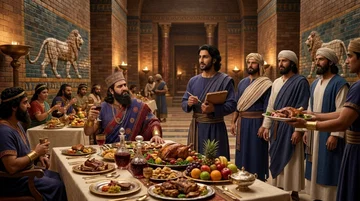
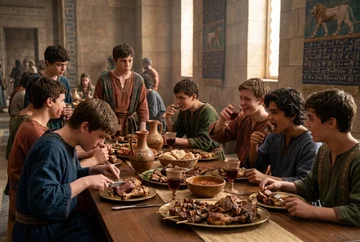
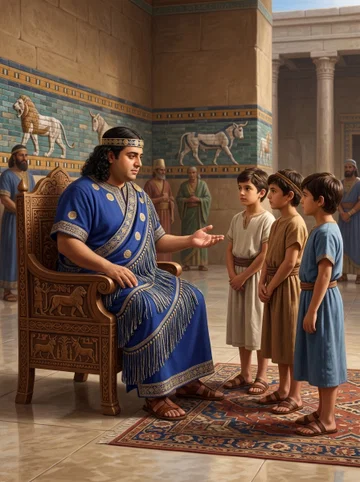
And the king appointed them a daily provision of the king’s meat, and of the wine which he drank: so nourishing them three years, that at the end thereof they might stand before the king.
Translations
American King James Version, King James Version, KJV Cambridge Paragraph Bible
And the king appointed them a daily provision of the king’s meat, and of the wine which he drank: so nourishing them three years, that at the end thereof they might stand before the king.
And the king appointed them a daily provision of the king's food, and of the wine which he drank: so nourishing them three years, that at the end of them they might stand before the king.
And the king appointed for them a daily portion of the king’s meat, and of the wine which he drank, and that they should be nourished three years; that at the end thereof they might stand before the king.
And the king appointed for them a daily portion of the king’s dainties, and of the wine which he drank, and that they should be nourished three years; that at the end thereof they should stand before the king.
And the king doth appoint for them a rate, day by day, of the king's portion of food, and of the wine of his drinking, so as to nourish them three years, that at the end thereof they may stand before the king.
And the king appointed unto them a daily provision of the king's delicate food, and of the wine that he drank, to nourish them three years, that at the end thereof they might stand before the king.
And the king appointed them the provision of each day upon its day, out of the delicacies of the king and out of the wine which he drank, and so to let them grow three years,—and, at the end thereof, that they should stand before the king.
Berean Standard Bible, Majority Standard Bible
The king assigned them daily provisions of the royal food and wine. They were to be trained for three years, after which they were to enter the king’s service.
The king appointed for them a daily portion of the king’s delicacies and of the wine which he drank, and that they should be nourished three years, that at its end they should stand before the king.
And a regular amount of food and wine every day from the king's table was ordered for them by the king; and they were to be cared for for three years so that at the end of that time they might take their places before the king.
And the King appointed them prouision euery day of a portion of the Kings meate, and and of the wine, which he dranke, so nourishing them three yeere, that at the ende thereof, they might stande before the King.
Douay-Rheims (Challoner revision)
And the king appointed them a daily provision, of his own meat, and of the wine of which he drank himself, that being nourished three years, afterwards they might stand before the king.
Pictures

Cross-references
- Daniel 1:20
And in all matters of wisdom and understanding, that the king enquired of them, he found them ten times better than all the magicians and astrologers that were in all his realm.
Their wisdom and understanding surpassed the king’s other advisers after their training.
- Daniel 1:12
Prove thy servants, I beseech thee, ten days; and let them give us pulse to eat, and water to drink.
Daniel requests pulse and water instead of the royal provision.
- Daniel 1:17
As for these four children, God gave them knowledge and skill in all learning and wisdom: and Daniel had understanding in all visions and dreams.
God gave Daniel and his companions knowledge, skill, and wisdom for their work in Babylon.
- Daniel 1:15
And at the end of ten days their countenances appeared fairer and fatter in flesh than all the children which did eat the portion of the king’s meat.
After the simple diet, Daniel and his companions look healthier than those eating the king’s food.
- Daniel 1:19
And the king communed with them; and among them all was found none like Daniel, Hananiah, Mishael, and Azariah: therefore stood they before the king.
After their training, they stood before the king.
- Isaiah 39:7
And of thy sons that shall issue from thee, which thou shalt beget, shall they take away; and they shall be eunuchs in the palace of the king of Babylon.
The taking of royal youths to Babylon fulfills Isaiah’s warning about Hezekiah’s descendants.
- Daniel 1:10
And the prince of the eunuchs said unto Daniel, I fear my lord the king, who hath appointed your meat and your drink: for why should he see your faces worse liking than the children which are of your sort? then shall ye make me endanger my head to the king.
The official fears the consequences of withholding the king’s appointed food.
- Leviticus 11:7-8
And the swine, though he divide the hoof, and be clovenfooted, yet he cheweth not the cud; he is unclean to you.
The king’s provision included meat forbidden by the law of Moses.
- Jeremiah 25:11
And this whole land shall be a desolation, and an astonishment; and these nations shall serve the king of Babylon seventy years.
The captives’ removal to Babylon marked the beginning of the seventy years.
- Daniel 1:9
Now God had brought Daniel into favour and tender love with the prince of the eunuchs.
God gives Daniel favor with the official overseeing him.
- Daniel 1:18
Now at the end of the days that the king had said he should bring them in, then the prince of the eunuchs brought them in before Nebuchadnezzar.
marks end of appointed days
- Jeremiah 27:6-8
And now have I given all these lands into the hand of Nebuchadnezzar the king of Babylon, my servant; and the beasts of the field have I given him also to serve him.
God directs the nations under Nebuchadnezzar’s rule.
- Jeremiah 25:9
Behold, I will send and take all the families of the north, saith the LORD, and Nebuchadrezzar the king of Babylon, my servant, and will bring them against this land, and against the inhabitants thereof, and against all these nations round about, and will utterly destroy them, and make them an astonishment, and an hissing, and perpetual desolations.
Nebuchadnezzar’s authority over Judah frames the setting for the royal provision.
- Daniel 1:1
In the third year of the reign of Jehoiakim king of Judah came Nebuchadnezzar king of Babylon unto Jerusalem, and besieged it.
Dates the start of the three-year training.
- Daniel 3:16-18
Shadrach, Meshach, and Abed-nego, answered and said to the king, O Nebuchadnezzar, we are not careful to answer thee in this matter.
The three Hebrews remained faithful and refused to worship the image.
- 2 Kings 20:18
And of thy sons that shall issue from thee, which thou shalt beget, shall they take away; and they shall be eunuchs in the palace of the king of Babylon.
Hezekiah’s descendants are taken to Babylon to serve in the king’s palace.
- Daniel 11:26
Yea, they that feed of the portion of his meat shall destroy him, and his army shall overflow: and many shall fall down slain.
Uses the same word for a king’s choice food.
- Daniel 5:12
Forasmuch as an excellent spirit, and knowledge, and understanding, interpreting of dreams, and shewing of hard sentences, and dissolving of doubts, were found in the same Daniel, whom the king named Belteshazzar: now let Daniel be called, and he will shew the interpretation.
original name still known later
Commentary
Each commentary is drawn from primary sources: the writings of Ellen G. White and Adventist pioneers and periodicals. Each commentary is separate. Its own words are not a quotation; follow the references to read the source passages.
Ellen G. White
54 sources
The king appointed Daniel, Hananiah, Mishael, and Azariah with other chosen youths a daily share of his own meat and wine to nourish them for three years of training so they might stand before him in service in his court.Ms 110, 1904, par. 5–6Ms 132, 1901, par. 3–4PK 476B.1PK 480.1–2FE 77.2–3 The provision was offered as a special honor for their best physical and mental development, yet it was an insidious plan to familiarize them with idolatrous customs and efface their religious impressions without open compulsion.Ms 2b, 1895, par. 21–22BS 16.3–17.1ST Sep 28, 1882Ms 110, 1904, par. 7Ms 2b, 1895, par. 19–20 The fare included meats pronounced unclean by the law of Moses and food and wine consecrated to Babylonian worship, so that to partake would defile them and count as homage to false gods and denial of loyalty to Jehovah.CTBH 25.5–26.2PK 481.2ED 54.2–3ST Sep 28, 1882 Daniel purposed in his heart not to defile himself, and with his companions courteously sought and obtained a ten days' trial of pulse and water, which proved them healthier and fairer than those eating the king's dainties and let them continue the simple diet.Ms 33, 1909, par. 1–8Ms 132, 1901, par. 11FE 79.2–80.1Ms 51, 1898, par. 4–8 The appointment is the Bible's most comprehensive illustration of true temperance, teaching strict self-denial in eating and drinking to preserve physical powers and increase mental, spiritual, and intellectual strength for God's service.Ms 93, 1910, par. 3–4Ms 175, 1898, par. 3–4RH May 22, 1900Lt 42, 1900, par. 20
Provision and Training Period
The king assigned the chosen youths a daily portion of his own meat and of the wine he himself drank, to nourish them through three years of preparation so that at the end they might stand before him in service in his court.Ms 110, 1904, par. 5–6Ms 132, 1901, par. 3–4PK 476B.1BS 16.2 Those who received this appointment included Daniel, Hananiah, Mishael, and Azariah of Judah, young Hebrew captives being trained for service in the royal court.Ms 110, 1904, par. 5–6Ms 132, 1901, par. 3–4PK 476B.1 The allowance was meant to sustain them during their three years of education before they stood before the king.Ms 132, 1901, par. 3–4BS 16.2
Those four were selected to be taught the learning and tongue of the Chaldeans that they might stand in the palace, receiving unusual educational advantages including the language of the Chaldeans.PK 480.1–2FE 77.2–3 King Nebuchadnezzar took Daniel and the three other captive youths of princely birth into his court to prepare them to fill important positions in Babylon.FE 77.2–3 Because of their superior talents they were admitted to the royal palace for three years of thorough physical and intellectual discipline, including learning the language according to Oriental custom, to fully qualify them for life at court.FE 77.2–3 Eating the meat and drinking the wine from the king's table was part of that training.FE 77.2–3
The provision was presented as a special honor, different from food normally apportioned to captives, expressing the king's favor and care.Ms 2b, 1895, par. 21–22BS 16.3–17.1ST Sep 28, 1882 The king regarded it as an honor and as the means to secure for them the best physical and mental development that could be obtained for important positions.BS 16.3–17.1ST Sep 28, 1882FE 77.2–3BS 16.2 It was intended to honor them and to develop their physical and mental abilities for places at court and service before the king.BS 16.3–17.1ST Sep 28, 1882BS 16.2
The three years were a set period as students under tutors in thorough physical and intellectual discipline, ending in examination and presentation before the king.FE 77.2–3FE 350.1–351.112MR 121.3–123.1 The king supplied food from his table and the wine he drank for three years, until their examination and presentation before him.12MR 121.3–123.1 At the close they were to stand before him in active service rather than enter again upon another line of book study, putting into practical use what had been learned and practicing the theories gained.FE 350.1–351.1
Captivity Setting and Design
The verse belongs to Israel's humiliation when departure from God led to captivity in Babylon, with the vessels of God's house placed in the temple of the Babylonish gods as supposed proof by the victors that their religion and customs were superior to those of the Hebrews.PK 479.2 Yet through that very humiliation Babylon was given evidence of God's supremacy, of the holiness of His requirements, and of the sure results of obedience, and that testimony came through those who stayed loyal to Him.PK 479.2
Daniel and his companions were carried away early in the reign of Jehoiakim when Nebuchadnezzar for the first time besieged and captured Jerusalem, with others specially chosen to be trained for service in the court of Babylon to stand before the king.PK 428.1 They did not enter that court by pride or ambition or choice, but were brought there in warfare as captives in a strange land, while Infinite Wisdom placed them there and permitted them to be there.Ms 132, 1901, par. 1–2Ms 35, 1890, par. 7 Their position tried their faith to the utmost, yet conscientious observance of the commands of Holy Scripture brought them opportunities to exalt the true God, and the instruction received in their parents' homes made them strong in faith and constant in service, with trust in God's promises proving all-sufficient and the Scriptures proving a guide and stay in every experience.PK 428.1
God's purpose was that they carry knowledge of Him as the only true God and Creator to the king and nobles, bring the blessings of knowing God to heathen nations, and represent Jehovah among them.6T 219.1–2PK 428.1 They were not to compromise with idolaters but to honor their faith and their identity as worshipers of the living God, remaining loyal in prosperity and adversity even when doing so brought loss, and God honored them for it.PK 479.16T 219.1–2CH 205.1–2
The king's appointment of daily meat and wine for three years so they might stand before him was an insidious, gradual plan to cause full apostasy and make them one with the Babylonians in religion.Ms 110, 1904, par. 7 Though vested with absolute authority as ruler of a kingdom of surpassing grandeur over young men of perfect form and fine mental qualities standing before him, he did not seek by imposing display of power to influence them nor try to compel them to renounce their faith for idolatry.Ms 110, 1904, par. 7 He himself brought them into his presence to judge their ability and qualifications, took kindly to them because he saw independence joined with true courtesy, and found they were of royal lineage and well instructed.Ms 2b, 1895, par. 19–20 He had them sit at table with idolaters for three years to become familiar with idolatrous customs, hoping that daily opportunity to observe the display connected with the charming, seductive rites of heathen worship, with change of country and associations and the influence of court life in Babylon, would efface the impressions made by their early religious education in childhood.Ms 110, 1904, par. 7Ms 2b, 1895, par. 19–20
Before captivity separated them from home they had received the regular Hebrew home training, the same as Moses in Goshen, Samuel by Hannah, David at Bethlehem, Christ at Nazareth, and Timothy by Eunice and Lois.FE 95.5–96.1 Their parents, as guardians of their little ones, feared God and taught them to prize His precepts, and they had made the Bible the study of their lives, showing what may be expected from youth so trained; when parents fail in duty and neglect their children the defective characters and sins of sons and daughters are charged to the parents as well as to the transgressors.Ms 110, 1904, par. 11 That education made the youth of Israel vigorous in body and mind, quick to perceive and strong to act, with the heart prepared like good ground for precious seed and the mind trained to see God in revelation and nature, so that stars, trees, flowers, mountains, brooks, and the voices of the prophets met a response in the heart.FE 95.5–96.1 The royal provision of food and wine belongs to the later Babylonian setting, not to that childhood education in the family home before separation from their people.RH Oct 30, 1900
Amid idolatrous practices and court pressures, while receiving advantages and being prepared with royal food and wine for three years to serve before the king, they guarded their religious instruction and held fast to the faithful education received at home.Ms 140, 1906, par. 19–20Ms 35, 1890, par. 1Ms 56, 1895, par. 8 They resolved to remain true to God's commandments and reject idolatry, remaining true to Jehovah and the only true God under every circumstance and becoming faithful representatives of God's religion.Ms 140, 1906, par. 19–20Ms 35, 1890, par. 1Ms 35, 1890, par. 7 Their faithful principles and early education preserved them amid the test of captivity, and despite the envy and hatred of enemies God helped them and did not allow enemies to prevail against them, leading to their exaltation.Ms 140, 1906, par. 19–20Ms 56, 1895, par. 82T 139.2
Defilement in Food Refused
The king's daily allowance included meats pronounced unclean by the law of Moses and forbidden to Jews, such as swine's flesh and other things of an abominable character, so eating them would defile and could not be done conscientiously.CTBH 25.5–26.2Ms 2b, 1895, par. 21–22 Though presented as an honor and as support for physical and mental development, the provision therefore became a test of loyalty.CTBH 25.5–26.2ST Sep 28, 1882 The meat from the king's table had often been portions of sacrifices offered in heathen temples and was consecrated to Babylonian worship, and the wine had been dedicated to the gods with a portion poured out as a libation before each meal.Ms 2b, 1895, par. 21–22PK 481.2ED 54.2–3 To partake was to be regarded as connected with heathen worship, and even to pretend to partake would count as homage to false gods and as denial of loyalty to Jehovah and dishonor to His law.Ms 2b, 1895, par. 21–22PK 481.2ED 54.2–3
The rich food and luxurious living would weaken physical, mental, and moral power and threaten development through luxury and dissipation.Ms 2b, 1895, par. 21–22ED 54.2–3FE 79.2–80.1 Partaking would stimulate and confuse the brain and impair the faculties given by God for His service, harming clear intellect and clear presentation of truth, since intelligence depends on what is eaten and drunk.Ms 71, 1910, par. 1Ms 2b, 1895, par. 21–22 Daniel refused the wine because he knew it could become a snare and a pleasure he would come to prefer to water, and with his associates he carefully considered how such choices would affect physical and mental powers.Ms 71, 1910, par. 1Ms 122, 1897, par. 25–26 He controlled appetite rather than accept the royal food and drink.CTBH 189.2
With his companions he preferred the favor of God and the approval of a clear conscience above all honor from the greatest monarch of the time.CTBH 189.2Ms 2b, 1895, par. 21–22 The approval of God was dearer to him than the favor of the most powerful earthly potentate, even dearer than life itself.FE 79.2–80.1
Trial Request and Outcome
Daniel purposed in his heart not to defile himself, and with his associates declined both the wine and the luxuries of the table.Ms 132, 1901, par. 11 They did not treat the king's appointment as a duty to partake, but prayed over the matter, studied the Scriptures, and reasoned carefully from cause to effect.Ms 51, 1898, par. 4–8 By courteous conduct they sought permission for simpler fare, trusting God as their dependence even in captivity.Ms 132, 1901, par. 11Ms 51, 1898, par. 4–8
God brought Daniel into favor and tender love with the prince of the eunuchs, and by courteous conduct he obtained favor with Melzar, the officer in charge.FE 79.2–80.1Ms 13, 1900, par. 7–10 The officer feared that rigid abstinence would render them pale and sickly and deficient in strength, hurt their appearance, and bring himself into disfavor with the king and endanger his life.FE 79.2–80.1 He thought luxurious food from the king's table would make them ruddy and beautiful and promote activity of body and mind.FE 79.2–80.1
Daniel obtained a ten days' trial of pulse to eat and water to drink, asking that the matter be decided by its result.FE 79.2–80.1 At the end they proved far more healthy and fair in appearance than those eating the king's dainties, with the result opposite to expectation.Ms 33, 1909, par. 1–8FE 79.2–80.1 They were therefore permitted to continue their simple diet through the whole course of training.FE 79.2–80.1
Their temperance was joined with self-denial, earnest purpose, diligence and steadfastness, not from pride or ambition but for the honor of their people and the glory of God.HSFM 209.6–210.2CTBH 26.3–27.2PK 484.2 The blessing of the Lord was not a substitute for taxing effort, for through grace their destiny depended upon their own will, choice and action.SPBC 178.1MYP 147.1Lt 55, 1895, par. 16–17 They were diligent in study, bringing all their ability to the work and by close, severe taxation of their powers making the most of their opportunities for study and labor.SPBC 178.1MYP 147.1Lt 55, 1895, par. 16–17
At the testing of ability and acquirements at the end of the three years none were found like Daniel, Hananiah, Mishael and Azariah in keen apprehension, choice language, extensive knowledge, physical activity and mental vigor.CTBH 26.3–27.2 With erect form, fair countenance, undimmed senses and untainted breath they stood before the king, proving that God honors obedience to nature's laws.CTBH 26.3–27.2MYP 241.1–2 God gave them knowledge and skill in all learning and wisdom, with understanding in visions and dreams to Daniel, and when the king communed with them he found them ten times better than all the magicians and astrologers in all his realm.CTBH 26.3–27.2Ms 13, 1900, par. 7–10
Temperance Teaching Preserved
The appointment of a daily share of the king's own food and wine to nourish the chosen youths for three years that they might stand in the palace is the Bible's most comprehensive and forcible illustration of true temperance and its attendant blessings.Ms 132, 1901, par. 1–2 The integrity and firmness shown in that setting make the whole chapter a lesson in Christian temperance.RH May 22, 1900Lt 42, 1900, par. 20 The youths so provided for were Hebrew captives in a strange land, selected to be taught the learning and tongue of the Chaldeans, and they were not there by pride or ambition but placed there by Infinite Wisdom.Ms 132, 1901, par. 1–2 Daniel purposed in his heart not to defile himself with the portion of the king's food nor with the wine, and with his associates declined both the wine and the luxuries of the table. The appointed food included swine's flesh and other meats pronounced unclean by the law of Moses and forbidden to the Jews, so that eating would defile them. They requested simpler fare, and when the officer feared that rigid abstinence would injure their appearance and bring himself into disfavor with the king, Daniel obtained a ten days' trial on pulse and water, proved healthier and fairer in appearance than those eating the king's dainties, and thereafter continued on the simple diet.
The account teaches strict temperance in eating and drinking.Ms 175, 1898, par. 3–4 Daniel and his companions adhered strictly to these principles, thereby preserving their physical powers and gaining mental strength, while their physical, mental, and spiritual understanding increased.Ms 175, 1898, par. 3–4 Students are thereby taught to practice self-denial in eating and drinking.Ms 93, 1910, par. 3–4Ms 186, 1907, par. 38–41 Wise care of the diet and the blood-making organs honors God and supports the development of knowledge and mental power.Ms 93, 1910, par. 3–4 Daniel's resolve not to defile himself is the example of guarding the mind and preserving its power for God's work and for bringing the knowledge of God and truth before others.Ms 93, 1910, par. 3–4Ms 186, 1907, par. 38–41
The first chapter is full of valuable instruction for youth who feel they do not have the advantages they should have in eating.Ms 71, 1910, par. 5–6 The king's provision of food and drink was the test that Daniel and his fellows faced, and they endured that test with consistency.Ms 71, 1910, par. 5–6 That consistency calls youth to remain consistent when tested and to remain true to religious principle despite the pressures of court life and youth, as Daniel showed by refusing to eat and drink as the Babylonians did.Ms 71, 1910, par. 5–64T 569.1–570.1
Faithful Example Applied
Daniel's course in Babylon shows that heavenly wisdom surpasses the learning of the highest schools, and it demonstrates the value of pursuing education under God's guidance while depending on His power.STE 221.1 After completing a set period of study under tutors, he put into practical use what he had learned instead of entering again upon another line of book study.FE 350.1–351.1 The three years of provision and nourishing ended with standing before the king in active service, making him an example that students should enter upon the work for which they have studied and practice the theories they have gained.FE 350.1–351.1
Those who are established, rooted and grounded in truth and led by God may enter worldly colleges as students and live the truth as Daniel and Paul did.4MR 51.1–53.1 They make no pretensions and sacrifice no principle, while respecting all rules and regulations, keeping the living principles of truth, observing the Sabbath, praying to the Saviour as the only mediator between God and man, and telling inquirers in simple language the simple Bible doctrines without starting open controversy.4MR 51.1–53.1 Their distinct life provokes questions and arouses investigation, lets light shine forth, and lets the leaven of godly lives work more than words, so that seeds of truth spring up to bear fruit for the glory of God in the saving of souls.4MR 51.1–53.1 Those with no connection with God must not take up this work, lest instead of correcting error and diffusing light they themselves be led astray.4MR 51.1–53.1
What worldly wisdom counted as every advantage secured to them was their first test, where their principles came into collision with the regulations and appointments of the king.Ms 51, 1898, par. 4–8 They did not take the position that the king's appointment made it their duty to partake, but prayed over the matter, studied the Scriptures, and reasoned carefully from cause to effect, trusting God as their dependence even in captivity.Ms 51, 1898, par. 4–8 Their course is an example to youth to be true to principle and duty by taking a courteous, intelligent, firm stand on the side of righteousness and strict temperance even in licentious surroundings at the risk of life.Ms 51, 1898, par. 4–8
Sources
Pioneers and periodicals
85 sources
The king appointed the chosen youths a daily portion of his own choice food and the wine he drank, nourishing and schooling them for three years so that at the end they might stand before him as his personal attendants, counselors and advisers.RH Jan 12, 1869ST Nov 28, 1911 The provision was generous and honorable treatment at public expense, because he counted his own diet best for mind and body, yet it included meats forbidden by the law of Moses and food offered to idols, with fermented wine, so that to eat and drink would defile them and join idolatrous worship.STST Nov 18, 1897ST Jun 9, 1914ST Oct 30, 1879 Daniel purposed in his heart not to defile himself, and with his companions declined the luxuries and wine, asking for pulse and water, and after a ten-day trial they appeared fairer and healthier than those eating the king's dainties.ST Mar 2, 1882RH Aug 7, 1866RH Nov 17, 1874 Their refusal was the first test of religious loyalty, holding with fixed principle to early training against royal pomp and displeasure, since yielding at the outset would have led to further wrong and severed connection with Heaven.ST Nov 24, 1898ST Jan 21, 1886 Their self-denial and obedience were joined with bodily health, mental strength and wisdom ten times greater than Babylon's teachers, making the three years God's object-lesson contrasting the world's education at its best with His own way of developing the whole person physically, mentally and spiritually.STST Jan 29, 1885ST Sep 25, 1901RH Sep 30, 1902
Royal Provision Described
The king appointed the selected youths a daily portion of his own food and of the wine which he himself drank, nourishing them through three years of special training so that at the end they might stand before him.RH Jan 12, 1869ST Nov 28, 1911ST Dec 5, 1911ST Sep 11, 1901 That standing before him meant entering his service as his personal attendants, assistants, counselors and advisers, a position of high honor after preparation and examination.ST Nov 28, 1911ST Dec 5, 1911ST Sep 11, 1901 The Babylonian king thus assigned the Judean captives a daily share of royal food and wine and provided for them during the full three-year course before they were to serve in his presence.RH Jan 12, 1869
The word translated meat does not mean ordinary fare but delicate, choice food, the king's own portion, as the same word is used in Daniel 11:26.ST Oct 30, 1879 To refuse it was therefore to refuse both a royal order and a royal favor, an act that could appear rebellious and ungrateful.ST Oct 30, 1879 The provision was generous and honorable treatment, giving captives the privileges of the royal household at public expense under trusted royal servants.STST Jul 27, 1904RH Jan 12, 1869 Nebuchadnezzar extended the diet of his own table because he considered it best for mind and body, assumed the best students should receive the empire's best provisions, regarded it as the best diet for developing physical and mental powers, and intended it to sustain and benefit them physically through their preparation as future advisers.ST Nov 18, 1897ST Jul 27, 1904ST Dec 5, 1911
The wine appointed in the verse was fermented wine, the same kind afterward served at Belshazzar's feast that led its drinkers to desecrate the holy vessels of the Lord, and to drink it would defile Daniel.ST Jun 9, 1914 This appointment stands in the first chapter of Daniel, which is largely historical and descriptive rather than prophetic.ST Nov 17, 1914 That chapter belongs to a book written nearly six hundred years before Christ which foretold the outline of world history for thousands of years to its end and to the second coming of Christ.ST Nov 17, 1914
Babylon and Captivity
Babylon was one of the first great cities of antiquity, founded by Nimrod, the lawless warrior of the family of Ham, and was the center and starting point of the civilization that afterward spread through Western Asia, cradling the earliest religious, scientific and artistic traditions of present civilization.ST Nov 28, 1911 Its founders in rebellion against God rejected His law for peopling the earth, sought their own glory and name, and purposed to escape future deluges, concentrate effort, control men's destiny, and become arbiters of destiny by building a city and tower whose top would reach heaven.ST Nov 28, 1911 They called it Bab-il or Bab-ilu, the Gate of God or Gate of Heaven, which was man's attempt to improve upon God's plan, to put man's work in place of God's free grace and Spirit, and to exalt the creature to the throne of the Creator.ST Nov 28, 1911 God named it Babel or Babylon, meaning confusion, because erecting other standards which must be universally and forever false always leads to confusion, and from that false principle has sprung every false system of religion and every perversion of the true religion that has cursed the nations and the world, put millions of God's children to death, and made all the earth drunken.ST Nov 28, 1911
At this time Babylon, no longer Hamitic but decidedly Shemitic, had risen from ruins and vassalage to proud Nineveh into ascendancy under Nabopolassar, appointed B.C. 626 by the Assyrian emperor, after Assyria yielded to the united superior power of Media, Egypt and Babylonia and Nineveh fell as predicted.ST Nov 28, 1911 Nebuchadnezzar, son of Nabopolassar, Babylon's greatest, progressive and enlightened king, was associated with his father as joint ruler in B.C. 607, with Amyitis daughter of Cyaxares king of the Medes as his wife by marriage alliance between the royal families that strengthened their mutual interests.ST Nov 28, 1911 Egypt had been defeated, proud and wealthy Tyre humbled, and Edom and Moab and Philistia passed under his rod, while Babylon was just beginning to crown herself with greater glory as the seat of ancient learning, with ancient public buildings and heathen temples repairing and new ones projected on a much larger scale.ST Nov 28, 1911
The youths were captives of royal blood and noble families, children and lads probably in their teens and about fourteen years old, picked for the best physical appearance and well-developed intellectual ability after rigid tests of physical perfection and mental capacity.RH Jun 4, 1908RH Feb 20, 1900ST Jun 6, 1916 The haughty king would admit no bodily imperfection into his presence and would not spend effort and expense to educate foreigners unable to render intelligent service, and those chosen excelled the Chaldean youths in mental and physical qualities.RH Jun 4, 1908RH Jan 12, 1869ST Jun 6, 1916 Their selection as servants for the royal palace both evidenced complete subjugation of the conquered people in keeping with Babylonian pride and eastern custom and placed them at the age when surroundings most powerfully influence conduct, when those not controlled by a living principle within are swayed by outward circumstances.RH Jun 4, 1908RH Feb 20, 1900 The most promising youths from the whole dominion were thus chosen to be given an education qualifying them to be leaders and counselors, and their three years of training was completed with honor so they were judged worthy to be numbered among the wise men.RH Feb 20, 1900ST Jun 6, 1916
Their deportation fulfilled the word spoken to Hezekiah that his sons should be eunuchs in the palace of the king of Babylon, when Nebuchadnezzar, the greatest king of Babylon, first captured Jerusalem in B.C. 605, plundered it of its treasures, burned the city and its glorious temple, and took youths of the royal seed for his servants, among them Daniel, Hananiah, Mishael and Azariah.ST Jan 13, 1888RH Jan 12, 1869STST Nov 21, 1911 Their captivity was the consequence of their fathers' iniquities and of utter apostasy, for which the children suffered, so that God could do nothing else for them or through them.RH Jan 12, 1869ST It was the consequence of Judah's failure to make God's goodness and salvation known, when Hezekiah showed Babylon its treasures instead of telling of God and stirred its greed until Jerusalem's treasures were coveted and the city fell.ST Israel had kept for itself the truth and light God had entrusted to it for all nations, and therefore was scattered among the nations under the hardship of exile to carry that knowledge to the nations, though sharing God's gifts freely would have brought blessing to Israel and the world.RH Feb 13, 1900ST In that exile God set up His light and center of illumination on earth in the persons of the faithful in the heathen city, purposing to use that great empire for the promulgation of His truth, and the book of Daniel is the divine record of that work, shaped by a divine hand, selected by divine foresight for later times, and penned by divine inspiration.ST Jan 13, 1888ST
Records of old Babylon, Assyria and Egypt brought to light from clay tablets, cylinders, obelisks, steles and bas-reliefs fulfill God's Word and silence critics by confirming Scripture history, including the capture of Babylon, Nebuchadnezzar's building of Babylon, and the death of Belshazzar, to which the true record of Babylon under its kings in Daniel belongs.RH May 13, 1909
Training for Royal Service
The three years was the set university course, the advanced training planned to fit the chosen youths for positions of usefulness in government and among the wise men. ST Nov 28, 1911ST Jun 6, 1916 During that time they were to be nourished on the king's dainties at his expense, supplied with food and drink from his own table to prepare them to pass examination for places in his service and favor. ST Mar 2, 1882ST Nov 28, 1911ST Jan 21, 1886 They were taught the language and learning of the Chaldeans so they could serve acceptably in appointed places, and at the end their abilities were tested before Nebuchadnezzar, who found them exceptional. ST Mar 2, 1882RH Jun 2, 1904ST Jun 6, 1916 Standing before the king represents serving under his authority, in contrast to the king who sits in rule. RH Jun 2, 1904 During the three years they were not counted among the wise men nor involved in public affairs. RH Jan 19, 1869ST Feb 1, 1877
That preparation was completed in the year before the dream recorded in Daniel 2, so that in the very next year after becoming qualified they were brought to sudden notoriety, still young men. ST Dec 2, 1897ST Jul 28, 1881ST Feb 1, 1877 Daniel had been taken captive four years before the second year of sole reign, when the king dreamed of the great image, having been carried captive in the first year of Nebuchadnezzar and placed under instructors for three years of nourishing and training. RH Apr 18, 1871ST Feb 1, 1877 That second year is reckoned as Nebuchadnezzar's second year by Chaldean reckoning and fourth year by Jewish reckoning. RH Jan 19, 1869ST Feb 1, 1877 The conquest therefore preceded the second regnal year by at least three years, which supports placing the first expedition in 606 B.C. when the seventy years of captivity began. RH May 28, 1908
The king's set purpose in this provision and schooling at public expense was to transform and naturalize the noble youths from Jerusalem by education and association into wise men of Babylon. RH Jun 4, 1908RH Jun 4, 1908 It was meant to cause them to forget as far as possible their national religion, the true God and past history, and to disconnect them from that past. RH Jun 4, 1908RH Jun 4, 1908 They were to become assimilated to the priestly class, a wealthy and influential order devoted to native deities and philosophy. RH Jun 4, 1908RH Jun 4, 1908 That order guarded temples and served at altars, explained dreams and prodigies, understood omens, read warnings of the stars, and instructed how to escape threatened evils by purifications, incantations and sacrifices. RH Jun 4, 1908 It held traditional knowledge handed from father to son without question as sole possessors of recondite wisdom, forming a distinct power in the state with direct communication with the monarch, feared and respected as possessing not merely human learning but supernatural power to predict the future. RH Jun 4, 1908
God's providence overruled the national disaster to prepare missionaries to proclaim the gospel and carry salvation to Babylon, a people sitting in darkness. RH Jun 4, 1908ST The three years of nourishing and training were the apparently natural means for giving these young missionaries the required education, since as in modern times missionaries to strange peoples must first learn the language of those to whom they minister. RH Jun 4, 1908 Learning the tongue of the Chaldeans was necessary because old Chaldee amid Babylon's babel of languages was the most ancient speech, the very speech of Asshur, the sacred hieratic language and peculiar dialect of religion and science with hieratic writing in a distinct dialect if not distinct character sacred to religious subjects and known only to the wise men called Chaldees. RH Jun 4, 1908 So trained, the captives could stand before the king and share in his own language knowledge of the true God and His work, through whom God intended to reach Babylon and the nations whose power could command attention. RH Jun 4, 1908ST Jul 30, 1902 He set up His light and center of illumination on earth in the persons of the faithful in the heathen city to use the empire for promulgation of truth, and the book of Daniel is the divine record of that work shaped by divine hand, foresight and inspiration for later times. STRH Jan 28, 1902ST Nov 21, 1911
The royal provision and training held out to youths deprived of religious worship and surrounded with idolatry a place of profit and power, with ease and luxury. RH Jun 4, 1908 It set before them a question of loyalty: whether to yield to Babylonish influences or remain true to the religion of the fathers and proclaim in Babylon the gospel that restores the image of God marred by sin. RH Jun 4, 1908 Their steadfastness required great strength of character to resist those combined influences, and it rebukes the strong current of worldly influence today and the temptation to choose ease over missionary hardship. RH Jun 4, 1908
Defilement Refused, Health Gained
The king's table held swine's flesh and other meats pronounced unclean and forbidden by the law of Moses, and the fare was such as a conscientious Hebrew could not eat without violating belief, religious scruple, temperance principle and loyalty to God.ST Mar 2, 1882ST Feb 11, 1886ST Sep 28, 1882ST Nov 18, 1897 That eating would have defiled him, and because the food was likely prepared contrary to that law and offered or dedicated to idols, to eat would have been to express worship of idols and to join idolatrous worship.ST Nov 18, 1897RH Jun 11, 1908ST May 13, 1886 Daniel purposed in his heart not to defile himself with the portion of the king's meat nor with the wine, and with his companions declined both the wine and the luxuries of the table.RH Aug 7, 1866 They requested instead simple fare of pulse, vegetarian plant foods, and water, after the original food appointed for humanity of every herb bearing seed and every tree fruit, not animal food.RH Aug 7, 1866RH Nov 17, 1874RH Aug 3, 1911 The officer in charge feared that such rigid abstinence would injure their appearance and bring himself into disfavor with the king who had made the appointment. Daniel obtained a ten-day trial in expectation that God would vindicate faith, and at its end they appeared fairer and with more flesh and far more healthy in appearance than those eating the king's dainties, and thereafter they continued on the chosen diet through the course.ST Mar 2, 1882RH Aug 7, 1866ST May 13, 1886RH Aug 3, 1911
Their healthier appearance stands as evidence of the effectiveness of the Lord's rule, not as the result of a miracle, and the same rule can produce beneficial results when applied now.ST Jan 29, 1885 Self-denial, obedience to God's laws and disciplined habits are linked with physical health and mental strength, and God's blessing gave the young men physical and intellectual vigor.ST Feb 11, 1886ST Mar 2, 1882 Living by God's plan for food leads to bodily health and vigor of intellect, and temperate eating of simple food at regular times supports physical health.ST Feb 13, 1896 Yet the account does not establish that foods a person believes to be right will improve health, nor that God will suspend natural laws to make any conscientiously chosen diet beneficial.RH Jul 21, 1904
Refusing food from the king's table was necessary to keep minds clear so that the schooling would produce its proper result.RH Jul 31, 1913 The result was wisdom acknowledged as ten times greater than that of Babylon's teachers, and to Daniel was given instruction in visions of divine foresight.RH Jul 31, 1913RH Jul 14, 1903 The lesson is that food and drink matter not merely to avoid illness or discomfort, but to keep the body in the best condition to serve God, and using God-given powers to satisfy appetite at that expense robs God of what is due Him.RH Sep 30, 1902 Accepting the provision would have defiled their bodies as the Lord's temple, and would have amounted to rejecting the sanctuary's teaching and righteousness by faith in favor of man's way of righteousness.RH Jul 22, 1902
The opening seven verses introduce the experiences of the captivity and the personal lesson of Daniel, and present the real theme carried through the historic and prophetic portions, the temple or sanctuary and its significance in the worship of God.RH Jul 15, 1902 That theme proclaims the provision God has made to cleanse the conscience from dead works to serve the living God through Christ as high priest of good things to come, entering through the greater and more perfect tabernacle by His own blood to obtain eternal redemption.RH Jul 15, 1902 In this setting the chapter is a lesson in Christian temperance and integrity, where firmness under pressure and abstinence from wine and other harmful things amid the royal provision brought God's blessing.RH May 22, 1900ST Aug 12, 1880ST Aug 26, 1913 Diet and righteousness by faith are the physical and spiritual sides of receiving God's life in the right way for service that glorifies Him, and Christian temperance is thus connected with keeping God's law.ST Nov 20, 1901
Rival Systems of Education
The king's appointment of daily provision and three years of nourishing and training to stand before him is the world's education at its best.STST Sep 25, 1901 The first chapter of Daniel sets that program as God's object-lesson in education, placed in contrast with His own education at its worst, so that the comparative results call everyone to heed instruction and be taught of God.STST Sep 25, 1901 The Babylonian system described there stands in contrast to the Biblical system and its results.ST That Babylonian course is an influence that has persisted through the ages, and the same Babylonian principle continues in today's worldly educational system, which is like it and shares its four great defects.STST Oct 21, 1908ST Sep 25, 1901
That system means a one-sided education aiming largely to develop the mental at the expense of the physical and spiritual by the cramming process.ST Sep 25, 1901 It assumed that the best students should receive the empire's best provisions from the king's own table and wine for three years to prepare them for his service, though a rich diet was not necessary for intellectual ability.ST Dec 12, 1911ST Dec 5, 1911 The Hebrew youths instead lived on simple pulse and water under far harder conditions, yet surpassed the Babylonian students in learning, knowledge and wisdom, showing the different results of Babylon's worldly education and God's plan.ST Dec 12, 1911ST Sep 25, 1901 Its result in children is wrecked nervous systems and shattered health during the formative growing period when the child should be storing up energy instead of using it all up.ST Sep 25, 1901 Thousands of children between eight and fourteen are taken from school with minds incapable of going further, and tens of thousands more each year have health shattered by over-study, with restless nights, loss of appetite, haggard appearance, loss of energy and ambition, feverish excitement, inability to sleep or eat properly, and no time for play until they break down.ST Sep 25, 1901
The remedy for these defects is a properly balanced religious education in which religion possesses the whole man and acts as motive power in every act of life.ST God's plan develops the whole person physically, mentally, morally and spiritually, with God as supreme Teacher who can teach and instruct above all the schools of the world.ST Aug 9, 1910ST Dec 1, 1914ST Dec 5, 1911 Daniel was thoroughly educated in Babylon, a city illustrious for its schools where astronomy and all the sciences were taught, with the best opportunities Nebuchadnezzar could furnish.RH Jun 18, 1872 That education, joined with most fervent piety, fitted him to receive the most wonderful prophecy giving the history of the world for thousands of years in advance, proving God prefers learning to ignorance when choosing agents for His work.RH Jun 18, 1872
Those taught of God as eternal living truth excel in every branch of true science and every useful occupation and are ten times better in every matter of wisdom and understanding than mere secular teaching can produce.ST Sep 25, 1901 That result is to be repeated in modern Babylon as in Babylon of old, in making men who value true worth above wealth, faithfulness above fame, purity above power, character above coin, and serving God above ruling.ST Sep 25, 1901 Such men serve faithfully under successive kingdoms because they serve God.ST Sep 25, 1901
Faithfulness and Witness
The royal provision of food and drink from the king's own table for three years of schooling to prepare chosen youths for examination and service became a test of religious loyalty, because some of that food and drink conflicted with conscience and eating it would violate religious scruples and defile.ST Nov 24, 1898ST Jan 21, 1886ST Apr 14, 1909 Daniel, though only a mere boy set in Babylon at the height of its glory with its wealth, luxury, intemperance and heathen manners, led in purposing in his heart not to defile himself with that provision, and his three companions stood with him apart from what the king expected and what all the other students were willing to do.ST Nov 4, 1886ST Jan 21, 1886 His refusal displays real principle and integrity instilled from tender years and standing out against prevailing wickedness, doing right without counting the cost, with purpose undeterred by the pomp and glory of the royal court and unsoftened by fear of incurring royal displeasure.ST Nov 4, 1886ST Nov 24, 1898 It was a fixed purpose not to conform in any way to heathen customs nor to let the evil influences around him defile him and not to yield to known sin, for yielding at the outset could have led to further wrong choices and severed connection with Heaven.ST Nov 4, 1886ST Jan 21, 1886ST Apr 14, 1909
Daniel was a young prince taken to Babylon in fulfillment of the prophecy concerning the king's sons, and he remained faithful to his early teachings and to God during his education. He received his upbringing and training in right principles in his family home before captivity separated him from his father's household and people, and that faithful early preparation fitted him for a life of trusted public responsibility.RH Oct 30, 1900ST Jun 24, 1913 The provision of royal food and wine belongs to the later Babylonian setting, not to that childhood education.RH Oct 30, 1900
Daniel and his companions were captives in a strange land nourished and instructed in the palace of the king of Babylon during trouble and distress upon Jerusalem, where their circumstances were more favorable than they would have been in their native land.ST Aug 9, 1910ST Jan 18, 1877 Daniel entered the Babylonian court after former hopes and joys had been crushed, serving under Melzar before God exalted him to the sphere intended for him, and his rise was not driven by ambition but came through humility and obedience. He lived in Babylon, a wicked place with evil seen and heard all around him, yet remained not wicked himself, which proves he had the grace of God.RH May 29, 1855
They trusted God for wisdom, and their experience seeking Him prepared them to remain loyal to Him rather than bow to Nebuchadnezzar's image.ST Jun 3, 1913 Ancient pagan rulers employed devoted children of God who kept the Sabbath, and Daniel and his companions served in the king's court while remaining faithful to God.ST Dec 3, 1902
Israel had kept for itself the truth and light entrusted to it for all nations and was therefore scattered among the nations, and through captivity the people were made to carry that knowledge to the nations, so the setting of the royal provision shows Israel's mission being carried out under the hardship of exile.RH Feb 13, 1900 God used these faithful young men taken captive and placed in the king's service to bring the knowledge of the true God to Nebuchadnezzar, whom He had positioned to spread that light to the world, and there Daniel later let his light shine as a faithful witness in captivity.RH Jan 28, 1902RH Dec 17, 1914 Their experiences as captives illustrate a life guided and ruled by God's indwelling presence and serve as a type of the church in Babylon.RH Sep 30, 1902 That early life in captivity also illustrates how Christian principles can be practiced in all business transactions.RH May 18, 1905 Daniel as a young man at court faced temptation like that faced by boys from thirteen to twenty in a time of waking powers, unrest, doubt and questioning, and his life there proves that such youthful temptation can be fought and won, giving encouragement in the hour of temptation and showing him chosen in youth for a great work, with the wisdom and excellent spirit God gave him needed also by missionaries sent to places like New York City.
Judah's captivity marks the beginning of the book's prophetic history.ST Dec 12, 1911 Daniel lived in Babylon with the Jewish captives during the whole of their seventy-year sojourn in constant communion with God and jealous for the law of his God, so he would have corrected his people had they been in danger of losing or forgetting the Sabbath; therefore the Sabbath was not lost during the Babylonish captivity.
Sources