Daniel 11:6
And in the end of years they shall join themselves together; for the king’s daughter of the south shall come to the king of the north to make an agreement: but she shall not retain the power of the arm; neither shall he stand, nor his arm: but she shall be given up, and they that brought her, and he that begat her, and he that strengthened her in these times.
Translations
American King James Version, King James Version, KJV Cambridge Paragraph Bible
And in the end of years they shall join themselves together; for the king’s daughter of the south shall come to the king of the north to make an agreement: but she shall not retain the power of the arm; neither shall he stand, nor his arm: but she shall be given up, and they that brought her, and he that begat her, and he that strengthened her in these times.
And in the end of years they shall join themselves together; for the king's daughter of the south shall come to the king of the north to make an agreement: but she shall not retain the power of the arm; neither shall he stand, nor his arm: but she shall be given up, and they that brought her, and he that begat her, and he that strengthened her in these times.
Revised Version, American Standard Version
And at the end of years they shall join themselves together; and the daughter of the king of the south shall come to the king of the north to make an agreement: but she shall not retain the strength of her arm; neither shall he stand, nor his arm; but she shall be given up, and they that brought her, and he that begat her, and he that strengthened her in those times.
'And at the end of years they do join themselves together, and a daughter of the king of the south doth come in unto the king of the north to do upright things; and she doth not retain the power of the arm; and he doth not stand, nor his arm; and she is given up, she, and those bringing her in, and her child, and he who is strengthening her in [these] times.
And after the course of years they shall join affinity; and the king's daughter of the south shall come to the king of the north to make equitable conditions: but she shall not retain the strength of her arm; neither shall he stand, nor his arm; and she shall be given up, she and they that brought her, and he that begat her, and he that strengthened her in [ those] times.
And, at the end of years, they will league together, yea, the daughter of the king of the south, will go in unto the king of the north, to make peace, but she shall not retain strength of arm, neither shall he stand, nor his arm, but she shall be delivered up—she herself, and they who brought her in, and he who begat her, and he that strengthened her in the times.
Berean Standard Bible, Majority Standard Bible
After some years they will form an alliance, and the daughter of the king of the South will go to the king of the North to seal the agreement. But his daughter will not retain her position of power, nor will his strength endure. At that time she will be given up, along with her royal escort and her father and the one who supported her.
At the end of years they will join themselves together; and the daughter of the king of the south will come to the king of the north to make an agreement, but she will not retain the strength of her arm. He will also not stand, nor will his arm; but she will be given up, with those who brought her, and he who became the father of her, and he who strengthened her in those times.
And at the end of years they will be joined together; and the daughter of the king of the south will come to the king of the north to make an agreement: but she will not keep the strength of her arm; and his offspring will not keep their place; but she will be uprooted, with those who were the cause of her coming, and her son, and he who took her in those times.
And in the ende of yeeres they shalbe ioyned together: for the Kings daughter of ye South shall come to the King of the North to make an agreement, but she shall not reteine the power of the arme, neither shall he continue, nor his arme: but she shall be deliuered to death, and they that brought her, and he that begate her, and he that comforted her in these times.
Douay-Rheims (Challoner revision)
And after the end of years they shall be in league together: and the daughter of the king of the south shall come to the king of the north to make friendship, but she shall not obtain the strength of the arm, neither shall her seed stand: and she shall be given up, and her young men that brought her, and they that strengthened her in these times.
Pictures
Cross-references
- Daniel 11:40
And at the time of the end shall the king of the south push at him: and the king of the north shall come against him like a whirlwind, with chariots, and with horsemen, and with many ships; and he shall enter into the countries, and shall overflow and pass over.
The north and south kingdoms reappear in the conflict at the time of the end.
- Daniel 11:15
So the king of the north shall come, and cast up a mount, and take the most fenced cities: and the arms of the south shall not withstand, neither his chosen people, neither shall there be any strength to withstand.
The northern king overcomes the southern armies.
- Daniel 8
In the third year of the reign of king Belshazzar a vision appeared unto me, even unto me Daniel, after that which appeared unto me at the first.
Daniel 11 further explains the vision of successive kingdoms.
- Daniel 11:13
For the king of the north shall return, and shall set forth a multitude greater than the former, and shall certainly come after certain years with a great army and with much riches.
Another verse in the prophecy applied to Turkey.
- Daniel 11:11
And the king of the south shall be moved with choler, and shall come forth and fight with him, even with the king of the north: and he shall set forth a great multitude; but the multitude shall be given into his hand.
Another verse in the prophecy applied to Turkey.
Commentary
Each commentary is drawn from primary sources: the writings of Ellen G. White and Adventist pioneers and periodicals. Each commentary is separate. Its own words are not a quotation; follow the references to read the source passages.
Ellen G. White
3 sources
This verse is part of the wonderful prophecies of Daniel 7-12 entrusted to Daniel as God's ambassador to unveil the mysteries of ages to come.PK 547.1 Even Daniel himself did not fully understand it, for it was shut up and sealed until the time of the end.PK 547.1 It belongs to the closing period of this world's history and concerns the very time now being lived, and therefore it demands special attention.PK 547.1 It is to be unsealed in the latter days, when the wise shall understand it.PK 547.1
The prophecy to which it belongs has almost reached complete fulfillment.9T 14.2–15.4Lt 80, 1910, par. 3 The world is stirred by war, and its foretold scenes of trouble will soon take place.9T 14.2–15.4Lt 80, 1910, par. 3 Special blessing attends its study together with the teachings of Revelation.PK 547.1 Daniel himself received the blessed assurance that he would rest and stand in his lot and place at the end of the days.PK 547.1
Sources
Pioneers and periodicals
74 sources
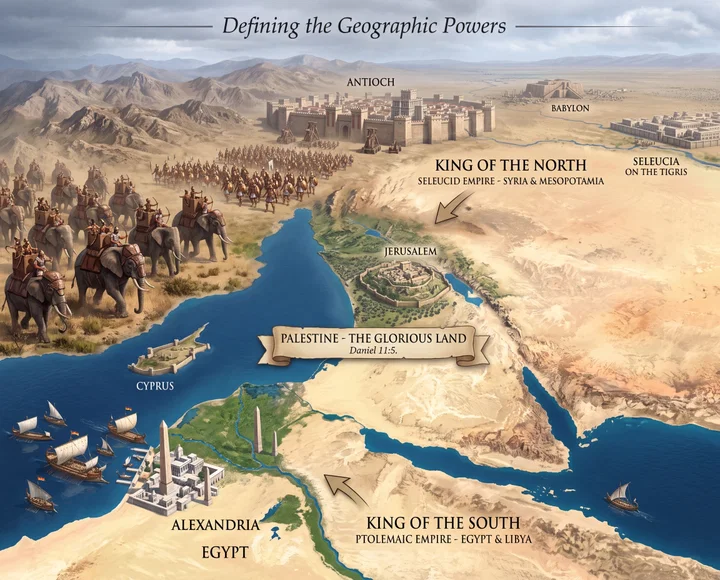
After long wars the king of the south, Egypt, and the king of the north, Syria, join together in a peace agreement in the end of years.ST Apr 6, 1882ST Jan 24, 1878 The south is Egypt founded by Ptolemy and the north is Syria founded by Seleucus, measured from Palestine, and those territorial titles stay with those lands to the end of the prophecy whatever power occupies them.ST Jun 19, 1884RH Nov 14, 1912RH Feb 16, 1911RH Oct 9, 1916 The king's daughter of the south is Berenice, daughter of Ptolemy Philadelphus, brought to Antiochus Theus of the north with a great dowry after he put away his wife Laodice, with the promise that her child by him would inherit the throne.ST Apr 6, 1882ST Apr 16, 1912ST Apr 16, 1912RH Mar 6, 1900 She does not retain the power of the arm, for after her father died Antiochus took back Laodice, who had him poisoned, so neither he nor his arm by Berenice stood in the kingdom.ST Apr 6, 1882ST Jan 24, 1878 She is given up and murdered with her son on Laodice's orders to secure the succession for Seleucus Callinicus, while her Egyptian attendants who defended her are killed, her father is lost by death, and he that strengthened her, her husband and her supporters, are lost.ST Apr 6, 1882ST Jan 24, 1878
North and South Defined
After Grecia was broken and divided toward the four winds, two of the divisions drop out of sight and the king of the south and the king of the north occupy the entire prophetic field for a long period, leaving only these two of the original four divisions at this point.RH Jan 23, 1913ST Dec 24, 1912 The king of the south is Egypt founded by Ptolemy, which became strong, and the king of the north is the kingdom founded and enlarged by Seleucus, one of Alexander's princes, which became strong above Ptolemy with a great dominion.RH Jan 23, 1913 The king of the north is the power ruling the territory of the Seleucidae with its center at Byzantium and the king of the south is the power ruling Egypt as the territory of the Ptolemies.ST Dec 24, 1912 The territory of these two kingdoms remains the territory of the kingdom of the north and the kingdom of the south to the end of the prophecy, so whatever kings reign over those territories are the king of the north and the king of the south, and the history of these two kingdoms sustains the prophecy in every particular.RH Jan 23, 1913ST Dec 24, 1912
The king of the south is Egypt and its neighboring lands, and the king of the north is Syria, including Palestine and Babylon, founded and enlarged by Seleucus.ST Jun 19, 1884ST Jan 10, 1878 Directions are measured from Palestine, with the northern territory principally Syria and Babylon and the southern territory Egypt and its neighboring lands.ST Jan 10, 1878 These are the two Grecian kingdoms that became dominant after Alexander's kingdom was divided, with Syria as the king of the north and Egypt as the king of the south as the chief actors for a long time, their struggle for control of Palestine making it a battlefield.ST Jun 19, 1884 The Seleucid kingdom in the north and Ptolemaic Egypt in the south, founded by Seleucus and Ptolemy, fit the events foretold in Daniel 11:5-15 for more than a century, identified by southern and northern location regardless of later changes in borders, kings, or dynasties.RH Oct 9, 1916 The northern territory was associated with Thrace and Bithynia and later included Macedonia and Thrace, originally centered in Syria, while the southern kingdom became Egypt.RH Dec 28, 1911RH Mar 6, 1913RH Dec 19, 1912
King of the north and king of the south are territorial titles tied to those original northern and southern territories even when wars and revolutions change borders or rulers, so whatever power occupies them is the king of the north or south.RH Dec 28, 1911RH Dec 19, 1912ST Jan 10, 1878 The chapter's king of the north first refers to the Seleucid kingdom, but the title belongs to the power occupying the northern territories as history changes, and after wars and revolutions the Ottoman Turks took much of that territory and became the king of the north.RH Nov 14, 1912 That northern territory later passed into Turkish hands, centered at Byzantium-Constantinople since 1453, and Turkey still held that territory in 1798 when Egypt and Syria were under Mameluke and Turkish rule.RH Feb 27, 1913ST Jan 7, 1913 At the time of Napoleon's invasion Egypt was nominally dependent on Turkey but was effectively governed independently by the Mamelukes, while Turkey occupied Syria including Palestine and was therefore identified as the king of the north.RH Dec 19, 1912 The king of the north is the power that reigns over Syria for the time being, now the Turkish Dynasty with its territories including Syria, Asia Minor, and Thrace, not Russia by name, so that if Russia, Austria, England, or France should become possessed of supreme power over Syria, that power would become the king of the north.RH Feb 16, 1911RH Dec 12, 1854
The account concerning the king of the north is a major subject continuing through verse 15, alongside the king of the south.RH Jan 23, 1913 The king of the north in this part of the chapter is the same power as the king of the north in verse 40, since the same designation in one prophecy should refer to the same power unless clear evidence shows otherwise.RH Jan 23, 1913 Those who held it to be Lysimachus in the north taught that the king of the north and the king of the south are whoever holds the territory first given to Lysimachus in the north and to Ptolemy in the south so long as they have any place in prophecy.ST Jan 7, 1913 This early part gives more attention to the king of the north than any other period covered by the prophecy except the closing verses, with the Seleucid power ruling that northern territory governed for 250 years from the same center afterward held at Constantinople, and since 1453 Turkey holding that same northern territory with its seat at Constantinople therefore remains the king of the north.ST Jan 7, 1913 The king of the south is kept before view as one of the principal subjects from verse 5 to verse 15, found by tracing the prophecy from its beginning with Persia stirring up all against the realm of Grecia and the rise of the mighty king of Grecia who rules with great dominion and does according to his will.RH Jan 16, 1913
The two dynasties, the Seleucid dynasty as king of the north and the Ptolemaic dynasty as king of the south, fought for 116 years after the kingdoms formed from Alexander's empire took shape, with their borders repeatedly changing, but neither exterminated the other.RH Feb 27, 1913 They remained separate and independent until Rome absorbed them.RH Feb 27, 1913 Palestine, between the two kingdoms, became their battleground and suffered the changing hardships of war, with the Holy Land as the meeting place of the opposing armies, repeatedly afflicted by war, famine, victory, persecution, and distress, while the details of the intervening history are passed over.RH Nov 16, 1914 By the later part of this period the Syrian kingdom had reached its height and come under Rome's pressure, while Egypt was also declining under Roman protection, marking Rome's rise and coming triumph over these kingdoms.ST Mar 5, 1912
Marriage Alliance Formed
In the end of years, after frequent wars and intrigues, the two kings joined themselves together in a peace agreement between Egypt, the king of the south, and Syria, the king of the north.ST Apr 6, 1882ST Jan 24, 1878ST Feb 17, 1904ST Feb 17, 1904 The alliance was made through marriage, for the king's daughter of the south was to come to the king of the north to make an agreement.ST Feb 17, 1904ST Feb 17, 1904 History supplies the details of these prophetic events in the conflicts of the divided Greek kingdoms, especially Egypt and Syria, which are to be compared with their history.RH Mar 6, 1900ST Apr 16, 1912
The king's daughter of the south was Berenice, daughter of Ptolemy Philadelphus of Egypt.ST Apr 6, 1882ST Apr 16, 1912ST Apr 16, 1912ST Jan 24, 1878 She came to Antiochus Theus, also called Theos, king of the north, and Ptolemy brought her to him with a great dowry.ST Apr 6, 1882ST Apr 16, 1912ST Apr 16, 1912ST Jan 24, 1878 As the condition of the union Antiochus agreed to put away his former wife Laodice and their two sons.ST Apr 6, 1882ST Jan 24, 1878 The peace treaty between Ptolemy Philadelphus, king of Egypt, and Antiochus Theos, king of the north, was thus sealed by Antiochus's marriage to Berenice.ST Apr 16, 1912ST Apr 16, 1912ST Jan 24, 1878
The agreement included the expectation and promise that the child of Berenice by Antiochus would inherit the throne.ST Apr 16, 1912ST Apr 16, 1912
Alliance Ends in Death
She shall not retain the power of the arm means Berenice did not keep her influence, support and power with Antiochus, for he restored Laodice and her children to court.ST Apr 6, 1882ST Jan 24, 1878ST Apr 16, 1912ST Jan 24, 1878 After Ptolemy died Antiochus took back Laodice, and she, fearing he might again favor Berenice and leave her, had him poisoned.ST Apr 6, 1882ST Apr 16, 1912ST Jan 24, 1878 Neither he shall stand nor his arm means neither Antiochus nor his son by Berenice succeeded in the kingdom, for the son did not inherit the throne.ST Apr 6, 1882ST Jan 24, 1878ST Jan 24, 1878 Laodice secured the succession for her own eldest son Seleucus Callinicus, while Berenice was given up and murdered on Laodice's orders together with her son, the child promised the throne under the agreement that Berenice's child should inherit.ST Apr 6, 1882ST Jan 24, 1878ST Apr 16, 1912ST Apr 16, 1912
They that brought her were her Egyptian attendants and women who tried to defend her, and they also were killed with her.ST Apr 6, 1882ST Jan 24, 1878ST Apr 16, 1912 He that begat her was her father Ptolemy, who was lost by death, and he that strengthened her refers either to Antiochus her husband who had supported her or to those who supported and defended her, all lost and given up or dying with the failure of the marriage alliance.ST Apr 6, 1882ST Jan 24, 1878ST Apr 16, 1912ST Apr 16, 1912ST Apr 16, 1912 This alliance belongs to a prophetic outline of about three and a half centuries of history in which God cared for His people despite their distance from Him, including hardship under Ptolemy Soter and Antigonus followed by favor toward the Jews under Ptolemy Philadelphus, whose reign saw the Septuagint translated.ST Apr 16, 1912
Prophecy Nature and Scope
Daniel 11 is a literal prophecy, not a symbolic one, speaking of nations directly without the symbols used in the preceding chapters.RH Dec 28, 1911ST Jul 8, 1897ST Nov 8, 1905 It is a graphic, literal and consecutive account of the leading kingdoms of earth, beginning in Daniel's time with Medo-Persia and reaching in order to the end of the age.RH Dec 28, 1911ST Nov 28, 1895ST Apr 13, 1882 Its events continue to the time of the end, when Michael, who is Christ, stands up to reign, execute judgment, and reap the harvest of the earth shortly before the second coming, with the king of the north in its latter part identified as Turkey, the Mohammedan power.ST Nov 8, 1905ST Nov 28, 1895 In this consecutive course it fully explains the Eastern Question.ST Apr 13, 1882
The verse belongs to the last recorded vision of Daniel 10 to 12, the fourth of Daniel's four parallel lines of prophecy, whose order of events was revealed by the angel to Daniel in the third year of Cyrus king of Persia and whose message continues through Daniel 12:4 to the end of the world.RH Nov 16, 1914ST Apr 9, 1912 This line begins with Medo-Persia and covers the same prophetic ground as the visions in Daniel 2, 7, and 8-9, ending at the close of the fourth monarchy and the same final events when earthly rule passes away and Michael, Jesus Christ, stands up to reign forever at His second coming.ST Dec 24, 1912ST Apr 9, 1912 It develops the earlier visions of Daniel 8 and 9 in greater detail, adding to their outlines of the same powers and events.ST Dec 24, 1912ST Apr 9, 1912 Daniel 11 is thus part of the continuing explanation of the vision in chapter 8, which contains the 2300-, 1260-, 1290-, and 1335-day prophetic periods, with the 2300 days as the principal period and the others as subdivisions, while the seventy weeks have a different foreground in God's people, the Messiah and the restoration.ST Jul 27, 1882
The prophecy outlines world history from the Medo-Persian empire and Daniel's day onward through the invasion of Grecia, the division of Alexander's Greek empire into four kingdoms, and the long detailed conflict between the Syrian kingdom of the north and Ptolemy's kingdom of the south.RH Nov 14, 1912RH Dec 12, 1912RH May 29, 1900 It traces in literal language all the great political changes on earth during twenty-five centuries, through the succession of Babylon, Medo-Persia, Greece and Rome in phases, to the eternal kingdom of God, the reign of Michael who is Christ, the time of trouble, deliverance, resurrection, reward to the saints, and glory worthy of their long waiting.ST Sep 21, 1915RH May 29, 1900 Rome is the great subject in the last half of the book of Daniel as Babylon is the great subject in the first half, and the revelation given in the third year of Cyrus and extending through chapters 10-12 explains how long the host would be trodden underfoot and concerns what would happen to Daniel's people in the latter days, the end of the indignation, and the appointed prophetic time.RH May 29, 1900RH Jan 10, 1856 It is one of the great lines alongside Daniel 2, 7, 8-9, Revelation, Matthew 24, Mark 13 and Luke 21, each starting at a different date but carrying to Christ's kingdom, sealed until the time of the end when many would travel and knowledge would increase, and its details are to be studied step by step.
The outline centers on the struggle for dominion or political supremacy in the Near East, centering on Syria and Palestine and the whole region of the eastern Mediterranean, from ancient times to the final solution of the Eastern Question amid the scenes of the end.RH Nov 16, 1914RH May 11, 1916 It accurately foretells the rise and fall of empires, with its broader fulfillment seen in the history of France and Turkey, identified as the king of the north, and it reaches down to present developments in Europe and gives the true meaning of those events.RH Dec 19, 1912RH Dec 26, 1912 After wars and revolutions the Ottoman Turks took much of the northern territory and became the king of the north, and the prophecy as a whole foretells Turkey's eventual downfall and extinction.RH Nov 14, 1912 Turkey stands in the way of the nations, held in place as a buffer that keeps them back, and when Turkey is removed the nations will be free to move toward its territory, so the closing events on the Eastern Question are the vital point of the whole prophecy.RH Jan 15, 1914ST Jul 29, 1897
The early section speaks only of the principal events occurring between the king of the north and the king of the south, before the Roman power is introduced in Daniel 11:14 as the children of robbers to become the principal actor.ST Dec 24, 1912 The title king of the north is never given to Rome in the scriptures that plainly refer to Rome.ST Dec 24, 1912 The chapter presents the course of apostate powers from Daniel's time toward the end, including the kings who followed Alexander and a persecuting king of the north who defiles worship and is overthrown, with Rome succeeding the Seleucid power and the persecuting king serving as a type of Rome.ST Apr 30, 1912
The weight of teaching holds that the prophecy concerns the Roman power, pagan and papal, rather than Antiochus Epiphanes, and that the little horn is Rome, both pagan and papal, since Antiochus Epiphanes was a Syrian king who could not resist the mandates of Rome.RH Dec 23, 1852RH Dec 10, 1857 Those who so shift the prophecy of Daniel 11 from Rome to Antiochus Epiphanes do so to avoid its application to the Roman power, pagan and papal, and to save the Roman church from any share in the fulfillment of the prophecy.RH Apr 30, 1857 Another teaching presents two great periods of persecution against God's government, covenant, and people, under Antiochus Epiphanes and under pagan and papal Rome, beyond which the prophecy points to the contrasting reign of Christ, the great Prince.ST Apr 9, 1912
Fulfillment Points to End
The predictions were given centuries before the Christian era and have been fulfilled with minute accuracy, and the history of the two kingdoms sustains the prophecy in every particular.ST Nov 24, 1914RH Jan 23, 1913ST Mar 1, 1905RH Nov 17, 1910 Compared with history its fulfillment is seen, for the chapter foretells the rise and fall of great nations and those foretellings are fulfilled in recorded history, with history supplying the details of frequent wars and intrigues and the attempted marriage agreement.RH Apr 8, 1873ST Mar 1, 1905ST Feb 17, 1904 Its details become clear as events unfold, and this fulfilled accuracy supports confidence in the prophecies that remain.ST Nov 24, 1914RH Nov 17, 1910
Its specifications have been fulfilled and its historical fulfillment has reached nearly its final specification, nearing final fulfillment toward the approaching final crisis.RH Dec 14, 1905ST Oct 10, 1878RH Feb 6, 1913 Only the coming of the Son of man remains unfulfilled in the prophetic lines traced in Daniel, with Michael's standing up, the time of trouble, the resurrection and the glory to follow still future.ST Oct 10, 1878RH Dec 13, 1853 Its last fulfillment is still future and occurs during the pouring out of the plagues, with its closing scenes enacted in earth's last generation amid grievous troubles and unprecedented war before the Lord's return.RH Dec 14, 1905RH Feb 6, 1913 All its chains were once reckoned to locate the advent within a few years of 1864.RH Apr 26, 1864
The chapter runs in consecutive historical sequence to Michael's standing up, which is Christ commencing His reign, leaving the Father's throne to take His own throne and coming to reign forever.ST Dec 24, 1912ST Jan 8, 1880ST Jul 8, 1897 To stand up or rise up means a king reigns, and to raise up a king means to bring him to the throne.ST Jan 8, 1880 His standing up is Christ's second coming to execute judgment shortly before that coming, bringing deliverance of the saints, followed by the great time of trouble, resurrection of the dead and glory, when earthly rule passes away and the kingdom of Christ is established.ST Dec 24, 1912ST Jan 8, 1880ST Nov 8, 1905 The prophecy thus explains Daniel 8 in greater detail and runs parallel with it, tracing leading events among the nations in literal account without symbolism to the time of the end, when the king of the north as the earthly representative of God's adversary gives way to Michael who is Christ, whose coronation as coming King is its last and next event.ST Dec 24, 1912ST Jul 8, 1897ST Nov 8, 1905
Comparison with history shows improvements and increase of knowledge in the present day just as expected while Daniel's prophecy is fulfilled, giving evidence of the second coming once reckoned about the year 1843.RH Apr 8, 1873 The prophecy was sealed until the time of the end, when many would travel and knowledge would increase. The Papacy arose and fulfilled its allotted period, helping establish that the time of the end had arrived and that Christ's second coming was near.RH Oct 6, 1868 Daniel 11 is named among the prophetic lines that fix the beginning of the time of the end at 1798, when the 1,260-year persecution of the Dark Ages ended.ST Nov 28, 1895
The last link of the prophecy is the Turk and his territory, closing just before the final gathering of the nations, and its downfall signals that the final crisis and the time of trouble are near, leading to Christ's second coming, the resurrection of the dead and the reward of the saints.RH Nov 6, 1900ST Dec 24, 1896 He comes to his end under the sixth plague and will then belong to the dragon, whose seat has been Constantinople ever since the city was built, held by Rome till 1453 and by the Turks ever since.RH Nov 6, 1900 Russia is to be commander of the dragon power and will control this seat in the last part of time, with the powers in each division eventually standing as a whole yet separate, East against West, so movements in the East must be watched closely.RH Nov 6, 1900 Turkey stands in the way of the nations, held in place as a buffer that keeps them back, and when removed the nations will be free to move toward its territory.ST Jul 29, 1897 The 1911 war between Italy and Turkey further weakened Turkish power toward elimination from the map of Europe, graphically describing with the breaking up of the Roman Empire and the rise of the Ottoman kingdom its final destruction just before the coming of the Lord.RH Jan 4, 1912 No timetable is given for how long after Constantinople is abandoned Jerusalem as the seat of government of the king of the north will be reached, or how long he will rule there before being overthrown.RH Mar 11, 1915
The scattering of the power of God's people could not be complete until an independent government existed where the true Israel, the church of God, could be protected in civil and religious liberty, identified as the United States and connected with the predicted end of the indignation.RH Jul 30, 1867 Like the other great lines of prophecy in Daniel and Revelation it focalizes at the second coming of Christ and, compared with history and present conditions, proclaims that the closing days of earth's history have been reached. It stands as one of the great lines alongside Daniel 2, Daniel 7, Daniel 8 and 9, seven prophecies in Revelation, and Matthew 24, Mark 13 and Luke 21, each beginning at a different date yet all carrying forward to the glorious consummation of the kingdom of Christ.ST Aug 5, 1913 Prophecy is given to be heeded as a light shining in a dark place until the day dawn, to make known what shall be in the latter days, to mark the church's place in time and point to the nearness of Christ's return, with the fulfillment concerning the Eastern question showing the time is near when Michael will stand up.ST Aug 5, 1913ST Dec 23, 1913RH Jun 2, 1904
Sources