Daniel 11:7
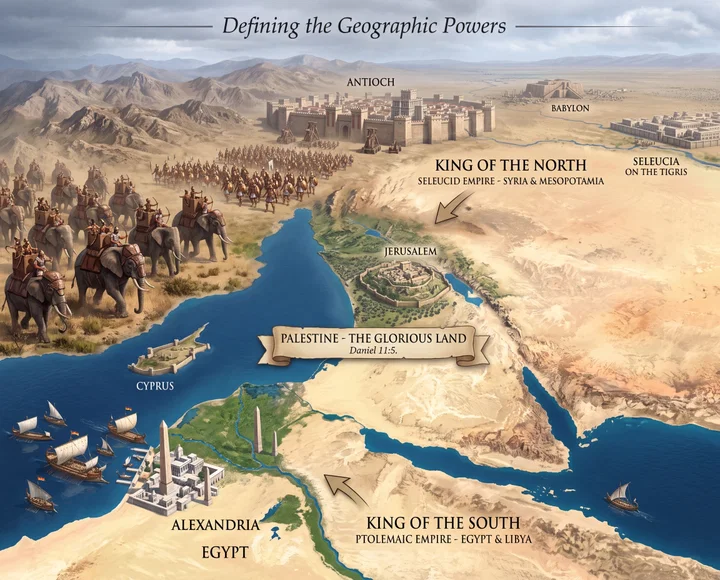
But out of a branch of her roots shall one stand up in his estate, which shall come with an army, and shall enter into the fortress of the king of the north, and shall deal against them, and shall prevail:
Translations
American King James Version, King James Version, KJV Cambridge Paragraph Bible
But out of a branch of her roots shall one stand up in his estate, which shall come with an army, and shall enter into the fortress of the king of the north, and shall deal against them, and shall prevail:
But out of a branch of her roots shall one stand up in his estate, who shall come with an army, and shall enter into the fortress of the king of the north, and shall deal against them, and shall prevail:
But out of a shoot from her roots shall one stand up in his place, which shall come unto the army, and shall enter into the fortress of the king of the north, and shall deal against them, and shall prevail:
But out of a shoot from her roots shall one stand up in his place, who shall come unto the army, and shall enter into the fortress of the king of the north, and shall deal against them, and shall prevail.
'And [one] hath stood up from a branch of her roots, [in] his station, and he cometh in unto the bulwark, yea, he cometh into a stronghold of the king of the south, and hath wrought against them, and hath done mightily;
But out of a shoot from her roots shall one stand up in his place, who shall come to the army, and shall enter into the fortress of the king of the north, and shall deal against them, and shew himself mighty.
But one will stand up from the sprout of her roots, [in] his stead,—and he will enter the army, and enter into a fortress of the king of the north, and deal with them and shew himself strong;
Berean Standard Bible, Majority Standard Bible
But one from her family line will rise up in his place, come against the army of the king of the North, and enter his fortress, fighting and prevailing.
“ But out of a shoot from her roots one will stand up in his place, who will come to the army and will enter into the fortress of the king of the north, and will deal against them and will prevail.
But out of a branch from her roots one will come up to take his place, who will come against the army, forcing his way into the strong place of the king of the north, and he will take them in hand and overcome them:
But out of the bud of her rootes shall one stand vp in his stead, which shall come with an armie, and shall enter into the fortresse of the King of the North, and doe with them as he list, and shall preuaile,
Douay-Rheims (Challoner revision)
And a plant of the bud of her roots, shall stand up: and he shall come with an army, and shall enter into the province of the king of the north: and he shall abuse them, and shall prevail.
Pictures
Cross-references
- Daniel 11:40
And at the time of the end shall the king of the south push at him: and the king of the north shall come against him like a whirlwind, with chariots, and with horsemen, and with many ships; and he shall enter into the countries, and shall overflow and pass over.
Both texts describe the king of the north confronting the king of the south and invading with an army.
- Daniel 11:15-16
So the king of the north shall come, and cast up a mount, and take the most fenced cities: and the arms of the south shall not withstand, neither his chosen people, neither shall there be any strength to withstand.
Continues the history and identifies Rome as a new power.
- Daniel 11:20-21
Then shall stand up in his estate a raiser of taxes in the glory of the kingdom: but within few days he shall be destroyed, neither in anger, nor in battle.
Both passages use “stand up” for a ruler assuming power.
- Daniel 8
In the third year of the reign of king Belshazzar a vision appeared unto me, even unto me Daniel, after that which appeared unto me at the first.
Daniel 11 develops the prophecy explained in Daniel 8.
- Daniel 11:3
And a mighty king shall stand up, that shall rule with great dominion, and do according to his will.
Both describe a ruler standing up to begin his reign.
- Daniel 11:21
And in his estate shall stand up a vile person, to whom they shall not give the honour of the kingdom: but he shall come in peaceably, and obtain the kingdom by flatteries.
shares stand up to show beginning of reign
- Daniel 10
In the third year of Cyrus king of Persia a thing was revealed unto Daniel, whose name was called Belteshazzar; and the thing was true, but the time appointed was long: and he understood the thing, and had understanding of the vision.
Daniel 10 introduces the vision whose explanation continues in Daniel 11.
- Daniel 2:31-45
Thou, O king, sawest, and behold a great image. This great image, whose brightness was excellent, stood before thee; and the form thereof was terrible.
Daniel 11 expands the empires prophecy symbolized by the image.
- Daniel 9:24-27
Seventy weeks are determined upon thy people and upon thy holy city, to finish the transgression, and to make an end of sins, and to make reconciliation for iniquity, and to bring in everlasting righteousness, and to seal up the vision and prophecy, and to anoint the most Holy.
Daniel 11 supplements the vision explained here.
- Daniel 11:2
And now will I shew thee the truth. Behold, there shall stand up yet three kings in Persia; and the fourth shall be far richer than they all: and by his strength through his riches he shall stir up all against the realm of Grecia.
gives the starting kingdom of the same prophecy
- Daniel 11:31
And arms shall stand on his part, and they shall pollute the sanctuary of strength, and shall take away the daily sacrifice, and they shall place the abomination that maketh desolate.
The same word Mahoz occurs in this verse.
- Daniel 11:38
But in his estate shall he honour the God of forces: and a god whom his fathers knew not shall he honour with gold, and silver, and with precious stones, and pleasant things.
Mahuzzim refers to guardian powers honored as a god of forces.
Commentary
Each commentary is drawn from primary sources: the writings of Ellen G. White and Adventist pioneers and periodicals. Each commentary is separate. Its own words are not a quotation; follow the references to read the source passages.
Ellen G. White
2 sources
Daniel 11:7 belongs to a prophecy that has nearly reached its complete fulfillment.9T 14.2–15.4Lt 80, 1910, par. 3 Its approaching fulfillment is the signal that the scenes of trouble foretold in that prophecy will soon take place.9T 14.2–15.4Lt 80, 1910, par. 3 Those remaining scenes of trouble will unfold amid a world stirred by war.Lt 80, 1910, par. 3
Sources
Pioneers and periodicals
84 sources
The branch out of her roots is her brother from the same family line, Ptolemy Euergetes, son of Ptolemy Philadelphus, who stood up in his father's place and estate as king of the south, which is Egypt.ST Mar 2, 1904RH Jan 10, 1871ST Jan 24, 1878ST Apr 16, 1912ST Apr 16, 1912
To avenge his sister Berenice after she was given up and murdered, he came with an army against Seleucus Callinicus the king of the north, which is Syria, entered his fortress at Seleucia, dealt against his forces, and prevailed.ST Feb 17, 1904ST Jan 24, 1878ST Apr 16, 1912ST Apr 6, 1882ST Jun 19, 1884
He overran Syria, Cilicia, and lands to the Euphrates and nearly all Asia, carried its silver and gold vessels and captive gods back to Egypt, and won the name Benefactor for restoring images and favoring Jerusalem.RH Jan 10, 1871ST Jan 24, 1878ST Apr 16, 1912ST Apr 6, 1882
Recalled by revolt at home, he returned to his own land and outlived Seleucus, while the strife of north and south continued with changing borders until both kingdoms were absorbed by Rome.RH Jan 10, 1871RH Nov 14, 1912RH Feb 16, 1911RH Feb 27, 1913ST Dec 24, 1912
The account stands as part of a plain, literal and chronological unfolding of empires from Persia and Grecia to the end, when Michael stands up to deliver His people, so its exact fulfillment confirms divine foreknowledge and the nearness of Christ's coming.ST Dec 24, 1912RH Dec 12, 1912RH Feb 17, 1903ST May 25, 1882
Words and Phrases
The branch out of her roots is a ruler from the same family line and root as the woman named in the preceding verse, rising in his predecessor's place and estate.ST Mar 2, 1904ST Apr 16, 1912ST Apr 30, 1912RH Mar 13, 1900 That ruler is her brother, succeeding their father as king, namely Ptolemy Euergetes, brother of Berenice and son of Ptolemy Philadelphus.ST Apr 16, 1912ST Apr 6, 1882 In the historical sequence this marks the rise of a successor among Alexander's kingdoms and the continuing career of the northern power before Rome takes its place.RH Feb 27, 1913ST Apr 30, 1912
To stand up in his estate is to succeed to the throne and commence a reign.RH Mar 28, 1907ST Oct 20, 1914ST Feb 21, 1878ST Apr 15, 1875RH Nov 30, 1869 Throughout Daniel standing up signifies reigning, so that to raise up a king is to bring him to the throne and cause him to reign.ST May 6, 1886ST Apr 15, 1875RH Nov 30, 1869 The Hebrew expression one shall stand up in his place means the beginning of a king's reign, an aggressive action on the part of a ruler in which he manifests his sovereignty.ST Oct 20, 1914 The same sense is applied to Michael's standing up as the beginning of Christ's reign.RH Mar 28, 1907RH Nov 30, 1869
The fortress is Mahoz, translated fortress, meaning a stronghold or protector.ST Apr 30, 1912 The same word is used for God as the true strength and protector of His people.ST Apr 30, 1912 In this verse it is the fortified place of the king of the north, identified as Seleucia, which was captured in the invasion.ST Apr 6, 1882ST Jan 24, 1878
Coming with an army, entering into the fortress, dealing against them, and prevailing describes an invasion of the northern king's stronghold and territory with military success against his forces.ST Mar 2, 1904ST Apr 16, 1912RH Feb 27, 1913ST Apr 30, 1912RH Dec 20, 1870 The successor enters the northern king's stronghold with an army, attacks and acts against the northern forces, and prevails.ST Mar 2, 1904ST Apr 16, 1912ST Apr 30, 1912RH Dec 20, 1870
Rival Kingdoms Identified
After Alexander's kingdom was divided into four parts, the king of the north is Syria and the king of the south is Egypt, and they become the chief actors of the early part of the prophecy.ST Feb 17, 1904ST Jun 19, 1884 The northern kingdom is the Seleucid kingdom founded by Seleucus in 281 B.C., lying north and west of Palestine and including Palestine, and the southern kingdom is the Ptolemaic kingdom founded by Ptolemy in 301 B.C.RH Nov 14, 1912RH Oct 9, 1916 Verses 5-15 keep the south in view, and verses 6-14 concern their repeated wars and intrigues, whose details history supplies.ST Feb 17, 1904RH Oct 9, 1916 That struggle between the dynasties of Seleucus and Ptolemy continued 116 years, with repeatedly changing borders but separate and independent kingdoms until both were absorbed by Rome.RH Feb 27, 1913
The titles king of the north and king of the south belong to whatever powers occupy the territories originally assigned to the northern and southern divisions of Alexander's empire, with those first divisions serving as the standard even when borders and ruling powers change.ST Jan 10, 1878 Their identities are determined by the kingdoms' locations, not by particular rulers or dynasties. The king of the north is any power that reigns over Syria for the time being, at present the Turkish Dynasty, and if Russia, Austria, England, or France should become possessed of supreme power over Syria, whichever it is would become the king of the north.RH Dec 12, 1854 The verse does not mean Russia must overflow Turkey before Christ can come the second time, and hope of the Lord's return from heaven does not depend on Turkey first being overwhelmed by Russia.RH Dec 12, 1854
One position ties the northern title to the northern territory originally given to Lysimachus, namely Thrace and Bithynia, just as the southern title follows the southern territory originally given to Ptolemy.RH Dec 28, 1911ST Jan 7, 1913 Whoever later rules that territory of Thrace and Bithynia, once held by Lysimachus, is the king of the north.RH Dec 28, 1911 The Seleucid kings governed that same northern territory from Constantinople for 250 years, a period receiving more attention in Daniel 11 than any other except the closing verses, and since 1453 Turkey has held possession of that northern territory with its seat of government at Constantinople, and therefore Turkey is the king of the north.ST Jan 7, 1913 In this application the successor from the roots of the southern line who rises in a predecessor's place, invades the northern stronghold with an army, and prevails is understood with Turkey as the northern power whose rule came to include the territory once controlled by Seleucus, and Turkey's end is seen in the shrinking from its possessions of a hundred years ago to its dwindled possessions of today.RH Feb 27, 1913ST Jan 7, 1913
In the later course of the prophecy the title king of the north passes to the nation occupying the northern territory, and after conquering much of it the Ottoman Turks became that power.RH Nov 14, 1912 This includes Rome as it absorbed both kingdoms and emerged while Syria and Egypt weakened, introduced in verse 14 as the children of robbers and soon becoming the principal actor on the stage, and finally the Ottoman Turks with lands in Syria, Asia Minor, and Thrace.RH Feb 16, 1911RH Feb 27, 1913ST Dec 24, 1912 The chapter's account of this power also names Palestine, Egypt, and North Africa among the lands it conquers or occupies.RH Feb 16, 1911 The section from verses 6 to 15 that presents the king of the north concerns the same power as the king of the north in verse 40, so the earlier section's details about that power's origin and location help identify it, and in the war involving France and Egypt Turkey, or the Ottoman Empire, is the king of the north while England acted as Turkey's ally.RH May 15, 1900RH Jan 23, 1913 Verse 35 brings the close of the period of papal supremacy in 1798, which is the beginning of the time of the end, and in verse 40 the king of the south and the king of the north are introduced again, with the king of the north occupying a prominent place in international conflicts to the very end, although in all the scriptures plainly referring to Rome it is never called the king of the north.ST Dec 24, 1912
Another position applies the prophecy to Roman power, both pagan and papal, rather than to Antiochus Epiphanes.RH Dec 23, 1852RH Apr 30, 1857 Antiochus was a Syrian king subject to Rome who could not resist the mandates of Rome and cannot account for the prophecy's intended application.RH Dec 23, 1852RH Apr 30, 1857 Rome could be said to come from one of the four divisions of Alexander's empire because it incorporated Macedonia, one of those divisions, before entering prophetic history in connection with God's people.RH Feb 15, 1870 The application of the prophecy to Antiochus Epiphanes is a shift from Rome to Antiochus to save the papal church from any share in the fulfillment of the prophecy.RH Apr 30, 1857
Ptolemy Euergetes Avenges
The branch out of her roots is Berenice's brother, Ptolemy Euergetes, son of Ptolemy Philadelphus, who stood up in his father's estate as king of Egypt.RH Jan 10, 1871ST Jan 24, 1878ST Apr 16, 1912ST Apr 6, 1882ST Jan 24, 1878 The branch imagery marks him as from the same family root as Berenice, succeeding to the southern throne in her father's place.ST Apr 16, 1912ST Apr 6, 1882ST Jan 24, 1878
After the daughter of the south was given up and Berenice was murdered, he made war against Seleucus Callinicus, king of the north, to avenge her death.ST Jan 24, 1878ST Apr 16, 1912ST Apr 6, 1882ST Jan 24, 1878 He came with an army into the northern king's territory, entered his fortress, dealt against his forces, and prevailed.ST Jan 24, 1878ST Apr 16, 1912ST Apr 6, 1882ST Jan 24, 1878 He marched as far as the Euphrates, killed Laodice, and captured Seleucia, the fortress of the king of the north.ST Apr 16, 1912ST Apr 6, 1882ST Jan 24, 1878
He conquered extensive territory, including Syria, Cilicia, lands beyond the Euphrates, and neighboring lands, gaining control of much of the northern kingdom and nearly all Asia.RH Jan 10, 1871ST Jan 24, 1878ST Apr 6, 1882ST Jan 24, 1878 He was recalled before he could take the whole kingdom of Seleucus.RH Jan 10, 1871ST Jan 24, 1878ST Jan 24, 1878
He plundered the kingdom, carrying its silver, gold vessels, and images of gods back to Egypt.RH Jan 10, 1871ST Jan 24, 1878ST Apr 16, 1912ST Jan 24, 1878 Among them were Egyptian gods previously carried away, and restoring those captive images earned him the title Euergetes, meaning Benefactor.ST Apr 16, 1912ST Jan 24, 1878 His victories and gifts at Jerusalem likewise belonged to the winning of that title.ST Apr 16, 1912ST Jan 24, 1878
Recalled by a revolt at home, he returned to his own land as foretold.RH Jan 10, 1871ST Jan 24, 1878ST Jan 24, 1878 He outlived Seleucus by four or five years.RH Jan 10, 1871ST Jan 24, 1878 The struggle between the dynasties of Seleucus and Ptolemy continued 116 years, with the two kingdoms remaining separate and independent though their borders changed repeatedly, until both were absorbed by Rome.RH Jan 10, 1871RH Feb 27, 1913ST Jan 24, 1878 That Roman power is introduced in verse 14 as the children of robbers and soon becomes the principal actor on the stage, while verses 5-14 give only the principal events between the king of the north and the king of the south.RH Feb 27, 1913ST Dec 24, 1912
Literal Prophecy to End
Daniel 11:7 is part of the angel's words in the great vision spanning Daniel 10-12, continuing from Daniel 11:2 and reaching to the end of the world.RH Dec 12, 1912ST May 25, 1882 It belongs to a literal, chronological prophecy tracing events from the Medo-Persian kingdom through the Greek empire and its division, including the conflict between the Syrian Seleucid kingdom of the north and the Ptolemaic kingdom of the south.RH Dec 12, 1912ST May 25, 1882 The chapter uses plain terms without symbols and no symbolic imagery as in the earlier chapters, making it easier to understand than the symbolic prophecies in Daniel 2, 7, 8, and 9.RH Dec 28, 1911RH Mar 8, 1915 Its minute specifications are to be compared with history as evidence of the reliability of divine foreknowledge.RH Mar 8, 1915 It is explained as unfolding Daniel 8 with its periods of 2300, 1260, 1290, and 1335 days.
The concluding prophecy of Daniel expands on Daniel 8 and runs in parallel to it, carrying events forward to the end of earthly rule and the time when Michael, who is Jesus Christ, stands up to reign forever at His second coming.ST Dec 24, 1912 It parallels and supplements the visions in Daniel 2, 7, and 8-9, tracing the same broad history of kingdoms from the ancient empires toward the end of the fourth monarchy and the establishment of God's eternal kingdom.ST Apr 9, 1912ST Apr 9, 1912 What is bridged over in one prophecy is filled up in another, with fuller detail of Medo-Persia, Grecia and its fourfold division, Babylon, Rome in pagan and papal phases, and the breaking up of Rome.RH May 29, 1900ST Apr 30, 1912 Every particular of the history of Medo-Persia and Grecia, including the division of Alexander's kingdom into four parts, is fulfilled as history plainly demonstrates, while the latter part of the chapter covers the great movements of the empire of Rome.RH May 29, 1900 The final consummation of all things is stated in the last verse of the chapter, followed by the close of earthly dominion when the great Prince Michael stands up to reign in Daniel 12:1, a time of trouble such as never was, deliverance of everyone found written in the book, a resurrection of the righteous dead, and salvation to every loyal child of God.
The prophecy traces the leading events among nations and God's people in the latter days from Daniel's time, Darius the Mede and Persian rule, through the Grecian power and the divisions of Alexander's kingdom, continuing to events associated with the closing of God's work and Christ's second coming.ST Dec 24, 1912STST Oct 28, 1908ST Feb 7, 1906 It covers all the great political changes on the face of the earth during twenty-five centuries, about 2,500 years, until the eternal kingdom of God when the kingdoms of the world become Christ's kingdom.ST Dec 24, 1912ST Sep 21, 1915 Its long and bloody struggle ends in a consummation worthy of God who rules in the affairs of men, and the reward given to the saints of the Most High is worthy of their long, sad waiting.ST Sep 21, 1915 Its historical scenes were revealed long before they occurred, and its sequence reaches the time of the end, when Michael, who is Christ, stands to execute judgment and deliver His people shortly before the second coming.
History supplies the details of fulfillment for the frequent wars and intrigues between Syria and Egypt, and the details of the prophecy are to be compared step by step with the corresponding history, tracing the identities and territories of the king of the north and the king of the south.ST Feb 17, 1904RH Mar 6, 1900RH Mar 6, 1900 Its prophecies were shown to have been fulfilled up to that time and its foretold events accurately fulfilled in history, with the prophetic line nearing its final consummation.RH Jul 4, 1854RH Nov 17, 1910 Part of the prophecy is yet unfulfilled, but the present generation will see it come to pass, and each detail must be studied carefully and patiently step by step so faith is strengthened and others are helped to hear and believe.RH Mar 6, 1900 The chapter alone is of great worth to the student of profane history.
The chapter's historical scenes belong to the subject whose meaning was sealed until the time of the end, when knowledge of these prophetic events would increase.RH Dec 21, 1869 Prophetic time in Daniel is reckoned symbolically, with each day representing a year.RH Dec 29, 1863 Revelation fills out Daniel's broader prophetic picture more definitely and points to the approaching crisis at the end of the world.ST Dec 17, 1896 The chapter describes in detail the leading characteristics of the great empires that would arise, forming part of the Old Testament background from which Paul learned of the coming apostasy.
Eastern Question and Coming
The latter part of the chapter foretells the Eastern Question, the struggle for political supremacy in the Near East.RH Nov 16, 1914RH May 11, 1916RH Dec 26, 1912 That struggle centers on Syria, Palestine, and the eastern Mediterranean, a region repeatedly fought over because of its strategic position.RH Nov 16, 1914 Through disintegration the Ottoman Empire grows weaker and weaker until it is driven from Europe and removes its capital from Constantinople to Jerusalem.RH Jan 2, 1913RH Jul 31, 1913 There on the holy mountain between the seas it establishes its government before being overthrown, and then, left without friend or helper, comes to its end.RH Jan 2, 1913RH Mar 11, 1915 Its retreats and changes of headquarters will not prevent that untimely end.RH Jul 31, 1913
The correctness of this meaning is demonstrated by events taking place in Europe.RH Dec 26, 1912 England's selling out of Turkey and the war then going on are rapidly fulfilling the prophecy.RH Nov 9, 1911 Italy's war against Turkey and seizure of Tripoli in 1911 advanced its weakening and eventual removal from Europe.RH Jan 4, 1912 The shrinking from its possessions of a hundred years ago to its dwindled possessions of today shows Turkey and its end.ST Jan 7, 1913 The expected Russian advance against the Ottoman Empire signals the approach of the final steps, yet the interval between abandoning Constantinople, occupying Jerusalem, and overthrow is not given.RH Feb 17, 1903RH Mar 11, 1915
That expulsion and end immediately precede Michael standing up.RH Feb 17, 1903ST Sep 14, 1882 Michael is Jesus Christ the great Prince, who stands up to reign forever, to deliver His people, to execute judgment shortly before the second coming, and to come the second time to reap the harvest.ST Dec 24, 1912ST Nov 8, 1905 His standing gives way to a time of trouble such as never was.RH Feb 17, 1903 The remaining final steps occur during the plagues, after Christ's ministry in the heavenly sanctuary has ceased, and bring the close of earthly rule and earthly dominion.ST Dec 24, 1912RH Dec 14, 1905
The prophecy has been fulfilled through almost all its specifications and is nearly reached, nearly fulfilled and rapidly fulfilling.RH Dec 14, 1905 Its final scenes belong to the time of the end, the present generation, and earth's last generation.RH Mar 11, 1875ST Dec 23, 1913 The crowning event of prophecy, the coming of the Son of man, was still future when the earlier specifications were fulfilled.ST Oct 10, 1878 The prophetic line shows that the coming of the Lord is near, and the time is near when Michael will stand up.ST Aug 14, 1893ST Dec 23, 1913 Followed link by link with ten other long chains spanning the whole Christian dispensation and reaching back ages before Christ, through Daniel 2, 7, 8-9, 11, Daniel 12:1-2, Revelation, Matthew 24, Mark 13, and Luke 21, the chain places the present in the last link on the verge of the day of God and makes certain the nearness of the personal second coming to punish the ungodly, reward the saints, and bring redemption, restitution of all things, and the eternal kingdom.ST Sep 21, 1915RH Mar 11, 1875
The king of the north is any power that reigns over Syria for the time being, not Russia by name, and at present that power is the Turkish dynasty.RH Dec 12, 1854 If Russia, Austria, England, or France should become possessed of supreme power over Syria, whichever it is would become the king of the north.RH Dec 12, 1854 The verse does not mean Russia must overflow Turkey before Christ can come the second time, and hope of the Lord's return does not depend on Turkey first being overwhelmed by Russia.RH Dec 12, 1854 Those who held otherwise taught that the seat of the dragon has been Constantinople ever since the city was built, held by Rome till 1453 and by the Turks ever since, but Russia as commander of the dragon power will control this seat in the last part of time.RH Nov 6, 1900 In that teaching the prophecy closes just before the final gathering of the nations to give place to the three divisions of the world, with the East against the West, and for this reason the Turk comes to his end under the sixth plague belonging to the dragon.RH Nov 6, 1900
The long prophecy embraces all the great political changes on the face of the earth during twenty-five centuries until the eternal kingdom of God.ST Sep 21, 1915 The long and bloody struggle it describes ends in a consummation worthy of God who rules in the affairs of men, and the reward given to the saints of the Most High is worthy of their long, sad waiting.ST Sep 21, 1915 Turkey is held in place as a buffer state and major obstacle to the nations, and when it is removed at the appointed time the nations will rush for its territory.ST Jul 29, 1897 Turmoil there in the East as that fulfillment approaches may endanger gospel work in needy regions.RH May 13, 1909 The great war of the last days thus placed in the Holy Land and Jerusalem is against Christ the Lamb rather than a fight for the Christian religion, for Christ is the rightful King but men wage war to gain control for human rulers, not to establish His reign.ST Apr 30, 1912
Providence Study and Warning
The wars of the northern Syrian kingdom and the southern Egyptian kingdom made the Holy Land between them their meeting place and battlefield, subject to the hardships and shifting fortunes of war until Rome came.RH Nov 16, 1914 Those contests show the calamities that would come upon the Jews through the kings of the north and the kings of the south when God's people sinned. God controls the nations by His angels, protecting His people as they obey Him and chastising them as they rebel against Him.
The scattering of Israel's national power under Gentile rule was the abolition of Israel's government in Palestine and the dispersal of the people among the nations.RH Feb 14, 1856 That scattering was accomplished in 1798.RH Feb 14, 1856 It could not be ended until Israel's national power and government were restored.RH Feb 14, 1856
The persecutions described in Daniel 11 fall upon the righteous, and they are distinct from the later time of trouble which falls upon the wicked through the plagues of God's wrath.ST May 7, 1912 That persecuting line includes Antiochus Epiphanes and pagan and papal Rome as powers opposed to God's government, covenant, and people.ST Apr 9, 1912 Beyond them stands Christ's kingdom as the hope of the faithful people.ST Apr 9, 1912
The prophecy of Daniel 11 and 12 foretelling the Eastern Question is timely truth to be set forth now and stands among the immovable old landmarks.RH Jan 2, 1913 It begins in the time Daniel lived and points out the history of the world straight through to the events immediately preceding the coming of Christ, with part yet unfulfilled that the present generation will see come to pass.RH Mar 6, 1900 It foretells the Turk being driven from Europe, and the expected Russian advance against the Ottoman Empire signals the approach of Michael's standing up and a time of trouble such as never was, as a warning to get ready and a sign of greater events to follow.RH Feb 17, 1903 Almost all its specifications have been fulfilled, while its remaining final steps occur during the plagues after Christ's ministry in the heavenly sanctuary has ceased, so that waiting for their fulfillment before taking a stand will be too late.RH Dec 14, 1905
Each detail must be studied carefully and patiently step by step, with the historical fulfillment of each point such as the successor from the same roots rising in his predecessor's place, attacking the northern king's stronghold with an army, and prevailing to be reviewed, and with the question pressed how many of the chapter's prophecies have been fulfilled in history.ST Mar 2, 1904RH Mar 13, 1900RH Mar 6, 1900 Such study strengthens faith and helps others hear and believe.RH Mar 6, 1900
The chain of Daniel 11 through Daniel 12:1-2 is one of eleven long chains of prophecy spanning the whole Christian dispensation and reaching back ages before Christ, and followed link by link it places the present in the last link on the verge of the day of God.RH Mar 11, 1875 With the ten other chains it makes certain the nearness of the personal second coming of Christ to punish the ungodly, reward the saints, and bring redemption and restitution of all things.RH Mar 11, 1875 Covering the same history as Daniel 2, 7, 8, and 9, it continues through violent events and ends with Michael's reign, not with the conversion of the world, and its fulfilled details support that conclusion.ST Jul 1, 1908 Giving an outline of much of the world's history from the days of Daniel down to the end of time, graphically describing the breaking up of the Roman Empire, the rise of the Ottoman kingdom as a great power, and its final destruction just before the coming of the Lord, it like the other great lines in Daniel and Revelation focalizes at the second coming of Christ, and compared with history and present conditions it proclaims that the closing days of earth's history have been reached.
Sources