Daniel 11:5
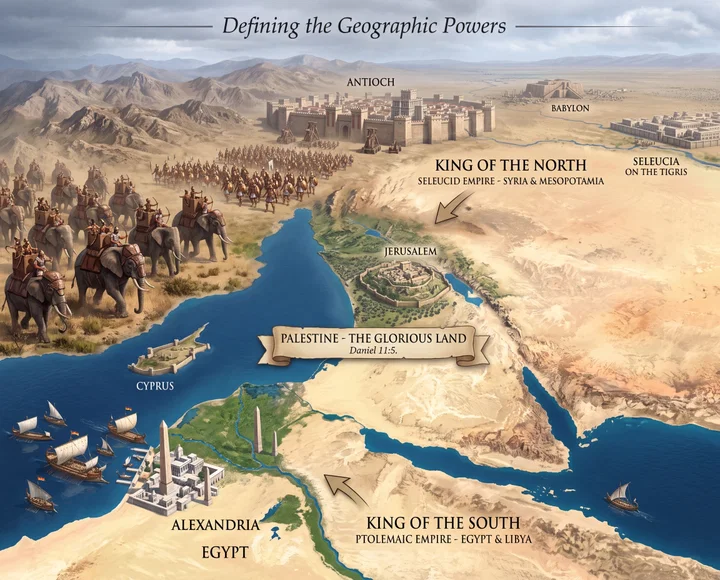
And the king of the south shall be strong, and one of his princes; and he shall be strong above him, and have dominion; his dominion shall be a great dominion.
Translations
American King James Version, King James Version, KJV Cambridge Paragraph Bible, Webster Bible, Revised Version, American Standard Version
And the king of the south shall be strong, and one of his princes; and he shall be strong above him, and have dominion; his dominion shall be a great dominion.
'And a king of the south — even of his princes — doth become strong, and doth prevail against him, and hath ruled; a great dominion [is] his dominion.
And the king of the south, who is one of his princes, shall be strong; but [another] shall be stronger than he, and have dominion: his dominion shall be a great dominion.
But a king of the south, will become strong, even from among his rulers,—and will prevail against him, and have authority, a great authority, shall his authority be.
Berean Standard Bible, Majority Standard Bible
The king of the South will grow strong, but one of his commanders will grow even stronger and will rule his own kingdom with great authority.
“ The king of the south will be strong. One of his princes will become stronger than him, and have dominion. His dominion will be a great dominion.
And the king of the south will be strong, but one of his captains will be stronger than he and will be ruler; and his rule will be a great rule.
And ye King of ye South shalbe mightie, and one of his princes, and shall preuaile against him, and beare rule: his dominio shalbe a great dominion.
Douay-Rheims (Challoner revision)
And the king of the south shall be strengthened, and one of his princes shall prevail over him, and he shall rule with great power: for his dominion shall be great.
Pictures
Cross-references
- Daniel 11:40
And at the time of the end shall the king of the south push at him: and the king of the north shall come against him like a whirlwind, with chariots, and with horsemen, and with many ships; and he shall enter into the countries, and shall overflow and pass over.
Both verses use the king of the north and king of the south imagery.
- Daniel 8:3-8
Then I lifted up mine eyes, and saw, and, behold, there stood before the river a ram which had two horns: and the two horns were high; but one was higher than the other, and the higher came up last.
Daniel 8’s vision of successive kingdoms is developed with further detail in Daniel 11.
- Daniel 2:31-45
Thou, O king, sawest, and behold a great image. This great image, whose brightness was excellent, stood before thee; and the form thereof was terrible.
Daniel 7–12 expands the empire outline shown by the image.
- Daniel 11:15
So the king of the north shall come, and cast up a mount, and take the most fenced cities: and the arms of the south shall not withstand, neither his chosen people, neither shall there be any strength to withstand.
Continues the conflict between the kingdoms.
- Daniel 10
In the third year of Cyrus king of Persia a thing was revealed unto Daniel, whose name was called Belteshazzar; and the thing was true, but the time appointed was long: and he understood the thing, and had understanding of the vision.
The vision introduced here is explained in the prophecy of these kings.
- Daniel 11:14
And in those times there shall many stand up against the king of the south: also the robbers of thy people shall exalt themselves to establish the vision; but they shall fall.
Introduces Rome as it rises against the king of the south.
- Daniel 8:21-22
And the rough goat is the king of Grecia: and the great horn that is between his eyes is the first king.
Both texts describe the rise and division of kingdoms after Alexander.
- Daniel 9:24-27
Seventy weeks are determined upon thy people and upon thy holy city, to finish the transgression, and to make an end of sins, and to make reconciliation for iniquity, and to bring in everlasting righteousness, and to seal up the vision and prophecy, and to anoint the most Holy.
The chapter 11 instruction continues information connected with the vision explained in Daniel 9.
- Daniel 7
In the first year of Belshazzar king of Babylon Daniel had a dream and visions of his head upon his bed: then he wrote the dream, and told the sum of the matters.
Another parallel prophetic outline of kingdoms.
Commentary
Each commentary is drawn from primary sources: the writings of Ellen G. White and Adventist pioneers and periodicals. Each commentary is separate. Its own words are not a quotation; follow the references to read the source passages.
Ellen G. White
4 sources
This verse stands within the prophecies of Daniel chapters 7 through 12, which unveil mysteries concerning future ages.PK 547.1 Those revelations were not fully grasped by Daniel himself, and they were sealed until the time of the end.PK 547.1 The longer prophecy of Daniel 11:1-45 in which this verse stands had almost reached its complete and final fulfillment, being described as nearly fulfilled and by 1910 as all but complete.RH Nov 24, 19049T 14.2–15.4Lt 80, 1910, par. 3 Its approaching completion means the foretold scenes of trouble are soon to occur and the end is near.RH Nov 24, 19049T 14.2–15.4Lt 80, 1910, par. 3
Sources
Pioneers and periodicals
82 sources
The king of the south is Egypt under Ptolemy, the southern division of Alexander's empire lying south of Palestine, made strong by annexing Cyprus, Phoenicia, Caria, Cyrene and neighboring lands and cities.ST Feb 17, 1904 One of his princes is Seleucus, one of Alexander's generals, who after defeating Lysimachus in 281 B.C. joined Macedon and Thrace to Syria, ruled three of the four divisions and nearly all of Alexander's former empire except Greece and Egypt, and became stronger than Egypt with a great dominion stretching from Persia to Macedon.ST Feb 17, 1904 North and south are reckoned from Palestine and fixed by the first divisions of Alexander's empire, so that king of the north and king of the south name whichever power holds that territory, not a particular ruler or dynasty, even to the time of the end.ST Jan 10, 1878ST Apr 6, 1882RH Apr 11, 1907RH Dec 28, 1911 The announcement is given in plain literal detail rather than symbol, beginning with Medo-Persia and Grecia and tracing the conflict of the northern and southern powers on toward Michael standing up, judgment and Christ's second coming.ST Dec 24, 1912RH Dec 12, 1912RH Dec 28, 1911 Those who reckon it differently hold the strong king of the south to be Ptolemy Philadelphus and the stronger ruler with the greater dominion to be Antiochus Soter, son and successor of Seleucus Nicator.ST Apr 16, 1912ST Apr 16, 1912ST Apr 16, 1912
Wording and Historical Setting
The verse belongs to the revelation given in the third year of Cyrus king of Persia, when the angel came to show Daniel the order of events and what would befall his people in the latter days.RH Nov 16, 1914RH Jan 10, 1856 That message begins in Daniel 11 and continues into Daniel 12:1-4, reaching to the end of the world.RH Nov 16, 1914 It explains how long the host would be trodden under foot, revealing the end of the indignation and the appointed prophetic time, which is described as long.RH Jan 10, 1856
The prophecy is literal and detailed rather than symbolic, announced in plain terms, and it begins in Daniel's own time.RH Dec 12, 1912RH Dec 28, 1911ST Nov 8, 1905 It starts with Medo-Persia and then traces the Grecian empire, its division into four parts, and the conflict between the northern and southern powers.RH Dec 12, 1912RH Dec 28, 1911 It gives a literal account of leading events among the nations, expanding the world-empire history introduced in Daniel 2 with added details and features, and it traces history forward until the king of the north gives way to Michael, who is Christ, standing up to execute judgment at the time of the end shortly before Christ's second coming and His everlasting reign.ST Nov 8, 1905ST Oct 8, 1896
The rising or standing up of the king of the south and of one of his princes means coming to reign, for to stand up is to commence a reign.RH Mar 28, 1907ST May 6, 1886 The prince thus rises to power, becomes stronger, and gains a great dominion.ST May 6, 1886
Alexander's empire was divided into four parts, parallel to the four horns in Daniel 8 and the four heads of the leopard in Daniel 7.RH Dec 19, 1912RH Nov 26, 1914RH Nov 21, 1854 Those four were then consolidated into two dominant kingdoms, north and south, with the northern kingdom ruled by Seleucus and based on Syria and later including Macedonia and Thrace, and the southern kingdom ruled by Ptolemy in Egypt.RH Dec 19, 1912RH Nov 26, 1914RH Dec 3, 1857 The names refer to the original territories, so that the power occupying Seleucus's territory is the king of the north and the power occupying Ptolemy's territory is the king of the south even when political control changes.RH Dec 19, 1912 By Napoleon's invasion Egypt was nominally under Turkey but effectively governed independently by the Mamelukes, while Turkey occupying Syria was identified as the king of the north.RH Dec 19, 1912 This is part of the expanded account in Daniel 11 of the second and third world empires only briefly touched on in the vision of the four empires, continuing through the history of Alexander's successors until their empire is reduced by another power, Rome rising later.RH Dec 19, 1912RH Dec 3, 1857RH Apr 2, 1908
Kings and Kingdoms Identified
The king of the south is Egypt under Ptolemy, the southern division of Alexander's empire lying south of Palestine.ST Feb 17, 1904RH Nov 14, 1912ST Apr 6, 1882 He was strong and became strong by annexing Cyprus, Phoenicia, Caria, Cyrene, islands, cities, and neighboring countries, and in the division made in 301 B.C. his was the strongest of the four kingdoms.RH May 11, 1916ST Apr 6, 1882 One of his princes is Seleucus, one of Alexander's generals and princes.ST Feb 17, 1904ST Apr 6, 1882RH Apr 11, 1907 After Seleucus defeated Lysimachus in 281 B.C. he annexed Lysimachus's territory, including land Lysimachus had taken from Cassander, and joined Macedon and Thrace to Syria.ST Feb 17, 1904ST Apr 6, 1882 By uniting the eastern, western, and northern divisions he ruled three of the four divisions and nearly all of Alexander's former empire except Greece and Egypt, stretching from Persia to Macedon and from Persia through Asia Minor to Greece and Macedonia, extending Syrian rule through much of Asia Minor and into Thrace, and he became stronger than Egypt with a great dominion.RH Nov 14, 1912RH May 11, 1916ST Apr 6, 1882 His territory became the kingdom of the north while Ptolemy's remained the kingdom of the south, and these first divisions establish the names used for those territories throughout the rest of the prophecy.RH May 11, 1916ST Apr 6, 1882RH Apr 11, 1907
Egypt and Syria, the Ptolemaic south and the Seleucid north, thus became the chief powers and the main powers and main focus of the prophecy.RH Jan 23, 1913ST Jun 19, 1884 In 281 B.C. these were the two prominent surviving divisions of Alexander's Greek empire, the northern kingdom being larger and stronger, and after Lysimachus's territory was absorbed Alexander's former empire was held chiefly by Ptolemy in Egypt and Seleucus in the northern division.RH Oct 9, 1916RH Jan 16, 1913 Their conflicts over Palestine made that land a repeated battlefield. Their history fills the outline in verses 5-15 leading to the conflict in verse 15, with the south identified as Egypt founded by Ptolemy and the north as the kingdom founded and enlarged by Seleucus.RH Jan 23, 1913RH Oct 9, 1916RH Mar 6, 1913
A different reckoning identifies the strong king of the south as Ptolemy Philadelphus and the stronger ruler with the greater dominion as Antiochus Soter, son and successor of Seleucus Nicator, one of the northern rulers descended from Alexander's empire.ST Apr 16, 1912ST Apr 16, 1912ST Apr 16, 1912 On that reckoning the verse concerns the dominant power north of Palestine and its succession, not control of European lands.ST Apr 16, 1912 Seleucus briefly held territory after conquering Lysimachus but never truly ruled it, and his Seleucid successors did not rule Thrace or what is now Turkey in Europe, while the north-country language describes the power north of Palestine that succeeds Babylon.ST Apr 16, 1912
Geographic Rule for Titles
North and south in the prophecy are reckoned from Palestine and are fixed by the first territorial divisions of Alexander's empire.ST Jan 10, 1878ST Apr 6, 1882RH Apr 11, 1907RH Dec 28, 1911ST Jan 10, 1878 The southern division was Ptolemy's Egypt with neighboring countries, which became strong when Cyprus, Phoenicia, Caria, Cyrene, and other islands, cities, and neighboring countries were added to it.ST Jan 10, 1878ST Apr 6, 1882RH Apr 11, 1907 The northern territory was first held by Lysimachus and later by Seleucus, one of Alexander's princes, who became stronger than Ptolemy when he defeated Lysimachus in 281 B.C. and gained Macedon and Thrace along with Syria, so that he ruled three of the four portions and nearly all of the former empire except Greece and Egypt.ST Apr 6, 1882RH Apr 11, 1907RH Dec 28, 1911 Those first divisions establish the names used throughout the rest of the prophecy, for the territory that came under Seleucus became the kingdom of the north while Ptolemy's remained the kingdom of the south.RH Apr 11, 1907RH Dec 28, 1911RH Apr 11, 1907 Almost all of Alexander's empire eventually resolved into these two divisions, and because they identify enduring geographical areas, whichever powers later occupy those areas are called their respective kings, including at the time of the end.RH Dec 28, 1911ST Jan 10, 1878
King of the north and king of the south designate locations and territories, not particular rulers or dynasties.RH Dec 28, 1911RH Dec 19, 1912ST Jan 7, 1913ST Dec 24, 1912 Their boundaries could shift and their rulers change while the northern and southern identities continued, and whatever kings reign over those territories are the king of the north and the king of the south.ST Dec 24, 1912 The titles remain with the powers holding the territory originally given to Lysimachus in the north and Ptolemy in the south so long as they have any place in prophecy, even when political control changes and through later changes of power to the end of the prophecy.RH Dec 19, 1912ST Jan 7, 1913RH Apr 11, 1907ST Dec 24, 1912 These two kingdoms, the southern founded by Ptolemy and strong, and the northern founded by Seleucus with the greater dominion stretching from Persia to Macedon, fulfilled the details foretold in the following verses for more than a century.
By that rule Turkey later became the king of the north by taking possession of much of the northern territory.RH Nov 14, 1912RH Feb 16, 1911RH Dec 19, 1912ST Jan 7, 1913ST Nov 3, 1914 Turkey has been the king of the north since 1453 by holding possession of the northern territory with its seat of government at Constantinople, the same city from which the Seleucid kings had governed that territory for 250 years.ST Jan 7, 1913ST Nov 3, 1914 That power is identified with the Turkish empire and its territory in Syria, Asia Minor, and Thrace, the same king of the north later described as conquering the glorious land, Egypt, and lands of North Africa.RH Feb 16, 1911 By Napoleon's invasion, Egypt was nominally under Turkey but effectively governed independently by the Mamelukes, while Turkey occupying Syria was identified as the king of the north.RH Dec 19, 1912 The verse's kingdoms of Egypt in the south under Ptolemy and Syria in the north under Seleucus, established in 281 B.C., later corresponded closely to the territories of the southern and northern parts of the Eastern Roman Empire.RH Feb 27, 1913
Verses 5-14 describe only the principal events occurring between the northern Seleucid kingdom centered at Byzantium and the southern Ptolemaic kingdom in Egypt.ST Dec 24, 1912ST Dec 24, 1912 In verse 14 the Roman power is introduced as the children of robbers and soon becomes the principal actor on the stage, yet in all these scriptures referring to Rome it is never called the king of the north.ST Dec 24, 1912 The prophetic line runs on to verse 35, which brings the close of the period of papal supremacy in 1798 and the beginning of the time of the end, and to verse 40, where the time of the end is mentioned again and the king of the south and the king of the north are again introduced, with the king of the north henceforth occupying a prominent place in international conflicts to the very end itself.ST Dec 24, 1912
Prophetic Scope and Connections
The vision of the kings of the north and south is one of four parallel lines of prophecy, beginning after Babylon's fall and covering the same broad ground and powers as Daniel 2, 7, and 8.ST Dec 24, 1912ST Apr 9, 1912ST Aug 5, 1913 It develops the earlier visions more fully, especially Daniel 8 and 9, expands the history of world empire introduced by the metallic image with added details and features, and carries forward to the close of the fourth monarchy and the end of earthly rule.ST Apr 9, 1912ST Apr 9, 1912ST Oct 8, 1896ST Apr 29, 1903 It reaches the same end as those lines, the violent end of earthly kingdoms with no picture of the world being converted, and the everlasting reign of Christ when Michael the great Prince stands up to reign forever.ST Dec 24, 1912ST Apr 9, 1912ST Oct 8, 1896ST Jul 1, 1908
Its opening portion sketches the Medo-Persian kingdom up to the invasion of Grecia, then the Grecian kingdom until the rise of the Roman Empire, tracing succession from Persia and Alexander through Alexander's successors toward Rome in its later phases.RH May 29, 1900ST Apr 30, 1912ST Apr 30, 1912 The Roman Republic appears in verse 14 as the children of robbers who exalt themselves to establish the vision, and soon becomes the principal actor on the stage, taking over the Seleucid realm and more.RH May 29, 1900ST Apr 30, 1912ST Dec 24, 1912 A persecuting king of the north is used as a type of this Roman power, and Rome in both its pagan and papal forms, identified also with the little horn, is the great subject of the last half of Daniel as Babylon is of the first half, set forth in the fulfilled succession of Babylon, Medo-Persia, Greece, and Rome.RH May 29, 1900ST Apr 30, 1912ST Jul 24, 1884RH Dec 10, 1857 That subject is not Antiochus Epiphanes, for he was only a Syrian king who could not resist the mandates of Rome, and the application to him is made to save the Roman church from any share in the fulfillment.RH May 29, 1900RH Dec 23, 1852RH Dec 10, 1857
The prophecy was sealed until the time of the end, identified as 1798, the close of the 1,260-year persecution and of papal supremacy, and for that reason the first angel's message could not be given before that time.RH Feb 14, 1854ST Dec 24, 1912ST Nov 28, 1895 Its line runs on to verse 35, which brings that close and the beginning of the time of the end, and to verse 40, where the time of the end is mentioned again and the king of the south and the king of the north are again introduced, with the king of the north henceforth occupying a prominent place in international conflicts to the very end itself.ST Dec 24, 1912ST Nov 28, 1895 Yet in all these scriptures referring to Rome, Rome is never called the king of the north.ST Dec 24, 1912
Given centuries before the Christian era and announced in plain terms rather than through symbols, its fulfillment with minute accuracy as confirmed by recorded history gives confidence in its remaining details and stands as historical evidence for the reliability of divine prophecy.ST Nov 24, 1914ST Mar 1, 1905RH Mar 8, 1915 Its long course of past accuracy is assurance that what remains will also be fulfilled, its fulfillment is presented as nearly complete, and with other lines it points toward the final consummation and the soon deliverance of God's people.ST Nov 24, 1914RH Dec 14, 1905RH Nov 17, 1910 It stands in one great series with Daniel 2, Daniel 7, Daniel 8 and 9, seven prophecies in Revelation, and Matthew 24, Mark 13, and Luke 21, given as a more sure word to take heed to as a light shining in a dark place until the day dawn, because God in heaven reveals secrets and makes known what shall be in the latter days and what shall come to pass, each line beginning at a different date of the world's history but all carrying forward to the glorious consummation of the kingdom of Christ.ST Aug 5, 1913RH Nov 17, 1910
It describes in detail the leading characteristics of the great empires that would arise and forms part of the Old Testament background for Paul's teaching about a coming apostasy. It traces successive powers opposed to God's government, covenant, and people, with Christ's kingdom beyond them as the contrast, presenting earthly dominion and glory as temporary and showing God's people brought through earthly troubles to His eternal kingdom of righteousness.ST Oct 20, 1909ST Apr 9, 1912 It is in harmony with the other great prophecies concerning the last-days conflict whose center is the Holy Land and Jerusalem, which Revelation fills out more fully, together indicating that the approaching crisis is the end of the world.ST Apr 30, 1912ST Dec 17, 1896ST Oct 20, 1909
It deals with the Eastern Question, the struggle for dominion or political supremacy in the Near East centering in Syria and Palestine and the whole region of the eastern Mediterranean where military nations collide.RH Nov 16, 1914RH May 11, 1916ST Dec 23, 1913 That contest for possession of this meeting place has continued from remote antiquity, and the prophecy traces its course from ancient times over twenty-five centuries to its final solution amid the scenes of the end and to God's eternal kingdom.RH Nov 16, 1914RH May 11, 1916ST Sep 21, 1915 Its fulfillment shows that the time is near when Michael will stand up.ST Sep 21, 1915ST Dec 23, 1913
Fulfillment and End-Time Meaning
Daniel 11 belongs to a prophetic chain whose specifications have been fulfilled in history with minute accuracy, and its long course of past fulfillment assures that its remaining details will also be fulfilled.RH Dec 14, 1905ST Oct 10, 1878RH Nov 17, 1910 Nearly all relating to human probation was seen as fulfilled, with only the crowning event—the coming of the Son of man—still future.ST Oct 10, 1878ST Sep 14, 1882 It stands among several parallel lines beginning at different dates in past centuries and culminating in the present time, warning of coming judgments and dangers and teaching lessons for God's people.ST Nov 1, 1910 Verse 5 begins the account of the conflict of south and north, that the southern king would be strong but one of his princes would become stronger and rule a great dominion, and these points are to be reviewed step by step through their historical fulfillment to strengthen faith and help others believe.RH Mar 13, 1900RH Nov 17, 1910
Its final fulfillment is nearly reached and almost complete, shown by the world's growing wars and approach to a final crisis.RH Nov 24, 1904RH Feb 6, 1913 The prophecy begins during Persian rule under Darius the Mede and extends to when Michael stands up and Christ's kingdom is established, with events of the past century belonging to the time of the end.STST Feb 7, 1906 That nearness is associated with the approaching time of trouble and scenes of war and great trouble before the Lord's second coming.RH Nov 24, 1904RH Feb 6, 1913 Present fulfillment before people's eyes is a portent calling people to prepare, making the time urgent for mission work before Jesus comes.RH Nov 24, 1904
That end is when Michael, who is Christ, the great Prince, stands up to reign forever, deliver His people, execute judgment, and be crowned King.ST Dec 24, 1912ST Jul 8, 1897 The literal chain from Daniel's time through Grecian power and the divisions of Alexander's kingdom follows events to the closing of God's work, when the king of the north gives way to Michael.ST Oct 28, 1908ST Nov 8, 1905ST Nov 28, 1895 It reaches the end of earthly rule and earthly kingdoms, the judgment, resurrection, redemption and restitution, the reign of peace, and the establishment of Christ's kingdom.ST Dec 24, 1912 This gives certainty of His personal coming to punish the ungodly and reward the saints, with no picture of the world being converted.ST Jul 8, 1897
The later course includes the Ottoman Turkish power weakening through disintegration and ultimately coming to its end.RH Jan 2, 1913RH Jul 31, 1913 That fulfillment was associated with the expected driving of the Turk from Europe and into Asia, heralding the standing up of Michael and the time of trouble.RH Feb 17, 1903ST Aug 3, 1882 Turkey would be driven from Europe, its seat at last transferred to Jerusalem, and it would come to an untimely end with none to help him.RH Nov 6, 1900RH Jul 31, 1913 It comes to its end under the sixth plague belonging to the dragon, whose seat has been Constantinople ever since the city was built, held by Rome until 1453 and by the Turks ever since.RH Nov 6, 1900
Turkey stands preeminently in the way of the kings of the east, held for years as a sort of buffer-state to keep the nations back from her territory.ST Jul 29, 1897 When God's time for her end comes all the nations of earth cannot bolster her up any longer, and the moment she is removed there will be a grand rush for her territory, preparing the way of the kings.ST Jul 29, 1897 Her dwindled possessions compared with those of a hundred years earlier mark that approaching end.ST Jan 7, 1913 That closing link of the Turk and his territory comes just before the final gathering of the nations to give place to the three divisions of the world, with Russia to command the dragon power and control this seat in the last part of time, the powers of each division standing as a whole yet separate, and East against West.RH Nov 6, 1900
The same king of the north described earlier conquers the glorious land, Egypt, and lands of North Africa in the closing verses, identified with the Turkish empire and its territory in Syria, Asia Minor, and Thrace.RH Feb 16, 1911ST Nov 28, 1895 Details about that power's origin and location in the earlier part of the chapter help explain its later appearance, the same designation referring to the same power.RH Jan 23, 1913 In verses 5-14 only the principal events between the northern Seleucid kingdom and the southern Ptolemaic kingdom are described, in verse 14 the Roman power is introduced as the robbers of thy people and soon becomes the principal actor, yet in all these scriptures referring to Rome it is never called the king of the north.ST Dec 24, 1912 The line runs to verse 35 bringing the close of papal supremacy in 1798 and the beginning of the time of the end, and to verse 40 where the time of the end is mentioned again and south and north are reintroduced, with the north henceforth occupying a prominent place in international conflicts to the very end itself.RH Jan 23, 1913ST Dec 24, 1912
The wars of north and south brought calamities upon the Jews, whose land lay between the kingdoms of Syria and Egypt after Alexander's kingdom was divided. The prophecy teaches that God directed the nations through His angels and that His people would be protected or chastised according to whether they obeyed or rebelled against Him. The northern title belongs to the power ruling over Syria, at the time held by the Turkish dynasty, but another power would hold it if it gained supreme control over Syria.RH Dec 12, 1854 Russia's takeover of Turkey is not required before Christ's return.RH Dec 12, 1854
Sources