Daniel 11:8
And shall also carry captives into Egypt their gods, with their princes, and with their precious vessels of silver and of gold; and he shall continue more years than the king of the north.
Translations
American King James Version, King James Version, Webster Bible
And shall also carry captives into Egypt their gods, with their princes, and with their precious vessels of silver and of gold; and he shall continue more years than the king of the north.
and shall also carry captives into Egypt their gods, with their princes, and with their precious vessels of silver and of gold; and he shall continue more years than the king of the north.
Revised Version, American Standard Version
And also their gods, with their molten images, and with their goodly vessels of silver and of gold, shall he carry captive into Egypt; and he shall refrain some years from the king of the north.
and also their gods, with their princes, with their desirable vessels of silver and gold, into captivity he bringeth [into] Egypt; and he doth stand more years than the king of the north.
He shall also carry captive into Egypt their gods, with their princes, and their precious vessels of silver and of gold; and he shall subsist for more years than the king of the north;
yea, even their gods, with their molten images, with their delightful vessels of silver and gold, with a host of captives, will he bring into Egypt,—and, he, will stand more, years, than the king of the north;
Berean Standard Bible, Majority Standard Bible
He will take even their gods captive to Egypt, with their metal images and their precious vessels of silver and gold. For some years he will stay away from the king of the North,
He will also carry their gods with their molten images, and with their goodly vessels of silver and of gold, captive into Egypt. He will refrain some years from the king of the north.
And their gods and their metal images and their fair vessels of silver and gold he will take away into the south; and for some years he will keep away from the king of the north.
And shall also carie captiues into Egypt their gods with their molten images, and with their precious vessels of siluer and of golde, and he shall continue more yeeres then the King of the North.
Douay-Rheims (Challoner revision)
And he shall also carry away captive into Egypt their gods, and their graven things, and their precious vessels of gold and silver: he shall prevail against the king of the north.
Pictures
Cross-references
- Daniel 11:40
And at the time of the end shall the king of the south push at him: and the king of the north shall come against him like a whirlwind, with chariots, and with horsemen, and with many ships; and he shall enter into the countries, and shall overflow and pass over.
The king of the north reappears at the time of the end as the same power described earlier.
- Daniel 11:2-4
And now will I shew thee the truth. Behold, there shall stand up yet three kings in Persia; and the fourth shall be far richer than they all: and by his strength through his riches he shall stir up all against the realm of Grecia.
These verses begin the prophetic sequence of kings and kingdoms leading into verse 8.
- Daniel 10
In the third year of Cyrus king of Persia a thing was revealed unto Daniel, whose name was called Belteshazzar; and the thing was true, but the time appointed was long: and he understood the thing, and had understanding of the vision.
Daniel 10 introduces the vision continued in Daniel 11.
- Daniel 8:20-25
The ram which thou sawest having two horns are the kings of Media and Persia.
Daniel 11 develops the outline of the vision, including its kingdoms and rulers.
Commentary
Each commentary is drawn from primary sources: the writings of Ellen G. White and Adventist pioneers and periodicals. Each commentary is separate. Its own words are not a quotation; follow the references to read the source passages.
Ellen G. White
2 sources
Daniel 11:8 belongs to the wonderful prophecies of Daniel 7-12 given as revelations of the mysteries of ages to come.PK 547.1 Its full meaning was not understood even by Daniel himself.PK 547.1 It was to be shut up and sealed until the time of the end.PK 547.1 That time of the end is the closing period of this world's history, when Daniel will rest and then stand again in his lot and place.PK 547.1
By 1910 the prophecy of Daniel 11 was almost completely fulfilled.Lt 80, 1910, par. 3 Only its remaining scenes were still future at that date.Lt 80, 1910, par. 3 Those remaining scenes are scenes of trouble soon to take place.Lt 80, 1910, par. 3
Sources
Pioneers and periodicals
69 sources
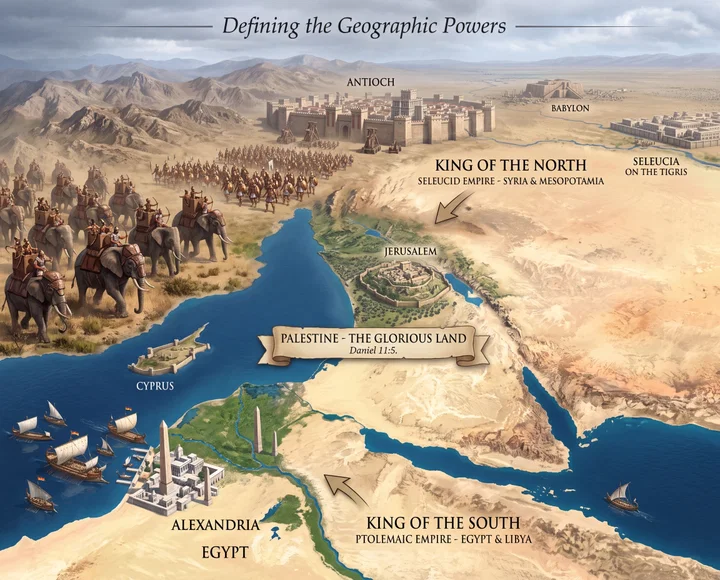
The verse was fulfilled when Ptolemy Euergetes, the king of the south in Egypt, invaded the territory of Seleucus Callinicus, the king of the north in Syria, prevailed over him and avenged his sister Berenice.RH Jan 10, 1871ST Apr 16, 1912ST Apr 6, 1882 He advanced as far as the Euphrates, plundered the northern kingdom, and carried back to Egypt its captive gods with molten images, its princes, and its precious vessels of silver and of gold, even 2,500 images including gods formerly taken from Egypt which he restored to Egypt.RH Jan 10, 1871ST Apr 16, 1912ST Apr 16, 1912ST Apr 6, 1882ST Jan 24, 1878 Because he restored their idols the Egyptians called him Euergetes, meaning Benefactor, and his victories were followed by gifts and thanksgiving at Jerusalem, including thanks to the God of Israel.RH Jan 10, 1871ST Apr 16, 1912ST Apr 6, 1882 His continuing more years than the king of the north means he outlived Seleucus Callinicus by four or five years, and then refrained from conflict with the king of the north for some years.RH Jan 10, 1871ST Apr 16, 1912ST Apr 16, 1912 After Alexander's kingdom was divided, the king of the north was Syria under the Seleucids and the king of the south was Egypt under the Ptolemies, reckoned from Palestine between them, and the titles follow territory rather than dynasties, so that the Turks occupying the Seleucid territory with their seat at Constantinople became the king of the north.ST Jun 19, 1884ST Feb 17, 1904RH Nov 14, 1912RH Dec 12, 1854RH Feb 16, 1911
Ancient Historical Fulfillment
The verse was fulfilled when Ptolemy Euergetes, the king of the south in Egypt, invaded the territory of Seleucus Callinicus, the king of the north in Syria, prevailed over him, and avenged his sister Berenice.RH Jan 10, 1871ST Apr 16, 1912ST Apr 6, 1882ST Jan 24, 1878ST Jan 24, 1878 He advanced as far as the Euphrates, entered and plundered the northern kingdom, and carried back to Egypt its captive gods with molten images, its princes or rulers, and its precious vessels of silver and of gold.RH Jan 10, 1871ST Apr 16, 1912ST Apr 16, 1912ST Jan 24, 1878ST Apr 16, 1912 He returned with captives and great quantities of silver and gold after defeating the forces of the king of the north.ST Apr 16, 1912ST Apr 16, 1912RH Mar 6, 1900RH Oct 9, 1916ST Apr 16, 1912 He then refrained from conflict with the king of the north for some years.ST Apr 16, 1912
He took 2,500 images of gods, including gods formerly carried away from Egypt, and restored Egypt's captive idols to Egypt.ST Apr 6, 1882ST Jan 24, 1878ST Jan 24, 1878 Because he restored their idols the Egyptians called him Euergetes, meaning Benefactor.RH Jan 10, 1871ST Apr 6, 1882ST Jan 24, 1878ST Jan 24, 1878 His victories were followed by gifts and thanksgiving at Jerusalem, including thanks to the God of Israel.ST Apr 16, 1912
He shall continue more years than the king of the north means he outlived Seleucus Callinicus by four or five years, described as about four years.RH Jan 10, 1871ST Apr 16, 1912ST Apr 16, 1912ST Apr 6, 1882ST Jan 24, 1878
Identities of North and South
After Alexander's kingdom was divided into four parts, the kings of the north and the south became its main powers, the king of the north being Syria under the Seleucids founded by Seleucus and the king of the south being Egypt under the Ptolemies founded by Ptolemy.ST Jun 19, 1884ST Feb 17, 1904RH Nov 14, 1912RH Feb 27, 1913RH Oct 9, 1916 This verse belongs to the early part of the prophecy concerning their frequent wars and intrigues, tracing world history through the kingdoms north and south of Palestine.ST Jun 19, 1884ST Feb 17, 1904RH Nov 14, 1912 These two kingdoms fit the prophecy's outline for more than a hundred years, continuing in conflict until both were absorbed by Rome.RH Feb 27, 1913RH Oct 9, 1916
North and south are reckoned from Palestine, which lay between the kingdoms as their battlefield and meeting place.ST Jan 10, 1878RH Nov 16, 1914 Their struggle for control of the Holy Land made Palestine repeatedly afflicted by war, famine, victory, persecution, and distress, suffering the effects of wars fought over it as contending armies raged back and forth.RH Nov 16, 1914 The titles king of the north and king of the south are determined by territory, with the naming of the powers by geographical location giving the key for identifying the king of the north in the closing latter-day portion of the prophecy.ST Jan 10, 1878RH Nov 16, 1914
The titles follow territory rather than particular kings or dynasties, applying to whatever powers later occupy those territories, so that whichever power occupies the land that originally formed the northern division is the king of the north and whichever occupies the southern division is the king of the south.RH Dec 28, 1911RH Mar 6, 1913ST Dec 24, 1912 Their borders could shift, but the northern kingdom's central territory of Syria and Asia Minor remained identifiable until the prophecy introduced a new power in verse 16, and those territorial identities remain to the end of the prophecy.ST Dec 24, 1912 The king of the north in verses 6 to 15 is the same power as the king of the north in verse 40, the same designation in the same prophecy not being applied to entirely different powers, with origin, location, and other information given in the early part identifying the king of the north in the closing part.RH Jan 23, 1913 The king of the north is any power reigning over Syria for the time being, now the Turkish dynasty and not Russia, and if Russia, Austria, England, or France should become possessed of supreme power over Syria, that power would become the king of the north.RH Dec 12, 1854 The verse gives no proof that Russia must overrun Turkey before Christ's second coming, and scriptural hope of the Lord's return does not depend on Turkey first being overwhelmed by Russia.RH Dec 12, 1854
The northern kingdom's central identifiable territory was Syria and Asia Minor, stretching from Persia through Asia Minor to Greece and Macedonia, while the southern kingdom was Ptolemy's kingdom in Egypt, the power ruling in the south.RH Nov 14, 1912RH Mar 6, 1913 It is also described as stretching from Thrace in Europe through Asia Minor to Syria and the Euphrates with its capital at Antioch, and as Thrace and Bithynia centered on Constantinople.RH Dec 28, 1911RH Nov 16, 1914 The titles remain with the powers holding the territory originally given to Lysimachus in the north and Ptolemy in the south so long as they have any place in prophecy, the latter eventually passing into Turkish hands.RH Mar 6, 1913ST Jan 7, 1913
Those two kingdoms fulfilled the details of the prophecy for more than a century, described as 116 years of conflict and as a 250-year period given more detail than any other part of the chapter except its closing verses, with neither completely destroying the other before both were absorbed by Rome.RH Feb 27, 1913ST Jan 7, 1913 Verses 5 to 14 deal only with those two powers, before the Roman power is introduced in verse 14 as the robbers and becomes the principal actor, never itself being called the king of the north.ST Dec 24, 1912 The extended prophecy of conflicts among Alexander's successors ends with the empire's reduction by another power.RH Dec 3, 1857
Those who held it taught that this part of the prophecy applies to Roman power, both pagan and papal, rather than to Antiochus Epiphanes the Syrian king.RH Dec 23, 1852RH Apr 30, 1857RH Dec 10, 1857RH Feb 15, 1870 The application to Antiochus, a Syrian king who could not resist the mandates of Rome, is made to save the Roman church from any share in its fulfillment and is followed by opposers of the Advent faith, who wrongly applied the prophecy to Antiochus instead of Rome.RH Apr 30, 1857RH Feb 15, 1870 Rome is presented as the rising power entering the account after two Syrian kings after Antiochus Magnus as the earlier kingdoms declined, placing Egypt under its protection.ST Mar 5, 1912 Its historical setting is also presented as including the persecutions of Antiochus Epiphanes and of pagan and papal Rome, separated by long periods of time, beyond which stands Christ's kingdom.ST Apr 9, 1912
Character and Scope of Prophecy
Daniel 11 is a literal, plain, minute and graphic prophecy that speaks mostly of nations directly rather than through symbols, without the symbolic imagery used in the preceding prophetic chapters.ST Jul 8, 1897RH Dec 28, 1911ST Nov 28, 1895 It is literal and consecutive, tracing in plain historical form the leading events among the nations and the great powers of earth from Daniel's time to the end of the age.ST Nov 8, 1905ST Nov 28, 1895ST Apr 13, 1882 Its fulfillment contributes historical evidence for the reliability of divine prophecy.ST Jul 8, 1897RH Dec 28, 1911 In a differing description, it is part of Daniel's detailed symbolic prophecies that expand the world-empire history outlined in Daniel 2 and add features not given there.ST Apr 29, 1903
The order of events was revealed to Daniel by the angel in the third year of Cyrus king of Persia.RH Dec 12, 1912RH Nov 16, 1914ST Apr 9, 1912 It extends from Daniel's days, Darius the Mede, and the Medo-Persian kingdom through the rise and fourfold division of Alexander's Greek empire, the conflict between the Syrian Seleucid kingdom and Ptolemy's kingdom, Rome's entrance and universal rule including the breaking up of Rome and the papal period, the rise of the Ottoman kingdom, and the dismemberment of Turkey, to the close of time.RH Dec 12, 1912RH May 11, 1916RH May 29, 1900ST Apr 9, 1912 It is a historic outline of the struggle for dominion and political supremacy in the Near East, in Syria and Palestine and the whole region of the eastern Mediterranean, a region that from remote antiquity has been a battlefield and meeting place where military nations violently collide, tracing that contest from ancient times to its final solution amid the scenes of the end.RH Nov 16, 1914RH May 11, 1916 Its latter part brings the Turkish or Mohammedan power into view and fully explains the Eastern Question, and its final event is the standing up of Michael, Christ, to reign and execute judgment, or his coming to reap the harvest of the earth, shortly before Christ's second coming in what Daniel calls the time of the end.ST Nov 8, 1905ST Nov 28, 1895ST Apr 13, 1882
History supplies and confirms its details, for the chapter foretells the rise and fall of nations and its fulfillment is seen in recorded history as part of the Bible's account of world history from its beginning to its close.ST Feb 17, 1904ST Mar 1, 1905ST Feb 17, 1904 Comparing the prophecy with history step by step proves its events have taken place, including the frequent wars and intrigues between Syria and Egypt and the particulars of Medo-Persia and Grecia and the division of Alexander's kingdom into four parts, and shows that the improvements and conditions of the present day are exactly what is to be expected at this time in fulfillment of Daniel's prophecy.ST Feb 17, 1904RH Apr 8, 1873ST Feb 17, 1904 As one of Daniel's prophetic dramas tracing Babylon, Medo-Persia, Greece, and Rome through the great movements of the Roman Empire to the consummation of all things in its final verse, it shows that earthly dominion and glory are temporary while God leads His people through earthly troubles to His eternal kingdom of righteousness, and it calls for careful patient study that strengthens faith.ST Mar 1, 1905ST Oct 20, 1909
In this chapter a king's rising or standing up means he begins to reign and comes to the throne, and to raise up a king is to bring him to reign.ST May 6, 1886ST Dec 27, 1905 That meaning shows that Michael standing up in Daniel 12:1 means Christ leaving the Father's throne to take His own throne and reign when His work as priest for sin is finished.ST Dec 27, 1905
Connections and Final Culmination
The passage stands in the last recorded vision of Daniel 10 to 12, which runs parallel to the earlier visions and covers the same prophetic ground to the same end.ST Dec 24, 1912ST Jan 8, 1880ST Apr 9, 1912 It explains Daniel 8 more fully and carries its history forward with more detail about its powers and events to the end of earthly rule.ST Dec 24, 1912ST Apr 9, 1912 It also supplements Daniel 8 and 9, filling up what is bridged over in one prophecy with matter given in another.ST Apr 9, 1912ST Apr 29, 1903 It is in harmony with the other great prophecies centered on the Holy Land and Jerusalem, the focal point of the last-days conflict against Christ, and it expands the world-empire history outlined in Daniel 2 with features not given there.ST Apr 30, 1912ST Apr 29, 1903 Its foreground is world empires, unlike the seventy-weeks prophecy whose subject is God's people and the Messiah.ST Apr 29, 1903
That history is traced from Daniel's time through the latter days to the close of the world kingdoms and the reign of Michael.ST Dec 24, 1912ST Apr 9, 1912 It continues to the standing up of Michael, Christ's reign and second coming, the time of trouble, the deliverance of the saints, and the resurrection of the dead.ST Dec 24, 1912ST Jan 8, 1880 At its consummation the kingdoms of the world become Christ's kingdom, when earthly rule ends in violence and destruction rather than by the conversion of the world.ST Dec 24, 1912ST Dec 24, 1912 It presents the succession of powers opposing God's people from Daniel's time onward, in a literal line of the great powers of earth until the king of the north, the earthly representative of God's adversary, gives way to Michael, the Christ of God.ST Apr 30, 1912ST Nov 8, 1905 The northern king who persecutes them and is overthrown is then used as a type of Rome, a new king of the north that takes over the Seleucids' dominion and more.ST Apr 30, 1912
Events of the past century up to the present described in it pertain to the time of the end, from Persian dominion to the time when Michael shall stand up.ST Feb 7, 1906 It fixes the beginning of the time of the end at 1798, the close of the 1,260 years of persecution.ST Nov 28, 1895 Together with what is presented in Daniel 2, 7, 8, and 12:1-4, it belongs to the wonders pertaining to earthly empires and the coming and kingdom of Christ about which is asked how long shall it be to the end of them.ST Jul 29, 1880
It presents successive powers opposed to God's government, covenant, and people, with a historical setting that includes the persecutions of Antiochus Epiphanes and of pagan and papal Rome, separated by long periods of time, and beyond these powers stands Christ's kingdom.ST Apr 9, 1912 It describes in detail the leading characteristics of the great empires that would arise. Its prophecies also provide a background for Paul's teaching about the coming apostasy. In its course rulers are shown turning from trust in God to trust in their riches.
Later and End-Time Application
As control of the northern territory changed, the Turks came to occupy much of it and became the king of the north.RH Nov 14, 1912RH Feb 16, 1911RH Feb 27, 1913 Since 1453 Turkey has held the Seleucid territory with its seat at Constantinople, the same territory and city from which the Seleucid kings governed for 250 years.RH Nov 14, 1912 The titles follow territory rather than particular kings or dynasties, so the king of the north is whatever power rules the territory of the Seleucidae and the king of the south is whatever power rules the Ptolemaic territory of Egypt, with borders able to shift while the central territory of Syria and Asia Minor remained identifiable.RH Dec 12, 1854ST Dec 24, 1912 Verses 5 to 14 deal only with those two powers before the Roman power is introduced in verse 14 as the robbers and becomes the principal actor without itself being called the king of the north.ST Dec 24, 1912 If Russia, Austria, England, or France should gain supreme power over Syria, that power would become the king of the north.RH Dec 12, 1854
The latter part of the prophecy brings the Turkish Empire into view and gives the true meaning of the Eastern Question.RH Nov 14, 1912RH Dec 26, 1912 It traces the Ottoman rise, weakening, disintegration, loss of European territory, and final destruction just before the Lord's coming.RH Jan 2, 1913RH Nov 14, 1912RH Dec 26, 1912 Turkey stands as a buffer state until God's appointed time, is expected to move its capital from Constantinople to Jerusalem and plant its seat at the holy mountain, and then come to its end under the sixth plague.RH Jan 2, 1913RH Nov 6, 1900ST Sep 14, 1882RH Mar 11, 1915 Its specifications through the final verse are described as fulfilled or almost to their final fulfillment, with only the closing movements remaining on the last link on the verge of the day of God.RH Dec 14, 1905ST Sep 14, 1882 The next event is the coronation of Christ as King and the coming of the Son of man amid wars and growing trouble, proclaiming the closing days, the nearness of the second advent and thousand-year reign, and calling people to prepare and carry the warning.ST Jan 8, 1880ST Oct 10, 1878ST Jul 8, 1897RH Dec 26, 1912
That coming continues to the standing up of Michael, Christ's reign and second coming, the time of trouble, the deliverance of the saints, and the resurrection.ST Jan 8, 1880ST Sep 14, 1882 Its remaining final phase belongs to the closing events, when the king of the north comes to his end and probation has closed.RH Dec 14, 1905ST Sep 14, 1882 The verse gives no proof that Russia must overrun Turkey before Christ's second coming, and scriptural hope of the Lord's return does not depend on Turkey first being overwhelmed by Russia.RH Dec 12, 1854 One position holds that the Turk comes to his end and then belongs to the dragon power whose seat is Constantinople, which Russia is to command and may control in the last days.RH Nov 6, 1900
The Ottoman loss of independent power on August 11, 1840, the war connected with England's dealing with Turkey, and the events of 1911 to 1914 were seen as its rapid fulfillment before the world's eyes and the portent of the present time signaling Turkish history's final hour.RH Mar 11, 1915RH Dec 26, 1912RH Nov 9, 1911RH Jan 4, 1912ST Dec 17, 1896 Its fulfillment marks the portent of the present time and points to events soon to come, calling people to prepare and carry God's warning message to the world.RH Dec 26, 1912 The later course of the prophecy is linked to the weakening and eventual removal of Turkish power from Europe.RH Jan 4, 1912 Though the prophecy points ultimately to the king of the north establishing his seat of government at Jerusalem's holy mountain and then being overthrown, it does not specify how long these stages will take.RH Mar 11, 1915
Sources